
The Short Answer
Backend Developer pays $10,000 more at the median US base salary ($150,000 vs. $140,000), is nearly twice as remote-friendly (31% vs. 17% remote), and focuses squarely on server-side systems. Software Engineer is almost 7 times larger by posting volume (49,510 vs. 7,177) and opens a far wider career path. The two roles share 71% of their top-30 skills: if you can do one, you are most of the way to the other.
Key Findings
- 49,510 active Software Engineer postings vs. 7,177 Backend Developer postings (6.9x gap) analyzed from the InterviewStack.io job board as of May 2026.
- Skill overlap coefficient: 0.71 (Jaccard) on top-30 skill sets. Python, Java, AWS, CI/CD, Docker, Kubernetes, and SQL anchor both roles.
- Median US base salary: $140,000 for Software Engineer (n=11,120 postings) vs. $150,000 for Backend Developer (n=555 postings), a $10,000 gap. See the salary section for important caveats on the Backend Developer figure's representativeness.
- Backend Developer is 31% remote vs. 17% for Software Engineer. Both roles are roughly 25% hybrid.
- Entry-level share: 3.8% for Software Engineer (1,881 openings) vs. 2.1% for Backend Developer (154 openings). Neither role has a large junior pipeline.
- Salary premiums by skill: Rust leads the Backend Developer chart at $175,000 (n=44, +$25,000 above the $150,000 BD baseline). AI integration skills (OpenAI $170,000, LLMs $168,500, Generative AI $167,000) add $17,000–$20,000 to the BD baseline but are based on small samples (n=27–44), so treat as directional. For Software Engineers, Rust ($160,000, n=602) leads among high-volume backend skills, with niche specializations like Deep Learning ($172,500, n=176) and Computer Vision ($166,000, n=434) ranking higher.
| Software Engineer | Backend Developer | |
|---|---|---|
| Median US base salary | $140,000 | $150,000 |
| Active postings | 49,510 | 7,177 |
| Top skill | Python (32%) | AWS (38%) |
| Remote share | 17% | 31% |
| Entry-level share | 3.8% | 2.1% |
| Skill overlap (Jaccard) | 71% shared |
What Does Each Role Actually Do?
Software Engineers write code across the full software lifecycle. A typical week involves designing a feature, reviewing pull requests, debugging a production issue, and updating CI/CD pipelines. The scope is intentionally broad: a company posting for a Software Engineer may need someone who touches frontend, backend, infrastructure, or data work depending on team size. The exclusive skills in SE postings reflect this: Linux (13%), C# (12%), and C++ (12%) signal that embedded, native, and enterprise application work all live under this title.
Backend Developers work exclusively on the server side. Their week centers on API design and maintenance, database schema work, service reliability, and microservice integration. The exclusive skills confirm it: Kafka (a distributed event-streaming platform, found in 20% of BD postings), Spring (Java's dominant backend framework, 15%), Redis (in-memory caching and queuing, 12%), and MySQL (14%) appear far more often in Backend Developer postings than in Software Engineer ones. The job description rarely mentions frontend or UI.
What Skills Do Software Engineers and Backend Developers Share?
Both roles converge on the same core foundation. AWS, Java, Python, CI/CD, and APIs all rank among the top shared skills, each appearing in at least 22% of postings across both roles. The shared stack extends through Docker, Kubernetes, SQL, Agile, Monitoring, TypeScript, and Scalability.
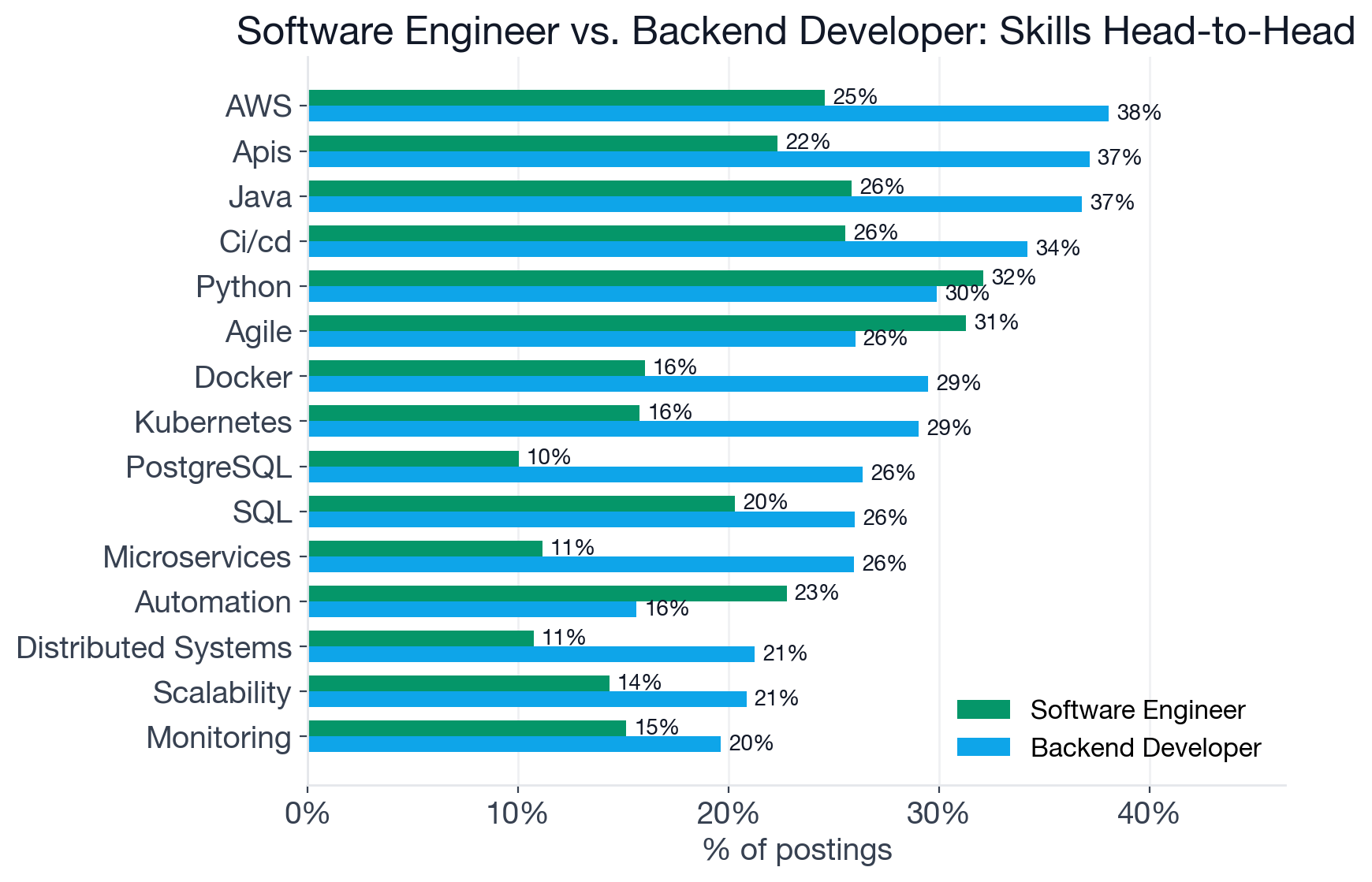
Top skills by posting frequency for both roles. AWS, Java, Python, CI/CD, and APIs each appear in at least 22% of SE postings and at least 29% of BD postings, anchoring both skill profiles.
A 0.71 Jaccard coefficient means 71% of the combined skill vocabulary is shared between the two roles' top-30 lists. The divergence is in depth and emphasis, not in a different set of fundamentals. Browse Software Engineer postings and Backend Developer postings to see this stack in action across live listings.
Where Do the Roles Diverge?
Software Engineer exclusives: Linux (13% of SE postings), C# (12%), C++ (12%), and Scrum (9%). This cluster points toward systems-level and enterprise application work that the broader SE title absorbs but Backend Developer filters out. If you have experience in embedded systems, gaming engines, or .NET enterprise applications, Software Engineer is the right filter.
Backend Developer exclusives: Kafka (20%), Spring (15%), MySQL (14%), Redis (12%), and RESTful APIs (12%). This is a tightly coherent server-side toolkit: an event stream, a Java framework, a relational database, an in-memory cache, and an API contract style. Together they describe a role that owns the plumbing, moving data between services, serving endpoints reliably, and scaling databases under load. Backend Developer postings also show meaningfully higher rates for Docker (29% vs. 16%), Kubernetes (29% vs. 16%), PostgreSQL (26% vs. 10%), and Microservices (26% vs. 11%), reinforcing the infrastructure-first orientation.
Which Pays More?
All salary figures here are US base salary only, from postings with disclosed compensation. Equity, bonuses, and sign-on are not captured in posting data, and total compensation at top employers runs meaningfully higher than these medians.
Backend Developer postings show a higher median US base salary: $150,000 (n=555) vs. $140,000 for Software Engineer (n=11,120). The smaller Backend Developer sample size reflects a substantially lower wage-transparency coverage rate: roughly 8% of BD postings disclosed salary (555 of 7,177) versus 22% for Software Engineer (11,120 of 49,510). The direction of that gap matters: Backend Developer postings are disproportionately placed by staffing agencies and IT outsourcing firms, which rarely publish salary in USD. The companies that do disclose salary tend to be US-based tech employers with state wage-transparency compliance, pulling the reported median upward. The $10,000 gap should be read as directionally plausible rather than a precise market differential; the Backend Developer figure likely reflects a higher-paying subset of the broader BD hiring market.
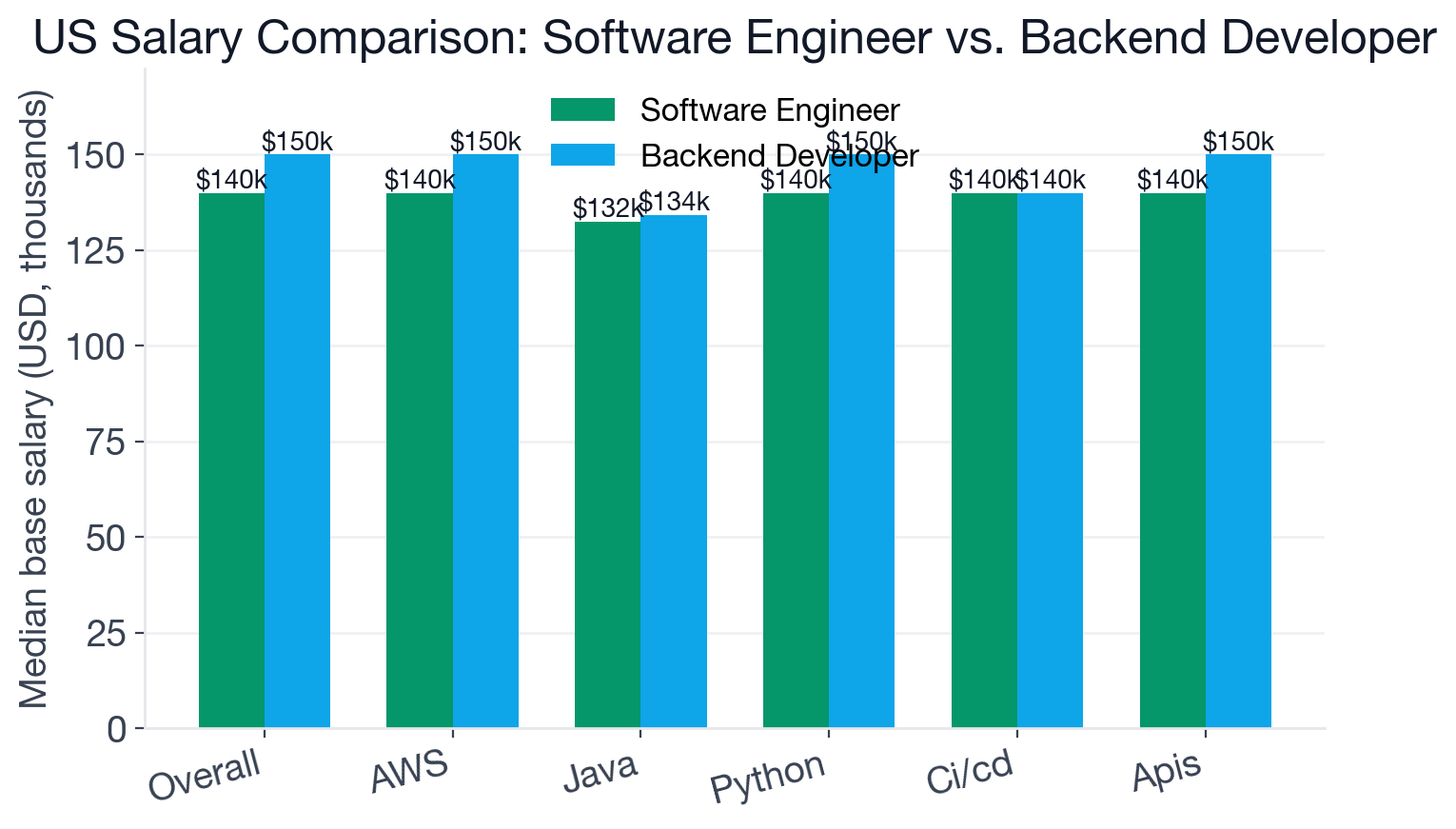
Median US base salary for each role overall and for selected high-premium skills. Software Engineer data from n=11,120 postings; Backend Developer from n=555. Base salary only.
What pushes salary up: For Software Engineers, the highest medians belong to specialized, lower-volume tools: Sentry ($190,000, n=82), Deep Learning ($172,500, n=176), and Computer Vision ($166,000, n=434). Among backend-relevant skills with broad hiring demand (n>500), Distributed Systems ($159,200, n=1,775), Observability ($159,200, n=1,515), and Rust ($160,000, n=602) each sit roughly $19,000 to $20,000 above the $140,000 baseline. For Backend Developers, Rust tops the salary chart at $175,000 (+$25,000 above the $150,000 baseline). The strongest AI-integration premiums follow: OpenAI ($170,000), LLMs ($168,500), and Generative AI ($167,000) each add $17,000 to $20,000 above the BD baseline. Go commands an extra $13,000 ($163,000 vs. the $150,000 baseline). Note that the BD AI-skill premiums are based on small samples (Generative AI n=27, OpenAI n=29, LLMs n=40), so the specific dollar figures should be read as directional rather than statistically robust estimates.
A note on AI skills in job postings: These premiums measure engineers hired to build LLM-integrated systems. Explicit AI requirements appear in the salary data for both roles but are rare enough that they do not make the top-30 most-demanded skills by frequency. That is the explicit bar, not the whole picture. According to a JetBrains April 2026 survey, 90% of developers use at least one AI tool at work regularly, a figure that applies equally to Software Engineers and Backend Developers regardless of whether any posting mentions it. The AI tooling shift in software engineering is now ambient: tools like GitHub Copilot and Claude Code are baseline productivity expectations, not differentiators you need a posting to name.
Which Has More Job Openings?
Software Engineer dominates on volume: 49,510 active postings vs. 7,177 for Backend Developer, nearly 7-to-1. The US accounts for 37% of Software Engineer postings (18,397 of 49,510) but only 18% of Backend Developer postings (1,290 of 7,177). Backend Developer postings are more geographically spread across India, Germany, and continental Europe, with a meaningful portion of unlocated listings that are likely fully remote. One compositional note: the Backend Developer posting pool is heavily weighted toward staffing agencies and IT outsourcing firms; no large US technology company appears among the top employers in this dataset. This affects how to read BD skill frequencies (staffing postings tend to list broad, generic requirements) and salary disclosures (outsourcing firms rarely publish salary in USD), and is why the geographic and salary mix for BD differs structurally from the Software Engineer pool.
On seniority, both roles are mid-heavy. Software Engineer is 53% mid-level and 29% senior; Backend Developer is 45% mid-level and 40% senior. The higher senior share for Backend Developer reflects that companies reach for this specific title when they need proven depth, not early-career potential. Entry-level openings are rare: 3.8% for Software Engineer vs. 2.1% for Backend Developer. In absolute terms, that is 1,881 SE entry openings vs. 154 BD entry openings across the analyzed period.
Which Should You Choose?
Choose Software Engineer if you:
- Want maximum options: 49,510 postings vs. 7,177 means more employers, more geographic locations, and more interview opportunities.
- Have or are building broad skills: C#, C++, Linux, or frontend experience maps naturally into the wider SE market.
- Are earlier in your career: the absolute count of entry openings (1,881) is more than 12 times larger for SE than BD.
Choose Backend Developer if you:
- Have strong server-side fundamentals: Kafka, Spring, distributed systems, or PostgreSQL experience is directly transferable and the postings explicitly ask for it.
- Prioritize remote work: the 31% vs. 17% remote gap is the most concrete practical difference between the two titles.
- Want to pursue AI integration work: the $17,000 to $20,000 AI-skill premiums above the $150,000 BD baseline are larger relative to baseline than the equivalent premiums on the SE side.
How to Use This in Your Job Search
Knowing the skill gap is step one; closing it efficiently is step two. Practice with AI mock interviews on distributed systems, API design, and system design questions, which are high-probability interview topics for both roles. The question bank covers role-specific tracks for both Software Engineer and Backend Developer, and our interview-prep courses build the backend and systems design foundations that both hiring bars require.
When you are ready to apply, browse live Software Engineer openings and Backend Developer openings on InterviewStack.io. Both feeds are sourced from company career pages and updated continuously. You can also filter by skill: Software Engineer + Python, Backend Developer + Kafka, or remote Backend Developer roles are all supported.
FAQ
Q. What is the difference between a Software Engineer and a Backend Developer?
Software Engineer is a broad title covering the full spectrum of software development: frontend, backend, full-stack, embedded, and mobile. Backend Developer is explicitly server-side: APIs, databases, and distributed systems. The two roles share 71% of their top-30 skills by Jaccard overlap, but Backend Developer postings more consistently demand Docker (29%), Kubernetes (29%), Kafka (20%), and microservices-focused tools.
Q. Which pays more, a Software Engineer or a Backend Developer?
Backend Developer postings show a higher median US base salary: $150,000 (n=555 postings with disclosed salary) vs. $140,000 for Software Engineer (n=11,120). Both figures are base salary only from postings with disclosed wages; equity and bonuses are not captured. The gap reflects the deeper server-side specialization the Backend Developer title signals.
Q. Which role has more job openings in 2026?
Software Engineer is far larger by volume: 49,510 active postings vs. 7,177 for Backend Developer, a ratio of nearly 7-to-1. The broad Software Engineer title absorbs most of what companies want from backend engineers. Backend Developer is primarily used when a company wants to signal a pure server-side, API-focused hire.
Q. What skills do Software Engineers and Backend Developers share?
Both roles share AWS (25% of SE postings / 38% of BD postings), Java (26% / 37%), Python (32% / 30%), CI/CD (26% / 34%), and APIs (22% / 37%) as their most-demanded shared skills. Docker, Kubernetes, SQL, Agile, Monitoring, TypeScript, and Scalability round out the shared stack, accounting for the 71% Jaccard overlap.
Q. Is Software Engineer or Backend Developer easier to break into?
Neither role has a large entry-level pipeline. Software Engineer is 3.8% entry-level (1,881 of 49,510 postings); Backend Developer is 2.1% (154 of 7,177). Software Engineer produces more absolute entry openings by sheer volume, making it marginally more accessible for career changers or new graduates.
Q. How remote-friendly are Software Engineer vs. Backend Developer roles?
Backend Developer is notably more remote-friendly: 31% of postings are remote vs. 17% for Software Engineer. Both have similar hybrid share (25%), but Software Engineer skews more onsite at 56% vs. 46% for Backend Developer. If remote work is a priority, Backend Developer postings offer roughly twice the remote share.
Q. Should I apply to Software Engineer or Backend Developer roles?
If volume, flexibility, and a broad career path matter most, target Software Engineer. If you have strong server-side skills (APIs, distributed systems, microservices), prefer a higher salary floor, and want more remote options, filtering for Backend Developer narrows the field but sharpens the match. The 71% skill overlap means building toward one role prepares you for the other.
Final Thoughts
Software Engineer and Backend Developer are more alike than their titles suggest: 71% shared skills, the same cloud-native foundation, and overlapping hiring companies. The real fork is specialization. Backend Developer signals pure server-side depth, a $10,000 salary premium, and notably more remote flexibility. Software Engineer signals breadth, a 6.9x larger posting pool, and a wider career path. For most job seekers, the practical move is to build the shared stack first and let the specific title be a search filter rather than a career identity.
Topics
Ready to practice?
Put what you've learned into practice with AI mock interviews and structured preparation guides.