
Two Roles, Two Entirely Different Skill Profiles
Engineering Manager is often treated as the career destination for developers who want more scope and responsibility. Frontend Developer is where many of those developers started. That lineage makes the two roles feel adjacent, but the hiring data tells a different story: the skill overlap between them is only 30%.
We analyzed 8,679 Engineering Manager and 5,362 Frontend Developer active postings on the InterviewStack.io job board as of June 2026, with skills extracted and synonyms collapsed. One scope note on the Engineering Manager dataset: it captures managers across technical disciplines (software, hardware, industrial, and aerospace), not exclusively software-team EMs. That breadth affects certain skill frequencies (Automation ranks #1 at 22% partly because industrial and test-automation contexts are included alongside software) and the overall salary median. The comparison reveals two roles that have diverged far enough to qualify as separate career tracks, not adjacent rungs on the same ladder.
| Engineering Manager | Frontend Developer | |
|---|---|---|
| Median US base salary | $180,000 | $139,000 |
| Active postings | 8,679 | 5,362 |
| Top skill | Automation (22%) | JavaScript (46%) |
| Remote share | 16% | 22% |
| Entry-level share | 4% | 20% |
| Skill overlap (Jaccard) | 30% shared | (pairwise) |
Key Findings
- Engineering Managers earn a median US base salary of $180,000 versus $139,000 for Frontend Developers, a $41,000 (29.5%) gap based on postings with disclosed compensation.
- The two roles share just 30% of their combined skill profiles (Jaccard 0.30 on top-30 skill sets): Agile, CI/CD, code review, and AWS are the strongest common ground.
- Frontend Developer is far more accessible early-career: 20% of postings are entry-level (1,054 of 5,362) versus just 4% for Engineering Manager (351 of 8,679).
- Engineering Manager postings outnumber Frontend Developer by 1.62x (8,679 vs. 5,362 active listings).
- Frontend Developer is slightly more remote-friendly: 22% remote versus 16% for Engineering Manager.
- Engineering Managers with AI skills (LLMs, Generative AI, Machine Learning) command salary premiums of $37,500 to $50,200 above the $180,000 EM median.
- CSS (33%), HTML (26%), and User Experience (23%) are the top Frontend Developer exclusive skills; Engineering Manager's top exclusives are Monitoring (14%), Project Management (14%), and Observability (10%).
What Do These Roles Actually Look Like?
Engineering Manager: The EM's week centers on people and coordination, not pixels and pull requests. Most time goes to 1:1s, sprint planning, architecture reviews, and unblocking engineers who hit cross-team dependencies. Hiring loops, performance discussions, and roadmap negotiations fill the rest. The job produces output through others: the operating question is not "how do I build this?" but "which engineer is best suited to build this, and what do they need to succeed?" Technical depth still matters for credibility and for making informed trade-off calls, but writing production code becomes the exception rather than the routine.
Frontend Developer: The FD's week is concrete and craft-driven. Writing React components, debugging layout issues in CSS, integrating REST and GraphQL APIs, writing tests in Jest or Playwright, and reviewing pull requests for performance or accessibility gaps. The output is the product: every commit ships something a user can see. Collaboration happens with designers (reviewing Figma specs), backend engineers (aligning on API contracts), and product managers (scoping features to the sprint). Technical skill is non-negotiable here, not a supporting competency.
The exclusive skills in each role's posting data reflect this divide precisely. Engineering Manager postings ask for monitoring, observability, and distributed systems because EMs are accountable for system reliability across an entire team's output. Frontend Developer postings ask for CSS, HTML, and Angular because FDs are accountable for the interface a user actually touches. Those responsibilities rarely overlap.
What Skills Do Both Roles Share?
Both roles appear in roughly the same Agile and CI/CD territory. Agile shows up in 18% of Engineering Manager postings and 22% of Frontend Developer postings; CI/CD appears in 17% and 21%, respectively. Code review is present in 10% of EM postings and 22% of FD postings. AWS sits at 16% for EMs and 14% for FDs.
JavaScript, React, and TypeScript technically qualify as shared skills under the data's definition (appearing in more than 5% of postings in both roles), but the balance is deeply asymmetric. JavaScript appears in 46% of Frontend Developer postings but only 7% of Engineering Manager postings. React is 43% for FD, 9% for EM. TypeScript is 35% for FD, 8% for EM. These are shared in the sense that some EMs still carry them, not in the sense that they define either role equally.
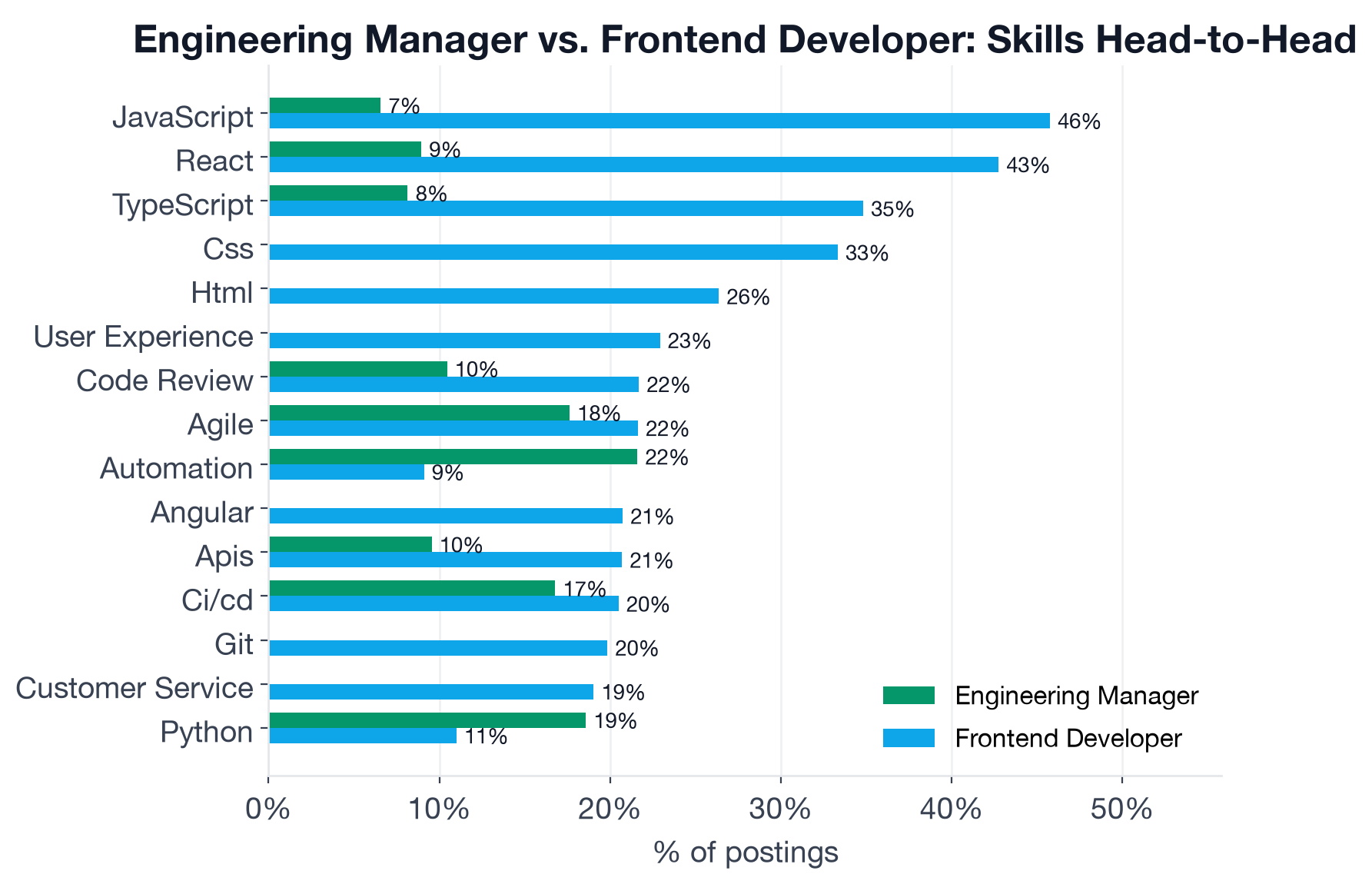
Top skills from both roles' posting data. Emerald bars represent Engineering Manager; blue bars represent Frontend Developer.
The practical implication for career switchers: if you are an EM who wants to stay current on the frontend stack, fluency in React and TypeScript overlaps with what you are managing. If you are an FD considering the management track, the Agile and CI/CD foundation is real and transferable, but the EM-exclusive skill set (monitoring, Kubernetes, distributed systems, people management) is a substantial new body of knowledge to build.
The Skills That Divide These Two Roles
Engineering Manager exclusives (appearing in at least 8% of EM postings but under 5% of FD postings):
- Monitoring (14%): System health tracking, alerting, and SLA oversight across a team's services
- Project Management (14%): Capacity planning, roadmap coordination, and delivery accountability
- Observability (10%): Instrumenting distributed systems for debugging and reliability
- Azure (9%): Microsoft cloud infrastructure, often in enterprise or hybrid-cloud contexts
- Kubernetes (9%): Container orchestration and platform operations at scale
- Distributed Systems (9%): Architecture, fault tolerance, and reliability of multi-service backends
- People Management (8%): Performance reviews, career development, team growth
Frontend Developer exclusives (appearing in at least 8% of FD postings but under 5% of EM postings):
- CSS (33%): Styling, responsive layout, and visual design implementation
- HTML (26%): Semantic markup, document structure, and templating
- User Experience (23%): UX patterns, user flows, and accessibility-driven interaction design
- Angular (21%): Component-based frontend framework for enterprise and large-scale web apps
- Git (20%): Version control, branching workflows, and collaborative code review tooling
- Accessibility (16%): WCAG compliance, screen-reader support, and inclusive design practices
- Node.js (14%): Server-side JavaScript for tooling, build pipelines, and API integration
- Next.js (11%): React-based full-stack framework with server-side rendering and static generation
One item excluded from this list: "customer service" appears in approximately 19% of Frontend Developer postings in this dataset: it is an artifact of the same retail-employer concentration that affects the FD salary median (see the salary section below). It is omitted here because it reflects hiring norms for customer-facing digital roles at large retail chains rather than core developer skill requirements.
The EM cluster is infrastructure, process, and people. The FD cluster is interface, tooling, and craft. These are not the same work performed at different seniority levels; they are different jobs with different hiring criteria.
Which Pays More: Engineering Manager or Frontend Developer?
The salary numbers below are from US postings only (where wage-transparency laws produce consistent disclosure) and reflect base salary only: equity, RSUs, and bonuses are not disclosed in posting salary fields and are not in this data, so total compensation at top employers runs meaningfully higher than what we report here.
Engineering Manager posts a median US base of $180,000 (n=2,187 postings with US salary disclosed). Frontend Developer comes in at $139,000 (n=545), a gap of $41,000 or 29.5%. One note on the FD figure: one employer accounts for 16% of Frontend Developer postings in this dataset, pulling in customer-service-adjacent roles that pay well below software-focused FD norms. The $139,000 reflects the full breadth of what companies classify as Frontend Developer work; technology-focused FD roles at product companies typically run higher. A parallel breadth effect applies on the EM side: the Engineering Manager dataset spans software, hardware, aerospace, and industrial disciplines, and compensation in non-software domains tends to run lower than in software. The $180,000 EM median reflects this mixed population; software-focused EM roles at product and tech companies likely skew higher. Both medians carry dataset-breadth caveats; the $41,000 gap is best read as a directionally reliable estimate rather than a precise software-vs-software figure.
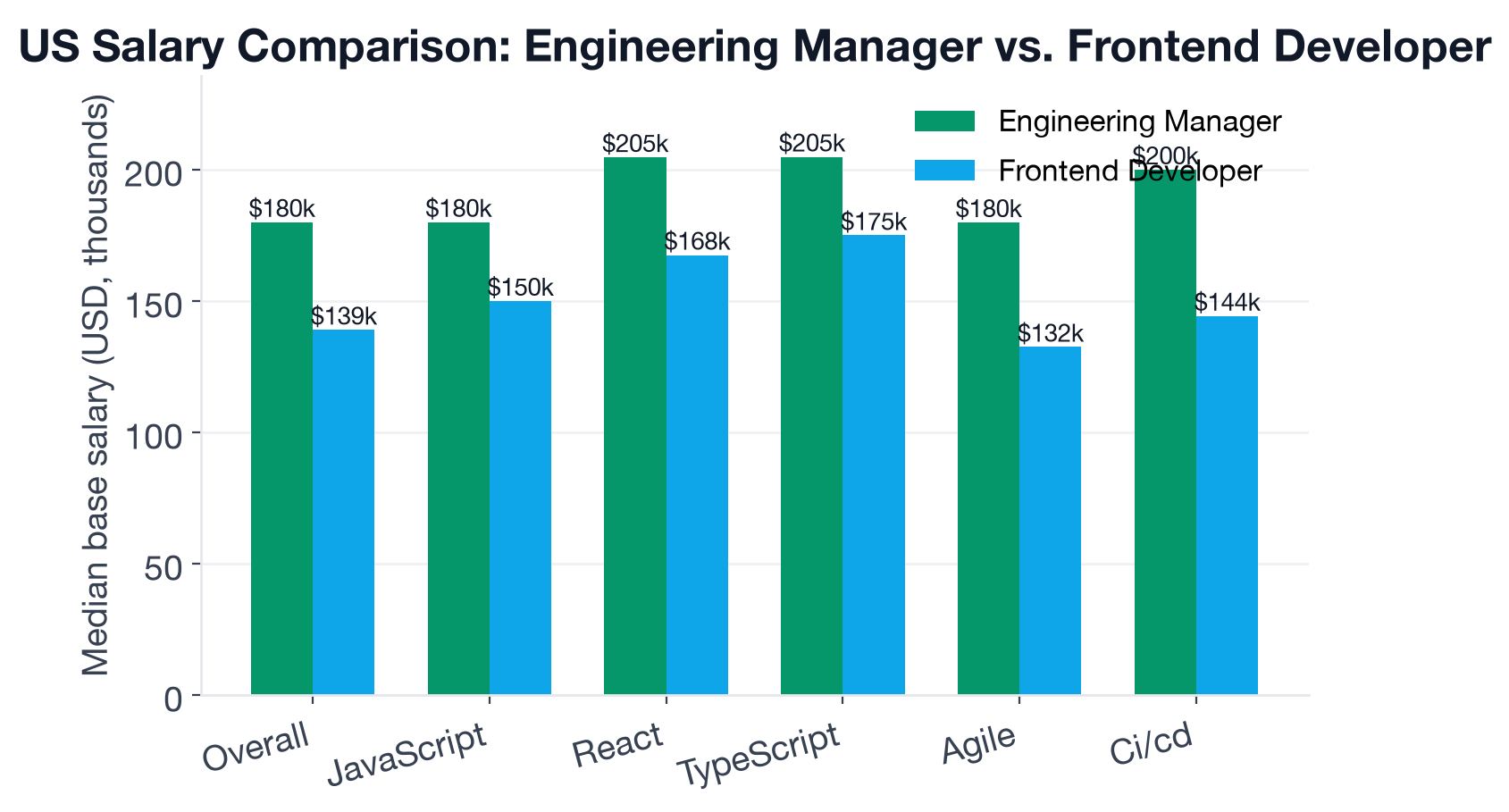
Median US base salary (base only, equity excluded) for Engineering Manager and Frontend Developer postings, including shared skill comparisons.
The EM salary curve rises sharply with AI specialization. EMs with LLM skills earn a median of $230,200 (n=84), a $50,200 premium over the $180,000 EM base. Generative AI postings show $217,500 (n=92), a $37,500 premium. Machine Learning reaches $224,300 (n=172). These are not ambient tool-use signals: they reflect Engineering Managers being hired specifically to lead AI-powered teams, evaluate model deployments, and own reliability for AI-dependent products. Managing a team of AI-assisted engineers is itself a premium specialization.
Frontend Developers sit on the other side of that equation. Explicit AI skill requirements are absent from the FD top-30 skills and salary data, but that absence does not mean FDs do not use AI. Developer survey data from 2025-2026 consistently shows that roughly 90-95% of software engineers use AI tools at least weekly, with the majority reporting AI assistance for half or more of their work. For FDs specifically, that means Copilot, Cursor, and Claude Code for component scaffolding, test generation, and CSS iteration: daily tools most employers now assume without stating in job descriptions. Among the top-paying distinctly frontend skills are TypeScript ($175,000), Next.js ($175,000), and GraphQL ($175,000), all reflecting engineering seniority rather than AI specialization. The AI layer is real for FDs; employers just do not price it explicitly yet.
Entry-Level Access Tells the Real Story
Frontend Developer opens far more doors for new practitioners: roughly 1 in 5 FD postings are explicitly entry-level (20%, or 1,054 of 5,362). Engineering Manager, by contrast, shows only 1 in 25 postings as entry-level (4%, or 351 of 8,679). The EM distribution is dominated by mid-level and above: 64% mid-level, 15% senior, 17% staff.
Engineering Manager is almost never a first job. Hiring managers typically want to see several years as a senior or staff individual contributor before the transition into management, with demonstrated ability to own systems, not just contribute to them. Frontend Developer, with its broader seniority distribution (20% entry, 48% mid-level, 23% senior, 9% staff), is one of the more accessible tech roles to enter from outside the field.
By raw volume, EM has the larger open market: 8,679 active postings versus 5,362 for FD, a 1.62x ratio. But volume without accessible entry points matters less for someone starting out. For that audience, the FD funnel is simply wider.
On remote work: Frontend Developer postings run 22% remote versus 16% for Engineering Manager. Both roles are predominantly onsite (around 59% each), but Engineering Manager tilts more toward hybrid (27%) as collaborative team oversight needs flexible face-time rather than full co-location. The US accounts for 44% of EM postings and 38% of FD postings, with India as the second-largest market in both at around 10-12%.
Which Should You Choose?
Choose Engineering Manager if you:
- Prefer driving output through a team rather than writing production code yourself
- Already have 5+ years as a senior or staff engineer and want to apply that foundation at a team level
- Are comfortable owning infrastructure reliability outcomes: monitoring, distributed systems, and cloud operations feature heavily in the role
- Want the higher salary ceiling and are ready to invest in people management, project coordination, and organizational navigation as genuine skills
Choose Frontend Developer if you:
- Prefer concrete, craft-driven work where your commits ship directly to what users see
- Are entering the field: the 20% entry-level share makes this one of the more accessible tech roles to break into
- Value remote flexibility: FD postings run 22% remote, compared with 16% for EM
- Want to build deep expertise in the React, TypeScript, and Next.js ecosystem before deciding whether a management track is the right next move
Browse current Engineering Manager openings and Frontend Developer postings on the InterviewStack.io job board, with filters for seniority, work mode, and location. For a deeper look at each role individually, see the Engineering Manager skills breakdown and the Frontend Developer skills analysis.
For interview prep, AI mock interviews adapt to both roles: system design and leadership questions for the EM track, frontend architecture and component design for the FD track. The question bank covers distributed systems, API design, and JavaScript/TypeScript fundamentals. Our interview prep courses build the technical foundations across algorithms, system design, and full-stack concepts that both paths draw on.
FAQ
Q. What is the salary difference between an Engineering Manager and a Frontend Developer in 2026?
Engineering Managers earn a median US base salary of $180,000 versus $139,000 for Frontend Developers, a $41,000 (29.5%) gap. These are base-only figures from postings with disclosed compensation; equity and bonus are not included, so total comp at top employers runs higher for both roles.
Q. How much skill overlap exists between Engineering Manager and Frontend Developer roles?
The Jaccard similarity between the top-30 skill sets of the two roles is 0.30, meaning roughly 30% of the combined skill profile is shared. The strongest common ground is Agile, CI/CD, code review, and AWS. Coding skills like JavaScript, React, and TypeScript do appear in both roles but are far more dominant in Frontend Developer postings (46%, 43%, 35%) than in Engineering Manager postings (7%, 9%, 8%).
Q. Which role is easier to break into as an entry-level candidate in 2026?
Frontend Developer is significantly more accessible. About 20% of Frontend Developer postings are explicitly entry-level (1,054 of 5,362), compared with just 4% for Engineering Manager (351 of 8,679). If you are early in your career, Frontend Developer is the clearer entry point.
Q. What skills does an Engineering Manager need that a Frontend Developer does not?
The Engineering Manager exclusive skills (appearing in at least 8% of EM postings but under 5% of FD postings) are Monitoring (14%), Project Management (14%), Observability (10%), Azure (9%), Kubernetes (9%), Distributed Systems (9%), and People Management (8%). These reflect the role's infrastructure oversight and team leadership responsibilities.
Q. Can Frontend Developer experience transfer to an Engineering Manager role?
Some skills carry over: Agile, CI/CD, code review, and AWS all appear in both role profiles. However, the core Engineering Manager skill set (monitoring, distributed systems, Kubernetes, people management, project management) has almost no overlap with the core Frontend Developer skill set (CSS, HTML, Angular, accessibility, Next.js, Git). Making the move requires actively building new competencies, not just advancing existing ones.
Q. How remote-friendly are Engineering Manager and Frontend Developer jobs in 2026?
Frontend Developer roles are slightly more remote-friendly: 22% of FD postings are tagged remote versus 16% for Engineering Manager postings. Both roles are predominantly onsite (around 59% for each). Hybrid is more common for Engineering Manager (27%) than for Frontend Developer (19%).
Q. Which role has more job openings in 2026?
Engineering Manager has more postings: 8,679 active listings versus 5,362 for Frontend Developer, a 1.62x volume ratio. However, Engineering Manager is heavily dominated by mid-level and above (only 4% entry-level), while Frontend Developer has a broader seniority spread with 20% entry-level openings.
The Bottom Line
Engineering Manager and Frontend Developer are not the same career at different stages of seniority. They share 30% of their skill profiles, sit $41,000 apart in median US salary, and attract completely different seniority distributions. Frontend Developer is the clearer entry point for new practitioners; Engineering Manager is the higher-paid destination for those who have already built a senior technical foundation and want to scale their impact through others. The data makes one thing plain: the skills required to reach the higher salary are not simply more of the skills that got you to the lower one.
Topics
Ready to practice?
Put what you've learned into practice with AI mock interviews and structured preparation guides.