
Engineering Manager's Skill Stack Doesn't Converge
Engineering Manager is the only tech leadership role in this analysis with no universally required technical skill. Not one language, framework, or process discipline clears the 50% threshold that defines non-negotiable in the market. Automation comes closest at 22.6%, followed by Python (19.2%), Agile (18%), and AWS (17%): a cluster so evenly distributed that you could build a competitive EM resume around any combination and still be in the running for the majority of postings. Looking across 8,717 active Engineering Manager listings on the InterviewStack.io job board as of June 2026, the picture is of a role that has branched into parallel career tracks: infrastructure-heavy on one side, process-heavy on the other.
That split has a salary signature. Engineering Manager postings that mention Distributed Systems, Kubernetes, or Machine Learning cluster around a $200,000 US median, roughly $45K above the overall role baseline. Postings that feature Agile, Scrum, and Excel sit in the $130K to $150K range. Both use the same title. What the data actually measures is two genuinely different jobs: one where the EM's value is in technical depth and system ownership, one where it's in delivery management and process leadership. Salary follows which job you are actually in.
Data scope note: The "Engineering Manager" label in job postings captures a wider population than software engineering management alone. This dataset includes hardware, industrial, semiconductor, and civil engineering manager roles, all of which use the same title on job boards. Skill frequencies and the salary baseline reflect this broad mix; candidates targeting software-focused EM roles at tech companies should use the skill and company filters below to identify relevant postings. The salary premiums for infrastructure and cloud skills are meaningful signals specifically within the software EM subset.
Key Findings
- 8,717 active Engineering Manager postings analyzed on the InterviewStack.io job board as of June 2026.
- No skill reaches the table-stakes tier (50%+): Automation, the most demanded skill, appears in only 22.6% of postings.
- Median US base salary is $154,900 (n=2,025 postings with US salary disclosed; equity, RSUs, and bonuses not included).
- Distributed Systems commands a $45K premium: postings mentioning it show a US median of $200,000, about $45,100 above the role baseline.
- Agile is common but pays below the median: appearing in 18.1% of postings, Agile-mentioning EM roles have a US median of $150,000, roughly $4,900 below baseline.
- Excel-mentioning postings sit $24K below the baseline: $130,900 median versus $154,900 overall.
- Mid-level dominates seniority at 63%, with staff at 17.7% and entry at just 4.4%.
- Only 17.4% of postings are tagged remote: engineering management carries above-average face-time requirements compared to IC roles.
What Does an Engineering Manager Posting Actually Ask For?
Group individual skills into families and the shape of the role becomes clearer than any single skill can show.
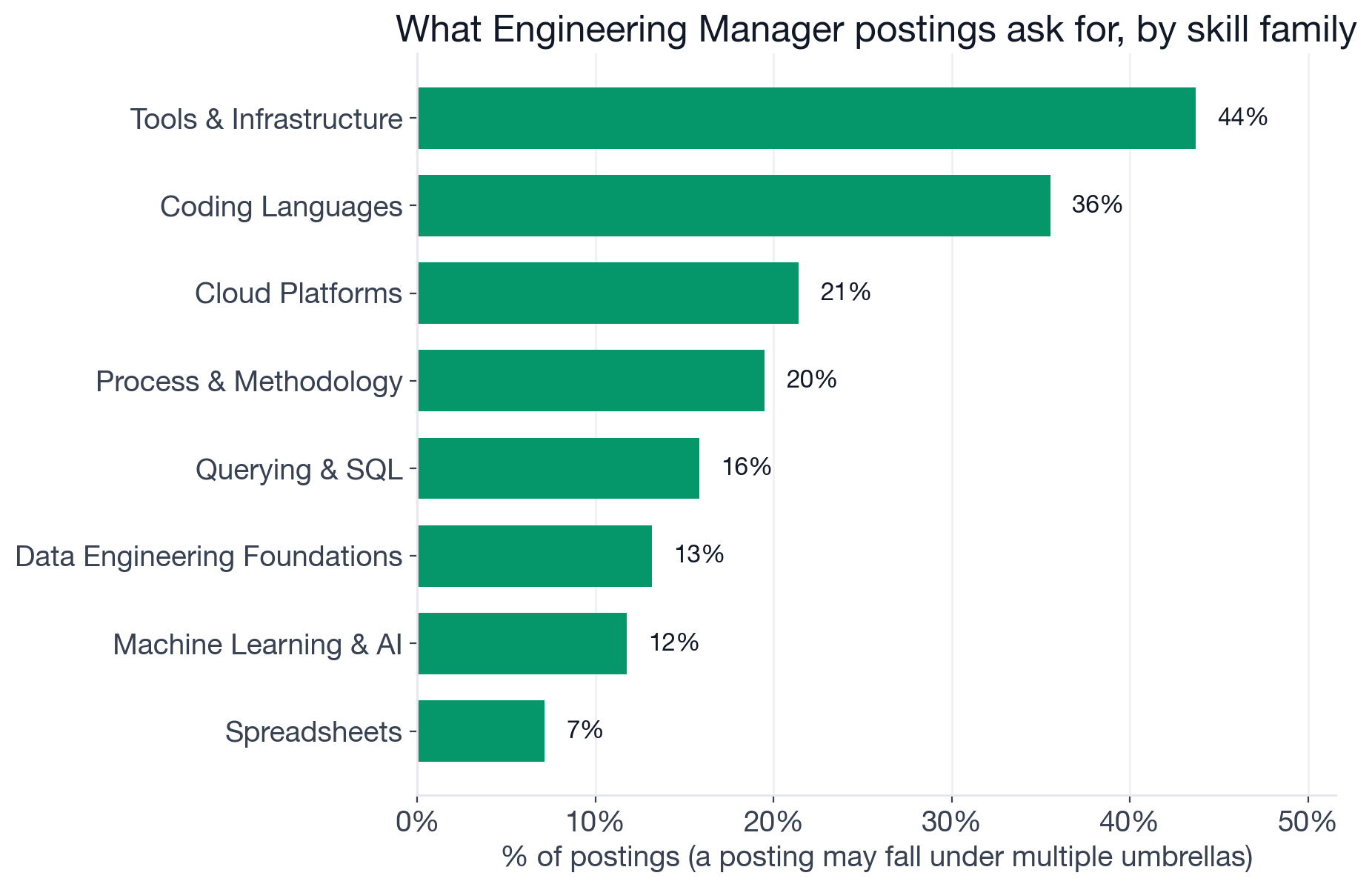
Share of Engineering Manager postings that ask for at least one skill in each family. A posting that mentions both Docker and Kubernetes counts once under "Tools and Infrastructure."
The "Other" family leads at 61% because it catches the technical-leadership skills that don't fit neatly elsewhere: CI/CD (16%), observability (11%), scalability (11%), distributed systems (10%), APIs (10%), system design (8%), and microservices (7%). Together these paint the picture of an EM who is accountable for the operational health of complex software systems, not just the delivery calendar.
Tools and Infrastructure (44%) covers the hands-on platform layer: automation, monitoring, Kubernetes, Docker. Coding Languages (36%) are present because many EM postings expect the manager to stay close enough to code to make architecture calls: Python leads at 19%, followed by Java (11%), TypeScript (8.6%), and JavaScript (7.2%). Cloud Platforms (21%) cluster just above the common-tier threshold, with AWS the most demanded cloud at 17%.
Process and Methodology (19.5%) covers Agile and Scrum. That is a meaningful but clearly secondary signal compared to the infrastructure and tooling families. Machine Learning and AI (11.8%) captures the EMs hired specifically to lead ML or AI product teams, the segment that correlates most strongly with the top salary band.
The Skill Tiers Reveal a Fractured Market
Drill into individual skills and the fracture becomes sharper.
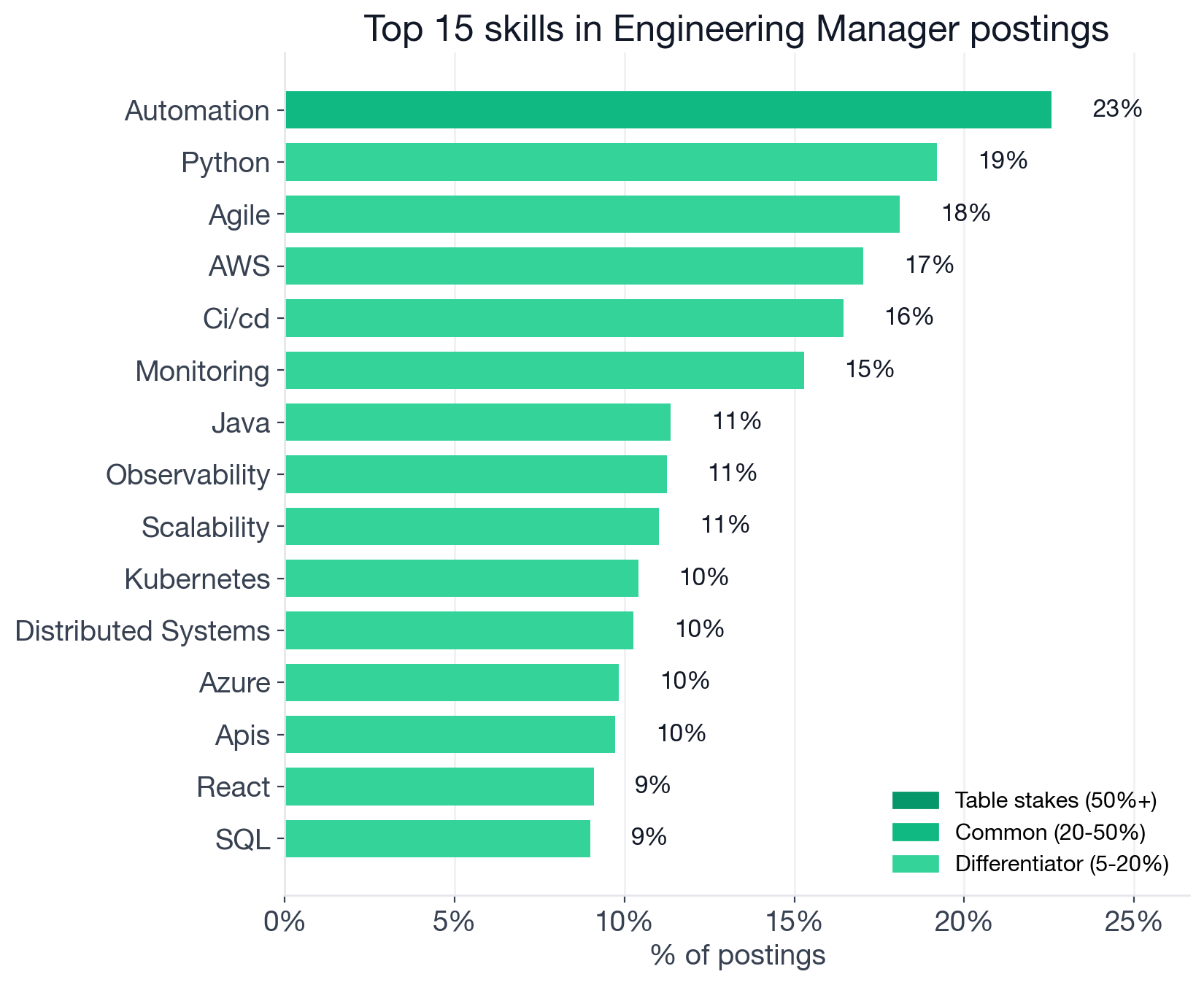
Individual Engineering Manager skills by share of postings that mention them. Table-stakes: 50%+; common: 20-50%; differentiator: 5-20%.
No skill sits in the table-stakes tier. Compare this to the Data Engineer role, where Python, SQL, and Data Pipelines each appear in more than 70% of postings. Engineering Manager has zero equivalents: there is no skill that a hiring manager for this role treats as a given.
One skill sits in the common tier: Automation at 22.6%. Process automation, CI/CD automation, and test automation all collapse under this label, which is why it surfaces across otherwise very different EM postings regardless of track.
The differentiator tier spans 28 skills from Python (19%) down to Kafka (5%), and those 28 skills break into two distinct groups with opposite salary implications.
The infrastructure group includes Python, AWS, CI/CD, Monitoring, Kubernetes, Observability, Scalability, Distributed Systems, and Docker: all sit above the salary baseline and some well above it. Browse Engineering Manager openings that emphasize Kubernetes and you'll see a different job description than the one that leads with Agile ceremonies.
The process and legacy-tool group includes Agile (18%), Scrum (5%), Excel (7%), and Jira: all sit at or below the salary baseline. These are real requirements for legitimate EM jobs. The salary gap reflects not that process skills are "wrong," but that the two tracks price differently in the market.
Understanding which group your target postings draw from is more useful than optimizing for the generic "Engineering Manager" profile.
Which Skills Command the Biggest Salary Premium?
Salary numbers below are restricted to US postings only (where wage-transparency laws produce consistent disclosure) and reflect base salary only: equity, bonuses, and sign-on are not disclosed in postings, so total compensation at top employers is meaningfully higher than what we report here.
The overall median US base salary for Engineering Manager postings is $154,900 (n=2,025). This figure spans the full mix of EM postings (software, hardware, industrial, and manufacturing) and likely understates the baseline for software-focused EM roles at tech companies, consistent with the infrastructure-skill premiums shown in the table below.
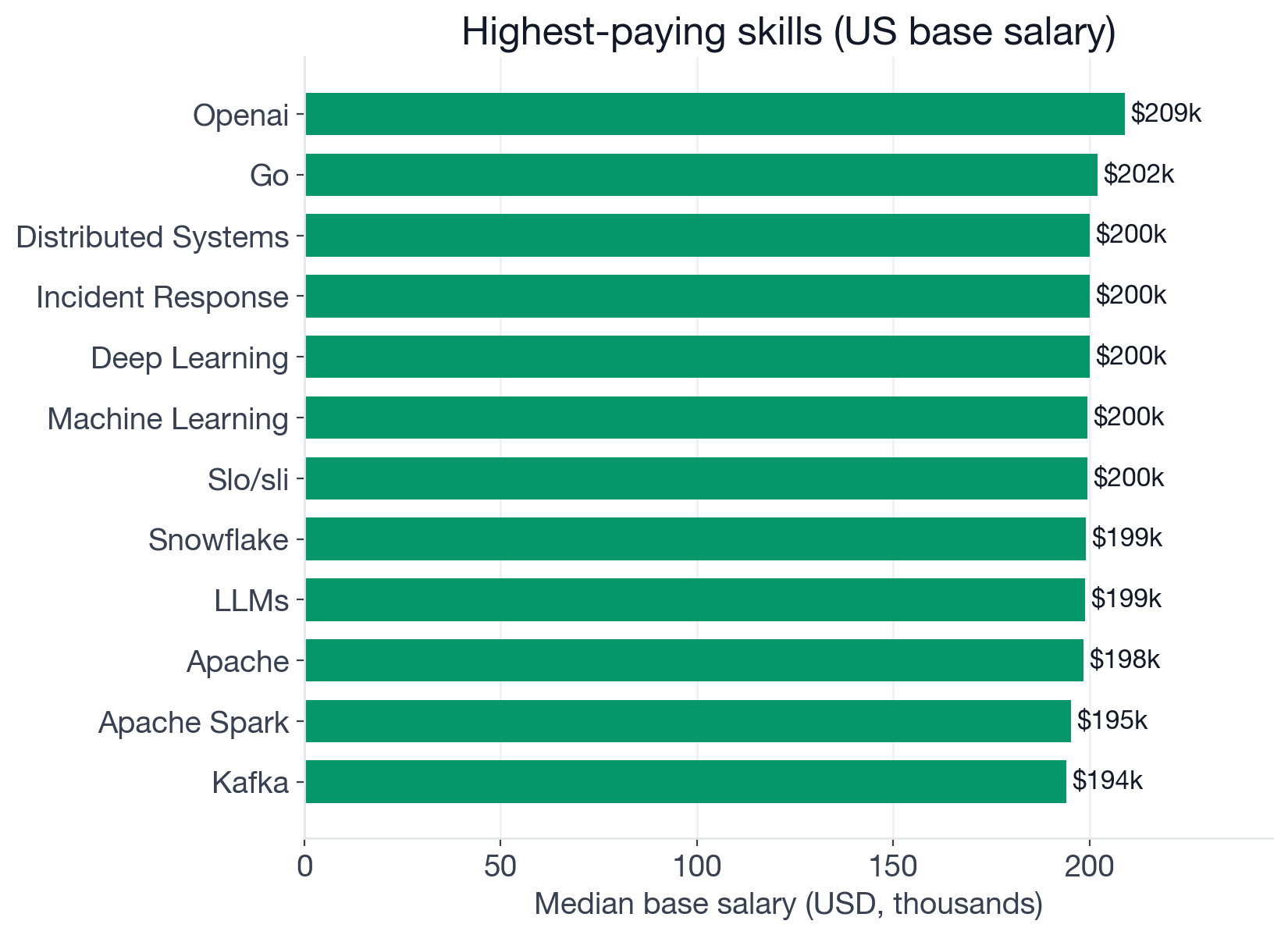
Median US base salary in USD for postings that mention each skill. US postings with disclosed salary data only.
The infrastructure and ML cluster sits $30K to $45K above the median:
| Skill | Median US Base | Premium Over Baseline | n |
|---|---|---|---|
| Distributed Systems | $200,000 | +$45,100 | 263 |
| Machine Learning | $199,500 | +$44,600 | 166 |
| LLMs | $198,800 | +$43,900 | 68 |
| Apache Spark | $195,300 | +$40,400 | 84 |
| Kafka | $194,100 | +$39,200 | 86 |
| Kubernetes | $188,000 | +$33,100 | 196 |
| Observability | $187,600 | +$32,700 | 209 |
| Generative AI | $185,000 | +$30,100 | 91 |
| AWS | $180,000 | +$25,100 | 324 |
| CI/CD | $171,000 | +$16,100 | 261 |
| Python | $170,000 | +$15,100 | 435 |
The process and legacy-tool cluster sits at or below the baseline:
| Skill | Median US Base | vs. Baseline | n |
|---|---|---|---|
| Automation | $154,100 | -$800 | 481 |
| Agile | $150,000 | -$4,900 | 341 |
| Excel | $130,900 | -$24,000 | 139 |
The pattern is clean: skills that require deep modern infrastructure knowledge command a 20-30% premium over the overall median. Skills associated with delivery process and project management sit at or below it. The LLMs and Generative AI premiums ($198,800 and $185,000) are meaningful directional signals, though their smaller sample sizes (n=68 and n=91) carry more variance than the larger clusters.
Two things stand out beyond the raw numbers. First, Distributed Systems-focused Engineering Manager roles represent roughly 10% of the overall market (895 postings); ML-focused EM roles are a meaningful 6% (507 postings), niche but not fringe. Second, the "process" track is not monolithic: Automation at $154,100 is essentially at baseline, which makes sense since automation is a broad skill that appears in both tracks. Agile at $150,000 is the cleaner signal for the process-only EM floor.
What the Dominant Stacks Signal About EM Archetypes
Co-occurrence analysis shows which skills travel together and how strongly. The pairs below are from the top-25 skill set; lift above 1 means the two appear together more often than their individual frequencies would predict.
| Skill pair | Postings with both | Share of market | Lift |
|---|---|---|---|
| Docker + Kubernetes | 461 | 5.3% | 7.23 |
| React + TypeScript | 439 | 5.0% | 6.40 |
| Azure + Google Cloud | 466 | 5.3% | 6.32 |
| AWS + Google Cloud | 592 | 6.8% | 4.63 |
| AWS + Azure | 624 | 7.2% | 4.27 |
| CI/CD + Docker | 386 | 4.4% | 3.83 |
| CI/CD + Microservices | 388 | 4.5% | 3.70 |
| AWS + Kubernetes | 503 | 5.8% | 3.26 |
The pairs reveal four identifiable sub-tracks inside the EM market:
Cloud-native infrastructure: Docker + Kubernetes (lift 7.23) is the strongest co-occurrence in the dataset by a wide margin. An EM posting that mentions Docker is more than seven times as likely as chance to also mention Kubernetes, signaling a role that owns container platform decisions. AWS + Kubernetes (lift 3.26) and CI/CD + Docker (lift 3.83) extend this cluster into deployment pipeline ownership.
Multi-cloud governance: The cloud provider pairs (Azure + Google Cloud at lift 6.32; AWS + Google Cloud at lift 4.63; AWS + Azure at lift 4.27) all over-index heavily. EMs in this cluster work at large enterprises managing multiple cloud environments, less hands-on infrastructure and more vendor strategy, compliance, and cross-platform reliability.
Frontend platform: React + TypeScript (lift 6.40) identifies a distinct niche: EMs managing frontend engineering teams where TypeScript and React are the primary delivery stack. Browse Engineering Manager openings filtered to React and the job descriptions read as frontend technical leadership, separated from the backend and infrastructure EM tracks.
DevOps and platform: CI/CD + Microservices (lift 3.70) and CI/CD + Docker (lift 3.83) identify EMs who own developer experience and release infrastructure. Their team maintains the pipelines that other teams depend on to ship.
Each stack signals a different management context and a different interview. A cloud-native infrastructure EM candidate should expect architecture conversations about container orchestration and reliability engineering. A frontend EM candidate should prepare to discuss team-level TypeScript decisions. Matching the stack you apply for to the stack you actually know is more useful than a generic EM preparation plan.
Who Gets Hired and Where?
Seniority
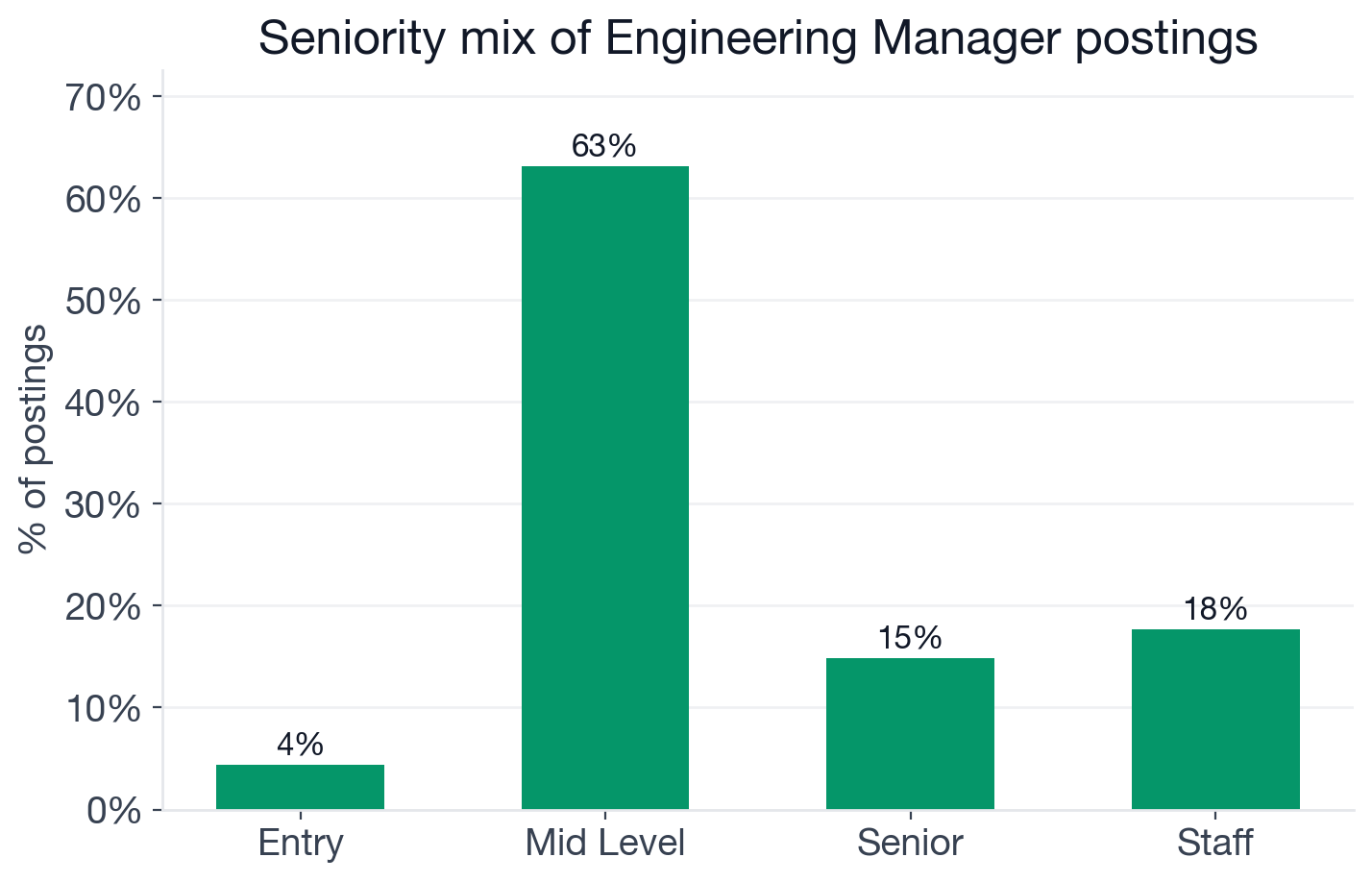
Seniority distribution of Engineering Manager postings, inferred from title keywords.
Mid-level dominates at 63.1% (5,502 postings). For a management title, that concentration is notable: it reflects how many organizations treat "Engineering Manager" as a mid-career transition point rather than a senior designation. Staff-level postings (17.7%, 1,539 openings) represent the director-adjacent layer where the EM owns multiple teams or a full engineering organization. Staff is larger than senior (14.8%) here, which is unusual: it suggests that big tech companies which use a "Staff Engineering Manager" designation make up a meaningful share of the market. Entry-level at 4.4% (382 postings) captures junior or associate EM roles at companies with structured IC-to-management tracks.
For candidates targeting the senior Engineering Manager tier, the salary data suggests that technical infrastructure depth matters considerably more at that level: senior and staff EM postings are more likely to name distributed systems, observability, and Kubernetes alongside leadership responsibilities.
Geography
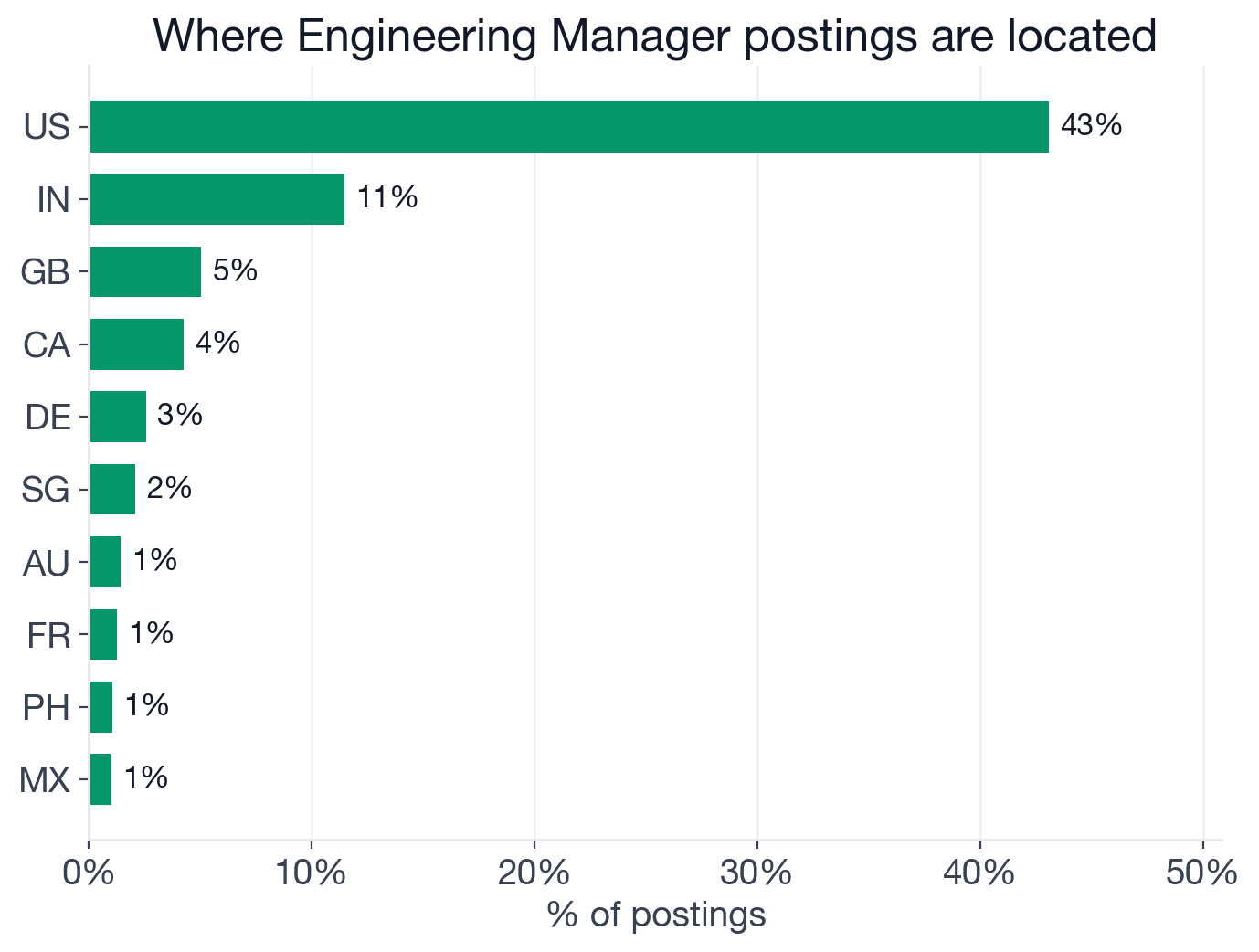
Top countries by share of Engineering Manager postings.
The United States accounts for 43% of postings, a larger US concentration than most other roles in this analysis. US Engineering Manager openings are the clear majority of the global market, followed by India (11.5%), UK (5%), and Canada (4.3%). The US dominance reflects how many of the top hirers are US-headquartered firms across technology, defense, and manufacturing.
Work mode
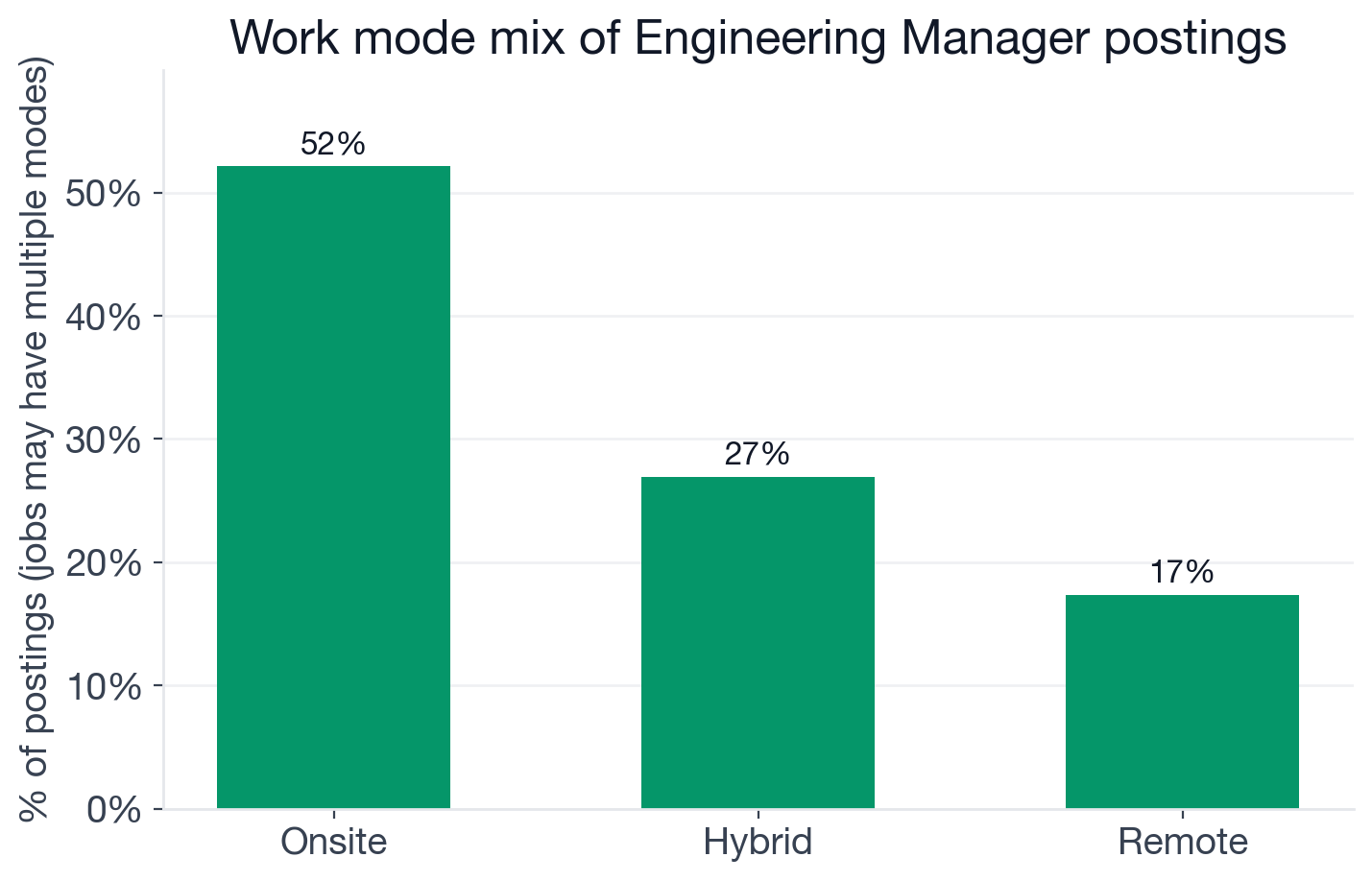
Share of Engineering Manager postings tagged with each work mode. Percentages reflect share of postings with each tag; 13.2% of postings carry no work-mode tag.
Only 17.4% of postings are tagged remote, well below the roughly 27% remote share for Data Engineer roles. Onsite is the dominant expectation at 52.2% (4,547 postings), with hybrid at 26.9% (2,349). Engineering management involves frequent 1:1s, team rituals, and cross-functional alignment: proximity matters more here than it does for pure IC work. Fully remote EM roles exist but concentrate in product-led software companies; industrial, defense, and government employers default firmly to onsite.
Who's Hiring Engineering Managers in 2026?
The top hiring companies tell an industry story that surprises most software-background candidates.
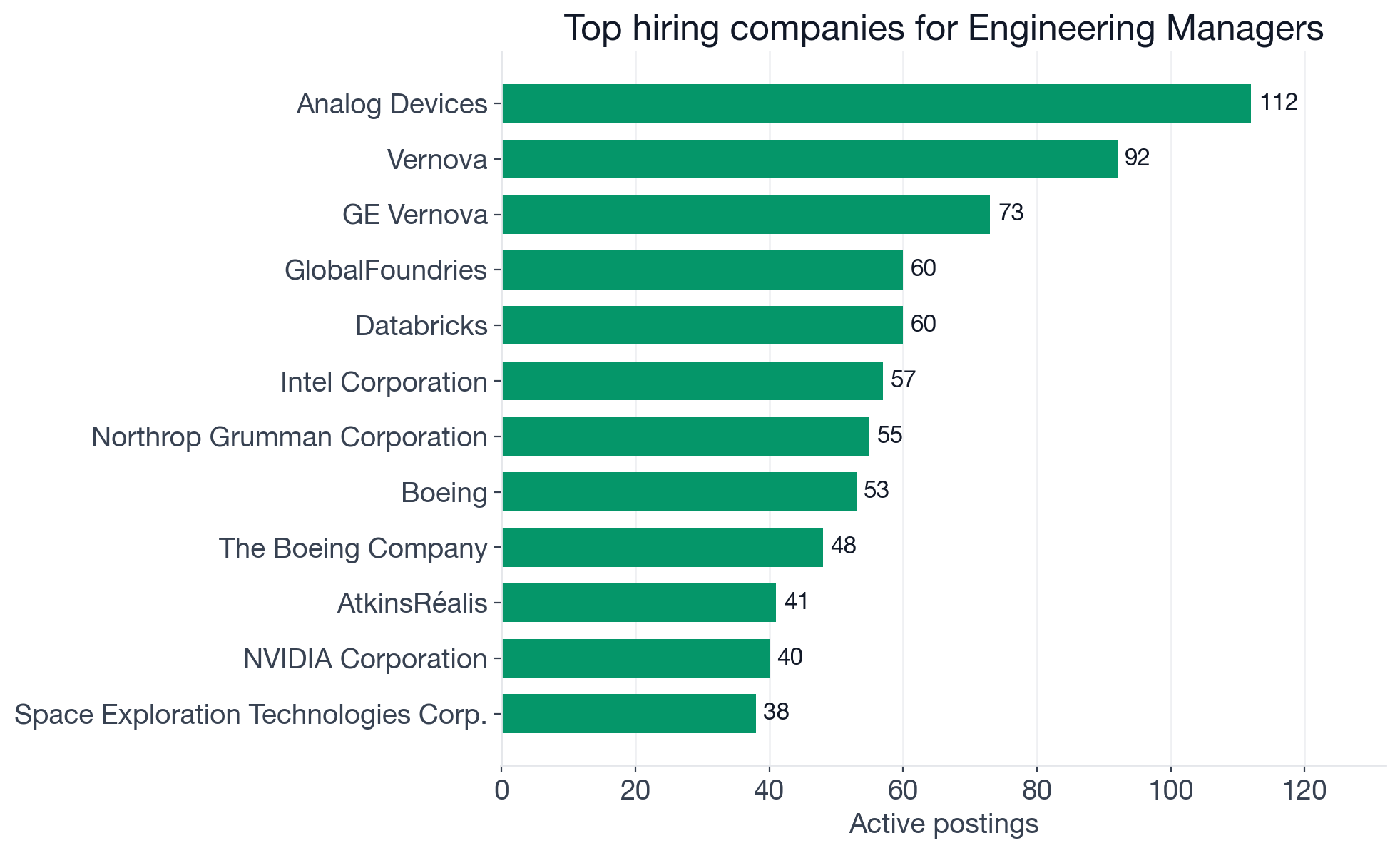
Top companies by active Engineering Manager postings. GE Vernova and Boeing each appear under two name variants in the raw data; the table below combines them.
| Company | Active Postings |
|---|---|
| GE Vernova | 165 (combined) |
| Analog Devices | 112 |
| Boeing | 101 (combined) |
| GlobalFoundries | 60 |
| Databricks | 60 |
| Intel Corporation | 57 |
| Northrop Grumman | 55 |
| AtkinsRéalis | 41 |
| NVIDIA Corporation | 40 |
| SpaceX | 38 |
| Comcast Corporation | 33 |
| Micron Technology | 33 |
GE Vernova, an energy technology company, leads the combined list at 165 postings (the platform recorded two name variants). Boeing follows at 101 combined postings (also recorded under two name variants). Semiconductor and chip companies (Analog Devices, GlobalFoundries, Intel, NVIDIA, Micron) add four more top-10 slots. Aerospace and defense (Northrop Grumman, SpaceX) round out the industrial cluster. Databricks is the one pure software-data company in the top tier, and AtkinsRéalis is a global engineering consultancy.
The practical implication: "Engineering Manager" spans very different professional contexts. An EM at GlobalFoundries manages process engineers in a semiconductor fabrication environment. An EM at Databricks manages software engineers building a cloud data platform. Both titles are identical in a job search. Use the Engineering Manager job board with skill filters to pre-filter to the industry context that matches your background, or apply to companies where your prior work aligns with the systems being managed. Our interview preparation guides cover the specific interview formats and expectations at individual employers for exactly this reason.
AI Is Reshaping Engineering Management Even When JDs Don't Say So
Only 11.8% of Engineering Manager postings explicitly mention machine learning or AI skills. That number measures something precise: EMs hired to lead teams that design, build, or deploy AI systems. It is not a measure of how many EMs are affected by AI's adoption.
The ambient layer is larger. Surveys show 86% of US engineers now use AI tools in their daily work (Omni Calculator 2026) and 51% of professional developers use AI coding tools daily (Stack Overflow Developer Survey 2025). The average EM in 2026 manages a team where AI productivity tooling is the default operating assumption, regardless of whether the job description mentions it.
DX's Q1 2026 Impact Report, analyzing 135,000+ developers, called the evolving Engineering Manager role "the most dramatic structural shift" in engineering organizations, noting that agentic AI tools are enabling a return of the "player-coach" EM who can re-engage with codebases without sacrificing leadership. At the same time, PR review time increases 91% on high-AI-adoption teams, even as those teams complete 21% more tasks. That review bottleneck lands directly on the EM.
The practical implication: EMs are increasingly accountable for AI governance, tool evaluation, output quality review, and cross-functional enablement. These responsibilities rarely appear in job descriptions but show up in the actual work. A candidate who already has a framework for evaluating AI output quality, setting coding-assistant policies, and managing the velocity-versus-reliability trade-off that AI tooling creates is a stronger candidate for any EM role in 2026, not just the 11.8% where AI is an explicit JD requirement.
How to Use This in Your Job Search
Identify your target track before you apply. The data shows at least four distinct EM sub-roles: cloud-native infrastructure EM, frontend platform EM, multi-cloud governance EM, and process/delivery EM. Each has a different skill profile and a different salary ceiling. Read job descriptions for the cluster signals: Docker + Kubernetes points to infrastructure ownership; React + TypeScript points to frontend leadership; Agile-heavy descriptions without cloud or infra depth suggest a delivery-management focus. Use the Engineering Manager job board with skill filters to pre-filter by your target track before committing time to applications.
Invest in infrastructure depth if your background supports it. Engineering Manager roles that mention Python pay a $15K premium over the baseline (US median $170K, n=435). Roles that mention AWS pay $25K more ($180K, n=324). The infrastructure skills further up the ladder (Distributed Systems at $200K, Kubernetes at $188K, Observability at $187.6K) are accessible to senior engineers transitioning to management with deep platform experience. Even CI/CD fluency alone correlates with a $16K premium.
Drill the topics that technical EM interviews surface. The question bank lets you work through system design, distributed systems, and cloud architecture topics at your own pace: these are the areas that distinguish a technical EM candidate from a generalist in onsite rounds. For the behavioral and leadership dimensions, AI mock interview practice includes engineering leadership scenarios with feedback on communication, conflict navigation, and technical decision framing.
Adjust your narrative for industrial and hardware employers. The top-hiring list is dominated by GE Vernova, Boeing, Intel, Northrop Grumman, and Analog Devices: employers whose EM roles look very different from a typical SaaS management role. Our preparation guides break down interview expectations at specific employers so you can calibrate your preparation to the company rather than the generic title.
Build the foundations first. If you're an IC preparing to transition to management, our interactive engineering courses cover the system design, cloud architecture, and software engineering principles that technical EM interviews assume as background. Management skills are layered on top of technical credibility, not substituted for it.
FAQ
Q. What skills do companies want for Engineering Manager roles in 2026?
No single skill is universally required. Automation leads at 22.6% of postings, followed by Python (19%), Agile (18%), and AWS (17%). The role divides into infrastructure-focused EMs (CI/CD, Kubernetes, Distributed Systems) and process-focused EMs (Agile, Scrum, Excel). Neither track dominates the full market.
Q. What is the median Engineering Manager salary in 2026?
The median US base salary across 2,025 Engineering Manager postings with disclosed salary data is $154,900 as of June 2026. Equity, bonuses, and sign-on are not included in posting data, so total compensation at top employers is meaningfully higher.
Q. Which Engineering Manager skills command the highest salary premium?
Distributed Systems leads with a $200,000 US median (263 postings), about $45K above the $154,900 baseline. Machine Learning ($199,500, n=166), Apache Spark ($195,300, n=84), and Kafka ($194,100, n=86) follow closely. Agile-mentioning postings have a $150,000 median (below baseline), and Excel sits at $130,900, roughly $24K below baseline.
Q. Is Engineering Manager a technical or management role in 2026?
Both, depending on the track. No single technical language clears 20% of postings, and process skills like Agile and Scrum appear in 18% and 5% respectively. Infrastructure-heavy EMs (managing distributed systems, Kubernetes, ML teams) command $30K-$45K premiums over the median. Process-focused EMs (managing agile ceremonies and delivery) sit at or below the $154,900 baseline.
Q. Are Engineering Manager roles remote-friendly in 2026?
Less so than most tech roles. Only 17.4% of Engineering Manager postings are tagged remote, versus roughly 27% for Data Engineer roles. Onsite accounts for 52.2% of postings. Management roles carry an above-average face-time expectation; fully remote EM roles exist but concentrate in product-led tech companies.
Q. Which companies hire the most Engineering Managers in 2026?
The top hiring companies skew heavily toward industrial sectors: GE Vernova (165 postings combined), Analog Devices (112), Boeing (101 combined), GlobalFoundries (60), and Intel Corporation (57) appear alongside software companies like Databricks (60) and NVIDIA (40). Aerospace, manufacturing, and semiconductor firms collectively represent a larger share of EM demand than most software candidates expect.
Q. How is AI changing the Engineering Manager role in 2026?
Only 11.8% of Engineering Manager postings explicitly mention ML or AI skills, measuring roles hired to lead AI teams. But surveys show 86% of US engineers now use AI tools in their work (Omni Calculator 2026). DX's Q1 2026 Impact Report identified the evolving EM role as "the most dramatic structural shift" in engineering organizations, as AI tooling creates new governance, PR review, and quality-evaluation responsibilities for managers regardless of whether their own JD mentions AI.
What the Data Means for Your Next Move
The Engineering Manager title is genuinely broad, and that breadth is what makes it hard to prepare for as a job seeker. But the data gives you a map. If your background is in cloud infrastructure, distributed systems, or ML: filter explicitly for the infrastructure and ML-adjacent tracks, use skill filters to find companies offering the $180K to $200K tier, and expect technical depth questions in your interviews. If your background is in delivery management and process: the market is large and mid-level demand is real, but the ceiling is lower and the competition for mid-level process EM roles is steeper. The clearest investment is developing fluency in at least one modern infrastructure layer: CI/CD knowledge alone adds $16K over baseline, and Kubernetes or Distributed Systems experience roughly doubles that premium. The EM role rewards engineers who manage teams AND understand the systems those teams build.
Topics
Ready to practice?
Put what you've learned into practice with AI mock interviews and structured preparation guides.