
Frontend Is the Most Accessible Tech Ladder, With a Real Pay Cliff Inside It
The conventional wisdom about tech hiring in 2026 says every door requires a portfolio, years of production experience, and a degree or equivalent credential. For Frontend Developer roles, that story is only half right. At 20.7% entry-level, the role has the highest entry-level share of any tech discipline tracked on the InterviewStack.io job board: nearly 1 in 5 openings is genuinely accessible to new graduates, bootcamp completers, and career changers with a solid project or two.
But accessible to enter doesn't mean flat to grow. Across 6,138 active Frontend Developer postings as of June 2026, a single choice drives the largest salary gap in the data: TypeScript over plain JavaScript. Postings that explicitly ask for TypeScript show a US median of $147,200. Postings listing plain JavaScript sit at $120,000. That $27,200 spread lives within the same job title, the same frameworks, and often the same companies.
The framework you pick (React, Angular, Vue) matters less than the language you write it in.
Key Findings
- 6,138 active Frontend Developer postings analyzed on the InterviewStack.io job board as of June 2026.
- No skill crosses the 50% threshold: JavaScript leads at 48.7%, reflecting real framework diversity across the market; every hiring signal is about direction, not dominance.
- Median US base salary is $134,500 (n=414 postings with US salary disclosed); TypeScript earns $27,200 more than plain JavaScript in that same market.
- Observability ($151,300), PostgreSQL ($150,000), and Next.js ($150,000) carry the largest premiums above the baseline, each $15K-$17K above the $134,500 US median. GraphQL ($147,400) and TypeScript ($147,200) follow.
- 20.7% of postings are explicitly entry-level (1,272 of 6,138), the highest rate of any tech role on the board.
- React leads at 41.1% but Angular holds 20.3%; no single framework is universal, and the language choice matters more than the framework choice.
- 44.8% of postings are onsite: remote (20.7%) and hybrid (18.7%) are each smaller than frontend's reputation as a remote-friendly discipline suggests.
- 74-85% of developers use AI coding tools regularly, per JetBrains and Stack Overflow surveys, even though only 5.4% of Frontend Developer postings explicitly list AI or ML skills.
Who Gets Hired, and at What Level?
Frontend development has a broader hiring funnel than most tech disciplines. The seniority breakdown makes that concrete.
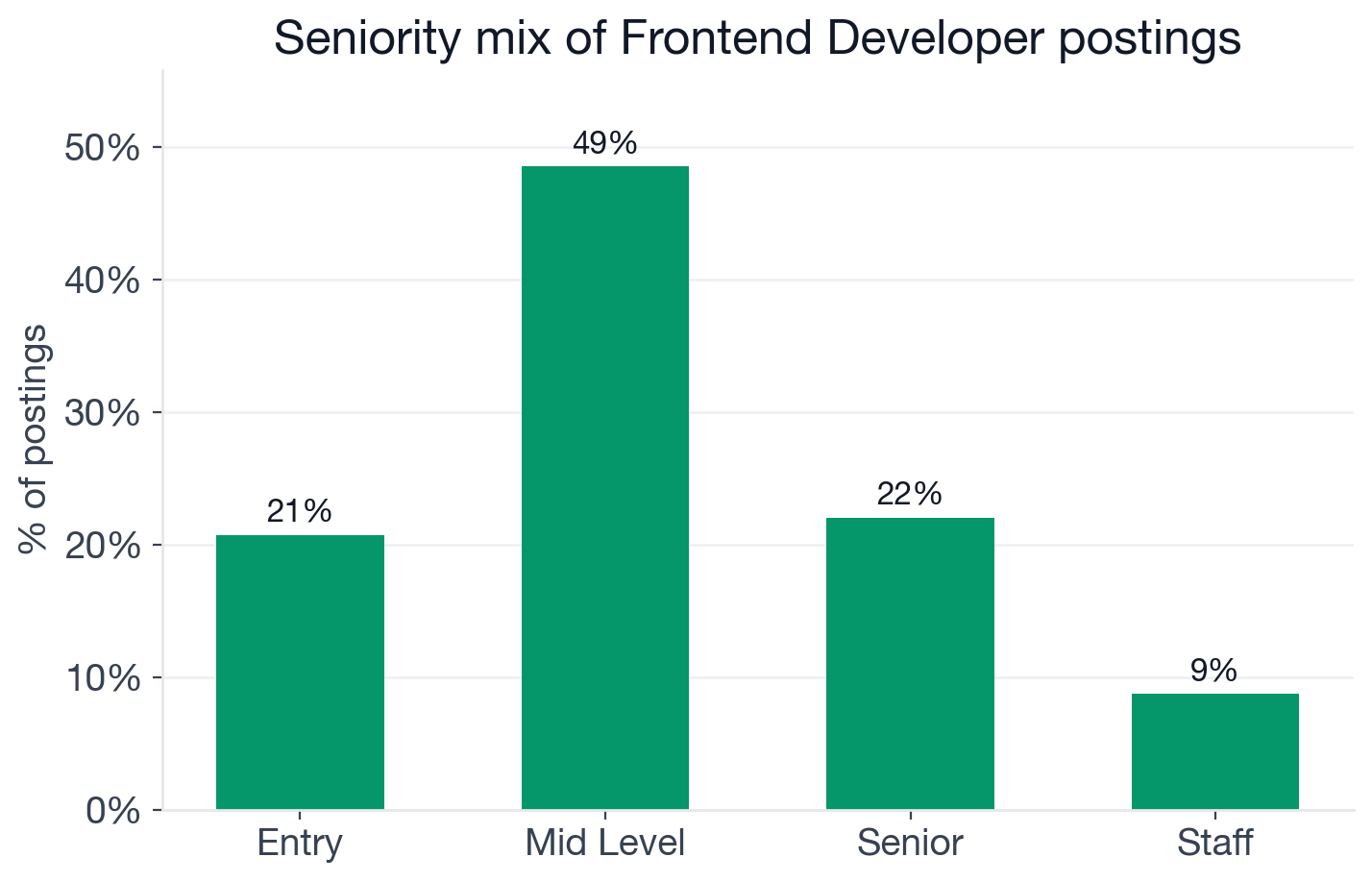
Seniority distribution of 6,138 active Frontend Developer postings.
- Mid-level: 48.5% (2,978 postings)
- Senior: 22.0% (1,352 postings) (browse senior Frontend Developer openings)
- Entry-level: 20.7% (1,272 postings)
- Staff: 8.7% (536 postings)
The 20.7% entry-level share stands out sharply against other roles. Data Engineers sit at 3% entry-level, Data Analysts at around 8%. Frontend Developer's 1-in-5 entry rate reflects the actual structure of the web: there is a large volume of maintenance work, feature additions, and greenfield apps at small and mid-size companies that don't require senior infrastructure judgment. Entry-level is a real door here, not a nominal category.
The senior and staff tiers together account for 30.7% of postings. That's real IC career runway. Senior frontend roles trend toward TypeScript, design systems, and observability skills, where the salary premium concentrates. Staff postings layer in architecture vocabulary: scalability (10.6%), microservices (6.3%), and system design signals show up consistently.
For career switchers targeting frontend specifically: the entry-level share, combined with a largely credential-free path in (no degree requirement on most postings), makes this one of the most realistic on-ramps into professional software development. The strategy of building a strong TypeScript and React portfolio project before applying reflects both the salary data and the hiring pattern.
What Skill Families Shape a Frontend Developer Role?
Group individual skills into families and count how many postings ask for at least one from each group. The role's breadth becomes visible as a layered stack: language, then UI layer, then infrastructure, then process.
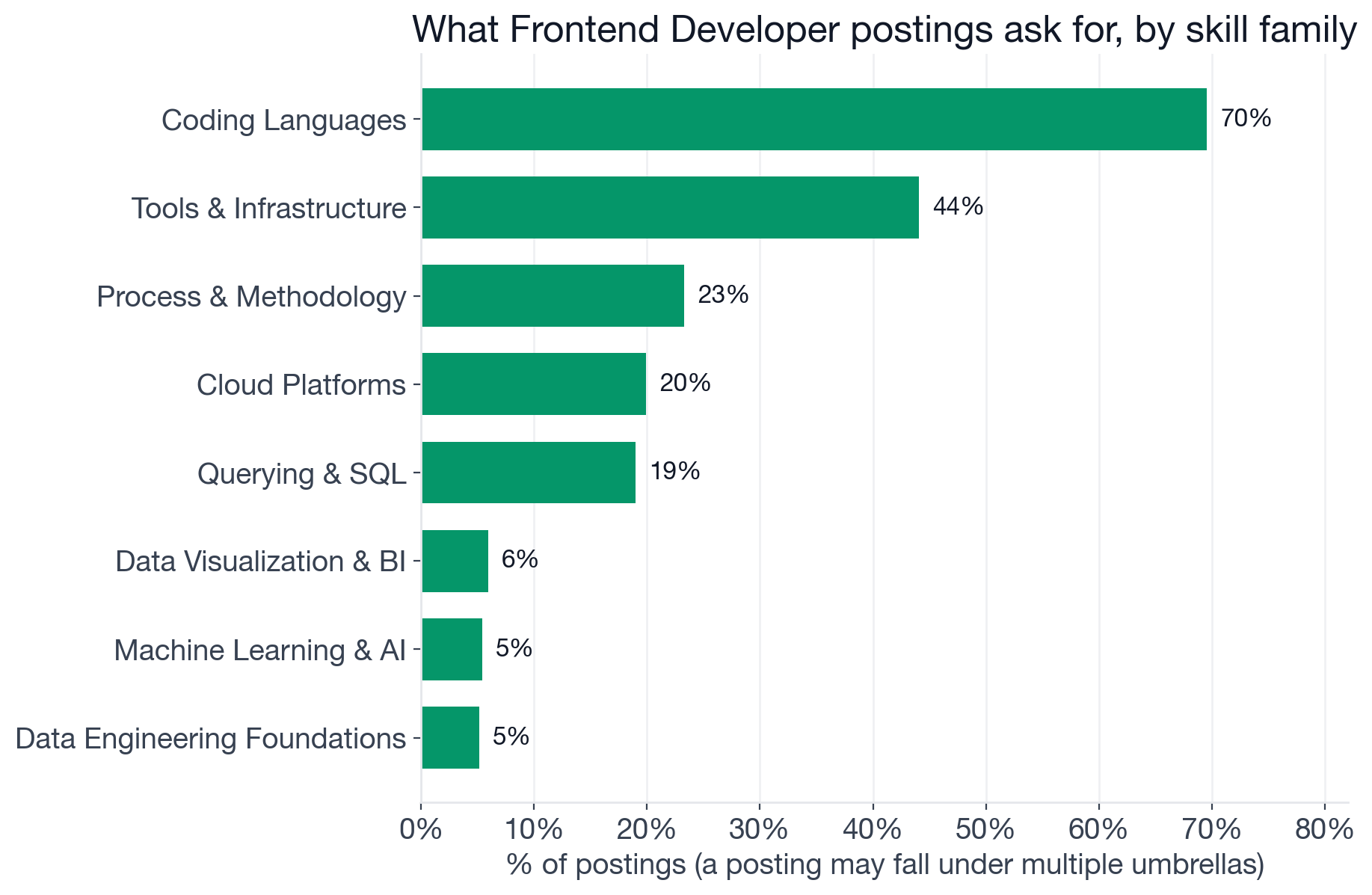
Share of Frontend Developer postings that ask for at least one skill in each family. A posting that mentions both React and Angular counts once under the frontend-specific family.
- Frontend-specific skills: 77.2%, covering React, CSS, HTML, Angular, Next.js, design systems, and the broader UI toolkit
- Coding Languages: 69.5%, overwhelmingly JavaScript and TypeScript, with Python (10.4%), Java (10.1%), and C# (6.2%) in secondary roles for full-stack adjacent positions
- Tools and Infrastructure: 44.1%, with Git (22.8%) as the baseline and Docker, GitHub, monitoring, and Kubernetes filling out the upper portion
- Process and Methodology: 23.3%, led by Agile (22.0%) and Scrum (8.4%)
- Cloud Platforms: 19.9%, split across AWS (14.0%), Azure (10.5%), and Google Cloud (5.0%)
- Querying and SQL: 19.0%, where SQL (11.1%) and PostgreSQL (6.8%) appear in roughly 1 in 5 postings, a signal that many Frontend Developers integrate directly with databases or build internal admin tooling
- Machine Learning and AI: 5.4%, covering postings that explicitly ask for AI skills, typically for building AI-powered UIs or connecting LLM APIs
That 5.4% figure for Machine Learning and AI is the explicit floor: jobs that require you to build AI features, not jobs where you use AI tools. The ambient picture is very different. According to the JetBrains State of Developer Ecosystem 2025, 85% of developers now use AI tools regularly, and frontend developers are the second-highest AI tool adopter by specialization. GitHub Copilot, Cursor, and Vercel v0 are standard scaffolding tools for component development in 2026, not experimental ones. A 5.4% explicit AI skill rate doesn't mean 94.6% of frontend developers aren't using AI: it means employers assume you already do. The GitHub Octoverse 2025 report found 80% of new GitHub developers adopted Copilot in their first week, and the same report documented TypeScript overtaking Python and JavaScript to become the most-used language on GitHub in mid-2025. That TypeScript rise is partly AI-driven: AI-generated code is safer to review and maintain when it carries static types.
The Three Tiers of Individual Skills
Individual skills split into three levels, with one notable structural fact: the table-stakes tier is empty. Nothing reaches 50%.
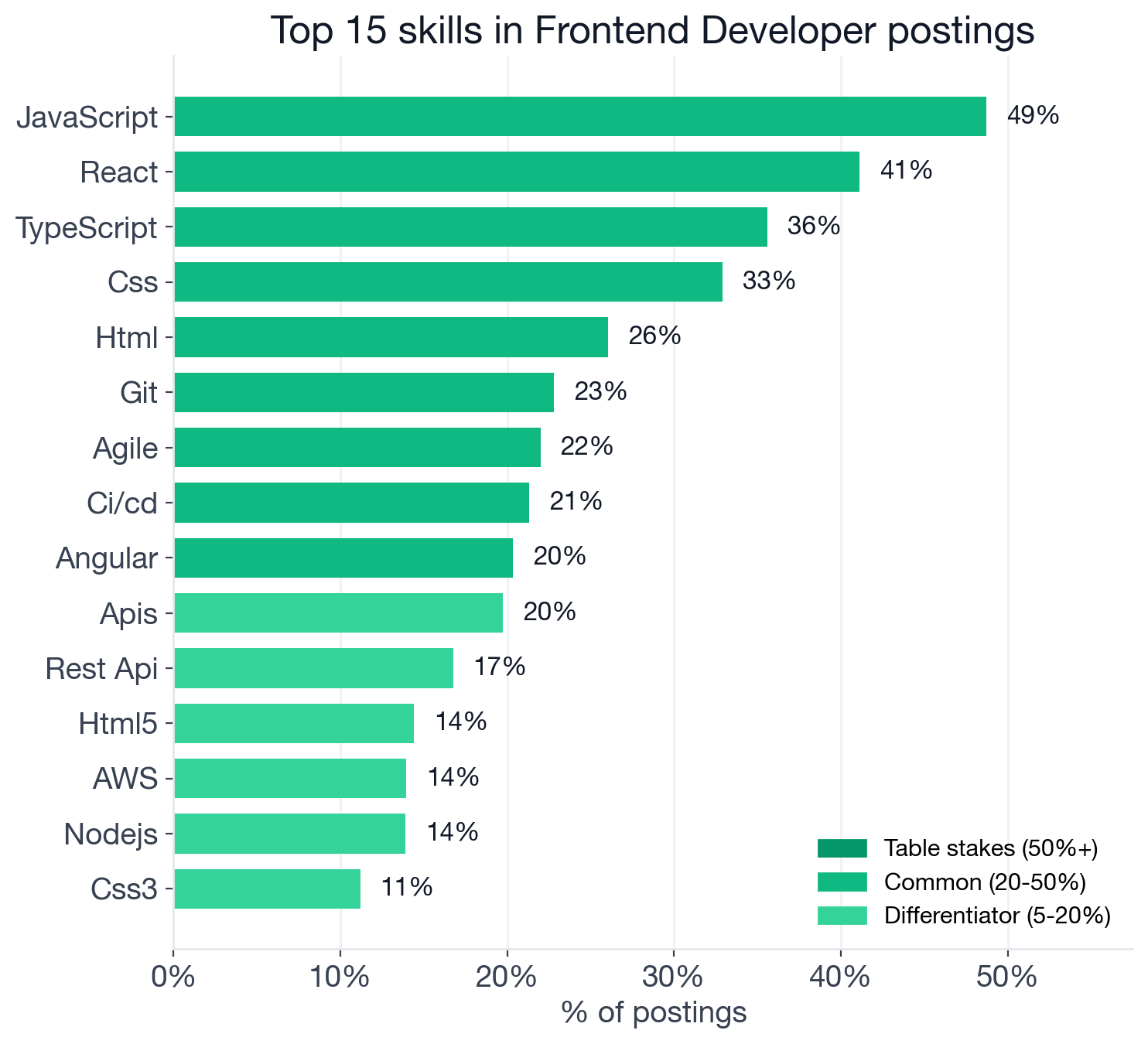
Top individual skills in Frontend Developer postings, by share of listings that mention them. The 50%+ table-stakes tier is empty; common spans 20-50%; differentiator spans 5-20%.
Common Expectations (20-50% of postings)
Everything in this tier appears in at least 1 in 5 postings. The market broadly expects these skills, even if none is strictly universal:
- JavaScript: 48.7% (Frontend Developer + JavaScript openings)
- React: 41.1% (React-focused openings)
- TypeScript: 35.6% (TypeScript-focused openings)
- CSS: 32.9%
- HTML: 26.1%
- Git: 22.8%
- Agile: 22.0%
- CI/CD: 21.3%
- Angular: 20.3%
The Angular entry at 20.3% (roughly 1,250 postings) deserves attention. Angular is a real market segment, not a legacy holdover. Enterprise and government buyers standardize on it for large-scale applications, and a candidate who has only worked in React is excluding themselves from approximately one fifth of the market. The JavaScript and TypeScript foundation transfers completely; the framework idioms differ.
Nothing in this tier is a filter-breaking requirement by itself. The absence of a table-stakes skill is the data's structural point: Frontend Developer is a fragmented role by design. Companies are hiring for different frameworks, different rendering approaches, and different infrastructure expectations. The signal that cuts across all of them is the language: TypeScript vs. plain JavaScript.
Differentiators (5-20% of postings)
These appear in a minority of postings but cluster around skills that signal a more complete and, as the next section shows, better-compensated profile:
- APIs and REST API: 14-20% (combined across naming variants)
- AWS: 14.0%
- Node.js: 13.9% (the JavaScript runtime that extends frontend developers into server-side logic)
- Next.js: 10.9% (a React framework that adds server-side rendering, file-based routing, and edge deployment)
- Docker: 10.1%
- Python, Java: approximately 10% each (secondary languages for full-stack adjacent roles)
- Design Systems: 9.5% (component libraries, tokens, and shared UI specifications)
- Testing: 9.7%; Jest: 8.2% (a JavaScript testing framework used with React projects)
- GraphQL: 8.0% (a query language for APIs, often used instead of REST in React and Next.js applications)
- Figma: 6.9% (design handoff and prototyping tool)
- Tailwind: 6.3% (a utility-first CSS framework that generates class-based styles)
The testing cluster is more broadly present than the explicit numbers suggest. Frontend teams overwhelmingly use testing in practice but don't always enumerate specific tools in job descriptions. Mentioning Jest and Playwright in a portfolio or interview signals more than the raw 8% posting rate implies.
Which Skills Actually Move the Needle on Frontend Salary?
Salary figures below are restricted to US postings only, where wage-transparency laws produce consistent disclosure. They represent base salary: equity, RSUs, bonuses, and sign-on are not disclosed in job postings and are excluded from all figures. Total compensation at top employers runs meaningfully higher than what is reported here.
The overall median US base salary for Frontend Developer postings is $134,500 (n=414).
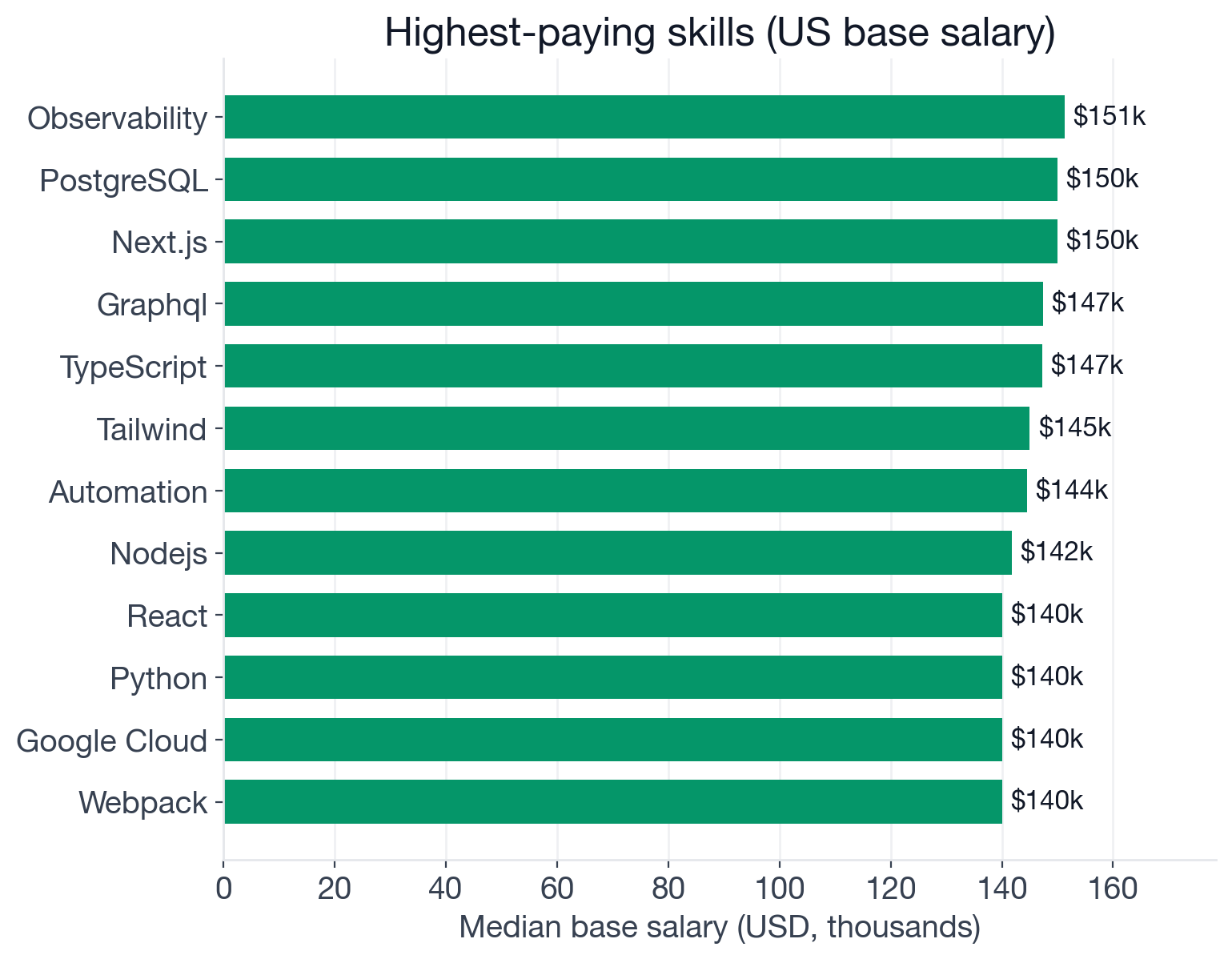
Median US base salary in USD for Frontend Developer postings that mention each skill. US-only postings with structured salary data.
The most important number in the chart is the gap between TypeScript and JavaScript:
- TypeScript: $147,200 (n=211), $12,700 above the $134,500 baseline
- JavaScript: $120,000 (n=213), $14,500 below baseline
That $27,200 spread within the same language category is the single largest skill premium in the dataset. A JavaScript-only frontend developer and a TypeScript-fluent one are evaluated very differently on the salary ladder, even when applying to the same framework, the same company, and the same seniority band.
Other premiums above the $134,500 baseline:
| Skill | US Median Salary | Premium vs. Baseline | Sample Size |
|---|---|---|---|
| Observability | $151,300 | +$16,800 | n=45 |
| PostgreSQL | $150,000 | +$15,500 | n=33 |
| Next.js | $150,000 | +$15,500 | n=47 |
| GraphQL | $147,400 | +$12,900 | n=50 |
| TypeScript | $147,200 | +$12,700 | n=211 |
| Tailwind | $145,000 | +$10,500 | n=26 |
| Automation | $144,500 | +$10,000 | n=74 |
| Node.js | $141,800 | +$7,300 | n=56 |
| React | $140,000 | +$5,500 | n=199 |
| Design Systems | $140,000 | +$5,500 | n=84 |
| Python | $140,000 | +$5,500 | n=89 |
| AWS | $139,500 | +$5,000 | n=62 |
| JavaScript | $120,000 | -$14,500 | n=213 |
Two groupings are worth naming separately:
The architecture and full-lifecycle cluster ($13-17K premium): Observability, Next.js, and GraphQL sit at the top of the salary distribution because they signal roles where the Frontend Developer is thinking beyond the component. Observability (monitoring browser errors, performance, and user sessions with tools like Datadog or Sentry) shows up in senior and staff postings where reliability is a first-class concern. Next.js says "this developer has moved from a client-rendered SPA to owning the full request lifecycle." GraphQL typically means a more senior API contract, where the frontend developer is co-designing the schema. These aren't niche or exotic skills; they're the markers of a senior-leaning frontend profile.
TypeScript as the threshold skill ($12.7K premium): Investing in TypeScript over plain JavaScript is the highest single-leverage skill decision in this dataset. TypeScript is already in 35.6% of postings (well into the common tier), commands a $12.7K premium over the baseline, and sits $27.2K above the median for JavaScript-only postings. Vite, Next.js, and Remix all make TypeScript the recommended starting point. Learning React without TypeScript is building on a foundation the market is actively moving away from.
The Dominant Stack: What Skills Appear Together
The highest co-occurrence pairs reveal the actual building blocks companies expect to see together on one resume. Lift greater than 1 means the two skills appear together more often than their individual frequencies would predict by chance.
| Skill pair | Joint postings | % of postings | Lift |
|---|---|---|---|
| CSS3 + HTML5 | 659 | 10.7% | 6.65 |
| CSS + HTML | 1,451 | 23.6% | 2.76 |
| Agile + Git | 592 | 9.6% | 1.92 |
| CSS3 + JavaScript | 633 | 10.3% | 1.89 |
| HTML5 + JavaScript | 809 | 13.2% | 1.87 |
| HTML + JavaScript | 1,415 | 23.1% | 1.82 |
| CSS + JavaScript | 1,703 | 27.7% | 1.73 |
| React + TypeScript | 1,497 | 24.4% | 1.67 |
| Git + JavaScript | 1,102 | 18.0% | 1.62 |
| CI/CD + TypeScript | 749 | 12.2% | 1.61 |
Each pair describes how hiring managers actually compose skill requirements:
CSS3 + HTML5 (lift 6.65) is the highest-lift pair in the dataset, nearly 7x the expected co-occurrence. Postings that list both are specifically asking for modern semantic web fundamentals, not just "can style things." This combination also appears in postings that explicitly want to distinguish from pre-HTML5 work: older codebases that need modernization. When you see both CSS3 and HTML5 in a job description, the role involves real care about markup quality, accessibility, and media-query CSS, not just framework usage.
React + TypeScript (lift 1.67, n=1,497) maps directly to the salary premium. React postings are 67% more likely to also ask for TypeScript than the market average. These 1,497 co-occurring postings represent 24.4% of the entire Frontend Developer market and are concentrated at mid-level to senior. Browse React + TypeScript openings to see the current demand in this pairing.
CI/CD + TypeScript (lift 1.61) captures the modern frontend platform expectation: TypeScript-native teams run typed builds through automated pipelines. Learning TypeScript and learning how to configure a basic CI/CD check (GitHub Actions is the dominant option) are natural complements that co-occur at significantly above-chance rates.
Agile + Git (lift 1.92) at nearly 2x expected co-occurrence signals that process and version-control are evaluated together. A frontend developer who can't describe their Git workflow in an Agile sprint context is missing a signal that matters to roughly 20% of postings.
The overall pattern: a core layer of HTML, CSS, and JavaScript or TypeScript, a framework (React or Angular), Git, and Agile, then extensions into CI/CD, API patterns, and either a testing discipline (Jest, Playwright) or a rendering approach (Next.js). The "CSS + Excel" world that parts of web development inhabited a decade ago does not appear in 2026 postings.
Where Are the Jobs, and How Remote-Friendly Are They?
The US leads the Frontend Developer market at 37.4% of all postings (2,295 postings), a higher domestic concentration than most backend roles. India is second at 11.2% (688 postings), followed by Germany (3.5%), Canada (3.0%), and the UK (2.7%).
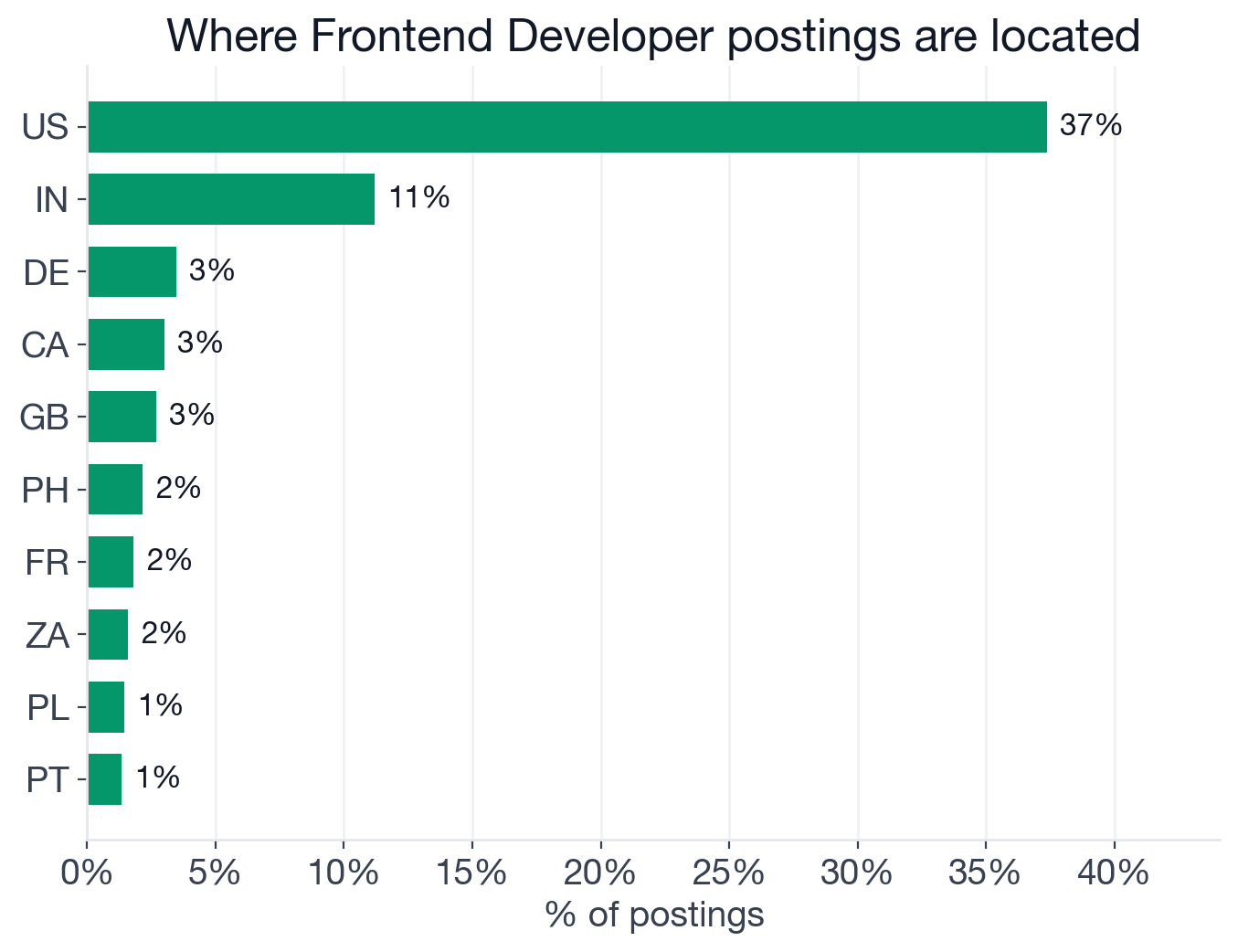
Top countries by share of active Frontend Developer postings.
The Philippines at 2.2% (133 postings) is a frontend-specific signal. Many US-based product companies hire offshore frontend contractors for maintenance, QA work, and feature development, and the Philippines is the primary labor market for that pattern. That's a different hiring dynamic from the US or Germany roles: typically contract-based, often focused on component-level work rather than architecture.
Work mode is more onsite-heavy than frontend's reputation suggests:
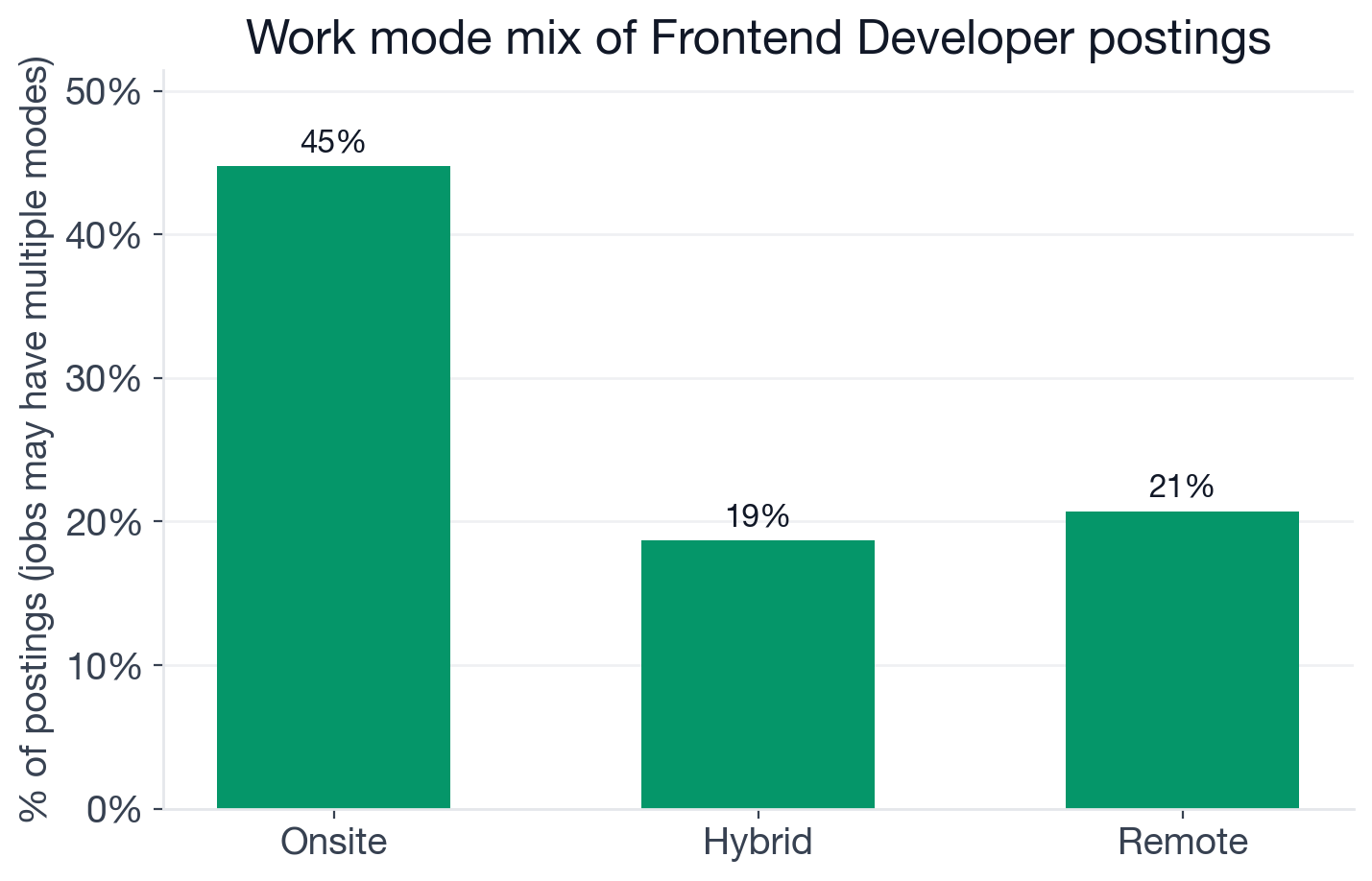
Share of Frontend Developer postings tagged with each work mode.
- Onsite: 44.8% (2,747 postings)
- Remote: 20.7% (1,272 postings) (fully remote Frontend Developer openings)
- Hybrid: 18.7% (1,145 postings)
- Unknown: 21.5% (1,318 postings)
Only 1 in 5 postings is explicitly remote. The remote-first narrative around frontend development is real, but applies to a specific employer profile: distributed-first product companies, SaaS startups, and agencies with distributed teams. Enterprise, retail, government, and large consulting firms, which collectively represent a plurality of postings, default to onsite or hybrid. Fully remote frontend roles do exist and number 1,272 active openings; they are just not the majority mode.
Data note: One large retail technology employer (Albertsons Companies) accounts for approximately 17% of this dataset, a concentration signal flagged in the underlying data. Retail tech typically skews onsite, so the 44.8% onsite figure may modestly overstate the broader market's onsite share. The directional finding is robust: even without that employer, onsite would remain the dominant mode, and fully remote would remain a minority.
How to Use This in Your Job Search
Make TypeScript the default, not the upgrade. The $27,200 salary gap versus plain JavaScript is the highest single-skill premium in this dataset, and TypeScript already appears in 35.6% of postings. Every major React scaffold defaults to TypeScript. Learning React without TypeScript now is building on a base the market is actively upgrading away from. Browse Frontend Developer openings that ask for TypeScript to see what those roles look like across seniority bands.
Don't write off Angular. At 20.3% of postings (approximately 1,250 active openings), Angular is a real market segment with strong presence in enterprise and government technology. If your target companies use it, learn the framework rather than trying to reposition React experience. The TypeScript and JavaScript foundation transfers completely.
Use AI tools fluently, not just casually. 74% of developers now use specialized AI coding tools at work, per the JetBrains AI Pulse Survey 2026, and 51% use them daily per the Stack Overflow Developer Survey 2025. Frontend is the second-highest AI tool adopter by role specialization. The skill the interview tests is not whether you use Copilot or Cursor: it's whether you understand the code they generate well enough to catch what they get wrong. TypeScript fluency, component architecture knowledge, and CSS specificity rules are the things that let you review AI output instead of just accepting it.
Target the Next.js and GraphQL layer for senior salary. The architecture-and-lifecycle cluster ($13-16K above the $134,500 baseline) is where senior frontend compensation separates from mid-level. Next.js and GraphQL both signal that a developer understands the full request lifecycle, not just the UI layer. Practice with AI mock interviews to sharpen the system design and API contract vocabulary those roles require.
Build the table-stakes fundamentals before drilling frameworks. The question bank covers HTML, CSS, JavaScript, TypeScript, and React topics by depth, which is where most entry and mid-level screens focus. Our interactive courses cover the foundational concepts in algorithms, system design, and JavaScript fundamentals that underpin both technical screens and take-home projects. Once the foundations hold, use the skill-filtered job board to find roles that match your current stack: browse all active Frontend Developer postings or filter by specific skills to match what you're targeting.
FAQ
Q. What skills do companies look for in Frontend Developer roles in 2026?
JavaScript (48.7%), React (41.1%), and TypeScript (35.6%) lead the common tier. HTML, CSS, Git, Agile, CI/CD, and Angular round out skills in 20-50% of postings. No single skill appears in more than half of all postings, reflecting genuine framework diversity across the market.
Q. What is the median Frontend Developer salary in 2026?
The median US base salary is $134,500 across 414 Frontend Developer postings with disclosed salary data. Equity, bonuses, and sign-on are not included in that figure, so total compensation at top employers runs higher.
Q. Which Frontend Developer skills pay the highest salary premium in 2026?
Among US postings, Observability tops the list at $151,300 (about $16,800 above the $134,500 US baseline), followed by PostgreSQL and Next.js tied at $150,000 (+$15,500). GraphQL ($147,400) and TypeScript ($147,200) follow closely. TypeScript earns $27,200 more than plain JavaScript ($120,000), the single largest skill premium in the dataset.
Q. Is Frontend Developer a good entry-level role to break into?
Yes. At 20.7% entry-level (1,272 of 6,138 postings), Frontend Developer has the highest entry-level share of any tech role analyzed on the InterviewStack.io job board. That is roughly 1 in 5 openings, compared with 3% for Data Engineer and around 8% for Data Analyst.
Q. Where are most Frontend Developer jobs located, and how remote-friendly are they?
The United States leads at 37.4% of postings, followed by India at 11.2%, Germany at 3.5%, and Canada at 3.0%. About 20.7% of postings are remote, 18.7% are hybrid, and 44.8% are onsite, so onsite is still the dominant mode despite frontend's reputation as a remote-friendly discipline.
Q. Which frontend framework should I learn for maximum job opportunities in 2026?
React leads at 41.1% of postings, making it the dominant framework choice. Angular holds 20.3%, giving it real market share especially in enterprise settings. Vue.js and Next.js appear in 7-11% of postings. The more consistent signal is language: TypeScript appears in 35.6% of postings and commands a $27K salary premium over plain JavaScript.
Q. What is the dominant Frontend Developer skill stack in 2026?
The strongest co-occurring skill pairs are CSS3 + HTML5 (lift 6.65), CSS + HTML (lift 2.76), and React + TypeScript (lift 1.67). React and TypeScript co-occur in 1,497 postings (24.4% of the market). The core stack is JavaScript or TypeScript, a framework (React or Angular), CSS, HTML, and Git, with CI/CD and APIs rounding out a full profile.
The Bottom Line
Frontend development in 2026 is genuinely open at the entry level in a way most tech roles aren't: 1 in 5 openings is explicitly accessible, and the framework diversity means a focused portfolio can be competitive without covering the whole market. But "accessible" and "undifferentiated" are different things. The $27K TypeScript premium signals that companies draw a real line between developers who have invested in the modern, typed stack and those who haven't. Next.js, GraphQL, and observability tooling extend that line further up the seniority curve. Start with the foundations, make TypeScript the language you reach for by default, and the door stays open at every tier above entry.
Topics
Ready to practice?
Put what you've learned into practice with AI mock interviews and structured preparation guides.