
One Job Uses the Skills. One Job Manages Them.
Pull up the top skill requirements for Engineering Manager and Backend Developer side by side, and the overlap is uncomfortable for anyone expecting two clearly distinct career tracks. At a Jaccard similarity of 0.67 (a measure of set overlap where 0 means nothing in common and 1 means identical), 67% of the technical skills demanded across both roles' top-30 lists appear in both. We looked at every active posting on the InterviewStack.io job board as of June 2026: 8,949 Engineering Manager listings and 6,901 Backend Developer listings.
The most striking data point is not the overlap itself. It is what the overlap says about each side of the ledger. Engineering Manager has zero technical skills that appear in at least 8% of its postings but below 5% in Backend Developer postings. Not one. Backend Developer has seven exclusive skills at that threshold. The EM's entire visible technical profile is a subset of what backend engineers already carry.
Data note: The Engineering Manager dataset captures the title broadly across software, hardware, and industrial sectors (a known pattern in how the title is used in the job market). Top employers in this dataset include semiconductor companies (Analog Devices, GlobalFoundries, Intel), power and energy firms (GE Vernova), and aerospace and defense contractors (Thales, Northrop Grumman, Boeing). Skill frequencies and the salary median reflect this cross-sector mix. Readers focused on software engineering management should treat the figures as directionally correct but conservatively estimated: the software-EM subset within this data likely commands higher compensation and has a sharper focus on CI/CD, cloud, and distributed-systems skills.
That does not mean the jobs are interchangeable. The technical skills on both resumes are similar because you need to know the stack to manage the people building it. What job-posting data cannot capture is everything the EM does with those skills: hiring, roadmap ownership, organizational strategy, unblocking engineers at 11 PM. The $8,500 median salary gap (5%) is notably small given that difference in scope, and that too is a useful signal about how the market prices the IC-to-manager transition.
Key Findings
- Engineering Manager and Backend Developer share a Jaccard skill overlap of 0.67 (67%), based on 15,850 active postings analyzed in June 2026.
- Engineering Manager has zero exclusive technical skills at the 8% demand threshold. Backend Developer has seven: Kafka (20%), Git (17%), NoSQL (17%), Spring (15%), MySQL (14%), RESTful APIs (13%), and Redis (13%).
- Median US base salary: $180,100 for Engineering Manager (n=2,210 postings with salary disclosed) versus $171,600 for Backend Developer (n=611), an $8,500 gap.
- Engineering Manager postings (8,949) outnumber Backend Developer (6,901) by 1.3 to 1.
- Backend Developer is twice as remote-friendly: 32% of postings are tagged remote versus 16% for Engineering Manager.
- Backend Developer skews significantly more senior: 40% senior-level postings versus 15% for Engineering Manager.
- AI-linked skills command a $44,000 to $52,000 premium over the Engineering Manager baseline; OpenAI-tagged Backend Developer postings show a $48,000 premium over the BD baseline.
| Engineering Manager | Backend Developer | |
|---|---|---|
| Median US base salary | $180,100 | $171,600 |
| Active postings | 8,949 | 6,901 |
| Top demanded skill | Automation (21%) | AWS (41%) |
| Remote share | 16% | 32% |
| Senior share | 15% | 40% |
| Exclusive technical skills | 0 | 7 |
| Skill overlap (Jaccard) | 67% shared | n/a |
What Does Each Role Actually Do?
Engineering Manager leads a team rather than shipping code full-time. The day-to-day runs on hiring pipelines, 1:1s, sprint planning, cross-functional conversations with product and design, and technical roadmaps. An EM's output is team throughput and quality, measured in what the team delivers. The technical skills in EM postings serve as credibility currency: you need to know Python, CI/CD, and AWS because your reports will ask hard architecture questions and you need to give useful answers. For a deeper look at the EM skill stack on its own, see our Engineering Manager skills analysis.
Backend Developer ships the systems. The work is designing and building services, APIs, and data pipelines, debugging production incidents, and staying current on the infrastructure the team runs on. The deliverable is working software, not team output. An experienced backend engineer uses Kafka for event streaming, Redis for caching, and Spring for Java services on a weekly or daily basis, not just as vocabulary to recognize in a design review. For the full BD skill breakdown, see the Backend Developer skills post.
What Skills Do Both Roles Require?
Automation is the most frequently cited skill in Engineering Manager postings at 21%, which is why it appears as the EM's "top demanded skill" in the summary table. That figure spans both CI/CD and test automation common in software EM roles and process or industrial automation from the hardware and manufacturing sectors captured in the broader EM dataset. For software-focused engineering management, Agile (18%) and CI/CD (17%) are the more role-defining signals.
Both role profiles share a dense technical core. AWS leads at 16% for Engineering Managers and 41% for Backend Developers. CI/CD appears in 17% and 36% of postings respectively. Java, Python, Agile, Kubernetes, Docker, monitoring, scalability, and distributed systems all appear on both lists at meaningful rates.
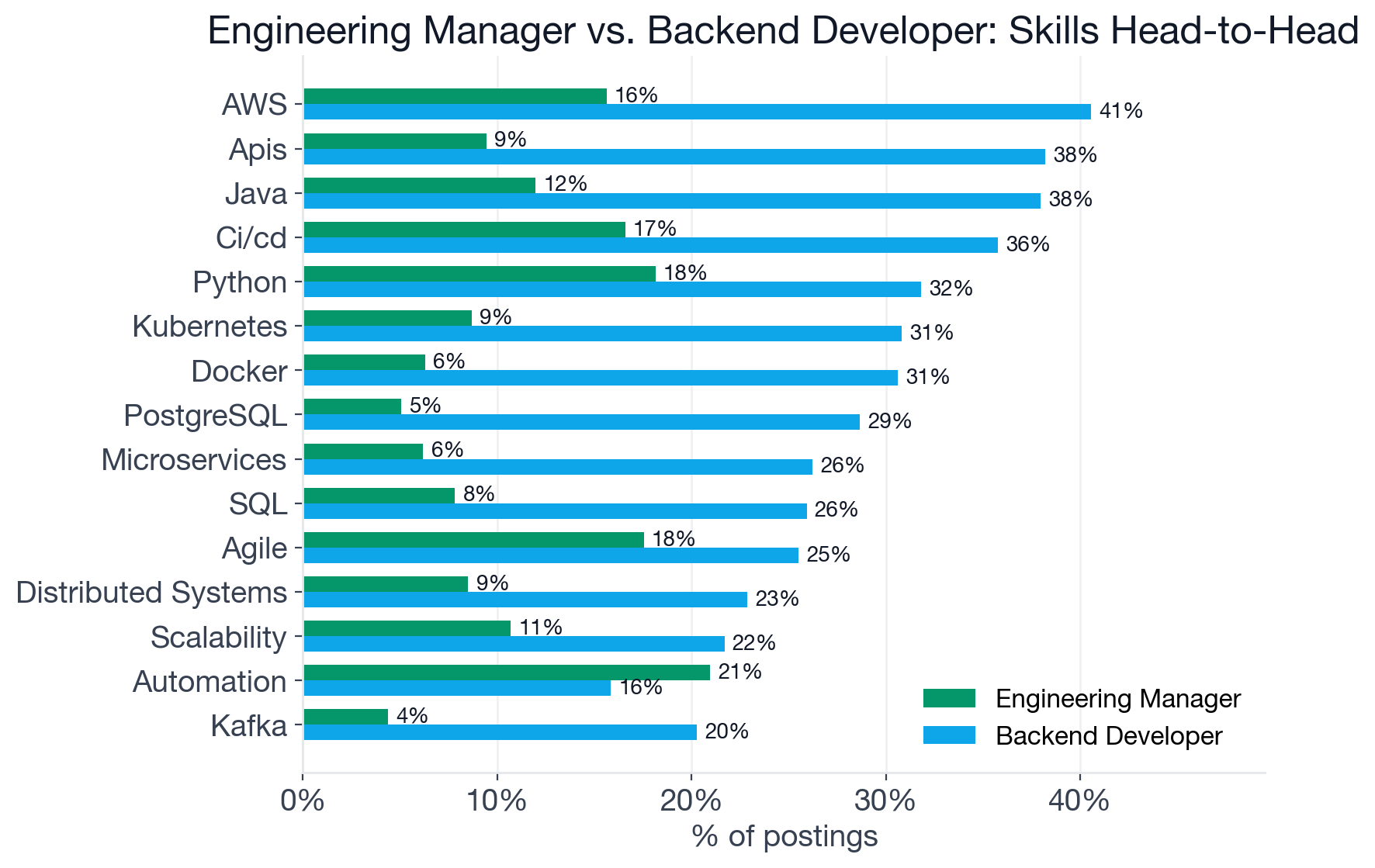
Top skills by frequency in Engineering Manager (emerald) and Backend Developer (sky) postings. Backend Developers demand most shared skills at two to three times the rate of Engineering Managers.
The rate difference tells the real story. Backend Developers are expected to use these tools intensively: AWS in 41% of postings, Kubernetes in 31%, Docker in 31%. Engineering Managers are expected to oversee teams using them: AWS at 16%, Kubernetes at 9%. The shared skills are the vocabulary of modern software infrastructure. EMs need to speak it fluently; BDs need to live in it. For anyone with a backend engineering background already, this cluster transfers directly to an EM role, and is the foundation for browsing Engineering Manager openings once the leadership layer is built.
The Skills Backend Developers Have That Engineering Managers Don't
Backend Developer's seven exclusive skills draw a clear operational boundary:
| Skill | Backend Developer | Engineering Manager |
|---|---|---|
| Kafka | 20% | below 5% |
| Git | 17% | below 5% |
| NoSQL | 17% | below 5% |
| Spring | 15% | below 5% |
| MySQL | 14% | below 5% |
| RESTful APIs | 13% | below 5% |
| Redis | 13% | below 5% |
These are the nuts and bolts of backend systems work: event streaming with Kafka, version control discipline at the Git depth expected in code review, multiple database paradigms (NoSQL, MySQL, alongside the shared PostgreSQL), the Spring framework for Java services, RESTful API design, and in-memory caching with Redis. A backend engineer uses most of these every week. An EM knows what they are and can evaluate architecture decisions involving them; daily hands-on use is not in the job description.
Engineering Manager has zero skills meeting the exclusivity threshold. Every technical signal in EM postings also surfaces meaningfully in Backend Developer postings. The things that actually distinguish Engineering Manager from Backend Developer, leadership judgment, hiring instinct, stakeholder management, team design, do not appear in skill tags at all.
AI tools follow the same invisible pattern. Copilot, Claude Code, and Cursor are standard-issue in backend development today, but they show up in neither role's top-30 skill list because companies assume ambient AI use rather than stating it. The 2025 Stack Overflow Developer Survey found 84% of developers using or planning to use AI tools, and JetBrains found 85% using AI tools regularly for coding in 2025. For Engineering Managers, the emerging AI obligation goes further: proving what those tools are doing to team velocity, not just using them. Neither role has an AI governance skill tag, but the expectation is everywhere.
Which Pays More?
These figures cover US base salary from postings with disclosed compensation; equity, bonuses, and sign-on are not captured in job posting salary fields, and total compensation at senior employers runs meaningfully higher.
Engineering Manager earns a median $180,100 US base (n=2,210) versus $171,600 for Backend Developer (n=611), an $8,500 gap. The EM figure blends software, hardware, and industrial management roles; the presence of lower-paying non-tech sectors in the dataset means the software engineering management subset at tech companies likely commands a median meaningfully above $180,100. That 5% gap over Backend Developer should be read as a floor, not a ceiling, for the IC-to-EM salary story at software companies. The IC-to-EM transition rarely justifies itself on base-salary grounds at the median; the calculus is usually about leverage, impact, and career direction.
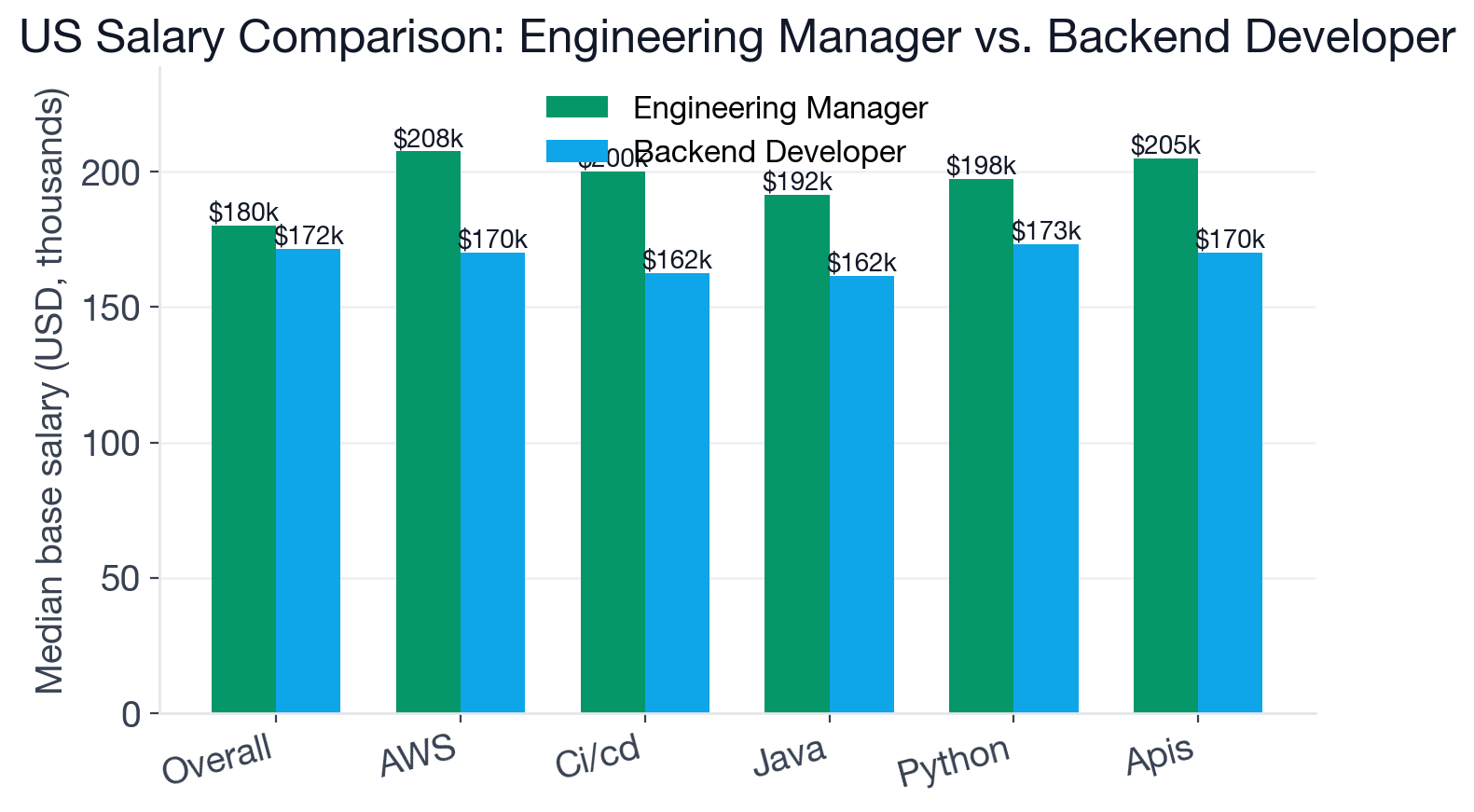
Median US base salary by role and skill. "Overall" bars show the role baseline; skill bars show the median for postings explicitly requiring that skill.
The ceiling is moved by complexity, not by the management track. Engineering Manager postings that mention Distributed Systems pay a median $232,500 (+$52,000 over baseline), LLMs pay $228,800 (+$48,700), and Machine Learning pays $224,500 (+$44,400). These are postings for EMs leading AI platforms or high-scale infrastructure organizations. For Backend Developers, OpenAI-tagged postings show a $220,000 median (+$48,400 over baseline) and Generative AI postings pay $195,000 (+$23,400).
One useful counterpoint: Agile, which appears in 18% of Engineering Manager postings and is the most common process-maturity signal in the role, is associated with a sub-baseline salary at $178,700, roughly $1,400 below the overall EM median. Process experience at the commodity end of the EM spectrum does not command a premium. Technical depth does.
Where Are These Roles and How Remote-Friendly?
Engineering Manager postings are heavily US-concentrated: 44% of the 8,949 listings are US-based, with India at 11%, the UK at 5%, and Canada at 4%. Backend Developer postings are significantly more global: the US accounts for only 19% of 6,901 listings, with Germany (4%), Poland (3%), Brazil (3%), and Spain (3%) each representing real markets. If location flexibility matters, Backend Developer has a structural advantage.
Remote work tells the same story. Backend Developer offers 32% remote postings versus 16% for Engineering Manager, which is majority onsite at 59%. Team leadership roles lean in-person: hiring panels, skip-level meetings, and cross-functional planning are harder to run distributed. Backend Developer openings reflect a role that has normalized remote and hybrid work at scale.
On seniority, the distribution differs more than most people expect. Backend Developer is 40% senior-level and 46% mid-level (the highest-volume tier). Engineering Manager is 64% mid-level and just 15% senior. The staff engineer track shows up in both roles: 17% staff for EM and 13% staff for BD, confirming that the IC path stays viable well into a backend career before the management question becomes pressing.
Which Should You Choose?
Choose Engineering Manager if you:
- Want to optimize team output rather than personal code output. Success shifts from "what did I ship?" to "what did the team deliver and learn?"
- Already have backend or full-stack experience and want to use that context to hire well, make architecture calls, and unblock engineers rather than write all the production code yourself.
- Are focused on the US market and comfortable with predominantly onsite or hybrid roles.
Choose Backend Developer if you:
- Want to stay close to the code. The exclusive-skill list (Kafka, Spring, Redis, NoSQL, RESTful API design) signals daily hands-on infrastructure work that does not exist in the EM role.
- Need geographic flexibility: 32% remote share and strong demand across Germany, Poland, Brazil, and Spain give Backend Developers far more optionality than Engineering Managers.
- Are earlier in your career: 40% senior-level postings mean clear IC progression exists before management becomes the natural next step. The 5% EM premium is not a compelling reason to make the switch early.
For preparing either path, AI mock interviews cover both the behavioral questions EM roles front-load and the distributed systems and API design rounds Backend Developer interviews favor. The InterviewStack question bank covers the topics that overlap between the two roles: system design, scalability, cloud infrastructure, and the engineering-process questions senior backend engineers and new EMs get asked in nearly identical form.
FAQ
Q. How much do Engineering Managers earn compared to Backend Developers in the US in 2026?
Engineering Managers earn a median $180,100 US base salary (n=2,210 postings with salary disclosed) versus $171,600 for Backend Developers (n=611), a gap of $8,500 or roughly 5%. Both figures are base salary only; equity, bonuses, and sign-on are not included in job posting data.
Q. How similar are Engineering Manager and Backend Developer technical skill requirements?
Very similar. The two roles share a Jaccard overlap coefficient of 0.67, meaning 67% of the union of their top technical skills appears in both. Engineering Manager postings have zero technical skills exclusive to the role at the 8% threshold; Backend Developer postings have seven exclusive skills: Kafka (20%), Git (17%), NoSQL (17%), Spring (15%), MySQL (14%), RESTful APIs (13%), and Redis (13%).
Q. Is Backend Developer experience a strong stepping stone to Engineering Manager?
Yes, structurally so. Since Engineering Manager postings require no technical skills that Backend Developer experience does not already cover, the technical resume transfers almost completely. The barrier to EM is organizational, not technical: demonstrating leadership impact, cross-team influence, and a hiring or mentoring track record.
Q. Which role has more job openings: Engineering Manager or Backend Developer?
Engineering Manager has more postings: 8,949 active listings versus 6,901 for Backend Developer, a ratio of roughly 1.3 to 1. Engineering Manager postings are heavily US-concentrated (44%), while Backend Developer postings are more globally distributed with the US representing only 19%.
Q. Which role is more remote-friendly: Engineering Manager or Backend Developer?
Backend Developer is significantly more remote-friendly: 32% of its postings are tagged remote versus 16% for Engineering Manager. Engineering Manager postings skew onsite at 59%, likely reflecting the expectation that leaders be present for in-person team building and stakeholder meetings.
What This Tells You About the Transition
The data reduces to a clean trade-off: Backend Developer and Engineering Manager share almost identical technical resumes, with the EM carrying zero exclusive skills and BD carrying seven. The management layer adds organizational scope and a 5% salary premium at the median, while reducing remote optionality by half and shifting the senior-to-mid ratio dramatically. The transition is not a technical leap. It is a scope change, and whether that trade works for you is more about what you want to optimize than what your current resume can cover. Browse Engineering Manager openings and Backend Developer openings to see what the current market looks like on each path.
Topics
Ready to practice?
Put what you've learned into practice with AI mock interviews and structured preparation guides.