
Everything Looks the Same Until You Look at the Skills
The names suggest a natural progression from pipeline builder to model trainer, but the job-posting data breaks that narrative. Data Engineers and Machine Learning Engineers share only 28% of their top-30 skill sets (a Jaccard coefficient of 0.28) on the InterviewStack.io job board (8,288 distinct DE postings and 4,805 MLE postings analyzed as of June 2026, with salary scoped to US postings with disclosed compensation; the MLE dataset, like most role classifiers, captures a small share of AI-adjacent research and L&D titles; core model-building skill frequencies are unaffected).
Python ties the roles together at 65-68% each. Everything else diverges: SQL appears in 70% of DE postings and 17% of MLE postings. PyTorch is in 42% of MLE postings and barely registers for Data Engineers. These are not the same job at different rungs of a ladder.
Key Findings
- The Jaccard skill overlap between the two roles is just 0.28 (28%) across their top-30 skill sets: Python is the only high-frequency skill that transfers cleanly between them.
- ML Engineers earn a $42,400 US base salary premium: $193,000 median (n=1,261) vs. $150,600 for Data Engineers (n=1,331). Both are base only; equity and bonus are not disclosed.
- Python is the only high-frequency bridge: 68% of DE postings and 65% of MLE postings require it.
- SQL splits the roles cleanly: 70% of DE postings require SQL; only 17% of MLE postings do.
- Data Engineering is the larger market by 1.73x: 8,288 distinct active postings vs. 4,805 for ML Engineers.
- Data Engineers have a tighter entry bar: 2.6% of DE postings are entry-level vs. 4.8% for ML Engineers.
- ML Engineers are US-concentrated (45% of postings in the US) while Data Engineers are more globally distributed (30% US, 19% India).
The Short Answer
ML Engineers earn $42,400 more than Data Engineers at the US base salary median, but they do fundamentally different work: model training and deployment rather than pipeline infrastructure. Python is the only skill both roles share at high frequency. The decision between them is a question of what kind of engineering problem you want to solve, not which pays more.
| Data Engineer | Machine Learning Engineer | |
|---|---|---|
| Median US base salary | $150,600 | $193,000 |
| Active distinct postings | 8,288 | 4,805 |
| Top skill | Data Pipelines (73%) | Machine Learning (70%) |
| Remote share | 20% | 24% |
| Entry-level share | 2.6% | 4.8% |
| Skill overlap (Jaccard) | 0.28 |
What Do These Roles Actually Do?
Data Engineers design and maintain the infrastructure that makes data usable at scale: pipelines, warehouses (Snowflake, Databricks), quality enforcement, and observability. The output is reliable, queryable, governable data that analysts, scientists, and ML teams consume downstream.
Machine Learning Engineers take model ideas from research and ship them to production: training and fine-tuning models (PyTorch, TensorFlow), operating the ML lifecycle via MLOps tooling, running experiments, and keeping models accurate over time.
The exclusive skill lists make the split concrete: Snowflake, Airflow, dbt (a SQL transformation framework), and Data Governance define the DE world. PyTorch, deep learning frameworks, and MLOps define the MLE world. No skill from one cluster meaningfully crosses into the other.
What Skills Do Both Roles Share?
Python anchors both roles at nearly identical rates: 68% for Data Engineers, 65% for Machine Learning Engineers. After Python, the overlap consists of cloud and operational plumbing: AWS (44% DE / 33% MLE), Azure (37% / 22%), monitoring (30% / 29%), CI/CD (31% / 23%), and Google Cloud (24% / 20%). These shared skills reflect the production-engineering demands that any system running at scale requires, regardless of whether it processes raw data or serves a model.
Browse Data Engineer postings filtered by Python or ML Engineer postings filtered by Python to see how the same foundation manifests in each context.
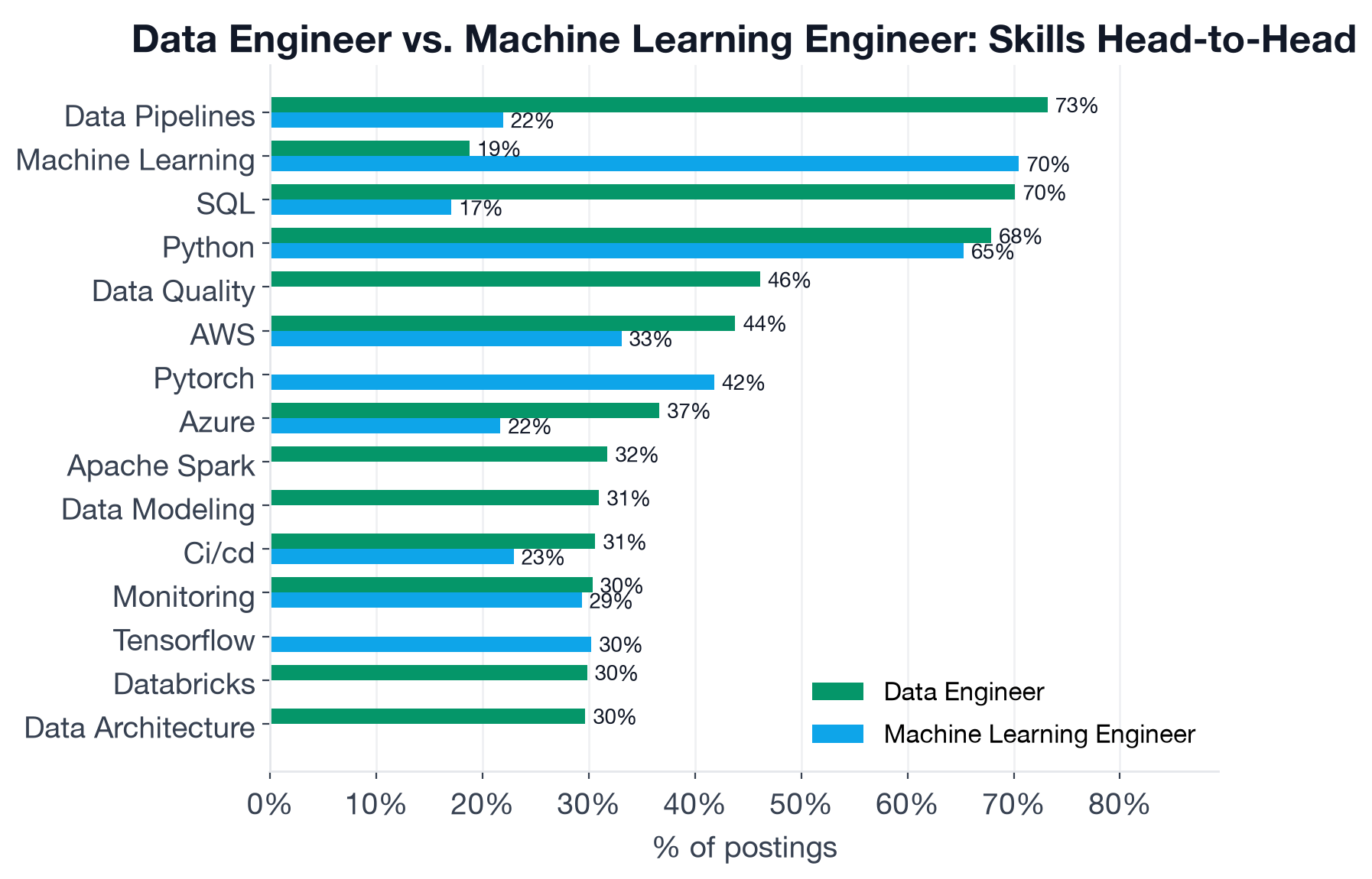
Skill demand as a share of postings for Data Engineers (emerald) and Machine Learning Engineers (blue). Skills exclusive to each role far outnumber the shared cluster.
Where the Roles Split
Skills exclusive to Data Engineer (strong in DE, absent from MLE top lists):
| Skill | DE frequency |
|---|---|
| Data Quality | 46% |
| Apache Spark | 32% |
| Data Modeling | 31% |
| Databricks | 30% |
| Data Architecture | 30% |
| Snowflake | 30% |
| Data Governance | 28% |
| Airflow | 27% |
| dbt | 23% |
The DE cluster reads as a data management stack: warehouses, transformation, orchestration, governance. Snowflake (30%) and Airflow (27%) are the anchors of the cluster; no ML framework comes anywhere near those frequencies on the DE side. Snowflake postings for Data Engineers alone number in the thousands. The Data Engineer skills analysis for 2026 covers the full tier structure and salary premiums by skill.
Skills exclusive to Machine Learning Engineer (strong in MLE, absent from DE top lists):
| Skill | MLE frequency |
|---|---|
| PyTorch | 42% |
| TensorFlow | 30% |
| Deep Learning | 28% |
| MLOps | 26% |
| LLMs | 24% |
| Generative AI | 23% |
| Kubernetes | 18% |
| Docker | 17% |
PyTorch (42%) and TensorFlow (30%) are the clearest differentiators: these are the model-building frameworks that define the ML practitioner's toolkit. MLOps (26%), the discipline of operating ML systems reliably in production, rounds out the cluster and signals that the role requires reliability engineering chops, not just research familiarity. The complete Machine Learning Engineer skills breakdown for 2026 covers how these frameworks combine and which carry the highest salary premiums.
One note on AI tooling: explicit AI skill percentages measure roles hired to BUILD AI systems. The Stack Overflow Developer Survey 2025 and JetBrains Developer Ecosystem 2025 show roughly 85-90% of all engineers, including Data Engineers, use Copilot, ChatGPT, and similar tools for their own productivity. ML Engineers train and deploy models; Data Engineers use the same tools to accelerate pipeline work. The ambient AI baseline is identical for both roles; the explicit build-AI bar is not.
Which Pays More: Data Engineer or Machine Learning Engineer?
All salary figures here are US base salary from postings with disclosed compensation. Equity, bonuses, and sign-on are not captured in job-posting data and push total comp meaningfully higher, particularly at tech employers.
ML Engineers earn more, and the gap is substantial. The median US base is $193,000 for ML Engineers vs. $150,600 for Data Engineers, a $42,400 premium equal to about 28% more for the ML role.
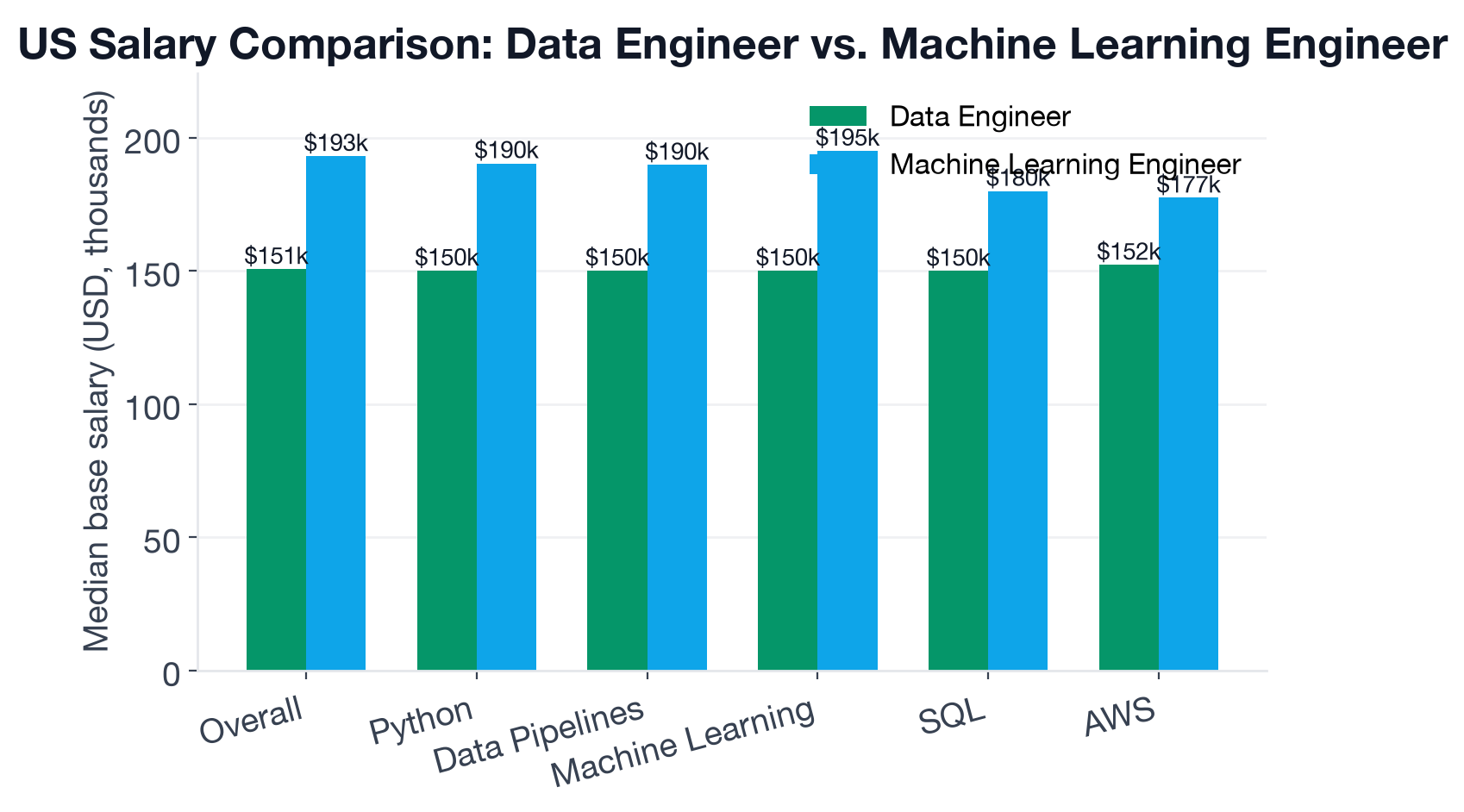
Median US base salary for each role. Data Engineer n=1,331; Machine Learning Engineer n=1,261. Base salary only; equity and bonus excluded.
Within Data Engineering, the highest premiums attach to specialized infrastructure: Flink (the stream-processing framework competing with Spark for real-time pipelines) leads at $192,500, a $41,900 premium above the $150,600 DE baseline. Iceberg (the open table format for data lakes) sits at $183,000 ($32,400 premium). Core orchestration skills like dbt, Airflow, and Kafka cluster at $160,000, about $9,400 above baseline.
Within Machine Learning Engineering, premiums concentrate in frontier AI. RLHF (Reinforcement Learning from Human Feedback, a leading alignment technique for language models) leads at $237,600, a $44,600 premium above the $193,000 MLE baseline. Fine-tuning reaches $212,100 ($19,100 premium) and CUDA (NVIDIA's GPU parallel computing platform) $208,000 ($15,000 premium). These premiums signal deep model internals expertise, not ML application work.
Which Has More Job Openings?
Data Engineering is the larger market by 1.73x: 8,288 distinct active postings vs. 4,805 for ML Engineers. More openings, more geographies, more employers hiring at any given time.
But the entry-level picture flips: ML Engineers have a higher entry-level share at 4.8% (229 of 4,805 postings) vs. 2.6% for Data Engineers (213 of 8,288). In absolute terms, entry-level DE and MLE openings are roughly equal in count, but as a fraction of the market, ML Engineering is modestly more accessible to juniors.
Seniority across both roles skews heavily mid-level (53% for DE, 53% for MLE). Senior makes up 30% of DE postings and 24% of MLE postings; staff-level is 14% for DE and 18% for MLE, suggesting a slightly higher ceiling visibility on the ML Engineering side.
Geography is where the markets diverge sharply. DE postings spread globally: 30% US, 19% India, 4% UK, 3% Canada. MLE postings concentrate in the US at 45%, with India at 13%. Remote share is similar: 20% for DE and 24% for MLE. If your target is the US market, ML Engineering has proportionally more density; if you want global optionality, Data Engineering spreads much further.
Which Should You Choose?
Choose Data Engineer if you:
- Prefer infrastructure and pipeline work over model training and deployment
- Have strong SQL skills or want to build them (SQL appears in 70% of DE postings vs. 17% for MLE)
- Want access to a larger and more globally distributed job market
- Are comfortable working across industries including consulting, finance, and healthcare, not just tech
- Are early in your career: entry-level openings are similar in count for both roles (213 DE vs. 229 MLE), and DE's larger total market means more overall openings to target at every level
Choose Machine Learning Engineer if you:
- Are drawn to model training, fine-tuning, deep learning, or MLOps engineering
- Are comfortable investing in PyTorch, TensorFlow, and ML systems tooling
- Are targeting the US market, where 45% of MLE openings are concentrated
- Are willing to accept fewer total openings in exchange for a $42,400 salary premium at the median
- Want to work at technology-intensive product companies where AI is a core output, not a support function
Use the question bank to drill the skills specific to your target role and practice with AI mock interviews before applying. Both roles reward strong preparation on system design and production-engineering trade-offs, though the specific scenarios differ sharply.
FAQ
Q. How much more do Machine Learning Engineers earn than Data Engineers in 2026?
The median US base salary for Machine Learning Engineers is $193,000 (n=1,261 postings with US salary disclosed) vs. $150,600 for Data Engineers (n=1,331), a $42,400 gap equal to about 28% more on the ML side. Both figures are base salary only; equity and bonus are not captured in posting data and push total comp higher, especially at tech employers.
Q. What skills do Data Engineers and Machine Learning Engineers share?
Python is the one high-frequency skill both roles share: 68% of Data Engineer postings and 65% of Machine Learning Engineer postings require it. AWS, monitoring, CI/CD, and cloud platforms appear in both at lower frequencies. The Jaccard overlap between the two top-30 skill sets is 0.28, meaning 28% of the combined skill pool shows up in both roles.
Q. Which role is harder to break into: Data Engineer or Machine Learning Engineer?
Data Engineer is the tighter entry point: just 2.6% of DE postings are explicitly entry-level (213 of 8,288 analyzed) vs. 4.8% for ML Engineers (229 of 4,805). Data Engineering also has more absolute openings, so competition is more diffuse; ML Engineering has fewer openings overall but a slightly more accessible junior share.
Q. Where are Data Engineer and Machine Learning Engineer jobs located?
Data Engineer postings are globally distributed: 30% US, 19% India, 4% UK, 3% Canada. Machine Learning Engineer openings skew heavily toward the US at 45%, with India next at 13%. For geography optionality, Data Engineer spreads wider; for the US market specifically, ML Engineer concentrates more of its volume there.
Q. What is the Jaccard skill overlap between Data Engineers and Machine Learning Engineers?
The Jaccard similarity on the top-30 skill sets of each role is 0.28: 28% of the combined skill pool appears in both roles. Python, AWS, CI/CD, monitoring, and Azure are the most meaningful shared skills. SQL appears in 70% of DE postings but only 17% of MLE postings, the single most diagnostic divergence point between the two roles.
Q. Which should I choose: Data Engineer or Machine Learning Engineer?
Choose Data Engineer if you prefer infrastructure and pipeline work, have strong SQL skills (in 70% of postings), want a larger and more globally distributed job market, or want to work across industries including consulting and finance. Choose Machine Learning Engineer if you want a higher salary ceiling ($193K median vs. $150,600), are drawn to PyTorch, deep learning, and MLOps, and are targeting the US market, where 45% of MLE openings are concentrated.
Where the Paths Lead
The $42,400 US salary gap between ML Engineers and Data Engineers is real, but it is not a measure of the same work at different pay grades. Pipeline infrastructure and model training are genuinely different engineering disciplines with almost non-overlapping toolkits. The right question is not which pays more; it is which kind of problem you want to spend the next few years building. Browse live Data Engineer postings and Machine Learning Engineer postings on InterviewStack.io to see what is hiring now. For related comparisons, see Data Engineer vs Data Scientist 2026 and AI Engineer vs Machine Learning Engineer 2026.
Topics
Ready to practice?
Put what you've learned into practice with AI mock interviews and structured preparation guides.