
One Paycheck, Two Very Different Careers
The conventional wisdom is that Data Scientist is the prestige track: more rigorous to hire for, higher paid, and a natural ceiling above Data Engineering. The job posting data from June 2026 does not support it. Across 8,535 active Data Engineer postings and 7,661 Data Scientist postings on the InterviewStack.io job board, the median US base salary is $127,000 for Engineers and $125,000 for Scientists. The gap is $2,000.
What is not parity is the skill set. The Jaccard overlap coefficient across each role's top-30 skills is 0.33: these jobs share only one-third of their defining competencies. One career is about building the infrastructure that data flows through. The other is about extracting meaning from the data once it arrives. Same paycheck, almost completely different days.
Key Findings
- Data Engineer has 8,535 active postings vs 7,661 for Data Scientist, a 12% volume edge on the InterviewStack.io job board as of June 2026.
- Median US base salary: Data Engineer $127,000 (n=1,250) vs Data Scientist $125,000 (n=1,495), a $2,000 gap in favor of Data Engineer.
- Skill overlap (Jaccard) is 0.33: only one-third of each role's top-30 skills are shared.
- Data Scientist has 3x more entry-level access: 8.6% of DS postings are entry-level vs 2.6% for Data Engineers.
- Data Engineer table stakes: Data Pipelines (71%), SQL (69%), Python (66%). Data Scientist table stakes: Python (61%), Machine Learning (47%), SQL (44%).
- Top salary premium for Data Scientist: A/B Testing and dbt each add $40,000 over the $125,000 US base median.
- Top salary premium for Data Engineer: Dagster adds $31,000 and Distributed Systems adds $23,000 over the $127,000 US base median.
| Data Engineer | Data Scientist | |
|---|---|---|
| Active postings | 8,535 | 7,661 |
| Median US base salary | $127,000 | $125,000 |
| Top skill | Data Pipelines (71%) | Python (61%) |
| Entry-level share | 3% | 9% |
| Remote share | 21% | 18% |
| Skill overlap (Jaccard) | 33% shared | n/a |
What Do Data Engineers and Data Scientists Actually Do?
Think of the data stack as a two-stage operation. Data Engineers build and maintain the first stage: the pipelines that pull data from source systems, transform it, and load it into a warehouse or lake that downstream consumers can query. Their week involves writing Python, scheduling jobs in Airflow (the open-source orchestrator most data teams use to manage pipelines), modeling warehouse schemas, and keeping the whole system observable and reliable. The output is infrastructure: something that runs every day without breaking.
Data Scientists operate at the second stage: they query that warehouse, build models, run experiments, and turn findings into decisions or products. A typical week involves feature engineering, training classification or regression models with scikit-learn or PyTorch, testing hypotheses with statistical rigor, and increasingly building or evaluating LLM-powered applications. If the Data Engineer keeps the assembly line running, the Data Scientist analyzes what it is producing and decides whether to change it.
The tools reflect this split. Where Engineers reach for Airflow, Kafka (the event-streaming platform), and dbt (a SQL transformation framework), Scientists reach for TensorFlow, PyTorch, and statistics libraries. One set of tools is about moving data reliably at scale. The other is about learning from it.
What Skills Do Both Roles Share?
Python and SQL anchor both roles. Python appears in 66% of Data Engineer postings and 61% of Data Scientist postings; SQL is in 69% of Data Engineer postings and 44% of Data Scientist postings. Below those two, the overlap shrinks quickly.
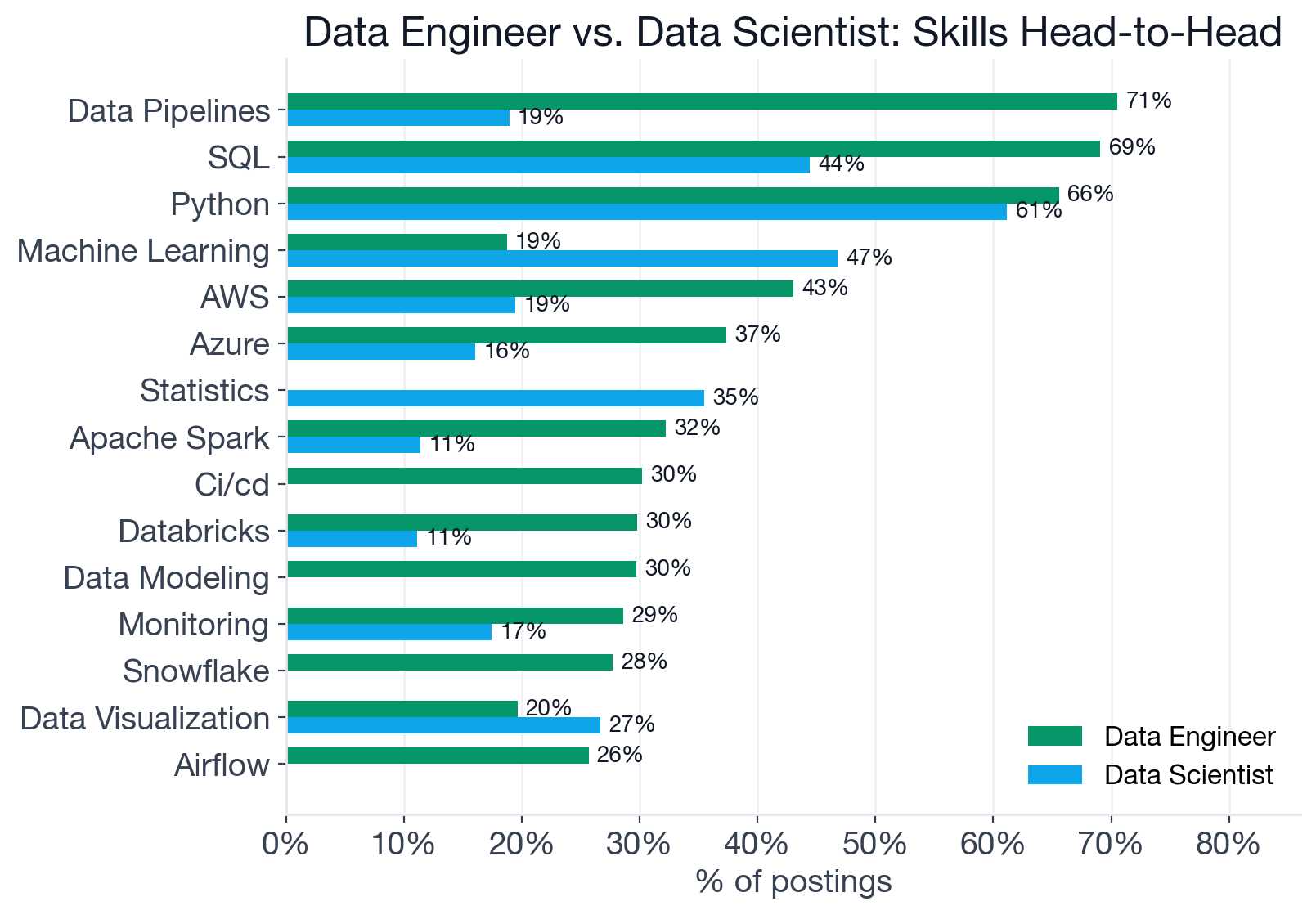
Skill demand by role from the union of each role's top-30 skill list. A short or absent bar means the skill did not crack that role's top-30.
AWS (43% for DE, 19% for DS), Apache Spark (32% for DE, 11% for DS), and Data Pipelines (71% for DE, 19% for DS) all appear in both lists but at very different rates. These shared skills are present on both resumes, but they are core requirements for Engineers and supporting context for Scientists. If you already know Python and SQL, you have the transferable foundation. What you build on top of it defines which role you land in.
Where the Skill Sets Diverge
Data Engineer's exclusive skills are the toolchain of production systems. CI/CD pipelines (30%), data modeling (30%), Snowflake (28%), Airflow (26%), dbt (21%), and Kafka (18%) all appear prominently in Data Engineer postings but negligibly in Data Science ones. These are the tools of someone responsible for a system that must run reliably: version-controlled pipelines, warehouse schemas, orchestration schedules, real-time event streams.
Data Scientist's exclusive skills cluster around modeling and analysis. Statistics is the defining signal at 35% of postings: it simply does not appear in the Data Engineer top-30, which captures the difference in daily work as clearly as any individual tool can. Beyond statistics, the exclusive DS stack is the modeling library tier: TensorFlow (11%), PyTorch (11%), scikit-learn (11%), and pandas (11%), plus Tableau (14%) for communicating findings.
The generative AI signal deserves specific framing. Generative AI appears explicitly in 13.5% of Data Scientist postings and LLMs in 12.3%, as requirements to build and evaluate AI systems. These terms do not crack Data Engineer's top-30 by frequency, though MLOps and LLM-infrastructure skills (RAG, vector databases) appear in the Engineer salary premium tier at roughly $140,000 median. But explicit AI requirements in postings measure hiring to build AI systems, not to use AI tools. According to the 2026 dbt Labs State of Analytics Engineering report, 72% of data teams now prioritize AI-assisted coding, and the 2025 Google DORA report puts developer AI adoption at 90%. Both Data Engineers and Data Scientists sit inside that ambient layer: the difference is in what the role is hired to build with AI, not whether hands are on Copilot or ChatGPT.
Which Role Pays More?
All salary figures below are US base salary only, from postings with structured pay data. Equity, bonuses, and sign-on are excluded because job postings do not disclose them. Total compensation at top employers will run materially higher, particularly in tech and finance.
The medians are nearly identical: $127,000 for Data Engineers (n=1,250 US postings with disclosed pay) and $125,000 for Data Scientists (n=1,495). The $2,000 gap is real but well within the variance introduced by industry, company size, and skill mix. As with any large-scale job board classifier, the Data Scientist pool captures a portion of adjacent data professional titles alongside pure ML/modeling roles (data architects, analytics practitioners, governance specialists are among the titles that appear); the $125,000 median and skill distributions reflect the broad data science professional market rather than a single narrow specialization.
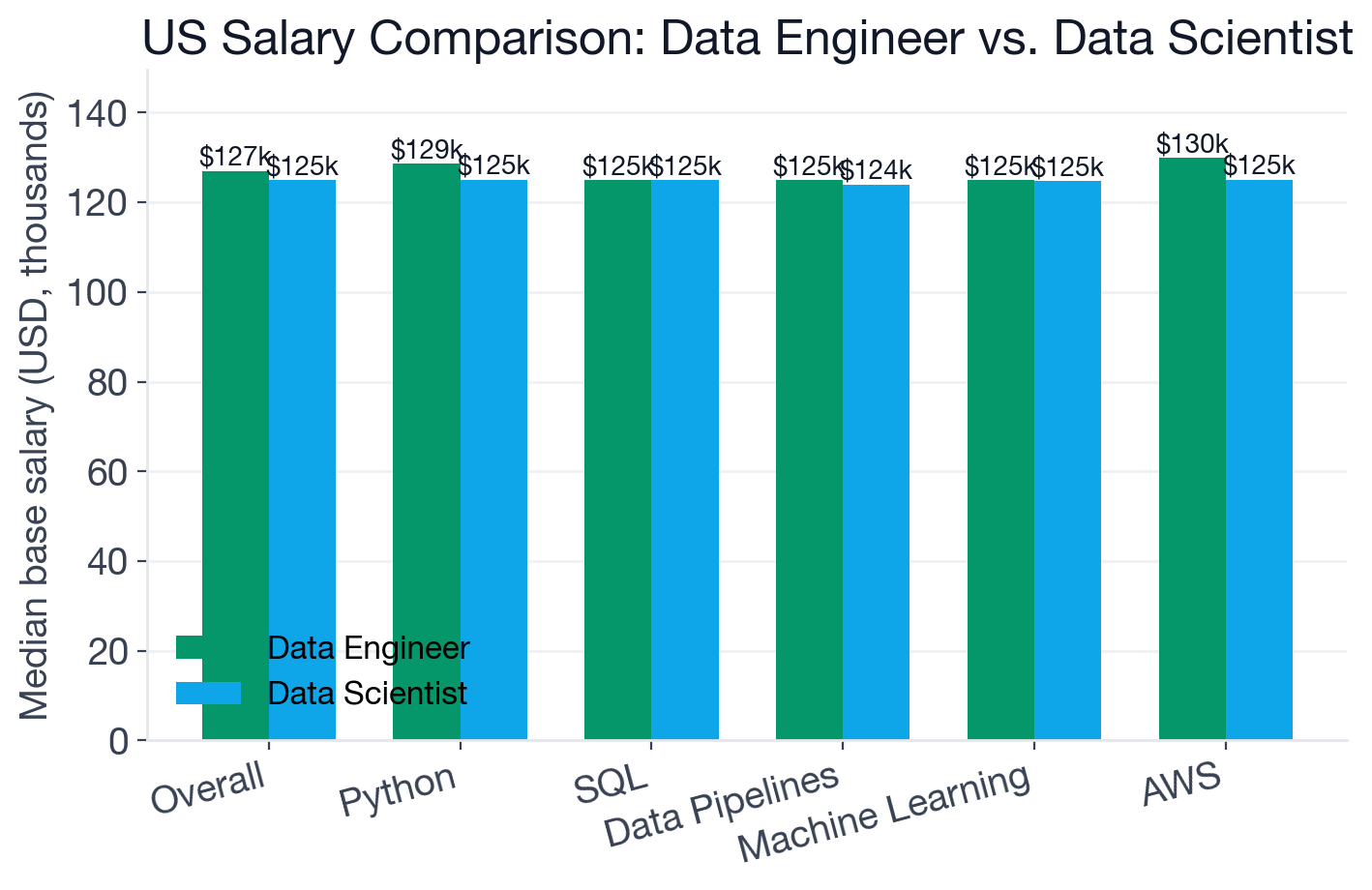
Median US base salary from postings with disclosed compensation. Data Engineer baseline: $127,000 (n=1,250). Data Scientist baseline: $125,000 (n=1,495).
What moves salary in both roles is specialization at the boundary between data and production. For Data Scientists, A/B Testing commands a $40,000 premium over baseline ($165,000 median, n=113), and dbt adds the same ($165,000, n=55): both signal a scientist who owns the full model lifecycle from experiment to deployment. MLflow (an experiment-tracking and model-lifecycle platform) adds $31,000 ($156,000, n=35). MLOps adds $17,300 ($142,300, n=114).
For Data Engineers, Dagster (a modern orchestration platform) adds $31,000 over baseline ($157,800, n=64) and Distributed Systems expertise adds $23,000 ($150,000, n=70). Observability tooling adds $19,200 ($146,200, n=260) and MLOps adds $17,000 ($144,000, n=60). The pattern is the same: skills that reduce friction between pipelines and reliability, or between models and production, command the largest premiums in both roles.
Which Has More Openings, and How Hard Is Entry?
Data Engineer postings outnumber Data Scientist postings by about 12% (8,535 vs 7,661 distinct active listings). Both are large, healthy markets with no sign of contraction.
The entry bar is where they sharply diverge. Just 2.6% of Data Engineer postings are explicitly entry-level (226 of 8,535): 97% of the role's postings are mid-level or above, and companies overwhelmingly expect production pipeline experience before they consider a candidate. For Data Scientists, 8.6% of postings are explicitly entry-level (659 of 7,661), giving career changers and recent graduates roughly three times more openings to target, especially in the US, where 36% of Data Scientist postings are located versus 29% for Data Engineers.
Both roles are predominantly onsite or hybrid. Remote is 21% for Data Engineers and 18% for Data Scientists. Data Engineering also skews more internationally: 18% of DE postings are in India versus 11% for Data Scientists, which reflects the large consulting and software-services market that supports enterprise data platform work globally.
Which Should You Choose?
Choose Data Engineering if you:
- Prefer systems-thinking work: designing how data flows, scales, and runs reliably under production load.
- Have a software engineering or backend background that translates naturally to pipelines and infrastructure tooling.
- Are prepared to route in through a related role first: with only 3% of postings entry-level, most Data Engineers arrive with prior experience in analytics engineering, backend development, or data analysis.
Choose Data Science if you:
- Want to work closer to the business question: running experiments, building predictive models, and communicating findings to stakeholders who make decisions based on them.
- Are entering the data field fresh: 9% entry-level postings across a pool of 7,661 openings gives you a broader initial target, particularly in the US where Data Scientist hiring concentrates.
- Have or want depth in statistics and modeling: Statistics appears in 35% of DS postings and is essentially absent from Data Engineer ones; it is not optional background, it is the job.
How to Use This in Your Job Search
If you are leaning toward Data Engineering, the Data Engineer skills deep dive breaks down every skill tier, salary premium, and seniority level in detail. Browse current Data Engineer openings and filter by your cloud or stack to find roles matching your background. If you are leaning toward Data Science, the Data Scientist skills analysis covers the same ground for that role. Start with current Data Scientist openings, then use the InterviewStack question bank to drill the statistics, ML, and SQL topics that recur across DS interview rounds. For either path, AI mock interviews let you practice the role-specific question types (system and pipeline design for DE, ML design and case studies for DS) before the real thing.
FAQ
Q. Is the Data Engineer or Data Scientist salary higher in 2026?
Both pay nearly the same. The median US base salary is $127,000 for Data Engineers (n=1,250 postings with disclosed salary) and $125,000 for Data Scientists (n=1,495), a $2,000 gap. These are base salaries from job postings; equity, bonuses, and sign-on are not reflected, so total compensation at top employers will run higher.
Q. How much do Data Engineer and Data Scientist skills overlap?
Less than most people expect. The Jaccard similarity coefficient across the top-30 skill sets is 0.33, meaning only about one-third of the skills on each role's typical resume are the same. Python and SQL are the main shared foundation. Data Engineers lean on pipeline tooling (Airflow, dbt, Kafka, CI/CD), while Data Scientists lean on modeling libraries (TensorFlow, PyTorch, scikit-learn) and statistics.
Q. Which role is easier to break into at the entry level?
Data Scientist has a notably lower entry bar: 8.6% of Data Scientist postings (659 of 7,661 analyzed) are explicitly entry-level, compared with just 2.6% for Data Engineers (226 of 8,535). Data Engineers overwhelmingly expect production pipeline experience, which makes the role harder to land without prior data or software engineering background.
Q. Which role has more job openings in 2026?
Data Engineer postings (8,535 active distinct postings) outnumber Data Scientist postings (7,661) by about 12% as of June 2026. Both are healthy markets. Data Engineers skew heavily toward mid-level and senior roles (97% combined), while Data Scientist hiring includes a larger entry-level slice.
Q. Which AI skills should Data Engineers and Data Scientists learn in 2026?
For Data Scientists, Generative AI is explicitly required in 13.5% of postings and LLMs in 12.3%, and both show up in the salary premium tier. For Data Engineers, MLOps and LLM-infrastructure skills (RAG, vector databases) appear at roughly $140,000 median in the salary data. Both roles sit inside the ambient AI layer: 72% of data teams now prioritize AI-assisted coding (dbt Labs 2026 State of Analytics Engineering, https://www.getdbt.com/resources/state-of-analytics-engineering-2026) and 90% of developers use AI tools daily (Google DORA 2025, https://cloud.google.com/resources/content/2025-dora-ai-assisted-software-development-report). The difference between the roles is in what you build with AI, not whether you use it.
Q. What are the main skills that separate Data Engineers from Data Scientists?
Data Engineers are defined by pipeline and infrastructure skills absent in Data Science postings: CI/CD (30%), Data Modeling (30%), Snowflake (28%), Airflow (26%), dbt (21%), and Kafka (18%). Data Scientists are defined by modeling and analysis skills absent in Data Engineer postings: Statistics (35%), Tableau (14%), Generative AI (13%), LLMs (12%), and the modeling library stack (TensorFlow, PyTorch, scikit-learn, pandas).
Now Pick a Lane
Both paths are well-compensated and in demand. The $2,000 salary gap is not the deciding factor; what you build every day is. Data Engineering gives you more total openings and a steeper but more systematic skill ramp (pipelines, cloud, orchestration). Data Science gives you a wider entry-level door and a path that runs closer to the business questions that drive decisions. Browse live Data Engineer openings and Data Scientist openings side by side, and let the actual job descriptions tell you which world you want to work in.
Topics
Ready to practice?
Put what you've learned into practice with AI mock interviews and structured preparation guides.