
What Is the Difference Between a Software Engineer and an Embedded Developer?
Software Engineer and Embedded Developer salaries are nearly identical at the US median: $143,100 vs. $140,000 in base pay. That is where the similarity ends. Software Engineer roles outnumber Embedded Developer roles by about 34 to 1 (32,835 vs. 954 active postings), remote-work availability is nearly three times higher for SWE (20% vs. 7%), and the core skill sets share only about 28% of their combined vocabulary. The decision between these roles is less about money and more about which kind of system you want to build: one that lives in the cloud, or one that runs directly on silicon.
We analyzed 33,789 active postings on the InterviewStack.io job board as of May 2026, with skills extracted from descriptions and synonyms normalized.
| Software Engineer | Embedded Developer | |
|---|---|---|
| Median US salary | $143,100 | $140,000 |
| Active postings | 32,835 | 954 |
| Top skill | Python (38%) | Debugging (38%) |
| Remote share | 20% | 7% |
| Entry-level share | 3.5% | 2.9% |
| Skill overlap (Jaccard) | 28% shared | (same metric) |
Key Findings
- Software Engineer roles outnumber Embedded Developer roles by 34 to 1: 32,835 vs. 954 active postings as of May 2026.
- Median US base salary is nearly identical: $143,100 for Software Engineer (n=8,663) vs. $140,000 for Embedded Developer (n=311).
- Skill overlap (Jaccard) is just 0.28: the two roles share only about 28% of their combined skill vocabulary.
- Embedded Developer roles are nearly three times less remote: 7% remote vs. 20% for Software Engineer, and two-thirds are onsite.
- Computer Vision postings for Embedded Developers command a median $191,000 US base salary, a $51K premium over the role baseline (n=38; treat as directional given the small salary sample).
- Software Engineer salary premiums split by volume: niche picks like Sentry ($190,000, n=82) and A/B Testing ($180,000, n=67) lead overall, but among high-volume skills (n≥1,000), Distributed Systems ($160,800, n=1,648), Observability ($160,000, n=1,447), and Machine Learning ($160,000, n=979) add $17-18K over the $143,100 baseline.
- Half of all Embedded Developer postings are in the US; India accounts for only 6% (vs. 23% for Software Engineer).
What Does Each Role Actually Do?
Software Engineers build systems that run in networked environments: web services, mobile apps, cloud infrastructure, internal tools, and AI-integrated pipelines. A typical week involves writing and reviewing code across a service layer (REST APIs, microservices, event-driven architectures), deploying via CI/CD pipelines, and debugging distributed systems. The work largely runs on someone else's hardware in AWS, Azure, or GCP. For a deeper look at how the SWE skill set has evolved, see our Software Engineer skills analysis.
Embedded Developers (whose job titles span firmware engineer, FPGA engineer, and electronics engineer, based on the title sample in the data) write software that runs on physical hardware: microcontrollers, FPGAs, communication chipsets, robotics systems, and aerospace components. Timing constraints are often measured in nanoseconds. The software is inseparable from the hardware it runs on, which is why the vast majority of these roles require lab access and physical presence. The output ships inside a device, not as a URL.
The exclusive skill lists confirm the divide: Software Engineers are defined by cloud platforms and web frameworks; Embedded Developers by C++, Linux, hardware debugging, and real-time OS tooling.
What Skills Do Software Engineers and Embedded Developers Share?
Both roles expect Python in 38% of postings each, which signals that scripting, automation, and tooling are now baseline across hardware and software alike. Eight other skills appear in both roles' top-30 lists.
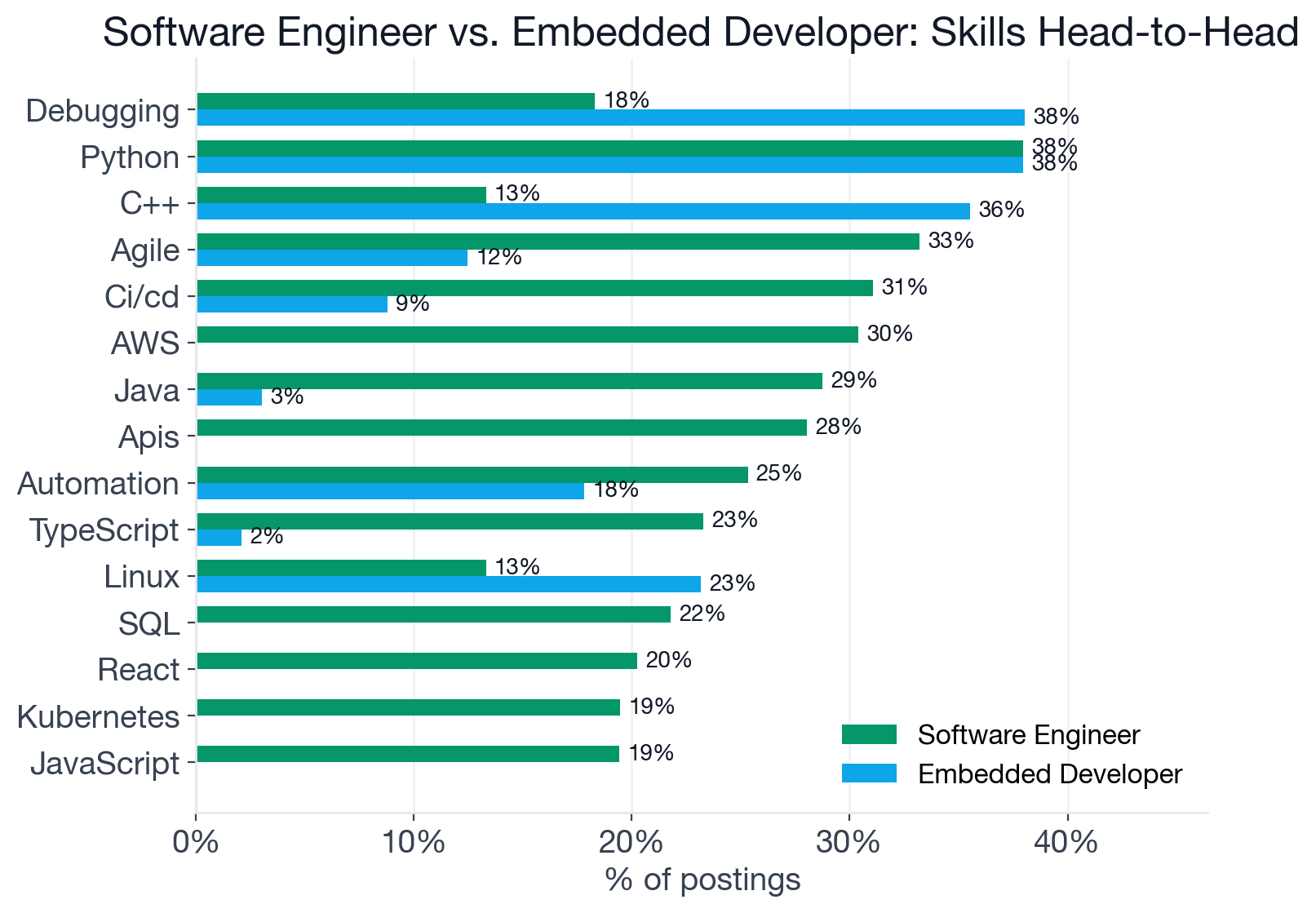
Share of postings mentioning each skill, for Software Engineer (emerald) and Embedded Developer (sky). Skills are drawn from the intersection of both roles' top-30 lists.
The most important shared skills and what they mean for career transitions:
- C++ at 36% for Embedded and 13% for SWE is a genuine bridge. A Software Engineer with solid C++ experience is already closer to firmware work than most peers, and that skill transfers at a premium in both markets.
- Debugging leads Embedded postings at 38% (vs. 18% for SWE). Both roles spend real time diagnosing misbehaving systems, just at different abstraction layers.
- Linux appears in 23% of Embedded and 13% of SWE postings, reflecting demand for engineers building on higher-compute embedded platforms , industrial controllers, connected gateways, and SBCs , alongside the bare-metal and RTOS work that constitutes much of the embedded device universe.
- CI/CD sits at 31% for SWE and 9% for Embedded, showing that release automation is more entrenched in cloud workflows, though firmware teams are adopting it.
Note: Accenture accounts for roughly 11% of Software Engineer postings in this dataset (a consulting firm whose postings typically emphasize process-oriented skills). This may modestly inflate frequency figures for Agile and similar methodology terms within the SWE numbers.
If your resume already includes Python, C++, Linux, Git, and Debugging, a meaningful foundation transfers to either path.
Where Do Software Engineers and Embedded Developers Diverge?
The exclusive skill sets draw the sharpest boundary.
Software Engineer exclusives (present in 8%+ of SWE postings, under 5% for Embedded): AWS (30%), Java (29%), APIs (28%), TypeScript (23%), SQL (22%), React (20%), Kubernetes (19%), JavaScript (19%), Docker (19%), and Scalability (18%). This cluster maps directly to cloud-connected, distributed applications: services talking over networks, deployed in containers, managed by orchestrators, accessed through APIs. None of these appear in Embedded postings at meaningful rates because the embedded world simply does not use Kubernetes or React.
Embedded Developer exclusives: Prototyping is the only skill that clears the formal 8% threshold (9%), but the real differentiation appears in hardware-specific skills found almost exclusively in Embedded postings. Computer Vision shows up in 7% of Embedded postings (vs. near-zero for SWE), Machine Learning in 6%, and Zephyr (an open-source real-time operating system for connected devices) in 4%. This cluster signals the AI-on-the-edge trend: embedded engineers are being asked to deploy inference on constrained devices, a problem requiring model compression, RTOS scheduling, and power-budget awareness that cloud engineers never encounter.
AI tooling divergence: Software Engineer postings explicitly mention LLMs in about 11% of listings, but developer surveys (Stack Overflow 2025, JetBrains 2025) put ambient AI tool usage above 84% of software engineers: Copilot, Claude Code, and Cursor are now as assumed as a laptop. For Embedded Developers, the same ambient workflow faces real structural barriers. General-purpose AI coding tools consistently struggle with timing-critical code like interrupt service routines (ISRs) and DMA chains, where model training data lacks the hardware-specific register maps and vendor HALs from ARM, STMicroelectronics, and NXP. Code bound by safety standards like MISRA C requires full manual audit before AI-generated suggestions can be accepted. Embedded engineers are using AI for debugging assistance, documentation, and code review, but the core code-generation workflow is slower to adopt than in cloud development. The 11% explicit LLM figure for SWE, and the 6-7% ML/Computer Vision figures for Embedded, measure engineers hired to build AI products: the ambient usage floor is much higher for both roles, just with different access patterns.
Which Pays More: Software Engineer or Embedded Developer?
At the median, almost nobody.
Among US postings (where wage-transparency laws produce consistent disclosure), the median Software Engineer base salary is $143,100 (n=8,663) and the median Embedded Developer base salary is $140,000 (n=311), a difference of $3,100 or 2.2%. Both figures are base salary only; equity, bonuses, and sign-on are not disclosed in postings, so total compensation at top employers is meaningfully higher.
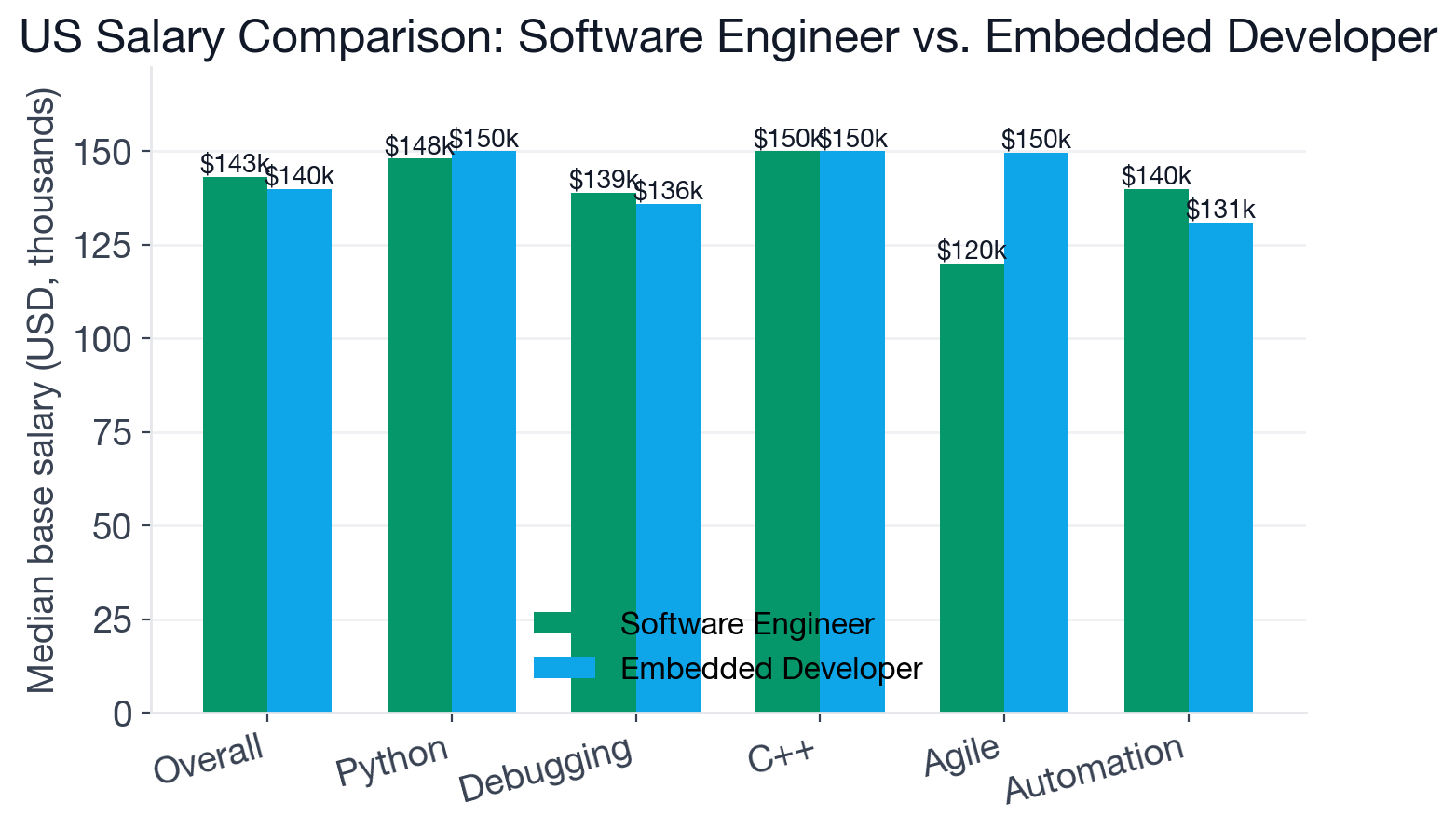
Median US base salary for postings that mention each skill, restricted to US postings with disclosed salary data.
Where the roles diverge is at the top end of each distribution. For Software Engineers, the salary picture splits by pool size. Niche tools carry the steepest premiums: Hubspot leads at $210,000 (n=36, +$66.9K over the baseline), followed by Sentry, Buildkite, and Pulumi at $190,000 each (sample sizes of 47-82). These are real signals but reflect specialized hiring pockets rather than the broad SWE market. Among skills with 1,000+ salary records, where the hiring pool is large enough to reflect market-wide rates, the leaders are Distributed Systems ($160,800, n=1,648, +$17.7K), Observability ($160,000, n=1,447, +$16.9K), and Machine Learning ($160,000, n=979, +$16.9K). For most Software Engineers, that cluster is the practical salary ceiling above the baseline. For Embedded Developers, the standout is Computer Vision at a median $191,000 (n=38), a $51,000 premium over the Embedded baseline. That figure reflects demand for engineers who can deploy vision models on constrained hardware: a scarce combination of ML knowledge, real-time systems expertise, and hardware awareness.
The practical message: both roles pay well, the baselines are nearly identical, and the top-end premiums are real on both sides. The Embedded Computer Vision premium is particularly notable for anyone considering that specialization.
Which Has More Job Openings?
Software Engineer has dramatically more volume: 32,835 active postings vs. 954 for Embedded Developer, a ratio of 34 to 1. This is among the sharpest volume contrasts between any two tech roles on the board.
Entry-level access is similarly constrained on both sides: 3.5% of SWE postings are explicitly entry-level (1,153 of 32,835) and 2.9% for Embedded (28 of 954). Neither role is easy to break into from zero. Senior and staff combined make up 48% of SWE postings and 54% of Embedded postings, meaning both markets strongly favor experienced hires.
The geographic picture differs significantly. Embedded Developer jobs are US-concentrated: 50% of postings are based in the US, driven by aerospace, defense, semiconductor, and robotics employers. India accounts for only 6% of Embedded postings vs. 23% for Software Engineer. Outside the US, the Software Engineer market is far larger and more accessible. Browse open Software Engineer roles or Embedded Developer roles to see the current count by country.
Remote availability is the most practical divergence for day-to-day life: 20% of SWE postings are remote vs. just 7% for Embedded. Two-thirds of Embedded Developer roles are onsite, reflecting real hardware lab requirements. If location flexibility matters, that ratio is decisive.
Which Should You Choose?
Choose Software Engineer if you:
- Want maximum job market breadth: 32,835 openings across web, cloud, backend, mobile, and AI systems
- Prefer remote or hybrid flexibility (20% remote vs. 7%)
- Are earlier in your career and want the largest pool of openings to compete in
- Want to use ambient AI coding tools (Copilot, Cursor, Claude Code) as a core part of your daily workflow
- Are based outside the US (SWE hiring is genuinely global; Embedded is US-heavy)
Choose Embedded Developer if you:
- Want to work directly with hardware where physical constraints govern the design (latency in nanoseconds, power in milliwatts, real-time guarantees)
- Have, or are building, depth in C++, Linux, and low-level debugging alongside Python
- Are comfortable with predominantly onsite work and US-centric employers (aerospace, defense, semiconductor, robotics)
- Are drawn to the AI-on-edge path: deploying vision and ML models on constrained devices, where Computer Vision commands a $51K salary premium and the candidate pool is genuinely small
- Want a 34x smaller candidate pool, where deep specialization differentiates you more directly
How Should You Use This in Your Job Search?
The skill overlap between these roles is real but limited. Drilling C++, Linux, Python, and Debugging prepares you for either path. AI mock interviews let you practice the rounds that differ most: system design and distributed systems for SWE, hardware-software integration and real-time constraints for Embedded. The question bank covers C++, algorithms, debugging, and system design topics common to both. For foundational skill-building, interactive courses cover algorithms, data structures, system design, and more. If you are comparing paths, the backend developer vs. embedded developer analysis covers a narrower slice of the SWE-to-Embedded overlap.
FAQ
Q. What is the salary difference between Software Engineers and Embedded Developers in 2026?
The two roles are nearly at salary parity: Software Engineers earn a median $143,100 US base (n=8,663 postings with disclosed salary) and Embedded Developers earn $140,000 (n=311), a gap of just $3,100 or 2.2%. Both figures are base salary only, excluding equity, bonuses, and sign-on.
Q. Which role has more job openings: Software Engineer or Embedded Developer?
Software Engineer has dramatically more volume: 32,835 active postings vs. 954 for Embedded Developer as of May 2026, a ratio of about 34 to 1. For most job seekers, Software Engineer roles are substantially easier to find, regardless of specialization.
Q. What skills do Software Engineers and Embedded Developers share?
Python appears in 38% of postings for both roles. C++, Agile, CI/CD, Linux, Git, Debugging, and Automation are also shared, though at different frequencies. The Jaccard similarity of the two skill sets is 0.28, meaning the roles share about 28% of their combined skill universe.
Q. Is Embedded Developer a remote-friendly role?
Significantly less so than Software Engineer. Only 7% of Embedded Developer postings are remote, compared to 20% for Software Engineer. Two-thirds of Embedded Developer roles are onsite, reflecting that hardware interaction and lab access often require physical presence.
Q. What makes Embedded Developer skills different from Software Engineer skills?
Embedded Developer roles lean heavily on hardware-adjacent skills: C++ (36%), Linux (23%), Debugging (38%), and real-time systems knowledge via Zephyr (4%). Computer Vision shows up in 7% of Embedded postings and commands a $51K salary premium over the role baseline. Software Engineer roles are defined by cloud stacks (AWS 30%), APIs (28%), TypeScript (23%), and containerization (Kubernetes 19%, Docker 19%).
Q. Should I become a Software Engineer or Embedded Developer?
Choose Software Engineer if you want a larger job market, more remote options, and work across cloud, backend, or frontend systems. Choose Embedded Developer if you prefer working close to hardware, building systems where performance and reliability constraints are physical rather than abstract, and you are comfortable with a more onsite-dominated, US-concentrated job market.
Q. How are AI tools being adopted differently in Software Engineer vs Embedded Developer roles?
Software Engineer postings explicitly mention LLMs in about 11% of listings, and developer surveys put ambient AI tool usage (Copilot, Claude Code, Cursor) at 84-95% of software engineers. Embedded Developers face structural barriers to the same ambient workflow: timing-critical firmware code, closed vendor toolchains, and safety standards like MISRA C limit how freely AI-generated code can be accepted without manual validation.
Final Thoughts
The salary parity between these roles is real and worth noting: years of assumption that embedded work pays less than cloud work is not what the 2026 data shows. What the data does show is a dramatically different practical reality: 34 times fewer jobs, two-thirds onsite, and a US-concentrated hiring market defined by aerospace, defense, and semiconductor. For engineers drawn to the physical layer of computing, the Computer Vision premium and the smaller candidate pool make Embedded Developer a strong specialization play. For everyone else, Software Engineer offers the largest, most flexible job market in tech.
Topics
Ready to practice?
Put what you've learned into practice with AI mock interviews and structured preparation guides.