
The Short Answer
Backend Developer is the larger, higher-paying, cloud-native half of the systems-software market. Embedded Developer is the smaller, hardware-anchored half with a much wider door at entry level. Among US postings, Backend Developer pays a $150,000 median base salary versus $134,600 for Embedded Developer (a $15,400, 11.4% gap), and Backend postings outnumber Embedded by 7,234 to 2,589 on the InterviewStack.io job board in May 2026. The two skill sets share only about 20% of their top-30 skills, so the choice is really a choice between two different software-engineering disciplines that happen to share a name suffix.
| Backend Developer | Embedded Developer | |
|---|---|---|
| Median US base salary | $150,000 (n=547) | $134,600 (n=848) |
| Active postings | 7,234 | 2,589 |
| Top skill | AWS (43%) | Python (37%) |
| Entry-level share | 2.0% | 6.7% |
| Remote share | 30% | 8% |
| Skill overlap (Jaccard) | 20% | 20% |
Key Findings
- Median US base salary is $150,000 for Backend Developer (n=547) versus $134,600 for Embedded Developer (n=848), a $15,400 (11.4%) gap.
- Backend Developer has 7,234 active postings versus 2,589 for Embedded Developer, a 2.79x volume ratio.
- The two roles share only 20% of their top-30 skill sets, one of the lowest overlaps between any two software-engineering titles we have compared.
- Embedded Developer is over three times more accessible at entry level: 6.7% of postings versus 2.0% for Backend Developer.
- Embedded is heavily onsite (77%) and US-anchored (53% of postings); Backend is 30% remote and only 17% US.
- Computer Vision ($166,000) is the highest-paying Embedded skill; Rust ($179,500) leads Backend, with LLM-related skills paying $20-25K above baseline.
What Does Each Role Actually Do?
Backend Developer is a cloud-services role. The week is writing API services in Java, Python, or TypeScript that run inside containers on AWS, Azure, or Google Cloud, designing and maintaining microservices, owning relational and NoSQL databases (PostgreSQL, MySQL, Redis), building CI/CD pipelines, and operating the result with monitoring, observability, and alerting. The exclusive-skill list (AWS at 43%, APIs at 35%, Docker at 34%, Kubernetes at 34%, Java at 33%, Microservices at 31%) reads exactly like the modern web-service stack. The output is usually a service that handles millions of user requests reliably.
Embedded Developer is a hardware-adjacent role. The work is writing C++ (and increasingly Rust) that runs on a microcontroller, board, or system-on-chip, debugging with logic analyzers, JTAG probes, and oscilloscopes, building Linux images for the device, and prototyping firmware against breadboards and reference hardware. The exclusive list is short and concrete: C++ at 29%, Linux at 23%, Prototyping at 9%. The output is code that runs on physical devices: chips, satellites, automotive ECUs, drones, medical instruments, and consumer products. Think of Backend as the engineer for cloud-scale software; Embedded as the engineer for the firmware that makes a physical product work.
What Skills Do Both Roles Require?
The shared core is small and concentrated. Python is the only skill that exceeds 25% in both roles (29% Backend, 37% Embedded), and Embedded actually leans on it harder than Backend does, primarily for build automation, test scripts, and ML inference on the edge. Beyond Python, the overlap is mostly engineering hygiene: Git, automation, and debugging.
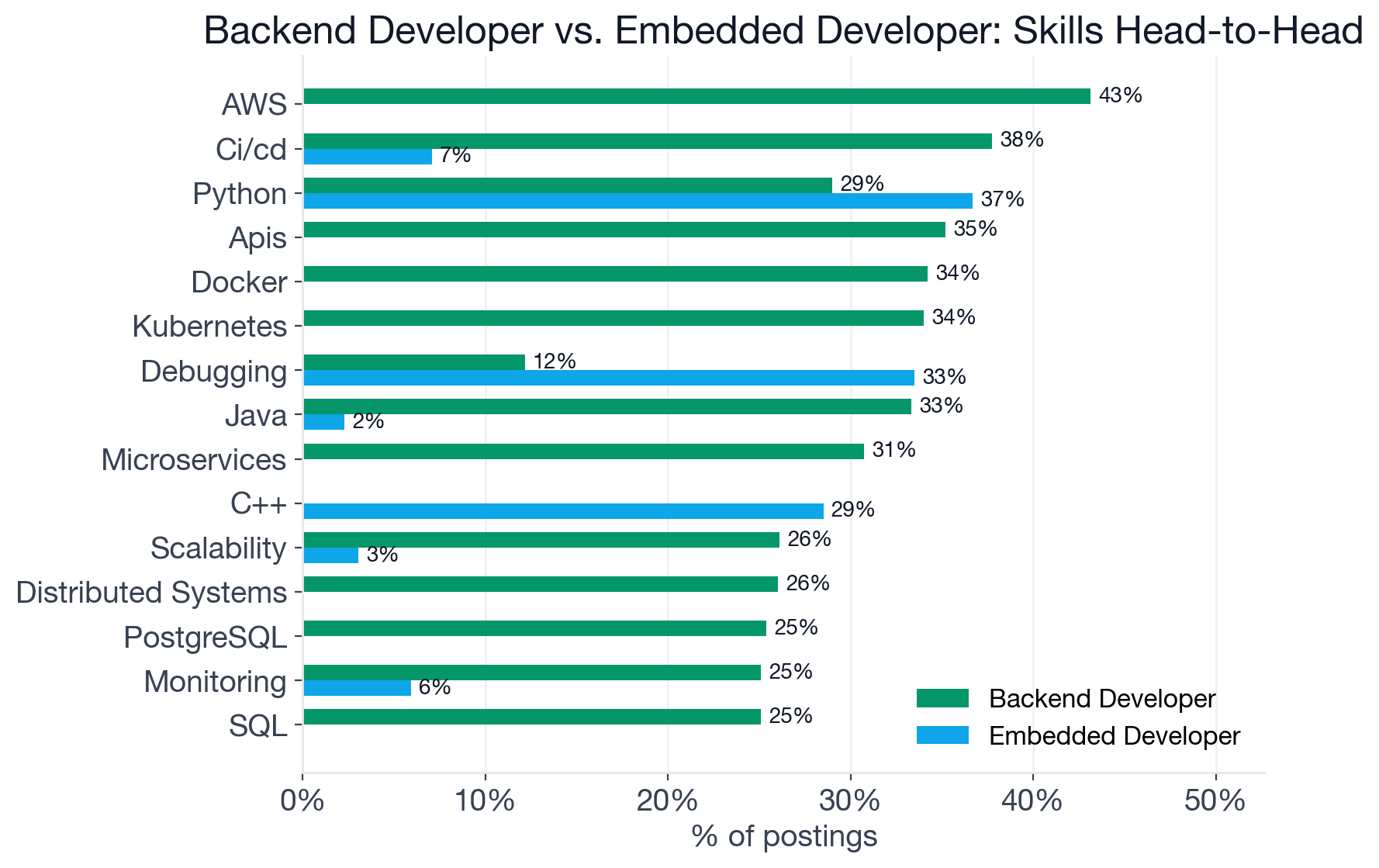
Share of postings that ask for each skill, comparing Backend Developer (n=7,234) to Embedded Developer (n=2,589). Skills shown are drawn from the union of each role's top set.
Even within the "shared" skills, the weights diverge. Debugging appears in 33% of Embedded postings versus 12% of Backend ones, because Embedded engineers debug at the silicon-and-signal level where a unit test cannot reach. CI/CD flips the same way: 38% of Backend postings versus 7% of Embedded, since Backend ships changes daily through automated pipelines while Embedded ships firmware on a release cadence measured in months. Monitoring (25% versus 6%) and Agile (24% versus 10%) tell you the same story from the operational side: Backend lives inside a continuously-deployed product cycle; Embedded lives inside a hardware product cycle.
Where Do the Roles Diverge?
Exclusive to Backend Developer
The Backend side of the fork is dominated by the cloud-native web-services stack.
- AWS: 43% (Backend + AWS openings)
- APIs: 35%
- Docker: 34%
- Kubernetes: 34% (Backend + Kubernetes openings)
- Java: 33%
- Microservices: 31%
- Scalability: 26%
- Distributed Systems: 26%
- PostgreSQL: 25%
- SQL: 25%
This is a single, coherent picture. A Backend posting is, by default, a containerized Java or Python service that talks to a relational database, sits behind an API gateway, and runs as one of many microservices on a Kubernetes cluster in AWS. The combination of Distributed Systems (26%), Scalability (26%), Microservices (31%), and Kubernetes (34%) means a real share of postings expect candidates to think about consistency, latency, and partial failure as part of normal day-to-day design work.
Exclusive to Embedded Developer
The Embedded side has fewer high-frequency exclusives, which itself is a signal: the role has a deep, narrow specialty rather than a broad surface area.
- C++: 29% (Embedded + C++ openings)
- Linux: 23%
- Prototyping: 9%
C++ is the language that defines the role. It appears in nearly three of every ten Embedded postings, while Backend uses C++ only as a high-paying differentiator outside its top-30. Linux at 23% reflects how much modern embedded work runs on Yocto, Buildroot, or a real-time Linux distribution rather than bare-metal microcontrollers. Prototyping at 9% sounds low, but it is a unique signal: it tells you a meaningful slice of Embedded jobs involves building physical proof-of-concept hardware, not only writing code against existing devices.
Which Pays More?
Among US postings, Backend Developer leads at a $150,000 median base salary (n=547) versus $134,600 for Embedded Developer (n=848), a $15,400 (11.4%) gap. Salary numbers below are US-only base salary. Equity, RSUs, bonus, and sign-on are not disclosed in postings and are not in this dataset, so total compensation at top employers runs meaningfully higher than these figures, particularly at large tech firms for Backend and at semiconductor and defense employers for Embedded.
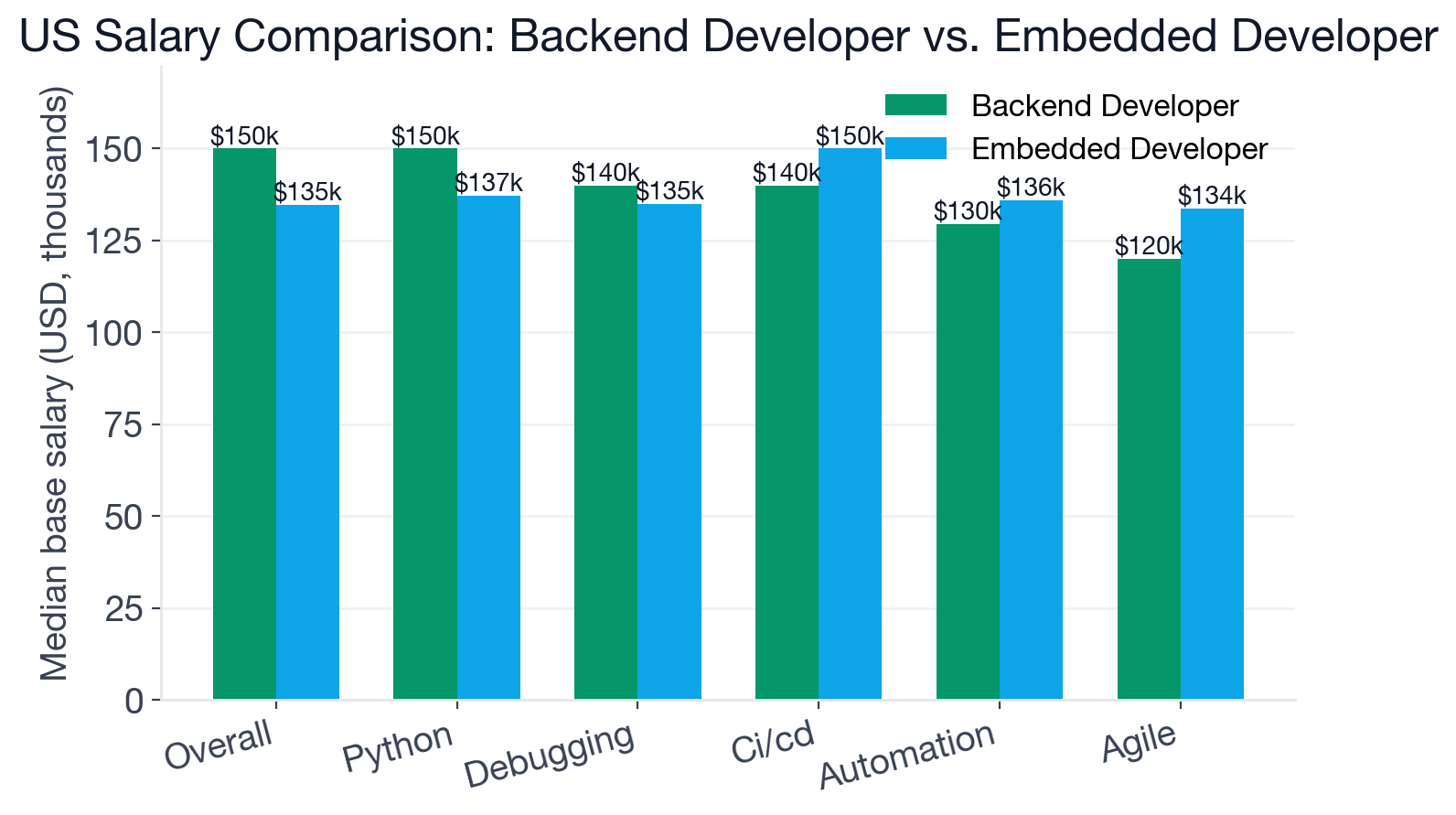
Median US base salary in USD for postings that mention each skill, restricted to US postings with structured salary data.
The headline gap is best read as a market-supply premium. Backend skills transfer across nearly every company that runs a website, so the demand pool is enormous and recruiters bid the median up. Embedded skills concentrate in a smaller set of hardware-centric employers, where supply and demand sit closer to balance.
The skill-level salary picture flips that logic for specialists. The biggest Backend premiums attach to systems and AI specialties: Rust at $179,500 (n=38, about $29.5K above baseline), Generative AI and OpenAI both at $175,000 (about $25K above), LLMs at $170,000 (n=36, about $20K above), and Observability at $168,900 (n=149, about $18.9K above). Distributed Systems at $165,000 (n=171, about $15K above) and Terraform at $164,000 (n=65) round out the top tier.
For Embedded, the biggest premiums sit on the boundary with adjacent software domains. Computer Vision leads at $166,000 (n=85, about $31.4K above the $134,600 baseline), reflecting the autonomy and robotics employers near the top of the hiring list. Rust sits at $154,500 (n=28, about $19.9K above), Machine Learning at $153,500 (n=46, about $18.9K above), and the in-domain trio of C++, CI/CD, and Scalability all reach $150,000 (about $15.4K above baseline). C++ pays $163,600 in Backend but $150,000 in Embedded, an instructive contrast: in Backend, knowing C++ is rare and rewarded; in Embedded, C++ is the price of admission.
Which Has More Job Openings?
Backend Developer is by far the larger market. The 7,234 active Backend postings outnumber Embedded's 2,589 by roughly 2.79x, a 4,645-listing gap. The structural reason is straightforward: every company that runs a website, an API, or an internal tool needs Backend engineers. Embedded demand concentrates in a smaller set of industries (semiconductors, defense, aerospace, automotive, medical devices, consumer hardware), so the volume ceiling is lower even when those industries are healthy.
The accessibility picture inverts. Embedded Developer is materially easier to enter: 6.7% of postings are explicitly entry-level (173 of 2,589) versus 2.0% for Backend Developer (145 of 7,234), more than three times the proportional share. The senior-plus-staff tier in Backend (43% senior, 12% staff) is heavier than in Embedded (27% senior, 17% staff), which means the Backend ladder leans toward people who are already in the field; Embedded teams are more willing to hire new graduates with the right CS or electrical-engineering foundation and train them on the toolchain.
Geography splits sharply. Embedded is a 53%-US market, with India (8%), Germany (4%), the UK (3%), and Canada (3%) trailing. The US concentration reflects where the customers are: defense contractors, aerospace primes, semiconductor companies, and autonomy-focused startups all anchor in the US. Backend is the opposite: only 17% of postings are US-based, with a substantial Indian presence (12%) and a long European tail (Germany 4%, UK 3%, Poland 3%, Spain 3%, Portugal 3%, Brazil 3%). Work-mode follows the same logic: 30% of Backend postings are remote and 51% onsite, while Embedded is 77% onsite with only 8% remote, because firmware engineers need physical access to the hardware they target. The top hiring lists confirm the split: Backend's leaders are consulting and software-services firms (AgileEngine, PradeepIT, Nexthire) plus product companies like Coupang, GitLab, and Tether; Embedded is dominated by semiconductors, defense, and aerospace (NVIDIA, Anduril, SpaceX, Marvell, Cisco, Cesium Astro, Analog Devices, Northrop Grumman, Honeywell).
Which Should You Choose?
Choose Backend Developer if you:
- Want to build cloud services and APIs that scale to millions of users: Java, Python, AWS, microservices, and Kubernetes form the core stack.
- Prefer a fast feedback loop where code ships through CI/CD on a daily cadence and you operate the running service yourself.
- Care about the bigger market and the slightly higher median pay, plus the much wider remote-work mix (30% versus 8%).
Choose Embedded Developer if you:
- Want to write C++ that runs on physical devices: chips, satellites, cars, drones, medical instruments, consumer hardware.
- Have or want a comfort zone near hardware: oscilloscopes, JTAG, board-bringup, and Linux build systems like Yocto.
- Care about the materially wider entry door (6.7% versus 2.0% entry-level), are open to onsite work in US hardware hubs, and want to work for companies like NVIDIA, Anduril, SpaceX, or Marvell.
If the choice is still close, the salary skill data is your tiebreaker. The highest-paying Embedded skills (Computer Vision, Rust, Machine Learning) are the same skills that command premiums in Backend, so a candidate who picks Embedded and invests in those specializations closes most of the median-pay gap. Our interactive courses cover the foundations across systems, distributed systems, and C++; the question bank lets you drill API design, scalability, and embedded-systems topics one at a time; and AI mock interviews put you under realistic conditions for either track.
FAQ
Q. What's the salary difference between Backend Developer and Embedded Developer in 2026?
The median US base salary is $150,000 for Backend Developer (n=547) versus $134,600 for Embedded Developer (n=848), a $15,400 (11.4%) premium for the Backend role. Both figures are base only and exclude equity, RSUs, and bonuses, so total compensation at top employers runs meaningfully higher than these numbers, especially in large tech for Backend and in semiconductors and defense for Embedded.
Q. How much do Backend Developer and Embedded Developer skills overlap?
About 20% (Jaccard similarity on each role's top-30 skills), one of the lowest overlaps between any two software-engineering titles we have compared. The shared core is small: Python, Git, debugging, automation, and a handful of process skills. Beyond that the stacks diverge sharply: Backend pulls toward AWS, Docker, Kubernetes, Java, microservices, and SQL; Embedded pulls toward C++, Linux, and prototyping.
Q. Which role has more job openings?
Backend Developer has roughly 2.79x more active postings: 7,234 versus 2,589 for Embedded Developer on the InterviewStack.io job board in May 2026, a difference of 4,645 listings. Backend roles span every company that runs a web service or API; Embedded roles concentrate in semiconductors, defense, aerospace, automotive, and consumer hardware, which is a structurally smaller pool.
Q. Which role is easier to enter at the junior level?
Embedded Developer has the wider entry door. About 6.7% of Embedded Developer postings are explicitly entry-level (173 of 2,589) versus 2.0% for Backend Developer (145 of 7,234), more than three times the proportional share. Backend overwhelmingly expects production-system experience, while Embedded teams are more willing to train new graduates with the right CS or electrical-engineering foundation.
Q. Should I become a Backend Developer or an Embedded Developer in 2026?
Pick Backend Developer if you want to build cloud services and APIs that scale to millions of users: Java, Python, AWS, microservices, and Kubernetes form the core stack, with the larger market and 11% higher median pay. Pick Embedded Developer if you want to write C++ that runs on physical devices like semiconductors, satellites, cars, drones, and medical devices, at companies such as NVIDIA, Anduril, SpaceX, and Marvell, where the work is closer to hardware and the entry door is materially wider.
Q. Which specific skills give the biggest salary premium in each role?
For Backend Developer, the highest-paying skills attach to systems and AI work: Rust ($179,500, +$29.5K above the $150K baseline), Generative AI and OpenAI ($175,000, +$25K), LLMs ($170,000, +$20K), Observability ($168,900, +$18.9K), and Distributed Systems ($165,000, +$15K). For Embedded Developer, the biggest premiums sit on the boundary with adjacent software domains: Computer Vision ($166,000, +$31.4K above the $134,600 baseline), Rust ($154,500, +$19.9K), and Machine Learning ($153,500, +$18.9K).
Q. Where are the jobs and how remote-friendly is each role?
Embedded Developer is sharply more US-concentrated: 53% of postings are in the US versus 17% for Backend Developer. Backend has a larger Indian presence (12% versus 8%) and a globally distributed long tail. Remote work splits the same way: 30% of Backend postings are remote and 51% are onsite, while only 8% of Embedded postings are remote and 77% are onsite. Embedded work needs lab access to physical hardware, which keeps it at the bench.
Bottom Line
Backend Developer and Embedded Developer share a name suffix, not a job. Backend is the cloud-services discipline: containerized Java and Python APIs, microservices on Kubernetes, distributed systems at scale, and a deep, global hiring market. Embedded is the hardware-adjacent discipline: C++ on microcontrollers and SoCs, Linux build systems, oscilloscopes and JTAG, and a US-anchored market dominated by semiconductor, defense, and aerospace employers. Backend pays 11% more at the median and has 2.79x the volume; Embedded has more than three times the proportional entry-level share and the wider door for new graduates. Browse live Backend Developer postings or Embedded Developer postings on the InterviewStack.io job board.
Topics
Ready to practice?
Put what you've learned into practice with AI mock interviews and structured preparation guides.