
One Role Codes All Day. One Doesn't.
When a job posting says "Test Automation Engineer," automation is in the contract: 92.6% of those postings list it as an explicit requirement. For QA Engineer, the same skill appears in just 26.7% of postings. That 3.5x gap, between two roles that share 71% of their top-30 skills, is the mechanical difference that explains a $10,800 salary premium and a very different day-to-day job. We looked at 16,277 active QA Engineer postings and 2,385 Test Automation Engineer postings on the InterviewStack.io job board as of June 2026, with skills extracted and synonyms collapsed.
Key Findings
- Test Automation Engineers earn a median $104,000 US base salary; QA Engineers earn $93,200: a $10,800 (10.4%) gap (base salary only, US postings with disclosed compensation; equity excluded). Note: the QA Engineer dataset includes manufacturing and life sciences quality roles, which pull the median down, making the gap for software-only comparisons likely smaller.
- Automation appears in 92.6% of Test Automation Engineer postings vs 26.7% of QA Engineer postings: a 3.5x difference between roles that share the same name in many job boards.
- The two roles share 71% of their top-30 skills by Jaccard coefficient, one of the higher overlaps across role comparisons.
- QA Engineer has 16,277 active postings vs 2,385 for Test Automation Engineer: 6.8x more volume.
- Test Automation Engineers are more remote-friendly: 14.4% remote vs 9.9% for QA Engineers; hybrid is 22.6% vs 16.1%.
- QA Engineer has a marginally higher entry-level share: 3.8% of postings vs 1.9% for Test Automation Engineer.
- 76% of QA professionals report using AI-powered testing tools regularly (Katalon 2025, n=1,400+), though neither role lists AI as a top-30 explicit skill requirement.
| QA Engineer | Test Automation Engineer | |
|---|---|---|
| Median US salary | $93,200 | $104,000 |
| Active postings | 16,277 | 2,385 |
| Automation in postings | 27% | 93% |
| Remote share | 10% | 14% |
| Entry-level share | 4% | 2% |
| Skill overlap (Jaccard) | 71% shared | n/a |
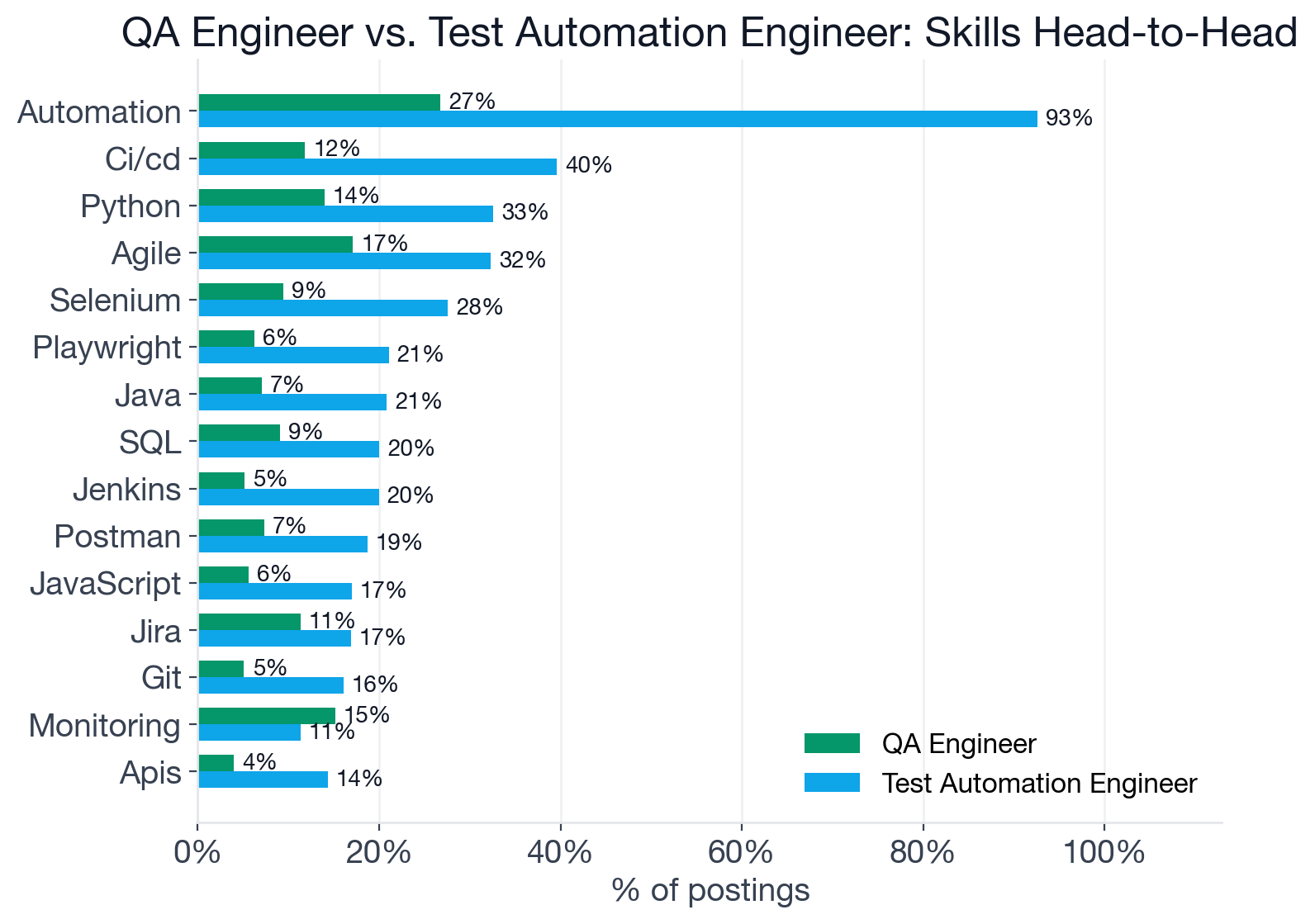 Top shared skills for QA Engineer (emerald) and Test Automation Engineer (blue); Test Automation Engineer postings show 2-3x higher frequency on every coding-adjacent skill.
What Does Each Role Actually Do?
QA Engineer covers the full quality lifecycle: test planning, manual and automated test execution, defect tracking through resolution, release sign-off, and process documentation. The title is broad by design. The top hiring companies in our dataset (Abbott Laboratories, Thermo Fisher Scientific, Jabil Inc., Northrop Grumman, Medtronic) are manufacturing and life sciences firms, not software companies, which signals that "QA Engineer" absorbs both software quality and physical or hardware quality roles. Excel appearing in 12.6% of QA postings and being absent from Test Automation Engineer's top-30 confirms this: spreadsheet-based process metrics and stakeholder reporting are as much the job as test execution.
Test Automation Engineer is narrower. The job is writing and maintaining automated test suites: Selenium or Playwright (browser automation frameworks for end-to-end testing) scripts, CI/CD integrations, and the test infrastructure that keeps them running at scale. The work is software engineering with a testing mandate. Cloud infrastructure skills (AWS, Azure, Docker) appearing exclusively in the TAE list are the tell: postings increasingly expect engineers who own the test platform, not just the tests.
Neither role lists AI tools as explicit requirements in postings. But the Katalon 2025 survey of 1,400+ QA professionals found 76% already use AI-powered testing tools, primarily for test case generation and coverage analysis. Test Automation Engineers tend to reach for AI coding assistants to generate and maintain scripts; QA Engineers apply AI more to test strategy, defect write-ups, and coverage gap analysis. Both roles now treat AI fluency as a baseline expectation, the same way email was assumed in 2000. For a deeper look at how AI is reshaping the field, see how AI is changing QA Engineer work in 2026.
Which Skills Do QA Engineers and Test Automation Engineers Share?
Both roles share a foundation of automation tooling, CI/CD, Agile, Python, and browser testing frameworks. The shared skills from the combined dataset, with frequency in each role (for a full breakdown of the QA Engineer skill stack, see our QA Engineer skills analysis):
- Automation: QA 27%, TAE 93%
- CI/CD: QA 12%, TAE 40%
- Python: QA 14%, TAE 33%
- Agile: QA 17%, TAE 32%
- Selenium: QA 9%, TAE 28%
- Java: QA 7%, TAE 21%
- Playwright: QA 6%, TAE 21%
Every skill that appears in both roles shows up at roughly 2-3x the rate in TAE postings. The shared foundation is genuine: a QA resume with Python, Selenium, and CI/CD already has the vocabulary for a TAE posting. The question is whether you run those tools occasionally or whether they are the primary output of your workday.
Where the Skill Stacks Diverge
Exclusive to QA Engineer: Only one skill clears the exclusivity threshold: Excel (12.6%), which does not appear in Test Automation Engineer's top-30 at all. That single data point captures the process-and-documentation scope that QA carries and TAE does not: metrics dashboards, test matrices, stakeholder reports. It is a small signal with a large implication.
Exclusive to Test Automation Engineer: The exclusive list reads like a modern software engineering stack. APIs (14.3%), AWS (14.2%), Cypress (a JavaScript-based end-to-end testing framework, 13.1%), TypeScript (11.2%), Cucumber (a BDD, or Behavior-Driven Development, framework for human-readable test specifications, 10%), Azure (9.5%), GitHub Actions (9.4%), C# (9.2%), GitLab (9%), Docker (8.9%).
This cluster explains the salary premium directly. Cloud infrastructure and typed scripting languages are skills the broader engineering market prices accordingly. A Test Automation Engineer posting competes for the same talent as a backend or DevOps role. Pricing follows supply and demand, not just what the word "testing" implies.
Which Role Pays More?
Test Automation Engineers earn more: $104,000 median US base salary vs $93,200 for QA Engineers. These figures are base salary only from US postings with disclosed compensation (QA Engineer: n=2,707; Test Automation Engineer: n=267). Equity, bonus, and sign-on are not included, so total compensation at top employers runs higher than these numbers for both roles. One important caveat: the QA Engineer dataset is not software-QA-only. As the top employer list shows (Abbott Laboratories, Thermo Fisher Scientific, Jabil, Medtronic), it includes manufacturing, life sciences, and physical quality roles, which typically pay less than software QA roles. This dilutes the QA median downward, meaning the $10,800 premium likely overstates the gap you would see if you compared software QA engineers to software test automation engineers specifically.
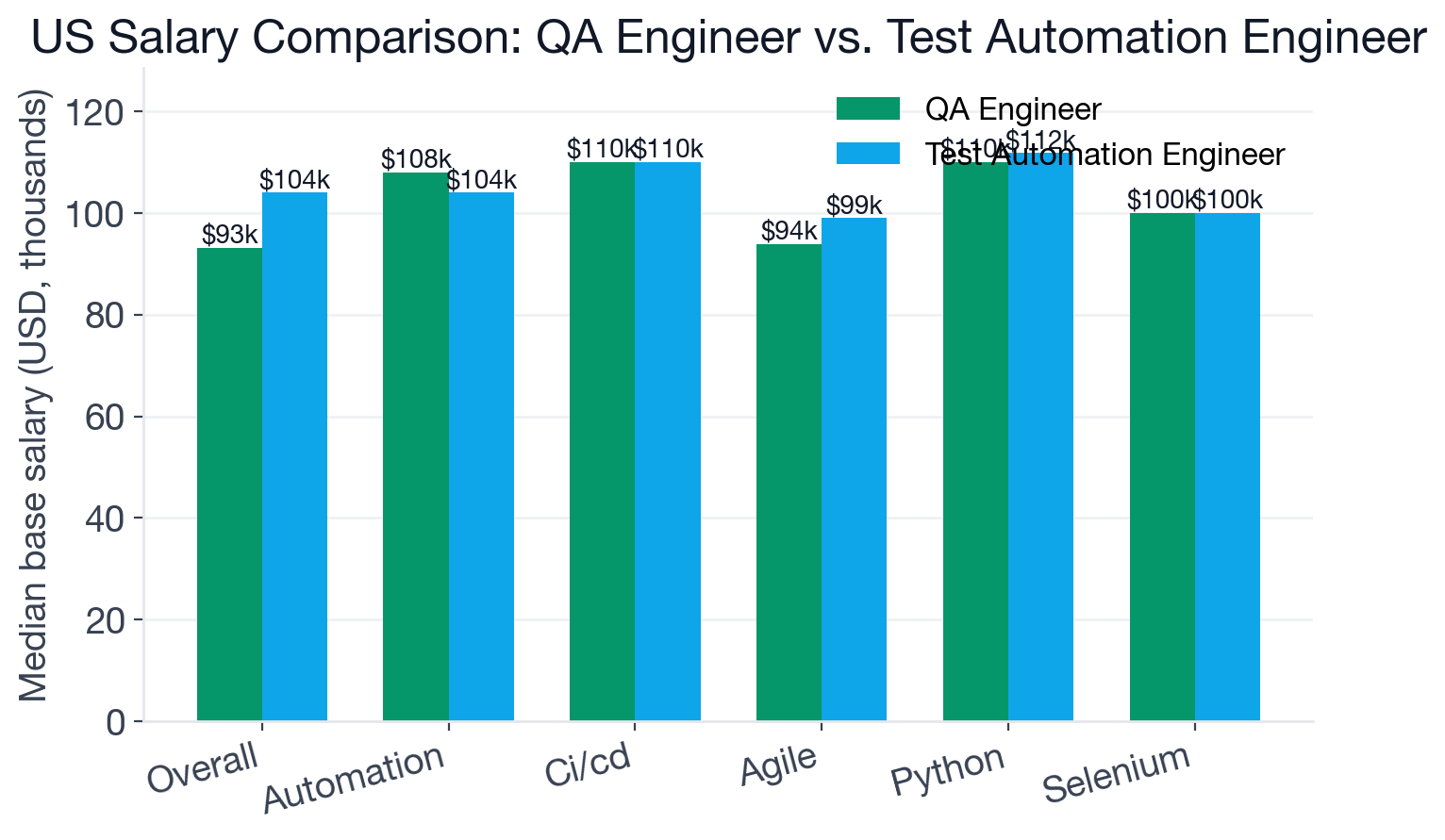 Median US base salary: QA Engineer $93,200 vs Test Automation Engineer $104,000; base salary only, US postings with disclosed compensation.
The skills that raise the ceiling follow the same code-intensity pattern in both roles. For QA Engineers, CI/CD ($110,000, n=239), Python ($110,000, n=536), and Cypress ($110,000, n=59) each add roughly $17,000 above the $93,200 baseline. The QA skills with the highest salary returns are, without exception, the ones that pull the role toward automation.
For Test Automation Engineers, API skills ($130,000, n=35), C++ ($122,500, n=27), and Docker ($118,500, n=30) carry the biggest premiums above the already-higher $104,000 base. AWS ($116,300, n=36) and GitLab ($115,000, n=27) follow closely. The pattern is consistent: cloud-native and infrastructure-aware test engineering raises the ceiling in both roles, and TAE starts that ceiling $10,800 higher.
Which Role Has More Openings, and How Hard Is It to Break In?
QA Engineer is the larger market by a significant margin: 16,277 active postings vs 2,385 for Test Automation Engineer, a 6.8x volume difference. Entry-level access favors QA (3.8% entry-level, about 620 postings) over TAE (1.9%, about 45 postings), though both roles are overwhelmingly mid-level (72% for QA, 68% for TAE). Senior share is notably higher for TAE (23.6% vs 15.8%), reflecting the engineering depth the role requires.
Breaking in cold to Test Automation Engineer without demonstrated code experience is harder than the raw numbers suggest. Most of those entry-level TAE postings assume you already write test scripts. For candidates coming from manual testing backgrounds, the practical path is QA first, automation skills second.
On flexibility: TAE is the more remote-friendly role. Remote is 14.4% of TAE postings vs 9.9% for QA Engineers, and hybrid follows the same pattern (22.6% vs 16.1%). If remote or hybrid work is a priority, the data consistently favors Test Automation Engineer. Geographically, QA Engineer is US-concentrated (41.5% of postings), while TAE is more globally distributed: the US accounts for 27%, with India (14%) and Australia (3.2%) also substantial markets.
Which Should You Choose?
Choose QA Engineer if you:
- Want a broad quality mandate spanning manual testing, process design, and stakeholder communication alongside some automation work.
- Are earlier in your career: 6.8x more openings and a marginally higher entry-level share give you more doors to knock on.
- Are interested in manufacturing, medical devices, aerospace, or life sciences, where the QA Engineer title spans physical and hardware quality alongside software.
- Plan to specialize in automation after building process and methodology fundamentals first.
Choose Test Automation Engineer if you:
- Already write code in Python, Java, or TypeScript and want a role where that work is the primary output, not an occasional task.
- Value more flexible arrangements: 14.4% remote and 22.6% hybrid beat QA's 9.9% and 16.1% respectively.
- Want the higher salary ceiling: $104,000 median vs $93,200, with cloud and infrastructure skills pushing further above that.
- Have hands-on experience with frameworks like Selenium, Playwright, or Cypress and want to deepen that specialization rather than broaden into manual quality processes.
How to Use This in Your Job Search
Use the Question Bank to drill testing fundamentals, automation strategy, CI/CD pipeline design, and test case methodology. Both roles test heavily on defect lifecycle, framework selection, and how to scope a test plan under time pressure. AI mock interviews let you practice technical walkthroughs of automation approaches before screening calls.
Our interactive courses cover scripting, testing principles, and the CI/CD toolchain for both paths. Pair study with live market tracking: browse current QA Engineer openings or Test Automation Engineer openings on InterviewStack.io to see which skills appear most often in postings in your target geography right now.
FAQ
Q. What is the salary difference between QA Engineer and Test Automation Engineer?
Test Automation Engineers earn a median $104,000 US base salary, compared to $93,200 for QA Engineers: a $10,800 (10.4%) gap. Both figures are base salary only from US postings with disclosed compensation (QA Engineer: n=2,707; Test Automation Engineer: n=267). Equity and bonus are not included. Note: the QA Engineer dataset includes manufacturing, life sciences, and physical quality roles alongside software QA; these tend to pay less and likely pull the QA median down. The gap for software-only QA vs. Test Automation Engineer is probably smaller than $10,800.
Q. How much skill overlap do QA Engineers and Test Automation Engineers share?
The two roles share 71% of their top-30 skills by Jaccard coefficient. Core shared skills include Automation, CI/CD, Agile, Python, Selenium, and SQL. The main differentiator is intensity: Automation appears in 92.6% of Test Automation Engineer postings vs 26.7% of QA Engineer postings.
Q. Which role is easier to break into?
QA Engineer has a marginally higher entry-level share (3.8% of postings vs 1.9% for Test Automation Engineer) and far more total volume (16,277 active postings vs 2,385), so there are simply more opportunities at every level. Both roles are predominantly mid-level.
Q. How do AI tools fit into QA and Test Automation Engineer work?
Neither role lists AI tools as explicit skill requirements in job postings, but the Katalon 2025 survey of 1,400+ QA professionals found 76% already use AI-powered testing tools regularly, primarily for test case generation and coverage analysis. Test Automation Engineers tend to use AI coding assistants to write and maintain test scripts faster; QA Engineers apply AI more broadly to test strategy and defect analysis. For both roles, AI tool fluency is a baseline expectation, not a listed differentiator.
Q. Which role is more remote-friendly, QA Engineer or Test Automation Engineer?
Test Automation Engineers have a higher remote share (14.4% of postings vs 9.9% for QA Engineers) and more hybrid options (22.6% vs 16.1%). Both roles skew onsite overall, but Test Automation Engineer postings are meaningfully more flexible, consistent with their software-engineering-oriented profile.
Q. What skills pay the most in Test Automation Engineer roles?
API skills ($130,000 median US base, n=35), C++ ($122,500, n=27), and Docker ($118,500, n=30) sit highest above the $104,000 Test Automation Engineer baseline. AWS ($116,300) and GitLab ($115,000) follow. These cloud and infrastructure skills signal the engineering-heavy profile of the specialized role.
The Bottom Line for 2026
QA Engineer is the broader, more accessible role: 6.8x the openings, a lower technical bar on average, and a market that spans manufacturing, life sciences, and software alike. Test Automation Engineer is the specialized path: narrower in scope, more remote-friendly, code-intensive at its core, and worth $10,800 more at the median US base salary. The decision comes down to one question: do you want quality to be your lens on the full software lifecycle, or do you want automation engineering to be your primary craft? Browse live QA Engineer openings and Test Automation Engineer openings on InterviewStack.io to see where your current skill set fits today's market.
Topics
Ready to practice?
Put what you've learned into practice with AI mock interviews and structured preparation guides.