
QA Engineering in 2026: Automation Has Split the Role
No individual QA Engineer skill clears the 50% threshold that defines a "table-stakes" requirement in most other major tech roles. Compare: Data Engineers have Python, SQL, and Data Pipelines each appearing in 71-74% of postings. QA Engineers have their highest individual skill, Automation, at just 27.5%. That gap is not an accident. It reflects a role fragmented across more specializations than most engineering titles: web automation, API testing, mobile testing, performance testing, and manual process management each pull the required skill set in a different direction.
We looked at every active QA Engineer posting on the InterviewStack.io job board as of May 2026: 16,491 listings, with skills extracted from descriptions and synonyms collapsed. The headline is that there is no single canonical QA stack in 2026, but there is a clear direction in which well-paying roles are moving: toward code, toward CI/CD pipelines, and toward the automation engineer who writes and ships tests rather than just executing them.
Key Findings
- 16,491 active QA Engineer postings analyzed on the InterviewStack.io job board as of May 2026.
- No skill clears the 50% table-stakes line: the highest individual skill is Automation at 27.5%, reflecting the role's fragmentation across testing disciplines and industries.
- Only Automation (27.5%) clears the common tier (20-50%); the top differentiator skills include Agile (17.2%), Monitoring (15.8%), Python (14.9%), Excel (12.4%), CI/CD (12.3%), Jira (12.3%), SQL (9.7%), and Selenium (9.5%).
- Median US base salary is $92,100 (n=2,728 postings with US salary disclosed). Equity and bonus are not captured in posting data.
- Python adds $17,900 above the $92,100 baseline ($110,000 US median, n=563); CI/CD adds $16,900 ($109,000). Monitoring sits $6,100 below the baseline ($86,000), a signal that process-oriented QA without scripting commands below-median pay.
- Mid-level dominates at 72.3% of postings; only 4.0% are explicitly entry-level, roughly 1 in 25 openings.
- Onsite is the dominant work mode at 62.2%, one of the highest onsite rates of any tech role analyzed, driven by manufacturing, healthcare, and aerospace demand.
What Skill Families Define a QA Engineer in 2026?
Grouping every extracted skill into its broader family reveals where the role actually concentrates.
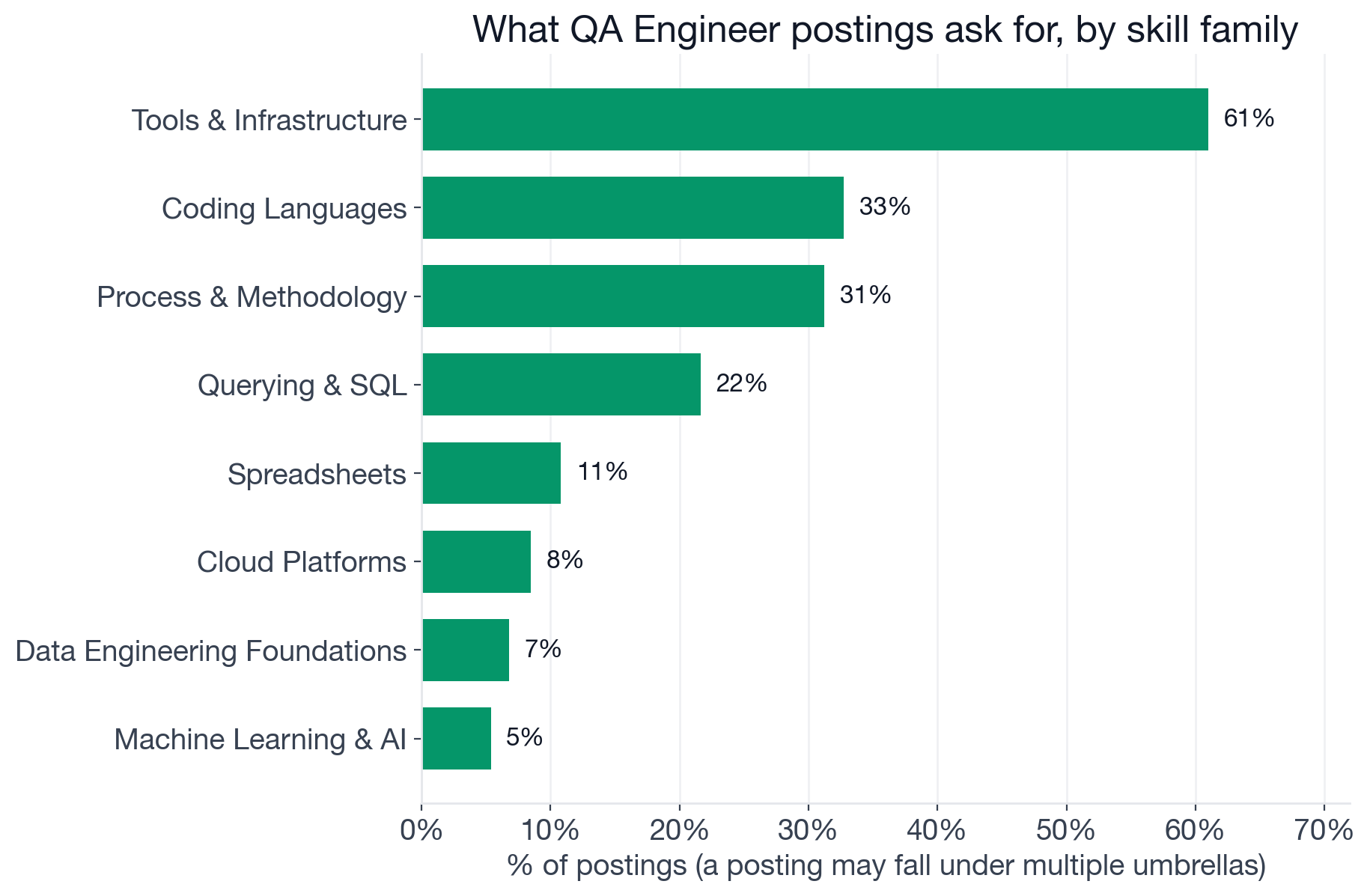
Share of QA Engineer postings that ask for at least one skill in each family. A posting that mentions Selenium, Playwright, and Cypress counts once under its testing-platform family. The Spreadsheets family (Excel at 12.4%) is not shown in this chart; it is discussed in the skills section below.
Tools & Infrastructure (45.9%) is the broadest signal: automation tooling, Jira, monitoring, Git, and Docker. This family covers the operational side of QA, the tools used to run test suites, track defects, and observe production systems.
Testing Platforms and Practices (42.6%) is what the data groups as "Other" but is really the QA-specific core: CI/CD (12.3%), API testing with Postman (7.3%), browser automation with Selenium (9.5%) and Playwright (6.2%, Microsoft's open-source browser automation framework built as a modern alternative to Selenium), Cypress (4.0%, a JavaScript-first end-to-end testing framework for web apps), test management with TestRail (2.2%, a platform for organizing and tracking test execution), and mobile testing with Appium (2.3%, an open-source framework for automating iOS and Android apps).
Coding Languages (22.8%) reflects the automation turn. Python (14.9%), Java (7.6%), and JavaScript (6.0%) each appear in meaningful shares of postings, with TypeScript close behind at 4.7%. A role that was historically described as "programming-optional" is no longer that.
Process & Methodology (19.0%) is Agile (17.2%) and Scrum (6.9%): the workflow framework most QA engineers operate inside.
Querying & SQL (10.7%) runs higher than most people expect from a QA role. When testing a backend service, verifying database state is as important as checking the API response. Companies increasingly want QA engineers who can write the SQL to do it.
Machine Learning & AI (3.6%) captures the 588 of 16,491 postings that explicitly require AI or ML testing infrastructure: roles hired to build AI validation frameworks, evaluate LLM outputs, or test ML systems as a core job function.
That 3.6% is the floor, not the ceiling of AI use in QA. The Capgemini World Quality Report 2025-26 found that 89% of organizations are piloting or deploying generative AI in quality engineering. The Stack Overflow Developer Survey 2025 found 51% of professional developers use AI tools daily. Neither figure appears in job posting counts. Employers do not write "uses GitHub Copilot to generate test scaffolding" in a job description the same way they write "Selenium required." The 3.6% measures where AI system-testing is a core job function; ambient AI tool use in QA (faster test case generation, AI-assisted bug triage, autocomplete for boilerplate test code) is now an industry-wide expectation across all seniority levels.
QA is also unique among engineering disciplines: AI is simultaneously a productivity tool for QA work and the subject being tested. Engineers at companies deploying AI products increasingly need to validate those outputs, not just use AI to do their jobs faster. That dual role is reflected in the 89% figure but almost invisible in the 3.6% job-posting count. The companion post How AI Is Changing QA Engineering in 2026 covers this transformation in depth.
What Are the Three Tiers of Individual QA Engineer Skills?
Drill from families to individual skills and three tiers emerge, though QA has a structural feature worth naming first.
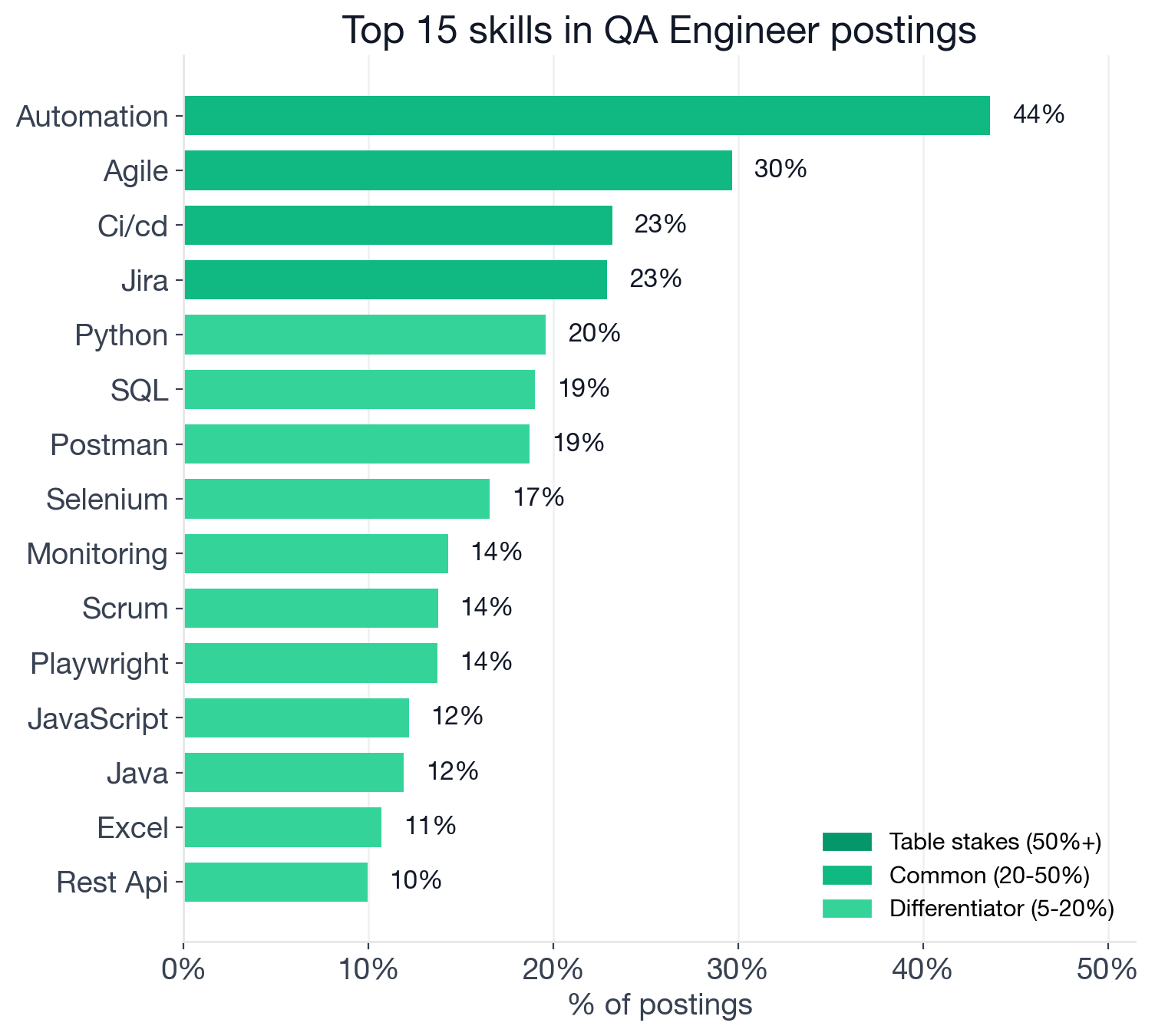
Top QA Engineer skills by share of postings. Skills above 50% are table stakes; 20-50% are common expectations; 5-20% are differentiators.
Table Stakes (50%+)
No skill clears the table-stakes line. The closest is Automation at 27.5%, still short of a majority. This is the defining structural feature of QA Engineering in 2026: the role has not consolidated around a shared core the way Data Engineering has consolidated around Python, SQL, and pipelines. There is no single "required" skill.
Common Expectations (20-50%)
Only one skill sits in the common tier:
- Automation (27.5%): the category, not a specific framework. Any posting that asks for Selenium, Playwright, or Cypress is typically captured here as well. More than 1 in 4 postings mention it, but 72.5% do not, which means the absence of "automation" from a job description does not mean the role is purely manual. It may just mean the posting named the specific framework without the umbrella term.
Differentiators (5-20%)
The differentiator tier in QA is among the longest of any role analyzed on this board. Sixteen skills fall between 5% and 20%, each representing a genuine career specialization. The most consequential:
- Agile (17.2%): the development process most QA engineers work inside. Browse QA Engineer postings with Agile.
- Monitoring (15.8%): APM tool familiarity (Datadog, New Relic) in software contexts; equipment or network monitoring in manufacturing and telecom settings. The salary data tells an important story here, covered in the next section.
- Python (14.9%): the primary scripting language for test automation. Browse QA Engineer postings that require Python.
- Excel (12.4%): signals process-oriented, documentation-heavy QA, common in regulated industries and manual testing environments.
- CI/CD (12.3%): continuous integration and delivery pipelines, where tests run automatically on every code push. CI/CD appearing at a frequency comparable to Python tells you companies care about where tests run, not just which framework wrote them.
- Jira (12.3%): defect tracking and sprint management. Knowing Jira in a QA context means filing structured bug reports, managing test plans, and working inside sprint ceremonies.
- SQL (9.7%): backend validation, where database state matters as much as UI behavior. QA Engineer roles requiring SQL.
- Selenium (9.5%): the established browser automation framework, strongest in Java and Python-based test suites. Selenium-specific QA Engineer openings.
- Java (7.6%): many enterprise QA organizations built their automation suites in Java with Selenium and JUnit years ago and have not migrated.
- Postman (7.3%): API testing via structured HTTP requests. Its frequency reflects how common API-layer testing has become as microservice architectures move business logic out of the UI and into backend services.
- Playwright (6.2%): the modern web automation alternative that pairs strongly with TypeScript and CI/CD. Pairs with CI/CD at a co-occurrence lift of 5.53, the highest of any CI/CD-plus-framework pairing in the dataset.
- JavaScript (6.0%) and Git (5.8%): JavaScript-first teams testing in the browser, and version control as a standard development hygiene signal.
Which QA Engineer Skills Pay More Than the Baseline?
The salary numbers below cover US postings only: wage-transparency laws in US states produce consistent disclosure, making the US slice more comparable than a global mix of markets. These are base salary figures only: equity, bonuses, RSUs, and sign-on are not captured in posting data, so total compensation at top employers runs meaningfully higher than what we report here.
The overall US base salary median for QA Engineers is $92,100 (n=2,728 postings with disclosed salary data). Note: this dataset spans a broad industry mix, including software, manufacturing, regulated life sciences (medical devices, pharma), and aerospace, which may compress the median relative to pure-software automation roles; automation engineers at software-focused employers typically command higher rates.
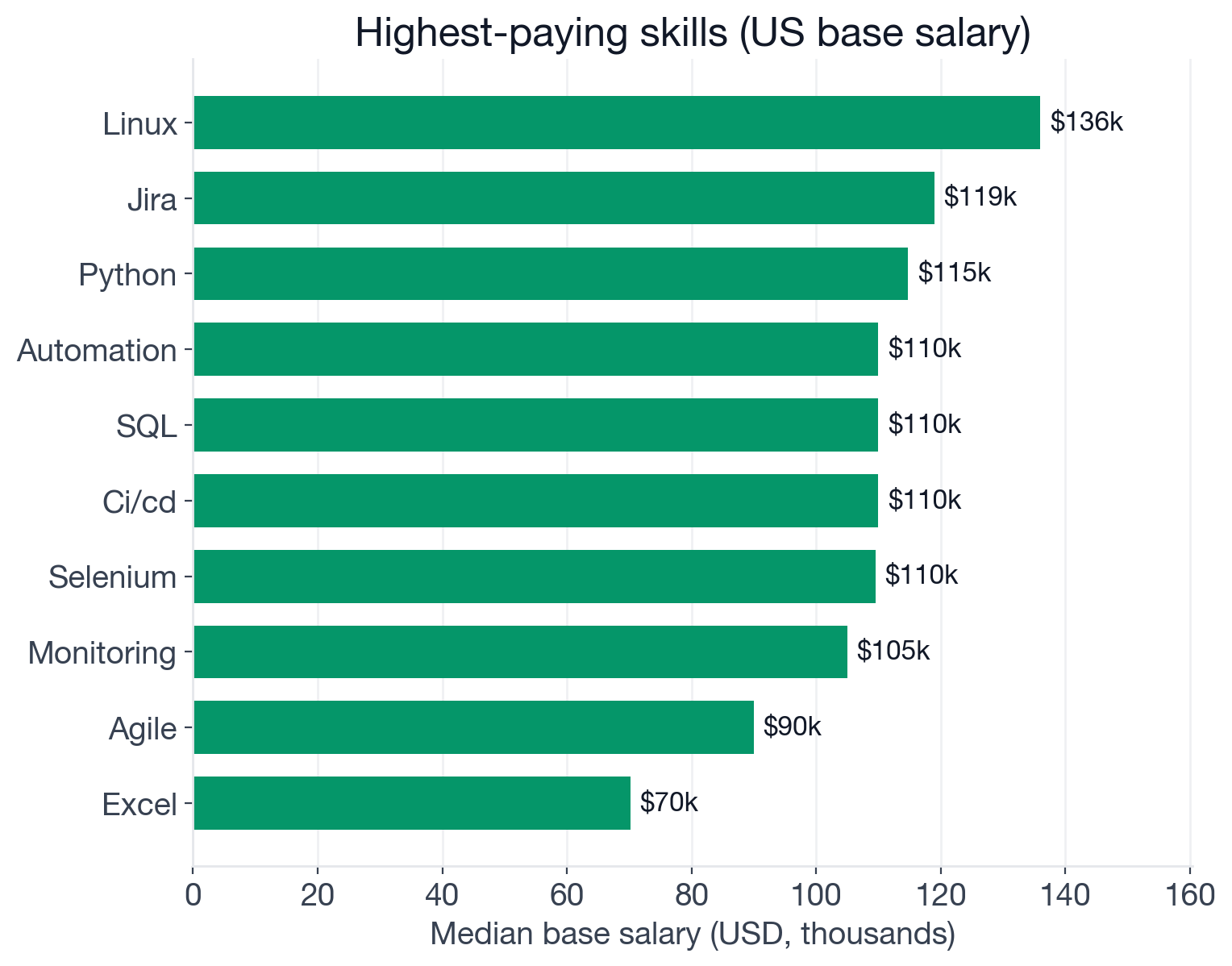
Median US base salary in USD for postings that mention each skill. US QA Engineer postings with disclosed salary data only (n=2,728). Skills require n>=25 to appear.
Skills commanding $10,000 or more above the $92,100 baseline:
- Python: $110,000 (n=563), a $17,900 premium. Scripting ability is the clearest single differentiator on the salary curve. QA engineers who author automation frameworks in Python are not interchangeable with those who configure pre-built tools.
- Linux: $110,000 (n=195), a $17,900 premium. Linux knowledge in a QA context points to backend testing, embedded systems, or DevOps-adjacent work: environments where Linux is a first-class requirement and the pay grade reflects broader engineering scope.
- CI/CD: $109,000 (n=241), a $16,900 premium. Test engineers who build pipeline-integrated test suites command different rates than those who run tests manually.
- Automation: $105,000 (n=725), a $12,900 premium. Even the broad automation category (not a specific framework) pulls salary upward, confirming that companies price automation expertise as a distinct and higher-value tier than process-only QA.
- SQL: $103,600 (n=168), an $11,500 premium. Backend validation work earns more than pure UI testing.
A mid-range signal:
- Jira: $100,000 (n=275), a $7,900 premium. This figure likely reflects company quality more than Jira expertise itself. Tech and fintech companies that pay QA engineers well also tend to run on Jira universally. The signal is real, but the causal relationship is weak.
- Selenium: $95,000 (n=168), a $2,900 premium. The directional message (Selenium expertise clusters with automation roles) still holds, but the premium is modest compared to Python or CI/CD.
At or below baseline:
- Agile: $92,000 (n=378), essentially at the $92,100 baseline. Process methodology alone, without coding ability, does not move salary.
- Monitoring: $86,000 (n=454), $6,100 below baseline. This is the most important reframe in the salary data. Monitoring without scripting skills is the process-oriented QA profile: manual oversight of dashboards and alerts, common in manufacturing and regulated-industry settings, which sits at or below the pay floor. Monitoring combined with Python and CI/CD is a different profile entirely, and its salary reflects that.
- Excel: $83,100 (n=396), $9,000 below baseline. Excel in a QA context signals manual test management and older-generation tooling. The companies still using Excel for test tracking are largely in lower-margin industries or lower-cost geographies.
The picture compresses to a single insight: the delta between a manual QA engineer who knows Agile and Jira and an automation engineer who knows Python and CI/CD is roughly $18,000 in US base salary. If you are currently in QA without scripting skills, the salary data is one of the more direct arguments for building them.
What Is the Dominant QA Engineer Skill Stack?
Co-occurrence across the top 25 skills reveals which pairs appear together more often than their individual frequencies would predict. Lift above 1.0 means the combination shows up together more than chance.
| Skill pair | Postings with both | % of postings | Lift |
|---|---|---|---|
| Java + Selenium | 683 | 4.1% | 5.77 |
| CI/CD + Playwright | 697 | 4.2% | 5.53 |
| Agile + Scrum | 1,009 | 6.1% | 5.16 |
| Agile + Postman | 750 | 4.5% | 3.64 |
| Automation + Selenium | 1,347 | 8.2% | 3.14 |
| Automation + CI/CD | 1,644 | 10.0% | 2.95 |
| Automation + Python | 1,737 | 10.5% | 2.57 |
| Agile + Automation | 1,870 | 11.3% | 2.40 |
Java + Selenium (lift 5.77) is the highest-lift pair in the dataset. Java-based Selenium suites are the enterprise default: organizations that built their automation infrastructure years ago and have not migrated. When a posting asks for Java and Selenium together, it is almost certainly a backend or full-stack testing role in an enterprise or regulated-industry environment. The pair appears in only 4.1% of postings in absolute terms, but the concentrated demand is real and represents a distinct career path.
CI/CD + Playwright (lift 5.53) is the highest-lift pair among modern automation combinations, and the highest of any CI/CD-plus-framework pairing. Playwright-based test suites do not sit in a folder on someone's laptop. They run in CI/CD pipelines triggered by pull requests, using Jenkins (the open-source CI/CD automation server widely used to schedule test runs, alongside GitHub Actions). If you learn Playwright, you will learn to wire it into a pipeline as part of the same workflow.
Agile + Scrum (lift 5.16) has the highest lift of any process-methodology pair, which makes sense: Scrum is a specific implementation of Agile, so teams practicing Scrum are almost definitionally tagged as Agile. The pair belongs on every resume targeted at a software development team.
Agile + Postman (lift 3.64): API testing is now a standard part of the Agile QA workflow. Postman validates the HTTP contract on each sprint; SQL (or database inspection) verifies the state change underneath. Postings that ask for both reflect a QA engineer expected to cover more than UI behavior.
Automation + Python (lift 2.57) is the core scripting pair. Companies using automation as a generic requirement disproportionately also ask for Python, because Python-based frameworks (pytest, Robot Framework, and custom scripts) have become the default for custom test automation. Browse QA Engineer openings that combine Automation and Python.
Two recognizable stack profiles emerge from the data: a process-oriented profile (Agile + Scrum + Jira + Postman) that is common but clusters near the salary floor, and an automation engineering profile (Python + CI/CD + Playwright or Selenium + SQL) that commands the $105-110K US median and is where job-posting demand is moving. Both are viable careers; they are not the same career.
Who's Hiring at Which Seniority Level?
Seniority is tagged by title keywords. Postings with no explicit signal default to mid-level.
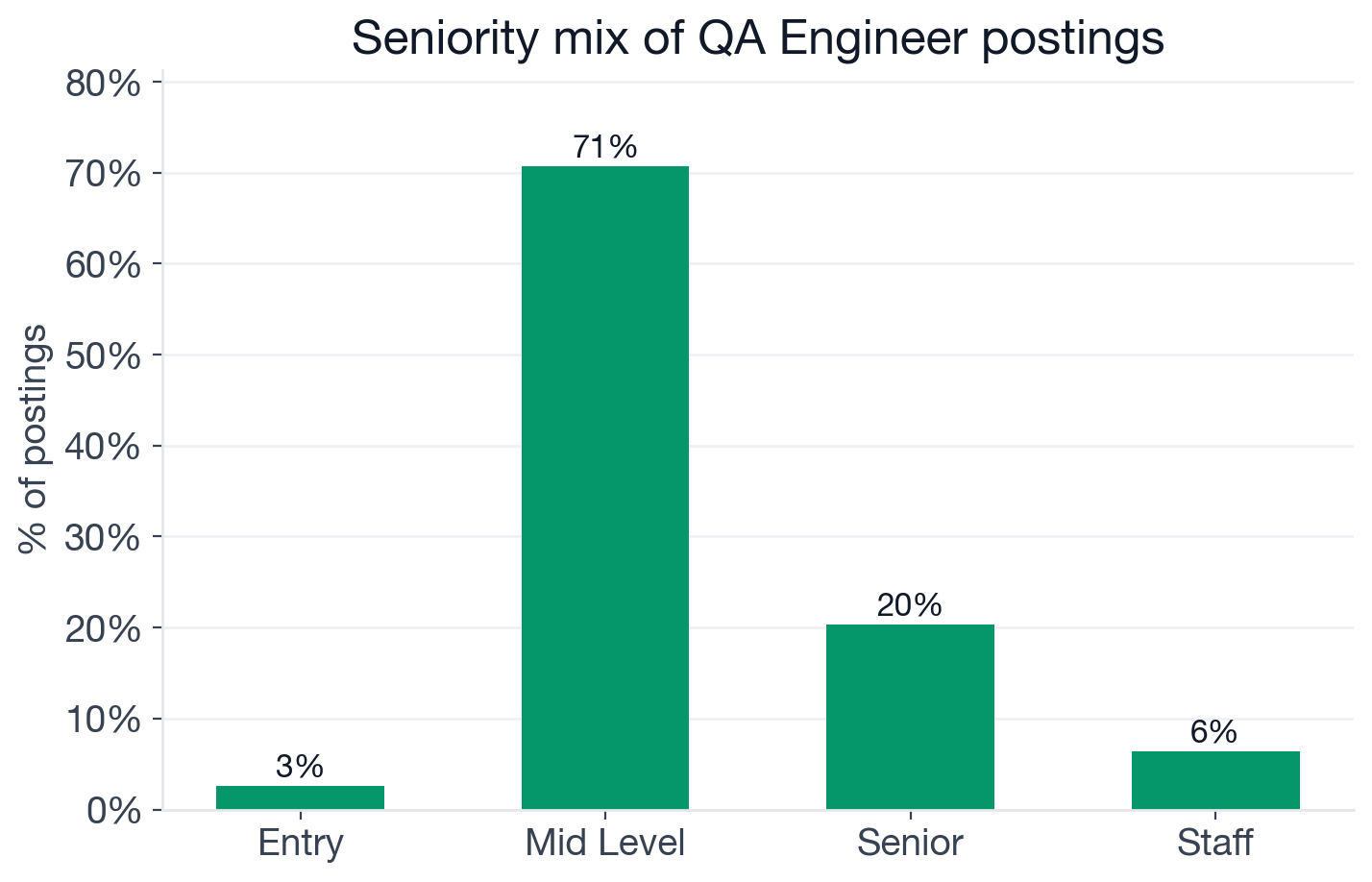
Seniority distribution across 16,491 QA Engineer postings, May 2026.
- Mid-level: 72.3% (11,930 postings)
- Senior: 15.9% (2,624 postings): browse senior QA Engineer openings
- Staff / Lead: 7.8% (1,281 postings)
- Entry: 4.0% (656 postings)
The mid-level concentration at 72.3% is among the highest of any role analyzed on this board. QA Engineering has a thin entry tier: only 656 postings explicitly target junior or entry-level candidates, roughly 1 in 25 openings. Companies are not budgeting to build QA talent from scratch. They are hiring people who already know how to find bugs and write tests.
The relatively slim senior tier (15.9%) compared to Data Engineering at 31% also means fewer explicit pathways upward once you are in. Career progression in QA tends to move toward QA lead, QA manager, or a pivot into software engineering proper for those who have built strong coding skills along the way. The staff tier (7.8%) concentrates at companies with mature QA platforms: larger tech firms, defense contractors, and regulated-industry employers where quality processes are formalized enough to need an engineering lead.
Where Are QA Engineer Jobs Located, and How Remote-Friendly Are They?
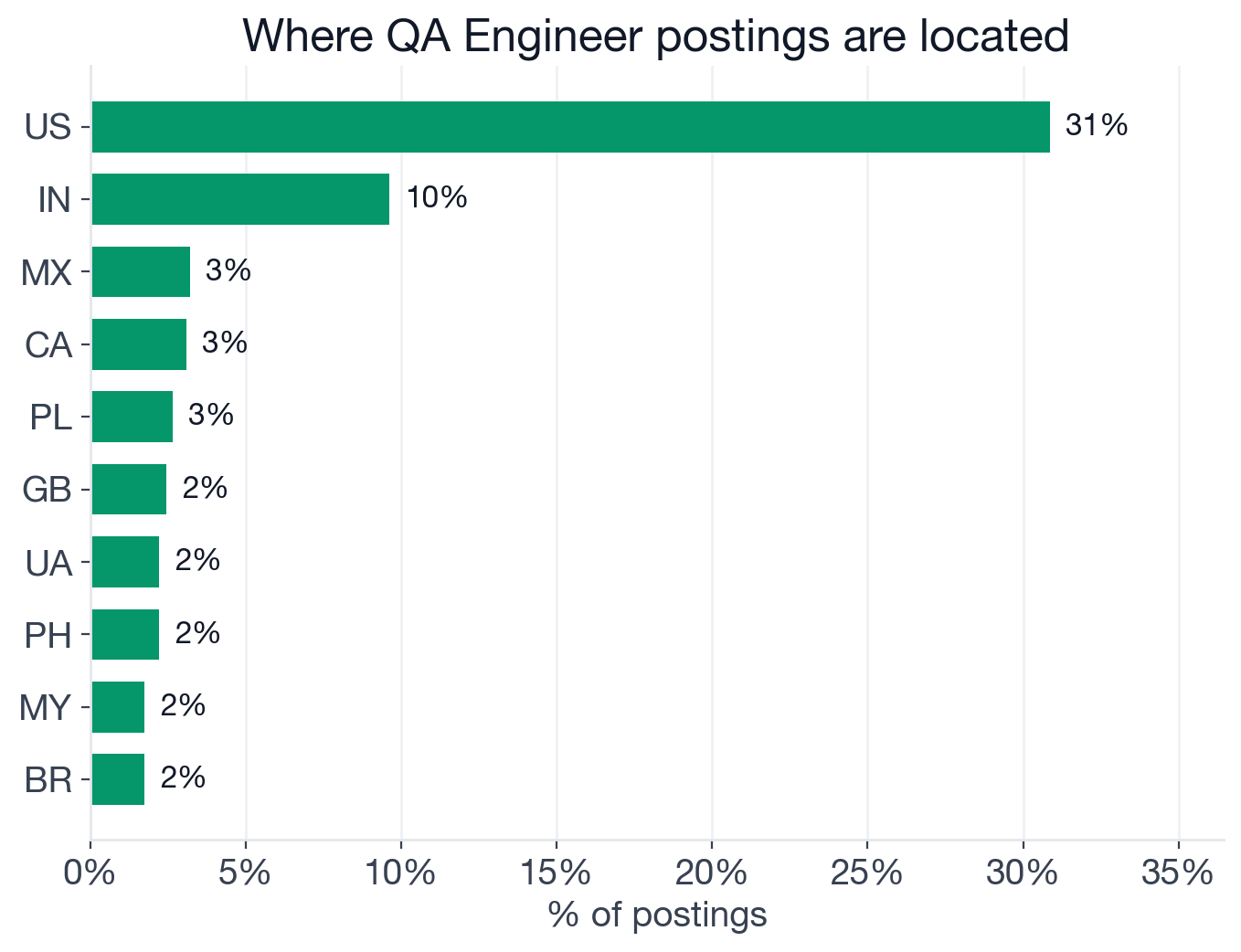
Top countries by share of QA Engineer postings, May 2026.
- United States: 41.6% (6,857 postings): US-only QA Engineer openings
- India: 7.9% (1,299)
- Canada: 3.9% (650)
- United Kingdom: 2.4% (403)
- Germany: 2.3% (378)
- Mexico: 2.3% (378)
- Philippines: 2.2% (371)
- Malaysia: 1.5% (246)
- Poland: 1.2% (194)
The US is the dominant market at 41.6%, notably larger than India's share (7.9%). Compared to Data Engineering, QA demand distributes more broadly across continental Europe (Germany, Poland) and Southeast Asia (Philippines, Malaysia), reflecting both cost arbitrage for manual testing work and the growth of QA-focused software services firms in those regions.
The work-mode picture is among the most onsite-heavy of any role analyzed:
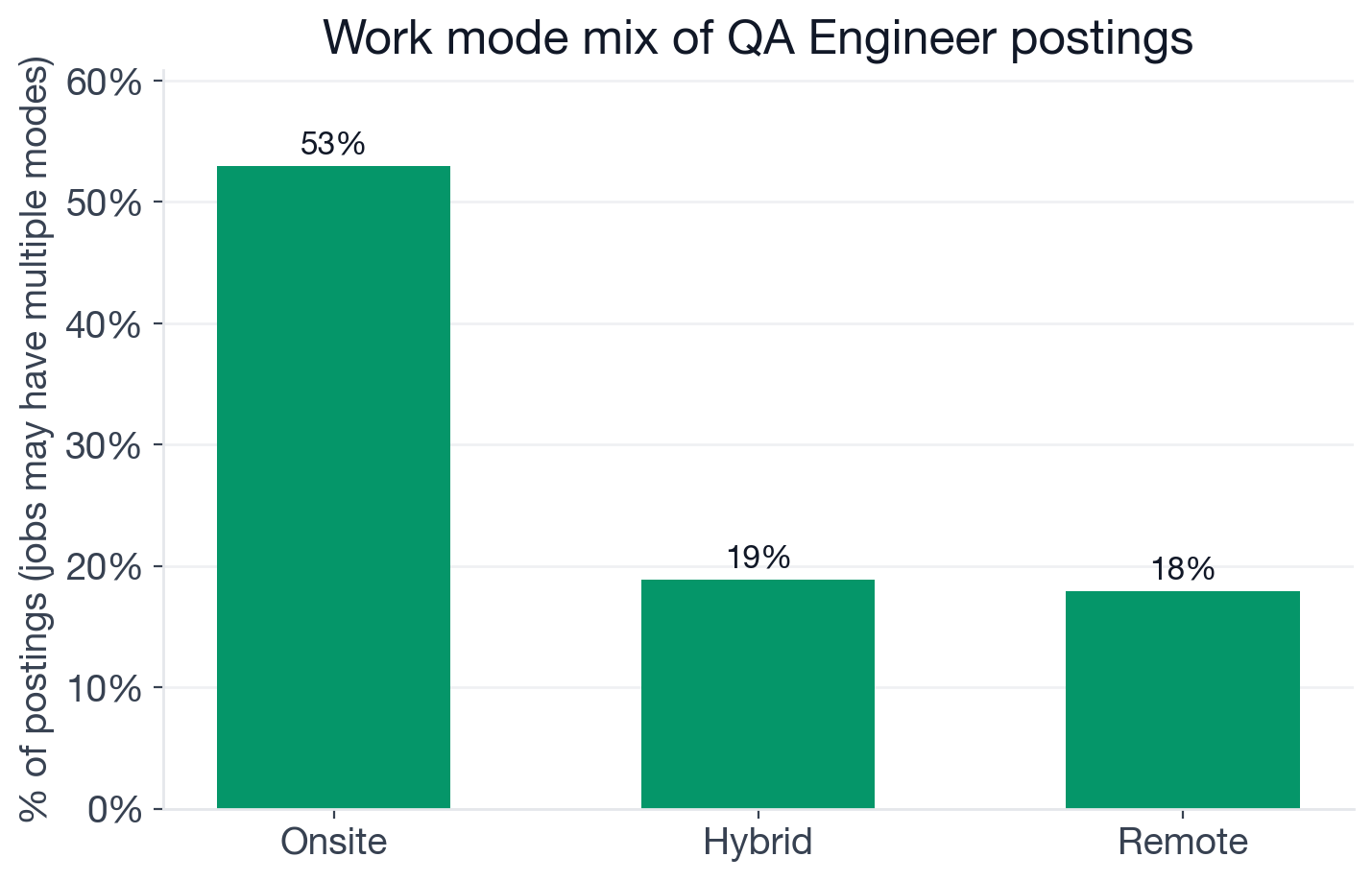
Work mode distribution across QA Engineer postings. Some postings carry multiple tags.
- Onsite: 62.2% (10,265 postings)
- Hybrid: 16.2% (2,669)
- Remote: 9.9% (1,625)
About three in five QA Engineer postings are onsite. The reason is visible in the industry breakdown: manufacturing (8.2% of postings), healthcare (7.9%), and aerospace (4.9%) all require physical environments for hardware testing, device validation, and on-site production support. A QA engineer at Jabil Inc. testing circuit board assemblies or at Abbott Laboratories validating medical devices cannot run those tests over a VPN. Even in software-only companies, security-sensitive and compliance-heavy products default to onsite QA. Fully remote QA Engineer openings exist but represent roughly 1 in 10 listings.
Who's Hiring QA Engineers in 2026?
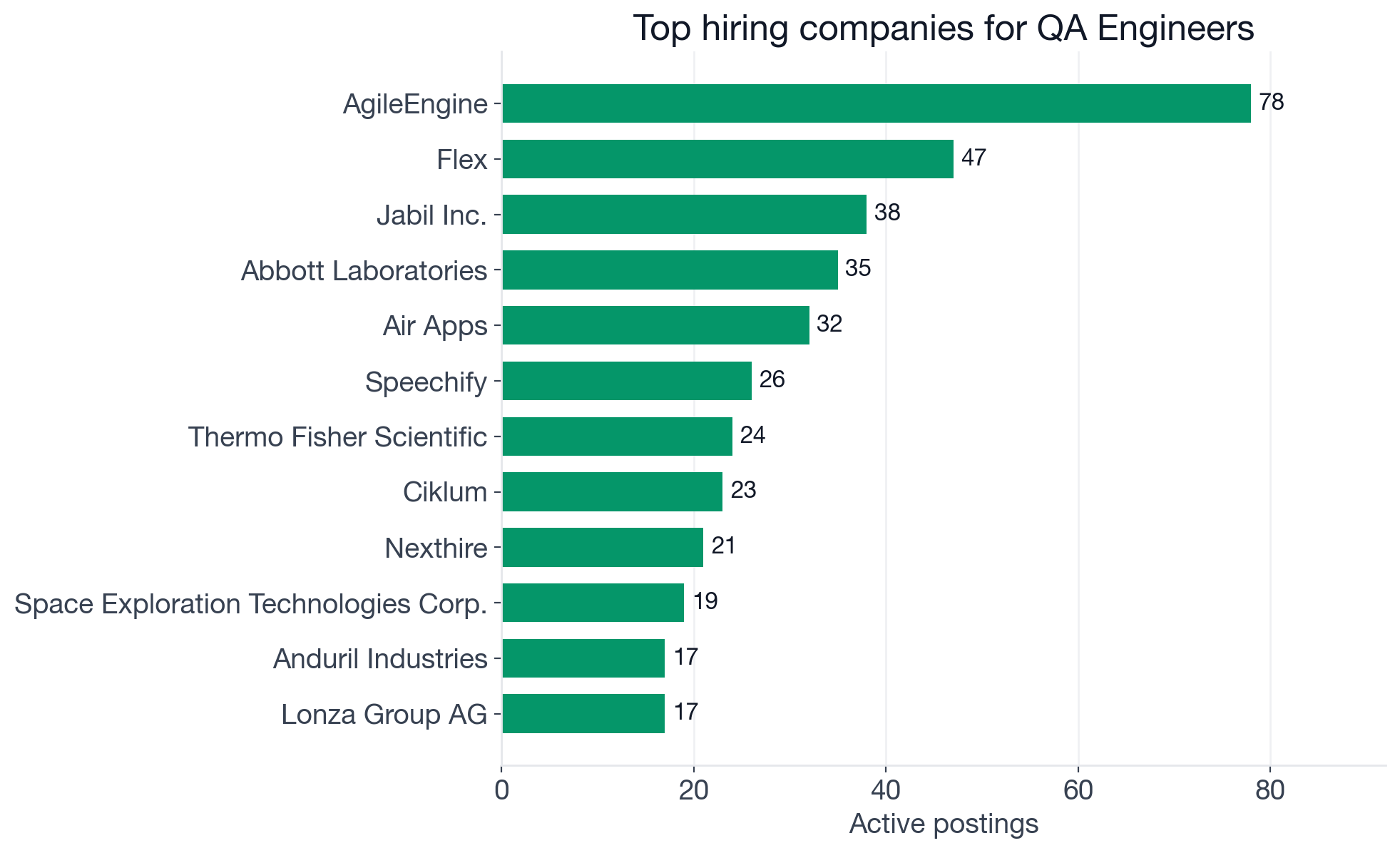
Top companies by active QA Engineer postings, May 2026.
- Abbott Laboratories: 250 (medical devices)
- Flex: 180 (electronics manufacturing)
- Jabil Inc.: 142 (electronics manufacturing)
- Thermo Fisher Scientific: 120 (life sciences)
- globalhr: 94 (staffing / HR services)
- Tasq Staffing Solutions: 86 (staffing)
- Northrop Grumman Corporation: 82 (defense / aerospace)
- QatarGas: 81 (energy / industrial)
- IQVIA: 79 (healthcare data / CRO)
- Anduril Industries: 79 (defense technology)
- AgileEngine: 77 (software services)
- Medtronic: 73 (medical devices)
- Space Exploration Technologies Corp.: 71 (aerospace)
- Johnson & Johnson: 68 (healthcare / medical devices)
The top hiring companies tell a clear story: QA Engineering demand comes overwhelmingly from regulated industries where quality failures carry legal, safety, or financial consequences. Flex, Jabil, Northrop Grumman, and QatarGas are manufacturers and industrial operators where hardware quality is mission-critical. Abbott, Thermo Fisher, Medtronic, IQVIA, and Johnson & Johnson are life sciences and healthcare companies where quality control is a legal requirement governed by FDA and ISO standards. Anduril and Space Exploration Technologies operate in aerospace and defense, where testing failures carry physical consequences. AgileEngine, globalhr, and Tasq Staffing Solutions are staffing and software services firms that place QA talent across these industries.
For job seekers, the industry concentration matters practically. QA at a fintech or consumer app means automating web and API tests; QA at a medical device company means validation protocols, IQ/OQ/PQ documentation (Installation, Operational, and Performance Qualification records mandated by FDA and ISO), and FDA audit trails. The skills on a resume need to match the industry, not just the role title. Our interview preparation guides cover company-specific process expectations for many of the tech employers in this list.
How to Use This in Your Job Search
Match your toolset to your target market. The most important split is between web and API automation (Selenium, Playwright, Cypress, Postman, Python or JavaScript) and regulated-industry QA (TestRail, Jira, manual testing protocols). Both have demand, but the automation profile pays roughly $18,000 more at the US median and is the direction the broader market is moving. If you are targeting software or tech companies, the Playwright + CI/CD + Python stack (lift 5.53 for the CI/CD-Playwright pair) is the most valuable combination to build. Browse Python-focused QA Engineer openings to see what companies pairing code and testing actually look like.
Pick your automation framework based on your target company type. All three main web frameworks appear in meaningful numbers, but they are not interchangeable. Selenium is the established enterprise standard, strongest with Java (Java + Selenium has the highest co-occurrence lift in the entire dataset at 5.77). Playwright is the modern choice for TypeScript and JavaScript teams running CI/CD. Cypress is the JS-native option preferred by frontend-heavy teams. One practical default: start with Playwright if you are building fresh (it has the highest pairing lift with CI/CD), but be ready to use Selenium when a job description asks for it.
Add SQL to your automation skills. Backend validation is where QA roles command higher salaries, because it requires understanding both the API contract and the underlying data model. If you can fire a Postman request and then verify database state with a SQL query, you are in a different conversation than a candidate who only validates the HTTP response. QA Engineer roles combining SQL and automation tend to skew more senior and better compensated.
Practice under conditions that match the interview. Our interactive courses cover the software engineering fundamentals, SQL, and system design concepts that QA automation interviews test. The question bank lets you drill specific topics: SQL queries, REST API concepts, CI/CD pipeline design. AI mock interviews let you run live practice scenarios with on-demand feedback, including behavioral questions about how you have found, reported, and tracked down real bugs in production systems.
FAQ
Q. What skills do companies want for QA Engineer roles in 2026?
Only one skill clears the common tier (20-50%): Automation at 27.5% across 16,491 analyzed postings. No other skill reaches 20%. The differentiator tier spans Agile (17.2%), Monitoring (15.8%), Python (14.9%), Excel (12.4%), CI/CD (12.3%), Jira (12.3%), SQL (9.7%), and Selenium (9.5%), reflecting the role's fragmentation across testing disciplines and industries.
Q. What is the median salary for a QA Engineer in 2026?
Among US postings with disclosed salary data, the median QA Engineer base salary is $92,100 (n=2,728 postings). Equity and bonus are not captured in job posting data, so total compensation at top employers runs meaningfully higher than these figures.
Q. Which QA Engineer skills command the highest salary premium?
Python ($110,000 US median, n=563), Linux ($110,000, n=195), and CI/CD ($109,000, n=241) post the largest premiums above the $92,100 baseline: roughly +$17,900 for Python and Linux, +$16,900 for CI/CD. Automation ($105,000, n=725) adds $12,900. SQL ($103,600, n=168) adds $11,500. Monitoring sits $6,100 below the baseline ($86,000, n=454), a signal that process-oriented QA without scripting skills earns below the role median. Excel sits $9,000 below baseline ($83,100), confirming manual-testing-heavy roles command lower pay.
Q. Should I learn Selenium, Playwright, or Cypress for QA automation?
All three appear in 2026 postings: Selenium at 9.5%, Playwright at 6.2%, and Cypress at 4.0% of QA Engineer listings. CI/CD plus Playwright has a co-occurrence lift of 5.53, the highest of any CI/CD-plus-framework pairing, making Playwright the preferred choice for teams running continuous integration pipelines. Java plus Selenium (lift 5.77) has the highest overall lift in the dataset, indicating that enterprise Java-based Selenium suites remain common in backend and regulated-industry settings.
Q. How hard is it to break into QA Engineering at the junior level?
Entry-level postings are just 4.0% of QA Engineer listings (656 of 16,491), with 72.3% tagged mid-level. That works out to roughly 1 in 25 openings explicitly targeting juniors. Candidates transitioning in typically come from manual testing, junior developer, or software support roles.
Q. Where are most QA Engineer jobs, and how remote-friendly is the role?
The United States leads at 41.6% of postings (6,857 of 16,491), followed by India at 7.9%. QA Engineering skews heavily onsite: 62.2% of postings are onsite, 16.2% hybrid, and 9.9% remote. The high onsite rate reflects demand from manufacturing, hardware, and regulated-industry employers that require physical testing environments.
Q. Which companies hire the most QA Engineers in 2026?
The top hirers in our May 2026 dataset are Abbott Laboratories (250 postings), Flex (180), Jabil Inc. (142), Thermo Fisher Scientific (120), globalhr (94), Tasq Staffing Solutions (86), Northrop Grumman Corporation (82), QatarGas (81), IQVIA (79), and Anduril Industries (79). The list is dominated by regulated-industry manufacturers, life sciences companies, and defense contractors, with staffing firms and software services filling the rest.
Final Thoughts
QA Engineering in 2026 is two adjacent careers wearing the same title. The test automation engineer, who writes Python, ships tests through CI/CD pipelines, and validates backend state with SQL, commands the $105-110K US median. The process-oriented QA specialist, who manages test cases, runs Agile ceremonies, and files bug reports, sits closer to the $92K floor. The industry footprint of QA (manufacturing, healthcare, aerospace, software, defense) means there is genuine demand for both profiles. But the salary data, the co-occurrence data, and the direction of the role all point toward automation engineering as the higher-ceiling path. Pick a scripting language, pick a framework that connects to a CI/CD pipeline, and learn enough SQL to verify the database, not just the UI. That combination is where the market is headed.
Topics
Ready to practice?
Put what you've learned into practice with AI mock interviews and structured preparation guides.