
Research Informs the Roadmap. PM Owns It.
Product managers and design researchers sit at the same product development table: one generates user insight, the other decides what to do with it. But the labor market doesn't treat that collaboration as an equal partnership. There are 39 times as many open Product Manager roles as Design Researcher roles right now, and PMs earn a median $50,600 more in US base pay. The two roles share exactly half their top-30 skill sets, and the exclusive territory that belongs to Design Researcher alone narrows to a single tool.
These 15,128 Product Manager and 388 Design Researcher active postings on the InterviewStack.io job board as of June 2026 tell a consistent story: the market prices the role that synthesizes insight into action at a steep premium over the role that generates it.
Key Findings
- Product Manager: 15,128 active postings. Design Researcher: 388. A 39x volume difference; PM is one of the broadest roles in the product domain.
- Median US base salary: $140,600 for PM vs. $90,000 for Design Researcher: a $50,600 gap (US-only, base salary; equity and bonus excluded).
- Three skills are shared at meaningful rates: Agile (PM 27%, DR 16%), Excel (PM 8%, DR 11%), and Machine Learning (PM 5%, DR 7.2%).
- PM has six exclusive skills above the 8% threshold. Design Researcher has one: Figma (14%).
- Jaccard overlap coefficient: 0.50: half the top-30 skill sets are common ground.
- Entry-level postings are tight for both: 4.3% for PM, 3.4% for Design Researcher.
- Design Researcher postings mention AI at a higher explicit rate: Generative AI in 8% of DR postings versus 4.8% for PM. That gap reflects specialist hiring on AI products, not an ambient fluency gap: industry surveys consistently show majority AI tool adoption across both roles.
- PM salary premiums attach to AI and infrastructure skills: LLMs ($159K), Observability ($165K), and Machine Learning ($157K) all sit $17K to $24K above the $140,600 baseline.
The Short Answer
Product Managers earn a median US base salary of $140,600 versus $90,000 for Design Researchers, a $50,600 gap, with 39 times more PM openings active in the current market. If you want scope, volume, and the higher salary ceiling, PM is the clearer path. If your core strength is structured inquiry and you want to specialize in user insight rather than own roadmap calls, Design Researcher is a real niche, but it comes with a smaller job pool and significantly lower pay.
| Product Manager | Design Researcher | |
|---|---|---|
| Active postings | 15,128 | 388 |
| Median US base salary | $140,600 | $90,000 |
| Top skill | Agile (27%) | Agile (16%) |
| Remote share | 24% | 25% |
| Entry-level share | 4% | 3% |
| Skill overlap (Jaccard) | 0.50 (50% shared) | N/A |
What Does Each Role Actually Do?
Product Manager owns the product roadmap and makes the calls about what to build and when. The work is synthesis: gathering signals from customers, data, design, engineering, and sales, then translating those signals into prioritized requirements. PMs carry accountability for whether the product solves the right problem, and their exclusive skills reflect that execution mandate. Scrum, Jira, APIs, SQL, and Automation all point to a role that lives at the intersection of strategy and delivery.
Design Researcher generates the user insight that informs product decisions. The work is structured inquiry: running interviews, usability studies, and surveys, then synthesizing findings into patterns PMs and designers can act on. The "Design Researcher" classification in the job market is a broad bucket in practice, covering UX Researchers, User Researchers, and Instructional Designers. A review of job titles in this dataset shows roughly 60% are UX or User Researcher titles and approximately 35% are Instructional Designer titles (an L&D-adjacent specialty that designs learning experiences rather than product research). The skill profile, salary figure, and volume numbers below reflect this blended population; readers targeting pure UX Research roles should treat these figures as directional rather than exact benchmarks for that specialty. The shared thread across the category is systematic investigation of human behavior. The role's exclusive skill footprint narrows to Figma, used to create prototypes, research stimuli, and visual deliverables, pointing to a role that intersects with design process rather than delivery management.
What Skills Do Both Roles Require?
Both roles share three skills at a meaningful rate: Agile, Excel, and Machine Learning.
Agile's presence in both (27% of PM postings, 16% of DR postings) reflects the iterative sprint context both roles work within. Excel shows a baseline data fluency expected of both. Machine Learning's appearance at low but real rates (5% and 7.2%) signals that neither role is hired to build ML models, but both are expected to understand what AI systems can and cannot do when making product or research decisions.
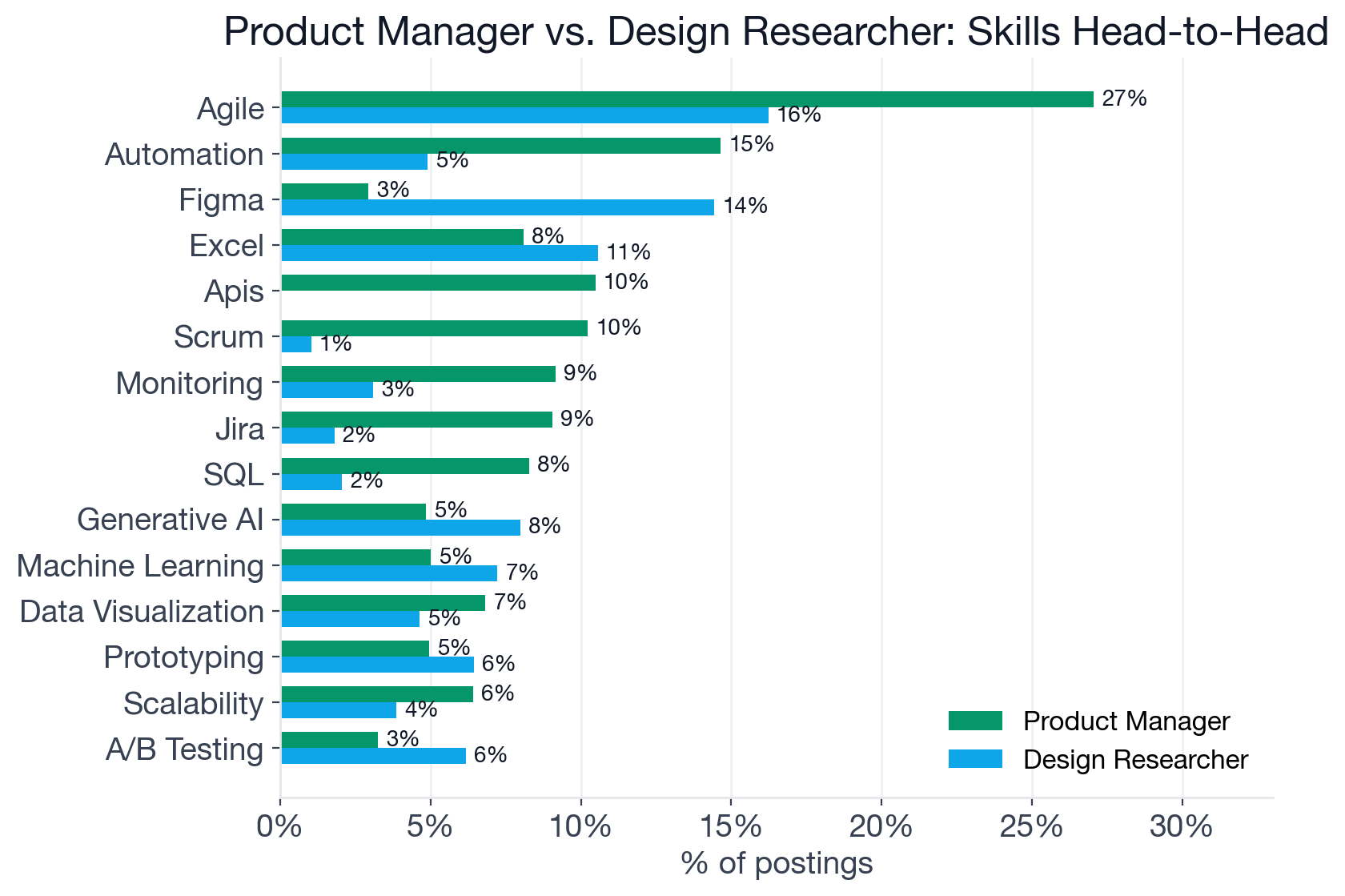
Top skills across both roles. The three shared skills (Agile, Excel, and Machine Learning) anchor the common ground.
The 50% Jaccard coefficient means that for someone considering a transition between these roles, the base is meaningful. The other half is where they genuinely fork.
Where Do the Roles Diverge?
Skills exclusive to Product Manager (present in 8%+ of PM postings, under 5% of DR postings):
- Automation (14.6%): Managing workflows, notifications, and automated pipelines is part of the PM's delivery surface
- APIs (10.5%): PMs are expected to read API documentation and spec integrations, a technical floor most tech PM roles now enforce
- Scrum (10.2%): Sprint planning, backlog grooming, and ceremony cadence are day-to-day PM execution
- Monitoring (9.1%): Tracking product health, alerts, and operational dashboards falls inside PM scope
- Jira (9.0%): Standard delivery-tracking tool across engineering teams globally
- SQL (8.3%): PMs at most tech companies are expected to query data directly rather than wait on analysts
Exclusive skill for Design Researcher (present in 8%+ of DR postings, under 5% of PM postings):
- Figma (14.4%): Used to create research stimuli, annotate flows, and communicate findings visually to product and design stakeholders
Six exclusive PM skills versus one for Design Researcher. That asymmetry isn't a tooling coincidence. It reflects how much wider the PM's operational surface is: strategy, delivery, technical alignment, and data all in scope. Design Researcher goes deep on a narrower, more specialized inquiry discipline, and the market prices that width premium at $50,600.
Which Pays More: Product Manager or Design Researcher?
Product Managers earn a median US base salary of $140,600, based on 3,662 US postings with salary disclosed. Design Researchers earn $90,000 (n=85 US postings). Both are base salary only from posting disclosures; equity and bonus are not reflected.
Two caveats on the Design Researcher figure. First, 85 data points is a small sample. Second, the category spans UX Researchers and Instructional Designers, two distinct career paths with different compensation ranges. Treat $90,000 as a directional estimate for the blended category. UX Researcher roles in the US typically command higher salaries than Instructional Designer roles, so this blended median likely understates what a pure UX Research role pays. The direction of the gap versus PM is unambiguous though.
For Product Managers, the skills that lift salary highest are not the traditional process credentials. They are AI fluency and technical infrastructure depth:
| Skill | Median US Salary | Premium over $140,600 | Sample |
|---|---|---|---|
| Observability | $164,800 | +$24,200 | 162 |
| Machine Learning | $157,300 | +$16,700 | 248 |
| LLMs | $159,100 | +$18,500 | 200 |
| Generative AI | $148,100 | +$7,500 | 276 |
| APIs | $150,000 | +$9,400 | 472 |
| A/B Testing | $150,000 | +$9,400 | 155 |
The traditional PM process skills pull salary below the baseline: Agile postings median at $127,000 ($13,600 below), Jira at $125,000 ($15,600 below), Scrum at $120,000 ($20,600 below). The market is rewarding technical depth and AI fluency, not process credential.
No skill-level salary data is available for Design Researcher; the total US sample of 85 postings does not support per-skill breakdowns at the 25-posting minimum.
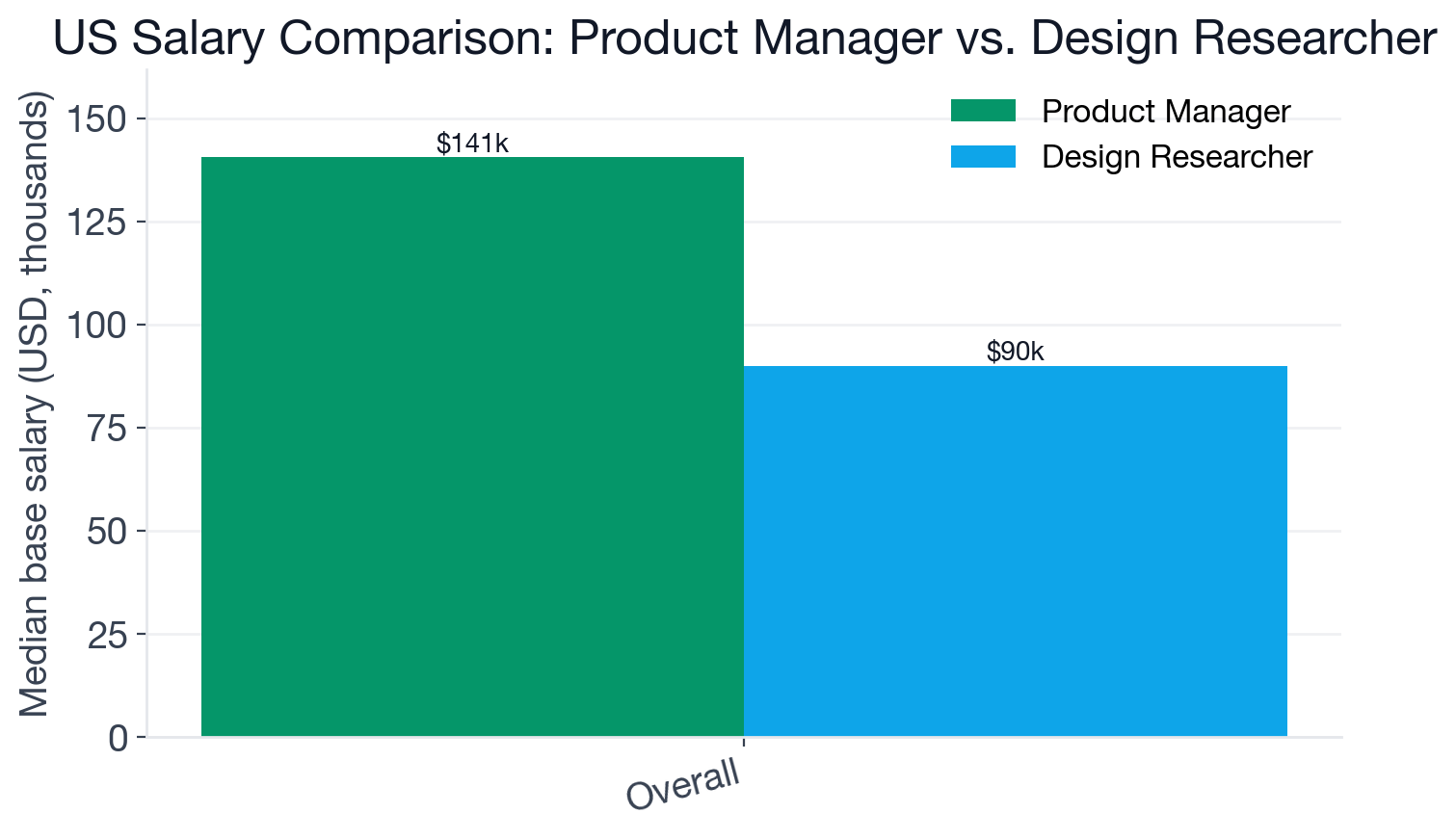
Median US base salary. Base only; equity and bonus excluded. Design Researcher figure based on n=85.
Which Has More Job Openings?
Product Manager has 15,128 active postings versus 388 for Design Researcher. That 39x ratio appears across industries, company sizes, and geographies: PM is a generalist product role that scales everywhere; Design Researcher is a specialty that appears predominantly at companies with mature research practices.
The seniority mix looks similar at mid-level, but diverges at the top:
| Product Manager | Design Researcher | |
|---|---|---|
| Entry-level | 4.3% | 3.4% |
| Mid-level | 59.6% | 66.2% |
| Senior | 25.3% | 26.0% |
| Staff / Principal | 10.8% | 4.4% |
PM has a meaningful staff and principal tier (10.8%) versus 4.4% for Design Researcher, reflecting the "Staff PM" and "Principal PM" career track that exists at most mid-to-large tech companies. Design Researcher has a narrower labeled ceiling.
Work mode is comparable: 24% remote and 44% onsite for PM; 25% remote and 48% onsite for Design Researcher. Both lean more onsite than many pure-tech roles. The US dominates both markets (43% of PM postings, 44.6% of DR postings). India accounts for 6.4% of PM openings but only 4.1% of DR postings, a gap that may reflect the higher demand for culturally-proximate researchers, though the data does not confirm this directly.
Which Should You Choose?
Choose Product Manager if you:
- Want to own decisions rather than generate evidence for them: PM carries accountability for the roadmap
- Are comfortable acquiring technical delivery skills: SQL, APIs, Jira, and Scrum are explicit expectations in PM postings
- Want the broadest possible job market and the ability to work across any industry vertical
- Come from business, engineering, analytics, or customer success (the most common PM entry paths)
- Care about a high salary ceiling: AI-fluent PMs earn $157K to $165K at the median, and the role scales to Staff and Principal levels at most companies
Choose Design Researcher if you:
- Have a core strength in structured inquiry: interviews, usability testing, synthesizing qualitative data into recommendations
- Want to specialize in human behavior research rather than manage roadmaps and delivery cycles
- Have a background in UX, psychology, social science, or instructional design (these map directly to the role's methods)
- Are comfortable working in a smaller, more selective job market where roles are concentrated at companies with dedicated research functions
How to Use This in Your Job Search
If you're targeting Product Manager roles, the skill data shows two distinct investment bets. One is process fluency: Agile, Scrum, and Jira appear in the majority of postings and represent the table stakes for getting past screening. The other is technical depth: SQL, APIs, and increasingly AI skills like LLMs and Generative AI are what move salary above the baseline. Use AI mock interviews to practice the technical and behavioral PM scenarios hiring teams lean on, or drill specific topic areas through the question bank.
For Design Researcher openings, postings cluster around UX research methods, Figma fluency, and growing AI tool integration. The smaller market means each application carries more weight. Interview-prep courses cover the research frameworks and case structures hiring teams test for.
For more context on the PM side, see the Product Manager skills deep dive and the AI shift analysis for Product Management.
FAQ
Q. What is the salary difference between Product Manager and Design Researcher?
Product Managers earn a median US base salary of $140,600 (across 3,662 postings with US salary disclosed) versus $90,000 for Design Researchers (n=85). The $50,600 gap reflects the broader scope PMs carry. The Design Researcher figure is a blended median across UX Researchers and Instructional Designers (two distinct specialties within the classifier), so treat it as directional rather than a precise benchmark for either path. Equity and bonus are excluded from posting salary data, so total comp at top employers is higher for both roles.
Q. How many job openings are there for Product Manager vs. Design Researcher?
There are 15,128 active Product Manager postings versus 388 for Design Researcher, a nearly 39x volume difference. PM is one of the largest roles in the product domain; Design Researcher is a niche specialty. That ratio affects how quickly you can find a role and which industries are genuinely accessible.
Q. What skills do Product Managers and Design Researchers share?
Both roles share three skills at meaningful overlap rates: Agile (PM 27%, DR 16%), Excel (PM 8%, DR 11%), and Machine Learning (PM 5%, DR 7.2%). The Jaccard similarity across their full top-30 skill sets is 0.50, meaning roughly half the skill territory is shared between the two roles.
Q. Can you transition from Design Researcher to Product Manager?
Yes, and it is a recognized path. The 50% skill overlap means your research foundation transfers directly. The main gaps are execution tools: PMs are expected to know SQL (in 8.3% of postings), APIs (10.5%), Jira (9%), and Scrum (10.2%). Design Researchers who invest in those areas and pick up product delivery concepts are well-positioned to make the move.
Q. Which role is easier to break into as an entry-level candidate?
Both roles are overwhelmingly mid-level. Entry-level postings account for just 4.3% of PM openings and 3.4% of Design Researcher openings, so neither is a strong first landing spot for career changers without relevant experience. PMs often enter through adjacent roles like business analyst or technical program manager; Design Researchers typically come from UX, psychology, or social science backgrounds.
Q. How do AI skill expectations differ between Product Manager and Design Researcher postings?
Design Researcher postings mention AI at a higher explicit rate: Generative AI appears in 8% of DR postings versus 4.8% for PM, and Machine Learning in 7.2% versus 5%. Those figures measure practitioners hired specifically to work on AI products or research. Ambient AI usage is much broader: industry surveys consistently show majority adoption of AI tools in both roles: PMs for writing specs, roadmaps, and prototyping; UX researchers for data analysis and interview transcription.
Q. Where are Product Manager and Design Researcher jobs located?
Both roles are US-dominant: 43% of PM postings and 44.6% of DR postings are based in the US. For PMs, the next-largest markets are India (6.4%), the UK (5.1%), and Canada (4.9%). For Design Researchers, Canada (6.4%), the UK (4.9%), and India (4.1%) follow. Remote share is similar: 23.7% for PM versus 24.7% for DR.
Before You Pick a Lane
The data draws a clear boundary: Product Management is a high-volume, broad-scope role that pays $51K more and opens into 39 times as many active positions. Design Research is a specialty that runs deep on user inquiry and shows up significantly only at companies with mature research functions. Half the skills transfer if you want to cross over later. Browse open Product Manager roles or Design Researcher openings on InterviewStack.io to see what is actively hiring in your region.
Topics
Ready to practice?
Put what you've learned into practice with AI mock interviews and structured preparation guides.