
How Has the Product Manager Job Description Changed Since 2022?
Something has quietly shifted in how companies write Product Manager job descriptions. Three years ago, the words "AI agents," "LLMs," and "prompt engineering" appeared in approximately zero PM postings. Today, roughly 1 in 6 active PM postings explicitly mention at least one new-wave generative AI skill.
To put numbers on this, we analyzed active Product Manager postings on the InterviewStack.io job board as of May 2026 (15,286 listings), extracting AI skill signals from job descriptions. The job description is the most honest artifact a company produces: it reveals what teams actually need, not what executives say they're building.
A note on dataset scope: these 15,286 postings span a broad range of product-focused titles (including Product Manager variants, Product Owner, and Director of Product Management) and the role classifier may include a small share of adjacent product roles or edge cases. The figures below represent patterns across this full population.
The headline is not that every PM must become an AI engineer. It is that a meaningful and growing share of PM roles now require genuine fluency with AI systems, understanding what they do well, what they fail at, and what makes a product built on them worth using.
Key Findings
- 15,286 active Product Manager postings analyzed across the live job board as of May 2026.
- 1 in 6 postings (15.7%, or 2,402) explicitly require new-wave generative AI skills, up from near-zero in 2022.
- AI Agents is the most common new-wave generative AI skill, appearing in 8.6% of all PM postings (1,315 of 15,286) as companies hire PMs to define and ship agent-based products.
- PM roles with new-wave AI skills carry a $29,000 US salary premium: $159,000 median vs. $130,000 for non-AI postings (base salary only, equity excluded).
- SaaS companies lead adoption: 36% of SaaS PM postings mention AI requirements, more than double the overall rate.
- AI adoption is not senior-only: entry-level PM postings show 15.4% AI adoption, nearly identical to senior (16.1%) and staff (17.0%).
- Salesforce (88%), Wing (92%), Snowflake (77%), and Morgan Stanley (68%) are among the heaviest AI adopters in PM hiring.
What Did the Product Manager Role Look Like Before Generative AI?
In 2021 and 2022, the canonical PM job description read like a version of the same template: user research, roadmap planning, cross-functional alignment, PRD authorship, and delivery metrics. SQL literacy was the bar for "data-forward" PMs. The AI requirement, where it existed at all, meant something narrow: working with a data science team to spec a recommendation algorithm or a fraud model. The PM wrote the requirements; the model was someone else's concern.
The Stack Overflow Developer Survey 2022 captured this baseline. When asked which technologies they worked with regularly, only about 6% of respondents across all roles cited ML and AI tools. For product-adjacent roles, the number was even lower. The GitHub Octoverse 2022 report showed no meaningful signal of AI-assisted workflows in product or design disciplines. AI was something tech companies built into their products. Most PMs didn't build it; they built around it.
That is the before state. The after state is messier, more specific, and more demanding.
What Are Companies Actually Asking Product Managers to Do with AI Now?
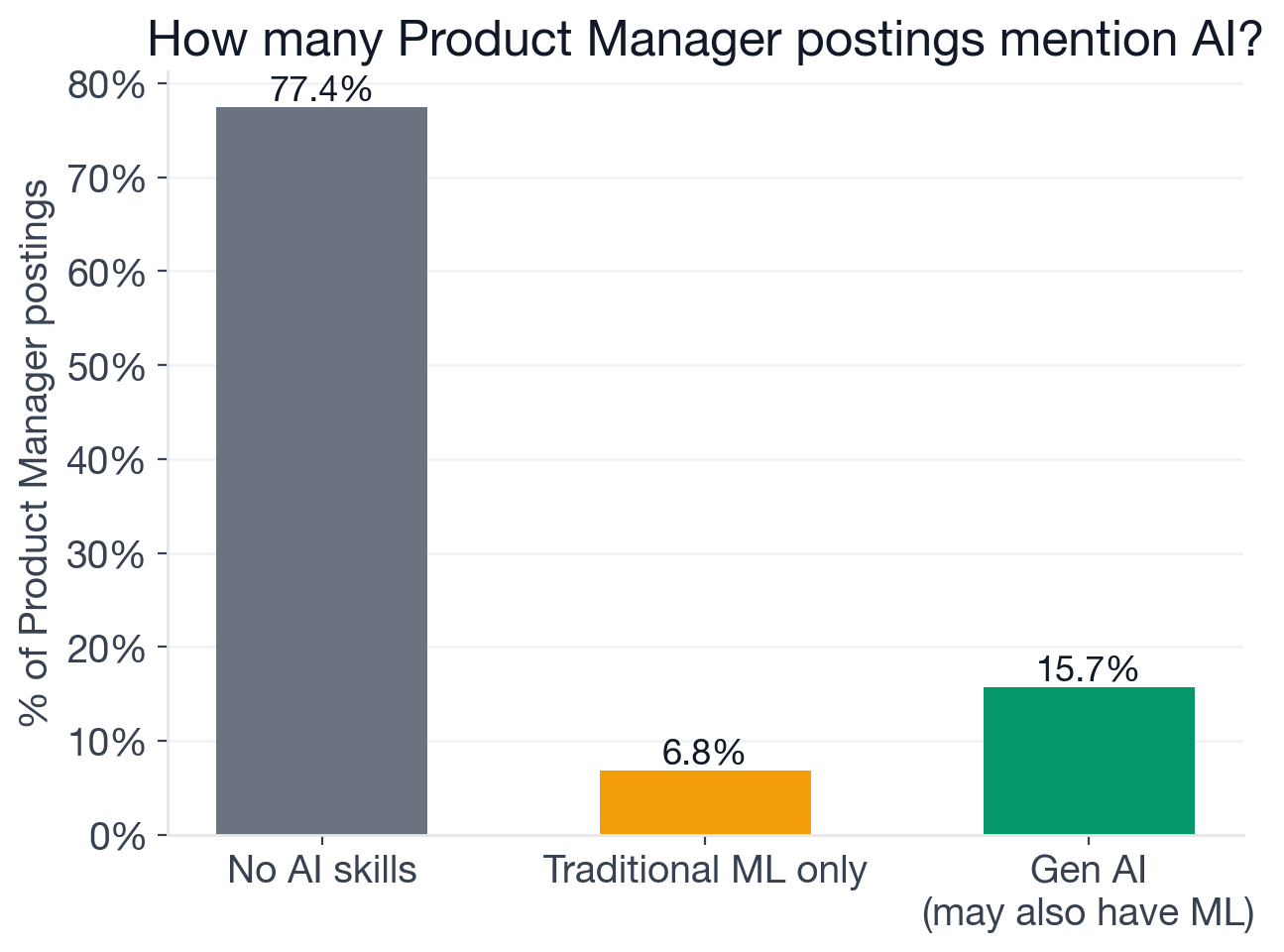
Share of active Product Manager postings by AI signal type, May 2026. "New-wave" covers generative AI tools and concepts introduced since 2022; "traditional ML" covers Machine Learning, Deep Learning, and related skills present in postings for five or more years.
Looking at the full picture: 22.6% of PM postings (3,452) mention any AI signal, but the more consequential figure is the generative AI slice. New-wave tools and concepts show up in 15.7% of postings (2,402). Roughly 77% of PM postings still do not require any AI at all, so this is not a universal mandate. But the generative AI share has grown from near-zero in 2022, and the companies moving fastest tend to be the most competitive employers.
What is changing is not just the frequency but the nature of the ask. The traditional ML requirement was mostly literacy: understand what the model does, help the team define success metrics, translate between engineers and stakeholders. The generative AI requirement is more hands-on. Companies want PMs who can evaluate LLM outputs, understand retrieval architectures, and design agent workflows as decision-makers who ship products, not as researchers who study them.
Which AI Skills Are Actually Reshaping the PM Role?
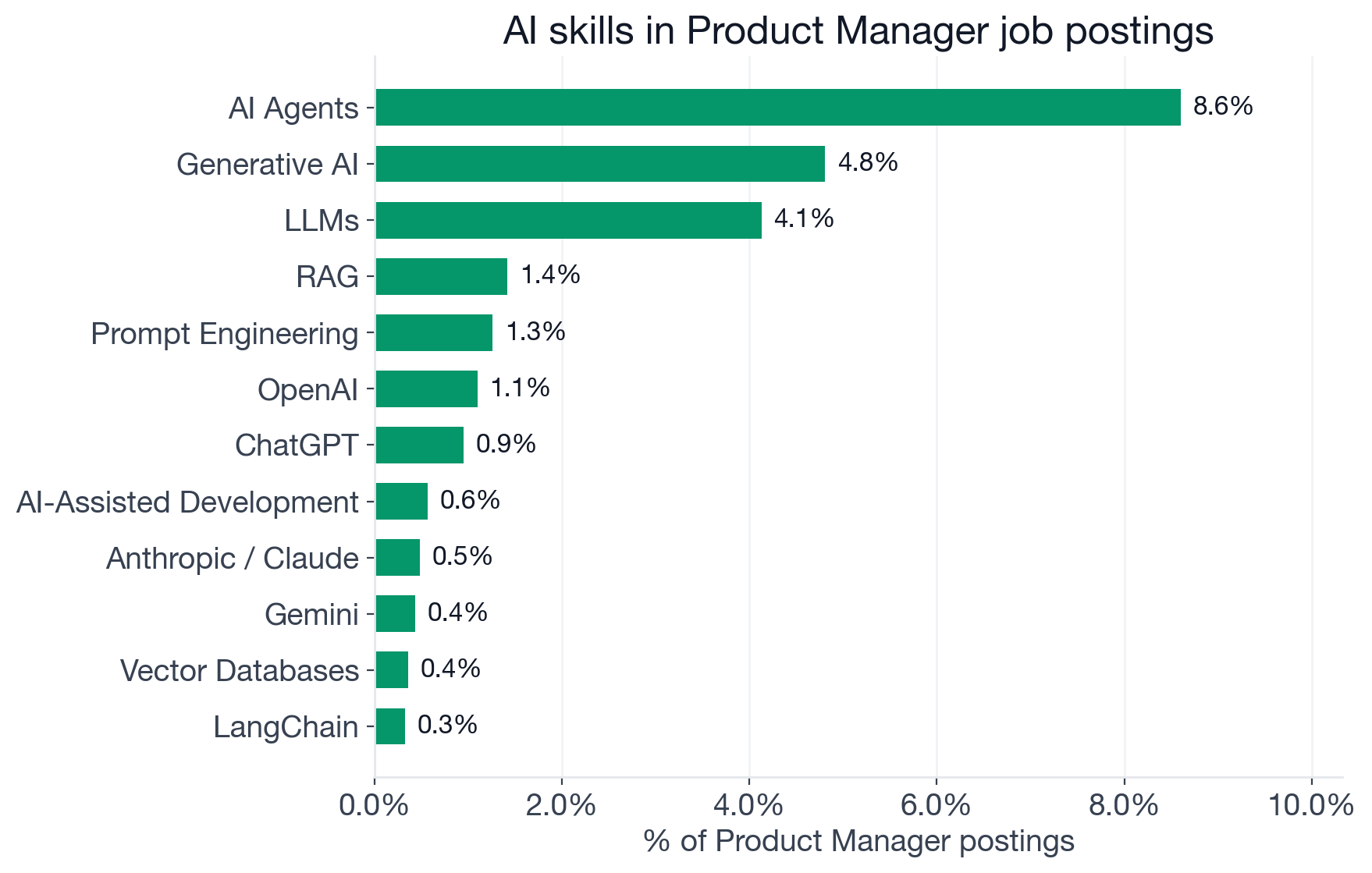
Share of active Product Manager postings that mention each AI skill, May 2026. Skills classified as "new-wave" (post-2022 generative AI) are shown separately from traditional ML infrastructure.
Machine Learning still tops the list at 12.3%, but it carries a different character than the newer entrants: it is a literacy requirement that has been building for several years, not a pivot signal. The new-wave skills paint a more specific picture of where the shift is actually happening.
AI Agents at 8.6% is the clearest signal of what is new. Companies posting this requirement are not asking PMs to commission a model from data science. They are asking PMs to design and ship autonomous agent workflows: systems where an LLM takes a goal, decomposes it into steps, calls tools or APIs, and executes, sometimes without a human in the loop. The PM's job in that context is product design for non-deterministic systems, a fundamentally different challenge than designing a form or a dashboard. Browse PM postings that require AI Agents experience and the job descriptions reveal how specific this has become.
Generative AI (4.8%) and LLMs (4.1%) indicate companies that want general fluency with the technology stack: understanding how LLMs work at a product level, what hallucination means for reliability promises, and how to spec guardrails. These postings are not asking for engineering depth; they're asking for enough technical grounding that the PM can make informed tradeoffs.
RAG (1.4%) and Prompt Engineering (1.3%) sit at the technical edge of the current PM skill curve. RAG (Retrieval-Augmented Generation, a technique that grounds LLM outputs in a company's own data rather than the model's training set alone) appears in postings where PMs own feature design for AI assistants. Prompt Engineering shows up at companies where PMs work directly with models in prototyping and evaluation, not just spec them for engineering to build.
The practical tier structure that emerges: general AI fluency is now a baseline for a meaningful minority of roles. Agent-based product experience is the differentiator. RAG and Prompt Engineering familiarity are specialist signals for companies building AI-native products from the ground up.
Do AI Skills Pay More for Product Managers?
The figures below are US base salary only, drawn from postings with structured salary disclosure. Equity, RSUs, bonuses, and sign-on are not captured in job postings and not in this data; total compensation at top employers is meaningfully higher than what these numbers show.
Among US postings with disclosed salary data, the median base salary for PM roles requiring new-wave generative AI skills is $159,000 (n=805). For PM postings with no AI requirement at all, the median is $130,000 (n=2,722). The gap is $29,000, or about 22% above the non-AI baseline.
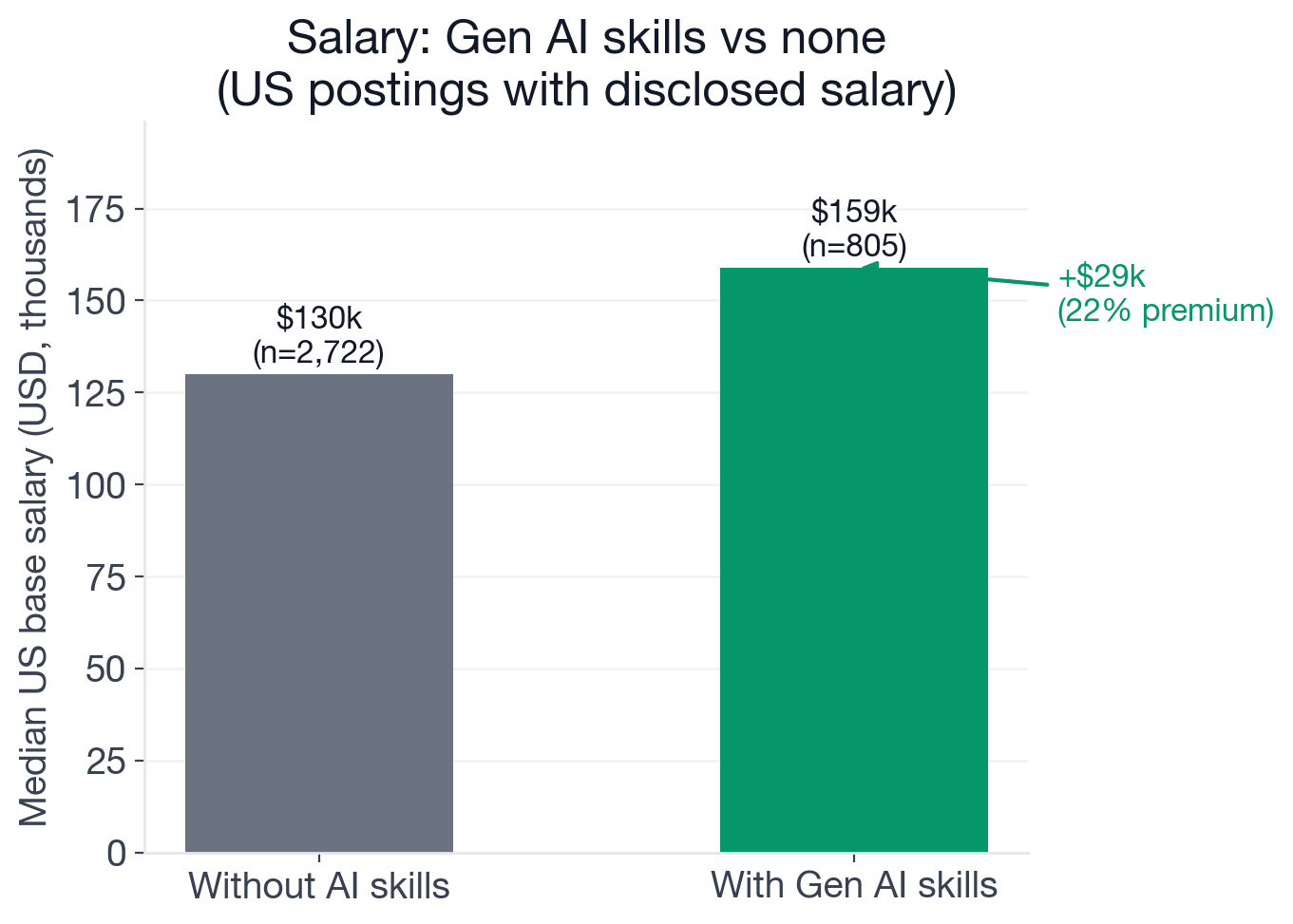
Median US base salary for Product Manager postings with and without new-wave AI requirements. US postings with disclosed salary data only; equity and bonuses excluded.
The $29K premium almost certainly reflects two overlapping effects: genuine scarcity of PMs who can credibly claim generative AI product experience, and the concentration of AI-requiring PM roles at better-compensating employers (SaaS, fintech, and pure-play AI companies all tend to pay above the full PM market average). These effects compound. The skills are rare, and the companies that want them pay above average regardless of any AI requirement.
The practical implication: AI fluency is not a minor signal on a PM resume. It is a filter that routes you into a slice of the market where the salary floor is $29K higher than the rest of the field.
Who Is Leading the AI Shift in PM Hiring?
Is AI adoption concentrated at senior levels?
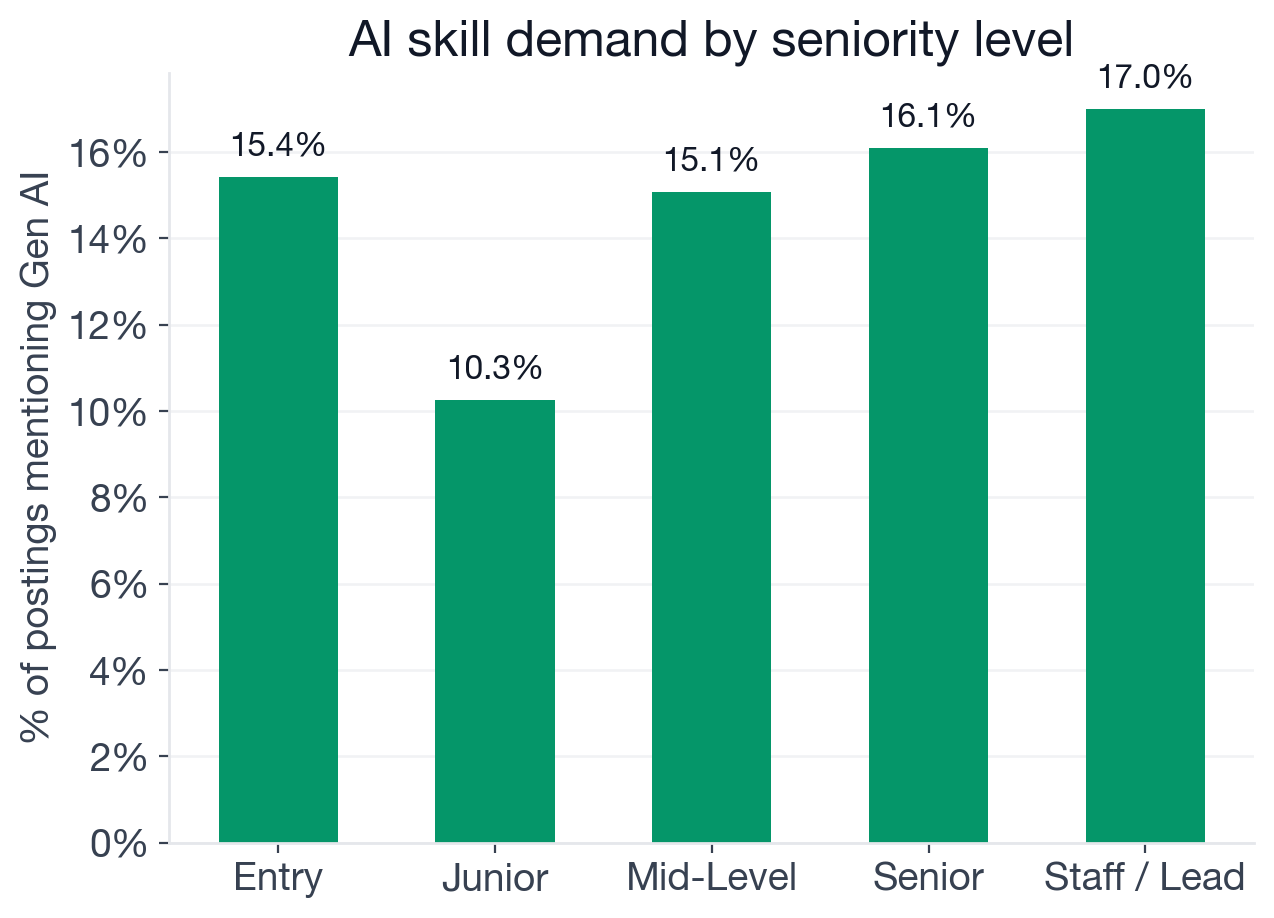
Share of Product Manager postings that mention new-wave AI skills, broken down by seniority level, May 2026.
The seniority distribution defies the usual assumption. AI adoption does not skew heavily toward senior hires. Staff PMs lead at 17.0%, senior at 16.1%, and entry-level at 15.4%, nearly the same rate. Junior PMs show lower adoption at 10.3%, likely because companies route more junior PM roles toward established product areas with known playbooks. But the headline is that AI requirements are entering the PM pipeline at every level simultaneously, not trickling down from the top.
For a job seeker, that means AI fluency is not a career-stage luxury. An entry-level candidate who can speak credibly to agent product design and LLM limitations is not ahead of the curve; they are at it.
Which industries are moving fastest?
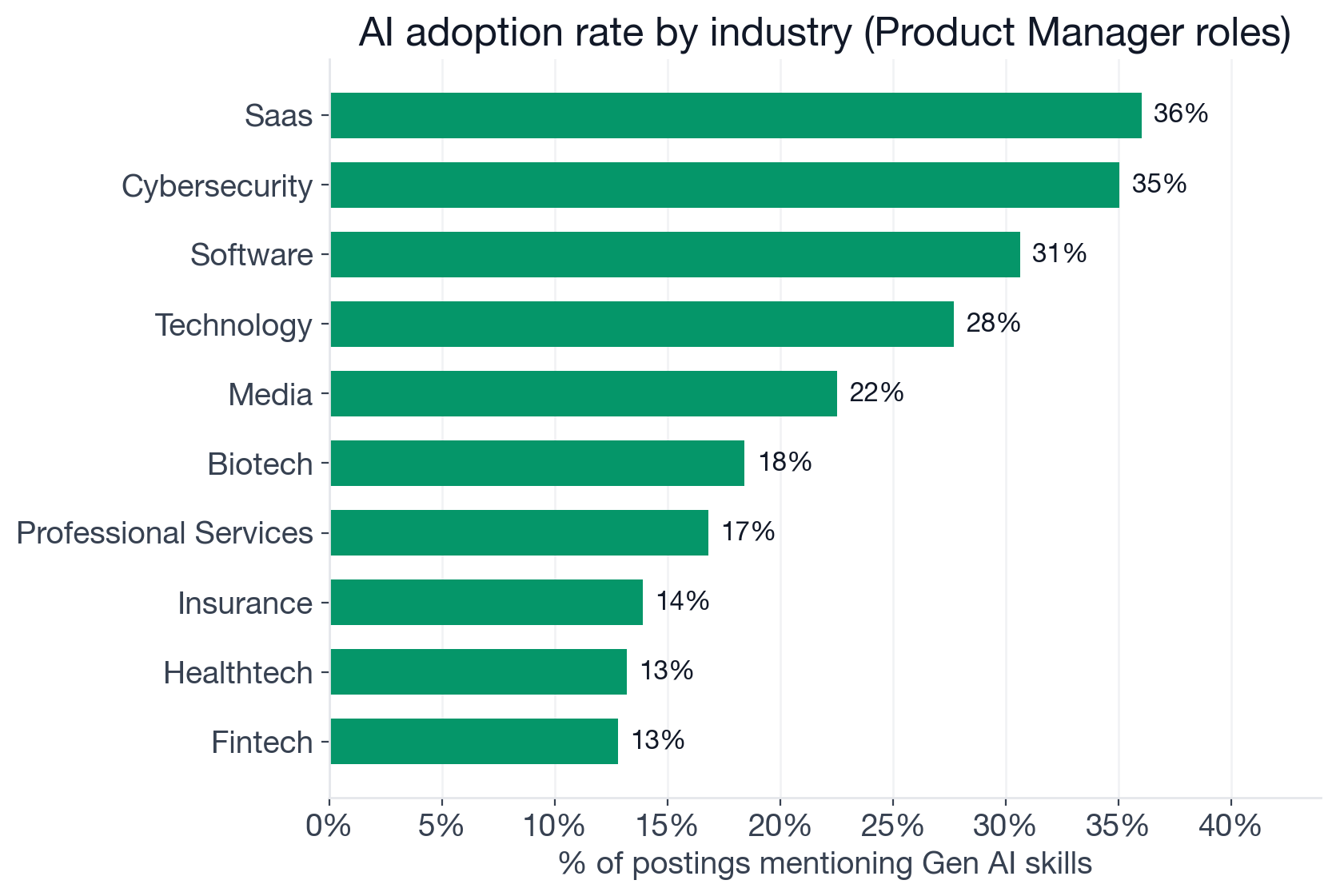
Share of Product Manager postings that mention new-wave AI skills, by industry sector, May 2026.
SaaS companies lead at 36% AI adoption in their PM postings: essentially 1 in 3 PM roles at SaaS companies now explicitly requires AI skills. Cybersecurity is close behind at 35%, a rate that reflects the industry's aggressive pivot to AI-assisted threat detection, automated response, and intelligent posture management. Software companies sit at 31% and technology firms at 28%.
The more traditional sectors tell a different story. Fintech is at 13%, healthcare at 12%, and consulting at 12%. Those sectors are not ignoring AI, but PM roles there tend to be defined around domain expertise (compliance, clinical workflows, client delivery) rather than AI product architecture. The AI requirement is real and growing, but it's growing more slowly than in software-native industries.
Which companies have made AI a PM baseline?
Among companies with meaningful PM hiring volume in the dataset, the highest AI adoption rates belong to pure-play AI and AI-adjacent firms. Salesforce posts 88% of its PM roles with AI requirements (37 of 42 postings), Wing reaches 92% (12 of 13), and Snowflake sits at 77% (17 of 22). OpenAI, Rubrik, Sierra, and Zip show 100% AI adoption across all their PM postings in the dataset.
What is notable about this list is the breadth beyond expected names. Morgan Stanley posting AI-fluent PM roles at 68% adoption (25 of 37 postings) indicates that financial services firms are now asking product teams to own AI features at a level that requires genuine technical literacy. NVIDIA sits at 48% (16 of 33), and Adobe shows roughly 55% across its PM postings. The shift is not confined to startups or tech-native companies; it is arriving across the broader enterprise landscape.
How to Use This in Your Job Search
The data draws a clear line. The roughly 77% of PM postings that don't mention AI are not about to disappear, but the 23% that do are disproportionately concentrated at the companies paying more, growing faster, and defining what product work looks like for the next decade. The practical question is whether you want to compete in that segment.
Build the conceptual foundation first. You don't need to train models. You need to understand what LLMs are reliable for, what they hallucinate on, how retrieval systems reduce that problem, and how agents decompose tasks into tool calls. Those are product design inputs, not engineering tasks. Our interview-prep courses cover AI and system design foundations that apply directly to PM interviews at AI-forward companies.
Get specific about agent products. AI Agents at 8.6% is the most concrete and fastest-growing signal in the data. Companies want PMs who can reason about agent architecture at the product level: what the workflow is, where human review should sit, how to measure reliability when outputs are probabilistic. Study real shipped agent products (customer support copilots, document processing pipelines, code review assistants) and develop opinions about where they hold up and where they break. The question bank includes AI product design questions that mirror what interviewers at Salesforce, Snowflake, and similar companies are asking in onsite rounds.
Practice the AI PM interview before you need to. A PM interview at an AI-forward company typically includes a product design round where the scenario involves an AI feature and a metrics round where the success criteria are more ambiguous than a standard engagement metric. AI mock interviews let you run these rounds on demand, with immediate feedback on how you framed the AI-specific tradeoffs.
Filter the board for your current level of fluency. Browse current Product Manager openings and use skill filters to find postings that match where you actually are. PM roles mentioning Machine Learning are a reasonable entry point if you have traditional ML product experience. PM roles mentioning AI Agents are the higher-bar target for candidates ready to define agent-first products.
FAQ
Q. How is AI changing the Product Manager role in 2026?
About 1 in 6 Product Manager postings (15.7%, or 2,402 of 15,286 active postings analyzed in May 2026) now explicitly require new-wave generative AI skills. AI Agents is the most common new-wave generative AI skill at 8.6% of postings, as companies hire PMs to define and ship agent-based products. The practical shift is that PMs are now expected to understand what AI systems can and cannot do, not just commission them from engineering teams.
Q. What is the salary premium for Product Managers with AI skills in 2026?
Among US postings with disclosed salary data, PM roles that require new-wave generative AI skills show a median base salary of $159,000 (n=805), compared with $130,000 (n=2,722) for postings without any AI requirement. That is a $29,000 premium, or about 22% above the non-AI baseline. These figures are US base salary only; equity and bonuses are not included.
Q. Which AI skills do companies most commonly ask for in PM job postings?
Machine Learning (12.3% of postings) leads overall, reflecting its multi-year presence as a PM literacy requirement. Among new-wave generative AI skills, AI Agents tops the list at 8.6%, followed by Generative AI (4.8%), LLMs (4.1%), RAG (1.4%), and Prompt Engineering (1.3%).
Q. Which industries are hiring the most AI-focused Product Managers?
SaaS companies lead at 36% AI adoption in their PM postings, followed by cybersecurity (35%) and software (31%). Technology companies overall sit at 28%. Traditional sectors like fintech (13%), healthcare (12%), and consulting (12%) show lower but growing rates of AI requirement in PM roles.
Q. Do entry-level Product Managers need AI skills in 2026?
Entry-level PM postings show a 15.4% AI adoption rate, nearly identical to the senior-level rate of 16.1%. AI skills are not being reserved for senior hires: they are spread across all experience levels. Entry-level candidates who can speak credibly about AI concepts, agent-based product design, or prompt engineering have a real edge.
Q. Which companies lead in hiring AI-focused Product Managers?
Pure-play AI companies set the highest bar: OpenAI, Rubrik, Sierra, and Zip post 100% of their PM roles with AI requirements. Salesforce follows at 88% (37 of 42 PM postings mention AI) and Wing at 92% (12 of 13). Among larger-volume hirers, Morgan Stanley (68%, 25 of 37 postings) and Snowflake (77%, 17 of 22 postings) stand out as aggressive adopters outside pure tech.
Q. How much of the Product Manager job market has shifted toward AI requirements?
Of 15,286 active Product Manager postings analyzed in May 2026, 22.6% (3,452) mention any AI signal, including traditional ML. The new-wave generative AI slice, tools and concepts introduced since 2022, reaches 15.7% (2,402 postings). That means roughly 77% of the PM market still does not explicitly require AI skills, but the generative AI share has grown from near-zero in 2022.
Final Thoughts
The Product Manager role is dividing into two populations: a large segment that operates the way it always has, and a growing segment that requires genuine fluency with generative AI products and agent architectures. The salary data, industry skew, and company concentration make clear which segment is attracting the most competitive employers and the highest compensation. The entry bar for that segment is not engineering depth; it is product judgment applied to systems that are probabilistic, non-deterministic, and still maturing. Building that fluency now, while it still differentiates, is the highest-leverage move for any PM who wants to stay competitive through the next transition.
Topics
Ready to practice?
Put what you've learned into practice with AI mock interviews and structured preparation guides.