
Product Designer Is Not a Single Job
Most design roles converge on a recognizable baseline. A UX Designer needs Figma, user research, and interaction design. A brand designer needs a visual system and illustration tools. But Product Designer (one of the most-posted design titles in the market) shows a stranger picture: not one skill appears in more than half of active postings.
Looking across all 3,397 active Product Designer openings on the InterviewStack.io job board as of June 2026, the most-demanded skill is Product Design itself, cited in just 47.9% of listings. Figma, the tool nearly synonymous with the role, sits at 45.2%. Design Systems reaches 45.9%. Every other skill falls below that, and the list of "common" skills runs nine deep before a single one breaks 50%.
That is not a role with a clear universal baseline. It is a role where different companies are hiring for fundamentally different versions of the same job. The salary data resolves the ambiguity in a way most designers haven't considered: which version pays $200K, and which pays $125K.
Note on dataset scope: The "Product Designer" label in job postings spans a wide design umbrella. This dataset includes Brand Designers, Senior Creative Designers, and other adjacent creative roles whose job descriptions share enough vocabulary to be classified alongside traditional product design postings. Core product design signals (Figma, Design Systems, User Research, Prototyping, Accessibility) are robust throughout the dominant cohort. Lower-frequency signals like Branding (4.4%) and the Adobe Creative Suite salary cluster at the lower end of the compensation table partly reflect this adjacent creative segment of the dataset.
Key Findings
- 3,397 active Product Designer postings analyzed: no skill clears the 50% table-stakes threshold, the widest required-skill spread of any design role in our dataset.
- Nine skills occupy the 20-50% common tier: Product Design (48%), Design Systems (46%), Figma (45%), Product Strategy (36%), Prototyping (35%), User Experience (29%), User Research (23%), Interaction Design (22%), and Visual Design (21%).
- The median US base salary is $165,400 across 840 postings with disclosed US compensation data. Equity, bonuses, and sign-on are not captured in posting data.
- Strategy skills earn $13K-$32K above the role baseline: Design Strategy ($197,500, n=79), Roadmapping ($192,500, n=116), A/B Testing ($179,400, n=161), and Accessibility ($178,500, n=202) all carry significant premiums.
- Figma earns at baseline: $165,300 US median (n=375), essentially equal to the $165,400 role median. Being expected everywhere means it cannot command a premium.
- Adobe Creative Suite postings median $125,000, $40K below the role baseline, pointing to a lower-paid flavor of the role built around graphic execution rather than product decisions.
- Senior and staff roles together are 49.8% of the market (31% senior, 18.8% staff). Entry-level is just 4.9% of postings.
- 33.1% of postings are tagged remote: higher than many engineering roles in our dataset, and higher than many other design specializations.
Which Skills Actually Command a Premium?
The salary numbers below are restricted to US postings only (where wage-transparency laws produce consistent disclosure). These are base salary figures: equity, bonuses, RSUs, and sign-on are not disclosed in postings and are not in our data, so total compensation at top employers runs meaningfully higher.
The overall median US base salary for Product Designer postings is $165,400 (n=840). That number looks unified. The skill-by-skill breakdown shows it is not.
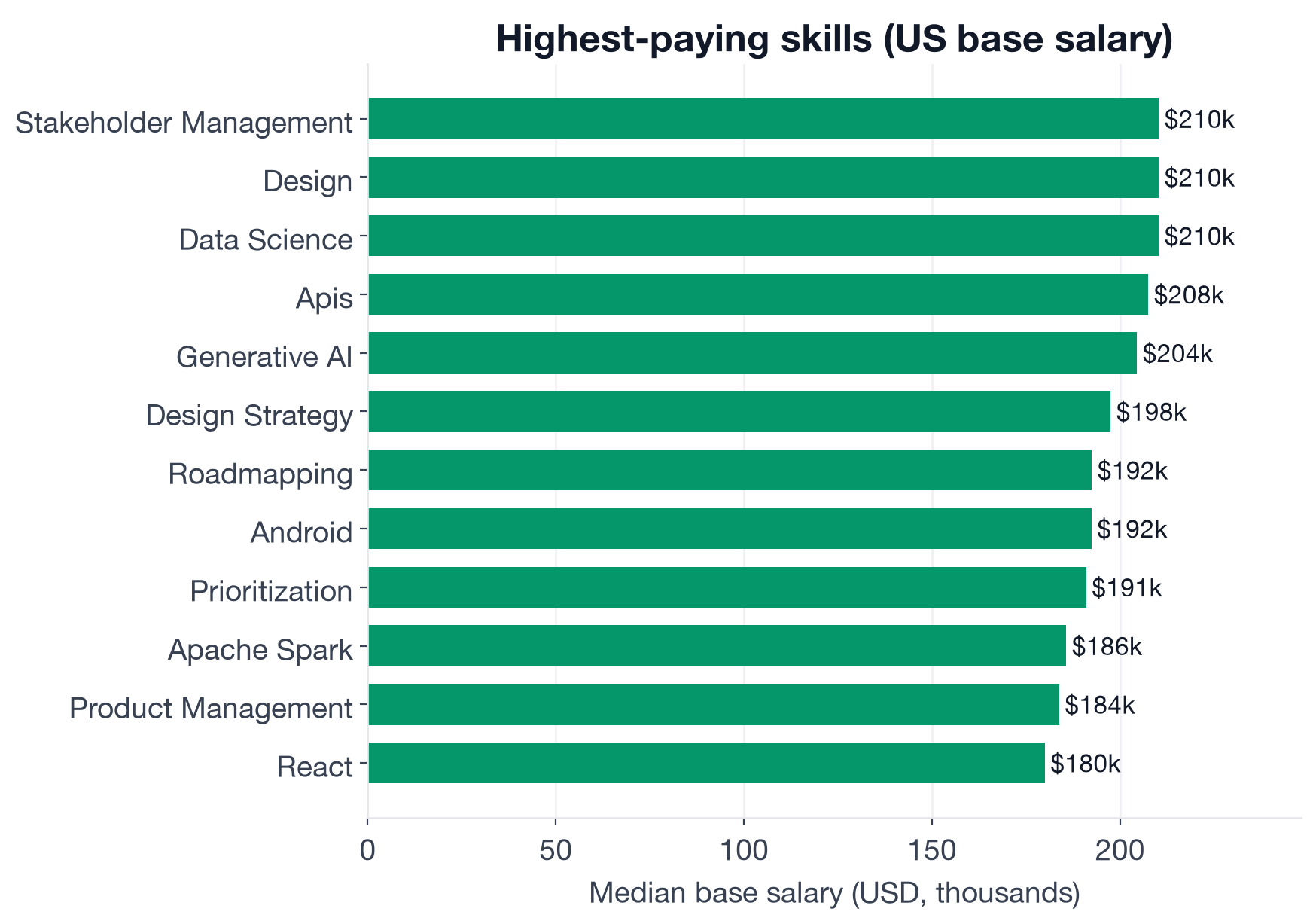
Median US base salary for Product Designer postings, restricted to US postings with disclosed compensation data. Skills require at least 25 US salary data points to appear.
| Skill | US Median Base | vs. $165,400 Baseline |
|---|---|---|
| Generative AI | $204,500 | +$39,100 |
| Design Strategy | $197,500 | +$32,100 |
| Roadmapping | $192,500 | +$27,100 |
| Product Management | $183,800 | +$18,400 |
| A/B Testing | $179,400 | +$14,000 |
| Product Strategy | $179,400 | +$14,000 |
| Accessibility | $178,500 | +$13,100 |
| Design Systems | $170,000 | +$4,600 |
| Figma | $165,300 | at baseline |
| Adobe Creative Suite | $125,000 | -$40,400 |
Figma, present in 45% of all postings, earns essentially at the $165,400 median: $165,300, just $100 below the role median. It is so universal that hiring managers cannot pay a premium for it; it is priced in. The same logic applies to Design Systems: at 46% of postings and a $170,000 median, it sits only $4,600 above baseline. Near-universal skills equalize across the candidate pool.
The bottom of the table tells the sharpest story. Adobe Creative Suite postings median $125,000, a $40,400 downward signal. Postings that still list Adobe as a primary requirement tend to be more graphic-design-oriented or brand-execution-focused: a different job wearing the same title. If the posting language centers on Adobe Illustrator, InDesign, or Photoshop rather than Figma and user research, the compensation reflects a different scope.
The top of the table reveals what the market pays for instead: skills that move the designer upstream of the screen. Roadmapping means influencing where the product goes, not just designing how it looks when it gets there. Design Strategy means thinking in product systems and trade-offs, not in components. A/B Testing at 18.4% of postings (and a $14K premium) means the designer is expected to produce measurable outcomes, not just deliverables. Product Management, appearing as a differentiator for 8.5% of Product Designer postings (earning $183,800 median), signals companies that want their senior designers to own decisions, not execute them.
The Generative AI line deserves its own note. Postings that explicitly mention AI earn $204,500 US median (n=54), a $39K premium over baseline. That 4.8% explicit mention rate measures companies hiring designers specifically to build AI-powered products: interfaces for AI systems, AI-first design systems, generative UI components. The remaining 95% of postings do not mention AI because they do not need to state it: per the AI in Design Report 2026, 91% of product designers now use AI tools at least weekly, up from 54% in 2025. Figma ships native AI features. Half of designers have shipped AI-generated code to production, per the UX Tools State of Prototyping survey. The 4.8% posting figure is a floor on the explicit-AI market, not a ceiling on AI's relevance: every design job today assumes ambient AI tool fluency, whether the posting says so or not.
What a Product Designer Is Actually Expected to Know
Breaking postings into skill families makes the cross-disciplinary nature of the role concrete. Core design skills appear in 95.2% of postings, effectively universal. The supporting families tell you what distinguishes one posting from the next.
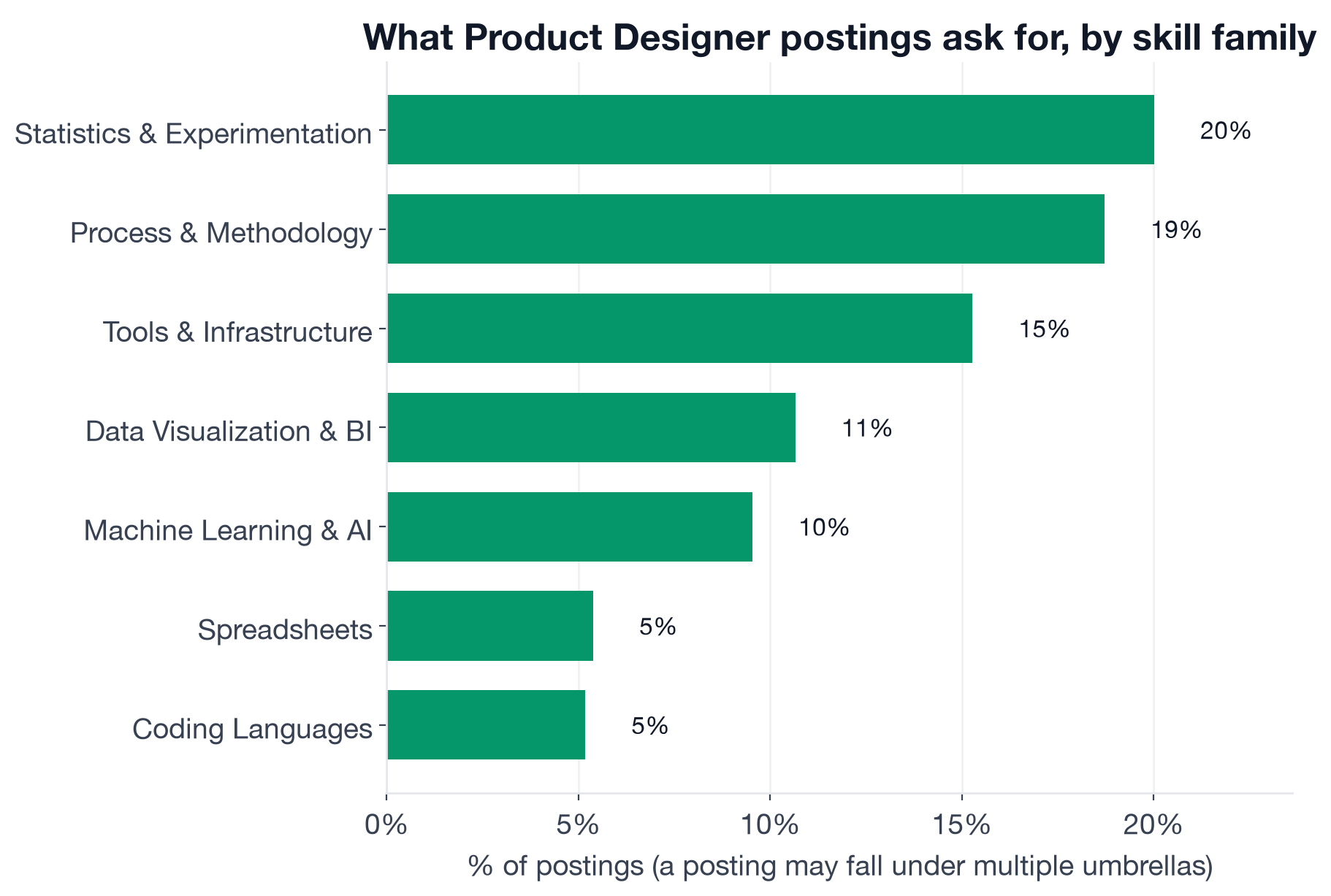
Share of postings asking for at least one skill in each family. A posting mentioning both A/B Testing and data visualization counts once under Statistics & Experimentation and once under Data Visualization & BI.
The non-craft families in the data make the case for designer-plus hiring:
- Statistics & Experimentation: 20% of postings ask for at least one skill here, driven almost entirely by A/B Testing (18.4%). One in five Product Designer postings treats experimentation as a core job function, not a nice-to-have. That share is high enough to factor into how you position your portfolio.
- Process & Methodology: 18.7%, covering Agile (10.2%) and project management (6%). Product teams running sprints want designers who know how to operate inside them.
- Tools & Infrastructure: 15.3%, largely automation (9.8%). Some postings expect designers to automate parts of their own workflow or contribute to design tooling pipelines.
- Data Visualization & BI: 10.7%. Roughly 1 in 10 postings expects designers to communicate with data alongside visuals.
- Machine Learning & AI: 9.5%, led by Generative AI (4.8%) with additional ML-adjacent requirements spread across the dataset. These are the postings hiring for the premium version of the role described in the salary section above.
A significant share of the market is looking for a designer-plus: someone who can run an experiment, interpret the result, and fold it back into the next design iteration. The salary data is consistent: those are exactly the skills that earn premiums.
The Three Tiers of Product Designer Skills
Drill into individual skills and three tiers emerge, with a notable absence at the top.
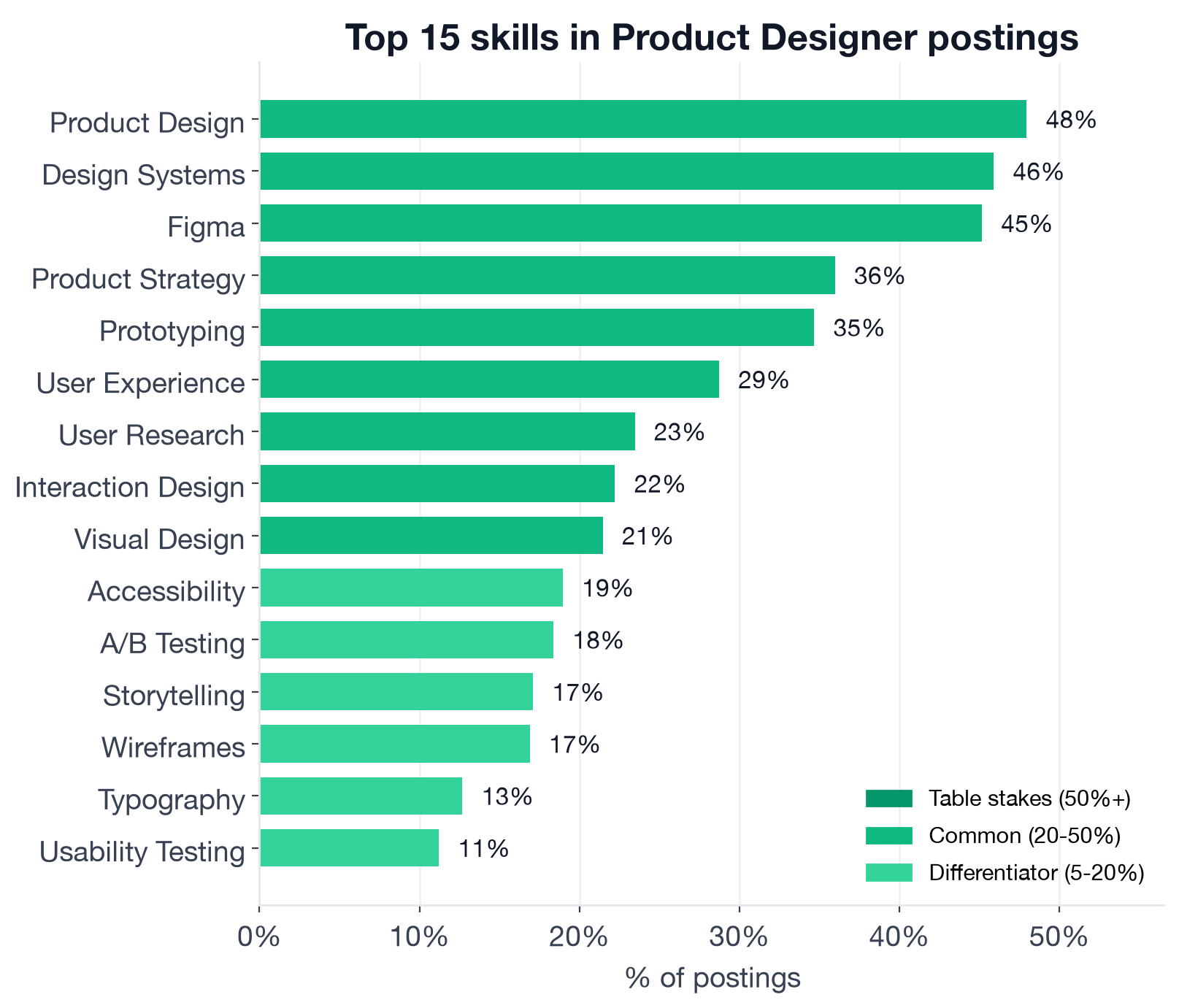
Individual Product Designer skills ranked by share of postings. Skills in the 20-50% band are "common"; 5-20% are "differentiators." No skill clears the 50% table-stakes line.
Table Stakes (50%+): None. This is the most unusual finding in the dataset. Compare Product Designer to Data Engineer (Python and SQL each at 71%), or even UX Designer: Product Designer is the only design role in our analysis where not a single skill achieves near-universal demand. The closest candidates are Design Systems at 45.9% and Product Design at 47.9%.
Common Tier (20-50%):
Nine skills cluster between 21% and 48%, a tighter band than you would see in a role with a sharper core definition:
- Product Design: 48%
- Design Systems: 46%; browse Product Designer + Design Systems openings
- Figma: 45%; browse Product Designer + Figma openings
- Product Strategy: 36%
- Prototyping: 35%
- User Experience: 29%
- User Research: 23%
- Interaction Design: 22%
- Visual Design: 21%
These nine are the credentialing layer: a portfolio that credibly demonstrates most of them will survive the screening stage for most postings. A portfolio that demonstrates only two or three of them will not.
Differentiator Tier (5-20%):
This is where the salary premium lives, and where the split between craft-focused and strategy-focused designers becomes most visible:
- Accessibility: 19%, one of the highest-paid differentiators at +$13K. It signals design-infrastructure thinking, not just compliance awareness. Browse Product Designer + Accessibility openings to see how these roles are framed.
- A/B Testing: 18.4%, the most analytical differentiator. Postings that ask for it pay $14K above baseline.
- Storytelling: 17%, increasingly required as designers present work and roadmap decisions to senior stakeholders.
- Wireframes: 17%
- Roadmapping: 10.8%, appearing in roughly 1 in 10 postings but earning a $27K premium. The low frequency and high premium mean companies that want this skill are willing to pay specifically for it.
- Design Strategy: 6.7%, earning a $32K premium, the highest in the differentiator tier. Only 226 postings ask for it, but they pay $197,500 median.
A smaller cluster of code-adjacent differentiators (CSS at 7.4%, HTML at 6.7%, iOS at 5.5%, Android at 5.1%) signals that some companies want design-to-code fluency, not just design deliverables. This is consistent with the survey data: 50% of product designers have shipped AI-generated code to production, and postings are beginning to reflect that capability shift.
The Pairs That Define a Modern Design Practice
Looking at which skills appear together more often than chance reveals the architecture of what a high-functioning design practice looks like in 2026.
| Skill Pair | Postings Together | % of All | Lift |
|---|---|---|---|
| User Experience + User Research | 417 | 12.3% | 1.82 |
| Interaction Design + Prototyping | 460 | 13.5% | 1.76 |
| Prototyping + User Research | 461 | 13.6% | 1.67 |
| Accessibility + Design Systems | 468 | 13.8% | 1.58 |
| Design Systems + User Research | 569 | 16.8% | 1.56 |
| Design Systems + Figma | 993 | 29.2% | 1.41 |
Lift > 1 means the pair appears together more often than each skill's individual frequency alone would predict. A lift of 1.82 means these two skills co-occur 82% more often than chance.
User Experience + User Research (lift 1.82) is the tightest pair in the dataset. Companies asking for UX expertise are 82% more likely than chance to also require user research. The execution-without-research designer is not what this market is buying: research and execution are being treated as a single, inseparable capability.
Interaction Design + Prototyping (lift 1.76): an interaction designer who only specifies behavior without prototyping it is less valued than one who can show it in motion. The prototype has become part of the interaction definition, not a separate deliverable.
Prototyping + User Research (lift 1.67) connects the two: companies want the research-to-prototype-to-test loop, not a linear handoff of specs that goes straight to engineering.
Accessibility + Design Systems (lift 1.58): when a company builds a design system, they almost always want it accessible from day one. This pair has become a signature for design infrastructure roles: companies investing in design-at-scale, not just individual product screens.
Design Systems + Figma (lift 1.41, 993 postings): nearly 3 in 10 Product Designer postings want both together. Design systems are built and maintained in Figma at most large product organizations; these two have become essentially the same job function in many postings.
Who's Hiring, and at Which Level?
The seniority distribution for Product Designer is notably top-heavy.
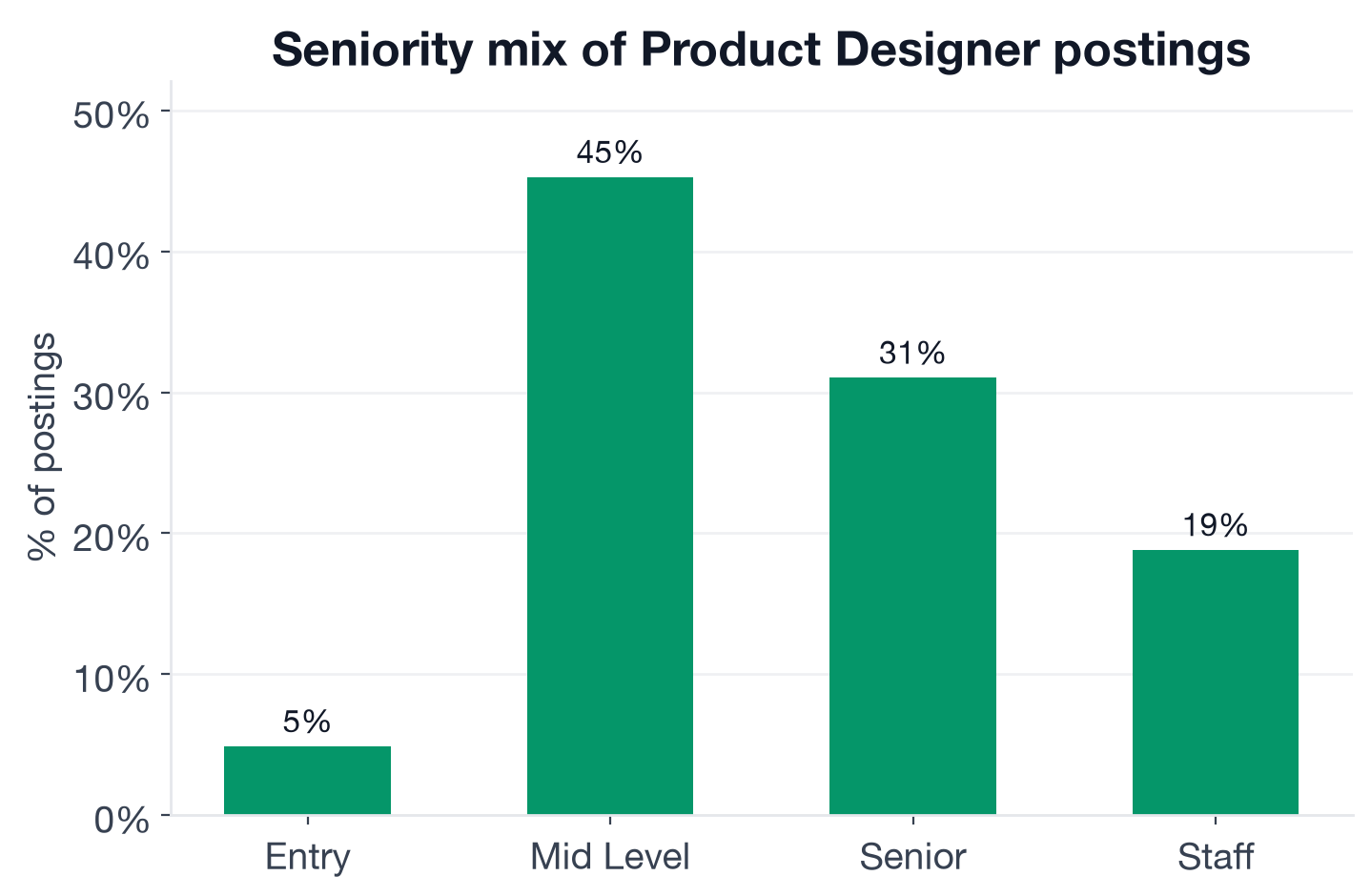
Seniority breakdown of Product Designer postings, inferred from title keywords. Postings without an explicit seniority signal default to mid-level.
- Mid-level: 45.3% (1,538 postings)
- Senior: 31% (1,054)
- Staff: 18.8% (639)
- Entry: 4.9% (166)
Staff at 18.8% is higher than most design titles and comparable to the IC tracks you see in engineering. There is a real, well-defined staff-level career path here at larger product organizations, and roughly half of all postings (senior plus staff combined at 49.8%) want someone with significant demonstrated ownership of shipped work.
Entry-level at 4.9% (166 of 3,397 postings) is tight but not as restricted as Data Engineer (3% entry-level share). A portfolio demonstrating real shipped product work, even from internships or growth-stage companies, is what the market actually screens on.
Adobe leads among active employers by a wide margin.
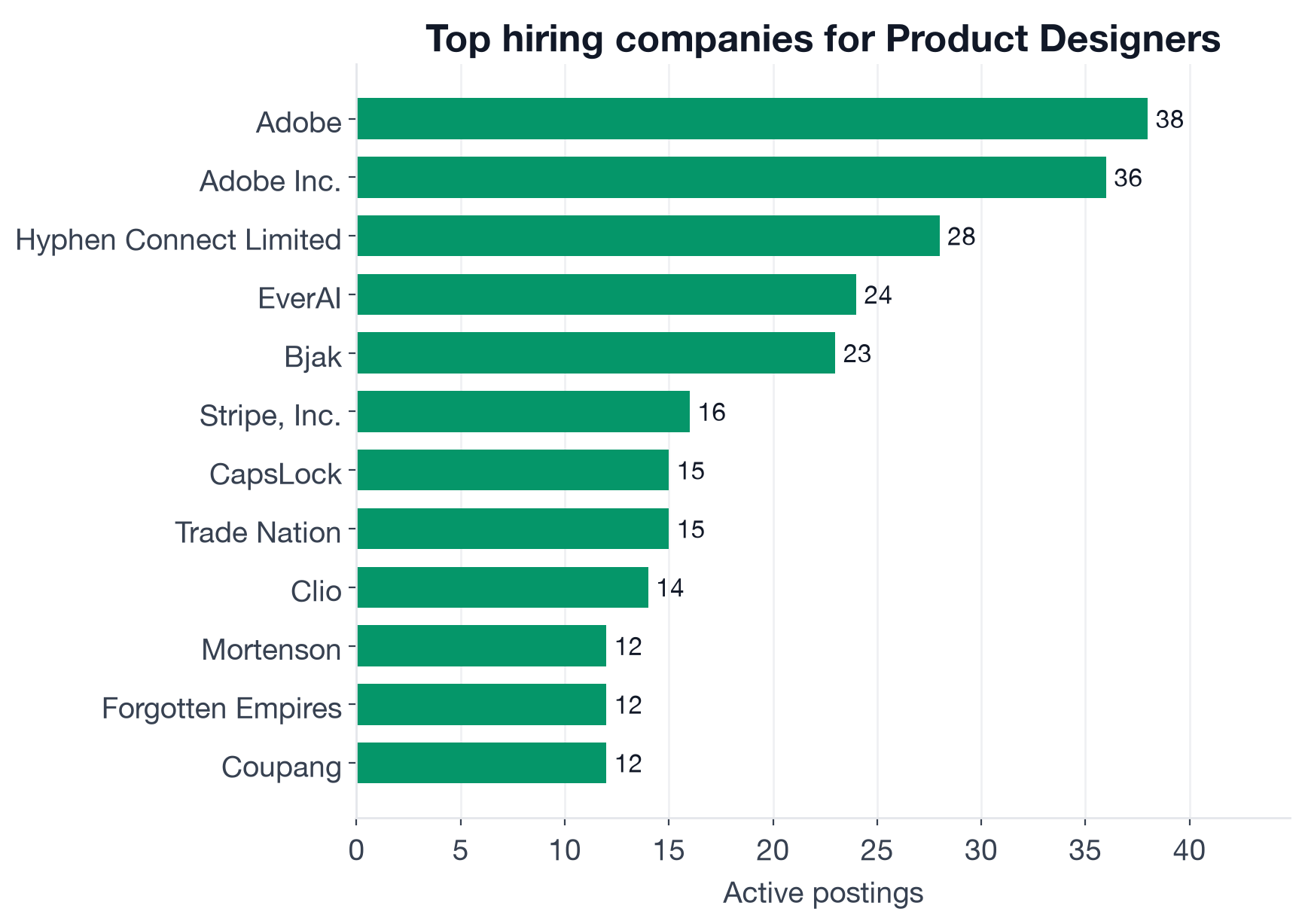
Active Product Designer postings by employer. Adobe appears under two entity names in the source data.
| Company | Active Openings | Sector |
|---|---|---|
| Adobe | 38 | Design software |
| Adobe Inc. | 36 | Design software |
| EverAI | 24 | AI |
| Bjak | 23 | Fintech |
| Stripe, Inc. | 16 | Payments |
| Trade Nation | 15 | Trading platform |
| CapsLock | 15 | Tech/design |
| Clio | 14 | Legal tech SaaS |
| Mortenson | 12 | Construction |
| Coupang | 12 | E-commerce |
| Forgotten Empires | 12 | Gaming |
| Thales | 11 | Defense/aerospace |
| Air Apps | 11 | Mobile apps |
| Anduril Industries | 11 | Defense tech |
Recruiting and staffing agencies (including contractor placement firms) that appear in the raw posting data are excluded from this table; their listings represent placements rather than direct employer headcount.
Adobe hiring under two entity names reflects a large, distributed design org: the combined 74 postings make it the single largest employer by a significant margin. Beyond Adobe, the roster spans fintech (Bjak, Stripe, Trade Nation), legal tech (Clio), e-commerce (Coupang), gaming (Forgotten Empires), construction (Mortenson), and defense tech (Anduril). The breadth reflects how fundamental product design has become: virtually every company building a digital product now hires for this role, well beyond consumer software and tech. For company-specific interview prep, the InterviewStack.io preparation guides cover formats and topic priorities at many of these employers.
Where Are the Jobs, and How Remote-Friendly Are They?
The US is the dominant market by a large margin, with notably distributed demand across Europe and APAC.
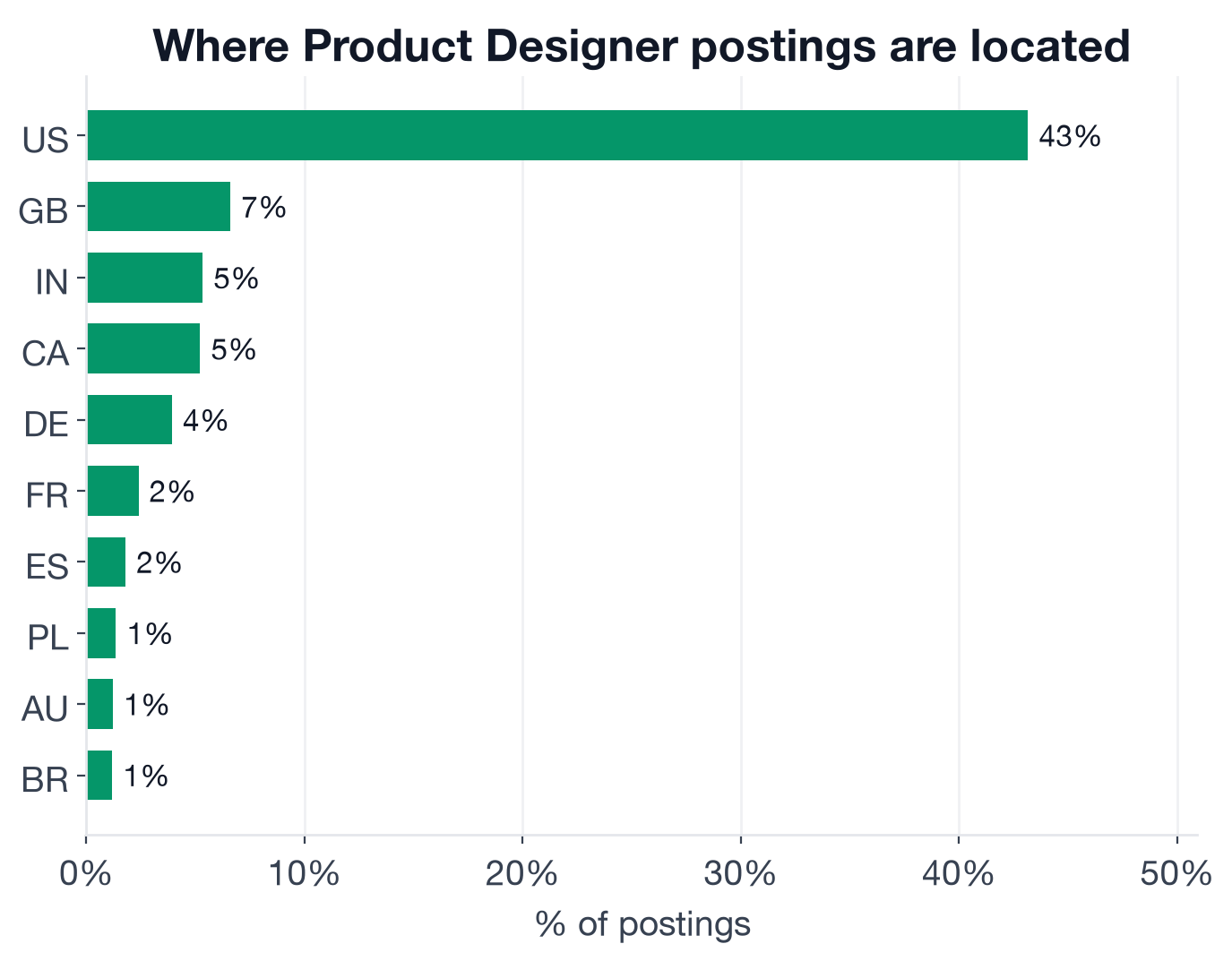
Top countries by share of Product Designer postings.
- United States: 43.2% (1,466 postings); browse US-only Product Designer openings
- United Kingdom: 6.6% (224)
- India: 5.3% (181)
- Canada: 5.2% (177)
- Germany: 3.9% (133)
- France: 2.4% (81)
At 43% of all postings, the US holds a much larger share than it does for engineering roles like Data Engineer (29% US) or Cloud Engineer. Product design in US-headquartered companies tends to stay onshore, partly because of how collaboration-intensive the role is: design reviews, cross-functional critiques, and stakeholder presentations are hard to fully distribute.
On work mode: Product Designer is among the more remote-friendly design titles in this dataset.
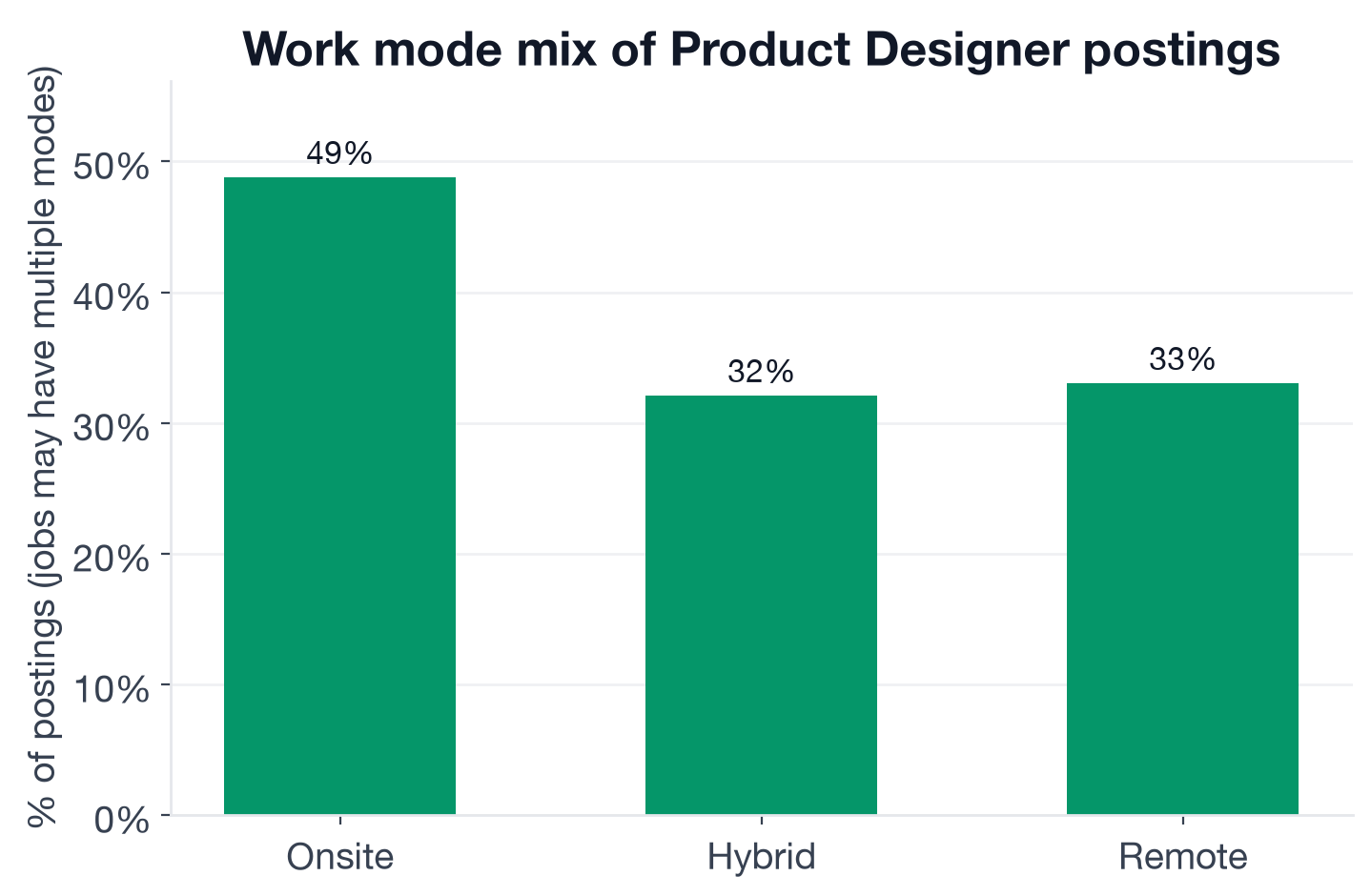
Share of postings tagged with each work mode. Some postings carry multiple tags, so percentages can exceed 100%.
- Onsite: 48.8% (1,658 postings)
- Remote: 33.1% (1,123); browse remote Product Designer openings
- Hybrid: 32.1% (1,091)
One in three postings is tagged remote, higher than many engineering roles in our dataset and comparable to the most remote-accessible design specializations. The fully-remote share concentrates in product-led software companies, SaaS, and fintech; enterprise, healthcare, and government employers default to onsite or hybrid.
How to Use This in Your Product Design Job Search
The data maps to a clear preparation sequence.
1. Build the common tier first. Nine skills cluster in the 20-50% band, and none is universal. A portfolio that credibly demonstrates 5-7 of them, with Design Systems, Figma, Prototyping, User Research, and Interaction Design as the core cluster, will survive screening for most of the 3,397 postings in this analysis. The goal is depth across the cluster, not shallow coverage of all nine.
2. Choose a premium differentiator. The salary data is clear about which skills move the offer: Design Strategy (+$32K), Roadmapping (+$27K), A/B Testing (+$14K), Accessibility (+$13K). Each requires genuine depth. Pick one based on the kind of company and role you are targeting. Accessibility is especially in-demand at enterprise and fintech companies with complex design systems. Roadmapping and Design Strategy tend to appear at senior and staff levels where the designer is expected to shape the product direction.
3. Position toward the upstream. The $30-40K gap between a production-execution designer and a strategy-and-experimentation designer is real and large. If you are targeting the higher tier, your portfolio should show decisions and their outcomes, not just polished screens: how you shaped the roadmap, what experiment you designed, what the data said, and how you iterated.
4. Use AI tools as the baseline they are. The 4.8% explicit AI mention rate understates the actual expectation significantly. Per the AI in Design Report 2026, 91% of designers use AI tools weekly. Figma AI, Claude for research synthesis, ChatGPT for copy iteration, AI-assisted prototyping: these are now assumed rather than stated. A designer who has not built AI tools into their workflow is behind the curve, whether or not any individual posting mentions it.
5. Drill the interview rounds, not just the portfolio. AI mock interviews let you practice design critique, portfolio walkthroughs, and cross-functional scenario questions under realistic conditions. The question bank covers UX, product strategy, and user research topics that routinely appear in Product Designer interviews. Our interactive courses build foundational competence in design thinking, product strategy, and experimentation.
6. Filter for your exact stack. Browse current Product Designer openings on the InterviewStack.io job board and layer skill filters to match your positioning: Design Systems + Accessibility for infrastructure-focused roles, or A/B Testing for analytics-oriented product teams. The board updates daily.
FAQ
Q. What skills do companies look for in Product Designers in 2026?
No single skill appears in more than half of postings. The nine-skill common tier (20-50%) includes Product Design (48%), Design Systems (46%), Figma (45%), Product Strategy (36%), Prototyping (35%), User Experience (29%), User Research (23%), Interaction Design (22%), and Visual Design (21%). Among differentiators, Accessibility (19%) and A/B Testing (18%) stand out: both pay meaningful premiums above the $165,400 US median.
Q. What is the median Product Designer salary in 2026?
Among US postings with disclosed compensation data, the median base salary is $165,400 (n=840). That covers base pay only; equity, bonuses, and sign-on are not included in posting data, so total compensation at top employers is higher.
Q. Which Product Designer skills earn the biggest salary premium?
Design Strategy earns a $197,500 US median ($32K above the $165,400 baseline, n=79). Roadmapping earns $192,500 ($27K above, n=116). A/B Testing ($179,400, n=161) and Accessibility ($178,500, n=202) add $13-14K. Generative AI postings median $204,500 ($39K premium, n=54), reflecting roles that design AI-powered products. By contrast, Adobe Creative Suite postings median $125,000, about $40K below baseline.
Q. Is Product Designer a good role to break into at entry level?
Entry-level postings are 4.9% of the market (166 of 3,397). Mid-level dominates at 45.3%, senior at 31%, and staff at 18.8%. A portfolio demonstrating real shipped work is essential. Junior or associate roles at agencies and growth-stage companies are the most accessible entry path.
Q. How remote-friendly are Product Designer jobs in 2026?
The US is the largest market at 43.2% of postings. Of all postings, 33.1% are tagged remote, 32.1% hybrid, and 48.8% onsite (some postings carry multiple work-mode tags, so percentages exceed 100%). The remote share is higher than many engineering roles in our dataset, making this one of the more location-flexible design specializations.
Q. How is AI changing what Product Designers need in 2026?
Only 4.8% of postings explicitly require Generative AI, but those postings median $204,500, a $39K premium. Per the AI in Design Report 2026 (stateofaidesign.com), 91% of designers now use AI tools at least weekly, up from 54% in 2025. The posting percentage measures roles explicitly designing AI-powered products; ambient AI tool use across Figma, Claude, and ChatGPT for research synthesis is now an expected baseline at virtually every company, whether stated or not.
Q. What is the dominant Product Designer skill stack in 2026?
Design Systems and Figma appear together in 29.2% of postings (lift 1.41). User Experience and User Research have the highest lift at 1.82, meaning a posting requiring UX expertise is 82% more likely than chance to also require user research. Interaction Design and Prototyping (lift 1.76) and Prototyping and User Research (lift 1.67) complete the core pattern: a design practice built around research, iteration, and systematic component libraries.
Where to Start in 2026
The absence of table stakes is actually useful information: there is no single shortcut through the Product Designer market. A candidate who builds genuine depth across 5-6 common-tier skills, develops one strategy-oriented differentiator, and builds a portfolio that shows decisions rather than just deliverables will be competitive across the widest range of postings. The $40K gap between legacy-tool-focused and strategy-fluent designers reflects a real difference in the scope of work those designers own, and that scope is learnable. Start with the stack, then build the upstream muscle.
Topics
Ready to practice?
Put what you've learned into practice with AI mock interviews and structured preparation guides.