
Two Markets Live Under the UX Designer Title
Most tech roles have a reasonably consistent salary story: learn the standard stack, advance in seniority, earn more. UX Designer is different. The same title covers two meaningfully distinct markets, and the salary gap between them exceeds $60,000. The fault line has nothing to do with years of experience.
We analyzed 3,675 active UX Designer postings on the InterviewStack.io job board as of June 2026. The "UX Designer" classifier captures a broad range of design-titled roles: digital product and interaction design is the dominant segment, but a meaningful share of postings represents engineering design (instrument, PCB, mechanical, telecom), architectural, and production art positions that share the "designer" label. Skill and salary patterns in this post are driven by the digital UX segment and hold up directionally, but the total posting count overstates demand specifically for digital UX roles. What emerged from the data is a clear picture of two design worlds: one anchored in product systems, research, and cross-functional delivery; the other in visual craft, branding, and production output. Both are called UX Designer. Only one commands the six-figure tech salaries that most candidates assume come with the title.
The signal lives in the salary data. Design Systems, User Research, and Interaction Design correlate with median US base salaries $34,000 to $43,000 above the $116,500 role baseline. Typography, Branding, and Adobe Creative Suite sit $18,000 to $27,000 below it. Figma, the most-mentioned skill in the dataset at 31.7%, correlates with $145,600 (a real premium, but not the top of the table). The skills that consistently land at the top of the salary range are the ones that make a designer less like a production artist and more like a technical collaborator.
Key Findings
- 3,675 postings analyzed on the InterviewStack.io job board as of June 2026; digital UX design is the dominant segment, but engineering design and production art roles are present in the dataset alongside it, so this figure reflects the broader designer-titled market rather than pure digital UX demand.
- No skill reaches the table-stakes threshold (50%+): Figma leads at just 31.7%, making UX Designer one of the most fragmented role definitions in tech hiring.
- Median US base salary is $116,500 (n=685 postings with disclosed salary data); the spread from highest- to lowest-paying skill cluster exceeds $74,000.
- Design Systems pays a median $159,500 (US, n=170), a $43K premium over the role baseline and the highest-paying core UX design skill in the dataset.
- Typography ($90,000) and Branding ($92,500) sit well below the baseline, signaling that graphic-craft-focused roles occupy a different market segment entirely.
- Mid-level dominates at 68.8% (2,527 of 3,675 postings); entry-level is just 4.4% (160 postings).
- Onsite is the dominant work mode at 57.6%, making UX Designer less remote-friendly than most tech roles; only 18.8% of postings are fully remote.
- AI tool use is ambient: 3.6% of postings explicitly require AI skills, but 72% of designers already use generative AI tools in their daily workflow (Figma State of the Designer 2026, 906 respondents).
Which UX Designer Skills Command Higher Pay?
Salary figures below are US-only base salary (n=685 postings with disclosed data). Equity, bonuses, and sign-on are excluded, so total compensation at top employers is meaningfully higher than what we report here.
The overall median US base salary for UX Designer postings is $116,500. The spread around that figure is the real story.
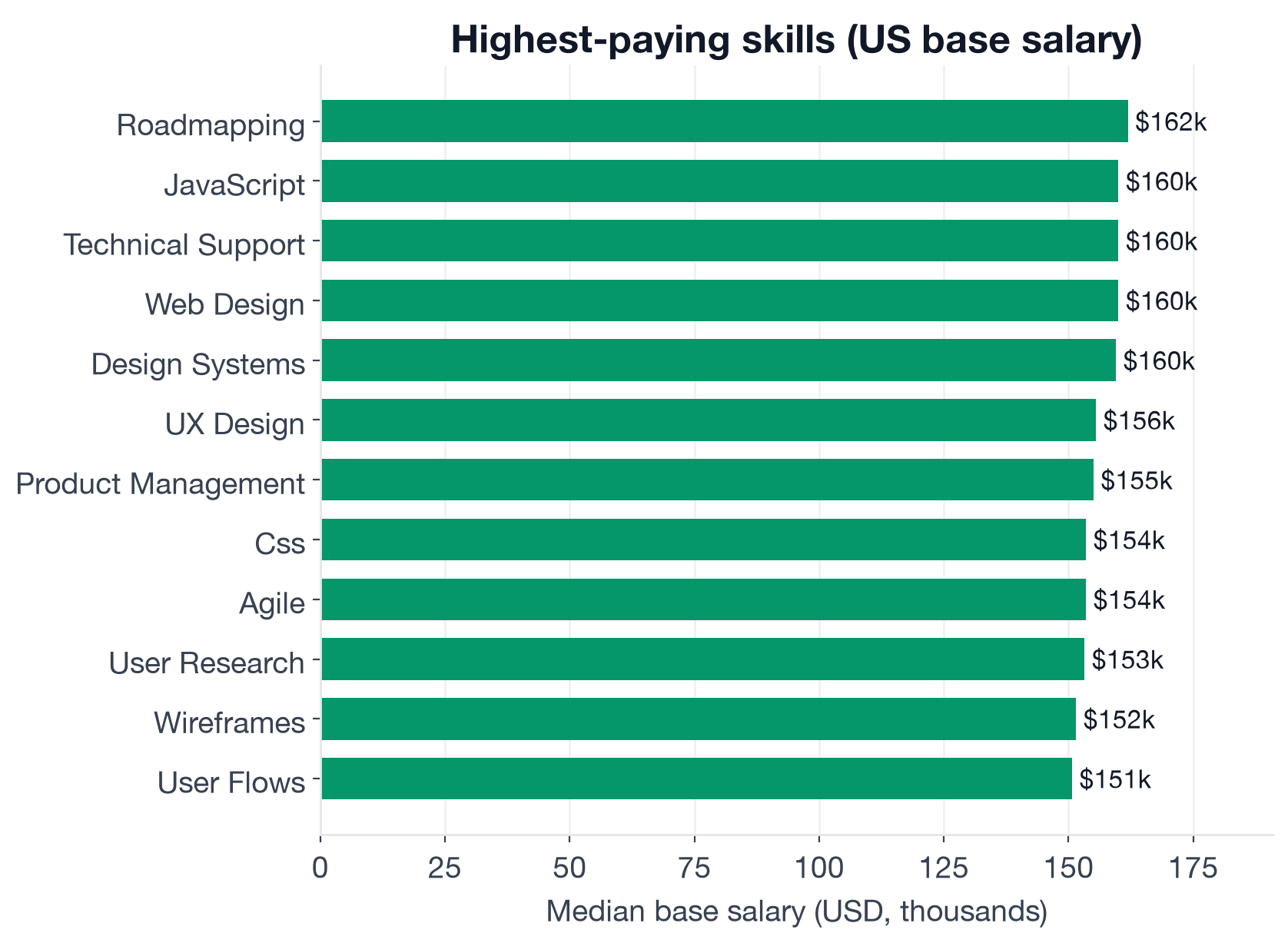
Median US base salary in USD for postings that mention each skill, among UX Designer postings with structured salary data. Skills with fewer than 25 US salary data points are excluded.
The high-paying cluster is anchored by systems and product-layer skills:
| Skill | Median US base salary | Premium over $116,500 baseline | n |
|---|---|---|---|
| Design Systems | $159,500 | +$43,000 | 170 |
| UX Design | $155,500 | +$39,000 | 124 |
| Agile | $153,500 | +$37,000 | 105 |
| CSS | $153,500 | +$37,000 | 77 |
| User Research | $153,200 | +$36,700 | 129 |
| Wireframes | $151,500 | +$35,000 | 107 |
| User Flows | $150,700 | +$34,200 | 71 |
| Product Design | $150,700 | +$34,200 | 91 |
| HTML | $150,500 | +$34,000 | 75 |
| Interaction Design | $150,500 | +$34,000 | 95 |
| Prototyping | $148,500 | +$32,000 | 124 |
| User Experience | $147,500 | +$31,000 | 147 |
| Figma | $145,600 | +$29,100 | 188 |
| Usability Testing | $145,600 | +$29,100 | 75 |
| Product Strategy | $143,200 | +$26,700 | 169 |
| A/B Testing | $140,300 | +$23,800 | 73 |
The lower end of the table tells an equally important story:
| Skill | Median US base salary | vs. baseline | n |
|---|---|---|---|
| Data Visualization | $113,900 | -$2,600 | 56 |
| Project Management | $102,500 | -$14,000 | 104 |
| Adobe Creative Suite | $98,700 | -$17,800 | 114 |
| Branding | $92,500 | -$24,000 | 29 |
| Typography | $90,000 | -$26,500 | 56 |
| Excel | $85,000 | -$31,500 | 67 |
The pattern is structural, not random. Design Systems, User Research, and Interaction Design concentrate heavily in product companies and tech firms, where the work ties directly into engineering pipelines and research programs. Adobe Creative Suite, Typography, and Branding concentrate in agencies, media companies, and in-house creative departments, where market rates follow a different curve. The "UX Designer" title covers both markets. The skill mix on your resume signals which one you are applying to.
Building toward Design Systems or User Research is not just adding skills. It is shifting to a higher-paying segment of a 3,675-job market.
What Skills Do UX Designer Postings Actually Ask For?
The first thing the data establishes is that UX Designer is one of the most fragmented roles in tech hiring. Not a single skill crosses the 50% threshold that would qualify it as table stakes. The entire market is common- and differentiator-tier skills.
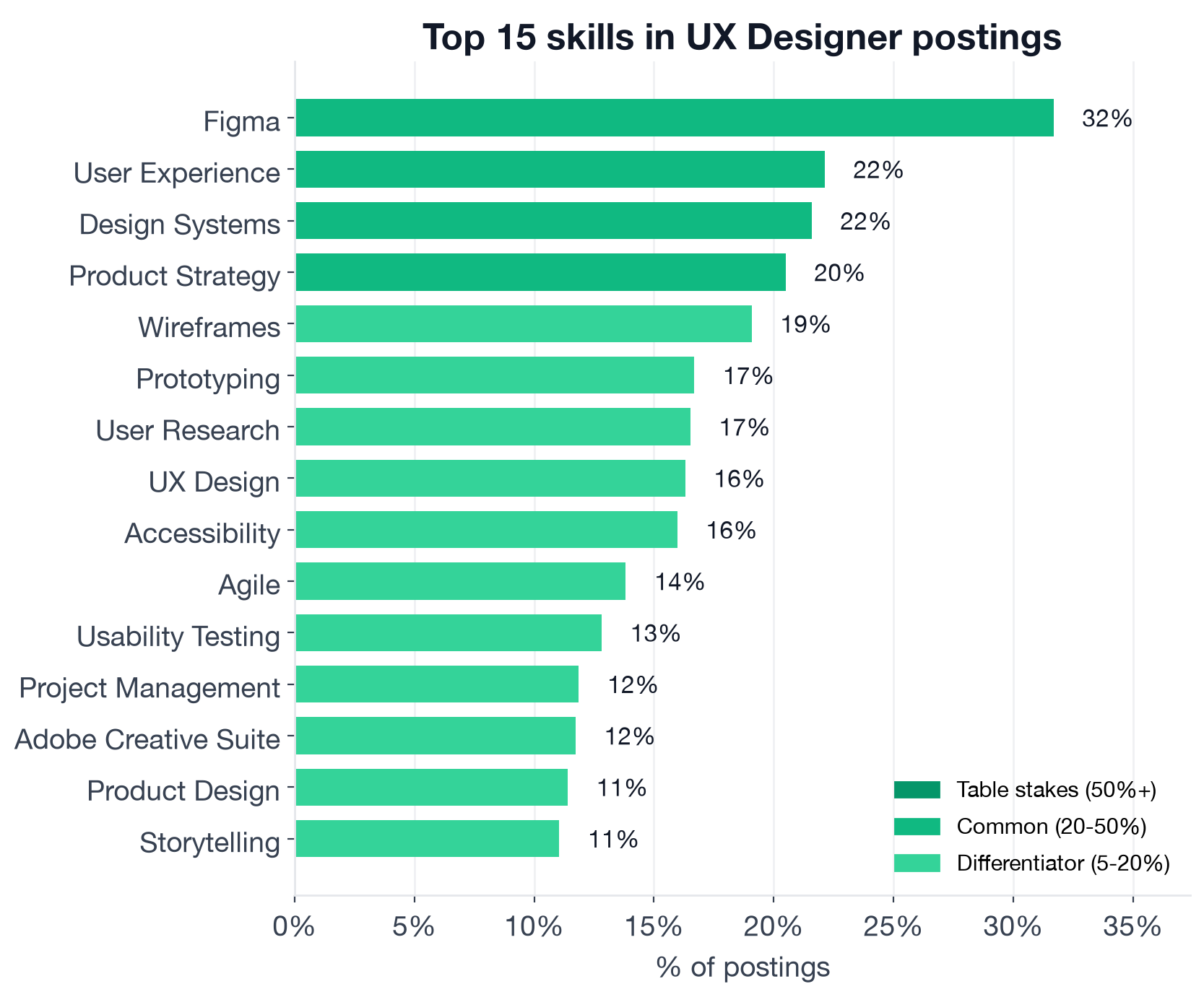
Top individual skills in UX Designer postings by share of listings. Skills above 50% are table stakes (none reach this threshold); 20-50% are common; 5-20% are differentiators.
Common Expectations (20-50% of postings)
These four skills are the closest thing UX Designer has to a shared baseline across the whole market.
- Figma: 31.7% (1,164 postings): browse Figma-focused UX openings
- User Experience: 22.1% (813 postings)
- Design Systems: 21.6% (793 postings)
- Product Strategy: 20.5% (753 postings)
Figma appearing in fewer than a third of postings does not mean the other two-thirds don't use it. Employers listing Figma by name are signaling that the tool matters in their specific workflow; those who don't list it typically assume fluency as a given. What is worth noting is that Design Systems sits nearly as high as Figma at 21.6%. A Design Systems skill signals something different from tool proficiency: it means working at the component, pattern, and token level to build reusable design infrastructure. That is exactly why it commands the highest salary in the dataset.
Differentiators (5-20% of postings)
The differentiator tier spans 28 skills and reflects how widely the role varies by company context.
- Wireframes: 19.1%, Prototyping: 16.7%, User Research: 16.5%
- Accessibility: 16.0%, Agile: 13.8%, Usability Testing: 12.8%
- Project Management: 11.9%, Adobe Creative Suite: 11.7%
- Interaction Design: 11.0%, Storytelling: 11.0%, User Flows: 10.8%
- HTML: 9.9%, CSS: 9.8%, Typography: 9.4%
- A/B Testing: 8.8%, Visual Design: 8.8%
- Motion Design: 6.1%, JavaScript: 5.6%
The differentiator spread is effectively a fingerprint for three distinct sub-types of UX work. Postings asking for Prototyping, User Research, Accessibility, and Usability Testing together are hiring product-oriented UX researchers and designers. Postings asking for Adobe Creative Suite, Typography, Branding, and Motion Design are hiring graphic and brand designers who happen to carry the UX title. Postings asking for HTML, CSS, and JavaScript are hiring design engineers. These sub-markets overlap in job title but diverge sharply in salary outcomes, as the table above shows.
The skill families chart shows which secondary domains supplement the core design toolkit:
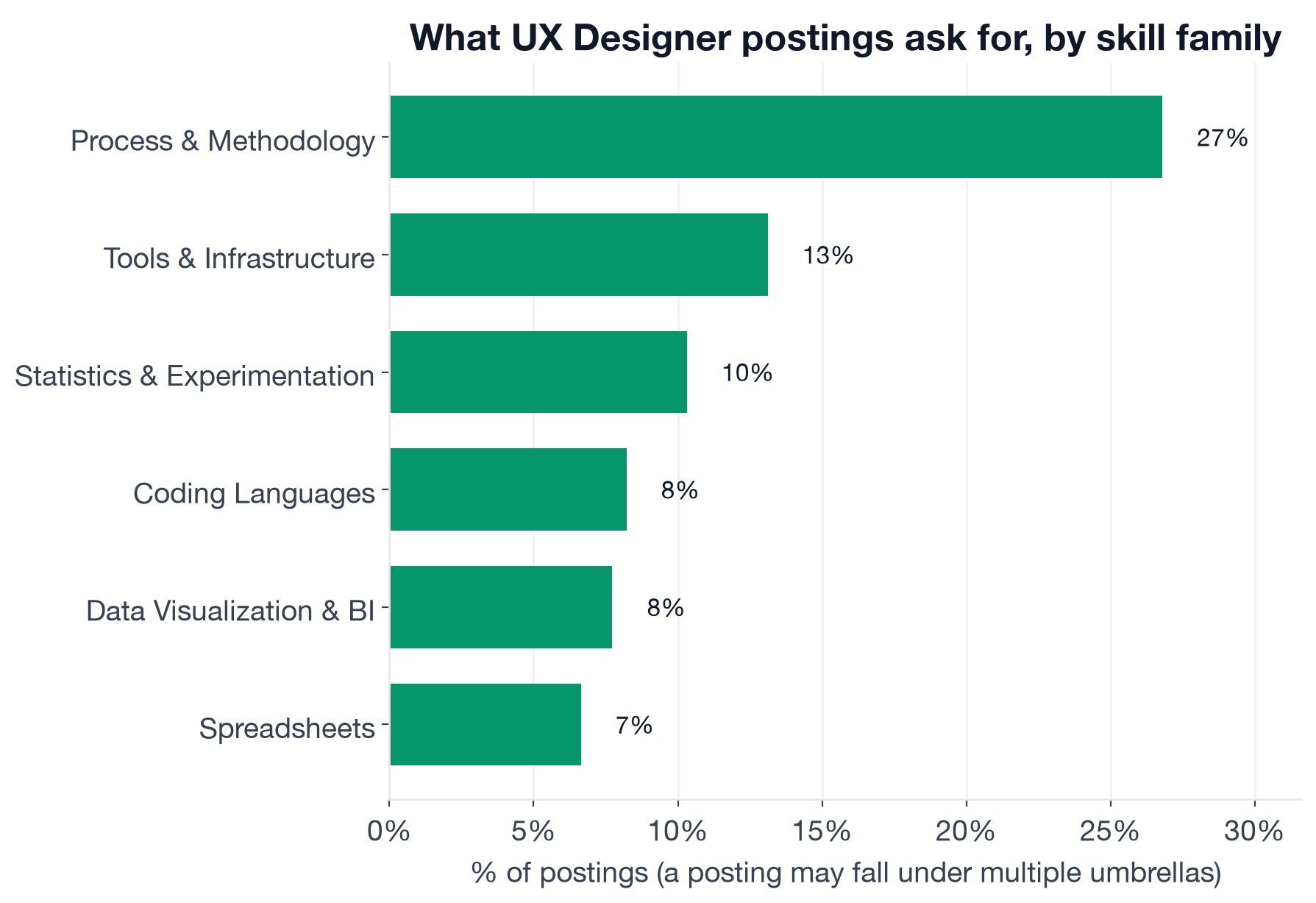
Share of UX Designer postings that ask for at least one skill in each secondary family. Core design skills aggregate under "Other," which covers 88% of postings.
Process and methodology skills appear in 26.8% of postings, led by Agile (13.8%) and Project Management (11.9%). UX Designers are increasingly expected to work inside Agile product teams rather than alongside them. Statistics and Experimentation at 10.3% reflects the growing portion of the market where designers are expected to validate decisions with data, not just advocate for users.
On AI tools: The Machine Learning and AI umbrella covers 3.6% of postings (133 of 3,675). That measures the narrow slice of roles explicitly hired to build or design AI-powered products. It does not capture ambient AI use. Across designer-specific surveys, 72% of designers report using generative AI tools in their regular workflow (Figma State of the Designer 2026, 906 respondents), and 89% say those tools make them faster. Postings do not mention "uses Figma AI" or "uses ChatGPT for copy ideation" for the same reason they stopped listing "proficient in email": employers assume it. For UX Designers, AI proficiency is ambient infrastructure. 73% of hiring managers say AI tool proficiency is increasingly expected even when job descriptions do not state it explicitly. The 3.6% explicit rate is the floor, not the ceiling.
The Stacks That Signal UX Sub-Roles
Co-occurrence data reveals which skills cluster together and, by extension, which postings describe the same underlying job.
| Skill pair | Postings with both | % of postings | Lift |
|---|---|---|---|
| CSS + HTML | 336 | 9.1% | 9.42 |
| User Flows + Wireframes | 329 | 9.0% | 4.36 |
| Usability Testing + User Research | 335 | 9.1% | 4.31 |
| UX Design + Wireframes | 365 | 9.9% | 3.19 |
| User Research + Wireframes | 356 | 9.7% | 3.07 |
| Figma + Design Systems | 587 | 16.0% | 2.34 |
Lift above 1 means the pair appears together more often than independent frequencies would predict. CSS + HTML at lift 9.42 stands apart from everything else in the table: when a UX posting asks for CSS, it almost always asks for HTML. These are design-engineer postings, roles where the deliverable is working code, not just a mockup. The salary data backs it up: HTML carries a US median of $150,500 and CSS $153,500, both well above the role baseline.
The research stack (Usability Testing + User Research, lift 4.31) and the process stack (User Flows + Wireframes, lift 4.36) are the two other high-cohesion pairs. They cluster in product and enterprise UX roles where the deliverable is a researched, tested, documented design artifact rather than a finished visual. User Research ($153,200), Usability Testing ($145,600), User Flows ($150,700), and Wireframes ($151,500) all sit comfortably above the baseline, which is consistent with that reading.
Figma + Design Systems (lift 2.34) is the most common pairing in absolute terms, appearing in 16% of postings. It is the modern product design stack: you work in Figma, and you use it to build or extend a design system rather than produce one-off screens. That combination also corresponds to the two highest-ceiling skills in the salary table ($145,600 for Figma, $159,500 for Design Systems).
How Hard Is It to Break Into UX Design?
More accessible than engineering roles, but the market is still skewed toward practitioners with shipped work.
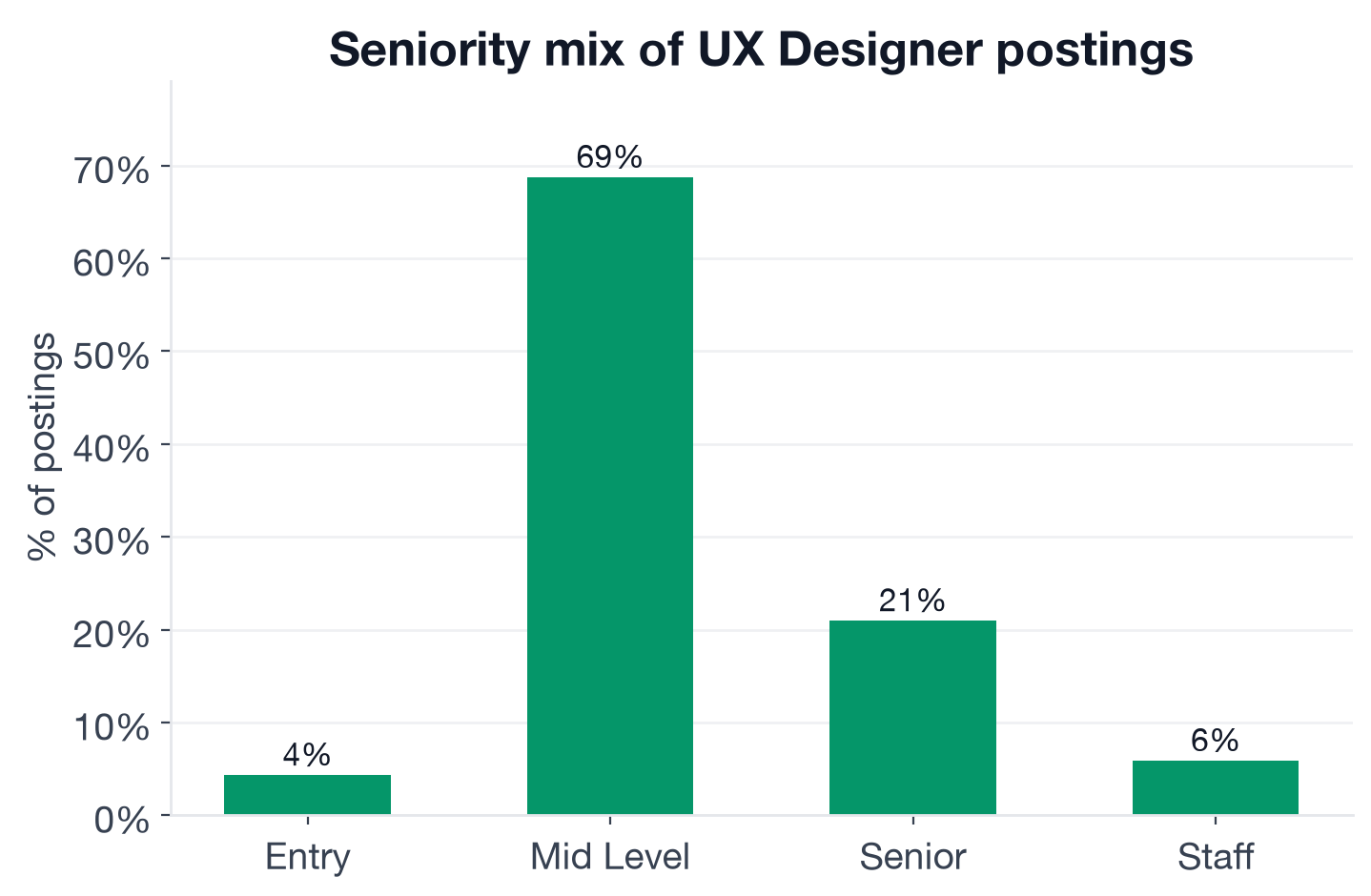
Seniority distribution of UX Designer postings. Seniority is inferred from title keywords; postings with no explicit signal default to mid-level.
- Mid-level: 68.8% (2,527 postings)
- Senior: 21.0% (771): senior UX Designer openings
- Staff / Lead / Principal: 5.9% (217)
- Entry-level: 4.4% (160)
Fewer than 1 in 23 postings is genuinely entry-level. The mid-level dominance (nearly 7 in 10 postings) means hiring managers uniformly expect practitioners who have shipped something real. Portfolio review is not a formality in UX hiring; it is the primary filter. Three to five case studies showing research, iteration, and documented outcomes carry more weight than credentials or years on the clock.
The senior tier at 21% offers meaningful IC runway. Senior UX Designers who add Design Systems expertise or quantitative research skills (A/B testing, usability metrics) tend to find the staff-level path well-supported, given how the salary table lines up with those skills. Practice AI mock interviews focused on design critique and portfolio walk-through to prepare for the senior gate specifically; those rounds are more conversational than a standard behavioral interview and reward practitioners who can narrate trade-offs, not just show polished deliverables.
How Remote-Friendly Are UX Designer Roles, and Where Are They?
The US is the dominant market by a significant margin, and on-site work is the norm.
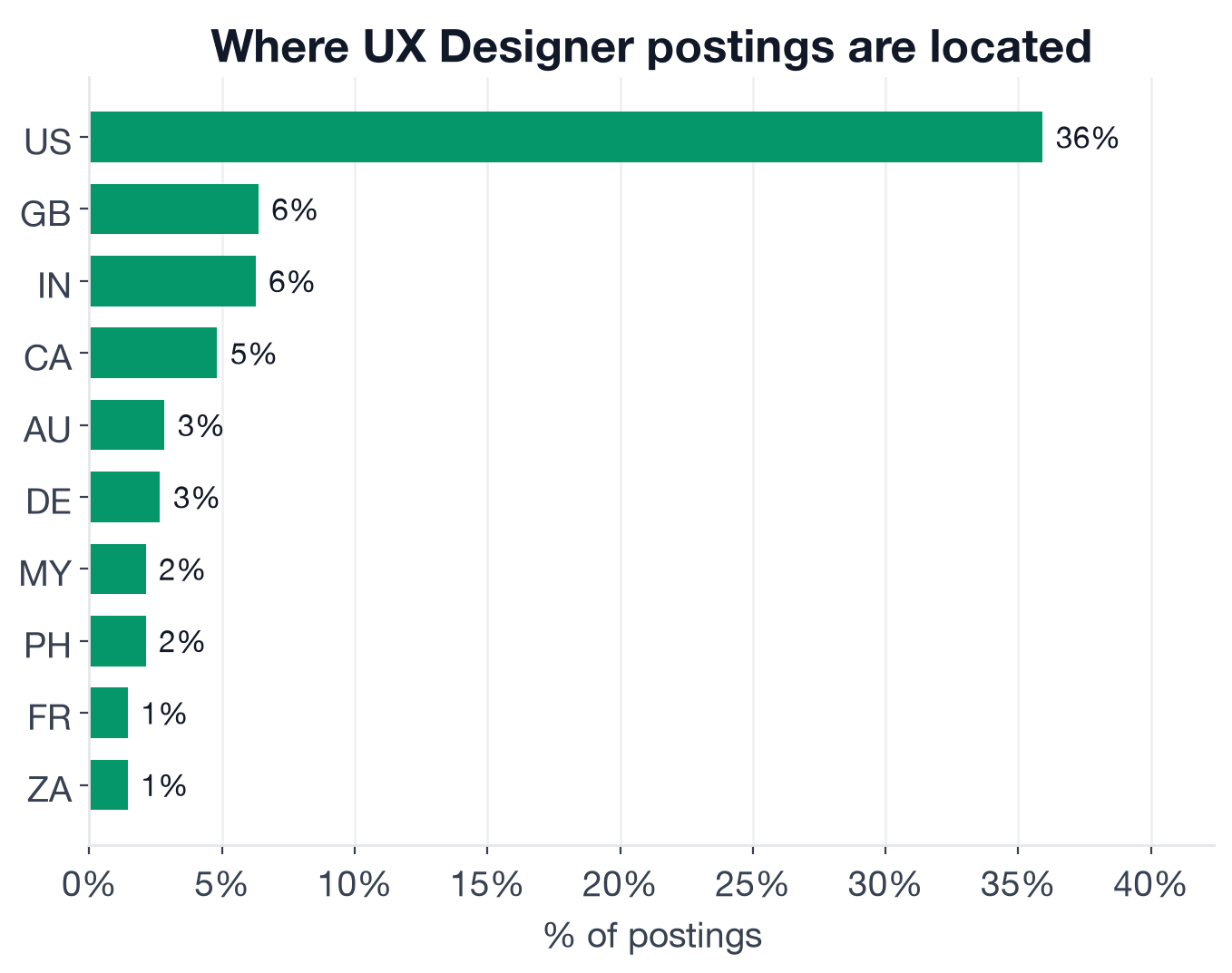
Top countries by share of UX Designer postings.
- United States: 35.9% (1,320 postings): US-only UX Designer openings
- United Kingdom: 6.4% (234)
- India: 6.3% (230)
- Canada: 4.8% (177)
- Australia: 2.8% (104)
- Germany: 2.7% (98)
The US accounts for more than a third of all postings, a reflection of how much UX hiring concentrates in US-based product companies and enterprise software firms. The UK and India run close behind, with robust demand across fintech, software, and technology sectors.
On remote work, UX Design is one of the less flexible roles in the market:
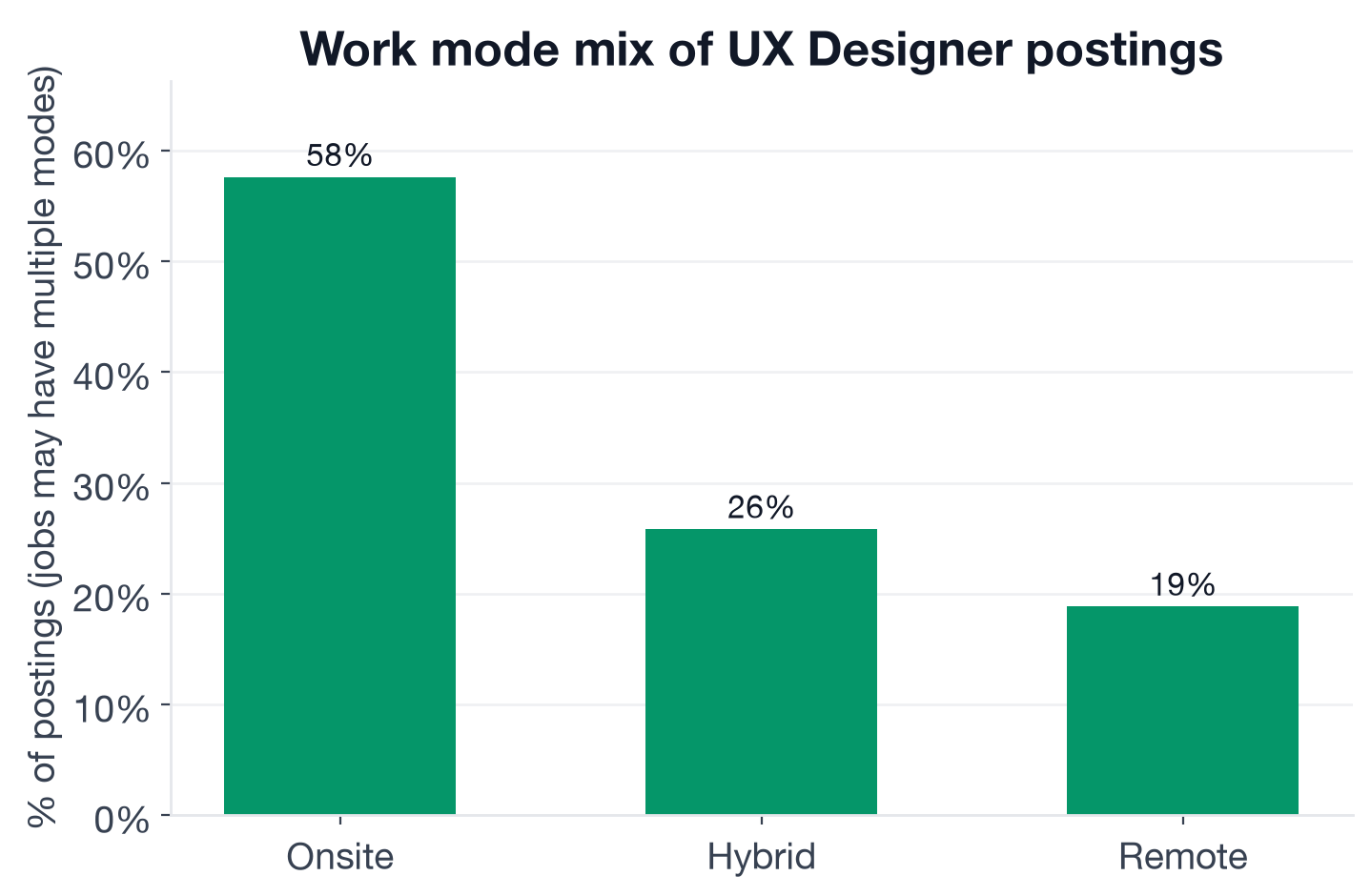
Share of UX Designer postings tagged with each work mode.
- Onsite: 57.6% (2,117 postings)
- Hybrid: 25.8% (949)
- Remote: 18.8% (692): fully-remote UX Designer openings
Fewer than 1 in 5 postings is fully remote. The collaborative mechanics of UX work (co-design sessions, user research facilitation, whiteboarding with engineering and product teams) keep the role more office-adjacent than a purely asynchronous discipline. If location flexibility is a priority, the 18.8% fully-remote pool exists, but it is smaller than the remote share most adjacent tech roles carry. The remote share concentrates in product-led SaaS companies; agencies, financial services, and healthcare employers default to onsite or hybrid.
How to Use This in Your Job Search
Lead your portfolio with the high-salary skills. If your case studies center on Design Systems, User Research, wireframing, and documented usability testing rather than visual polish alone, they sort you into the higher-paying market segment before a recruiter reads a word. Quantitative evidence of impact (conversion improvements, task-completion data, reduction in support tickets after a redesign) is particularly valued at the product-company tier.
Understand which sub-market you are applying to. A posting listing Adobe Creative Suite, Typography, and Branding signals agency or brand-design work with its own salary curve. A posting listing Design Systems, User Research, and Agile signals product-company work with a different one. The skills you foreground in your application should match the segment you are targeting. Browse current UX Designer openings and use skill filters to narrow to your segment.
Treat AI proficiency as table stakes, not a differentiator. 73% of hiring managers expect AI tool fluency even when job descriptions do not list it. Show how you use Figma AI for rapid prototyping, ChatGPT for copy iteration, or generative tools for early-stage ideation in how you describe your process, not just the final artifacts.
Drill the portfolio walk-through and design critique. UX interviews combine portfolio presentation, take-home exercises, and behavioral rounds in proportions that favor practitioners who can narrate decisions out loud. Our question bank covers behavioral and situational questions common to design-role interviews. AI mock interview sessions let you practice the portfolio walk-through under realistic conditions with on-demand feedback on how you frame trade-offs.
Invest in the skills that move salary. If your portfolio has strong visual craft but thin systems or research work, the salary table above gives you a clear answer on where to invest next. Design Systems openings and User Research openings represent the higher-paying segment of the market. Our interview-prep courses cover UX research methods and product design fundamentals. The challenges feed is where you practice shipping design work under real constraints and build portfolio artifacts in the process.
FAQ
Q. What skills do companies want from UX Designers in 2026?
No single skill reaches the table-stakes threshold (50%+) in the UX Designer market, reflecting how fragmented the role is. The four skills in the common tier (20-50%) are Figma (31.7%), User Experience (22.1%), Design Systems (21.6%), and Product Strategy (20.5%). The differentiator tier spans 28 skills including wireframes, prototyping, user research, accessibility, agile, usability testing, and interaction design.
Q. What is the median UX Designer salary in 2026?
The median US base salary across 685 UX Designer postings with disclosed salary data is $116,500. That figure excludes equity, bonuses, and sign-on, so total compensation at top employers runs meaningfully higher.
Q. Which UX Designer skills command the highest salaries?
Among US postings, Design Systems pays a median of $159,500 (n=170), or $43K above the $116,500 role baseline. UX Design skill itself pays $155,500 (n=124), Agile pays $153,500 (n=105), CSS pays $153,500 (n=77), and User Research pays $153,200 (n=129). Wireframes, User Flows, Product Design, HTML, and Interaction Design each cluster in the $148,500-$151,500 range. Skills at the bottom of the table include Adobe Creative Suite ($98,700), Branding ($92,500), Typography ($90,000), and Excel ($85,000), all well below the baseline.
Q. How hard is it to break into UX Design?
More accessible than engineering roles, but the market is still skewed toward experienced candidates. Only 4.4% of UX Designer postings (160 of 3,675) are explicitly entry-level. The market is 68.8% mid-level, so most job descriptions assume some prior project work. Building a portfolio with real research artifacts and usability testing documentation is the standard path in from an adjacent field.
Q. Is UX Design a remote-friendly career?
Less so than most tech roles. Only 18.8% of UX Designer postings (692 of 3,675) are tagged fully remote, below the rate for most adjacent tech roles. Onsite is the dominant mode at 57.6% (2,117 postings), with hybrid at 25.8% (949). The collaborative nature of UX work keeps most roles tethered to an office or hybrid schedule.
Q. Do UX Designer roles require AI skills in 2026?
Only 3.6% of UX Designer postings (133 of 3,675) mention AI as an explicit requirement; those are roles specifically building or designing AI-powered products. But survey data tells a different story: 72% of designers already use generative AI tools in their workflow (Figma State of the Designer 2026, 906 respondents), and 73% of hiring managers say AI tool proficiency is increasingly expected (Figma design statistics 2026). AI in UX is ambient infrastructure now, and employers assume it without stating it.
Q. What is the dominant UX Designer skill stack in 2026?
The strongest co-occurrence pair in UX Designer postings is CSS + HTML (lift 9.42, appearing together in 9.1% of postings), which signals design-engineer hybrid roles. The research stack (Usability Testing + User Research, lift 4.31) and the process stack (User Flows + Wireframes, lift 4.36) are the two other dominant sub-stacks. The modern product design layer adds Figma + Design Systems (lift 2.34), combining the most-mentioned tool with the highest-paying core UX design skill.
Start with Figma, Build Toward Systems
Figma is the market's de facto entry point, but the salary data is clear about where growth happens: in systems thinking, research depth, and the cross-functional delivery skills that make a designer a technical collaborator rather than a production resource. A portfolio heavy on polished UI and light on documented research, usability testing, and design system contribution sorts into the lower-paying segment of this market. The good news is that both markets are large, the job board has 3,675 active postings across them, and the path from one to the other is a matter of deliberate portfolio choices over the next six to twelve months.
Topics
Ready to practice?
Put what you've learned into practice with AI mock interviews and structured preparation guides.