
SOC Skills Get You Hired; Cloud Skills Get You Paid More
The Information Security Analyst role looks uniform from the outside: monitor threats, respond to incidents, keep systems secure. The job postings tell a more fractured story. No single skill appears in more than 35% of active listings: not even Monitoring, the most commonly listed skill, which reaches only 34.5% of postings. That absence of consensus is the role's defining feature. "Information Security Analyst" covers at least three distinct tracks: SOC operations, cloud security, and security scripting and automation. Which track you are on determines your skill set, your day-to-day work, and, most consequentially, your pay.
The pattern emerges from 5,066 active postings on the InterviewStack.io job board analyzed as of June 2026. The salary gap is the sharpest signal in the data: cloud and automation skills carry premiums of $12-17K over the $95,700 US base salary median, while the SOC fundamentals (Monitoring, SIEM, Incident Response) sit within $4-7K of it. Getting hired requires the SOC layer. Getting paid above the median requires adding cloud or automation depth on top.
Key Findings
- 5,066 active Information Security Analyst postings analyzed on the InterviewStack.io job board as of June 2026 (5,058 distinct).
- No skill appears in even half of all postings: the top skill, Monitoring, reaches only 34.5% (1,747 of 5,066), making this one of the most specialization-dependent roles in cybersecurity.
- Median US base salary: $95,700 across 812 postings with disclosed US salary data.
- Cloud and automation skills add $12-17K over the baseline: Encryption ($113,000, n=51), AWS ($112,900, n=101), Azure ($111,400, n=83), and Automation ($108,000, n=135) lead the premium tier.
- Mid-level roles dominate at 76.7% of postings (3,888); entry-level is only 3.7% (187 postings).
- Only 9.2% of postings are tagged remote (464 of 5,066), one of the lowest remote shares among tech roles.
- The US accounts for 46.5% of all postings (2,355), a higher concentration than most software engineering roles, driven largely by government, defense, and compliance-heavy sectors.
Data note: The "Information Security Analyst" title family on the job board captures primarily cybersecurity roles (SOC analysts, cloud security specialists, IAM engineers, and compliance analysts) but the dataset also includes a portion of physical and operational security analyst postings (security operations coordinators, facility security analysts, guard-company dispatchers). This contamination is estimated at roughly 15-20% of the total sample, based on title-sample inspection. Skill frequencies (particularly Monitoring) and the onsite work-mode share are modestly elevated by that broader capture. The salary benchmarks, cloud premium figures, and cybersecurity-specific skill patterns (SIEM, Incident Response, Splunk, IAM) are driven by the cybersecurity-focused majority of the dataset.
What Does the IS Analyst Title Actually Cover?
Most tech roles have a recognizable skill fingerprint. Python and SQL for data. JavaScript or TypeScript for frontend. Not here. Group all skills into higher-level families and no single family reaches even 60% of postings.
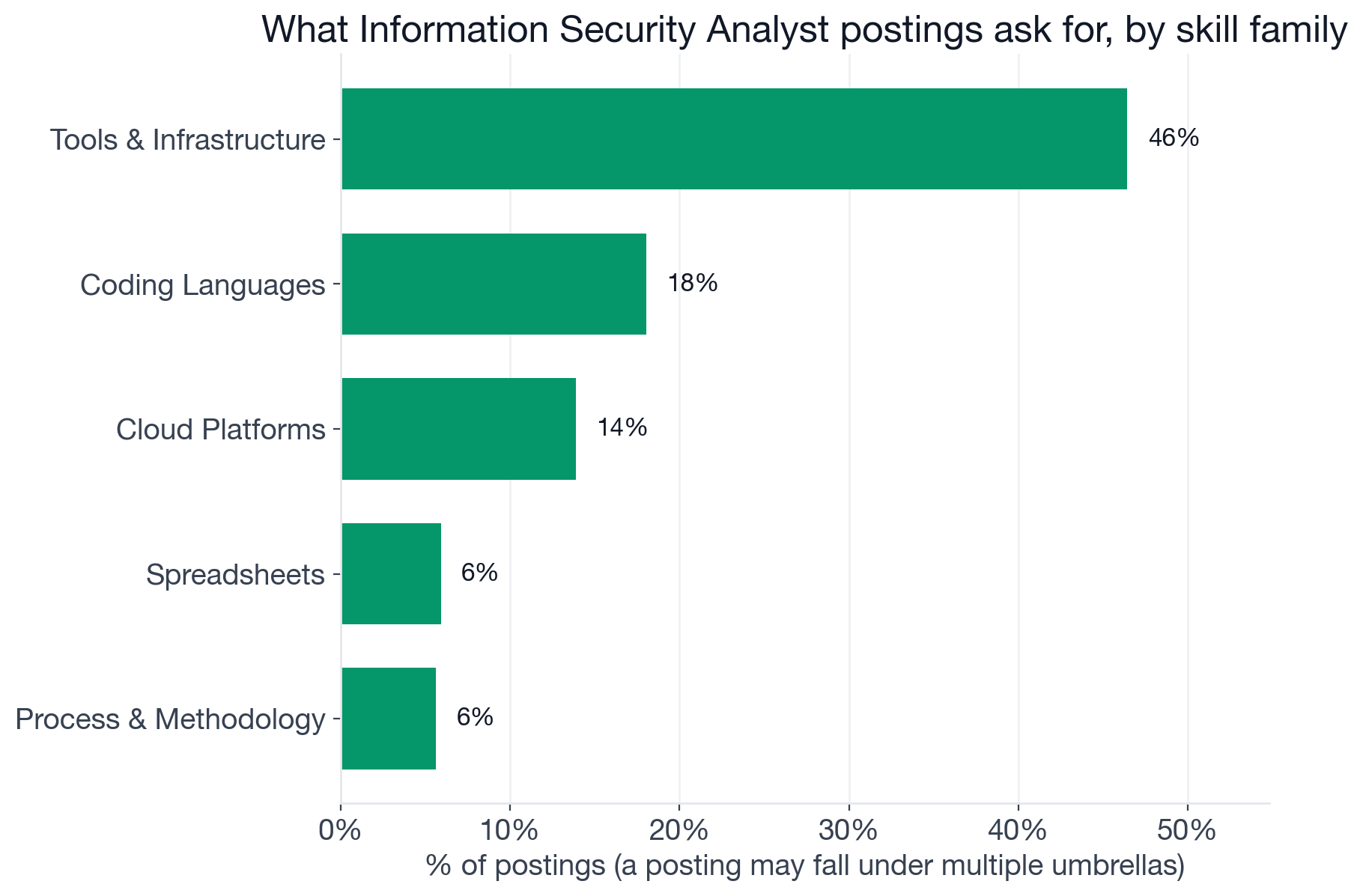
Share of Information Security Analyst postings that mention at least one skill in each family. A posting that lists both SIEM and Incident Response counts once under security-specific skills.
Two families set the stage. Tools and Infrastructure (Monitoring, Automation, Linux) appears in 46.4% of postings and captures the operational layer: regardless of specialization, IS Analysts are expected to work with monitoring systems and understand automation. The core security skills cluster (Incident Response, SIEM, Windows, IAM, Penetration Testing, Splunk) covers 57.7% of postings at the umbrella level, but individual skill rates tell a more fragmented story: Incident Response reaches 19.7% while Penetration Testing sits at 5.8%, meaning both are nominally "security skills" but they describe fundamentally different jobs.
Coding Languages (18.1%, led by Python at 10.2%) marks the divide between more technical and more operations-focused tracks. Cloud Platforms (13.9%, split across AWS, Azure, and Google Cloud) identifies the cloud security specialization. At the bottom of the list, Machine Learning and AI sits at 3.7% of postings, a figure that requires context.
That 3.7% measures postings explicitly asking analysts to build or architect AI-driven security systems: training anomaly detection models, tuning AI-powered SIEM engines, designing agentic threat response pipelines. It is not a ceiling on AI usage in the role. According to the ISC2 AI Pulse Survey 2025, 72% of cybersecurity professionals are already using or actively evaluating AI security tools (30% fully integrated, 42% actively testing). The WEF Cybersecurity AI Adoption Report 2026 puts organizational AI deployment in cybersecurity at 77%, with primary use cases covering phishing detection, anomaly monitoring, and incident response: exactly the core functions of this role. Natural-language SIEM querying, AI-assisted alert triage, and LLM-powered incident summarization are now embedded in how analysts work at most mature security operations centers, whether or not the job posting says so. The Cyware 2026 survey found 77% of security professionals want agentic AI in their workflows, but with mandatory human oversight. AI is present in this role's operations whether it appears in the JD or not. The explicit 3.7% measures a specific specialization, not the industry's AI exposure.
The bottom of the family list is also informative. SQL (2.9% of postings) and data engineering foundations (0.8%) confirm the role's orientation: IS Analysts secure systems and data; they don't build the pipelines behind them.
How Do Individual Skills Break Down by Demand?
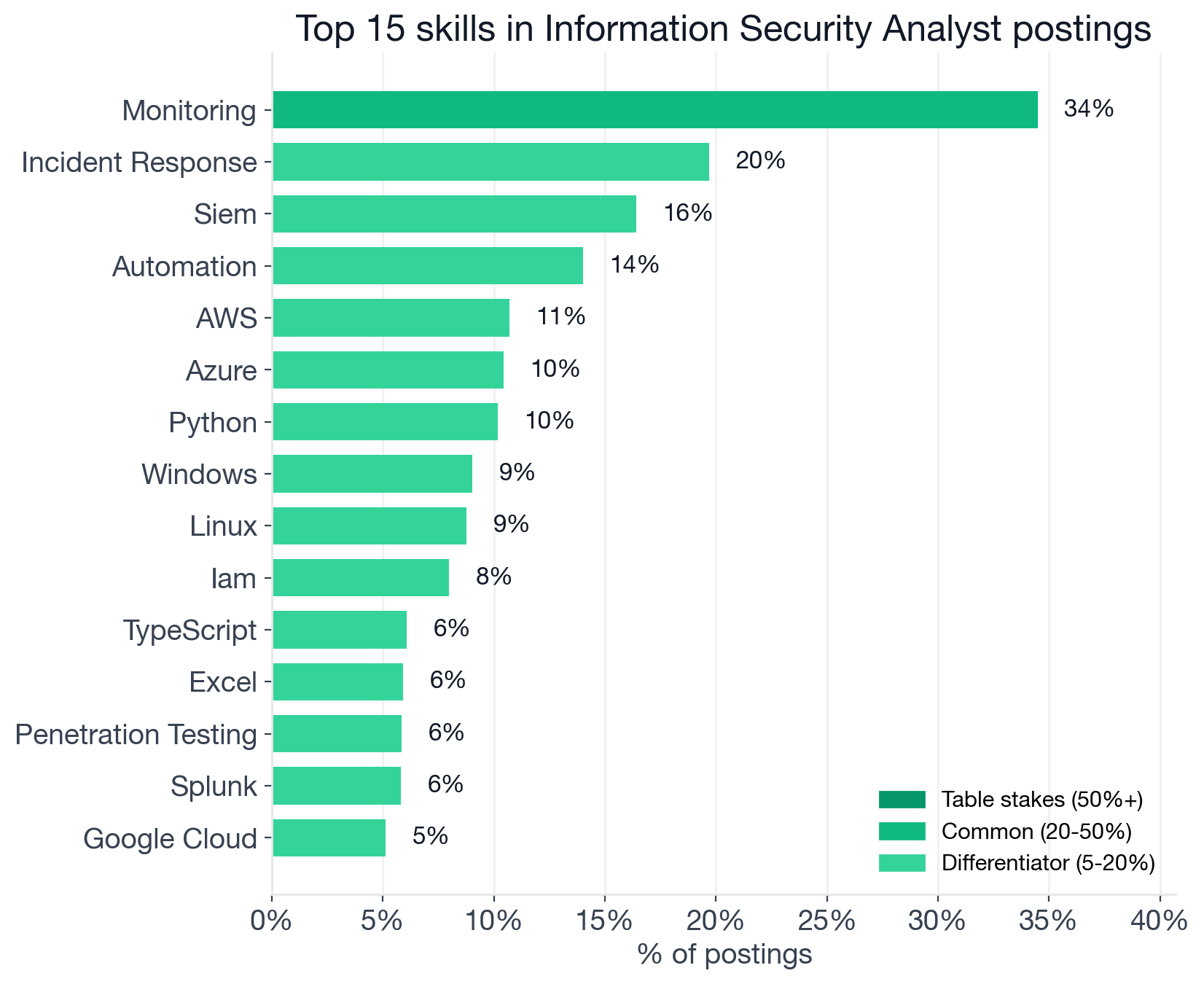
Top individual skills in Information Security Analyst postings, colored by tier. Skills above 50% are table stakes; 20-50% are common; 5-20% are differentiators.
The table-stakes tier (skills in 50%+ of postings) is empty. That is unusual in tech hiring. For Data Engineer roles, three skills cross the 50% line. For Cybersecurity Engineers, a similar clustering exists around infrastructure and scripting. For Information Security Analysts, no such consensus exists. The most common requirement appears in fewer than 4 in 10 postings: the data's way of confirming that "IS Analyst" is a title family, not a single job.
Common (20-50% of postings)
One skill lands here:
Monitoring at 34.5% (1,747 postings) is the closest thing this role has to a universal requirement. It spans SIEM alert monitoring, network traffic analysis, endpoint detection, and cloud security event watching. Whatever specialization track you are on, monitoring something is the common thread.
Differentiators (5-20% of postings)
Fourteen skills land in this range, covering the full breadth of the role's specializations:
| Skill | % of Postings |
|---|---|
| Incident Response | 19.7% |
| SIEM (Security Information and Event Management) | 16.4% |
| Automation | 14.0% |
| AWS | 10.7% |
| Azure | 10.4% |
| Python | 10.2% |
| Windows | 9.0% |
| Linux | 8.8% |
| IAM (Identity and Access Management) | 8.0% |
| TypeScript | 6.1% |
| Excel | 5.9% |
| Penetration Testing | 5.8% |
| Splunk | 5.8% |
| Google Cloud | 5.1% |
The table reads like a menu of specializations more than a single skill profile. Incident Response and SIEM define SOC analyst work. Python and Automation define security engineering and DevSecOps-adjacent roles. The three cloud platforms identify cloud security roles. Windows and Linux identify systems hardening work. IAM identifies access management and zero-trust roles. Penetration Testing identifies offensive security and red-team adjacent positions.
The TypeScript entry (6.1%) is a less obvious signal: security engineers building application security tooling, browser security extensions, or cloud security dashboards increasingly use TypeScript, pointing to a developer-adjacent sub-track inside the broader title.
Browse Information Security Analyst openings that require Incident Response
Where the Real Pay Differential Lives
Salary figures below are restricted to US postings with disclosed base salary (n=812), so they are directly comparable across skills. These are base-only numbers: equity, bonuses, RSUs, and sign-on are not captured in job postings, so total compensation at top employers runs meaningfully higher than what we report, especially in technology, finance, and government contracting.
The overall median US base salary is $95,700. The chart and table below show what specific skills do to that number.
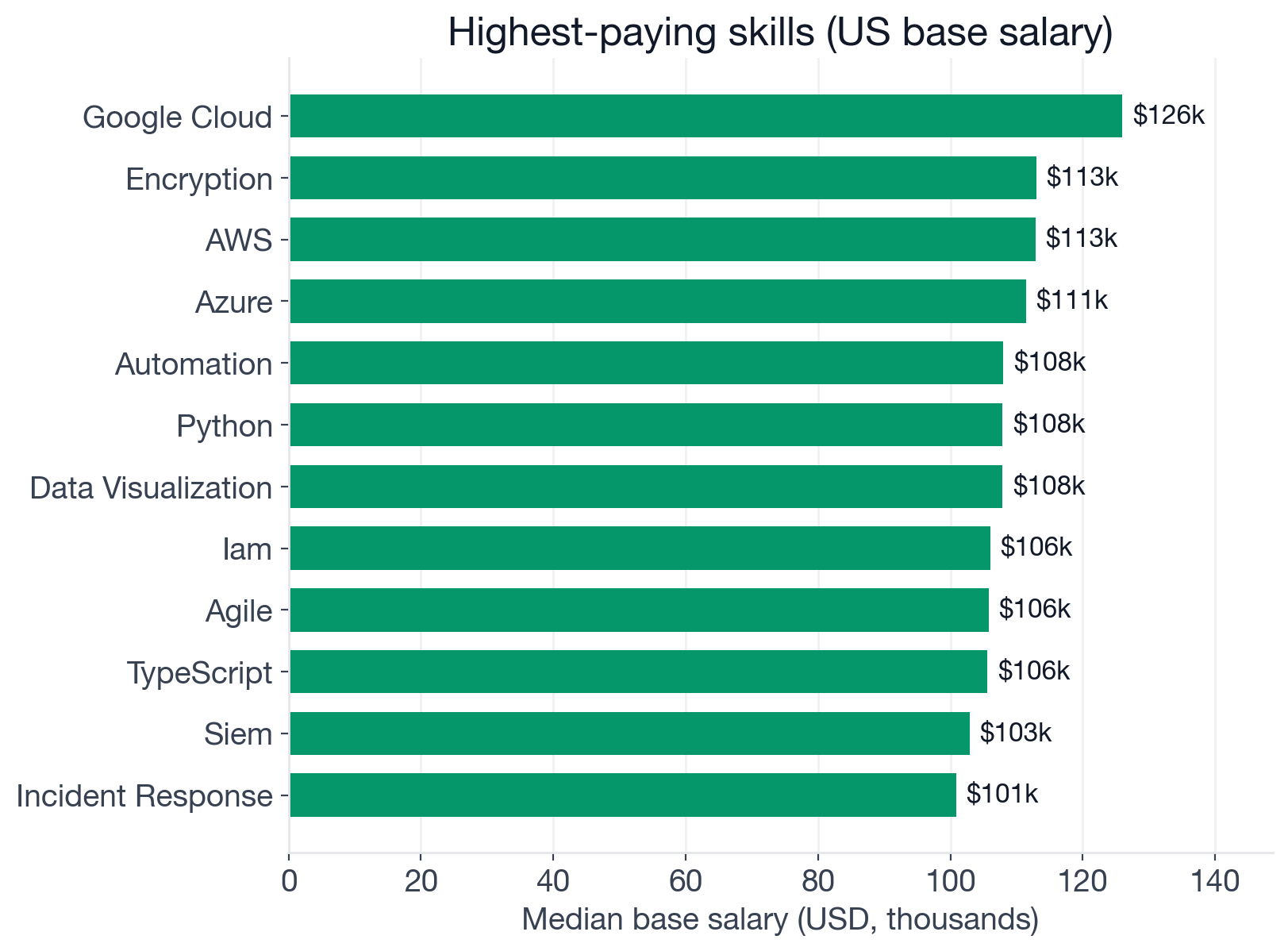
Median US base salary in USD for postings that mention each skill, among US Information Security Analyst postings with structured salary data.
| Skill | US Median | n | Premium Over $95,700 |
|---|---|---|---|
| Google Cloud | $126,000 | 32 | +$30,300 |
| Encryption | $113,000 | 51 | +$17,300 |
| AWS | $112,900 | 101 | +$17,200 |
| Azure | $111,400 | 83 | +$15,700 |
| Automation | $108,000 | 135 | +$12,300 |
| Python | $107,900 | 93 | +$12,200 |
| IAM | $106,000 | 101 | +$10,300 |
| TypeScript | $105,600 | 168 | +$9,900 |
| SIEM | $102,900 | 130 | +$7,200 |
| Incident Response | $100,900 | 194 | +$5,200 |
| Monitoring | $100,000 | 286 | +$4,300 |
| Splunk | $98,100 | 96 | +$2,400 |
The pattern inverts what the frequency data would lead you to expect. Monitoring is the most commonly listed skill; it pays $100,000 median, or $4,300 above baseline. AWS appears in roughly one-third as many postings as Monitoring; it pays $112,900, or $17,200 above baseline. The core SOC skills get you in the door, but the salary ceiling is held by cloud and automation depth.
Three tiers emerge from the table:
The cloud and technical premium tier ($10-30K above baseline): Google Cloud, Encryption, AWS, Azure, Automation, Python, and IAM. These are the skills that signal a more technical, cloud-fluent profile. Google Cloud's $126,000 median is based on a small sample (n=32) and should be treated as a directional indicator rather than a precise benchmark; the AWS (n=101) and Azure (n=83) figures are more reliable. Encryption at $113,000 and n=51 is worth a specific note: it is a noise-tier skill by frequency (4.9% of postings), but when it appears it flags specialized roles in cryptography, data security architecture, or zero-trust design: roles that command senior-level pay even if they are a small share of the market.
The mid-premium tier ($5-10K above baseline): SIEM, TypeScript, and Incident Response. These are skills that distinguish a more capable SOC analyst from a basic one, but they are not the ceiling.
Near-baseline skills: Monitoring and Splunk. These are operational requirements that most postings assume; they are common enough that they carry no scarcity premium.
The practical implication: learning SIEM or Incident Response is necessary to pass the filter on most IS Analyst applications. Layering AWS or Azure and some Python on top is what moves the offer from $95-100K to $108-113K.
Browse cloud-security-focused IS Analyst openings requiring AWS
Which Skill Clusters Define Each Track?
The co-occurrence data makes the specialization tracks concrete. Below are the strongest skill pairs by lift, where lift greater than 1 means the two skills appear together more often than their individual frequencies alone would predict:
| Skill Pair | Lift | Postings | % of All |
|---|---|---|---|
| AWS + Google Cloud | 8.70 | 242 | 4.8% |
| Azure + Google Cloud | 8.12 | 220 | 4.3% |
| PowerShell + Python | 7.97 | 200 | 3.9% |
| Linux + Windows | 7.89 | 316 | 6.2% |
| SIEM + Splunk | 4.28 | 207 | 4.1% |
| Automation + Python | 3.46 | 250 | 4.9% |
| Incident Response + SIEM | 3.09 | 506 | 10.0% |
Three clusters emerge:
The SOC stack. Incident Response plus SIEM (lift 3.09, 506 postings) and SIEM plus Splunk (lift 4.28, 207 postings) define the dedicated security operations center analyst. These are roles built around alert workflows: events flow into a SIEM platform, often Splunk, analysts triage and classify, and Incident Response processes handle confirmed threats. The 10.0% of postings carrying both Incident Response and SIEM is the largest co-occurrence cluster in the data by raw count.
The cloud security stack. AWS plus Google Cloud (lift 8.70) and Azure plus Google Cloud (lift 8.12) are the highest-lift pairs in the entire dataset. That extraordinary lift signals a small, distinct population of postings: multi-cloud security roles that require deep familiarity with two or more providers' IAM frameworks, networking security controls, and cloud-native security tooling. These are the cloud-security-focused IS Analyst roles that sit at the top of the salary table. They are a minority of postings but a disproportionate share of high-compensation ones.
The scripting and automation stack. PowerShell plus Python (lift 7.97) and Automation plus Python (lift 3.46) describe the DevSecOps-adjacent analyst: someone writing scripts to automate alert triage, patch deployment verification, threat hunting queries, and security monitoring integrations. Python also pairs meaningfully with Incident Response (lift 2.35) and SIEM (lift 2.27), suggesting that scripting is increasingly expected even in traditional SOC roles, not just in dedicated automation positions. The trajectory here is AI-accelerated: much of what "automation" now covers in this context is AI-assisted alert correlation and LLM-powered reporting, even when postings phrase it in pre-AI language.
Who's Being Hired, and at What Level?
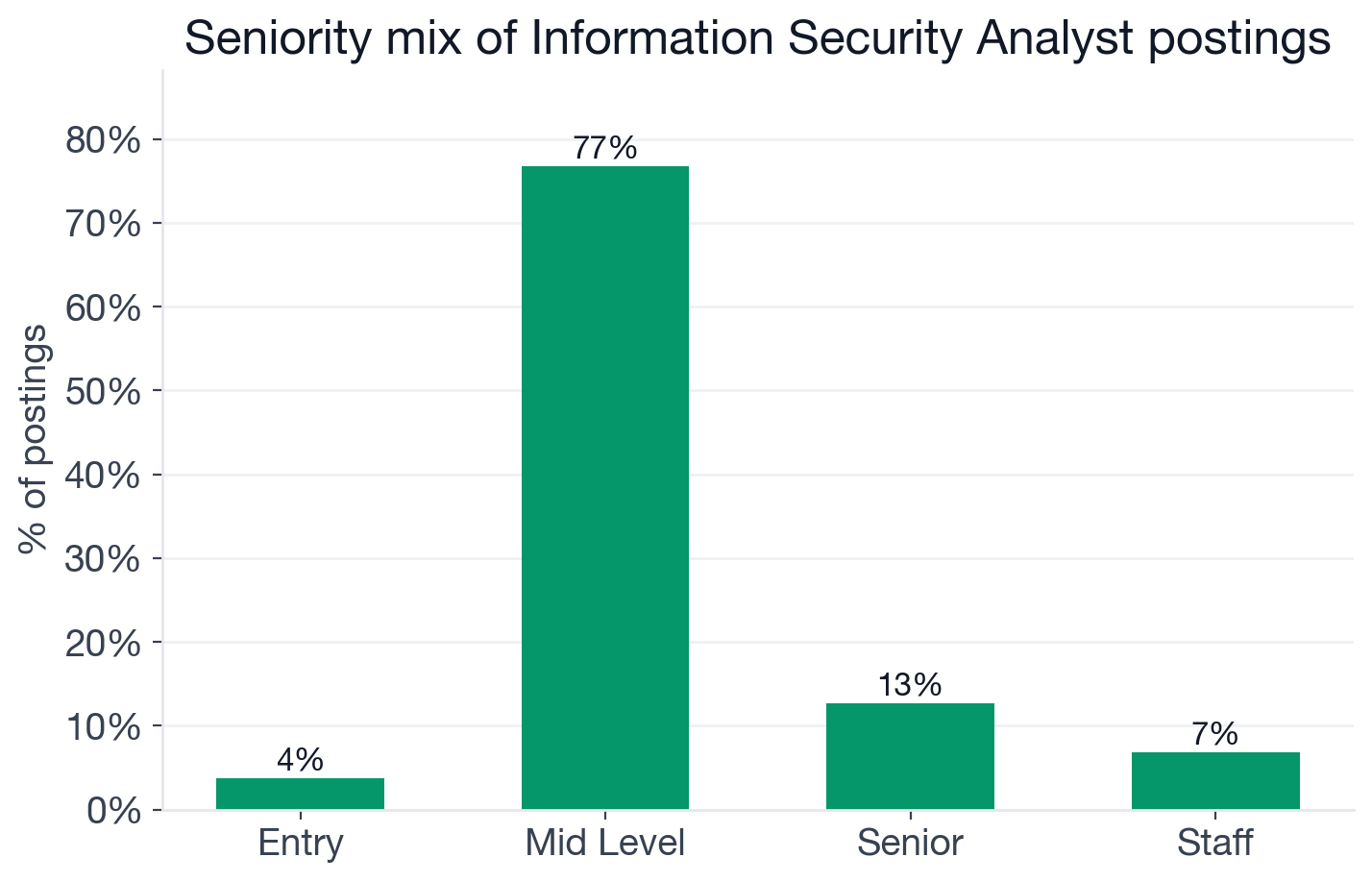
Seniority distribution of Information Security Analyst postings, inferred from job title keywords.
- Mid-level: 76.7% (3,888 postings)
- Senior: 12.7% (644)
- Staff: 6.8% (347)
- Entry: 3.7% (187)
The mid-level concentration at 77% is exceptional. Most tech roles we have analyzed run mid-level at 50-55%. For IS Analysts, it is closer to 3 in 4 open roles. (Note: seniority is inferred from job-title keywords; postings without an explicit level signal default to mid-level, which accounts for some portion of this concentration, particularly postings from physical and operational security contexts where junior/senior language is less common.) The picture this paints: companies are not building for the future (entry-level is only 3.7%, roughly 1 in 27 postings) or stretching for staff/principal talent (6.8%). They are filling the operational tier, where daily monitoring, incident triage, and compliance maintenance happen.
Breaking in without prior experience is genuinely difficult. Candidates who transition from IT helpdesk, network administration, or systems administration roles arrive with hands-on familiarity with the environments IS Analysts protect. Career switchers from non-technical backgrounds typically need to build those foundations first, whether through a certification track (CompTIA Security+, GCIH, or similar) or a junior IT role with security responsibilities. Once in at mid-level, the path to senior is more accessible, with 12.7% of the market at that level and the cloud and scripting skills above providing a clear upgrade path.
The InterviewStack.io question bank covers the threat analysis, incident handling, and cloud security architecture topics that distinguish mid-level performance from senior-level judgment in IS Analyst technical interviews.
Where These Jobs Are, and Why Remote Rarely Applies
Geography
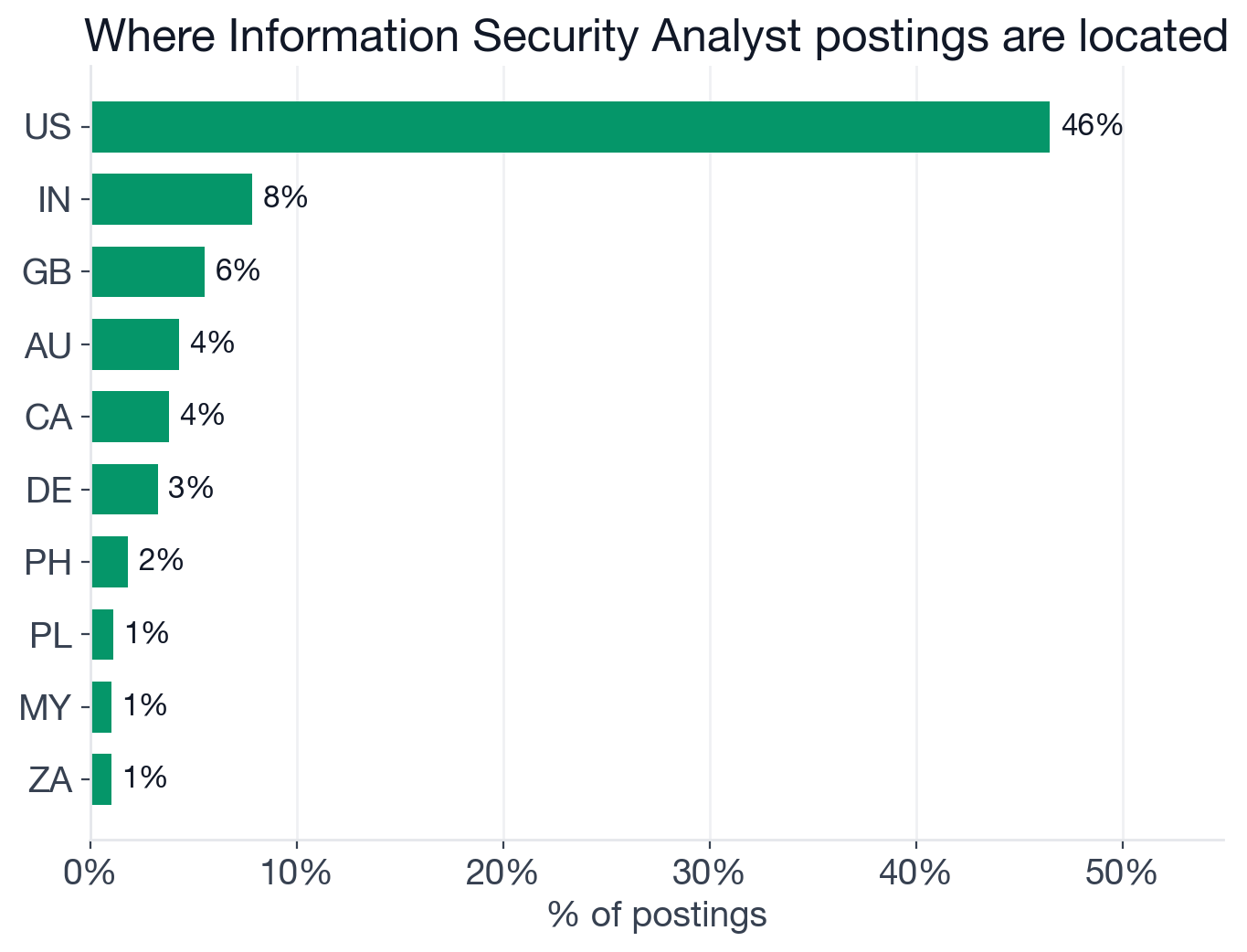
Top countries by share of Information Security Analyst postings.
The United States is the dominant market at 46.5% of postings (2,355 of 5,066), a higher concentration than most software engineering or data roles. Data Engineers split roughly 29% US and 23% India. IS Analysts skew much harder toward the US, reflecting a few converging forces: government and defense sector hiring (where roles frequently require security clearances tied to US residency), financial services and healthcare compliance mandates (HIPAA, SOX, NIST, FedRAMP), and a regulatory environment that creates persistent demand for on-shore security personnel.
India (7.9%, 398), the UK (5.5%, 281), Australia (4.3%, 218), and Canada (3.8%, 194) are the next-largest markets. For candidates in those countries, the skill profile transfers directly, but salary benchmarks must be set against local market rates rather than the US figures above.
Browse US-based Information Security Analyst openings
Work mode
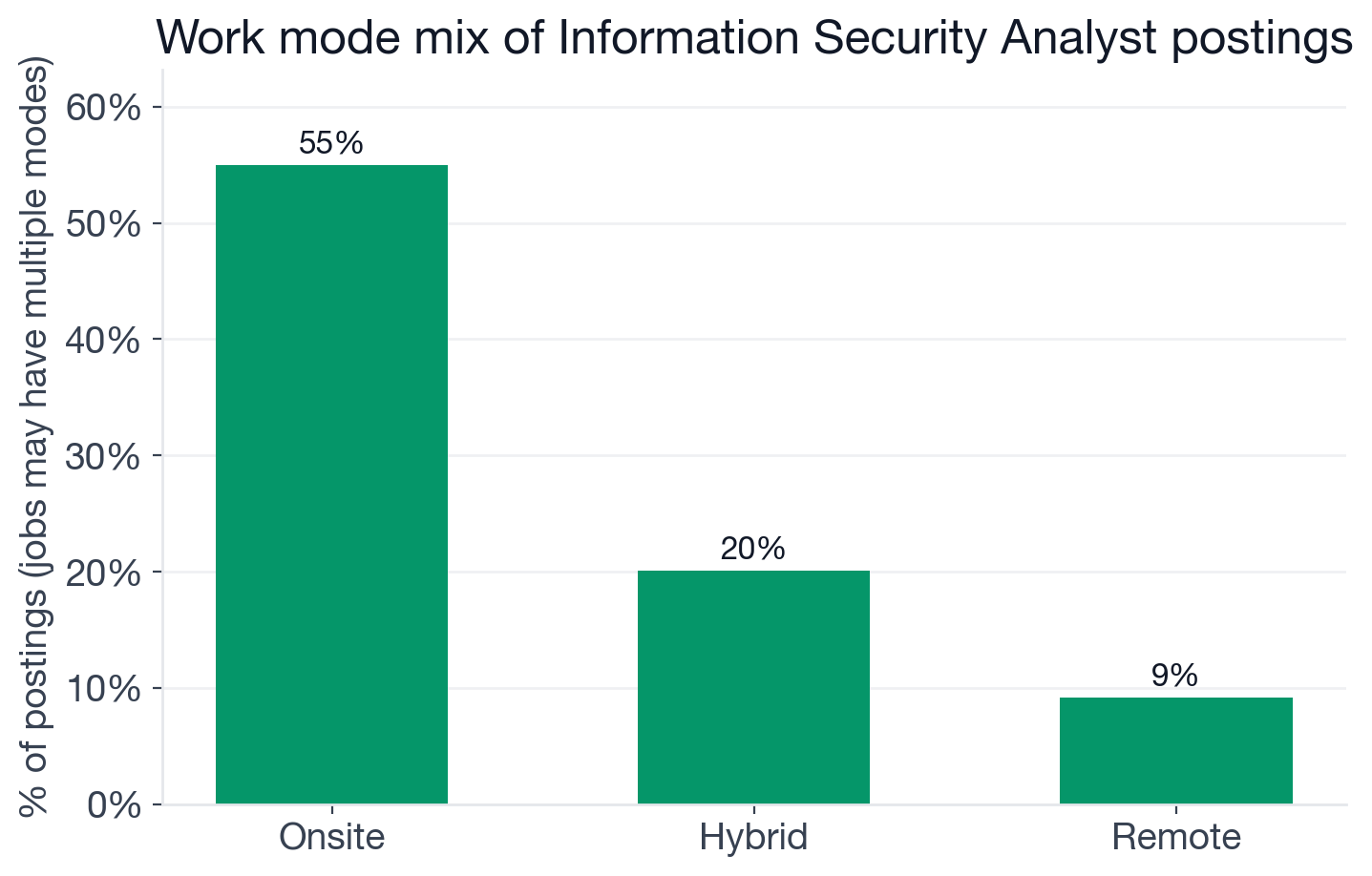
Work mode distribution of Information Security Analyst postings. Some postings carry multiple tags.
- Onsite: 55.0% (2,785 postings)
- Hybrid: 20.1% (1,019)
- Remote: 9.2% (464)
Nine percent remote is low by any modern tech-job standard. Data Engineers run at roughly 27% remote, well above the IS Analyst rate. IS Analysts at 9.2% are outliers. The 55.0% onsite figure is likely modestly elevated by the physical and operational security analyst postings in the dataset (those roles are inherently onsite), but the directional pattern holds firmly for genuine cybersecurity IS Analyst roles too. The security-driven constraint is real: incident response work often requires physical access to secure facilities, hardware security modules, or air-gapped networks. Roles in regulated environments (financial services, healthcare, defense, government) carry compliance and contractual requirements that have not yielded to remote-work norms.
The 20% hybrid figure is realistic for roles where some work is digital (monitoring dashboards, policy documentation, vendor management) while other responsibilities require on-site presence. Remote-tagged roles do exist: 464 currently listed, concentrated in managed security service providers, product-led tech companies, and consulting firms where analysts do not require persistent local system access.
How to Use This in Your Job Search
The data points to a clear two-phase approach.
Phase one: build the operational layer. Monitoring appears in 34.5% of postings, Incident Response in 19.7%, SIEM in 16.4%. These are what hiring managers screen for in the first pass. Hands-on familiarity with a SIEM platform (Splunk, Microsoft Sentinel, or another vendor's tooling) and the ability to walk through a realistic incident scenario are the baseline expectations for every IS Analyst role. Use AI mock interviews to practice threat triage, incident walkthroughs, and security-operations scenarios under realistic interview conditions, especially for the behavioral component of "tell me about a time you handled a significant security event."
Phase two: add the premium layer. The salary table is direct: the core operational skills keep you near the $95,700 baseline. Adding a cloud platform (AWS, Azure, or Google Cloud) raises the median offer by $10-17K. Adding Python and automation scripting pushes into the $108K range. Pick the track that matches the type of organizations you want to work for, then go deep rather than broad. One cloud platform well beats shallow familiarity across all three. Our interactive courses cover Python foundations, cloud security fundamentals, and system security topics that bridge from SOC operations into the cloud and automation premium tier.
Filter the job board to your target stack. The role and skill filters let you narrow to exactly what you are building toward: IS Analyst roles requiring Python and automation or IS Analyst roles with cloud security depth surface the specific postings most aligned with each specialization track. The question bank is where you drill the specific topics (IAM architectures, cloud security frameworks, vulnerability management, incident handling procedures) that appear in IS Analyst technical screens.
For context on how the broader cybersecurity market is shifting with AI, the post How AI Is Changing the Information Security Analyst Role in 2026 covers the tooling and workflow shifts that the posting data alone doesn't capture.
FAQ
Q. What is the median salary for an Information Security Analyst in 2026?
Among US postings with disclosed salary data (n=812), the median base salary is $95,700. Equity, bonuses, and sign-on are excluded, so total compensation at top employers runs meaningfully higher. Cloud skills raise this baseline substantially: AWS adds approximately $17,200 over the median (postings with AWS show a $112,900 US median), Azure adds $15,700 ($111,400 median), and Google Cloud adds $30,300 ($126,000 median, n=32).
Q. Which Information Security Analyst skills pay the highest premium in 2026?
The highest premiums over the $95,700 US base salary median come from cloud platforms and Encryption: Google Cloud ($126,000 median, n=32), Encryption ($113,000, n=51), AWS ($112,900, n=101), and Azure ($111,400, n=83). Encryption signals roles in cryptography, data-security architecture, or zero-trust design rather than cloud operations. Automation ($108,000) and Python ($107,900) follow. Core SOC skills like SIEM ($102,900) and Incident Response ($100,900) pay near baseline.
Q. What skills do companies most commonly require for Information Security Analysts in 2026?
Monitoring (34.5%), Incident Response (19.7%), and SIEM (16.4%) are the three most commonly listed skills. Monitoring sits in the common tier (20-50% of postings); Incident Response and SIEM are differentiators (5-20%). The role has no table-stakes skills (nothing appears in more than 35% of postings), reflecting how fragmented the IS Analyst title is across SOC, cloud security, IAM, and compliance specializations.
Q. Is Information Security Analyst a good entry-level role to break into?
It is one of the harder roles to enter. Only 3.7% of postings (187 of 5,066) are explicitly entry-level, and mid-level roles dominate at 76.7% (3,888 postings). Candidates transitioning from adjacent roles like systems administration, network engineering, or IT helpdesk typically have an easier path in than those switching from unrelated fields.
Q. Are Information Security Analyst jobs remote-friendly?
No, this is one of the least remote-friendly tech roles. Only 9.2% of postings (464 of 5,066) are tagged remote, compared with roughly 24-27% for most software engineering roles. Onsite dominates at 55.0% (2,785 postings), and hybrid accounts for 20.1% (1,019). The constraint is largely security-driven: handling sensitive data, air-gapped systems, and regulated environments often requires physical access that remote arrangements cannot satisfy.
Q. What is the dominant skill stack for Information Security Analysts?
The highest-lift skill pairings show three clusters: the SOC stack (Incident Response + SIEM, lift 3.09; SIEM + Splunk, lift 4.28), the cloud security stack (AWS + Google Cloud, lift 8.70; Azure + Google Cloud, lift 8.12), and the scripting stack (PowerShell + Python, lift 7.97; Automation + Python, lift 3.46). Cloud stacks show the highest co-occurrence lift, signaling they appear in more specialized and higher-paying postings.
Q. Where are most Information Security Analyst jobs located in 2026?
The United States is the dominant market at 46.5% of active postings (2,355 of 5,066). The UK (5.5%, 281), Australia (4.3%, 218), and Canada (3.8%, 194) are the next largest English-speaking markets. India accounts for 7.9% (398 postings). The US concentration is notably higher than most tech roles, reflecting the cybersecurity sector's strong government, defense, and compliance-driven hiring base.
Where to Invest from Here
The 2026 market for Information Security Analysts rewards a specific pattern: SOC operations as the entry layer, cloud or automation as the premium layer. The role's fragmentation across specialization tracks is actually a strategic opportunity. There is no single canonical IS Analyst skill stack, which means genuine depth in one track (cloud security, security automation, SOC operations) differentiates a candidate far more than shallow breadth across all of them. Pick your track, build the operational foundation, then layer the premium skill on top. The salary gap between staying at the SOC baseline and adding cloud fluency is $12-17K in base pay. That is a meaningful return on a deliberate skill investment.
Topics
Ready to practice?
Put what you've learned into practice with AI mock interviews and structured preparation guides.