
For Cybersecurity Engineers, Salary Is an Infrastructure Story
Traditional security tools are no longer the highest-value skills in Cybersecurity Engineer job postings. Splunk, the platform most security teams use to aggregate and query logs, shows up in 8.9% of postings and pays a US median of $112,500: that is $19,500 below the $132,000 role baseline. Windows administration pays $110,000. Active Directory (the on-premises identity system most enterprises still rely on) pays $100,000. Vulnerability Assessment pays $108,400. Every classic security-analyst tool in the dataset sits below the pay floor.
Kubernetes pays $150,000. Terraform (the infrastructure-as-code tool for provisioning cloud resources) pays $147,000. Infrastructure as Code broadly pays $148,400. CI/CD pipelines pay $145,000. Among the 5,411 active Cybersecurity Engineer postings on the InterviewStack.io job board analyzed in June 2026, the skills that command premiums are the ones that build and automate secure cloud infrastructure, not the ones that monitor it after the fact.
The role still requires security fundamentals. Incident Response appears in nearly a third of postings (31.4%), SIEM (security information and event management platforms that correlate alerts across an environment) in a quarter (25%), and IAM (identity and access management) in roughly one in five (20.3%). But employers are now willing to pay a premium specifically for engineers who can build the infrastructure they are supposed to protect.
Key Findings
- 5,411 active Cybersecurity Engineer postings analyzed from the InterviewStack.io job board as of June 2026.
- No individual skill clears the 50% table-stakes threshold: the role is more fragmented by employer type than most tech titles. Automation leads at 44.5%, Python at 41%.
- Median US base salary is $132,000 (n=1,382 postings with disclosed salary); infrastructure skills add $13-18K above that line while traditional security tools sit $2-32K below it.
- Among the most commonly-required skills, the top premiums attach to infrastructure and cloud skills: Kubernetes and Okta (+$18K each), Google Cloud (+$16.7K), Infrastructure as Code (+$16.4K), LLMs (+$16K), and Terraform (+$15K).
- Legacy security tooling underperforms: Splunk ($112.5K), Windows ($110K), Active Directory ($100K), and Vulnerability Assessment ($108.4K) all sit below the $132K baseline.
- Entry-level is essentially closed: 2.1% of postings are explicitly entry-level (115 of 5,411), the tightest pipeline of any major tech role analyzed to date.
- Multi-cloud is the default expectation: the three highest-lift skill pairs all involve two cloud platforms, with lift scores ranging from 2.10 to 2.52.
- Onsite still dominates at 43.5% of postings; 33.3% are hybrid and 22.9% are fully remote, driven in part by defense and government employers with clearance requirements.
Which Skills Pay More Than the Baseline?
The numbers below come from US postings only, where wage-transparency laws produce consistent salary disclosure. They reflect base salary only: equity, bonuses, RSUs, and sign-on packages are not disclosed in postings, so total compensation at top employers runs meaningfully higher than what we report here, particularly in tech and finance.
The overall US median is $132,000 (n=1,382 postings with structured salary data). The salary distribution has a clean split between infrastructure-oriented skills above the line and legacy security tooling below it.
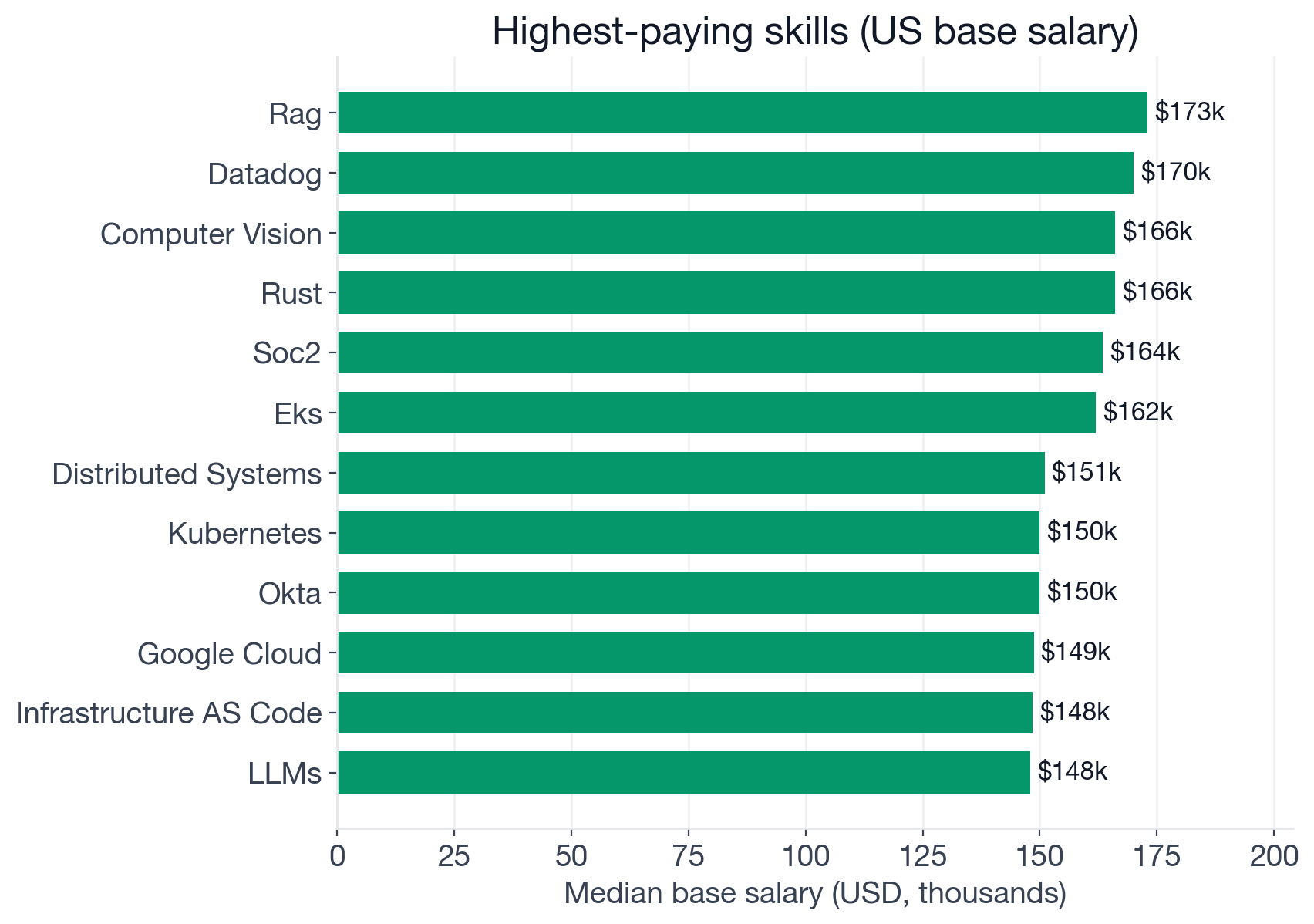
Median US base salary in USD for Cybersecurity Engineer postings that mention each skill. US postings only, base salary only.
Skills commanding premiums of $13-18K above the $132K baseline:
| Skill | US Median | Premium vs Baseline |
|---|---|---|
| Kubernetes | $150,000 | +$18,000 |
| Okta | $150,000 | +$18,000 |
| Google Cloud | $148,700 | +$16,700 |
| Infrastructure as Code | $148,400 | +$16,400 |
| LLMs | $148,000 | +$16,000 |
| Terraform | $147,000 | +$15,000 |
| AWS | $145,000 | +$13,000 |
| CI/CD | $145,000 | +$13,000 |
Security-specific skills at or near baseline:
- Penetration Testing: $136,500 (+$4,500)
- Incident Response: $135,000 (+$3,000)
- Encryption: $134,100 (+$2,100)
- OWASP: $132,000 (at baseline)
- DevSecOps (the discipline of integrating security into the DevOps pipeline rather than adding it after deployment): $132,000 (at baseline)
- SIEM: $130,000 (-$2,000)
Legacy tools that sit below baseline:
| Skill | US Median | Below Baseline |
|---|---|---|
| Splunk | $112,500 | -$19,500 |
| Virtualization | $111,600 | -$20,400 |
| Windows | $110,000 | -$22,000 |
| Vulnerability Assessment | $108,400 | -$23,600 |
| VMware | $103,800 | -$28,200 |
| Active Directory | $100,000 | -$32,000 |
These tools are not worthless. Splunk appears in 8.9% of postings, Windows in 12.3%, Active Directory in 5.4%. Employers still want them, particularly in on-premises enterprise and government environments. But the postings that list them are, on average, older-style security roles that pay less than the cloud-native and infrastructure-as-code tier. If you face a choice between deepening Splunk expertise and deepening Kubernetes expertise, the salary signal is unambiguous about which direction the market is paying toward.
The LLMs entry ($148,000, +$16K) is worth a closer look. Only about 5.6% of postings explicitly require LLM skills, meaning these are roles specifically hiring engineers to build AI-powered security tooling: LLM-assisted threat hunting, AI-augmented SIEM detection logic, or retrieval-augmented security response workflows. That 5.6% is a hard floor, not a ceiling. A 2025 ISC2 AI Pulse Survey found 30% of cybersecurity professionals have already integrated AI security tools into their operations, and 96% say AI improves their work speed and efficiency. Gartner projects that more than 60% of organizations will rely on AI-augmented security platforms by 2026. Most Cybersecurity Engineers will operate AI-assisted SIEM, SOAR (Security Orchestration, Automation, and Response platforms that automate alert triage and incident workflows), and threat-detection tooling regardless of whether "AI" appears in their job title. The Cloud Security Alliance found 92% of security professionals are already concerned about the impact of AI agents on their security posture, which makes AI literacy a baseline professional expectation rather than a differentiator.
What Skill Families Define Cybersecurity Engineer Work in 2026?
Group every individual skill into its broader category and count how many postings require at least one skill from each family.
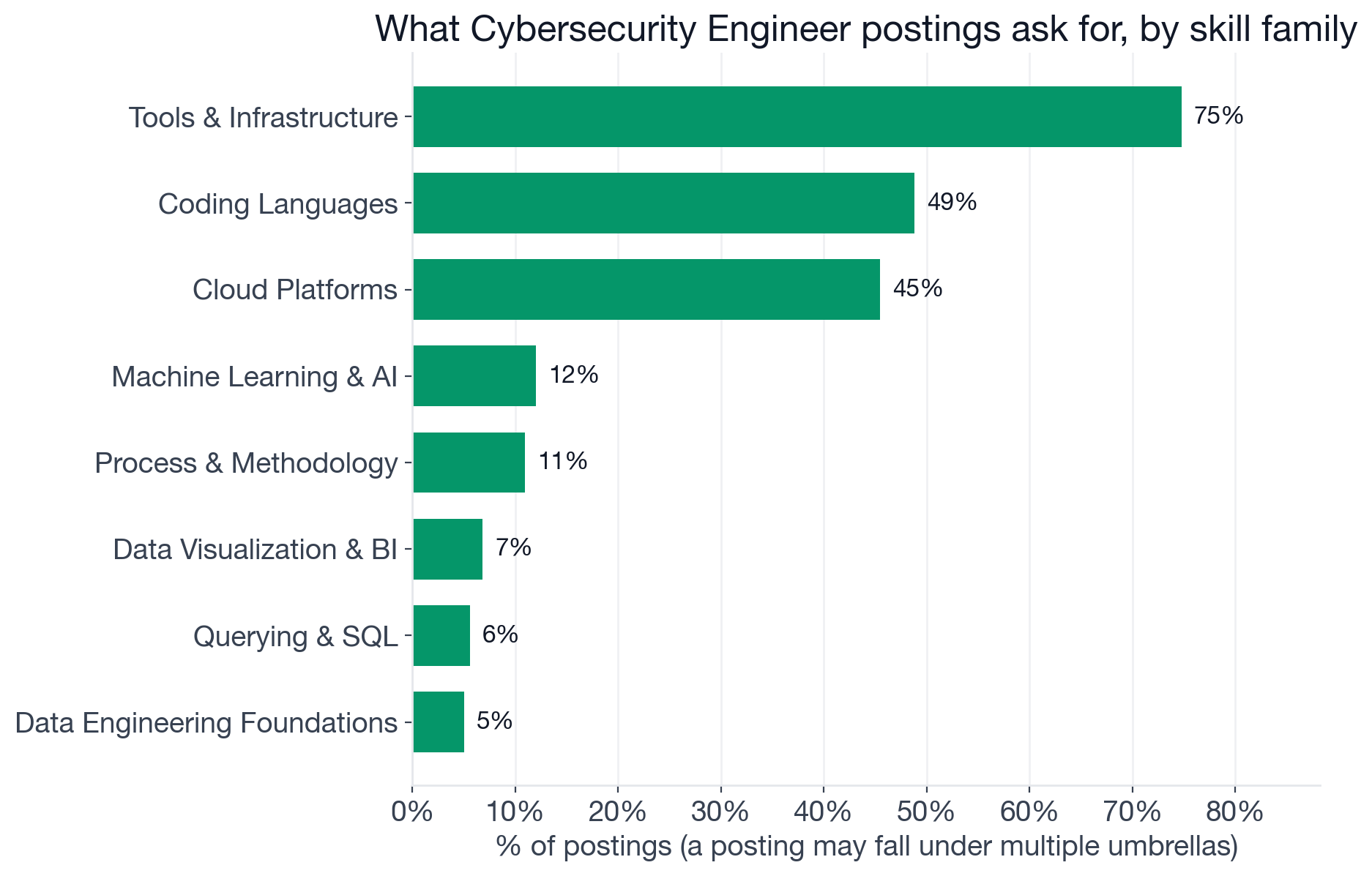
Share of Cybersecurity Engineer postings that mention at least one skill from each family. A posting that lists both Kubernetes and Linux counts once under "Tools and Infrastructure."
- Security and Operations Skills (incident response, SIEM, IAM, DevSecOps, penetration testing, OWASP, encryption, CI/CD, and others): 87.6%. Nearly 9 in 10 postings require at least one skill from this family, which spans both security-domain fundamentals and general platform operations. The role is still grounded in security knowledge.
- Tools and Infrastructure (automation, monitoring, Kubernetes, Linux, Terraform, Docker, CI/CD): 74.8%. Three-quarters of postings expect infrastructure operation alongside the security work, which is what distinguishes a Cybersecurity Engineer from a Security Analyst.
- Coding Languages (Python, Bash, Java, TypeScript): 48.8%. Just under half of all postings require code, a meaningful share. Python leads this family by a wide margin.
- Cloud Platforms (AWS, Azure, Google Cloud): 45.5%. Nearly half of postings name at least one public cloud provider, and the co-occurrence data shows most expect two.
- Machine Learning and AI: 12%. The explicit-requirement floor for engineers building AI security systems. The ambient layer, reflected in industry surveys, is considerably broader.
The dominant picture is that Cybersecurity Engineer in 2026 requires a combination of security-domain knowledge (family 1) and infrastructure engineering fluency (family 2). Candidates who have only one of those two layers are covering less than three-quarters of the market.
The 12% ML and AI umbrella measures engineers hired specifically to design AI security systems. It does not capture the much wider population of cybersecurity engineers who operate AI-augmented SIEM and SOAR platforms daily, or who use Copilot to write incident response scripting. The Stack Overflow 2025 Developer Survey found 84% of developers use or plan to use AI tools; JetBrains found 62% rely on at least one AI coding assistant. Security engineers who write significant Python automation belong to that same ambient-AI environment.
Three Tiers of Individual Cybersecurity Skills
Inside those families, individual skills sort into three frequency tiers.
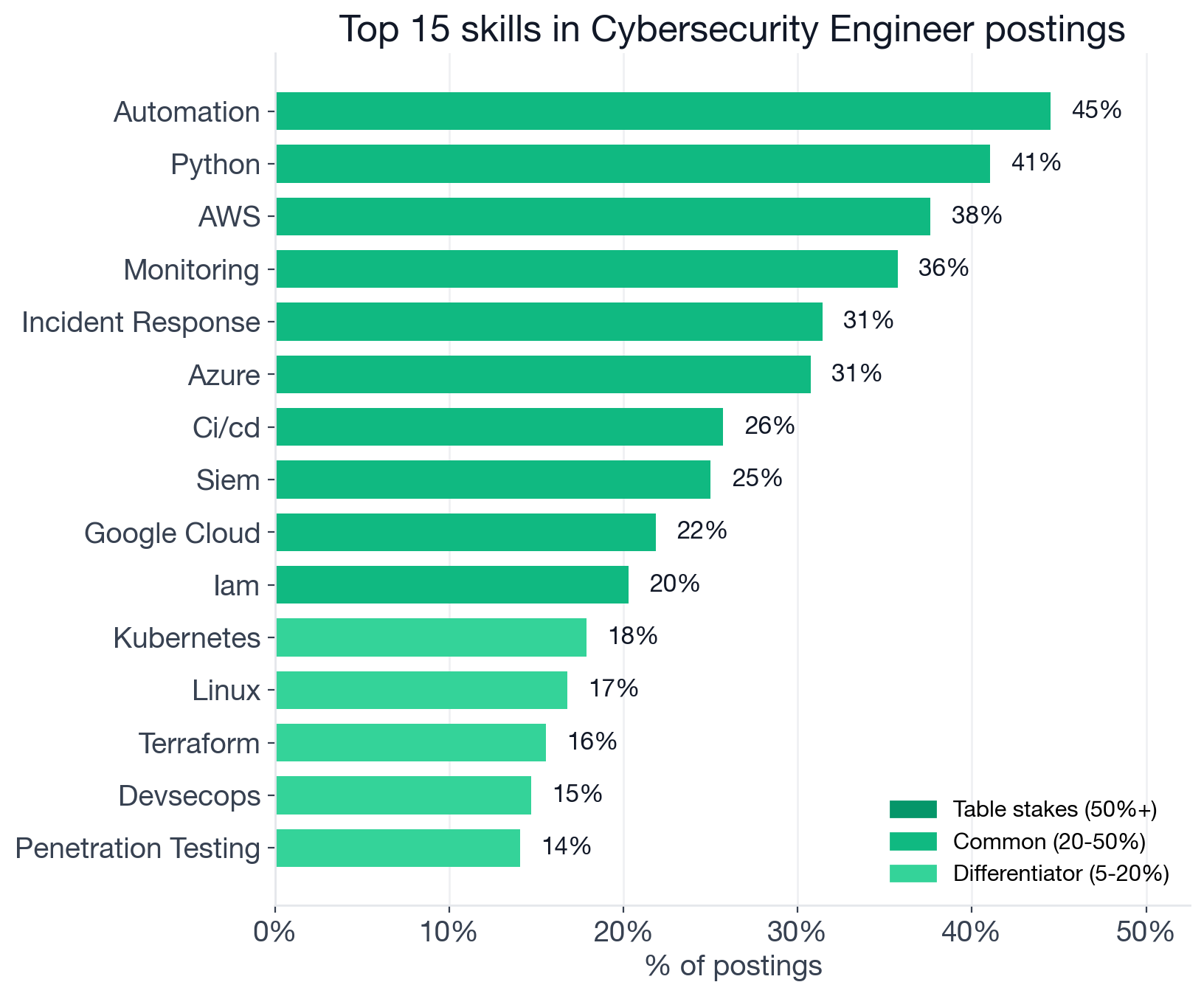
Top individual skills in Cybersecurity Engineer postings by share of active listings. 50%+ is table stakes; 20-50% common; 5-20% differentiator.
Nothing at Table Stakes (0 skills above 50%)
Unusually for a major tech role, no individual Cybersecurity Engineer skill clears the 50% table-stakes threshold. The highest is Automation at 44.5%. This means a financial services security team, a defense contractor, and a cloud-native SaaS company hiring for the same title will each ask for a genuinely different combination. Skills that are universal in software engineering (Python at 70%+, SQL at 71%+) simply do not exist in cybersecurity hiring at the same concentration.
Common Expectations (20-50% of postings)
Ten skills occupy the common tier: the ones that appear in a significant share of postings a candidate will encounter.
- Automation: 44.5% (Cybersecurity Engineer + Automation openings)
- Python: 41% (Cybersecurity Engineer + Python openings)
- AWS: 37.6% (Cybersecurity Engineer + AWS openings)
- Monitoring: 35.7%
- Incident Response: 31.4%
- Azure: 30.8%
- CI/CD: 25.7%
- SIEM: 25%
- Google Cloud: 21.9%
- IAM: 20.3%
Python at 41% is the role's coding language, primarily for writing automation, building detection scripts, and integrating with APIs. Automation at 44.5% and Python overlap substantially: the co-occurrence lift between them is 1.49, meaning postings that ask for Automation are 49% more likely to also ask for Python than baseline frequencies would predict. The two are effectively one signal.
Cloud coverage at this tier is deliberately broad: AWS 37.6%, Azure 30.8%, Google Cloud 21.9%. The co-occurrence data below explains why.
Differentiators (5-20% of postings)
These are the skills that separate an engineer who operates existing security infrastructure from one who builds it.
- Kubernetes: 17.9% (container orchestration, expected by nearly 1 in 5 postings)
- Linux: 16.8%
- Terraform: 15.5%
- DevSecOps: 14.7%
- Penetration Testing: 14% (pen-test-focused openings)
- OWASP: 13.3% (the Open Web Application Security Project framework for web security standards)
- Encryption: 11.5%
- Bash: 10.9%
- Splunk: 8.9%
- LLMs: 5.6%
The differentiators divide neatly into two tracks. The infrastructure cluster (Kubernetes, Terraform, DevSecOps, Linux, Bash) is where the salary premiums live. The security-specialization cluster (Penetration Testing, OWASP, Encryption, Splunk) is where deep domain expertise sits. Both matter at mid-level and above; they pay differently.
How the Multi-Cloud Expectation Shapes the Stack
Skill co-occurrence captures how postings compose their requirements together. The strongest pattern in the Cybersecurity Engineer dataset is a pronounced multi-cloud expectation.
| Skill pair | % of postings | Lift |
|---|---|---|
| Azure + Google Cloud | 17.0% | 2.52 |
| AWS + Google Cloud | 19.8% | 2.40 |
| AWS + Azure | 24.3% | 2.10 |
| AWS + Terraform | 12.2% | 2.09 |
| AWS + Kubernetes | 13.1% | 1.95 |
| Incident Response + SIEM | 13.7% | 1.75 |
| AWS + CI/CD | 16.4% | 1.70 |
| Automation + Python | 27.2% | 1.49 |
Lift greater than 1 means the two skills appear together more often than their individual frequencies would predict. Lift of 2.0 means they co-occur at roughly double the expected rate.
The three highest-lift pairs are all two-cloud combinations. A posting that lists Azure is 2.52 times more likely to also list Google Cloud than the base rate predicts; a posting that lists AWS is 2.40 times more likely to also list GCP. This is consistent: companies hiring Cybersecurity Engineers are explicitly asking for cloud-agnostic security thinking, because the organizations they protect operate across multiple cloud environments simultaneously. Single-cloud mastery is a floor for this role, not a differentiator.
AWS + Terraform (lift 2.09) and AWS + Kubernetes (lift 1.95) are the infrastructure-as-code and container-security pairs. They signal a DevSecOps flavor of the role: not just "secure the AWS environment" but "provision it safely with code and manage workloads in containers you can audit."
Incident Response + SIEM (lift 1.75) is the classic security operations pairing. It appears in 13.7% of postings: meaningful, but not the leading pattern. The role is tilting toward infrastructure-first security engineering.
How Hard Is It to Break In, and Where Are the Jobs?
Seniority: The Entry Door Is Nearly Shut
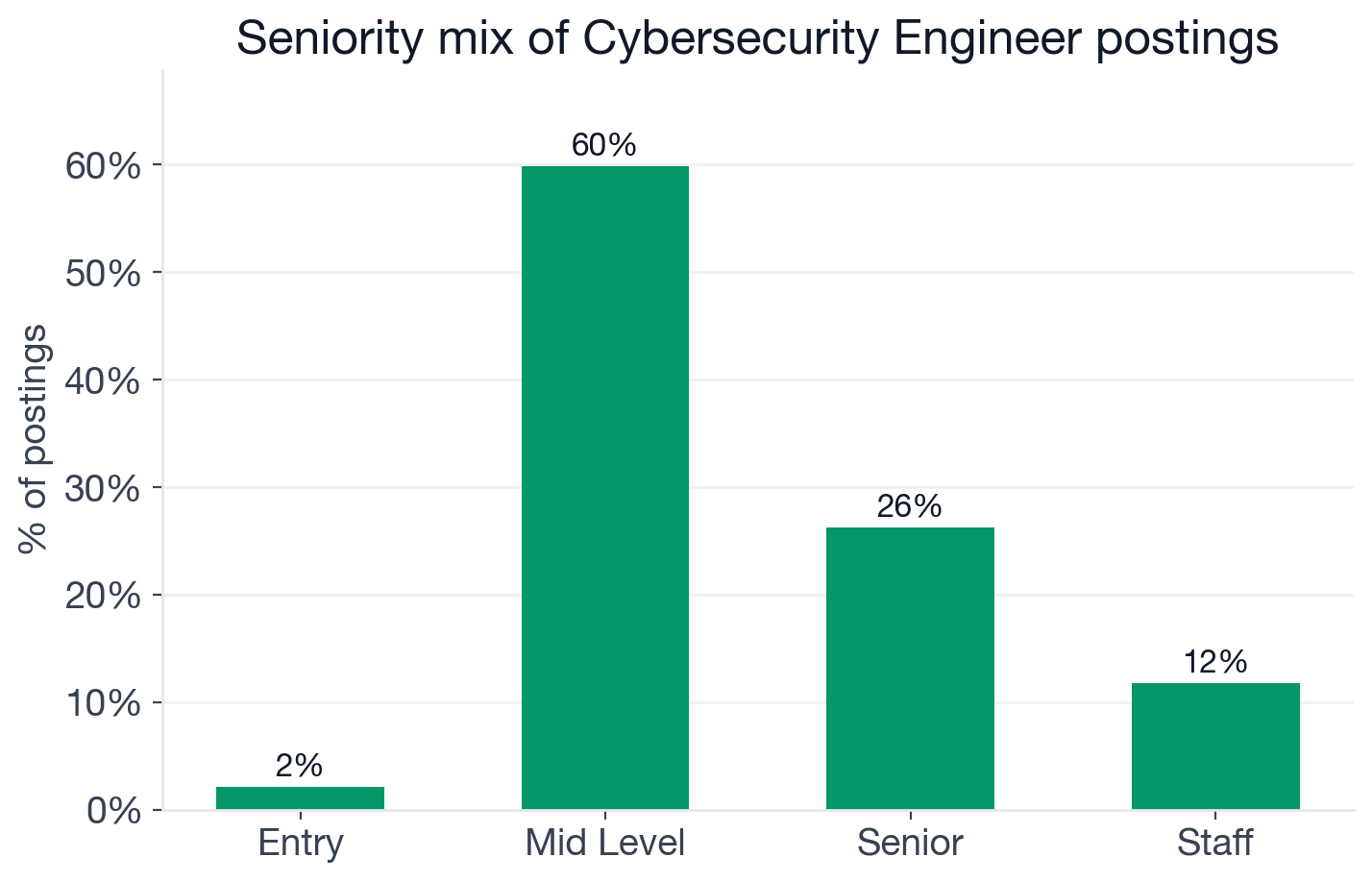
Seniority distribution of active Cybersecurity Engineer postings based on job-title keywords.
Only 2.1% of postings are explicitly entry-level: 115 of 5,411 analyzed. That is the tightest entry pipeline in the dataset, narrower than 3% for Data Engineer and considerably narrower than frontend and backend engineering roles. Mid-level dominates at 59.9% (3,239 postings); senior makes up 26.2% (1,420); staff-level adds another 11.8% (637). Senior and above together represent 38% of all active openings, a notably high senior concentration for a major tech role.
The practical implication: most candidates enter cybersecurity engineering not through a "Cybersecurity Engineer" posting, but through network engineering, DevOps, software engineering, or IT operations, accumulating security certifications (CISSP, Security+, cloud security specialties) alongside production infrastructure experience before transitioning. Career switchers from non-technical backgrounds face a particularly steep ramp. Senior Cybersecurity Engineer openings are the primary market; entry-level is a rounding error.
Geography: US-Heavy, With a Defense Concentration
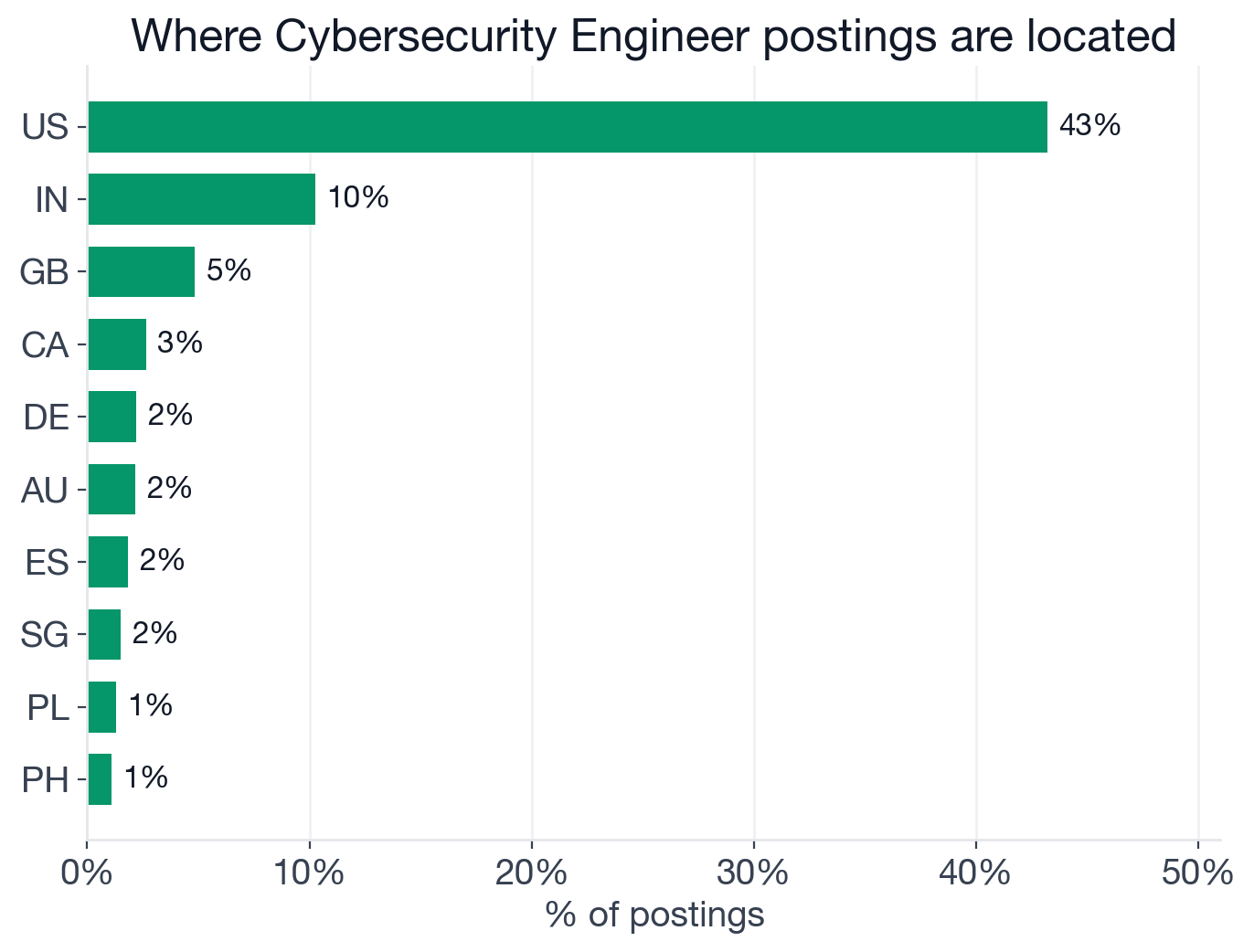
Top countries by share of active Cybersecurity Engineer postings.
The US accounts for 43.2% of active postings (2,338 of 5,411), a higher US concentration than most other tech roles. This reflects how much cybersecurity demand flows through US defense, finance, and healthcare sectors where domestic compliance requirements drive onshore headcount. India follows at 10.3%, the UK at 4.8%, Canada at 2.6%, and Germany and Australia each at 2.2%.
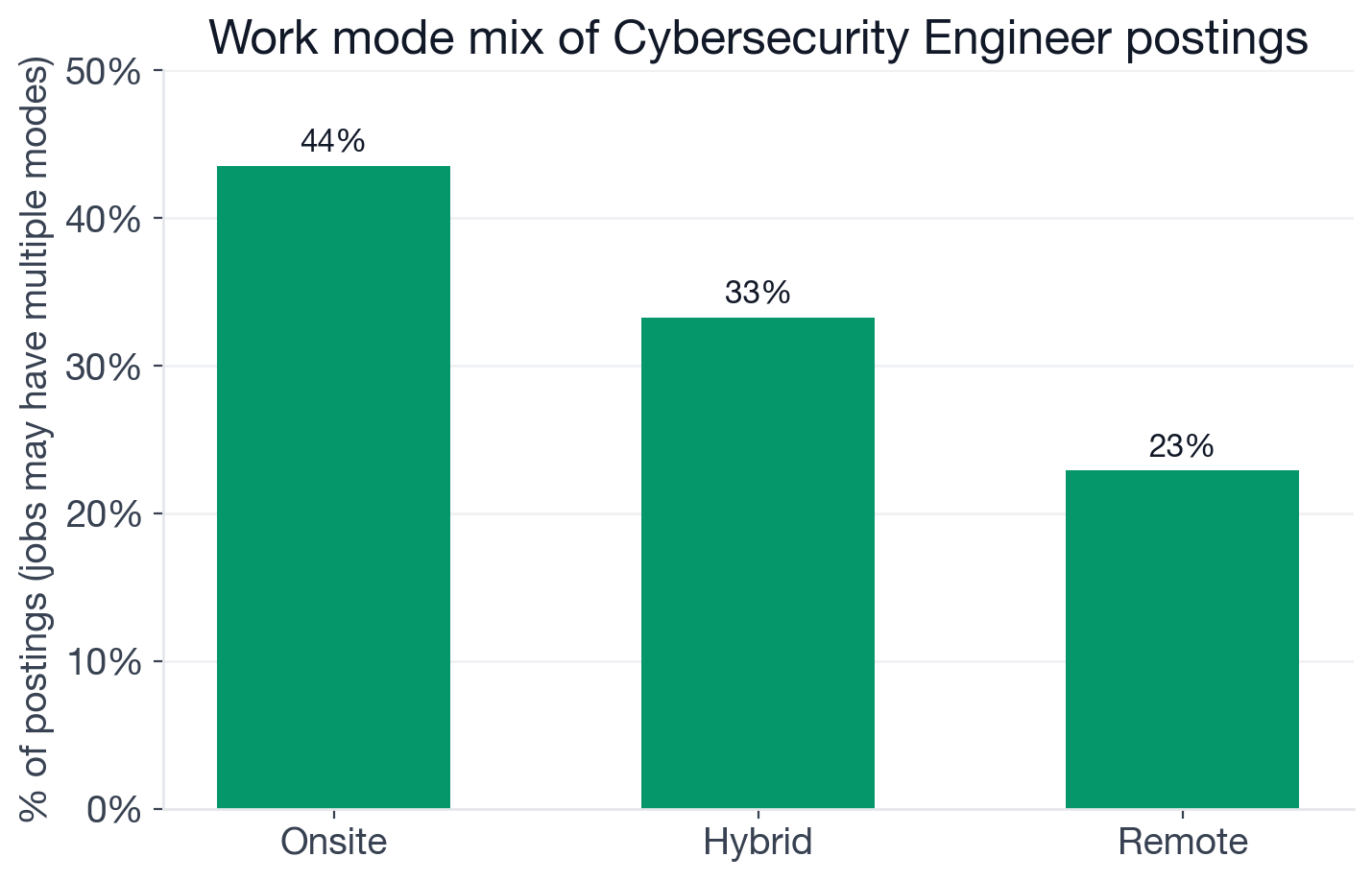
Share of Cybersecurity Engineer postings tagged with each work mode.
At 43.5% onsite, cybersecurity is one of the less remote-friendly major tech roles. Defense and government employers, which dominate the top-employer list below, typically require security clearances and physical presence. Fully remote Cybersecurity Engineer roles exist at 22.9% of postings and concentrate in cloud-native product companies and tech-forward financial services, but the market is narrower than in software or data engineering.
Who Is Hiring
The employer roster has an unusual character for a tech role: defense, government, and critical-infrastructure firms form a dominant cluster.
| Company | Openings | Sector |
|---|---|---|
| NTT Limited | 79 | Global IT and security services |
| Booz Allen Hamilton | 61 | Defense and government consulting |
| PricewaterhouseCoopers | 41 | Big Four advisory |
| Thales | 34 | Defense, security, and aerospace |
| Leidos | 33 | Defense IT services |
| Anduril Industries | 33 | Defense technology |
| Accenture Federal Services | 32 | US government consulting |
| Roche | 29 | Pharma and life sciences |
| CACI International | 24 | Defense IT services |
| Morgan Stanley | 22 | Finance |
| Royal Bank of Canada | 22 | Finance |
Seven of the eleven top employers are defense, government, or critical-infrastructure names. Booz Allen Hamilton, Leidos, Anduril, CACI, Accenture Federal Services, Thales, and NTT (which serves critical-infrastructure and government clients globally) together represent a sector cluster you do not see at this scale in data or software engineering hiring. Finance (Morgan Stanley, RBC) and pharma (Roche) complete the picture: regulated industries where security investment is a compliance requirement, not just best practice.
The defense and government concentration has practical consequences. Many of these roles tie to clearance requirements (Secret, Top Secret, or TS/SCI) and compliance frameworks like FedRAMP and CMMC. Clearances take months to process, so applicants without prior cleared experience should budget the timeline accordingly. Pay at government-adjacent employers typically lands at or slightly above the market median rather than at the tech-sector high end. For company-specific preparation resources, the InterviewStack.io interview preparation guides break down interview formats and expectations employer by employer.
How to Use This in Your Job Search
1. Orient skill building toward infrastructure. The salary data is unambiguous: Kubernetes, Terraform, Infrastructure as Code, and CI/CD pay $13-18K above the Cybersecurity Engineer baseline. Legacy tools like Splunk, Windows administration, and Active Directory pay below it. If you are choosing what to learn next, cloud security architecture and infrastructure-as-code should come before deeper SIEM-specific expertise. Browse active Cybersecurity Engineer openings and use skill filters to see which infrastructure skills appear in the roles you actually want.
2. Learn two clouds, not one. The co-occurrence data shows multi-cloud is the expectation: AWS plus Azure (lift 2.10), AWS plus GCP (lift 2.40), Azure plus GCP (lift 2.52). Pick a primary cloud platform and a secondary one, even at a shallow level, because most of the environments you will be hired to secure span multiple providers. AWS plus Python openings are a practical starting filter for cloud-native security roles.
3. Choose your specialization track. The differentiator tier splits into two viable paths: (a) infrastructure security (Kubernetes, Terraform, DevSecOps, IaC, the premium-paying path) or (b) security operations (penetration testing, OWASP, SIEM-based detection, the domain-depth path). Both tracks appear in hiring data and both are valuable. Most mid-career engineers eventually need both, but leading with one determines which postings to target first. The question bank covers cloud security architecture, system design, and the core security engineering topics that appear in senior-level onsite rounds.
4. Practice the two distinct interview formats. Cybersecurity Engineer interviews typically cover two different dimensions: security fundamentals (threat modeling, OWASP, incident response scenario walkthroughs) and infrastructure topics (cloud security posture, container security, IaC design). These have different formats and require different preparation. AI mock interviews let you simulate both under realistic pressure, with targeted feedback after each session. If you need to build foundational fluency in Python, Linux, or cloud security before applying, the interactive courses cover those foundations systematically.
5. Factor in sector context before applying. Defense and government roles often require clearances and carry specific compliance knowledge expectations. Tech and finance roles favor cloud-native security and DevSecOps. Knowing which sector a company falls into before you tailor your application saves time and sets salary expectations correctly. The job board updates daily, so checking current postings is the best real-time signal for which skill combinations employers are actively prioritizing.
FAQ
Q. What skills do companies want for Cybersecurity Engineer roles in 2026?
No single skill breaks the 50% threshold, but ten skills sit in the 20-44% common tier: Automation (44.5%), Python (41%), AWS (37.6%), Monitoring (35.7%), Incident Response (31.4%), Azure (30.8%), CI/CD (25.7%), SIEM (25%), Google Cloud (21.9%), and IAM (20.3%). The role straddles cloud infrastructure engineering and classic security operations.
Q. What is the median salary for a Cybersecurity Engineer in 2026?
The median US base salary across 1,382 Cybersecurity Engineer postings with disclosed salary data is $132,000. Equity, bonuses, and sign-on are excluded; total compensation at top employers is meaningfully higher.
Q. Which Cybersecurity Engineer skills pay the highest salary premiums?
Among US postings, the top premiums attach to infrastructure and cloud skills: Kubernetes ($150,000, +$18K above baseline), Google Cloud ($148,700, +$16.7K), Infrastructure as Code ($148,400, +$16.4K), LLMs ($148,000, +$16K), and Terraform ($147,000, +$15K). Traditional security tools like Splunk ($112,500) and Windows ($110,000) sit well below the $132,000 baseline.
Q. Is Cybersecurity Engineer a good entry-level role to break into?
It is one of the tightest entry-level markets in tech. Only 2.1% of Cybersecurity Engineer postings are explicitly entry-level (115 of 5,411 analyzed), compared with 3% for Data Engineer. Most employers expect prior security or infrastructure experience. Career switchers from network engineering, DevOps, or software engineering have the most natural entry path.
Q. Where are most Cybersecurity Engineer jobs located?
The United States represents 43.2% of active postings (2,338 of 5,411), followed by India (10.3%), the UK (4.8%), Canada (2.6%), Germany (2.2%), and Australia (2.2%). About 22.9% of postings are fully remote, 33.3% hybrid, and 43.5% onsite, meaning onsite is still the plurality mode.
Q. What is the dominant skill pair in Cybersecurity Engineer postings?
The three highest-lift pairs all involve multi-cloud coverage: Azure plus Google Cloud (lift 2.52), AWS plus Google Cloud (lift 2.40), and AWS plus Azure (lift 2.10). Employers that want one cloud platform are more than twice as likely to want a second one, which means single-cloud expertise is a practical floor, not a ceiling, for this role.
Q. Which industries hire the most Cybersecurity Engineers?
Defense, government, and critical-infrastructure sectors form a distinctive cluster: Booz Allen Hamilton, Leidos, CACI International, Accenture Federal Services, Thales, and Anduril Industries all rank in the top employers. Finance (Morgan Stanley, Royal Bank of Canada), tech consulting (NTT, PricewaterhouseCoopers), and healthcare (Roche) make up the rest of the top tier.
Where to Start Building Your Stack
The Cybersecurity Engineer market in 2026 rewards candidates who bridge security fundamentals and infrastructure engineering fluency. Neither alone is sufficient: 87.6% of postings need security-domain knowledge and 74.8% need tools-and-infrastructure depth. The entry door is narrow (2.1% entry-level), but the mid-to-senior market is large and the salary premium for infrastructure-oriented skill sets is among the strongest in security.
A practical starting sequence: cloud security certification (AWS Security Specialty, Google Professional Cloud Security Engineer, or Azure Security Engineer Associate) gives you the credential; Terraform and Kubernetes hands-on work gives you the salary signal the data supports. Pick a specialization track, drill the interview formats that track requires, and use the job board to filter for the specific skill combinations employers are hiring for right now.
Topics
Ready to practice?
Put what you've learned into practice with AI mock interviews and structured preparation guides.