
Building the AI That Tests the AI
Test automation engineers have spent years making software releases go reliably at scale: building frameworks, maintaining locators, integrating test suites into CI/CD pipelines. In 2026, a growing slice of those engineers are being asked to do something qualitatively different: build the AI systems that generate, optimize, and self-heal the tests themselves.
The data makes this concrete. Across 1,789 active Test Automation Engineer postings on the InterviewStack.io job board from the last 90 days, 16.1% explicitly require new-wave generative AI skills. What's striking about that 16.1% is not the size of the number. It's the composition. LLMs and AI Agents sit at the top of the explicit AI skill list, outranking GitHub Copilot. Companies hiring for the AI layer aren't primarily looking for engineers who use a coding assistant to write test scripts faster. They're looking for engineers who can build the infrastructure that generates and manages tests using AI.
That leaves the other layer: the ambient AI use that postings don't mention because employers assume it. Katalon's 2025 survey of more than 1,400 QA practitioners found 76% already use AI-powered tools in their daily testing work, and 72% use AI specifically for test case and script generation. Postings don't list this because it's as expected as knowing how to run a browser. The 16.1% is the "build AI" number. The 76% is the "use AI" floor. Both are real; they just measure different depths.
Key Findings
- 16.1% of 1,789 Test Automation Engineer postings explicitly require new-wave generative AI skills (288 postings); 19.6% mention any AI including traditional ML.
- LLMs (6.9%, 124 postings) and AI Agents (6.3%, 113 postings) are the top explicit new-wave AI skills, outranking Prompt Engineering (3.2%), GitHub Copilot (3.1%), and AI-Assisted Development (2.2%).
- 76% of QA professionals use AI tools in daily testing work; 72% use AI specifically for test case and script generation, per Katalon's 2025 survey of 1,400+ practitioners.
- Global median base salary: $120,000 for AI-skill postings versus $110,488 without, a roughly $9,500 premium (n=47 AI, n=238 non-AI; equity excluded). US baseline without AI requirements: $117,500 (n=189).
- Staff-level roles show the highest AI adoption rate at 24.1%; junior is the lowest at 8.1%, lower even than entry-level (19.4%).
- Technology companies have a 30.9% AI adoption rate in test automation postings; manufacturing sits at 3.8%.
- India's AI adoption rate in test automation postings (25.1%) is more than three times the US rate (8.0%).
- 82% of QA professionals believe AI skills will be critical within 3-5 years, making test automation one of the most AI-aware engineering disciplines, per Katalon 2025.
The Test Automation Engineer Before 2023
Three years ago, a senior test automation engineer's stack looked something like this: Selenium WebDriver (or Cypress, or the then-new Playwright), a page object model, a language binding in Java or Python, CI/CD integration via Jenkins or GitHub Actions, and Appium for mobile. The work was about engineering reliability: writing test code that wouldn't collapse when a UI changed, building reports that gave developers fast feedback, and reducing the regression burden that slowed releases.
The hardest problems were brittle selectors, test data management, and maintenance overhead. A large test suite needed constant care: locators broke on redesigns, test environments drifted from production, and the cost of keeping everything green was non-trivial.
AI assistance was rare in production testing contexts. A few research teams were exploring ML-based test generation and visual diffing tools, but most teams weren't running any of it at scale. Test generation meant engineers reading specs, exploring the application, and manually encoding expected behavior into assertions. The role sat at the intersection of QA and software engineering, valued for rigor and reproducibility rather than for building novel systems.
That baseline is now the starting point, not the job description.
What Do Today's Postings Actually Require?
The 16.1% figure covers the companies hiring for the "build AI" version of the role: engineers who architect the systems that generate and govern tests, not just execute them.
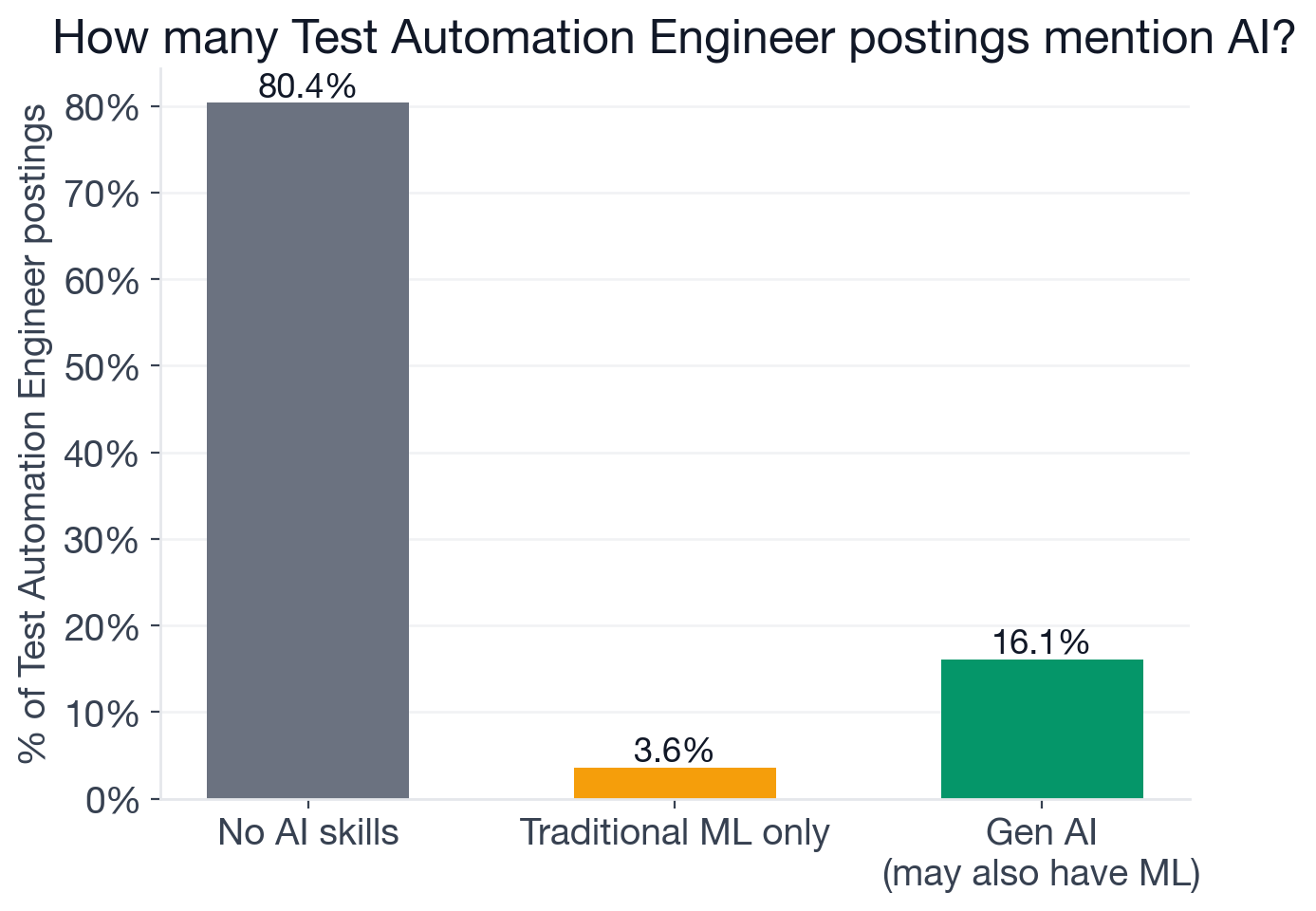
Share of 1,789 postings by AI requirement category. New-wave generative AI (2023+ tools) appears in 16.1%; traditional ML in 7.2%; 3.6% require both.
(Dataset note: the "automation engineer" classifier is intentionally broad. The title sample for this dataset includes industrial controls engineers, IT/OT automation specialists, hardware test and validation engineers, and laboratory automation engineers alongside software TAEs (an estimated 15–20% of postings are from non-software automation disciplines). The AI skill frequencies reported here are aggregates across the full dataset; the software-TAE-specific rates are likely similar or slightly higher.)
Generative AI without traditional ML appears in 12.4% of postings. Traditional ML shows up more narrowly: anomaly detection in test results, failure-prediction models, automated visual regression. These have been in the field for several years and show up at 7.2% overall, with the 3.6% overlap representing postings that ask for both.
Perforce BlazeMeter's 2025 State of Continuous Testing Report adds a useful counterpoint: while 75% of teams named AI-driven testing as a 2025 priority, only 16% had formally adopted it in a production pipeline. That tension between intent and execution is visible in the posting data too. The 16.1% that show up in job postings are the teams that committed resources to making it real. The other 84% are somewhere between strategic roadmap and daily Copilot use.
Rainforest QA's 2025 survey of 600+ developers in the US, UK, Canada, and Australia found 75% of teams using traditional code-based test automation frameworks had already adopted AI testing tools to assist with test writing and maintenance. That's the ambient layer: using AI to do the existing job faster, not to build an AI-powered testing platform.
Which AI Skills Appear Most Often?
When you break out the individual skills, the picture of what "build AI" means in a testing context gets specific.
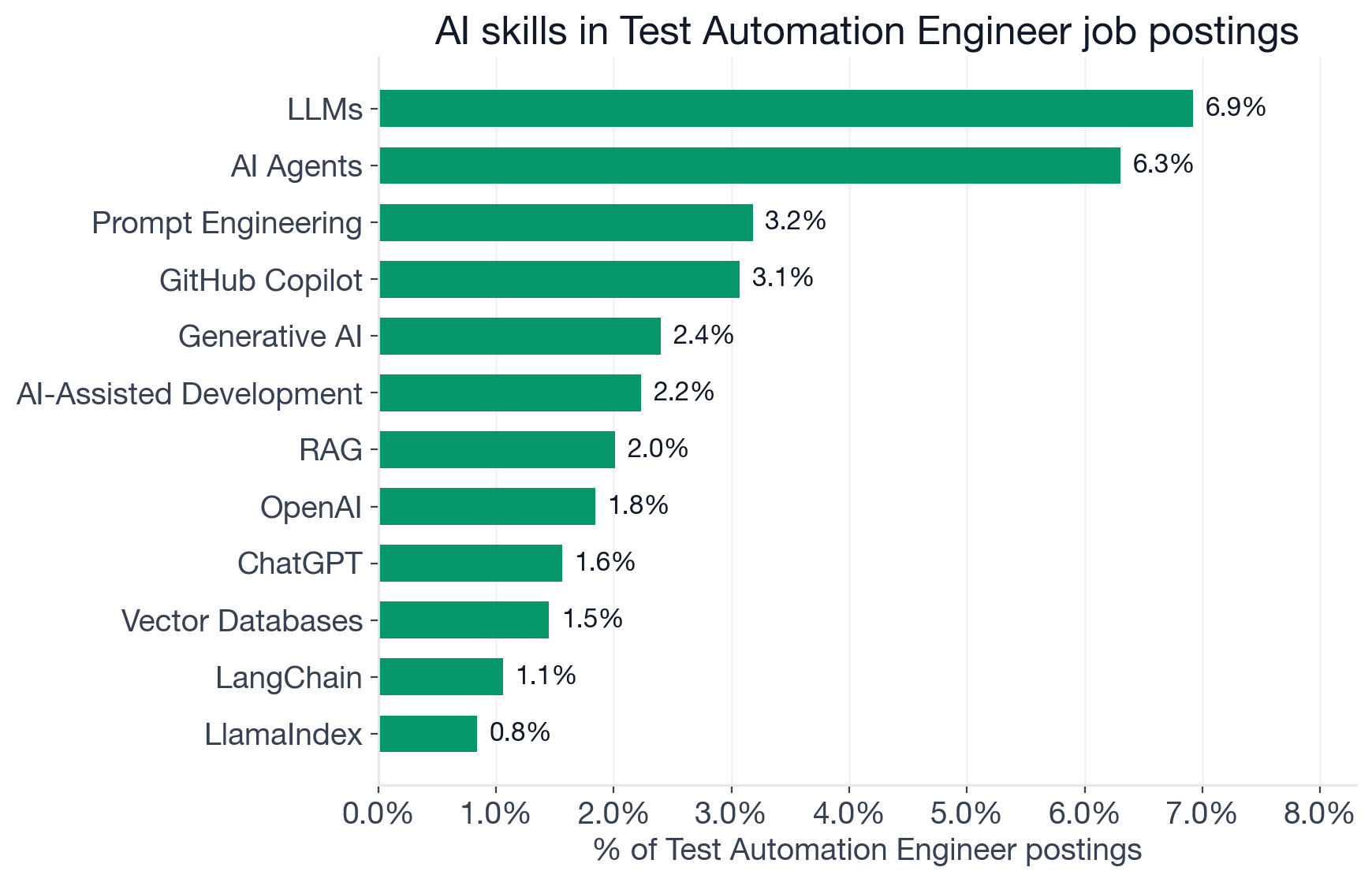
Percentage of Test Automation Engineer postings mentioning each AI skill. Multiple skills can appear in a single posting. New-wave generative AI skills (2023+) are the primary measure of the shift.
LLMs (6.9%, 124 postings) and AI Agents (6.3%, 113 postings) together make up the plurality of explicit demand. Both are system-building skills. An engineer who understands LLM APIs can build a test generator that takes a spec or user story and produces parameterized test cases. An engineer who can work with agent frameworks (CrewAI, AutoGen, LangChain) can build a self-healing suite that re-locates selectors when the UI changes, or an agent that explores the application autonomously to find coverage gaps.
Prompt Engineering (3.2%) and GitHub Copilot (3.1%) come next. Copilot is the most-cited specific AI tool in the data, and its position below LLMs and Agents is informative. The roles listing Copilot are asking for a productivity enhancement; the roles listing LLMs and Agents are asking for an architecture skill.
RAG (Retrieval-Augmented Generation, a technique for grounding AI model outputs in a specific knowledge base) appears in 2.0% of postings (36 total). In a testing context, RAG enables a specific use case: building a test oracle that checks application outputs against a specification document, or generating assertions grounded in API documentation. It's niche today, but its presence signals where some teams are heading.
Browse Test Automation Engineer postings that mention LLMs or postings that require AI Agents for a live view of what the explicit AI layer looks like.
On the ambient side: ChatGPT (41% daily use) and GitHub Copilot (30% daily use) are the tools developers actually use most for coding tasks day-to-day, per JetBrains' 2025 State of Developer Ecosystem Survey. Copilot appearing in only 3.1% of job postings is not evidence that it's less useful. It's evidence that employers don't list it for the same reason they don't list "uses the internet." GitHub Copilot's test-generation capabilities are now deeply integrated into major IDEs, making it less of an optional add-on and more of a baseline feature most developers reach for automatically. That's ambient AI becoming infrastructure.
Does AI Fluency Pay More?
All salary figures below are base pay only, with equity, bonuses, and sign-on excluded. Postings rarely disclose total compensation, so the numbers here represent what companies put in writing, not what candidates actually take home at top employers.
The global signal is directional: postings that mention AI skills show a median of $120,000 versus $110,488 without AI skills, roughly a $9,500 premium (n=47 AI, n=238 non-AI). With 47 postings in the AI group globally, this is a preliminary signal rather than an established premium. The US AI subsample was too small to produce a reliable separate figure: only 21 US postings both mentioned AI skills and disclosed salary, below the minimum threshold for a meaningful estimate.
What we can say about the US: the base salary for Test Automation Engineer postings without AI requirements is $117,500 (n=189). That's the current baseline. The directional premium globally is consistent with scarcity pricing: engineers who can build LLM-based test generation and agent-driven frameworks are uncommon, and uncommon skills command more.
The small US sample is itself a data point. Most AI-skilled test automation hiring is still flowing through consulting and services channels where salary disclosure is lower than at product companies. As more product teams commit to AI-native testing platforms, the US picture should sharpen.
Which Industries and Seniority Levels Lead AI Adoption?
The seniority data has an unexpected inversion.
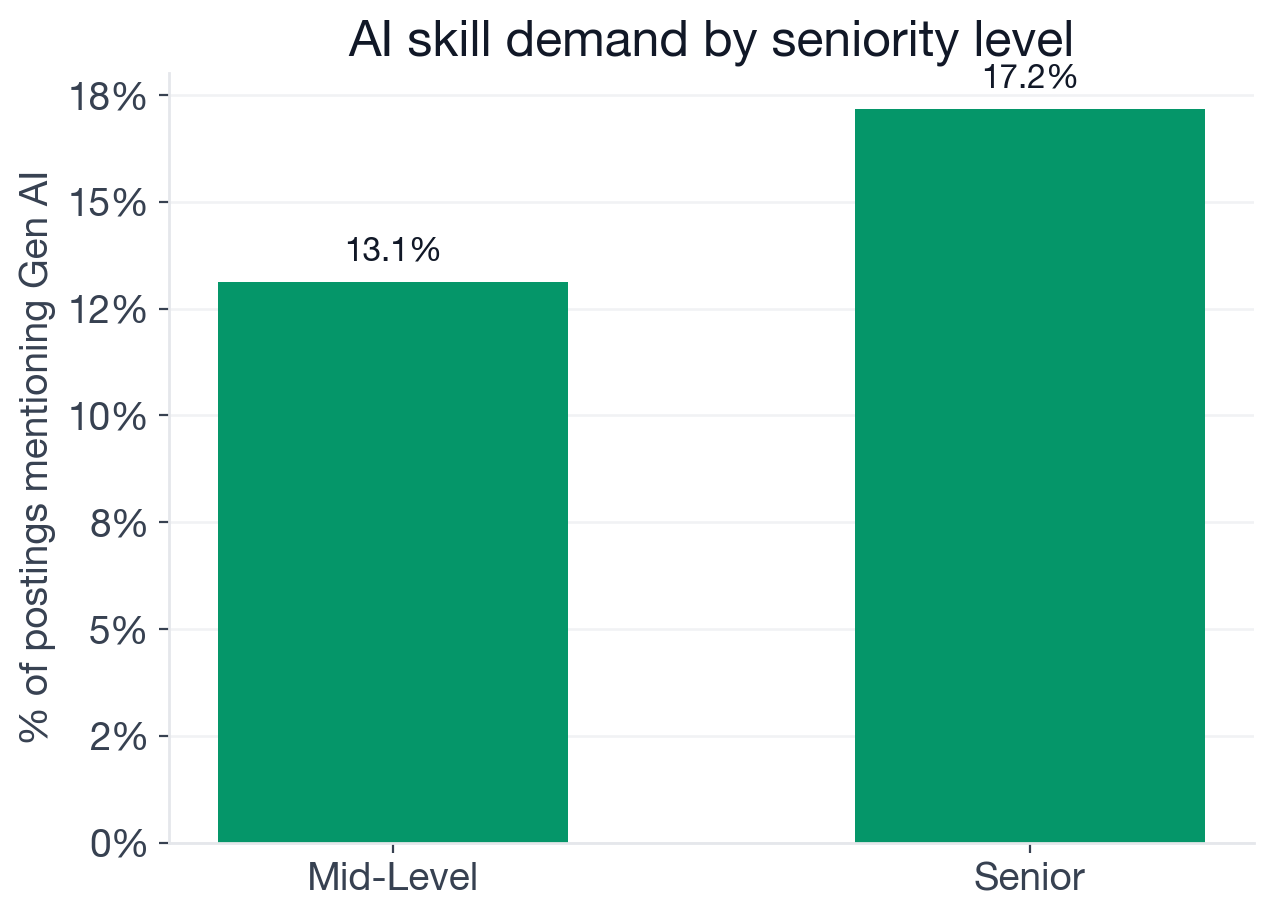
Share of Test Automation Engineer postings at each seniority level that explicitly require AI skills. Total postings by level: entry 36, junior 74, mid-level 434, senior 1,194, staff 54.
Staff-level roles lead at 24.1%, which makes sense: principal and staff engineers design test infrastructure rather than write individual test cases, so they're more likely to be building the AI layer. The surprise is entry-level at 19.4%, which sits above both junior (8.1%) and mid-level (13.1%). Junior roles show the lowest AI adoption rate in the entire dataset. Note that these buckets are small (7 AI postings out of 36 entry-level roles, and 6 AI postings out of 74 junior roles), so the entry-vs-junior inversion should be treated as directional rather than statistically conclusive.
One interpretation: companies building new AI-powered testing platforms are willing to hire entry-level engineers and grow them into the stack, while the large existing pool of junior automation engineering roles (Selenium, page object models, CI/CD scripting) hasn't shifted yet. For anyone entering the field: demonstrating LLM or agent framework familiarity isn't just a differentiator at the early career stage. It's a way into a segment of the market that is otherwise highly competitive.
The industry split is starker:
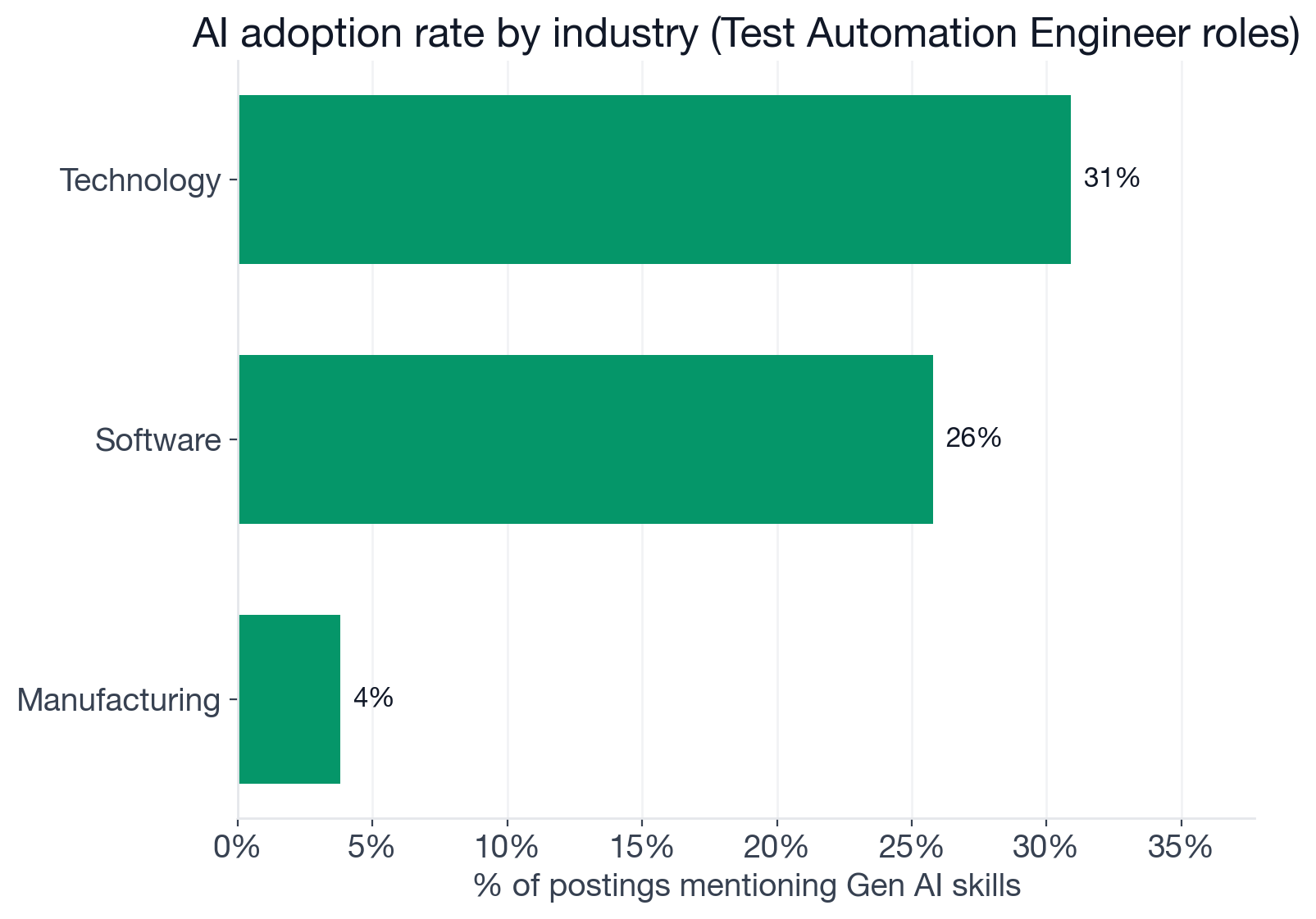
Share of Test Automation Engineer postings in each industry requiring AI skills. Industries with fewer than 100 postings are excluded for reliability.
Technology (30.9%, 220 postings) and software companies (25.8%, 159 postings) are the early movers. Nearly 1 in 3 technology postings now includes an explicit AI skill requirement for test automation. Manufacturing (3.8%, 132 postings) is a stark contrast: industrial test automation is a large market, but AI has barely touched the job descriptions yet. The same test automation discipline that is being rebuilt around LLMs and agents in software companies still runs on traditional frameworks and manual scripting in manufacturing environments.
Geography adds a further dimension. The US has the largest share of total postings at 29.2% (524 of 1,789), but its AI adoption rate within test automation is 8.0%. India, with 16.5% of postings (295 total), runs at 25.1%. Canada (2.4% of postings) shows a 30.2% AI rate, and Poland (1.8% of postings) runs at 27.3%. The offshore and nearshore centers that run large test automation practices have moved to AI-first hiring faster than traditional US domestic hiring reflects.
How to Use This in Your Job Search
The data draws a clear line between two versions of the role. Knowing which one you're targeting changes what you need to show.
For the build-AI track (the 16.1%): your resume needs to demonstrate system-building with AI, not just usage. That means understanding LLM APIs well enough to call them programmatically, familiarity with at least one agent framework, and ideally a project that shows test generation, self-healing behavior, or an LLM-based test oracle. The Test Automation Engineer question bank covers the testing fundamentals and AI concepts you'll be quizzed on. AI mock interview sessions let you rehearse the technical depth under interview conditions before the real thing.
For the ambient layer (everywhere else): using Copilot or ChatGPT to write test scaffolding, maintain page objects, and generate test data is now a baseline productivity expectation at most software companies. If you're not doing this yet, interactive courses covering AI-assisted development are a direct path to getting there. The InterviewStack.io job board for Test Automation Engineers filters by skill, so you can check the current mix of AI-skill and non-AI postings before targeting your search.
If you're entry-level: the seniority data is worth noting. Entry-level postings have a higher AI adoption rate than junior postings (19.4% versus 8.1%). Demonstrating even basic LLM fluency, a project using an AI agent or LLM API in a testing context, opens doors at a career stage where those roles are actively being filled by teams building AI-native testing infrastructure.
For a broader view of the QA hiring market, the QA Engineer skills data for 2026 shows how test automation fits within the wider quality engineering landscape and which core QA skills employers still rank highest.
FAQ
Q. What percentage of Test Automation Engineer postings require AI skills in 2026?
16.1% of Test Automation Engineer postings explicitly require new-wave generative AI skills (288 of 1,789 analyzed). A broader 19.6% mention any AI, including traditional ML. These figures capture engineers hired to build AI testing systems; the ambient baseline is higher, with 76% of QA professionals already using AI tools daily for test writing and maintenance, per Katalon's 2025 survey of 1,400+ practitioners.
Q. Which AI skills do companies look for in Test Automation Engineers in 2026?
LLMs (6.9% of postings) and AI Agents (6.3%) lead explicit AI demands, followed by Prompt Engineering (3.2%) and GitHub Copilot (3.1%). The LLMs-and-agents leadership signals what the 'build AI' layer looks like: companies hiring for explicit AI want engineers who can architect LLM-powered test generators and AI agent frameworks for self-healing test suites, not just engineers who use coding assistants to write scripts faster.
Q. Does having AI skills affect salary for Test Automation Engineers?
Global postings with AI skills show a median of $120,000 versus $110,488 without, roughly a $9,500 premium (n=47 AI, n=238 non-AI, global figures). The US baseline for Test Automation Engineer postings without AI skills is $117,500 (n=189). A US-specific AI salary premium could not be calculated reliably; only 21 US postings with salary data mentioned AI skills, below the minimum threshold for a reliable estimate.
Q. At what seniority level is AI adoption highest for Test Automation Engineers?
Staff-level roles have the highest AI adoption rate at 24.1% (13 of 54 postings). Entry-level comes in at 19.4% (7 of 36), higher than both junior (8.1%, 6 of 74) and mid-level (13.1%, 57 of 434). Senior roles sit at 17.2% (205 of 1,194). The pattern suggests AI skills matter at both ends of the career track: staff roles requiring engineering leadership on AI systems, and entry roles increasingly expected to arrive AI-ready.
Q. Which industries lead AI adoption in test automation roles?
Technology companies show the highest AI adoption rate at 30.9% (68 of 220 postings), followed by software at 25.8% (41 of 159). Manufacturing sits at just 3.8% (5 of 132). The gap suggests AI-powered testing is primarily a tech and software-company phenomenon; industrial and manufacturing automation has barely begun the same transition.
Q. What is the difference between explicit and ambient AI for test automation?
The 16.1% explicit figure captures engineers hired to build AI testing infrastructure: LLM-powered test generators, AI agent frameworks for self-healing test suites, and RAG-based validation pipelines. The ambient layer, which postings rarely state, is the Copilot, ChatGPT, and AI-assisted coding that 76% of QA professionals already use daily for script writing and test case generation. Both layers are real; they measure different depths of AI involvement in the role.
Q. Where are Test Automation Engineer jobs located, and which regions have the highest AI adoption?
The US leads in total volume at 29.2% of postings (524 of 1,789), followed by India at 16.5% (295 postings). India's AI adoption rate of 25.1% is more than three times the US rate of 8.0%, suggesting offshore and nearshore test automation centers are moving to AI-first approaches faster than domestic US hiring. Canada (30.2%) and Poland (27.3%) also show AI adoption rates well above the US average.
Where to Aim Your Skills in 2026
The dividing line in test automation is cleaner than it looks from the aggregate numbers. The large majority of the market is still traditional automation with AI as a productivity accelerant: Copilot for faster scripting, ChatGPT for test data, AI-assisted coverage review. The smaller and faster-growing slice is building the AI layer itself, LLM-powered generators, agent frameworks, RAG-based oracles, where the job description overlaps with building AI systems more than with maintaining test suites. Both tracks expect AI fluency; what differs is depth. Whichever track fits where you are, Test Automation Engineer openings on the job board let you filter by skill to see exactly what today's market demands.
Topics
Ready to practice?
Put what you've learned into practice with AI mock interviews and structured preparation guides.