
When AI Agents Became a Design Problem
The surprise in the Product Designer posting data isn't the overall AI adoption number. It's the skill that leads.
AI Agents appears in 8.2% of Product Designer postings (225 of 2,739 analyzed). Generative AI follows at 5.3%, then LLMs at 3.2%. That ranking matters more than the individual percentages. Generative AI is the most visible shift in design workflows: image generation, layout suggestions, content drafting tools. Yet companies are hiring Product Designers for agent interface work at a higher rate than for generative AI expertise. The signal is that agentic AI systems have created a design problem companies don't yet have enough people to solve.
We analyzed 2,739 active Product Designer postings on the InterviewStack.io job board over the past 90 days. The "Product Designer" classification captures the broad digital-product design category; a portion of postings in this dataset reflect adjacent roles such as brand and graphic designers (a known pattern in how companies title design positions across the market). Because those adjacent roles are less likely to carry AI requirements, the AI adoption figures below represent a conservative floor for software-focused Product Designers specifically. 18.3% (502 postings) explicitly require new-wave generative AI skills: roughly 1 in 5 postings, already. That figure measures designers being hired to build and own AI systems. The ambient layer sits much higher: 72% of designers now use generative AI tools regularly, per Figma's State of the Designer 2026 report. The posting signal and actual practice have separated significantly, and that gap is where the story lives.
Key Findings
- 18.3% of active Product Designer postings (502 of 2,739) explicitly require new-wave generative AI skills; 21.0% mention any AI skill at all.
- AI Agents is the top explicit AI skill at 8.2% (225 postings), ahead of Generative AI (5.3%, 144 postings), Machine Learning (4.7%, 130 postings), and LLMs (3.2%, 88 postings).
- Median US base salary: $185,000 for postings with new-wave AI requirements (n=141) vs. $151,500 without (n=511), a $33,500 gap (US base only, equity excluded).
- Staff-level Product Designers show the highest AI adoption rate at 28.75% (46 of 160 staff postings); Senior follows at 18.4% (336 of 1,825).
- Technology sector leads industry AI adoption at 27.0% (60 of 222 postings), ahead of software at 22.1% and fintech at 16.7%.
- 72% of designers regularly use generative AI tools, per Figma's 2026 report; 75% use AI every day, per the State of AI in Design 2026.
- 50% of designers have shipped AI-generated code to production; 65% are taking on more product or engineering responsibilities, per the Designer Fund AI in Design 2026 report.
What Product Design Looked Like Before AI Entered the Product
The Product Designer role at a technology company in 2021-2022 had a well-established definition. You owned feature areas within a product, collaborated with product managers on requirements, partnered with engineers on implementation, and produced high-fidelity interfaces in Figma. If the company had a design system, you contributed to it or built from it. User research, interaction design patterns, and cross-functional communication were the core disciplines.
The central design challenge was about deterministic systems: given a clear set of possible states, design the clearest and most usable path between them. The work involved managing scope, resolving edge cases in advance, and ensuring the experience held up across diverse users and contexts. AI existed on the fringes, limited to ML-powered recommendation surfaces that you designed around but rarely designed the fundamental experience of.
That changed in a compressed window. By 2023, generative AI was embedded in design workflows: Midjourney for visual exploration, ChatGPT for copy drafting, AI-assisted layout tools inside Figma. Those productivity shifts are the ambient layer now, already assumed by employers who don't bother listing them in job descriptions any more than they listed "comfortable using Google Docs."
What's newer is the structural design problem: systems where the output is probabilistic, where the AI reasons rather than retrieves, where multi-step autonomous action requires affordances that form-based interaction never needed. Designing trust and transparency for an AI agent is a different problem from designing a checkout flow. Companies building those systems are hiring for it specifically, and the postings reflect it.
What Percentage of Product Designer Postings Now Require AI Skills?
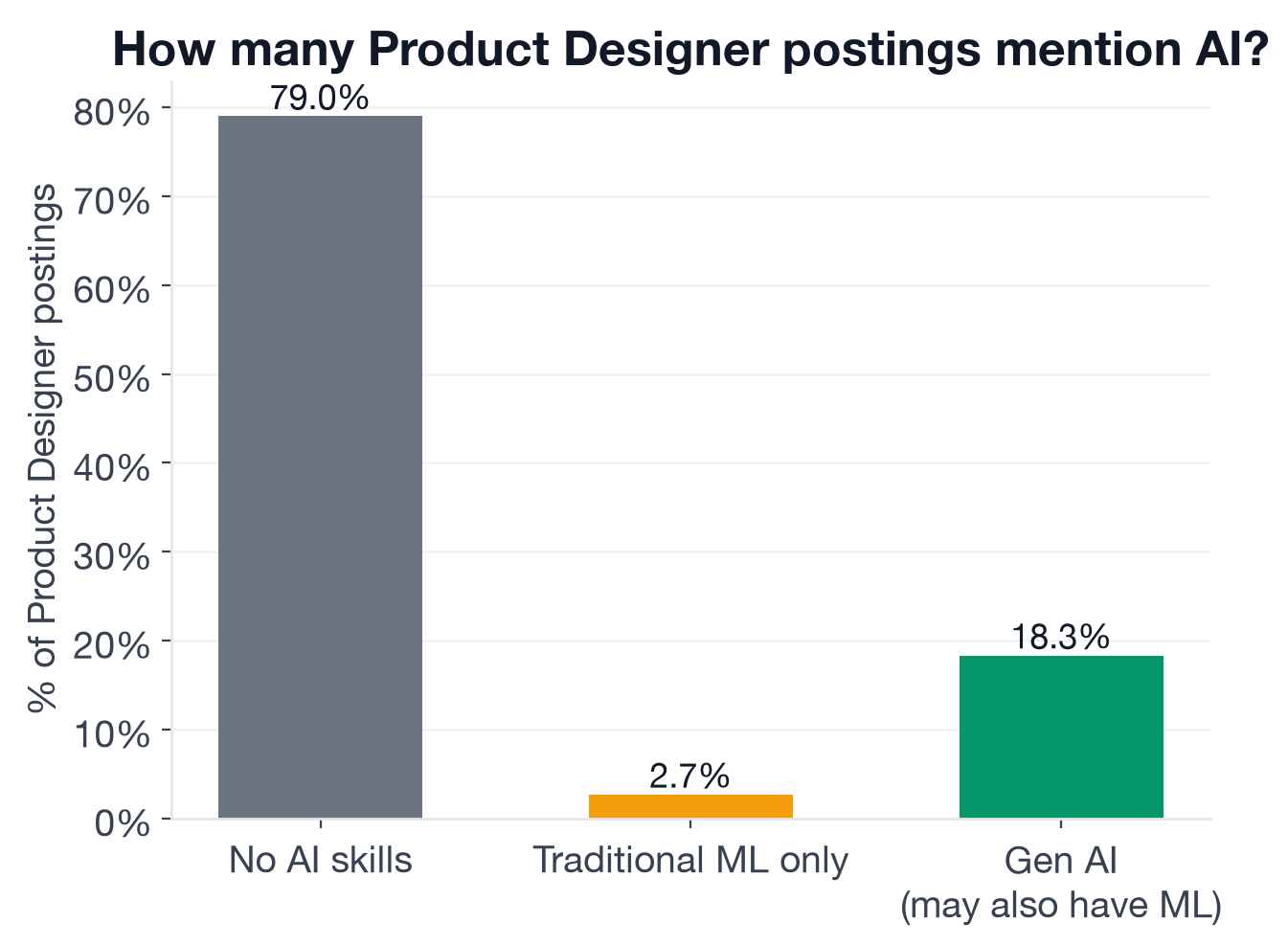
AI requirement breakdown across 2,739 active Product Designer postings, June 2026.
18.3% explicit AI adoption is a threshold, not just a data point. It means AI product design work has moved from a specialty signal to a meaningful chunk of the market. Compare that to the UX Designer posting data from June 2026, which showed 7.4% explicit AI adoption. The Product Designer context (embedded in product teams, owning feature areas, closely tied to engineering decisions) is pulling AI requirements into job descriptions faster than adjacent design roles.
The 18.3% figure is also not the ceiling on what AI means for the role. It captures the Build AI layer: companies that have already built AI-specific product areas and need designers who can own them end-to-end. The Use AI layer is broader. According to Figma's State of the Designer 2026, 72% of designers regularly use generative AI tools, and 98% of those have increased their usage over the past year. Employers expect that productivity fluency as a baseline; they just don't list it.
The Designer Fund's AI in Design 2026 report adds a harder-to-ignore data point: 50% of designers have shipped AI-generated code to production, and 65% are taking on more product and engineering responsibilities. AI has expanded what the role does, not just what tools it uses. Postings haven't caught up to that expansion yet.
Which AI Skills Are Showing Up in Postings?
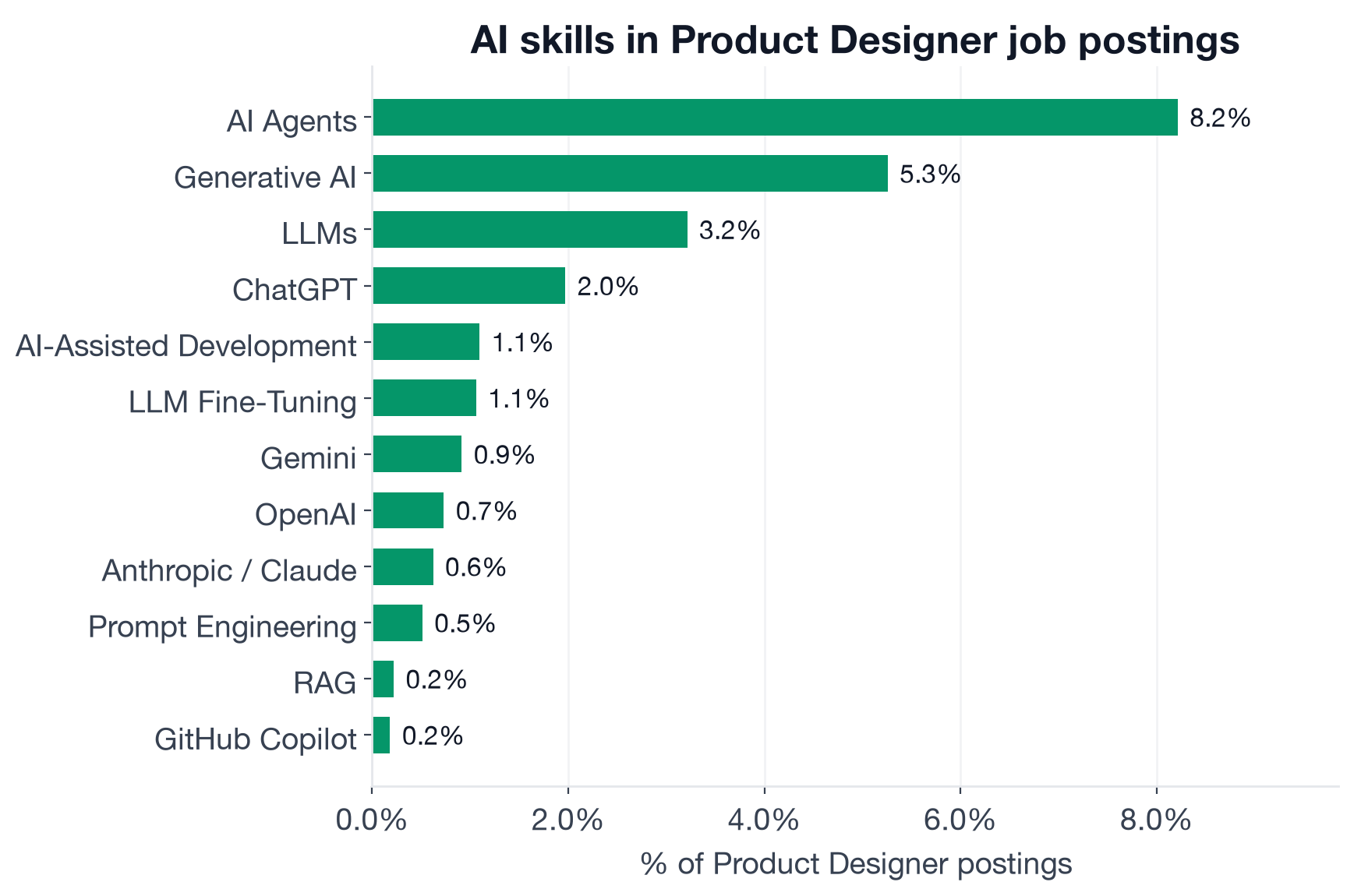
Explicit AI skill requirements across 2,739 active Product Designer postings.
| AI Skill | Postings | Share of Total |
|---|---|---|
| AI Agents | 225 | 8.2% |
| Generative AI | 144 | 5.3% |
| Machine Learning | 130 | 4.7% |
| LLMs | 88 | 3.2% |
| ChatGPT | 54 | 2.0% |
| AI-Assisted Development | 30 | 1.1% |
| LLM Fine-Tuning | 29 | 1.1% |
| Prompt Engineering | 14 | 0.5% |
Lower-frequency skills in this dataset, including LLM Fine-Tuning (1.1%, 29 postings), appear in postings for highly technical AI product roles or reflect companies with unusually broad AI requirement language. LLM fine-tuning is primarily an ML engineering task; its appearance in a small share of Product Designer postings likely reflects cross-functional role descriptions rather than mainstream Product Designer practice. The top four skills (AI Agents, Generative AI, Machine Learning, LLMs) represent the clearest signal of design-specific AI demand.
AI Agents at 8.2% outpaces Generative AI at 5.3%, and that gap is the telling signal. An AI agent handles multi-step tasks autonomously: it reads context, makes decisions, executes actions, and reports results. Designing that experience requires thinking through questions that have no settled answers in product design: What does transparency look like when the system is reasoning step by step? How do users know when to trust the output versus verify it? What are the right affordances for intervening mid-task? Companies hiring for this are hiring from a small pool of practitioners who have worked through those problems before.
Generative AI at 5.3% captures a different set of companies: those building image generation features, content drafting tools, or creative AI surfaces. This skill set is more accessible to designers who have used these tools in their own workflow, and it is also increasingly treated as a baseline rather than a differentiator. The postings that require it tend to be product teams where the generative capability is the core value proposition.
Machine Learning at 4.7% is a third type: designers expected to understand model behavior well enough to make product decisions. "Does the model handle this edge case reliably?" and "How do we communicate a confidence interval to a non-technical user?" sit at the boundary of design and ML engineering. Designers who can work at that boundary are genuinely useful to product teams that are building data-driven features. You can explore open Product Designer roles that require AI skills on the job board to see how this requirement is phrased in practice.
Does AI in the Title Pay More?
All salary figures here are US base salary only; equity, bonuses, and sign-on are excluded from posted compensation data and are not in this dataset. Total compensation at well-funded AI product companies runs meaningfully higher than these figures.
Product Designer postings with new-wave AI requirements show a median US base of $185,000 (n=141 postings with disclosed salary). Postings without new-wave AI requirements show $151,500 (n=511). The gap is $33,500.
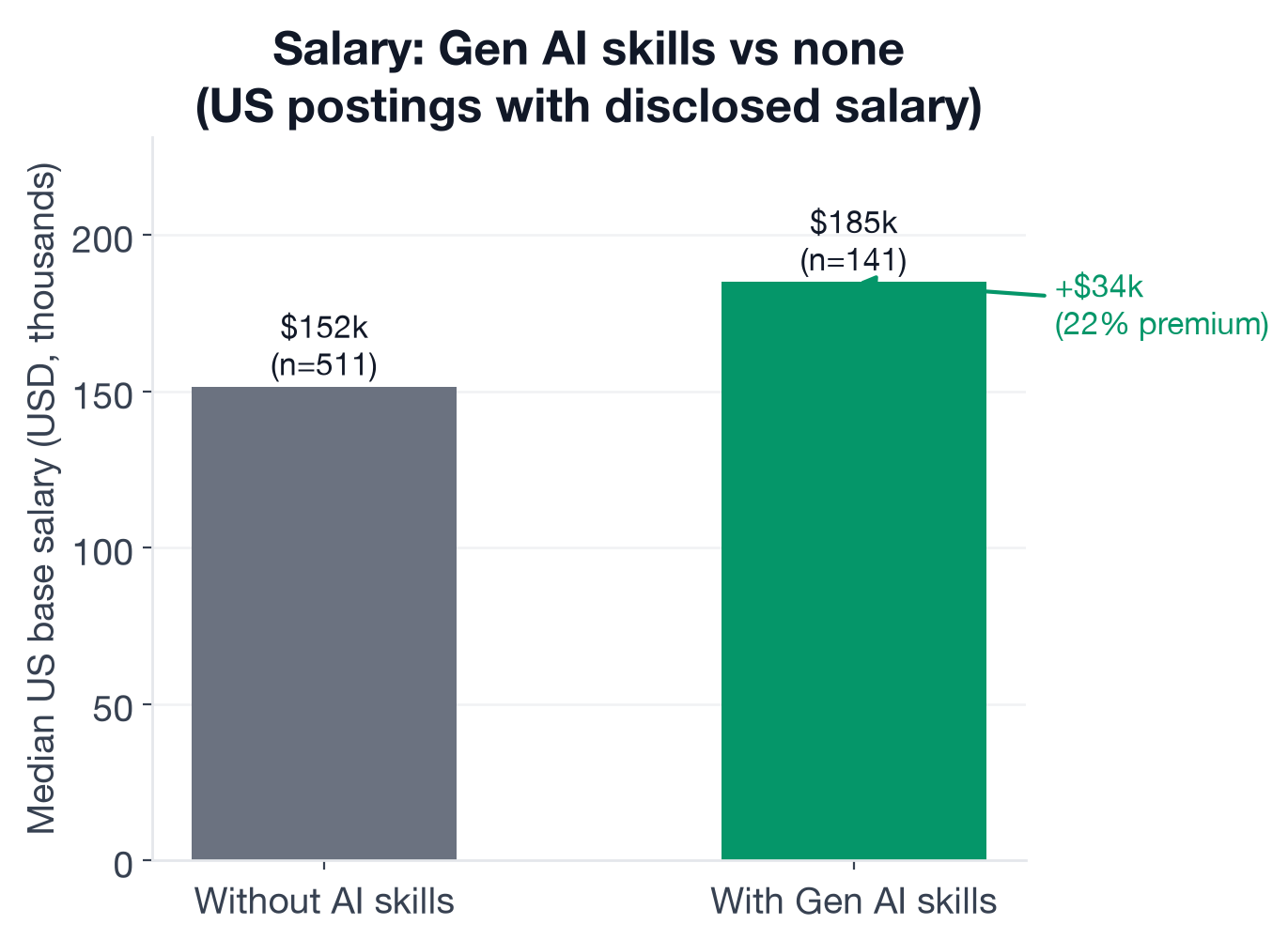
Median US base salary, Product Designer postings with and without explicit new-wave AI requirements.
Part of this gap reflects seniority concentration: AI-requiring postings skew toward senior and staff levels where pay is higher regardless of AI requirements. A second factor is scarcity: agentic interface design is a relatively new specialization, the talent pool is small, and the companies hiring for it are often AI-first or well-funded, which puts upward pressure on compensation. Both effects are real, and both are reflected in the $33,500 median difference.
The $151,500 median for Product Designer postings without AI requirements is itself a strong outcome. The AI premium is real, but it comes with a more specific market: concentrated in technology and software, weighted toward senior and above, and requiring demonstrated experience with AI product work rather than just familiarity.
Which Seniority Levels and Industries Lead AI Adoption in Product Design?
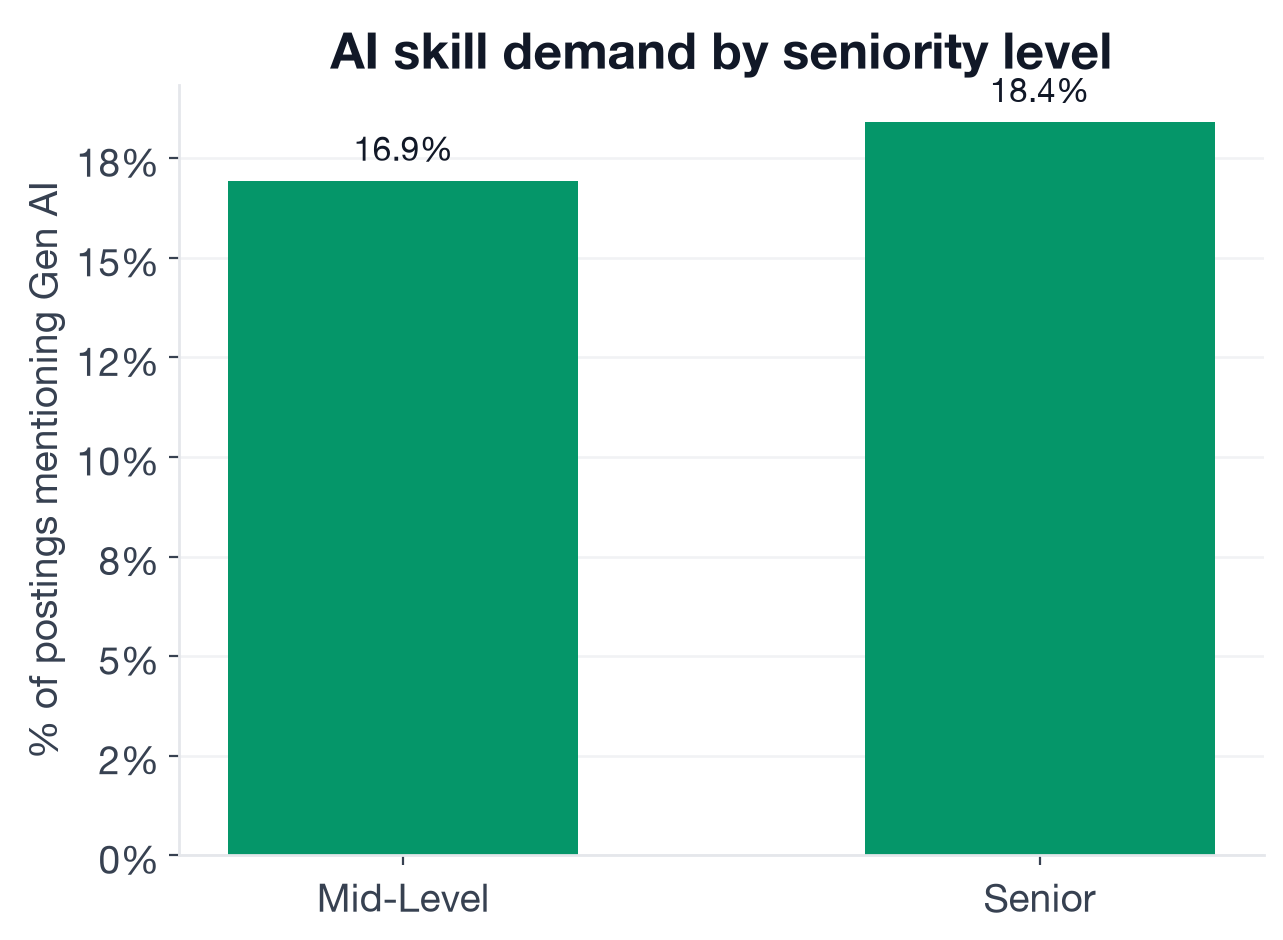
AI adoption rate by seniority, 2,739 active Product Designer postings.
Staff-level Product Designers have the highest AI adoption rate at 28.75% (46 of 160 staff postings). Senior follows at 18.4% (336 of 1,825), and Mid-level sits at 16.9% (94 of 555). The pattern makes sense: staff designers typically own product areas from a strategic vantage, and when those areas are AI-powered features or agent surfaces, AI requirements end up in the description as a matter of course.
The entry-level picture is worth noting. Entry-level postings show a 16.9% AI adoption rate (21 of 124), slightly above junior postings at 6.7% (5 of 75). The most plausible explanation: AI-first companies at the growth stage are bringing in entry-level designers with explicit AI product backgrounds, creating a cohort of designers entering the field with AI as a native skill rather than an acquired one.
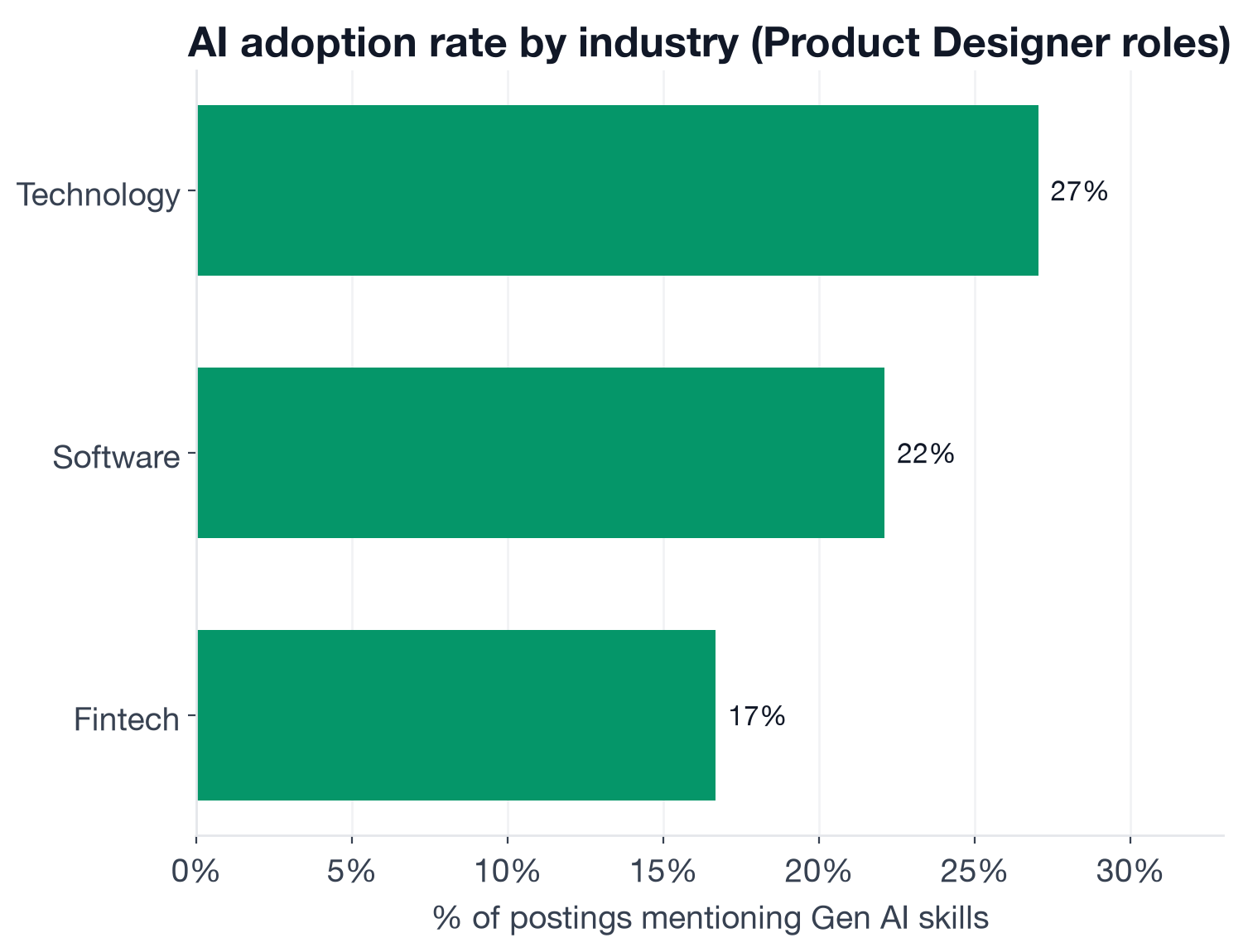
AI adoption rate by industry, top three sectors by volume in the Product Designer dataset.
Technology leads at 27.0% (60 of 222 postings), followed by software at 22.1% (78 of 353 postings) and fintech at 16.7% (23 of 138 postings). Companies building the AI systems are also building the design teams that own those systems' experience. Adobe, Salesforce, and Intercom each had active postings in this dataset requiring explicit AI skills, reflecting investment in AI product surfaces across enterprise tooling, CRM, and customer communication.
How to Use This in Your Job Search
Search where the signal is concentrated. Technology and software companies account for the large majority of explicit AI-requiring Product Designer roles. The Product Designer job board lets you browse active postings now, and filtering for postings that mention AI Agents or Generative AI puts you in the $33,500 premium bracket.
Practice the design interview for AI products. AI product design interviews aren't limited to portfolio walkthroughs. Hiring managers want to understand how you think through trust and transparency, how you handle model uncertainty in the user experience, and how you design graceful fallback states for autonomous systems. AI mock interviews let you work through this kind of structured reasoning before the real conversation.
Build conceptual fluency with ML. Machine Learning appears in 4.7% of postings, typically in contexts where designers need enough model understanding to make feasible product decisions. Our interactive courses covering ML fundamentals are accessible without an engineering background and close that gap quickly.
Drill the specific question types. The question bank includes Product Designer questions on AI agent design, generative AI UX, and cross-functional work with ML teams. Going through those before an AI product design interview is a concrete preparation step.
FAQ
Q. What AI skills do Product Designer postings require in 2026?
AI Agents tops the list at 8.2% of postings (225 of 2,739), followed by Generative AI (5.3%, 144 postings), Machine Learning (4.7%, 130 postings), and LLMs (3.2%, 88 postings). These are explicit requirements for designers hired to build or design AI-powered products, not a measure of ambient AI tool use.
Q. What percentage of Product Designer postings require AI skills in 2026?
18.3% of active Product Designer postings (502 of 2,739) explicitly list new-wave generative AI skills. Including traditional ML, 21% mention any AI skill. That figure measures the explicit Build AI layer: designers hired to design AI systems. The ambient Use AI layer (daily Figma AI, ChatGPT, image generation) applies to roughly 72% of designers regardless of posting language, per Figma's State of the Designer 2026 report.
Q. What is the salary premium for AI skills in Product Designer roles?
The median US base salary for Product Designer postings with new-wave AI requirements is $185,000 (n=141) versus $151,500 for postings without (n=511), a premium of $33,500. These are US base salary figures only; equity, bonuses, and sign-on are excluded.
Q. Which seniority level has the highest AI adoption in Product Designer postings?
Staff-level Product Designers have the highest AI adoption rate at 28.75% (46 of 160 staff postings), nearly 10 percentage points above the Senior level at 18.4% (336 of 1,825). Senior is the largest tier overall at 66.6% of all postings.
Q. Which industries hire the most AI-skilled Product Designers?
Technology leads at 27.0% AI adoption (60 of 222 postings), followed by software at 22.1% (78 of 353) and fintech at 16.7% (23 of 138). These three sectors collectively account for the majority of explicit AI requirements in Product Designer postings.
Q. Do Product Designers need AI skills even if their job posting doesn't mention AI?
Yes. The explicit AI percentage (18.3%) measures designers hired to build AI-powered products. Ambient AI use (Figma AI, ChatGPT for content ideation, AI prototyping tools) applies far more broadly. Figma's State of the Designer 2026 report found 72% of designers regularly use generative AI tools and 85% say AI fluency will be essential to future success. The posting signal is the floor, not the ceiling.
Q. What is the role of AI Agents in Product Designer job postings?
AI Agents is the top explicit AI skill in Product Designer postings at 8.2% (225 of 2,739), outranking Generative AI (5.3%) and LLMs (3.2%). This reflects demand for designers who can build the interfaces of agentic AI systems: handling uncertainty, designing for multi-step reasoning, and creating trust signals. It is not simply a measure of designers who use generative AI as a productivity tool.
The Starting Point, If You Need One
The 18.3% explicit AI figure will keep rising as AI product surfaces mature and more teams need experienced designers to own them. The design conventions for agentic systems are still being worked out: how to communicate reasoning, when to show confidence, what "graceful degradation" looks like when the AI is wrong. Designers who develop fluency in these problems now are building expertise the market is actively pricing.
Getting a foothold doesn't require an immediate jump to an AI-first company. It means taking on AI-adjacent work in your current role, building a working mental model of how agentic systems behave differently from traditional flows, and being prepared to articulate that thinking in interviews. The postings at that premium are already there for designers who can make that case.
Topics
Ready to practice?
Put what you've learned into practice with AI mock interviews and structured preparation guides.