
Designing AI vs. Designing With AI: Two Different Jobs, One Title
The "UX Designer" title in 2026 covers two meaningfully different jobs. One is the role most designers recognize: user research, wireframing, prototyping, and visual systems. The other is newer: designing the interfaces of AI-powered products, crafting conversation flows for AI agents, and thinking through what transparency, trust, and fallback handling mean when a system generates its own responses. The second job pays a $40,250 median salary premium (US base, equity excluded) over the first.
Only 7.4% of active UX Designer postings explicitly list generative AI skills as a requirement. Browse current UX Designer openings on the InterviewStack.io job board to see both types side by side. We looked at 3,343 active listings from the past 90 days, with AI skill requirements, salary, seniority, and industry extracted from job descriptions.
That 7.4% figure is not a ceiling on AI fluency in the field. It is the explicit signal: the share of companies actively hiring for AI-product design work. The ambient layer is far broader. According to Designlab's State of AI in UX & Product Design 2026 report, 91% of UX and product designers use AI tools at least weekly in 2026, up from 54% in 2025. That 84-percentage-point gap between the posting signal and actual practice is what this post maps.
Key Findings
- 7.4% of UX Designer postings (246 of 3,343) explicitly list new-wave generative AI skills; 9.2% (309 postings) mention any AI at all.
- AI Agents is the top explicit AI skill at 3.4% (115 postings), outranking Generative AI (1.7%) and ChatGPT (1.3%).
- Median US base salary: $147,750 for postings with new-wave AI requirements vs. $107,500 without, a $40,250 premium (n=50 with AI, n=517 without; US base only, equity excluded).
- 91% of UX/product designers report using AI tools weekly in 2026, up from 54% in 2025, per Designlab's 2026 survey.
- 66% of UX Designer postings are at the senior level (2,209 of 3,343); only 2.9% are entry-level (98 postings).
- Senior UX Designers show the highest explicit AI adoption at 8.2%; junior postings show just 1.3%.
- Technology (13.8% AI adoption rate) and software (13.2%) lead the shift; engineering and construction postings show 0%.
What the Role Looked Like Before 2023
Before the generative AI wave, a UX Designer job description had a remarkably stable core: Figma or Sketch for wireframing and high-fidelity prototypes, a user-research toolkit (interviews, usability studies, affinity diagrams), and close collaboration with product managers and engineers. Information architecture, interaction design, and visual hierarchy were the craft skills that separated strong candidates. AI was not part of the mainstream design workflow. GPT-3 existed, but it had no integration into common design tools or practice.
That changed in a compressed window. Figma introduced AI-assisted layout suggestions and design generation. ChatGPT and Claude became standard tools for synthesizing research notes, generating microcopy variations, and exploring content structures quickly. Image generators like Midjourney and Adobe Firefly entered the rapid ideation phase of product work. By the time Designlab surveyed designers in 2026, 75% were using AI every single day and 93% reported already implementing generative AI in their current work.
What did not change is the craft foundation. The Nielsen Norman Group's State of UX 2026 report frames the shift as "Design Deeper to Differentiate": AI handles surface-level visual generation, so competitive advantage shifts to systemic thinking, research depth, and information architecture. Designers whose value proposition was visual production speed alone are the ones under pressure. The designers employers pay a premium for are those who use AI to go deeper on the problems AI cannot solve.
What Companies Explicitly Require Now
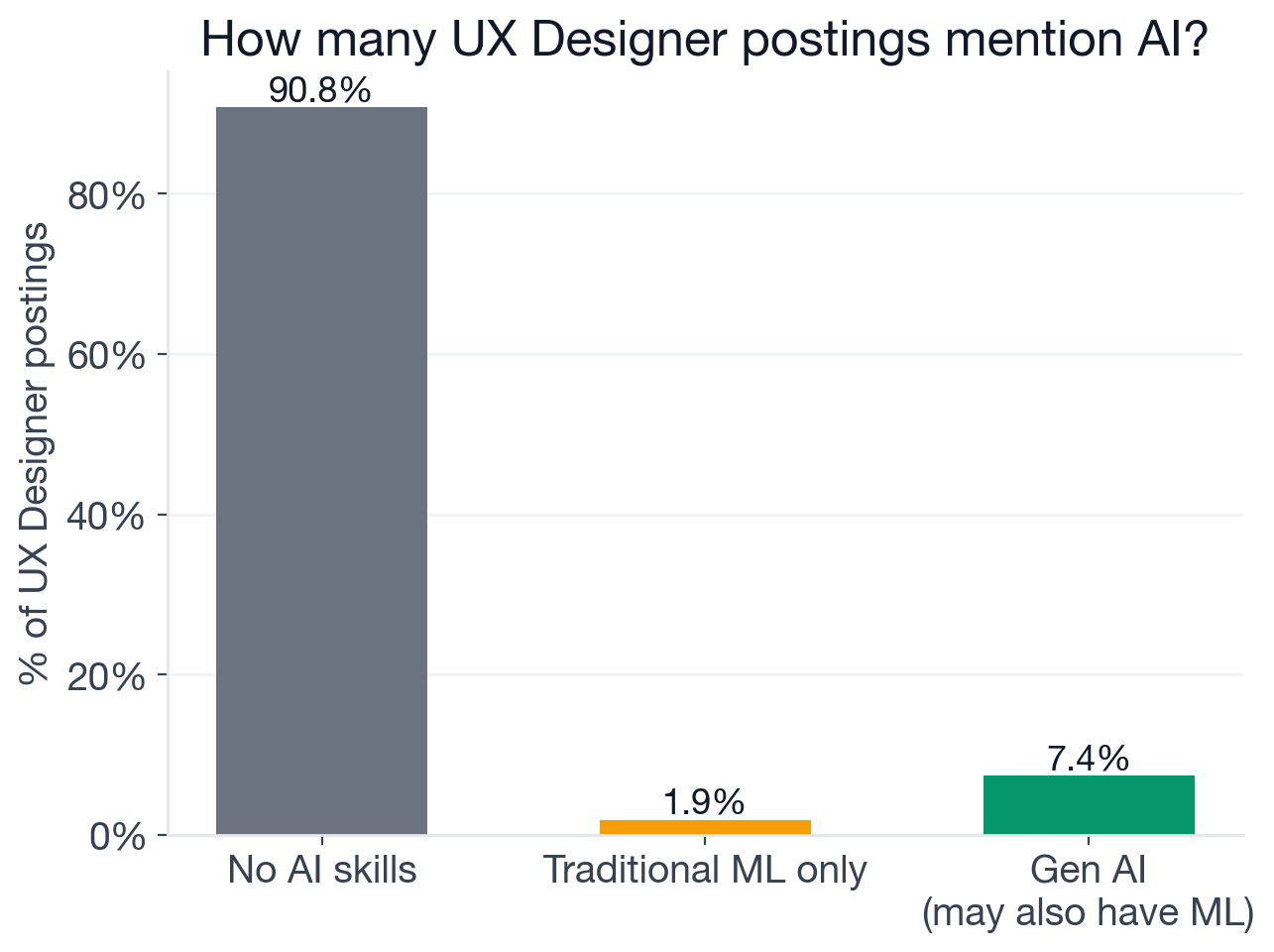
Share of UX Designer postings by AI requirement category, based on 3,343 active listings analyzed June 2026.
Nine in ten UX Designer postings do not list any AI skill. The 9.2% that do are concentrated in a specific type of work: designing AI-powered products, building AI-integrated experiences, or bringing LLM and agent design expertise to a product team. That is the explicit layer. It measures where companies have decided AI fluency is specific enough to a role to name in the posting.
The other 90.8% includes postings where AI tool use is assumed, not articulated. An employer listing Figma and user research does not also list "you will use ChatGPT to synthesize research data" for the same reason "comfortable with email" was never listed a decade ago. The ambient layer covers researchers using AI for synthesis, prototypers using Figma AI for iteration, and designers reaching for Claude or ChatGPT to draft interaction copy. None of that appears in the 9.2% figure.
This distinction matters for everything that follows. The explicit AI data tells you where companies are treating AI-product UX as a named specialty. It does not tell you where AI tools are being used.
A note on dataset scope: the job-board "UX Designer" classifier captures a broad range of design titles. The underlying title sample confirms it: alongside digital UX practitioners, this dataset includes facade designers, CAD specialists, structural designers, fire protection system designers, fashion designers, and footwear designers. These non-digital roles almost never list AI requirements, which deflates the 9.2% overall figure. Technology and software sector postings (where the captured roles are more consistently digital UX work) show 13–14% AI adoption, closer to the true demand signal for the field this post primarily addresses. All the figures below should be read with that context: they represent a conservative floor, not a ceiling, on AI adoption in digital UX.
Which AI Skills Are UX Designer Job Postings Requiring?
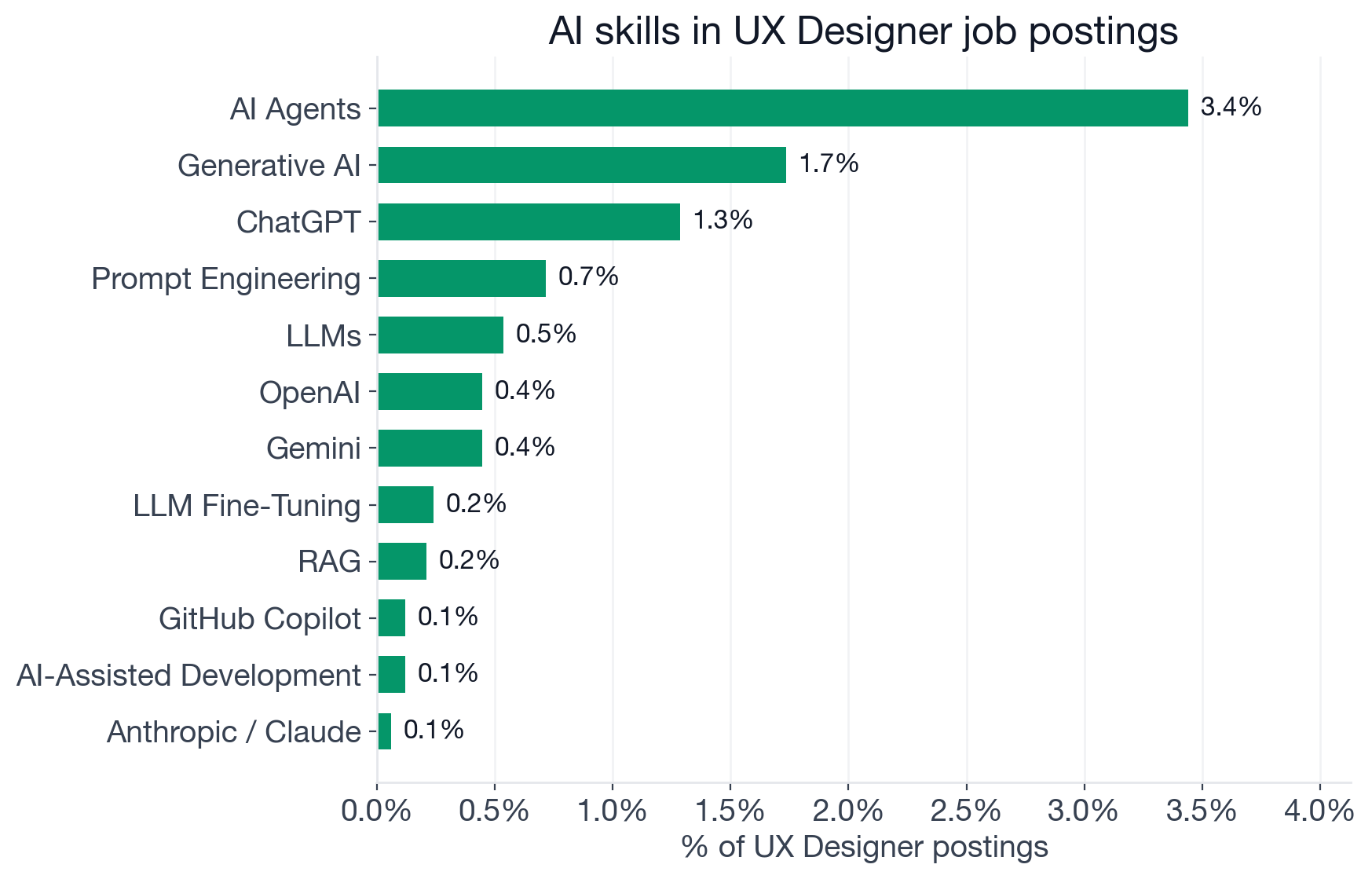
Share of active UX Designer postings listing each AI skill, June 2026.
AI Agents at the top of the list is the most significant signal in the data. At 3.4% (115 postings), it outpaces Generative AI (1.7%), ChatGPT (1.3%), and every other explicit AI skill. This is not about designers using agent tools. It is about designers being hired to build the interfaces of AI agent systems. Designing for agents requires solving genuinely novel problems: how do you communicate what an agent is doing in real time, how do you build user trust when actions are generated rather than predetermined, and how do you design transparent fallback states when the agent fails? These are hard new problems that require specific product expertise, which is why companies name the skill explicitly.
Machine Learning at 2.2% (75 postings) sits in the traditional tier: postings asking for this typically involve data visualization products or ML-driven recommendation systems where the designer needs to understand model outputs to design around uncertainty and edge cases. Generative AI at 1.7% (58 postings) and ChatGPT at 1.3% (43) represent the "designing with generative AI" category: companies that explicitly name tools as part of the designer's workflow rather than just assuming them. Prompt Engineering at 0.7% (24 postings) signals companies building prompt-driven products where the designer's ability to shape model behavior through prompt structure is part of the deliverable.
The ambient picture is much broader than these numbers. ChatGPT is cited as the most-used AI tool by 83.5% of designers surveyed in the Designlab 2026 report. The explicit skill counts measure only the specialized subsegment where AI product design is the named job, not the full population of designers using AI tools every day.
What Does Explicit AI Demand Pay?
All salary figures below are restricted to US postings with disclosed compensation data, where wage-transparency laws produce consistent disclosure. These are base salary only: equity, bonuses, RSUs, and sign-on are not captured in posting data, so total compensation at top employers is meaningfully higher than what these numbers reflect.
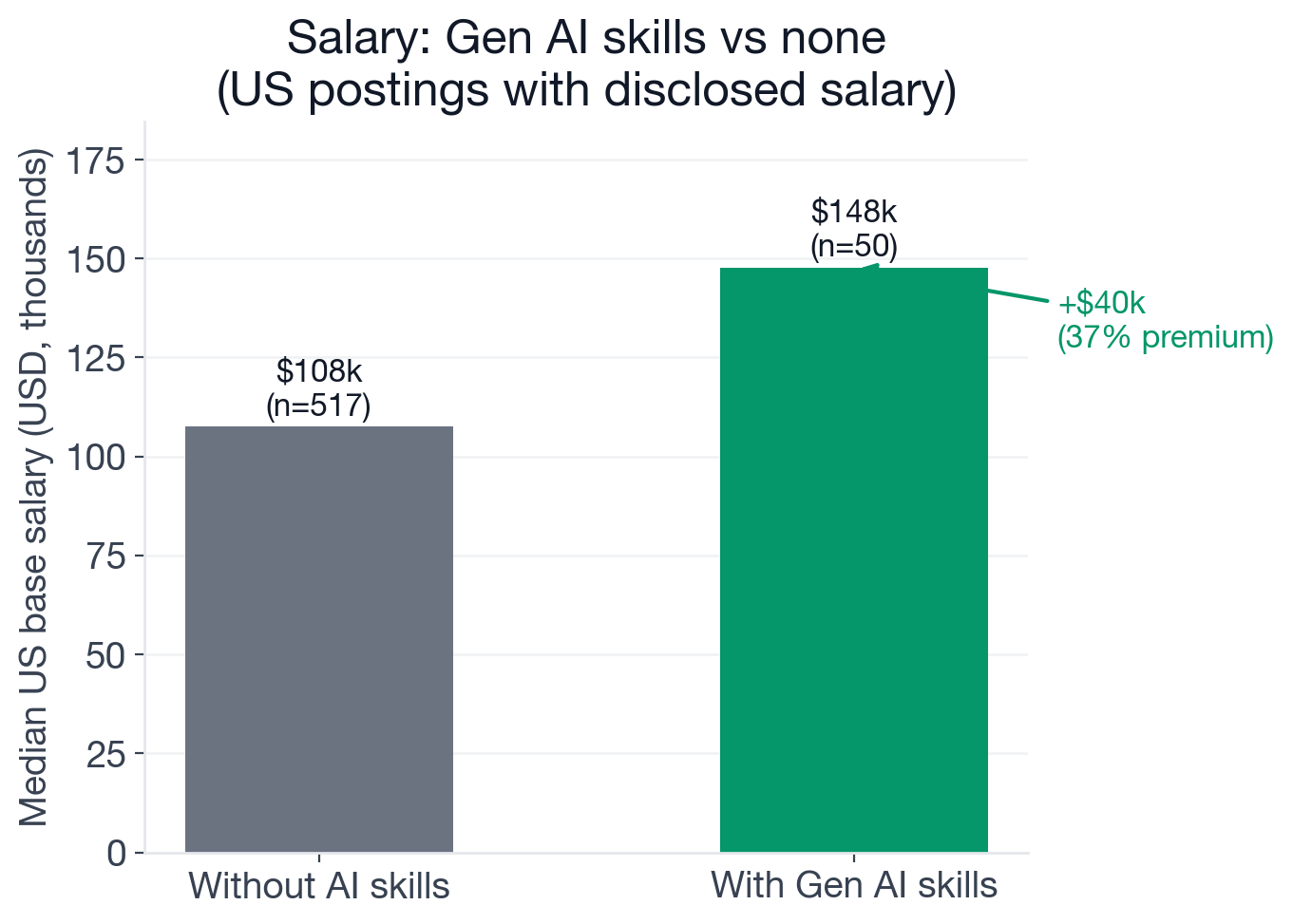
Median US base salary for UX Designer postings with and without new-wave generative AI requirements. US postings with disclosed salary only.
The gap is $40,250: $147,750 for postings requiring new-wave AI skills versus $107,500 for those without. That is a 37% salary lift for the AI-product specialist slice. The AI sample is 50 postings, enough to establish the direction clearly but not enough to treat the exact figure as definitive. The pattern is consistent with what appears in other technical roles where a new specialty concentrates in senior positions and commands a premium before the broader market catches up.
One caveat worth stating plainly: the $107,500 non-AI baseline reflects the full range of postings captured under "UX Designer," which, as the underlying title data shows, includes industrial designers, fashion designers, CAD specialists, and physical product designers alongside digital UX practitioners. The baseline for purely digital UX roles likely sits above $107,500. The AI premium over a digital-only comparison would still be significant, but the raw $40,250 figure overstates it somewhat.
The bottom line holds either way: if you are targeting AI-product UX work specifically, the premium is real, documented, and not marginal.
Where Is Explicit AI Demand Concentrating?
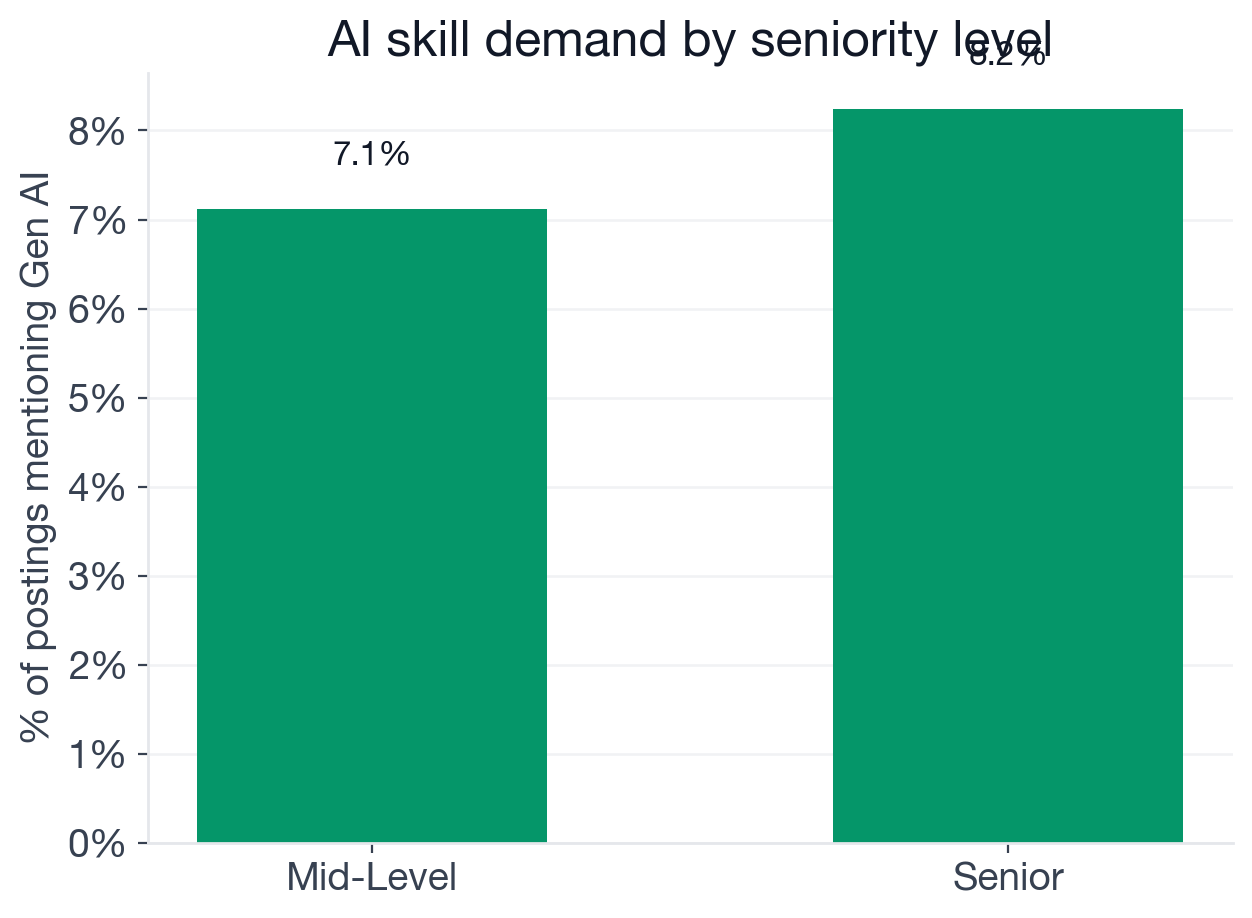
Percentage of UX Designer postings with explicit AI skill requirements, by seniority level.
The UX Designer market in 2026 is heavily senior-weighted: 66% of postings are at the senior level (2,209 of 3,343), with mid-level at 23% (773), junior at 4.7% (158), staff at 3.1% (105), and entry at 2.9% (98). Fewer than 8% of postings (one in 13) are genuinely entry-level. That distribution shapes where AI demand sits.
Senior UX Designers show the highest explicit AI adoption at 8.2% (182 of 2,209 senior postings). Mid-level follows at 7.1% (55 of 773). The drop at junior is sharp: only 1.3% (2 of 158) of junior postings name AI skills. AI-product work concentrates at the senior level for a structural reason: designers who own entire feature areas can take on the complexity and ambiguity of AI system design. Junior roles, where the work involves executing against defined requirements, rarely have that scope.
Entry-level shows 4.1% AI adoption (4 of 98), slightly above junior. The sample is small enough that the difference is directional at best, but it fits a pattern visible in other technical roles: entry hires at AI-native product companies land directly on AI product work, while traditional companies hire entry-level designers for execution-focused non-AI roles.
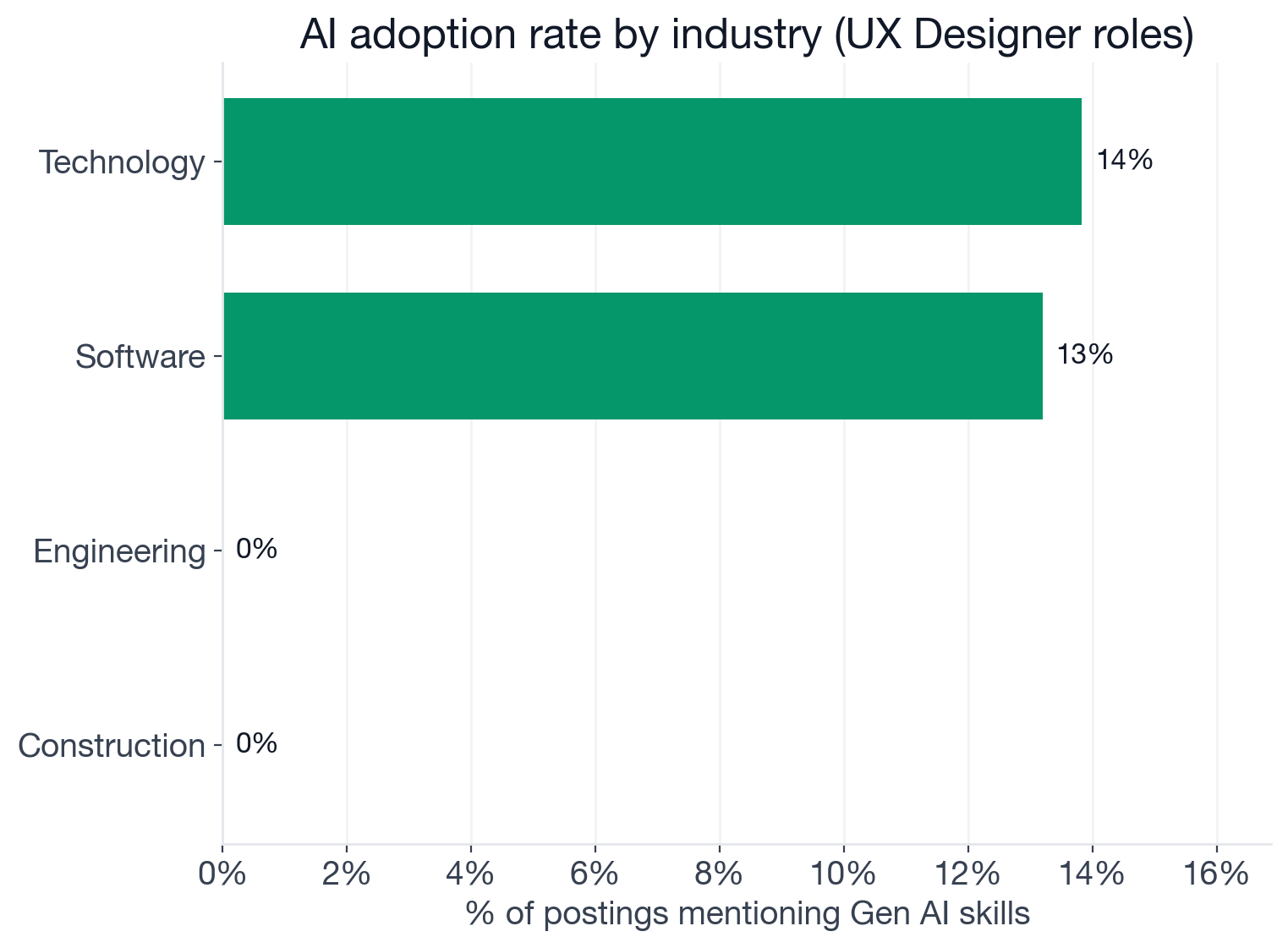
Share of UX Designer postings listing AI skills, by industry. Industries with fewer than 100 total UX Designer postings are excluded.
The industry split makes the geography of opportunity concrete. Technology (13.8% AI adoption) and software (13.2%) are where AI-product UX demand concentrates. Nearly 1 in 7 postings in those sectors names explicit AI skills. Engineering and construction sectors show 0% explicit AI adoption, a dataset artifact rather than a finding about digital UX practices in those industries. In engineering and construction, the postings captured under the "UX Designer" label are predominantly non-digital design roles: CAD drafting, facade design, infrastructure layout, structural design. For practical career purposes, the digital UX job market is effectively contained within technology and software companies. Autodesk, the design software company, is the most recognizable employer in the AI-flagged postings, a signal consistent with a company whose products are built for designers and whose UX team is expected to understand both sides of that equation. Digital agencies with AI-focused practices are also present.
If your target is AI-product UX work, the opportunity map is almost entirely within technology and software companies. Engineering and construction postings that appear under the UX Designer title represent a different discipline for most digital UX purposes.
How to Build Toward This in Your Career
The data maps to a clear decision: are you optimizing for the digital-UX mainstream, where AI tool fluency is ambient and assumed, or specifically for the AI-product specialty, where designing AI systems is the named deliverable and the salary premium is $40K?
For the AI-product track, the explicit skills that appear in postings name what companies want to see in portfolio work: AI Agents, Generative AI, and Prompt Engineering. Case studies showing you designed an agent conversation flow, built a transparent fallback state for an AI feature, or prototyped an LLM-powered interface demonstrate the specific competency that earns the premium. AI mock interviews let you practice articulating AI design decisions under pressure, since behavioral and portfolio questions about AI product work come up early in the process at technology and software companies. Our interview-prep courses cover interaction design and product design foundations relevant to both tracks.
For the ambient layer (all UX roles), AI tool fluency is now a baseline expectation regardless of whether a posting names it. Seventy-five percent of designers use AI every single day. If that is not yet part of your workflow for research synthesis, rapid prototyping, and copywriting, closing that gap matters before the job hunt starts. The question bank covers UX-specific interview topics including information architecture, interaction design patterns, and AI product design decisions.
To find the AI-product slice of the market directly, filter the UX Designer job board by the skills that signal AI-product work: postings that mention AI Agents and Generative AI postings surface the corner of the market where the premium concentrates.
FAQ
Q. How many UX Designer postings explicitly require AI skills in 2026?
7.4% of active UX Designer postings (246 of 3,343 analyzed) explicitly list new-wave generative AI skills (a conservative lower bound). The dataset captures a broad range of design titles including CAD specialists, structural designers, and fashion designers that almost never list AI requirements, which deflates the overall percentage. Technology and software sector postings, which are more purely digital UX work, show 13–14% AI adoption. That figure still does not capture the ambient layer: 91% of UX designers report using AI tools at least weekly in 2026 (Designlab State of AI in UX & Product Design 2026), making AI tool fluency a baseline expectation even when it is not listed.
Q. What is the salary premium for AI skills in UX Designer roles?
The median US base salary for UX Designer postings with new-wave AI requirements is $147,750 (n=50) versus $107,500 for postings without AI requirements (n=517), a difference of $40,250. These figures are US base salary only; equity, bonuses, and sign-on are excluded.
Q. Which AI skills appear most in UX Designer job postings?
AI Agents leads at 3.4% (115 of 3,343 postings), followed by Machine Learning at 2.2% (75 postings), Generative AI at 1.7% (58), ChatGPT at 1.3% (43), and Prompt Engineering at 0.7% (24). The dominance of AI Agents reflects demand for designers building the interfaces of AI-powered products, not just those using AI tools.
Q. Which industries are adding AI to UX Designer postings?
Technology and software lead by a wide margin: 13.8% and 13.2% of their UX Designer postings list AI skills respectively. Engineering and construction sectors show 0% explicit AI adoption, a dataset artifact: in those industries, the postings captured as UX Designer listings are predominantly non-digital design roles (CAD drafting, facade design, structural layout) rather than digital experience work. The relevant market for digital UX AI adoption is technology and software.
Q. What seniority level shows the highest AI adoption in UX Designer postings?
Senior UX Designers show the highest explicit AI adoption rate at 8.2% (182 of 2,209 senior postings). Junior postings show just 1.3% AI adoption (2 of 158). AI-native product work concentrates at the senior level, where designers are more likely to own AI product feature areas end-to-end.
Q. Should a UX Designer learn AI skills in 2026?
Practically every UX Designer already uses AI tools: 91% report weekly AI use in 2026 (Designlab). The targeted question is whether to specialize in designing AI-powered products, where there is a documented $40,250 salary premium and explicit demand for AI Agents, Generative AI, and Prompt Engineering skills. That specialization concentrates in technology and software companies, primarily at the senior level.
Q. What was the UX Designer role like before the AI era?
Before 2023, UX work centered on user research, wireframing, prototyping, and visual design. AI tools were adjacent at best: GPT-3 existed but had no mainstream design integration. Figma had no native AI features. The core skill stack was Figma, user research methods, information architecture, and cross-functional collaboration. AI has since entered all four of those areas, with Figma AI now offering layout suggestions and AI tools accelerating research synthesis.
Where to Go From Here
The gap between 7.4% explicit AI demand and 91% ambient AI use is this moment's defining signal for UX Designers: companies are not yet advertising the full extent of what they expect, but the premium for those who can design AI systems is already priced in. The designers who close the ambient-to-explicit gap first, by building AI tools fluently into their workflow and assembling portfolio work that shows AI-product design decisions, are positioning for a salary tier that exists now and will grow as AI product complexity increases. Browse current UX Designer openings on the InterviewStack.io job board to see where the two tracks show up in real postings.
Topics
Ready to practice?
Put what you've learned into practice with AI mock interviews and structured preparation guides.