
Frameworks Get You in the Door. Pipelines Get You Paid.
Every "which test automation framework should I learn?" debate circles the same three names: Selenium, Playwright, Cypress. The US salary data suggests that debate is almost entirely beside the point. Selenium and Playwright sit within $3,000 of each other in US median salary (Cypress has too few US postings for a statistically comparable figure). Jenkins, the CI/CD server most teams use to actually run those tests, sits $20,000 above the highest-paid framework. What companies pay extra for is ownership of the full automation pipeline, not fluency in a particular test runner.
That finding comes from 2,056 active Test Automation Engineer postings on the InterviewStack.io job board as of June 2026, with skills extracted from descriptions and salary restricted to US postings where wage-transparency laws produce consistent disclosure (283 postings with structured US salary data).
The broader pattern is consistent: automation as a generic skill is priced right at the role baseline. The premium accrues to engineers who can build, configure, and own the CI/CD infrastructure that runs automation at scale.
Key Findings
- 2,056 active Test Automation Engineer postings analyzed across the live job board as of June 2026.
- Automation is the only table-stakes skill, appearing in 94.2% of postings. No testing framework comes close: Selenium leads at 27.8%, Playwright at 21.5%, Cypress at 14.1%.
- Median US base salary is $123,200 (n=283 postings with US salary disclosed). Equity and bonus are excluded from posting data.
- Jenkins earns a $28,900 premium over the role baseline ($152,100 US median, n=36). GitLab earns $26,600 ($149,800, n=25). Playwright sits at $132,500 (+$9,300). Selenium sits at $129,600 (+$6,400).
- Java + Selenium is the highest-lift skill pair in the dataset (lift 2.48), appearing together in 16.8% of all postings. CI/CD + Jenkins (lift 2.16) and CI/CD + Playwright (lift 2.14) follow.
- Entry-level is nearly absent: only 2% of postings (41 of 2,056) target junior or entry-level candidates. Two-thirds of the market is explicitly mid-level.
- Remote is rare: 15% of postings (307 of 2,056) are tagged remote, compared with 25-30% for most software engineering roles. Onsite leads at 59%.
- Three languages, no clear winner: Python (36%), Java (24%), and JavaScript (21%) all clear the 20% common-tier line, making test automation one of the most fragmented language landscapes in tech hiring.
Which Skills Actually Drive Salary for Test Automation Engineers?
All salary figures below are restricted to US postings only and reflect base salary only. Equity, bonuses, RSUs, and sign-on are not included in posting data, so total compensation at top employers runs meaningfully higher than these numbers, particularly in tech and financial services.
The median US base salary for Test Automation Engineers is $123,200 (n=283). The skills above that baseline split cleanly into two groups: CI/CD infrastructure tools, and everything else.
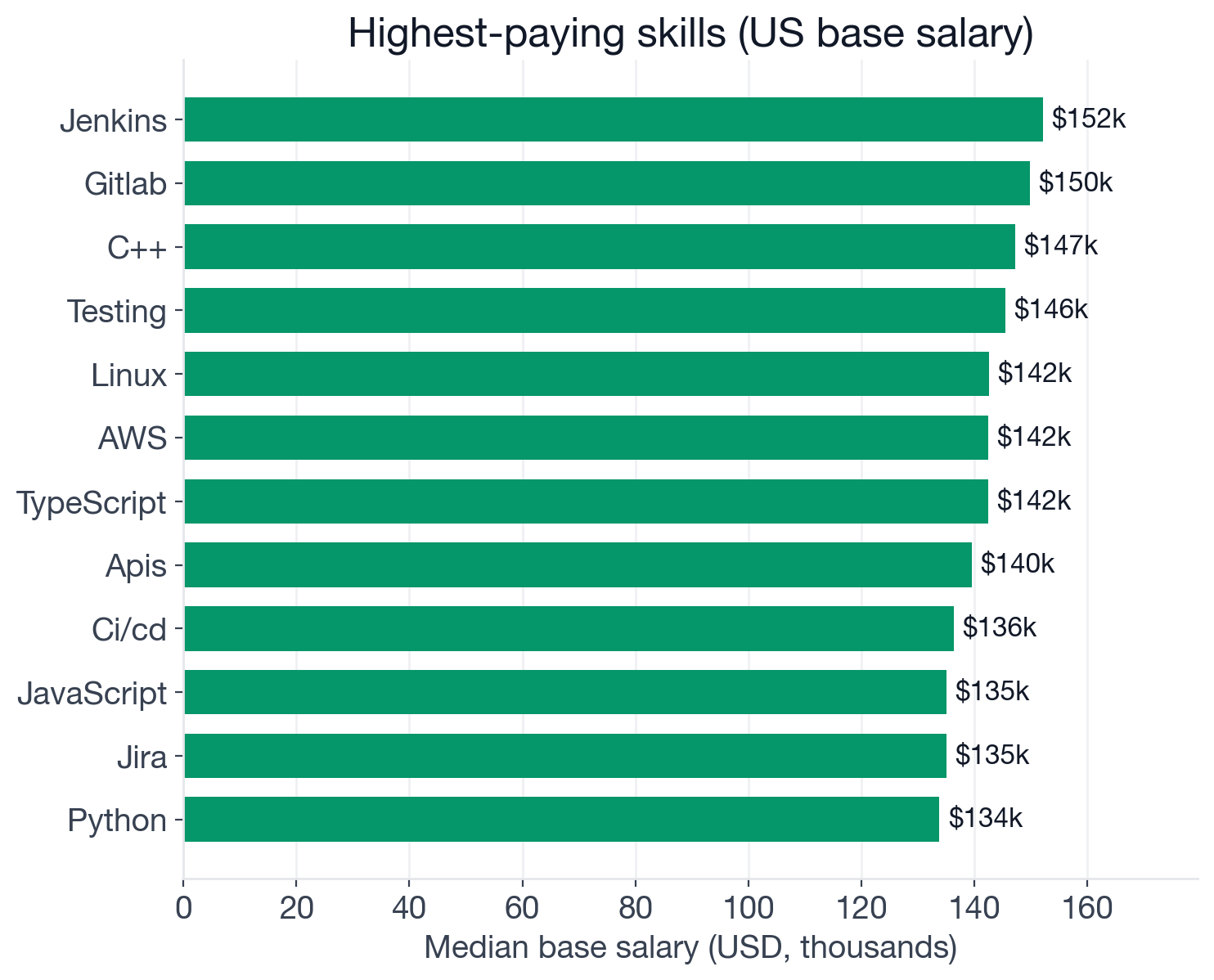
Median US base salary for Test Automation Engineer postings that mention each skill, US postings only with n≥25.
| Skill | US Median | Premium over $123,200 baseline | n |
|---|---|---|---|
| Jenkins | $152,100 | +$28,900 | 36 |
| GitLab | $149,800 | +$26,600 | 25 |
| Linux | $142,500 | +$19,300 | 35 |
| AWS | $142,400 | +$19,200 | 34 |
| TypeScript | $142,400 | +$19,200 | 26 |
| CI/CD | $136,300 | +$13,100 | 72 |
| Python | $133,800 | +$10,600 | 141 |
| Monitoring | $133,800 | +$10,600 | 63 |
| Playwright | $132,500 | +$9,300 | 27 |
| Selenium | $129,600 | +$6,400 | 39 |
| Java | $129,600 | +$6,400 | 37 |
| Agile | $123,100 | ≈ baseline | 46 |
| Automation (table stakes) | $122,500 | -$700 | 273 |
Note: C++ ($147,200, n=31) and "Testing" ($145,500, n=25) also meet the n≥25 threshold and fall in the $142K-$152K bracket, but both reflect narrow sub-specialties (embedded systems and hardware test automation respectively) rather than the broader software test automation market. They are excluded from the table above to keep the focus on skills relevant to the full role.
The contrast is stark. Jenkins (+$29K) and GitLab (+$27K) are not test frameworks: they are the servers and platforms that orchestrate when and how tests run in a CI/CD pipeline. The two most-debated frameworks, Selenium (+$6,400) and Playwright (+$9,300), sit within $3,000 of each other in US median salary. (Cypress has fewer than 25 US salary disclosures in the dataset, so a comparable US-only figure is not available; its global median of $129,600 aligns with Selenium's, which reinforces the same point.) Framework choice is effectively a wash at the salary level.
The last row is the most telling. Generic "automation" skills are priced $700 below the role baseline, because 94% of postings ask for them. A skill that universal cannot differentiate one candidate from another.
TypeScript (+$19,200) is the language-based standout. Its premium matches Linux and AWS rather than the test-runner tools, which points to where TypeScript appears: modern Playwright stacks running under CI/CD, not legacy Java + Selenium setups. The language signals the engineering maturity of the team behind the posting.
The practical takeaway: framework fluency gets your resume past the filter. CI/CD infrastructure depth (Jenkins, GitLab, Linux, cloud platform experience) moves the offer up the curve.
What Does the Competitive Skill Stack Look Like?
With the salary picture established, here is where demand actually concentrates.
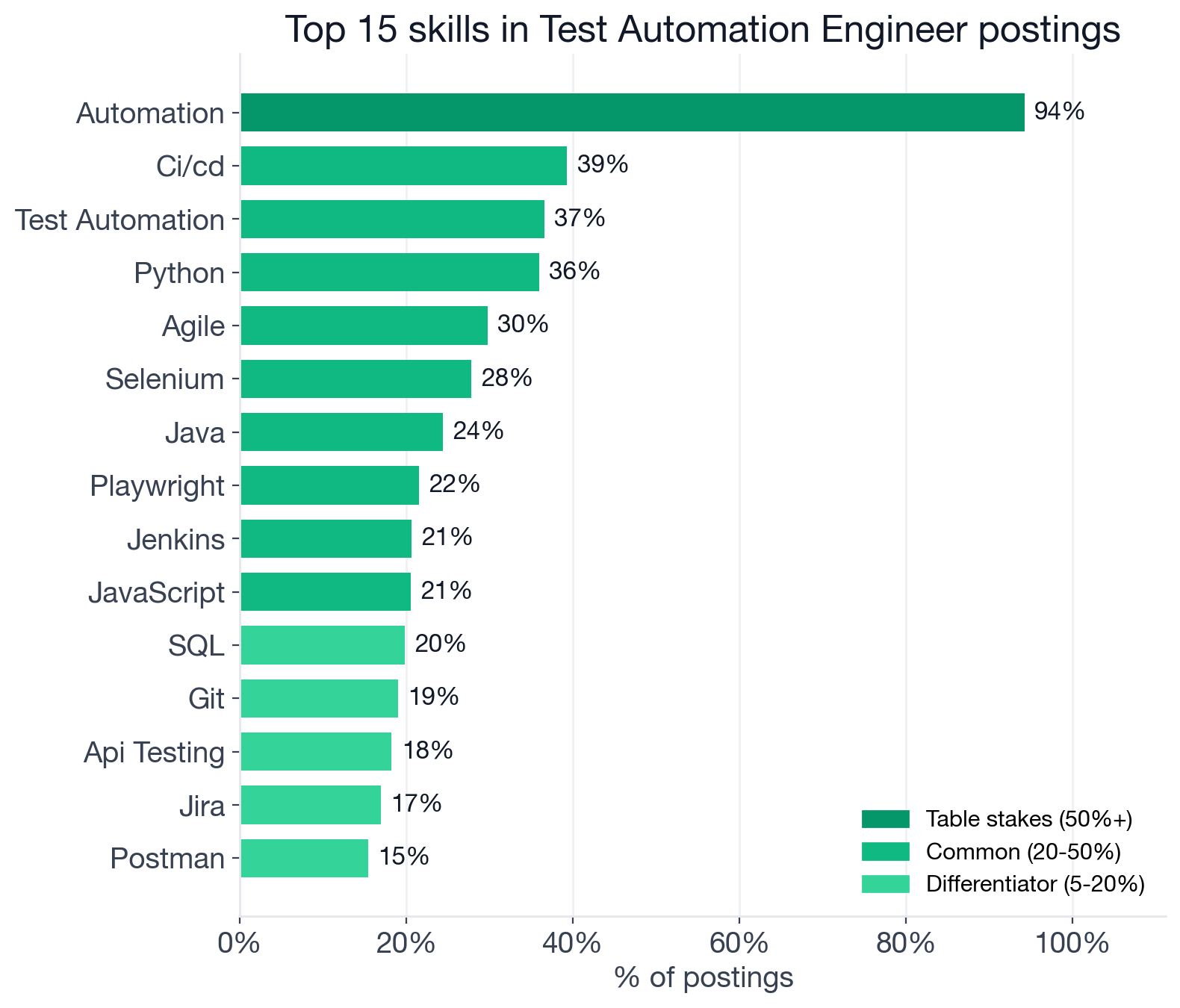
Top individual skills in Test Automation Engineer postings by share of listings, color-coded by tier. Above 50% is table stakes; 20-50% common; 5-20% differentiator.
Table Stakes (50%+)
Only one skill clears this bar: Automation, present in 94.2% of postings. This is essentially the role's own defining concept. Everything else falls below the common tier or lower.
Common Expectations (20-50%)
Nine skills form the role's working vocabulary:
- CI/CD: 39.3% (Test Automation + CI/CD openings)
- Test Automation: 36.6% (the role's defining concept; its explicit mention in postings signals teams that treat automation as a discipline rather than a checkbox)
- Python: 35.9% (browse Python openings)
- Agile: 29.8%
- Selenium: 27.8% (browse Selenium openings)
- Java: 24.4%
- Playwright: 21.5%
- Jenkins: 20.6%
- JavaScript: 20.5%
CI/CD leads all specific frameworks at 39.3%. The implication is direct: pipeline management is the more universal expectation than any individual test runner. Three scripting languages (Python, Java, JavaScript) all clear the 20% line, so there is no single canonical language for this role. The language is determined by what stack you are testing: Python for scripting-heavy API and backend testing, Java for enterprise backend platforms, JavaScript and TypeScript for frontend and Playwright-based stacks.
Differentiators (5-20%)
The differentiator tier maps to five distinct specialization tracks:
- API testing track: API Testing (18.2%), Postman (15.4%, an HTTP API testing tool for validating REST endpoints), REST API (8.4%)
- Web automation track: Cypress (14.1%), TypeScript (13.6%)
- Pipeline and infrastructure track: Git (19.0%), Monitoring (13.6%), AWS (12.8%), GitLab (10.7%), GitHub Actions (10.1%)
- Performance engineering track: Performance Testing (11.9%), Scalability (8.1%)
- Mobile testing track: Appium (7.4%, a mobile test automation framework for iOS and Android)
Picking one of these tracks and building depth in it aligns directly with the salary premiums in the previous section. The infrastructure track (Jenkins, GitLab, Linux, AWS) pays the most. The API and web automation tracks pay moderately above baseline. Generic process skills (Agile, Scrum) pay at or below baseline.
The Dominant Pairings That Define the Stack
Co-occurrence lifts measure how often two skills appear together versus what their individual frequencies alone would predict. Lift above 1 means the pair is strongly associated: the higher the lift, the more those two skills define a coherent hiring signal.
| Skill pair | Postings with both | % of total | Lift |
|---|---|---|---|
| Java + Selenium | 345 | 16.8% | 2.48 |
| CI/CD + Jenkins | 360 | 17.5% | 2.16 |
| CI/CD + Playwright | 372 | 18.1% | 2.14 |
| API Testing + CI/CD | 309 | 15.0% | 2.10 |
| Agile + Selenium | 346 | 16.8% | 2.04 |
| CI/CD + JavaScript | 302 | 14.7% | 1.82 |
Three stack archetypes emerge:
Enterprise Java stack (Java + Selenium, lift 2.48): The highest-lift pair in the dataset. In enterprise backend environments, Java is the automation language and Selenium is the browser layer. Postings with this pair typically also ask for TestNG (a Java-based testing framework that orchestrates Selenium suites) and Agile. This is the oldest and most established test automation archetype, concentrated in financial services, healthcare, and large-scale enterprise software.
Modern CI/CD stack (CI/CD + Jenkins or Playwright, lifts 2.16 and 2.14): Jenkins and Playwright are each strongly associated with CI/CD. This pairing signals teams that run automated tests as a formal deployment pipeline stage, not as a post-deployment health check. The JavaScript or TypeScript co-occurrence with CI/CD (lift 1.82) points to Playwright-based stacks under GitHub Actions or GitLab CI.
API testing stack (API Testing + CI/CD, lift 2.10): As microservices multiply, API integration testing has become a distinct specialization. The association with CI/CD rather than just individual tools like Postman signals roles where integration tests run as pipeline gates, not as manual QA exercises.
The Agile + Selenium pairing (lift 2.04) signals something subtler: Selenium concentrated in large enterprise teams that run formal sprint ceremonies. Where you see this combination, expect a slower release cadence with structured QA sign-off stages rather than continuous delivery, and likely a stack that also includes TestNG and Jira.
The practical read: frame your application around the stack archetype that matches your experience. A Java + Selenium background signals enterprise and backend; Python or JavaScript + Playwright + CI/CD signals modern web; API Testing + CI/CD signals services engineering. Each archetype has a different hiring pool and a different interview focus.
AI in Test Automation: Two Layers, Not One Number
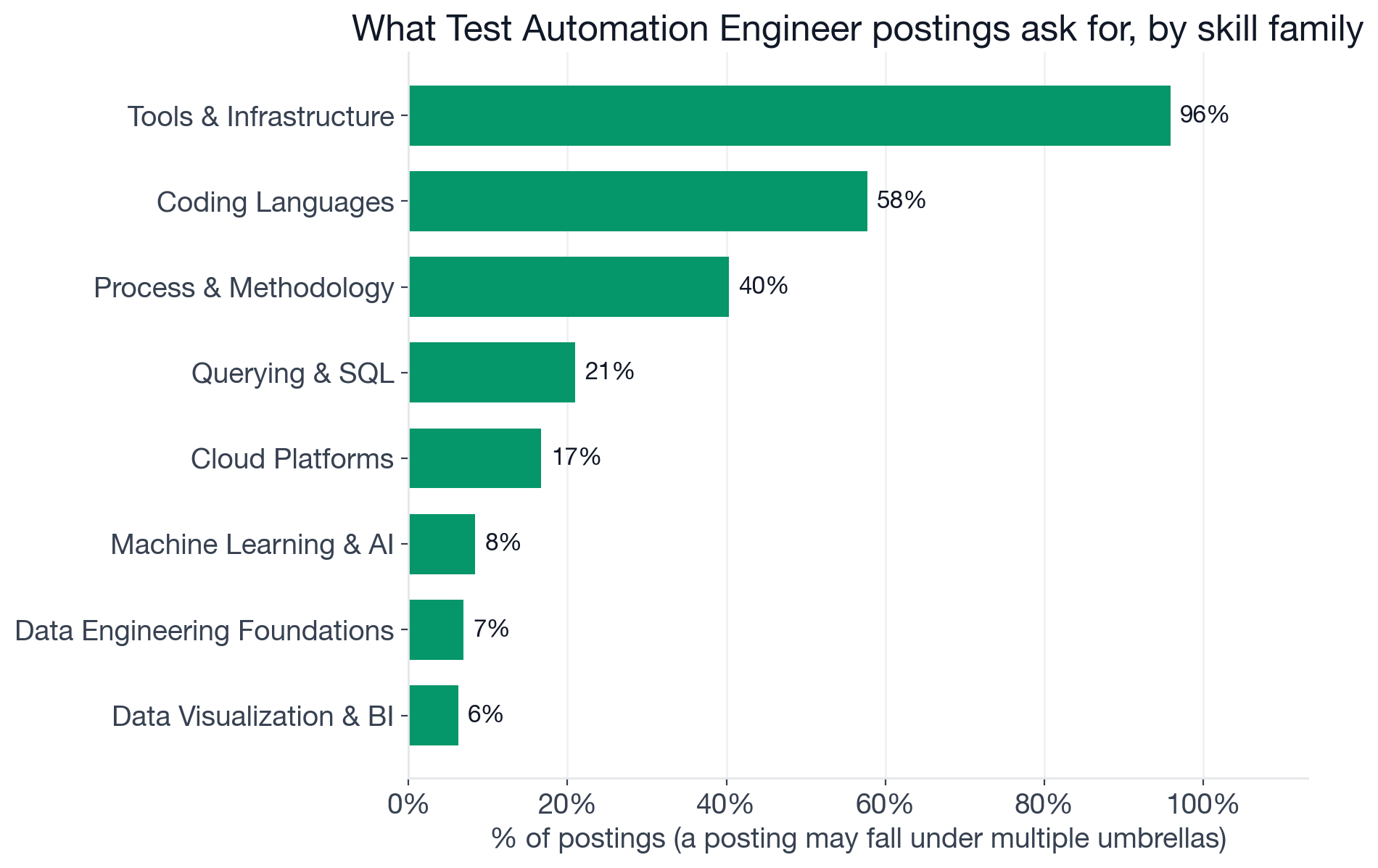
Share of Test Automation Engineer postings asking for at least one skill in each family.
The Machine Learning & AI family appears in 8.4% of postings (173 of 2,056). That figure measures roles explicitly asking engineers to build or architect AI-powered testing systems: autonomous test generation, AI-assisted regression analysis, intelligent test orchestration platforms. It is a floor, not a ceiling.
The ambient layer is much larger. The JetBrains Developer Ecosystem Survey 2025 found 85% of developers regularly use AI tools, with 74% reporting productivity gains. For test automation engineers, AI coding assistants (GitHub Copilot, ChatGPT) are now standard for generating test scaffolding, debugging assertion failures, and producing test data factories. The World Quality Report 2025 (Capgemini/OpenText) found 89% of organizations are piloting or deploying GenAI in quality engineering workflows, and 58% are actively upskilling QA teams in AI tools. Companies assume this fluency; they just do not write it into job descriptions.
The honest split: 8.4% of postings want you to build AI-powered test systems. The other 91.6% expect you to use AI tools as productivity amplifiers, regardless of what the job description says.
The Coding Languages family at 57.7% is the other family worth calling out. This is high for a role that some hiring managers still mentally file under "QA." More than half of all Test Automation Engineer postings require at least one programming language, which puts the coding bar closer to a software engineer role than to a manual QA or business analyst role.
Only 1 in 50 Openings Is Entry-Level
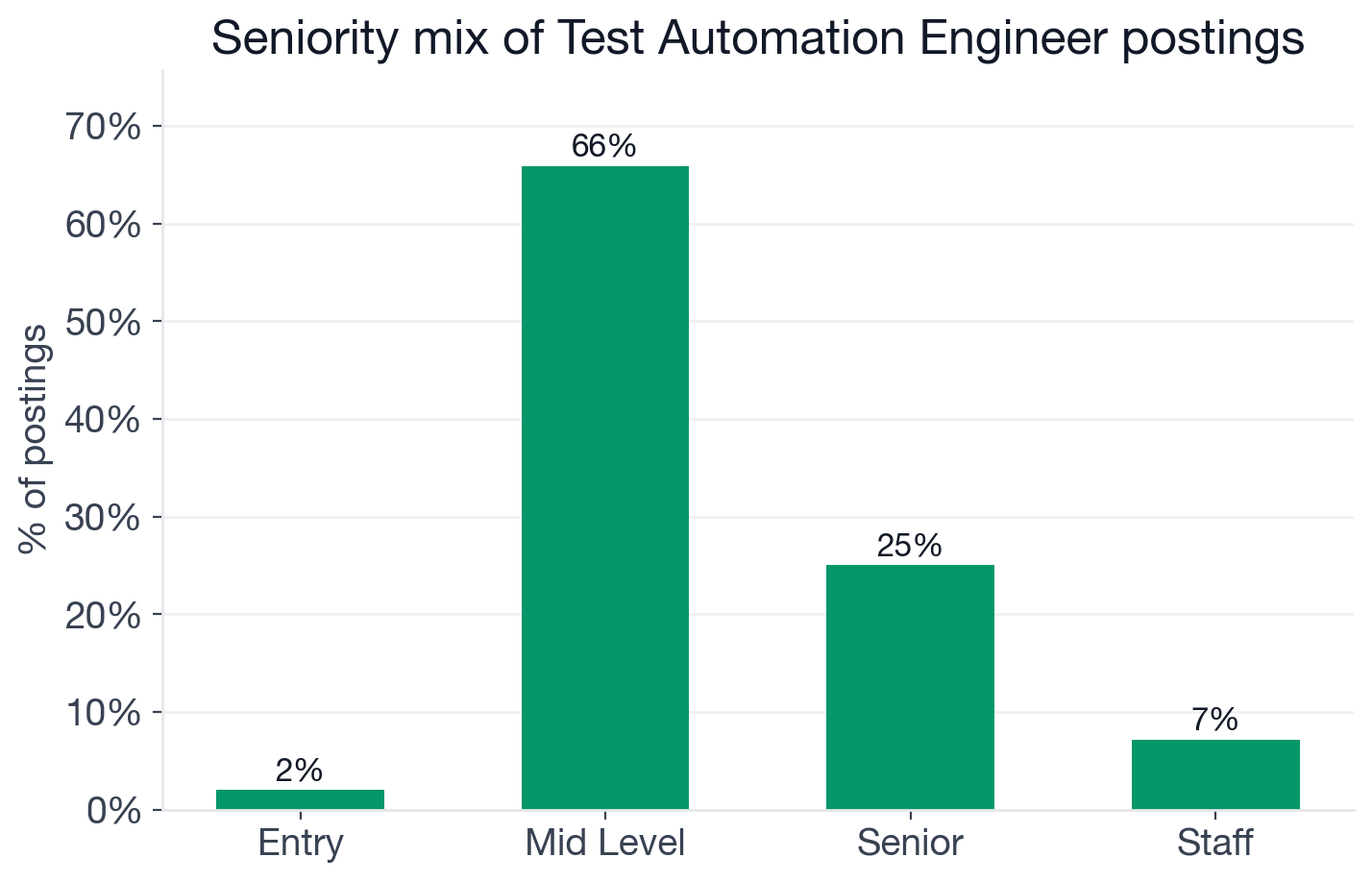
Seniority distribution of Test Automation Engineer postings, inferred from title keywords. Postings without explicit seniority signals default to mid-level.
- Mid-level: 65.9% (1,354 postings)
- Senior: 25.0% (514)
- Staff / Lead / Principal: 7.1% (147)
- Entry-level: 2.0% (41)
Only 1 in 50 openings is genuinely entry-level. Companies overwhelmingly want candidates who have already built and maintained automation suites in production. If you are coming from manual QA, the most direct path is: contribute to an existing automation codebase in a hybrid QA role, demonstrate ownership of at least one CI/CD pipeline integration, then make the transition to a dedicated test automation engineering title.
The senior-plus tier (senior and staff combined) makes up 32.1% of openings, which is substantial. There is real IC career runway here, particularly for engineers who move into performance engineering, infrastructure ownership, or technical lead territory. Senior Test Automation Engineer openings tend to add AWS, GitLab, and monitoring skills to the baseline framework requirements, which aligns with the salary data above.
Where Are Test Automation Jobs Located, and How Remote?
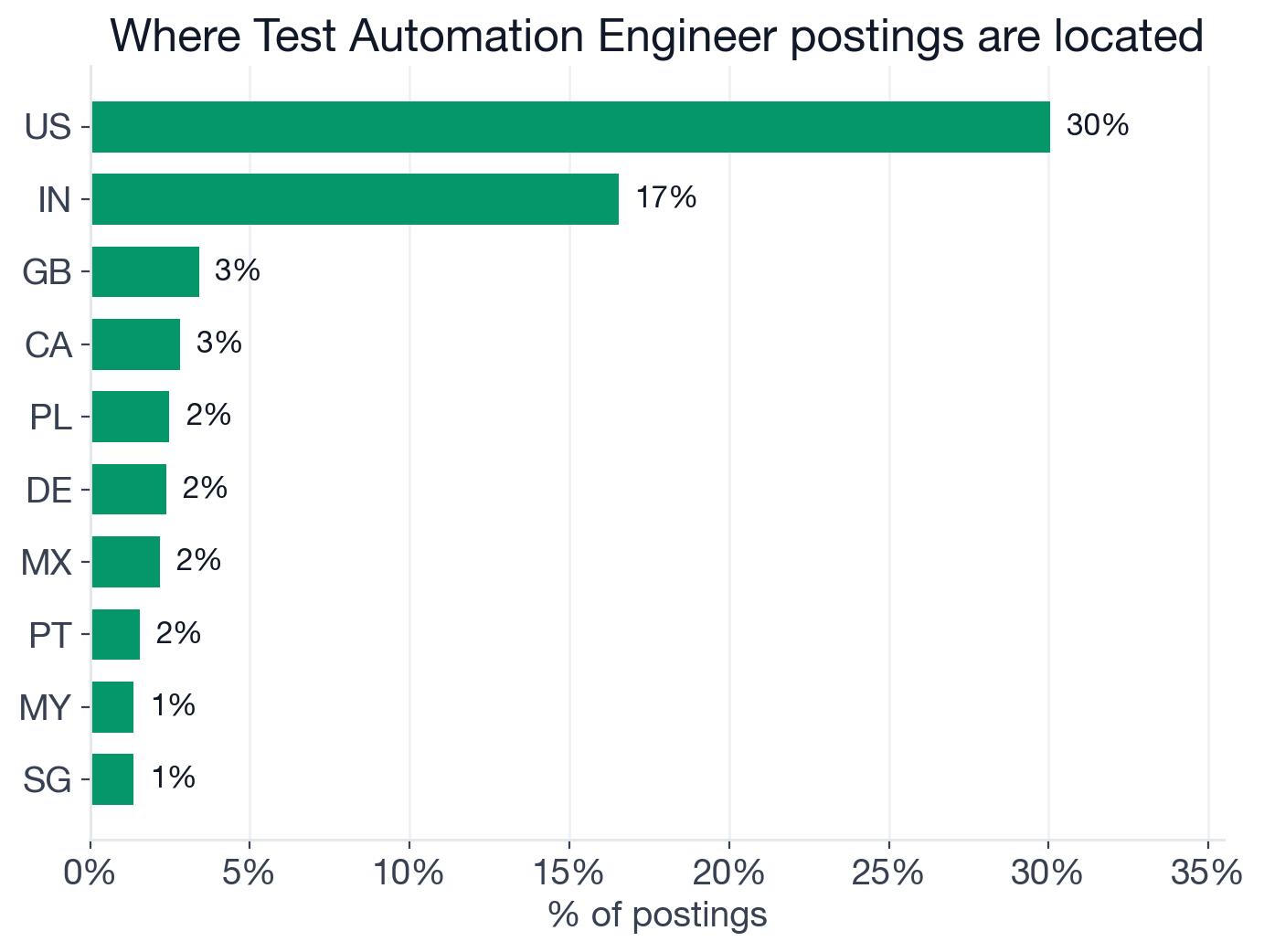
Top countries by share of Test Automation Engineer postings.
The United States leads at 30.1% of postings (US-only Test Automation Engineer openings), with India second at 16.5%. The UK (3.4%), Canada (2.8%), Poland (2.5%), Germany (2.4%), and Mexico (2.2%) round out the major markets. India's share is smaller here than for data engineering or backend development roles, reflecting the more on-location nature of hardware and device testing work that this role frequently involves.
The bigger story is work mode:
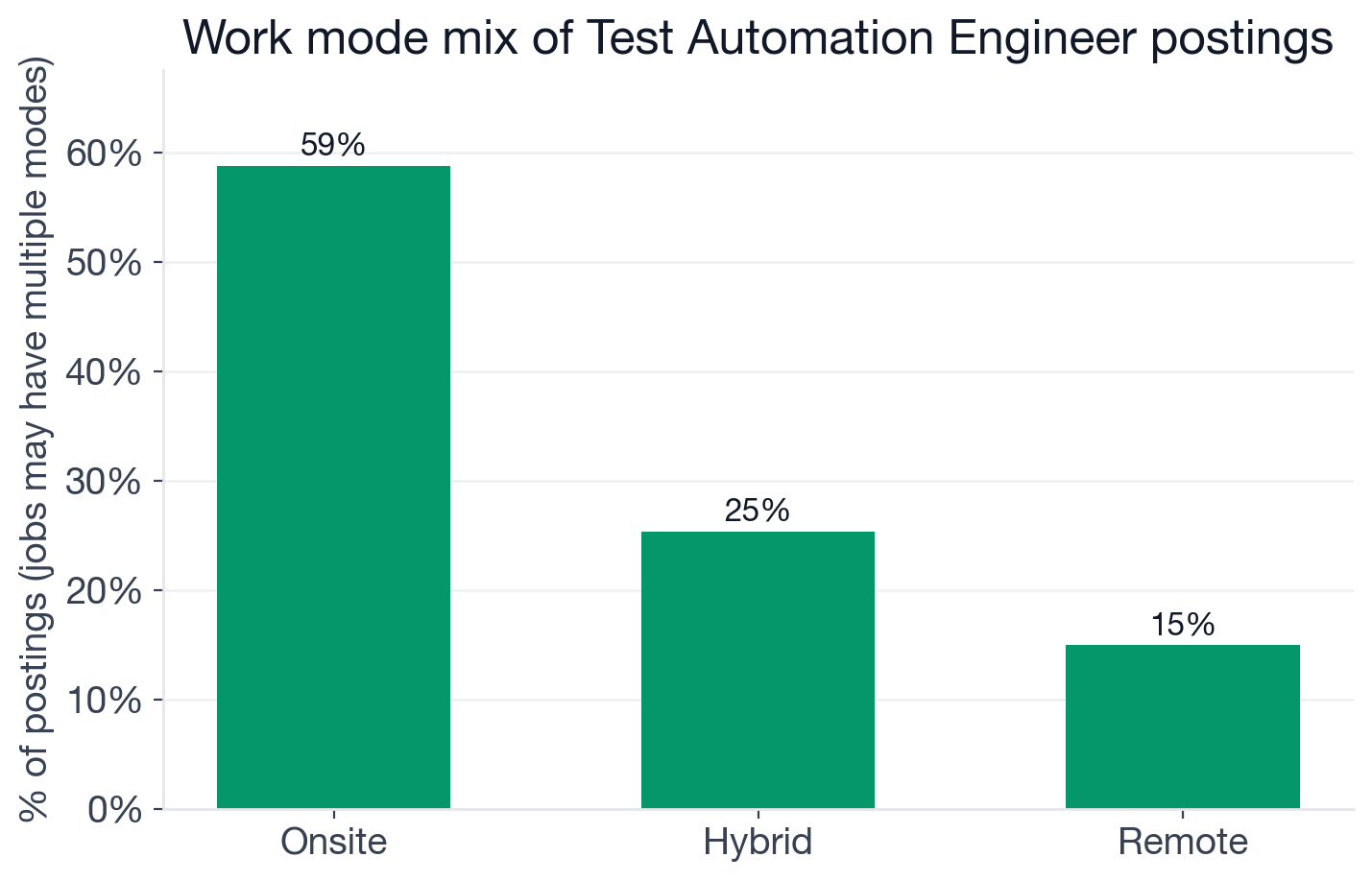
Share of Test Automation Engineer postings by work mode.
- Onsite: 58.8% (1,208 postings)
- Hybrid: 25.3% (521)
- Remote: 14.9% (307)
This is one of the most onsite-heavy distributions in software engineering. Test automation engineers are co-located because their work depends on hardware lab access, proximity to the development team's release cycle, and real-device testing environments for mobile and embedded work. Only 15% of postings are fully remote, well below the 25-30% typical for backend software engineering. If remote work is a firm requirement, filter specifically for remote postings before investing heavily in applications: the pool is smaller but it exists, concentrated in product-led tech and SaaS companies.
Who's Hiring Test Automation Engineers in 2026?
The employer mix reflects how broadly test automation engineering spans sectors: from professional services and financial technology to aerospace, electronics manufacturing, and pharma.
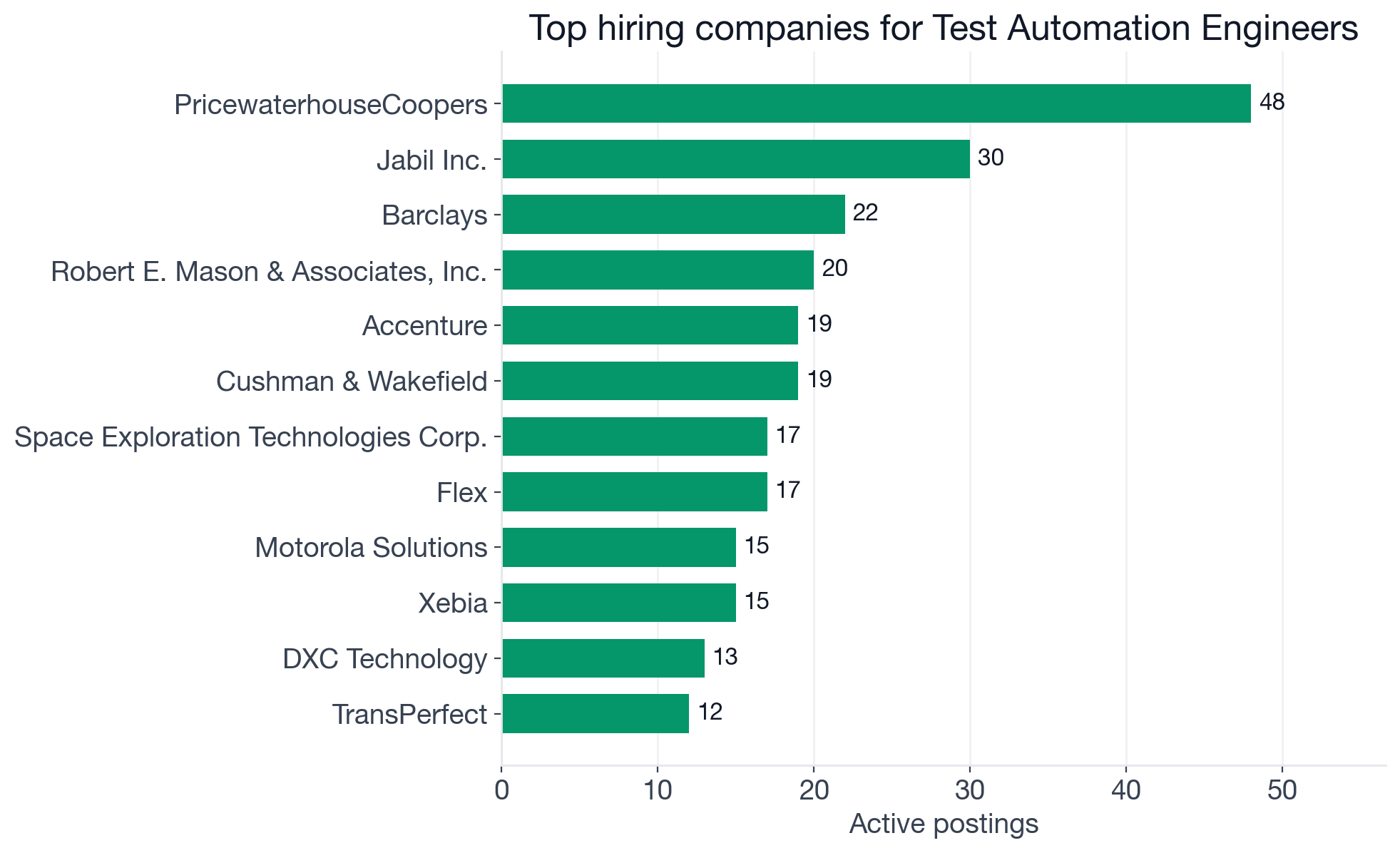
Top companies by active Test Automation Engineer postings (distinct openings).
| Company | Postings | Segment |
|---|---|---|
| PricewaterhouseCoopers | 48 | Professional services |
| Jabil Inc. | 30 | Electronics manufacturing |
| Barclays | 22 | Banking / fintech |
| Accenture | 19 | Consulting |
| SpaceX | 17 | Aerospace |
| Flex | 17 | Electronics manufacturing |
| Motorola Solutions | 15 | Safety and security tech |
| Xebia | 15 | QA / technology consulting |
| DXC Technology | 13 | IT services |
| GE Vernova | 12 | Energy technology |
| Nokia | 11 | Telecommunications |
| Novartis | 11 | Pharmaceutical |
PwC and Accenture at the top reflect large-scale software quality mandates that consulting firms deliver for enterprise clients. Jabil, Flex, and Motorola Solutions reflect hardware and manufacturing test automation: a sub-specialty that requires experience with device-level and embedded system testing environments, and explains part of the role's high onsite rate.
Barclays, Nokia, GE Vernova, and Novartis represent regulated-industry QA: slower-moving hiring cycles but consistent demand, with emphasis on compliance-critical test documentation and traceability. SpaceX's presence aligns with aerospace making up 2.3% of the broader posting mix, where verifying behavior under failure conditions is a safety requirement, not a nice-to-have.
Data note: the classifier behind this dataset captures generic "Automation Engineer" titles alongside explicit "Test Automation Engineer" postings, so a small fraction of employer listings may represent industrial process or facility automation rather than software test automation. The skill and salary patterns reported in this post are driven by the software-dominant segment of the data.
For company-specific interview processes, our preparation guides cover the rounds, topic priorities, and behavioral expectations for many of these organizations.
How to Use This in Your Job Search
The salary data, stack clustering, and seniority profile all converge on the same architecture: build your foundation in at least one test framework and one scripting language, then extend into the pipeline layer.
1. Commit to one stack archetype. Apply to roles matching your actual background: enterprise Java + Selenium, or Python + Playwright + CI/CD, or API Testing + CI/CD. Browse Python openings or Java + Selenium openings to see the volume in each track. A generalist resume that lists every framework without depth does not score well against specialized postings.
2. Add CI/CD pipeline ownership before your next job search. Jenkins (+$29K) and GitLab (+$27K) command premiums that no testing framework approaches. If you write tests but do not yet configure the CI/CD system that runs them, that is the single highest-value skill extension available. The question bank covers CI/CD concepts including pipeline configuration, deployment gates, and automation trigger patterns.
3. Treat the Selenium vs. Playwright debate as secondary. Both sit within $3,000 of each other in US median salary. A more useful question is whether your framework runs inside a real CI/CD pipeline, with proper reporting and gating, or just on a developer's laptop. The operational maturity around the test matters more than the test runner itself. Practice the full interview round including CI/CD architecture questions via AI mock interviews.
4. Plan for onsite. With 59% of roles onsite and only 15% remote, geographic flexibility matters more here than in most tech roles. Factor this in before building a pipeline around companies that do not have offices near you.
5. Prepare for a mid-level bar even if you feel junior. With only 2% entry-level openings, most interviewers assume prior production test suite experience. If you are still building toward this role, contributing to a CI/CD pipeline in an adjacent role (backend, QA generalist, DevOps) is more effective than self-study alone. Our interactive courses cover software testing concepts, Python, and system design as structured preparation.
FAQ
Q. What skills do companies want for Test Automation Engineer roles in 2026?
Automation is the only true table-stakes skill, appearing in 94% of postings. Above that, CI/CD (39%), Python (36%), Agile (30%), Selenium (28%), Java (24%), Playwright (22%), Jenkins (21%), and JavaScript (21%) all sit in the common tier. The differentiator tier includes API Testing, Jira, Postman, Cypress, TypeScript, AWS, and performance testing.
Q. What is the median salary for a Test Automation Engineer in 2026?
The median US base salary is $123,200 across 283 US postings with structured salary data. Equity, bonuses, and sign-on are not disclosed in postings, so total compensation at top employers runs higher than these figures.
Q. Which Test Automation Engineer skills pay the highest premium in 2026?
Among US postings, CI/CD infrastructure skills command the largest premiums: Jenkins ($152,100 median, +$28,900 over the $123,200 baseline), GitLab ($149,800, +$26,600), Linux ($142,500, +$19,300), and AWS ($142,400, +$19,200). TypeScript ($142,400) also earns above $140K. Testing frameworks cluster much lower: Selenium and Java both sit at $129,600 (+$6,400), Playwright at $132,500 (+$9,300).
Q. Is Test Automation Engineering a good role to break into at the entry level?
It is one of the harder roles to enter. Only 2% of postings (41 of 2,056 analyzed) are explicitly entry-level. The vast majority of openings (66%) are mid-level. Companies expect candidates to have prior experience writing and maintaining test suites in a production environment.
Q. Is Test Automation Engineering a remote-friendly career?
Less so than most tech roles. Only 15% of Test Automation Engineer postings are tagged remote (307 of 2,056), compared with 25-30% for many software engineering roles. Onsite dominates at 59%, hybrid at 25%. The hands-on nature of device testing, QA lab access, and integration with release teams keeps many of these roles co-located.
Q. What is the dominant skill stack for Test Automation Engineers in 2026?
The most tightly coupled pairings by co-occurrence lift are: Java + Selenium (lift 2.48, appearing in 16.8% of all postings), CI/CD + Jenkins (lift 2.16), and CI/CD + Playwright (lift 2.14). Python anchors the scripting-heavy stack, while Java anchors the enterprise backend testing stack. The overarching pattern is automation framework + CI/CD pipeline + scripting language.
Where This Leads
The test automation market in 2026 rewards engineers who see their job as broader than running a test suite. A $29K salary premium separates the engineer who can configure the Jenkins server and own the CI/CD pipeline from the one who can only write a Playwright spec file. Framework fluency gets you through the resume filter. Infrastructure ownership gets you the offer you want. Filter by your stack on the Test Automation Engineer board to see what's live today.
Topics
Ready to practice?
Put what you've learned into practice with AI mock interviews and structured preparation guides.