
One Title, Two Very Different Jobs
The median US base salary for a Technical Support Engineer posting that emphasizes API debugging and Python scripting is $92,000. The median for a posting that emphasizes Windows is $58,100. Same title, same job boards, and a $34,000 gap between them.
That spread is the defining story in Technical Support Engineer hiring right now. The role covers a wider range than almost any title in tech: from traditional IT helpdesk and desktop support to hands-on SaaS troubleshooting that requires reading logs, writing Python scripts, and tracing API failures with the same rigor a software engineer would bring. Both get recruited under "Technical Support Engineer," but companies pay significantly more for the second kind.
To quantify exactly where the line falls, we looked at every active Technical Support Engineer posting on the InterviewStack.io job board as of May 2026: 2,597 listings, with skills extracted from descriptions, synonyms collapsed, and salary data restricted to US postings for comparability.
Key Findings
- 2,597 active Technical Support Engineer postings analyzed across the live job board as of May 2026.
- No skill reaches the 50% table-stakes threshold. Windows is the most common at 23.6% (612 postings), followed by SQL (19%), Linux (16.7%), and Monitoring (16.5%). The role has no universal skill requirement.
- Median US base salary is $75,000 (n=265 postings with disclosed salary data). APIs ($92K), Debugging ($91.5K), and Python ($90K) are the top earners. Windows-only postings pay $58,100, nearly $17,000 below baseline.
- The highest-lift skill pairs are AWS + Azure (6.46) and Bash + Python (6.24), which anchor the multi-cloud and scripting-automation tracks. APIs + Debugging (lift 4.54) is the strongest signal for the SaaS/developer-support track specifically.
- 82% of postings are mid-level. Entry-level is 5% (131 of 2,597); senior is 9.8%; staff is 3.4%.
- Onsite dominates at 51% of postings. Remote is 23%; hybrid is 24%. This is one of the most onsite-heavy roles in the current tech job market.
- The US is 31.6% of postings, followed by India (9.9%), the UK (5.2%), and the Philippines (3.9%).
What Skill Families Define a Technical Support Engineer Role in 2026?
Group every individual skill into the higher-level family it belongs to, and the shape of the role comes into view. Not a single specialty, but a layered set of competencies where each layer signals a different kind of support work.
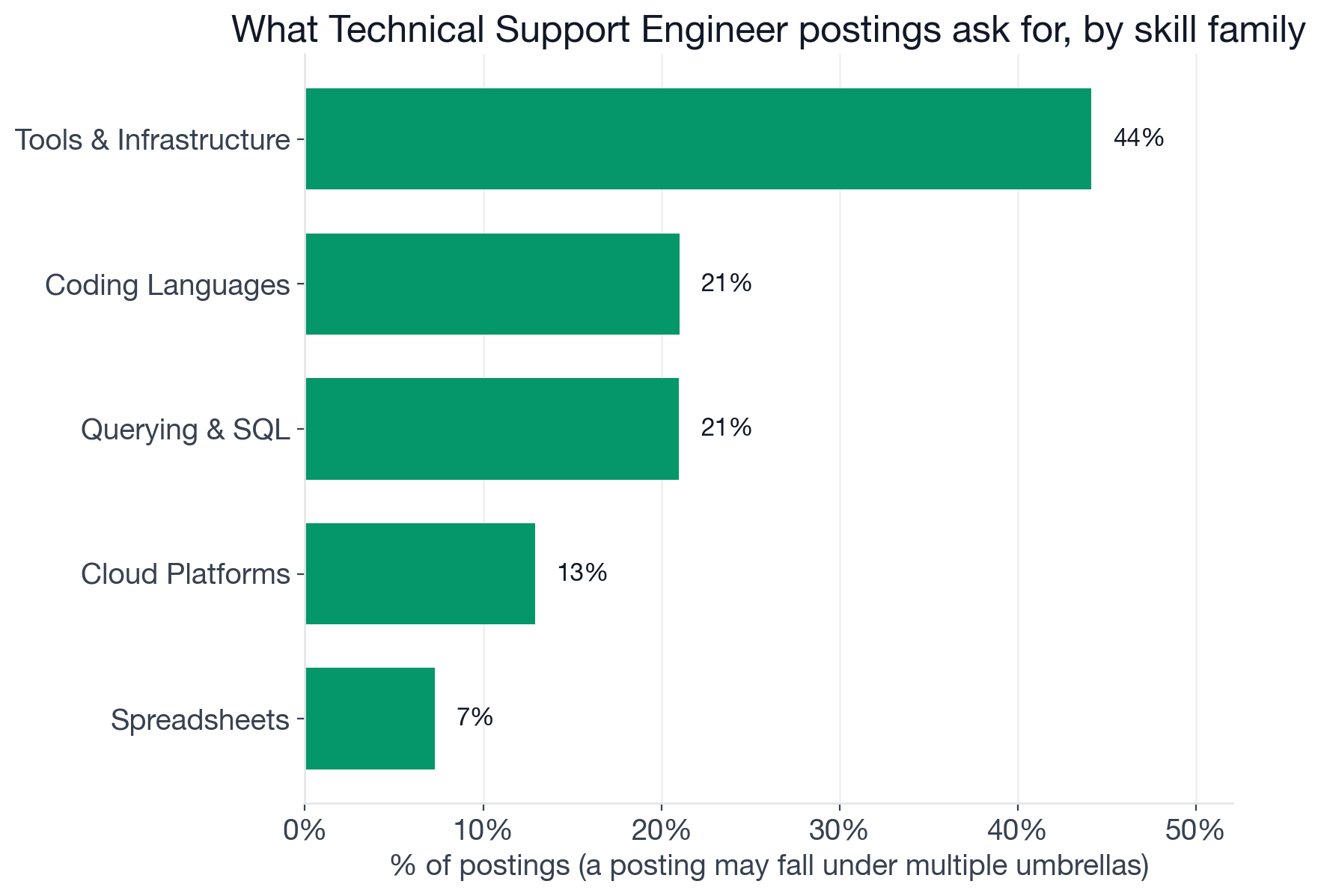
Share of Technical Support Engineer postings that mention at least one skill in each family. A posting mentioning both Zendesk and Salesforce counts once under "Other."
The "Other" family at 69.9% looks like a catch-all, but it tells you exactly where the role lives: operating systems (Windows, macOS), ticketing and CRM platforms (Zendesk, Salesforce, Active Directory), and core support competencies (APIs, Debugging, HTML). These are the tools a Technical Support Engineer spends their day in, and they don't have a natural home in a taxonomy built for data analysts and software engineers.
The other families complete the picture:
- Tools & Infrastructure (44.1%): Linux, Monitoring, Automation, and Jira make up the bulk of this layer. A posting that reaches into Tools & Infrastructure is typically asking for someone who can run commands, read system logs, and work alongside an engineering team, not just close tickets.
- Coding Languages (21.0%) and Querying & SQL (21.0%): Both families tie at 21%, and together they define the scripting-capable support engineer. Python (12.9%) and Bash (5.3%) handle automation; SQL (19%) handles database queries and log analysis. Reaching either threshold means the company expects you to write code, not just read documentation.
- Cloud Platforms (12.9%): Azure (8.5%), AWS (7.7%), and Google Cloud (4.4%) each appear separately, reflecting companies where the product lives in the cloud and support engineers need to navigate it.
- Machine Learning and AI (3.7%): Only 3.7% of postings explicitly list AI or ML as a requirement, which sounds low until you consider what's inside the platforms the other 96% of postings reference. Zendesk, which appears in 8.7% of postings, now runs AI agents in 66% of the service organizations that use it, according to its own CX Trends 2026 report (a vendor-published figure). Salesforce has projected 50% of service cases resolved by AI by 2027, per its State of Service report. Jira has shipped AI features across its cloud products. A Technical Support Engineer working in these platforms in 2026 is working alongside AI features whether the job posting says so or not.
The Stack Overflow 2025 Developer Survey found 84% of developers use or plan to use AI tools, with 51% using them daily. For Technical Support Engineers specifically, 73% of support agents say an AI copilot would help them do their job better (Zendesk CX Trends 2026). The 3.7% explicit figure measures the small slice of TSE postings where building or integrating AI is the job. The rest captures the ambient reality: AI is embedded in the tooling, not optional to the role.
What Are the Three Tiers of Technical Support Engineer Skills?
The most structurally unusual characteristic of this role is the absence of table stakes. In Data Engineer hiring, Python, SQL, and pipelines each appear in over 70% of postings and function as hard filters before a recruiter reads anything else. Here, nothing clears 24%. That tells you the market isn't looking for one kind of person: it's looking for several different archetypes under one job title.
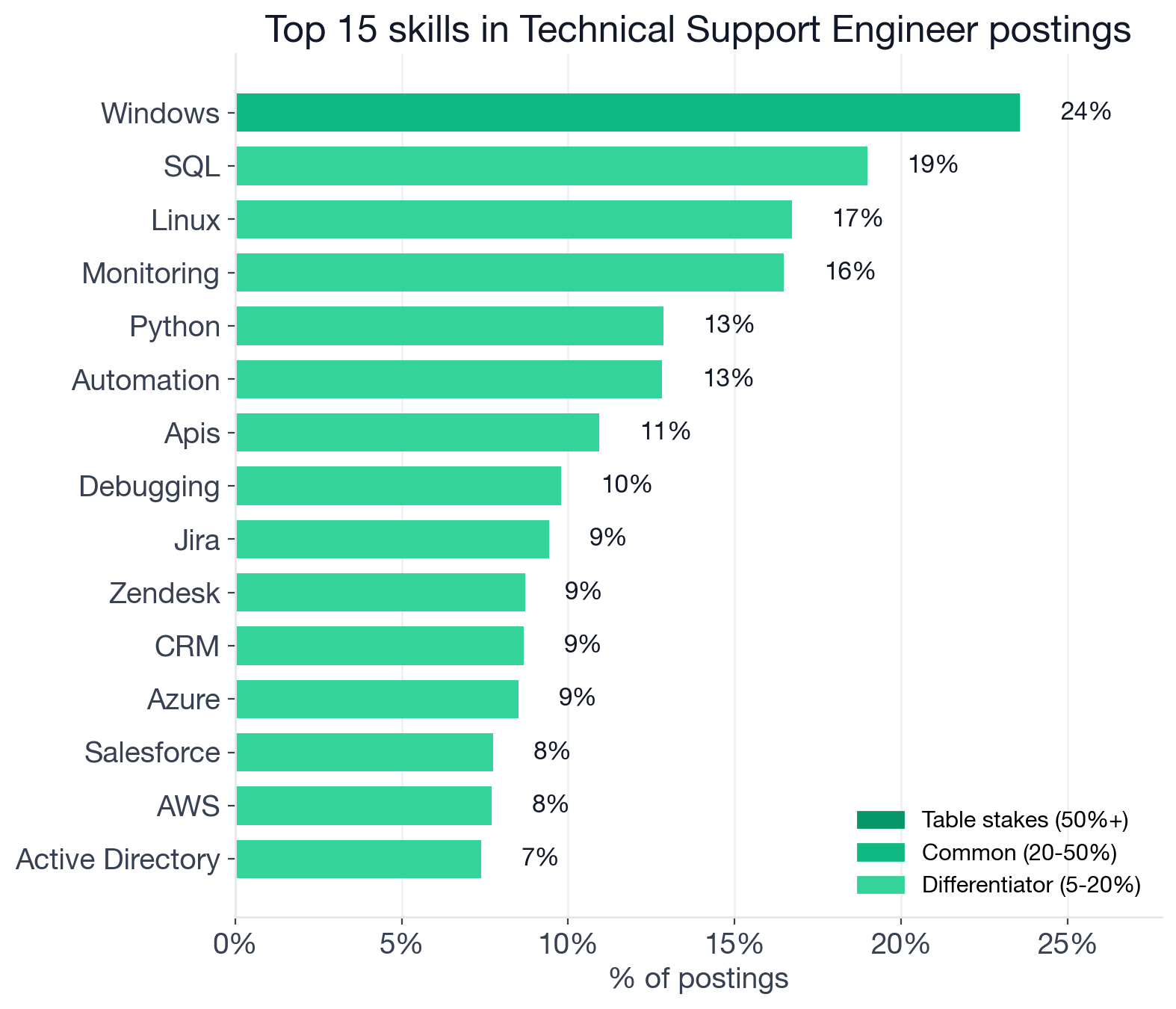
Top individual Technical Support Engineer skills by share of postings. Skills above 50% are table stakes (none for this role); 20-50% are common; 5-20% are differentiators.
No Table Stakes (50%+ of postings)
For the first time in this series, a role has no skills that clear the 50% threshold. The closest is Windows at 23.6%, but even that appears in fewer than 1 in 4 postings. This is the structural reflection of the role's breadth: a semiconductor manufacturer hiring to support Linux-based metrology tools and a SaaS company hiring to debug API integrations for enterprise customers are both posting "Technical Support Engineer," but they share almost no skill requirements.
The Only Common Skill (20-50% of postings)
One skill sits in the common tier:
- Windows: 23.6% (612 postings), browse Technical Support Engineer + Windows openings
Windows at 23.6% anchors the traditional IT and enterprise-support track. It tells you the company's end-users or internal systems run Windows, which typically comes paired with Active Directory (7.4%, the Microsoft directory service for managing users and permissions across Windows networks), help desk ticketing, and on-premise infrastructure. Windows alone, without cloud or coding skills, defines the lower end of the salary range. Its position as the only common skill rather than a table-stakes one reveals that even IT support is diversifying: macOS (5.4%), Linux (16.7%), and cross-platform management skills are all eating into the Windows-only support world.
Differentiators (5-20% of postings)
Twenty skills land in the differentiator tier. Collectively, they form a menu of specializations that each signal a distinct flavor of Technical Support Engineer work:
| Skill | % of Postings | What it signals |
|---|---|---|
| SQL | 19.0% | Database queries, log access, SaaS data support |
| Linux | 16.7% | Developer and infrastructure support track |
| Monitoring | 16.5% | Ops-adjacent, SRE-aligned support |
| Python | 12.9% | Scripting, automation, developer-support tier |
| Automation | 12.8% | Workflow efficiency and ticket-level scripting |
| APIs | 10.9% | SaaS/developer support, integration troubleshooting |
| Debugging | 9.8% | Hands-on technical depth, log analysis |
| Jira | 9.4% | Ticket management and dev-team alignment |
| Zendesk | 8.7% | Customer-facing support platform |
| CRM | 8.7% | Customer relationship and case management systems |
| Azure | 8.5% | Microsoft cloud ecosystem support |
| Salesforce | 7.7% | Enterprise CRM and service cloud |
| AWS | 7.7% | Amazon cloud ecosystem support |
| Active Directory | 7.4% | Enterprise Windows and identity management |
| Excel | 7.1% | Reporting, case tracking, data exports |
| JavaScript | 6.4% | Front-end product support at web companies |
| HTML | 5.6% | Web-adjacent troubleshooting and content support |
| macOS | 5.4% | Apple ecosystem or cross-platform corporate support |
| Bash | 5.3% | Linux scripting and task automation |
| Java | 5.0% | Enterprise software support |
The SQL entry at 19% deserves attention. A Technical Support Engineer who can write a query to pull relevant records when a customer reports a data issue is measurably more productive than one who routes every data question through an engineer. Companies that list SQL are explicitly signaling a more technical tier of support: one that can triage and often resolve without escalation.
Which Technical Support Engineer Skills Pay More Than the Baseline?
Among US postings, where wage-transparency laws produce consistent salary disclosure, the median Technical Support Engineer base salary is $75,000 (n=265). These are base salary figures only: equity, bonuses, RSUs, and sign-on are not disclosed in postings, so total compensation at top employers runs meaningfully higher than what we report here.
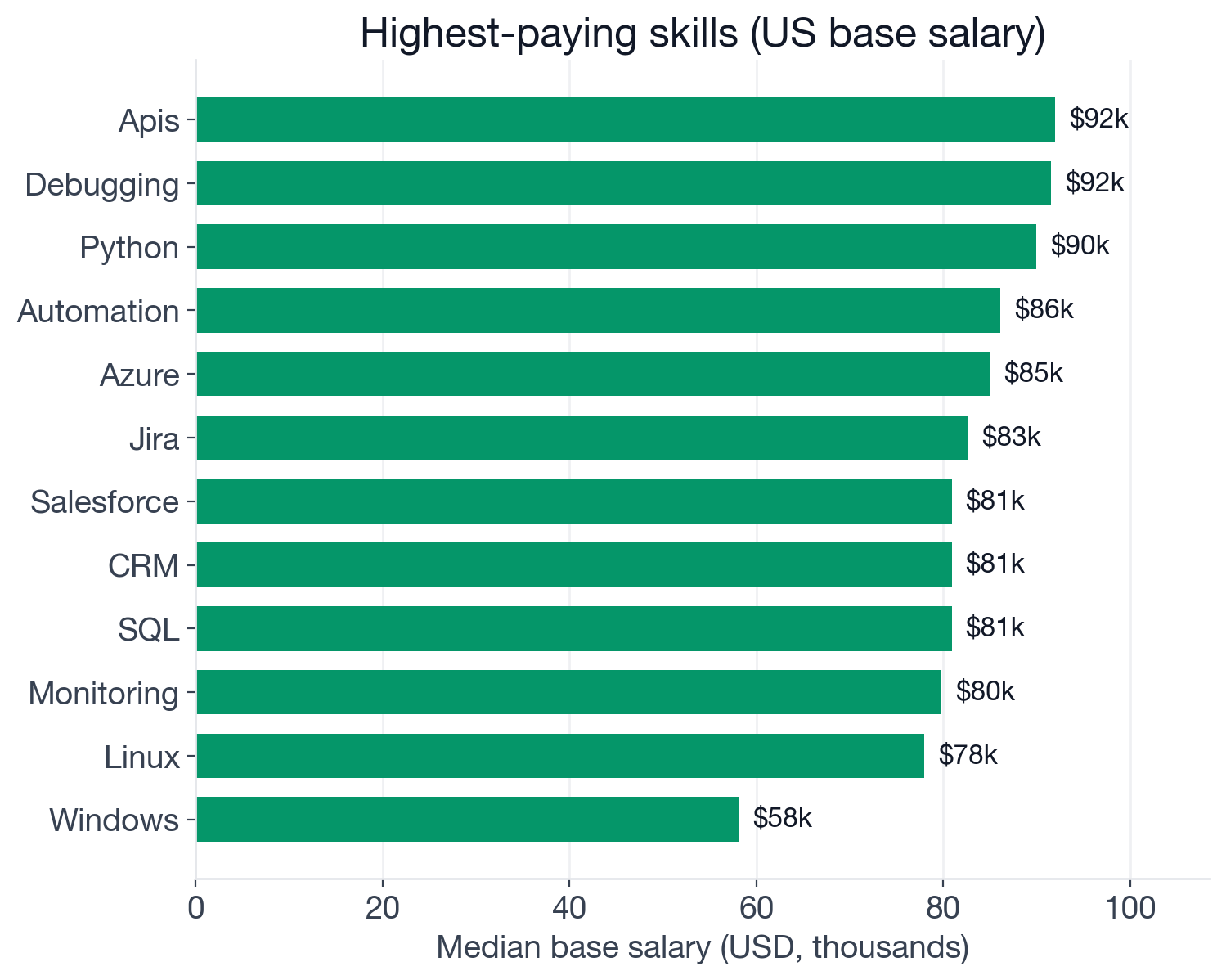
Median US base salary in USD for Technical Support Engineer postings that mention each skill. Baseline: $75,000 (n=265 US postings with disclosed salary data).
The salary curve is the most direct argument for which track is worth investing in. Skills at the technical end of the role carry premiums of $10K to $17K above the $75K baseline. The Windows-only end of the market sits nearly $17K below it. Here's the full breakdown among skills with sufficient US salary data:
High premium, $10K-17K above baseline:
- APIs: $92,000 (n=50), about $17,000 above baseline, browse TSE + API openings
- Debugging: $91,500 (n=36), about $16,500 above baseline
- Python: $90,000 (n=32), about $15,000 above baseline, browse TSE + Python openings
- Automation: $86,100 (n=42), about $11,100 above baseline
- Azure: $85,000 (n=29), about $10,000 above baseline
Moderate premium, $3K-8K above baseline:
- Jira: $82,600 (n=29), about $7,600 above baseline
- Salesforce: $80,900 (n=37), about $5,900 above baseline
- CRM: $80,900 (n=25), about $5,900 above baseline
- SQL: $80,900 (n=60), about $5,900 above baseline
- Monitoring: $79,800 (n=50), about $4,800 above baseline
- Linux: $78,000 (n=38), about $3,000 above baseline
Below baseline:
- Windows: $58,100 (n=72), about $16,900 below the $75,000 median
The Windows figure is not an error. Postings that list Windows without layering in cloud, scripting, or monitoring skills are largely helpdesk and desktop-support roles, which pay at the lower end of the technical market. The skill itself is not the variable: the combination is. Pair Windows with Active Directory and Azure cloud identity management, and the salary curve bends back up. Pair it with Python scripting and monitoring, and it climbs further. The differentiator tier skills that command premiums are the ones that push "support" toward "engineering."
What Is the Dominant Technical Support Engineer Skill Stack?
The co-occurrence data reveals that "Technical Support Engineer" is not one job market but at least three, each with its own signature skill combination. The lift score measures how much more often two skills appear together than their individual frequencies would predict: a lift of 1.0 means independent; above 1.0 means clustering; the higher the lift, the stronger the signal.
| Skill pair | Postings with both | % of all | Lift |
|---|---|---|---|
| AWS + Azure | 110 | 4.2% | 6.46 |
| Bash + Python | 110 | 4.2% | 6.24 |
| APIs + Debugging | 126 | 4.9% | 4.54 |
| Bash + Linux | 98 | 3.8% | 4.28 |
| macOS + Windows | 130 | 5.0% | 3.94 |
| Active Directory + Windows | 147 | 5.7% | 3.25 |
| AWS + Linux | 103 | 4.0% | 3.08 |
| Linux + Python | 158 | 6.1% | 2.83 |
What each cluster reveals:
The scripting-automation track (Bash + Python, lift 6.24; Bash + Linux, lift 4.28): These are the highest-lift scripting pairs in the dataset. A posting that asks for Bash alongside Python is almost certainly expecting someone who writes automation scripts, not someone who follows runbooks. The Bash + Linux pairing reinforces this: these roles live in Linux terminal environments, managing services, parsing logs, and building scripts that reduce manual work. This is the track most likely to transition toward DevOps or SRE over time.
The multi-cloud support track (AWS + Azure, lift 6.46; AWS + Linux, lift 3.08): Companies that list both AWS and Azure are typically cloud-agnostic software vendors or managed service providers supporting multiple customer environments. These roles require cloud literacy across providers, not deep specialization in one. The AWS + Linux pairing extends this: cloud-native infrastructure support almost always runs on Linux.
The SaaS developer-support track (APIs + Debugging, lift 4.54; Linux + Python, lift 2.83): APIs and Debugging cluster together with the highest lift of any non-scripting pair, because they describe the same kind of work: someone who can read an API response, identify why a customer integration is failing, and triage systematically before escalating to engineering. This is the track that commands the $92K and $91.5K salary medians.
The enterprise IT track (Active Directory + Windows, lift 3.25; macOS + Windows, lift 3.94): Active Directory and Windows cluster strongly because that is the canonical enterprise IT environment: Windows desktops managed through Microsoft's directory service, with identity, permissions, and device policy all flowing through Active Directory. The macOS + Windows pairing is the cross-platform variant, typical of tech companies that run Mac hardware for engineering staff while supporting Windows for back-office functions.
Before applying for any Technical Support Engineer role, identify which track the job description is actually written for. "API debugging," "log analysis," "Python scripting," and "Kubernetes" point to the SaaS/infrastructure track. "Active Directory," "desktop support," "Zendesk," and "ticketing SLA" point to the enterprise IT track. Both are real careers with different skill requirements, different interview formats, and different salary ceilings.
Who's Hiring Technical Support Engineers at Which Seniority Level?
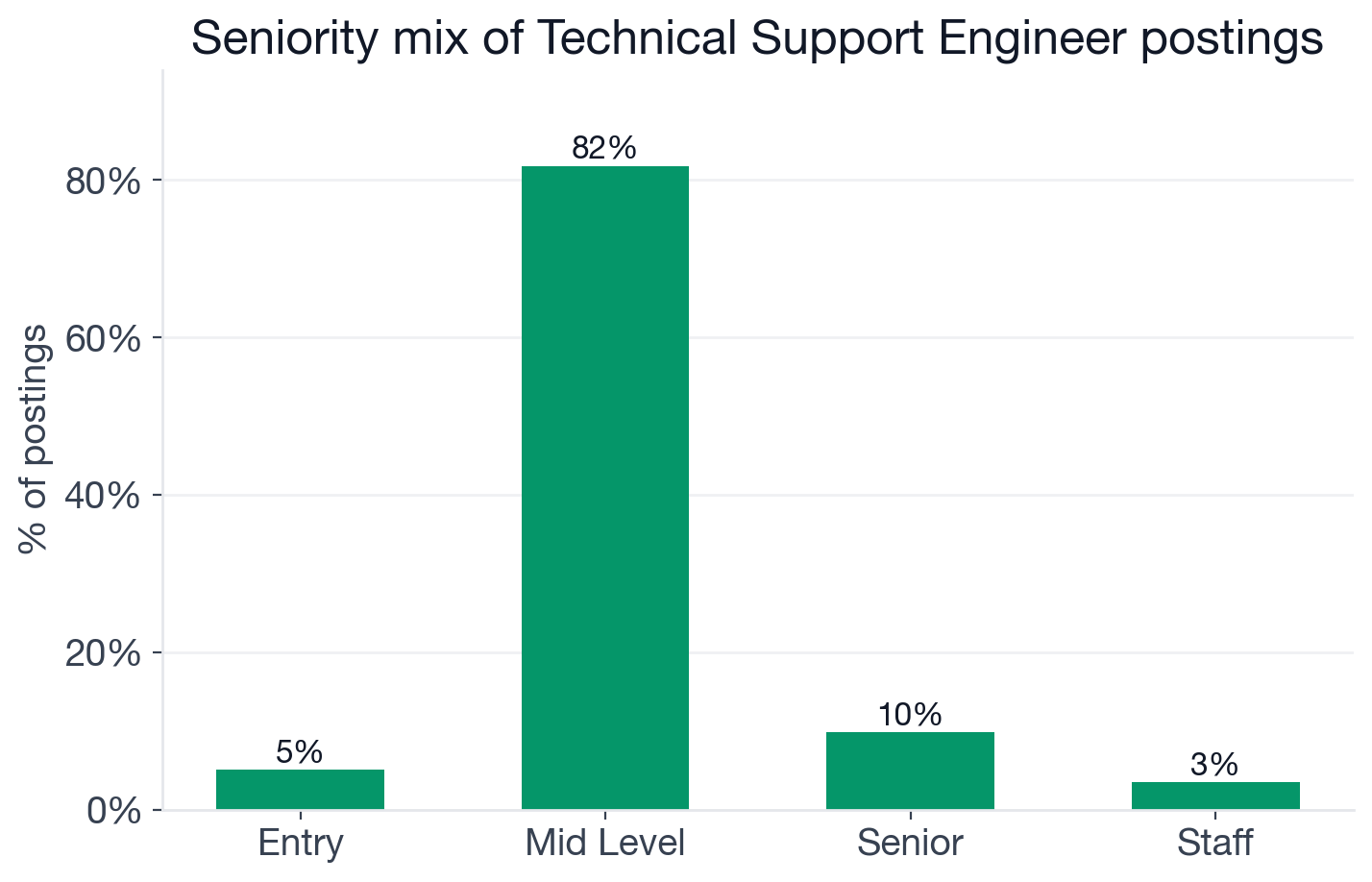
Seniority distribution of active Technical Support Engineer postings, inferred from job title keywords.
The mid-level concentration at 81.7% is the most extreme of any role analyzed in this series to date. Two dynamics explain it:
First, the senior and staff designations are rarely attached to this title. A company that wants a senior-level technical problem-solver usually posts it as "Senior Site Reliability Engineer" or "DevOps Engineer" rather than "Senior Technical Support Engineer." The senior postings that do exist here (9.8%) are concentrated at companies where deep product knowledge and long-term customer relationships genuinely warrant the designation, such as semiconductor equipment manufacturers and complex enterprise software vendors.
Second, the 5% entry-level share (131 of 2,597) makes this a meaningfully more accessible entry point than Data Engineering (3% entry-level). The bar is lower: most entry-level TSE roles require solid communication, Windows or macOS proficiency, and familiarity with ticketing systems, none of which require a CS degree to demonstrate. The technical depth comes later, as engineers layer in SQL, scripting, and platform-specific knowledge on the job.
For anyone targeting the higher-paying SaaS/developer track: the pathway typically runs entry-level helpdesk or Tier 1 support, then Tier 2 or Tier 3 roles that require debugging and scripting, then specialist positions at product companies paying the $90K+ medians we see for APIs and Python. The role is accessible enough to start without a technical background, and technical enough to reward depth over a career.
Where Are Technical Support Engineer Jobs Located, and How Remote-Friendly Are They?
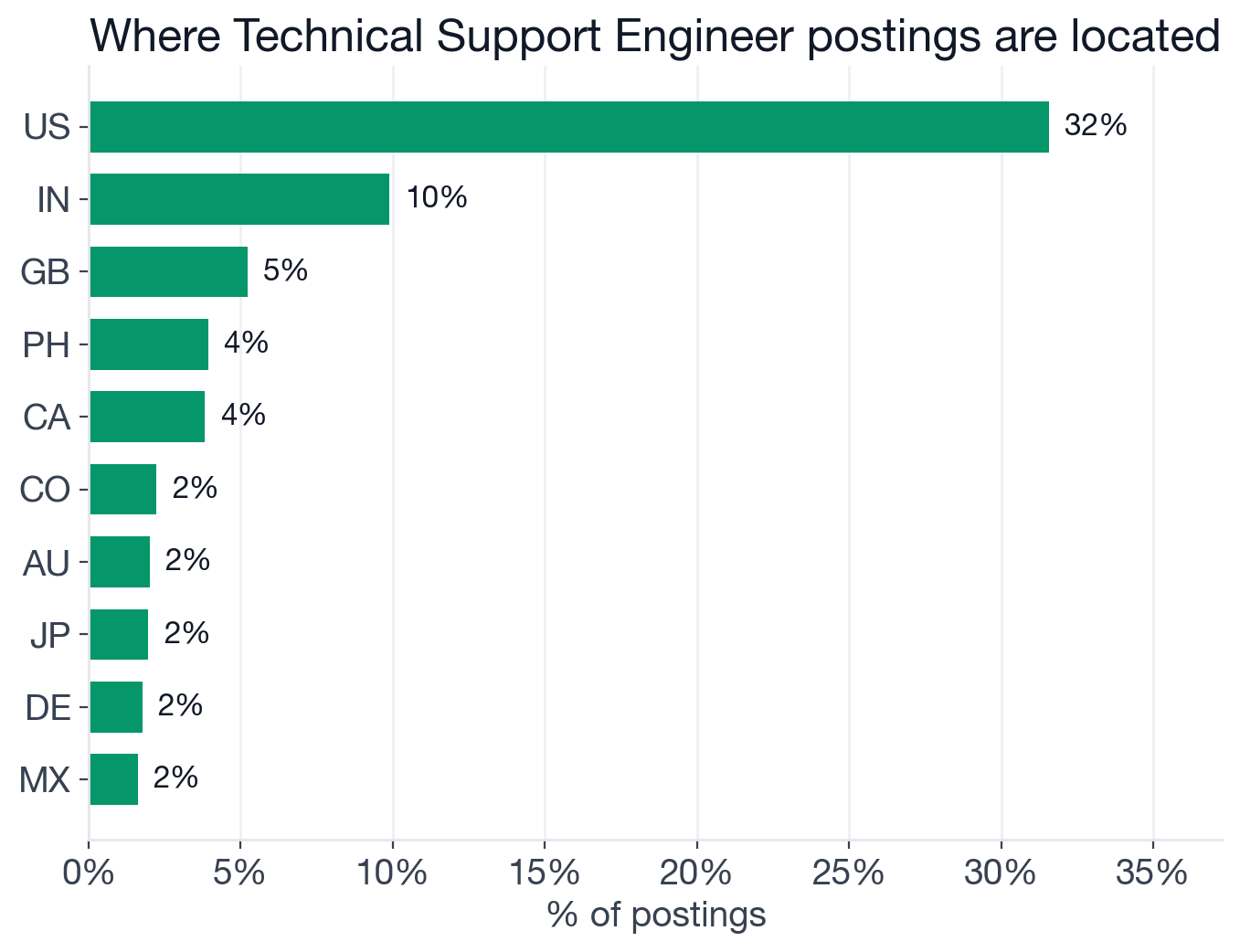
Top countries by share of active Technical Support Engineer postings.
The US leads at 31.6%. India (9.9%) and the UK (5.2%) are the next largest markets. Two countries stand out relative to other tech roles: the Philippines (3.9%) and Colombia (2.2%). Both are established offshore and nearshore support hubs, reflecting global demand for native English-speaking support coverage at costs below US or UK rates across multiple time zones. Based on global offshore-support industry patterns, postings in those markets likely skew toward customer-facing support and ticketing roles rather than the technical debugging track.
Japan (2.0%) and Germany (1.8%) show smaller but notable shares, suggesting some companies are staffing localized technical support for enterprise customers in those markets, often requiring language skills alongside technical competency.
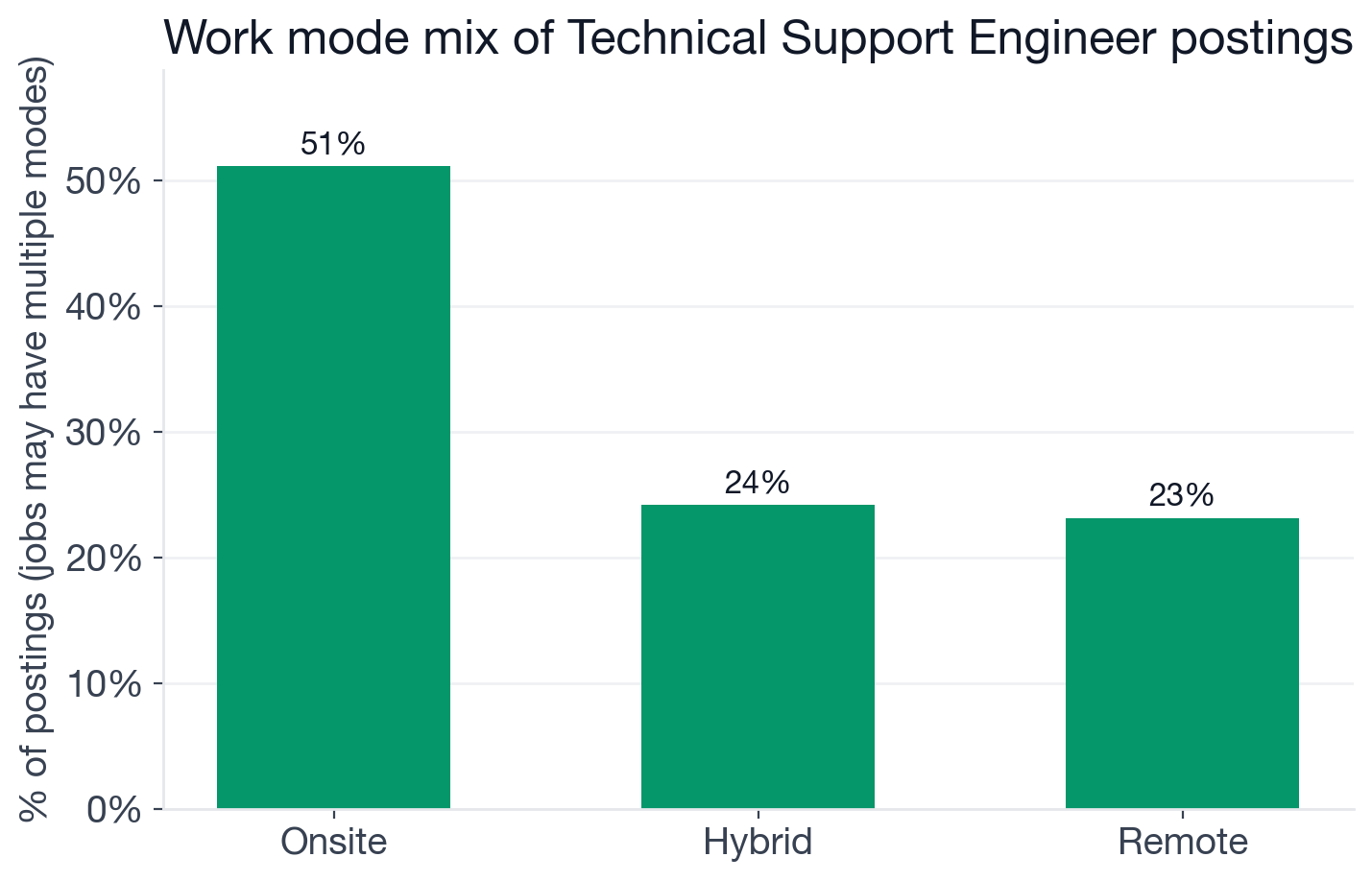
Work mode distribution for active Technical Support Engineer postings.
At 51% onsite, Technical Support Engineering is one of the most in-person roles in tech hiring. The answer to "can I do this remotely?" depends almost entirely on the track.
The enterprise IT and helpdesk track skews heavily onsite: you often need to be physically present to support hardware, troubleshoot network issues, provision devices, and work with users face to face. The SaaS and cloud-native developer-support track is meaningfully more remote-friendly, because the systems being supported exist entirely as software accessible from anywhere.
The 23% remote share is real, but concentrated. If remote flexibility matters to you, look for postings with the technical differentiator keywords: Linux, Python, APIs, and cloud platforms. Those postings are much more likely to support distributed work. Browse remote Technical Support Engineer openings on the job board to filter to the current remote-eligible pool.
Who's Hiring Technical Support Engineers in 2026?
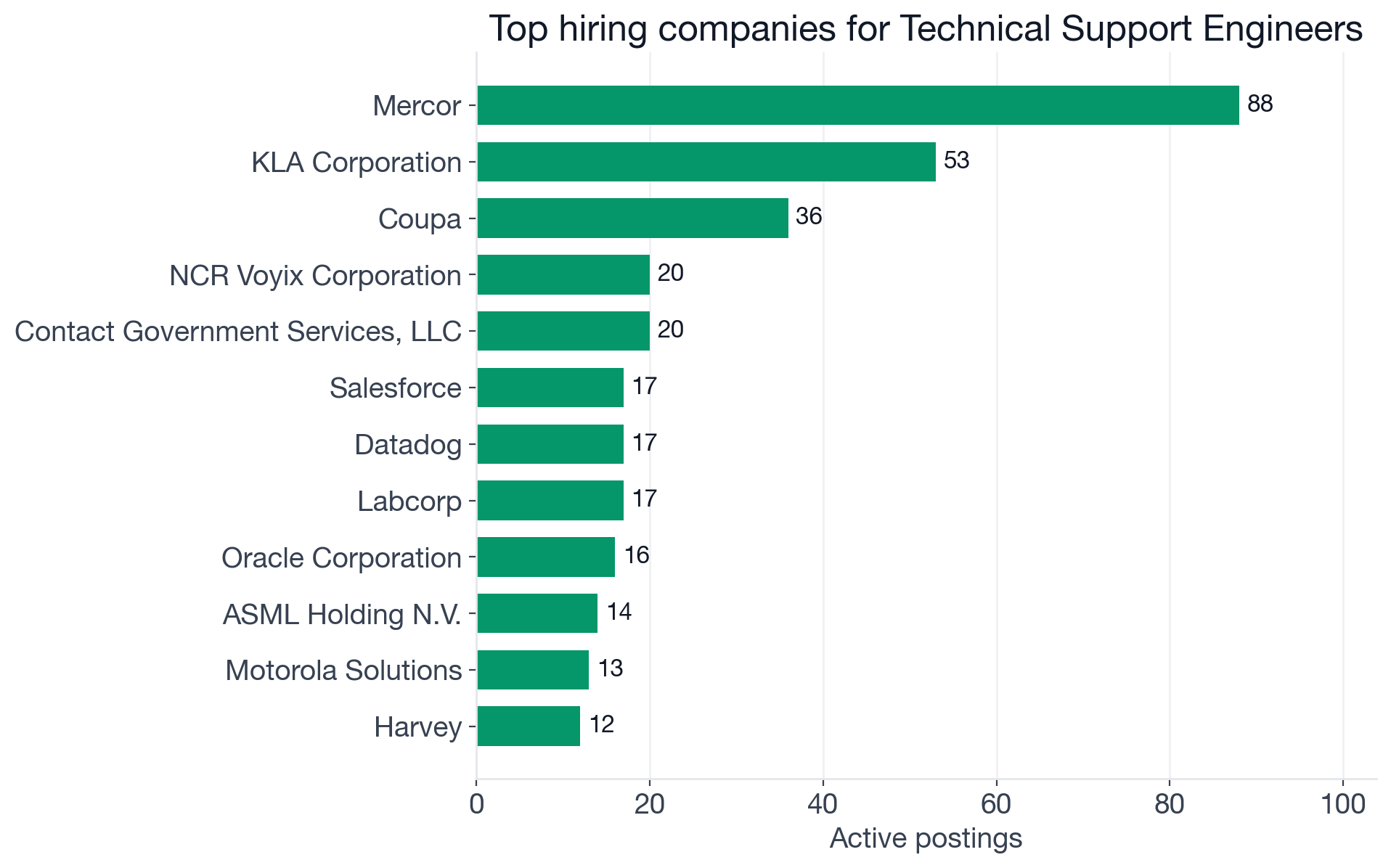
Top companies by active Technical Support Engineer postings.
The employer mix is more varied than most technical roles, reflecting the role's breadth across industries:
- Mercor (88 postings): An AI hiring platform; its volume here reflects matching and staffing activity across multiple client companies rather than a single team's internal hiring.
- KLA Corporation (53) and ASML Holding N.V. (14): Semiconductor equipment manufacturers. Supporting their tools requires deep product knowledge in Linux-based instrumentation environments. These roles tend toward the technical, higher-paying end of the range.
- Coupa (36) and Datadog (17): SaaS companies with large enterprise customer bases. Their Technical Support Engineers troubleshoot complex integration and API issues for paying customers, which is precisely why APIs and Debugging carry such strong salary premiums.
- NCR Voyix Corporation (20): Payment technology; support here spans point-of-sale hardware, payment processing software, and cloud services.
- Salesforce (17): Enterprise CRM and service cloud giant, hiring TSEs to support its own platform and its AI-powered service features.
- Labcorp (17): Healthcare and diagnostics; technical support here likely covers lab information systems and healthcare IT platforms.
- Oracle Corporation (16): Enterprise software; technical support involves complex database and ERP environments.
- Harvey (12): An AI-powered legal research company, where Technical Support means helping law firms configure and troubleshoot AI tools, placing it squarely in the AI-native category.
- Axon Enterprise (12): Public safety technology (body cameras, digital evidence management), requiring specialized technical support for law enforcement clients.
- Motorola Solutions (13): Communications hardware and software for public safety; technical support spans both hardware and cloud-managed services.
Note: several other companies in the broader top-20 roster (including Vets Hired, Shanghai BSF Human Resources, and Cross Border Talents) are staffing or recruiting platforms rather than direct employers. Combined with Mercor, agency-intermediated postings represent a modest share of this dataset and may modestly over-represent generic skill requirements relative to what direct-hire companies list.
For company-specific interview preparation, our interview preparation guides cover the hiring process, common question types, and expectations at major employers.
How to Use This in Your Job Search
The most actionable thing the data reveals is that "Technical Support Engineer" is not a single job market. Clarifying which track you're targeting changes what you should learn, what questions you'll be asked, and what you can realistically earn.
Targeting the SaaS/developer support track: Start with the skills that carry the largest premiums: APIs ($17K above baseline), Python ($15K), and SQL ($5.9K). The interview process for these roles often includes a hands-on technical round resembling a modified software engineering interview: reproduce this API error from the trace, write a SQL query to pull affected records, or walk through your debugging process on a simulated customer issue. Practice technical troubleshooting with AI mock interviews so you're comfortable reasoning through bugs under interview conditions. The question bank covers Linux fundamentals, SQL querying, and debugging-oriented topics that come up specifically in Tier 2 and Tier 3 support interviews.
Targeting the enterprise IT or helpdesk track and building toward higher pay: The path up the salary curve runs through cloud identity management (Azure Active Directory or AWS IAM, which explains the $10K Azure premium), scripting (Bash and Python for automation), and monitoring tools. Postings that combine Windows with any of those skills escape the $58K median. Our interactive courses cover Python and SQL foundations for engineers who want to move from helpdesk into more technical roles.
For both tracks: Use the job board's skill and location filters to identify the postings that actually fit your current stack. Browse all active Technical Support Engineer openings and narrow from there. A few filtered views worth bookmarking: TSE + Linux + Python for scripting-heavy infrastructure support, TSE + Zendesk + SQL for the SaaS customer support tier, and TSE + Active Directory for enterprise IT pipeline roles.
FAQ
Q. What skills do companies want for Technical Support Engineer roles in 2026?
Windows (23.6%) is the most commonly listed skill, followed by SQL (19%), Linux (16.7%), Monitoring (16.5%), Python (12.9%), and Automation (12.8%). No single skill appears in more than 24% of postings, which reflects how broadly the role spans from traditional IT helpdesk to SaaS developer support.
Q. What is the median salary for a Technical Support Engineer in 2026?
The median US base salary is $75,000 across 265 postings with disclosed salary data. That figure covers base pay only; equity and bonuses are not disclosed in job postings, so total compensation at top employers is meaningfully higher.
Q. Which Technical Support Engineer skills pay the highest salary premium?
Among US postings, APIs ($92,000, about $17,000 above the $75,000 baseline), Debugging ($91,500, +$16,500), and Python ($90,000, +$15,000) are the top-paying skills. Automation ($86,100, +$11,100) and Azure ($85,000, +$10,000) follow. Windows-only postings pay $58,100, nearly $17,000 below the baseline.
Q. Is Technical Support Engineer a good role for breaking into tech?
It is one of the more accessible technical roles: 5% of postings are explicitly entry-level (131 of 2,597 analyzed). Mid-level dominates at 82% of postings, and the skill floor is lower than roles like Data Engineer, where virtually no entry-level market exists (3% of postings). A foundation in Windows, ticketing tools, and basic scripting is enough to start.
Q. Where are Technical Support Engineer jobs located, and how remote-friendly are they?
The United States is the largest market at 31.6% of postings, followed by India (9.9%), the UK (5.2%), the Philippines (3.9%), and Canada (3.8%). Onsite dominates at 51% of postings; hybrid is 24% and remote is 23%.
Q. Which companies hire the most Technical Support Engineers in 2026?
Mercor (88 postings), KLA Corporation (53), Coupa (36), NCR Voyix Corporation (20), Contact Government Services (20), Salesforce (17), Datadog (17), and Labcorp (17) lead the list. The mix spans semiconductor equipment, SaaS, enterprise software, and government services.
Q. What skill combinations define the top-paying Technical Support Engineer track?
The SaaS developer-support track pairs APIs with Debugging (lift 4.54 in co-occurrence), and layers Python onto Linux (lift 2.83) for scripting. The automation track pairs Bash with Python (lift 6.24) and Bash with Linux (lift 4.28). AWS pairs strongly with Azure (lift 6.46), pointing to multi-cloud support roles at cloud-native companies.
Final Thoughts
The Technical Support Engineer market in 2026 rewards technical depth with unusual clarity. The $34,000 gap between the API-debugging, Python-scripting track and the Windows helpdesk track is not noise: it reflects genuine differences in the scarcity and leverage of those skills. The role is accessible enough to start without a CS background, and technical enough that any investment in SQL querying, Python scripting, API troubleshooting, or Linux administration compounds directly into a higher salary band. For engineers who want to grow toward SRE, DevOps, or platform engineering, the SaaS developer-support track is one of the cleaner on-ramps available in the current market.
Topics
Ready to practice?
Put what you've learned into practice with AI mock interviews and structured preparation guides.