
Fewer Jobs, Better Pay, More Remote Work
Cloud Engineer sounds like a narrower version of Systems Engineer. The data says something more interesting: the specialized role pays more and lands in more flexible work environments, while the broader role has 2.6 times the job volume but is concentrated in industries where you show up on-site. The Jaccard similarity between the two skill sets is 36%, meaning these roles share roughly a third of their top-30 skills. They are adjacent, not interchangeable.
We compared 9,213 active Systems Engineer postings and 3,574 Cloud Engineer postings on the InterviewStack.io job board as of June 2026. Cloud Engineer commands a median US base salary of $142,400 vs $137,300 for Systems Engineer, and 55% of Cloud Engineer postings are hybrid or remote compared with 37% for Systems Engineer. The explanation is not the skill set; it is the employers. Systems Engineers are disproportionately hired by defense and aerospace contractors (Northrop Grumman, General Dynamics, Leidos, Booz Allen Hamilton, Boeing lead the list) where physical presence at secure facilities is non-negotiable. Cloud Engineers cluster in consulting firms and commercial tech companies where remote and hybrid work are standard.
Key Findings
- 9,213 active Systems Engineer postings vs 3,574 for Cloud Engineer, a 2.6x volume advantage for Systems Engineer.
- Cloud Engineer pays $5,100 more at the median: $142,400 US base salary (n=648) vs $137,300 for Systems Engineer (n=3,704). Both exclude equity and bonus.
- Jaccard similarity is 36%: the roles share 15 skills in their top-30 lists, but Cloud Engineer demands cloud-native tools at up to 6x the frequency (Terraform: 6x, CI/CD: 4.4x, Kubernetes: 4.1x).
- Work mode splits sharply: 55% of Cloud Engineer postings are hybrid or remote vs 37% for Systems Engineer. Systems Engineers work onsite 68% of the time.
- Entry-level is thin in both: 3.2% of Systems Engineer and 3.4% of Cloud Engineer postings are explicitly entry-level.
- Employer type explains the work-mode gap: defense/aerospace dominates Systems Engineer hiring; tech consulting dominates Cloud Engineer hiring.
The Short Answer
Cloud Engineer pays a $5,100 salary premium over Systems Engineer and offers significantly more remote and hybrid work. Systems Engineer has 2.6 times more job openings and spans a wider range of industries and technical domains. The choice comes down to whether you optimize for job volume and breadth or for salary edge, remote flexibility, and cloud-native specialization.
| Systems Engineer | Cloud Engineer | |
|---|---|---|
| Median US base salary | $137,300 | $142,400 |
| Active postings | 9,213 | 3,574 |
| Remote or hybrid share | 37% | 55% |
| Entry-level share | 3.2% | 3.4% |
| Skill overlap (Jaccard) | 36% shared | (both roles) |
What Each Role Actually Does
Systems Engineer is the integration architect. The job is ensuring that dozens of subsystems (hardware, software, networking, firmware) function correctly together. In defense and aerospace (which dominate hiring), this means coordinating across proprietary components on multi-year programs with strict requirements documentation and testing protocols. The exclusive skills make the nature visible: System Design (13%), System Integration (13%), Technical Documentation (10%), and VMware (8%) are the language of complex, multi-stakeholder technical programs.
Cloud Engineer is the platform builder. Where a Systems Engineer integrates what exists, a Cloud Engineer provisions what will be: designing and maintaining the cloud infrastructure that applications run on. A typical week involves writing Terraform (a declarative infrastructure-as-code tool) configurations, managing Kubernetes clusters (the container orchestration platform most cloud environments use), setting up observability pipelines, and automating deployments. The exclusive skills (IaC 32%, Google Cloud 22%, Ansible 17%, Observability 16%) describe a narrower scope than Systems Engineering but deeper expertise in a specific, interconnected technology stack.
What Skills Do Both Roles Require?
Automation and monitoring anchor the shared skill set, appearing in more than 20% of postings for both roles. Python, Linux, and Agile are common ground at meaningful rates. Fifteen skills total appear in both top-30 lists.
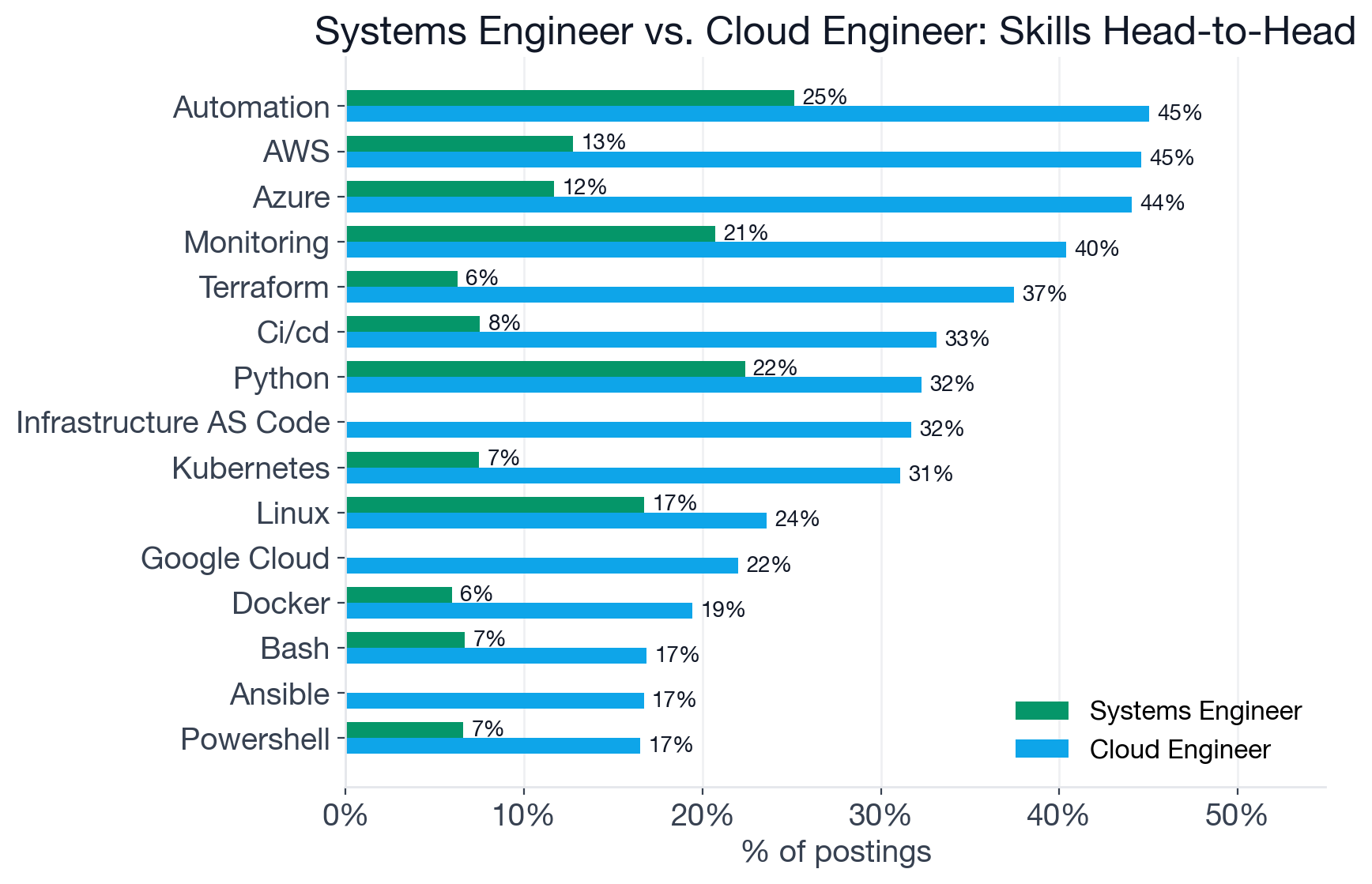
Top skills by posting frequency for Systems Engineer (emerald) and Cloud Engineer (sky). Source: InterviewStack.io job board, June 2026.
The chart understates the divergence. AWS appears in 13% of Systems Engineer postings and 45% of Cloud Engineer postings. Terraform is 6% for SE vs 37% for CE. Kubernetes: 7% for SE vs 31% for CE. For Systems Engineers, cloud skills are a secondary layer on a broader profile. For Cloud Engineers, they are the job. If you already have Python, Linux, and familiarity with one major cloud platform, roughly a third of your skill set transfers directly to either role, but the depth required in each direction is very different. For a deeper look at how Systems Engineer compares to a closely related role, see Systems Engineer vs Systems Administrator 2026.
Where the Roles Diverge
Exclusive to Systems Engineer (present in SE top-30 but not CE top-30): System Design (13%), System Integration (13%), TypeScript (11%), Project Management (10%), Technical Documentation (10%), VMware (8%). Most of these are coordination and integration skills: the vocabulary of complex, multi-component programs. VMware signals on-premises virtualization, common in enterprise and government data centers. TypeScript is the outlier: its 11% frequency reflects Systems Engineer roles in software platform engineering (where TypeScript and Node.js are native tools alongside traditional SE practices), not the defense, aerospace, or embedded SE archetype. Readers in those sub-disciplines should weight System Design, System Integration, Configuration Management, and MATLAB more heavily than TypeScript when assessing their skill fit.
Exclusive to Cloud Engineer (present in CE top-30 but not SE top-30): Infrastructure as Code (32%), Google Cloud (22%), Ansible (17%), Observability (16%), Scalability (16%), IAM (14%), Cloud Architecture (12%), Disaster Recovery (11%), Cloud Security (11%), High Availability (11%). This is a coherent, interlocking cluster: provision the platform (IaC, Ansible), run it across clouds (GCP, AWS, Azure), make it visible (Observability), secure it (IAM, Cloud Security), and design for failure (Disaster Recovery, High Availability). Learning one skill in this cluster creates pull toward the others.
Which Pays More?
Cloud Engineer holds a $5,100 median advantage, with US base salary coming in at $142,400 vs $137,300 for Systems Engineer. These figures are base salary only, drawn from postings with US wage disclosure; equity and bonus are not captured, so total compensation at top employers is higher than what these medians reflect.
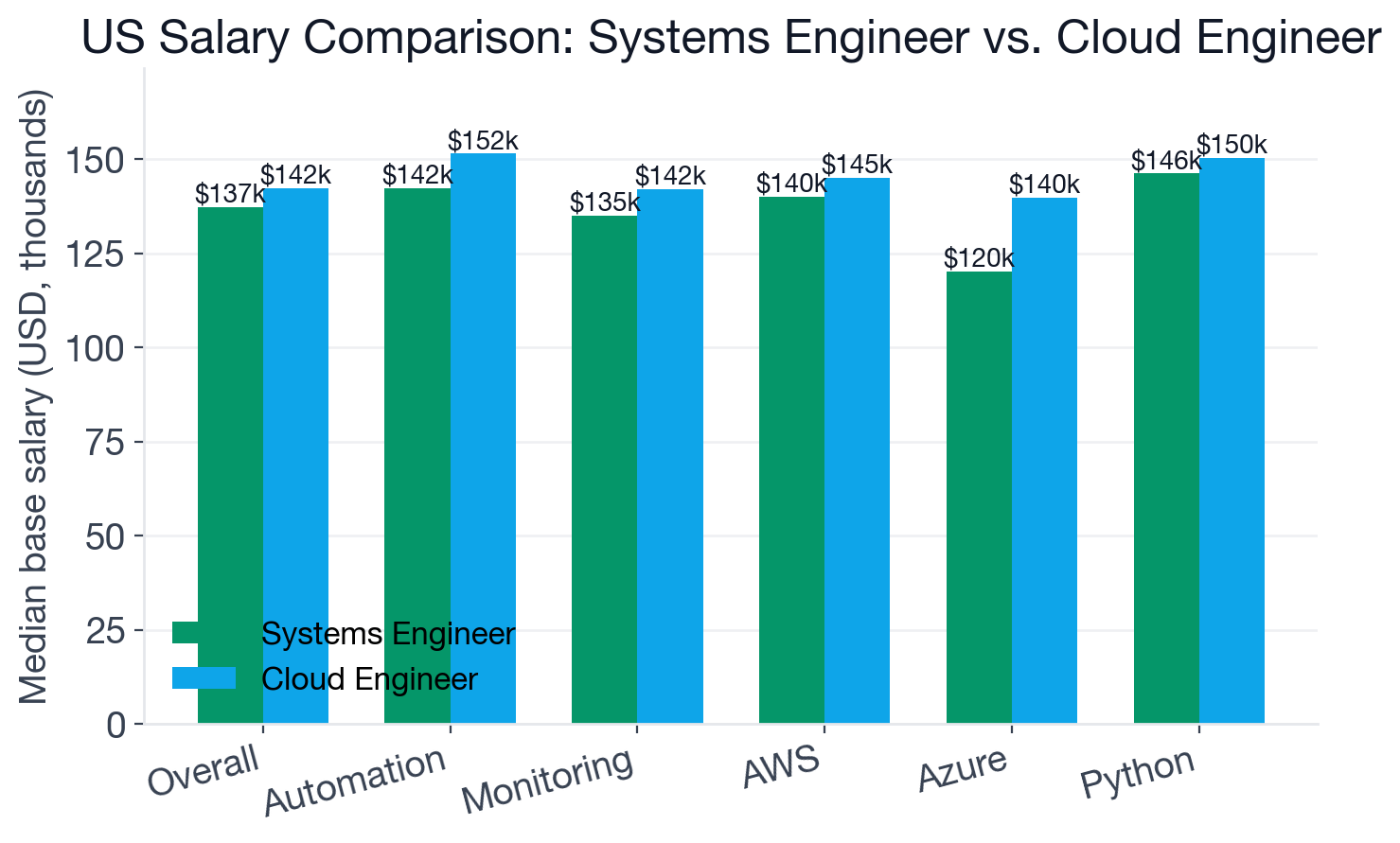
US base salary medians for Systems Engineer (emerald) and Cloud Engineer (sky). Base salary only; equity and bonus excluded. Source: InterviewStack.io job board, June 2026.
The skills that push pay highest are similar in both roles: Distributed Systems ($180,500 SE / $183,700 CE), Observability ($175,000 SE / $161,000 CE), and Kubernetes ($162,000 SE / $154,100 CE) sit well above both role baselines. Cloud-native depth is the salary lever on both sides. A Systems Engineer who builds Kubernetes and observability expertise effectively earns into Cloud Engineer pay territory; the difference is that Cloud Engineers already carry those skills as standard requirements. Browse Systems Engineer roles filtered by Kubernetes to see where those higher-paying SE postings concentrate. For Cloud Engineers, Terraform-filtered Cloud Engineer postings show where the IaC specialization premium lands.
Job Volume, Seniority, and Where You Will Actually Work
Systems Engineer is the larger market by a wide margin. The 9,213 vs 3,574 posting gap reflects the role's breadth: SE spans defense, aerospace, enterprise IT, embedded systems, and software platforms. Cloud Engineer is a more focused discipline with a correspondingly smaller but specialized pool.
Seniority is nearly identical in shape: mid-level dominates both (59% for SE, 63% for CE) and entry-level is thin for both (3.2% and 3.4%). Staff-level is slightly more common in Systems Engineering (14% vs 11%), reflecting the deeper seniority ladders common in defense program structures. Neither role offers a well-worn entry path for career changers; both expect prior production experience.
Work mode is the sharpest differentiator. Cloud Engineers have hybrid or remote options in 55% of postings; Systems Engineers have that flexibility in only 37%, with 68% requiring on-site presence. (Postings may carry multiple work-mode tags; these figures reflect the share offering at least one hybrid or remote option.) The geography reinforces the employer pattern: 63% of Systems Engineer postings are US-based (dominated by domestic defense programs), while Cloud Engineer is more internationally distributed, with India accounting for 17% of postings vs 5% for Systems Engineer.
On AI tools: neither role lists AI or ML in its top-30 skills, which captures engineers explicitly hired to build AI systems, a small fraction of each role. Developer surveys from Stack Overflow and JetBrains consistently report AI tool adoption above 80% among developers in 2025. For Cloud Engineers, that ambient layer maps directly onto core work: Terraform HCL, CI/CD YAML, and Python automation scripts are well within what AI coding assistants now generate reliably. For Systems Engineers working in classified defense environments, commercial AI tools like GitHub Copilot may be network-restricted, making ambient AI adoption lower in that segment of the role, even as it remains high for SE roles in enterprise IT and commercial tech.
Which Should You Choose?
Choose Systems Engineer if you:
- Want more job options and a broader scope of industries
- Have a background in mechanical, electrical, embedded, or hardware systems
- Are open to security clearances and primarily on-site work
- Prefer multi-disciplinary integration work over deep cloud-native specialization
- Are drawn to defense, aerospace, or large government programs
Choose Cloud Engineer if you:
- Prioritize remote or hybrid flexibility (55% vs 37%)
- Want a higher median salary with a clear, focused skill trajectory
- Come from a DevOps, network engineering, or Linux administration background
- Are comfortable with a smaller but more specialized job pool
- Want to specialize deeply in cloud-native tools and build toward a cloud architecture or platform engineering role
Prepare for either role with AI mock interviews and topic drilling in the question bank, which covers systems design, cloud architecture, and infrastructure scenarios relevant to both.
FAQ
Q. Which pays more, Systems Engineer or Cloud Engineer?
Cloud Engineer pays a median US base salary of $142,400 vs $137,300 for Systems Engineer, a $5,100 (3.6%) gap based on postings with disclosed US salary data. Both figures exclude equity and bonus. Skills like Kubernetes, Observability, and Distributed Systems push pay above $154,000 in both roles.
Q. Which role has more job openings in 2026?
Systems Engineer has significantly more openings: 9,213 active postings vs 3,574 for Cloud Engineer, a 2.6x difference. The larger market reflects the breadth of the Systems Engineer role across defense, aerospace, enterprise IT, and software platforms.
Q. Is Systems Engineer or Cloud Engineer more remote-friendly?
Cloud Engineer is more remote-friendly: 55% of Cloud Engineer postings are hybrid or remote (39% hybrid, 15.5% remote) vs 37% for Systems Engineer (27% hybrid, 10% remote). The difference is driven by employer type: Systems Engineer hiring is dominated by defense contractors that require onsite, clearance-controlled environments.
Q. What skills do both Systems Engineer and Cloud Engineer share?
Fifteen skills appear in both roles' top-30 lists: Automation, Monitoring, AWS, Azure, Python, Terraform, CI/CD, Linux, Kubernetes, Agile, Docker, Bash, Windows, PowerShell, and SQL. The Jaccard similarity is 36%, meaning the roles share roughly a third of their skill profiles.
Q. What skills are exclusive to Cloud Engineer vs Systems Engineer?
Cloud Engineers uniquely need Infrastructure as Code (32% of postings), Google Cloud (22%), Ansible (17%), Observability (16%), Scalability (16%), and IAM (14%). Systems Engineers uniquely need System Design (13%), System Integration (13%), Project Management (10%), Technical Documentation (10%), and VMware (8%).
Q. Is it hard to break into Systems Engineer or Cloud Engineer at the entry level?
Both roles have thin entry-level pipelines: 3.2% of Systems Engineer postings and 3.4% of Cloud Engineer postings are explicitly entry-level. Mid-level roles dominate both. Career changers typically bridge into Cloud Engineering from DevOps or network engineering; into Systems Engineering from mechanical, electrical, or embedded engineering backgrounds.
The Bottom Line
Cloud Engineer is the smaller, more specialized role that happens to pay more and land in more flexible work environments. Systems Engineer is the broader path with far more job openings, but the demand is concentrated in defense and aerospace where on-site presence is a requirement, not a preference. Neither is objectively better: the decision turns on your background, your tolerance for security-clearance environments, and how much weight you put on remote flexibility. Browse live Systems Engineer postings or Cloud Engineer postings on InterviewStack.io to see what is active in your region right now.
Topics
Ready to practice?
Put what you've learned into practice with AI mock interviews and structured preparation guides.