
When Action-First Gets You a 60-Point Hole
Picture this: you are three minutes into a mid-level Systems Engineer collaboration interview. A config rollout broke deployments for several partner teams. A senior engineer wants to ship the fix now. The SRE wants safeguards. The PM wants a written summary. You have a plan. You start explaining it.
That move just cost you the interview.
This interview is not testing whether you have the right answer. It is testing whether you ask the right questions before proposing one, then structure a response that accounts for all three stakeholders simultaneously. Sixty of the 100 rubric points sit in two dimensions: Interviewer Objectives Alignment (30 pts) and Level-Specific Expectations (30 pts). Both are scored on framing and judgment, not technical depth. The walkthrough below runs you through 4 coached turns of a real Systems Engineer collaboration and communication skills interview so you can see exactly where those points are won and lost.
Key Findings
- 60 of 100 rubric points are awarded for Interviewer Objectives Alignment (30 pts) and Level-Specific Expectations (30 pts), not technical solutions.
- The interview runs 30 minutes across 4 scored phases; Phase 1 (0-7 min) is scored entirely on clarification before any plan is proposed.
- Technical Proficiency accounts for only 20 of 100 points; Communication and Problem Solving accounts for the other 20 points.
- Phase 1 has 4 required checklist items: impact severity, stakeholder identification covering at least 4 types, rollback path, and success framing.
- Phase 2 (7-18 min) is the longest phase at 11 minutes and has 5 checklist items centered on collaborative sequencing and audience-aware communication.
- Mid-level candidates are expected to drive the collaborative response independently but should escalate unresolved risk or disagreements that exceed their authority.
- A concrete long-term improvement (staged rollouts, review checklist updates, or clearer partner communication ownership) is required to close Phase 4.
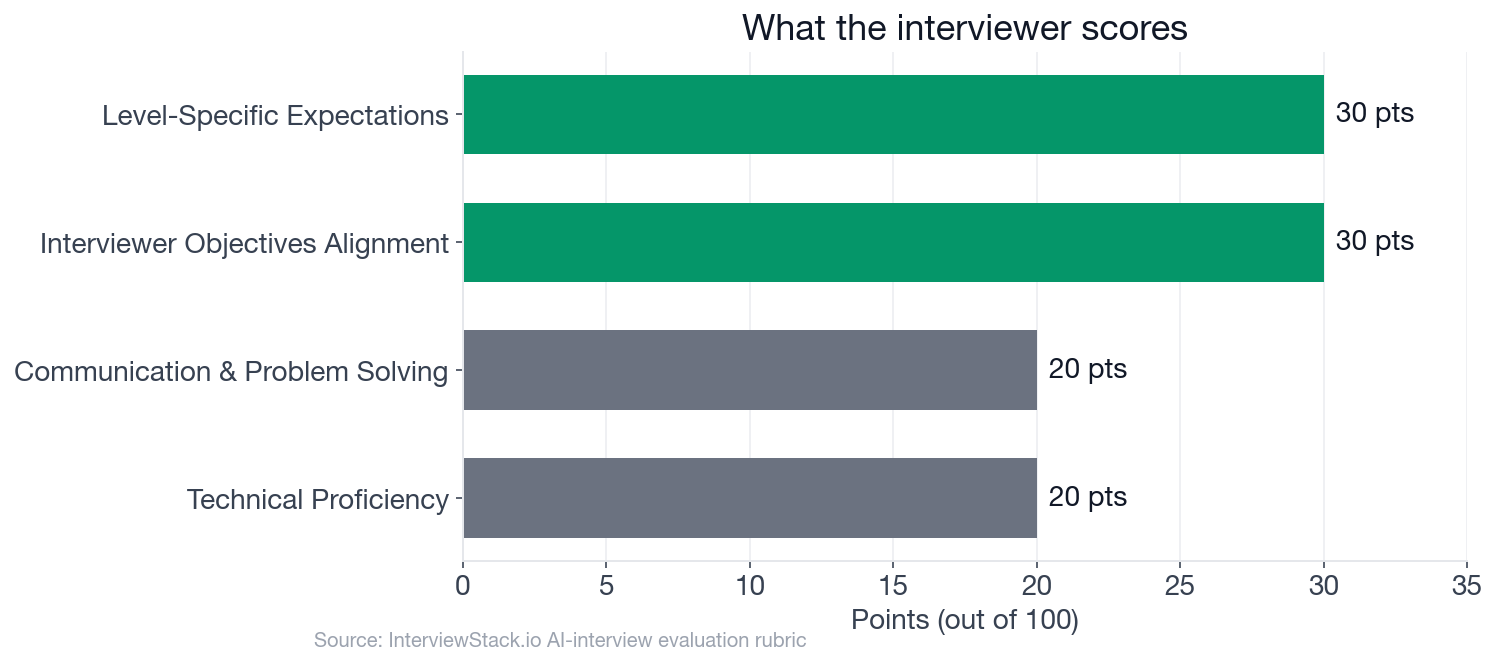
The chart above shows how the 100-point rubric is distributed. Technical Proficiency and Communication each account for 20 points; the other 60 points are split between whether you addressed the right objectives and whether you showed the right level of judgment.
What Is the Interviewer Actually Testing?
The interview question
You are joining a mid-sized infrastructure team that owns internal service deployment tooling used by dozens of engineering teams. A recent rollout of a configuration change caused failed deployments for several partner teams during business hours. There was no major outage, but trust in the tooling team took a hit. One senior engineer believes the fix should be shipped immediately with minimal discussion. A product manager wants a written summary for affected teams. An SRE asks for stronger rollout safeguards before any new change goes out.
You are the engineer assigned to help lead the response with your teammates. How would you approach this situation with the team and cross-functional partners?
The interviewer is probing a specific set of behaviors: do you gather context before acting, communicate with audience awareness, handle disagreement without blame, and know when to escalate? Architecture depth that does not serve a collaboration behavior will not move your score. This is explicitly a forbidden area: low-level systems design, scaling math, and vendor-tooling trivia are out of scope. What the interviewer is watching is how you navigate people and information under pressure.
A Systems Engineer Collaboration and Communication Skills Interview, Turn by Turn
The four turns below are drawn from the interview's follow-up sequence. Each one maps to a specific rubric phase and a scored checklist item.
Turn 1: The First Hour
Interviewer: "What would you do first in the first hour, and how would you communicate that to the different people involved?"
Turn 2: Disagreement With a Senior Engineer
Interviewer: "If the senior engineer strongly disagreed with slowing down for additional safeguards, how would you handle that conversation?"
Turn 3: Feedback on Your Write-Up
Interviewer: "Suppose you received feedback that your incident write-up was too technical and did not clearly address partner impact. How would you respond?"
Turn 4: Sync vs. Async
Interviewer: "How would you decide what should be discussed synchronously versus written down asynchronously?"
Spotting This on the Page Is the Easy Part
Reading these turns, the right moves feel obvious. Clarify before you plan. Acknowledge urgency before redirecting. Tie your answer to the actual scenario details. The problem is that none of those moves are automatic under 30 minutes of real-time pressure, with an interviewer probing a different angle every few minutes. The gap between recognizing the right approach here and producing it live is exactly what repetition closes.
The Complete Blueprint
This is the blueprint a strong candidate hits across the full 30 minutes, and the exact thing the AI mock interview tracks you against in real time.
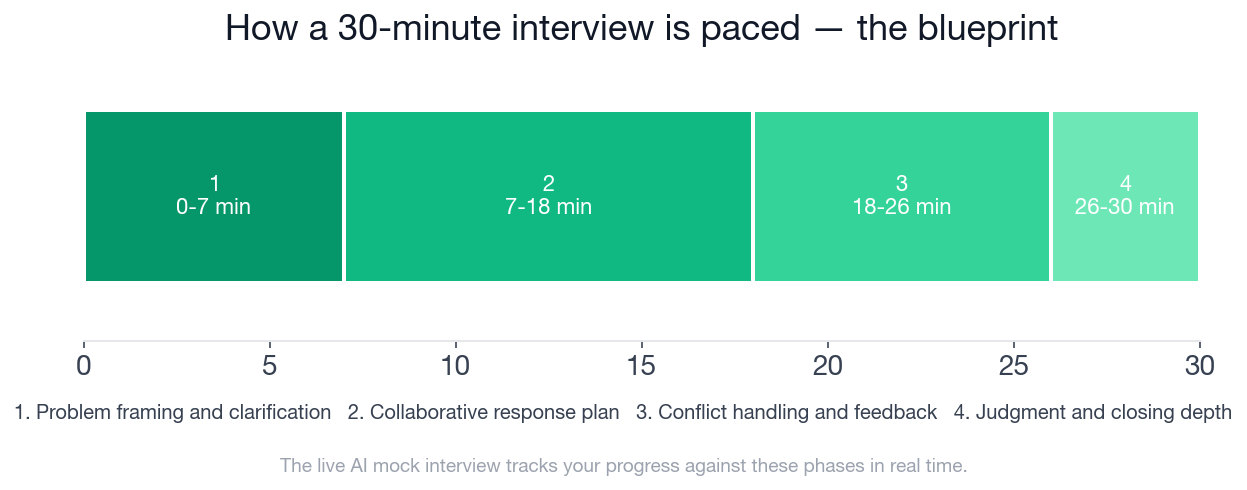
The chart shows how the interview's time is distributed. Phase 2 (the collaborative response plan) carries 11 minutes, the longest window, because structuring a multi-stakeholder response is the hardest thing to do well under pressure.
- ✓Asks about severity, current customer impact, and whether deployments are still failing
- ✓Identifies at least technical teammates, affected partner teams, SRE, and product/program counterparts as relevant stakeholders
- ✓Clarifies whether there is an immediate rollback or mitigation path
- ✓Frames success in terms of both service recovery and restoring partner confidence
- ✓Outlines a sensible sequence such as stabilize, align internally, communicate externally, then implement safeguards
- ✓Distinguishes what belongs in a rapid internal sync versus a written update to affected teams
- ✓Explains partner-facing communication in terms of impact, status, workaround if any, and expected next update
- ✓Includes teammates in ownership rather than presenting a solo hero approach
- ✓Acknowledges trade-offs between speed of fix and confidence in rollout safety
- ✓Responds to disagreement by acknowledging urgency while bringing discussion back to risk, evidence, and shared goals
- ✓Avoids blame toward the engineer who made the original change
- ✓Describes specific language or tactics for keeping review and retrospective discussions constructive
- ✓Receives criticism about their own communication without defensiveness and adapts the message for the audience
- ✓Summarizes the approach clearly in a few steps
- ✓Mentions when to escalate unresolved risk or disagreement
- ✓Includes at least one concrete long-term improvement such as staged rollouts, review checklist updates, or clearer ownership for partner communication
Practice This Live Before the Real Interview
The Systems Engineer AI mock interview runs the full 30-minute session against this exact blueprint. It scores each response against the four rubric dimensions in real time and gives you structured feedback on which checklist items you hit and where you dropped points. That feedback loop, repeated over two or three sessions, is what converts "I know what to do" into "I did it under pressure."
If you want to drill specific turns before running the full interview, the collaboration and communication skills question bank has the individual questions with rubric-anchored coaching notes. The Systems Engineer preparation guide covers the broader interview arc if you're mapping out the full process.
FAQ
Q. What does a Systems Engineer collaboration and communication skills interview test?
It evaluates your ability to identify stakeholders, structure a response across technical and non-technical audiences, handle disagreement constructively, and exercise mid-level judgment about when to escalate. The rubric assigns 30 points to Interviewer Objectives Alignment and 30 points to Level-Specific Expectations, meaning 60% of your score is tied to framing and judgment, not technical detail.
Q. How many phases does this Systems Engineer collaboration interview have?
The interview runs 30 minutes across 4 phases: Problem framing and clarification (0-7 min), Collaborative response plan (7-18 min), Conflict handling and feedback (18-26 min), and Judgment and closing depth (26-30 min). Each phase has a scored checklist the interviewer tracks in real time.
Q. What is the most common mistake in the problem framing phase?
Jumping straight into an action plan without asking clarifying questions. Candidates who skip Phase 1 fail to identify all relevant stakeholders (SRE, affected partner teams, product/program counterparts) and miss the clarification about rollback or mitigation paths, which costs points in both Interviewer Objectives Alignment (30 pts) and Level-Specific Expectations (30 pts).
Q. How much of the collaboration interview score goes to communication versus technical skills?
Technical Proficiency accounts for 20 points out of 100. Communication and Problem Solving accounts for another 20 points. The remaining 60 points (Interviewer Objectives Alignment and Level-Specific Expectations) depend on whether you address the right problem the right way for a mid-level engineer, which is more about judgment than technical depth.
Q. How should a mid-level Systems Engineer handle disagreement with a senior engineer during an interview?
Acknowledge the urgency the senior engineer is expressing, then redirect to shared risk and evidence rather than authority. Name what you agree on, surface the specific concern (rollout confidence, partner trust), and propose a concrete middle path. Avoid framing it as a binary win-lose. This maps to the conflict handling and feedback phase expectedChecklist item: respond by acknowledging urgency while bringing discussion back to risk, evidence, and shared goals.
Q. What does a strong collaborative response plan include in this interview?
A strong plan follows a stabilize, align internally, communicate externally, then implement safeguards sequence. It distinguishes what belongs in a rapid internal sync versus a written partner update, explains partner-facing communication in terms of impact, status, and next steps, includes teammates in ownership, and explicitly acknowledges the trade-off between speed of fix and rollout confidence.
Q. How do you handle critical feedback on your own communication during the interview?
Receive it without defensiveness, acknowledge the specific gap (too technical, not enough impact language), and describe concretely how you would revise the message for the audience. The rubric scores this under Communication and Problem Solving (20 pts) and Interviewer Objectives Alignment (30 pts), so a defensive or deflecting response is costly.
Where to Start
The clearest preparation path is also the shortest one: run the AI mock interview once, read the phase-by-phase feedback, identify the one or two checklist items you missed, then run it again. Thirty minutes of live practice with structured feedback surfaces gaps that hours of reading will not.
Topics
Ready to practice?
Put what you've learned into practice with AI mock interviews and structured preparation guides.