
The 60 Points Candidates Give Away in the First 8 Minutes
Picture the scene: you are a mid-level Solutions Architect sitting across from a product leader at a large cloud collaboration company. They say they want an "audit trail feature" this quarter. Enterprise customers are asking for it. You have 30 minutes.
Most candidates arrive prepared. They have non-functional requirement (NFR) templates in their head. They know retention windows matter, RBAC matters, latency matters. They are ready to talk compliance. What they miss is that the interview is grading something else first: whether you frame the problem before you solve it. Sixty of 100 rubric points sit in Interviewer Objectives Alignment and Level-Specific Expectations, and both of those dimensions reward what happens in the first 8 minutes. The Solutions Architect requirements elicitation mock interview on InterviewStack.io tracks this blueprint in real time.
Key Findings
- 60 of 100 rubric points hinge on two dimensions: Interviewer Objectives Alignment (30 points) and Level-Specific Expectations (30 points), together outweighing Technical Proficiency and Communication combined.
- Phase 1 (0-8 minutes) holds 5 checklist items: every one tests whether you clarify the business problem before naming a single technical requirement.
- Phase 2 (8-18 minutes) carries 7 checklist items covering event types, record attributes, read patterns, retention, access control, compliance, and testable acceptance criteria.
- Phase 3 (18-30 minutes) adds 6 more: MVP definition, must-have vs. nice-to-have split, measurable success metrics, dependencies and risks, concrete output artifacts, and phased rollout.
- Mid-level (2-5 years) bar: 30 points of rubric weight test whether the candidate surfaces enterprise concerns like RBAC, retention, exportability, and compliance-sensitive access without prompting and converts discussion into concrete artifacts.
- 4 skills are explicitly out of scope: detailed distributed storage design, live coding, deep UI critique, and contract negotiation. Demonstrating these burns time for zero points.
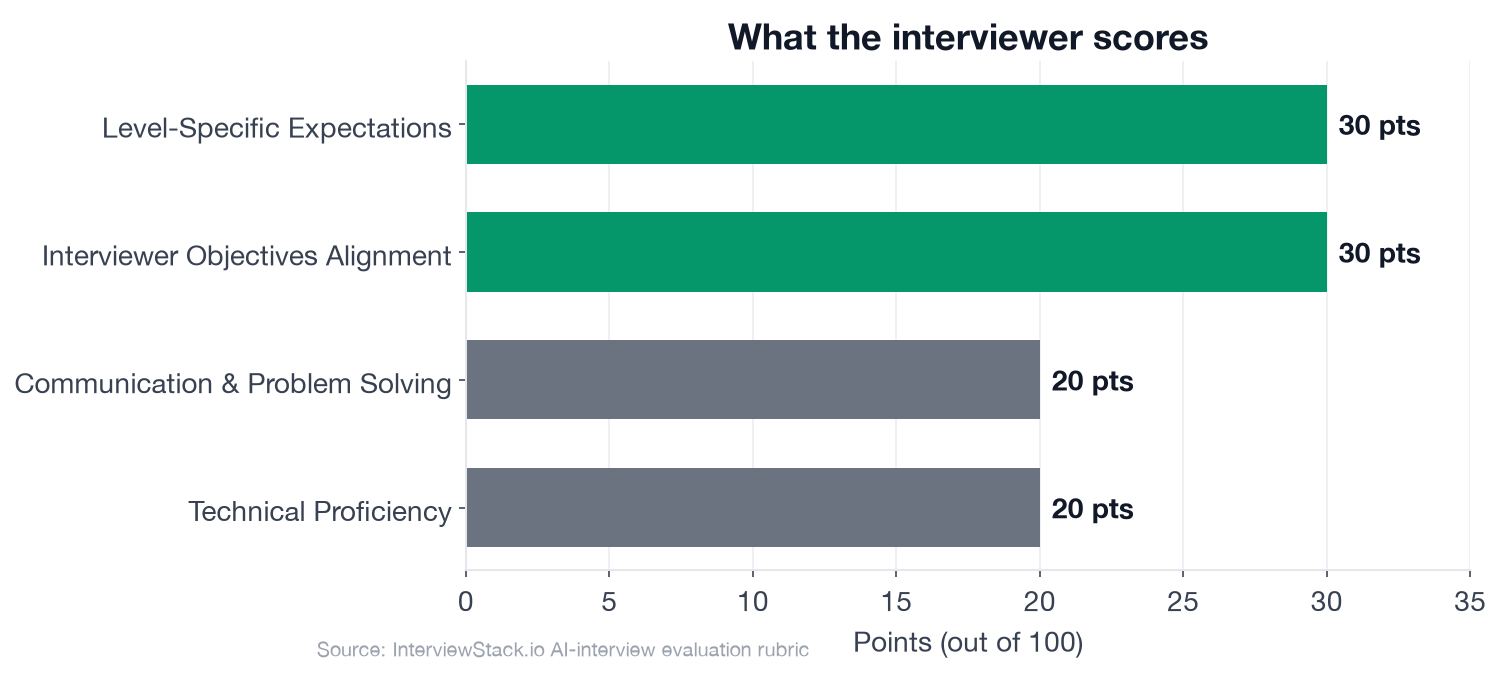
The rubric is front-loaded: the two framing dimensions together account for 60 of 100 available points.
What Does a Solutions Architect Requirements Elicitation Interview Test?
The interview question
A product leader at a large cloud collaboration company says: "Our enterprise customers are asking for an audit trail feature so admins can see what happened in their workspace. We want to launch something useful this quarter."
You are the Solutions Architect brought in before design starts. How would you approach clarifying and scoping this request so the team can align on what to build this quarter?
The interviewer is not testing whether you know what an audit trail is. They are evaluating whether you can turn an ambiguous business request into a scoped, testable set of requirements before any design decisions lock in: can you identify who needs this, ask questions that surface hidden assumptions, and define what "done" looks like in measurable terms?
The Walkthrough: Where Points Are Won and Lost
Turn 1: Naming the Wrong Primary User
Interviewer: "Who do you think the primary users and stakeholders are for this feature, and what would you want to learn from each of them before writing requirements?"
Turn 2: Listing Events Without Making Them Testable
Interviewer: "If the product leader says 'audit trail' but different customers may mean different things, how would you turn that into concrete, testable requirements?"
Turn 3: Fighting the Engineering Constraint
Interviewer: "Suppose engineering says a complete historical backfill across all products will not fit this quarter's timeline. How would you propose and justify a phased scope?"
Turn 4: Vague Success Metrics
Interviewer: "How would you define acceptance criteria and success metrics for the first release so both product and engineering know what good looks like?"
Knowing the Mistakes Is Not the Same as Avoiding Them Live
Reading through these turns, the corrections look straightforward. They are, on a blog post. In the actual interview you are managing time pressure, an unscripted follow-up from a human interviewer, and the instinct to demonstrate technical depth early. The pull toward architecture, storage systems, and latency numbers fires before you notice it.
Reliable performance in Phase 1 under that pressure comes from reps, not reading. The Solutions Architect requirements elicitation mock interview runs you through this exact 30-minute arc with unscripted follow-ups and live blueprint tracking. You can also drill specific turns first in the Solutions Architect question bank before going into a full simulation.
The Blueprint a Strong Candidate Hits
The chart below maps the 30-minute interview to its three phases: where each phase opens, how long it runs, and what the interviewer is watching for.
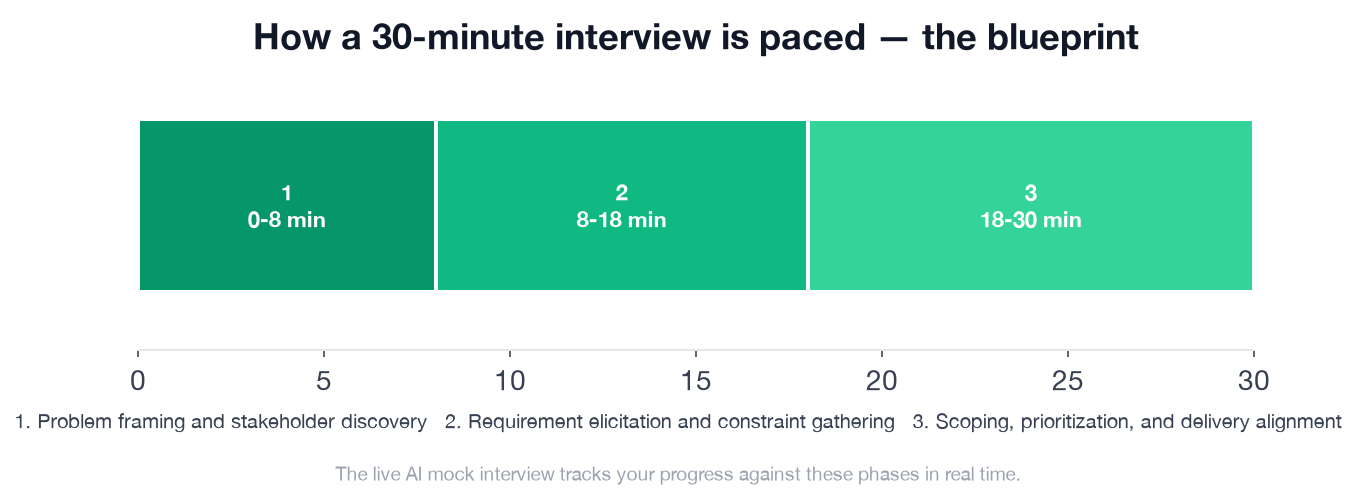
Phase timing for a strong Solutions Architect requirements elicitation and scoping interview. Phase 1 (0-8 min) is the gating layer.
This is the live blueprint the AI mock interview tracks you against. Every item below is an evaluable signal during the conversation.
- ✓Asks what business problem the audit trail is solving, not just what feature is requested
- ✓Identifies likely primary user as enterprise workspace admin or security/compliance persona
- ✓Mentions additional stakeholders such as product, security, legal/compliance, support, and engineering owners of event sources
- ✓Clarifies what "useful this quarter" means in terms of customer commitments, scope, or timeline constraints
- ✓Surfaces ambiguity in terms like audit trail, workspace, event, and admin visibility
- ✓Asks what events must be captured first, such as login, file access, sharing changes, permission updates, or admin actions
- ✓Clarifies event attributes needed in each record, for example actor, action, timestamp, target object, source IP, outcome, and workspace context
- ✓Asks about read patterns like search, filtering, export, alerting, or API access rather than assuming a UI-only solution
- ✓Covers retention expectations, ingestion volume, freshness or latency expectations, and whether data is append-only or mutable
- ✓Raises access control concerns, including who can view audit data and whether admins can see all data across a workspace
- ✓Mentions compliance or regulatory considerations such as data residency, tamper resistance, PII handling, or legal retention obligations
- ✓Starts expressing requirements as testable statements or acceptance criteria rather than only discussion notes
- ✓Proposes a sensible MVP, for example limited event categories, defined retention window, admin-only access, and basic filtering/export
- ✓Explicitly distinguishes must-haves from later enhancements such as custom alerts, long-term archival, broad product coverage, or external integrations
- ✓Defines measurable success metrics, such as adoption by pilot customers, audit query success, event freshness SLA, or support ticket reduction
- ✓Calls out dependencies and risks, such as inconsistent event generation across products, unclear compliance requirements, or timeline risk from backfill
- ✓Describes concrete output artifacts like a requirements doc, prioritized backlog, acceptance criteria list, and open-questions tracker
- ✓Communicates a phased rollout path that is plausible for a quarter and aligned to customer value
FAQ
Q. What do Solutions Architects most commonly get wrong in requirements elicitation interviews?
The most common mistake is jumping to NFR lists and event catalogs before clarifying the business problem. Sixty of 100 rubric points go to Interviewer Objectives Alignment (30 points) and Level-Specific Expectations (30 points), both of which reward structured problem framing in Phase 1 (0-8 minutes) before any technical requirements are named.
Q. How is a Solutions Architect requirements interview scored?
The rubric has four dimensions totaling 100 points: Interviewer Objectives Alignment (30 points), Level-Specific Expectations (30 points), Technical Proficiency (20 points), and Communication and Problem Solving (20 points). The first two dimensions together reward whether the candidate clarifies the business problem, identifies stakeholders, and scopes appropriately before solutioning.
Q. What does a mid-level Solutions Architect need to show in a requirements interview?
At the mid-level (2-5 years), the candidate should reliably ask core clarifying questions, identify the main requirement categories, and avoid premature over-design. They are expected to recognize common enterprise concerns such as RBAC, retention, exportability, and compliance-sensitive access, and to translate discussion outputs into concrete artifacts: user stories, acceptance criteria, and a scoped requirement checklist.
Q. How do you handle an ambiguous business request like an "audit trail feature" in a Solutions Architect interview?
Start by clarifying the business problem before naming features. Ask what the audit trail is supposed to solve, who the primary users are (enterprise workspace admin, security or compliance persona), and what "useful this quarter" means in terms of scope and customer commitments. Surface ambiguity in terms like audit trail, workspace, event, and admin visibility before moving to functional requirements.
Q. What acceptance criteria and success metrics should a Solutions Architect define for a first release?
Strong acceptance criteria are testable and time-bound: event delivery within 30 seconds of action (freshness SLA), audit log query results within 2 seconds, admin role can filter by user, event type, and date range with no gaps for in-scope events. Success metrics should be adoption-based: percentage of pilot enterprise accounts actively using audit log queries by end of quarter, and a reduction in compliance-related support tickets.
Q. What is the interview blueprint for a Solutions Architect requirements elicitation interview?
The interview runs 30 minutes across three phases: Problem framing and stakeholder discovery (0-8 minutes, 5 checklist items), Requirement elicitation and constraint gathering (8-18 minutes, 7 checklist items covering events, attributes, read patterns, retention, access control, compliance, and testable criteria), and Scoping, prioritization, and delivery alignment (18-30 minutes, 6 checklist items covering MVP, must-haves, success metrics, risks, artifacts, and phased rollout).
What the Blueprint Teaches You About Phase 1
The Phase 1 checklist is the gating layer of this interview. It is not testing whether you know what RBAC is. It is testing whether you resist the pull toward architecture long enough to frame the actual problem. Every candidate who earns top marks on this topic clears Phase 1 with all five items checked. The ones who do not usually answered a different question than the one the interviewer asked.
The blueprint is the map. Practicing it live is how you learn to use it without looking at it.
Topics
Ready to practice?
Put what you've learned into practice with AI mock interviews and structured preparation guides.