
Is an Engineering Manager Just a Senior Software Engineer in 2026?
From the outside, the two roles can look like steps on the same ladder. From the hiring data, they look like parallel tracks that share almost the same technical vocabulary but point toward very different day-to-day realities.
We analyzed every active Software Engineer posting (48,134 listings) and every active Engineering Manager posting (8,942 listings) on the InterviewStack.io job board as of May 2026, with skills extracted from descriptions and synonyms collapsed. Note: a title sample review found that a portion of the 8,942 Engineering Manager postings represent hardware, industrial, or manufacturing engineering manager roles rather than software-team EMs: the top employers include Analog Devices, GE Vernova, GlobalFoundries, and Boeing alongside software-native companies like Databricks. Skill frequencies and salary figures reflect this broader classification. The Jaccard overlap on each role's top-30 skill list is 0.76, meaning 3 in 4 required skills appear in both. More striking: no skill clears the exclusivity threshold for Engineering Manager. The management layer that distinguishes the two roles, performance feedback, headcount decisions, delivery accountability, does not show up as extractable keyword signals in job descriptions the way Python and Kubernetes do.
That said, the comparison is not a wash. Engineering Managers earn $15,000 more at the US median ($155K vs $140K base), the SE market is 5.4x larger, and the seniority ladders look different enough that the career choice matters.
| Dimension | Software Engineer | Engineering Manager |
|---|---|---|
| Active postings | 48,134 | 8,942 |
| Median US base salary | $140,000 (n=10,729) | $155,000 (n=2,008) |
| Top skill | Python (32%) | Automation (20%) |
| Skill overlap (Jaccard) | 76% shared | --- |
| Entry-level share | 4% | 4% |
| Senior + Staff share | 44% | 33% |
| Fully-remote share | 18% | 18% |
| US share of postings | 37% | 42% |
| Skills exclusive to role | Git, Linux, C++, C# | None above threshold |
Key Findings
- 48,134 Software Engineer vs 8,942 Engineering Manager active postings as of May 2026 (5.4x more SE roles).
- Median US base salary gap: $15,000 ($155,000 for Engineering Manager, n=2,008; vs $140,000 for Software Engineer, n=10,729). Both are base salary only; equity and bonus not disclosed in postings.
- Skill overlap is high at Jaccard 0.76: both roles share Python, Agile, AWS, CI/CD, Automation, and Monitoring in their top tiers.
- No skill is exclusive to Engineering Manager at the 8% threshold; the management differentiator is scope and leadership, not a different tool stack.
- SE skews more toward senior IC: 30% senior + 14% staff, vs EM's 14% senior + 19% staff.
- Both roles share an identical 18% fully-remote posting rate with onsite dominant at 60% for both.
- Technical-depth premiums are larger for EMs: distributed systems adds $45K to the EM median vs $20K to the SE median.
What Does Each Role Actually Do?
A Software Engineer's week is built around code: designing and shipping features, reviewing pull requests, debugging production incidents, and arguing about architecture trade-offs in technical design docs. The output is working software. Advancement comes from deepening technical judgment and expanding the scope of systems you can own.
An Engineering Manager's week is built around unblocking: running 1:1s, translating business priorities into engineering plans, setting technical direction for a team, managing hiring pipelines, and representing the team in cross-functional meetings. The output is team velocity, retention, and delivery. The tools on the EM job description (Python, AWS, CI/CD) reflect that companies expect managers to stay technically credible, not that they are the ones writing production code.
The people-management layer is what the analytics data cannot capture. Performance reviews, organizational design, and stakeholder communication do not emerge as extractable keyword signals the way tools do. That is why the Jaccard overlap looks so high: the data measures what the posting says, not what the job requires on a Tuesday afternoon.
What Skills Do Both Roles Require?
Both roles demand Python, Agile, Automation, AWS, and CI/CD in a meaningful share of postings. The shared tier confirms that EM candidates are expected to hold current technical credibility, not just historical credentials.
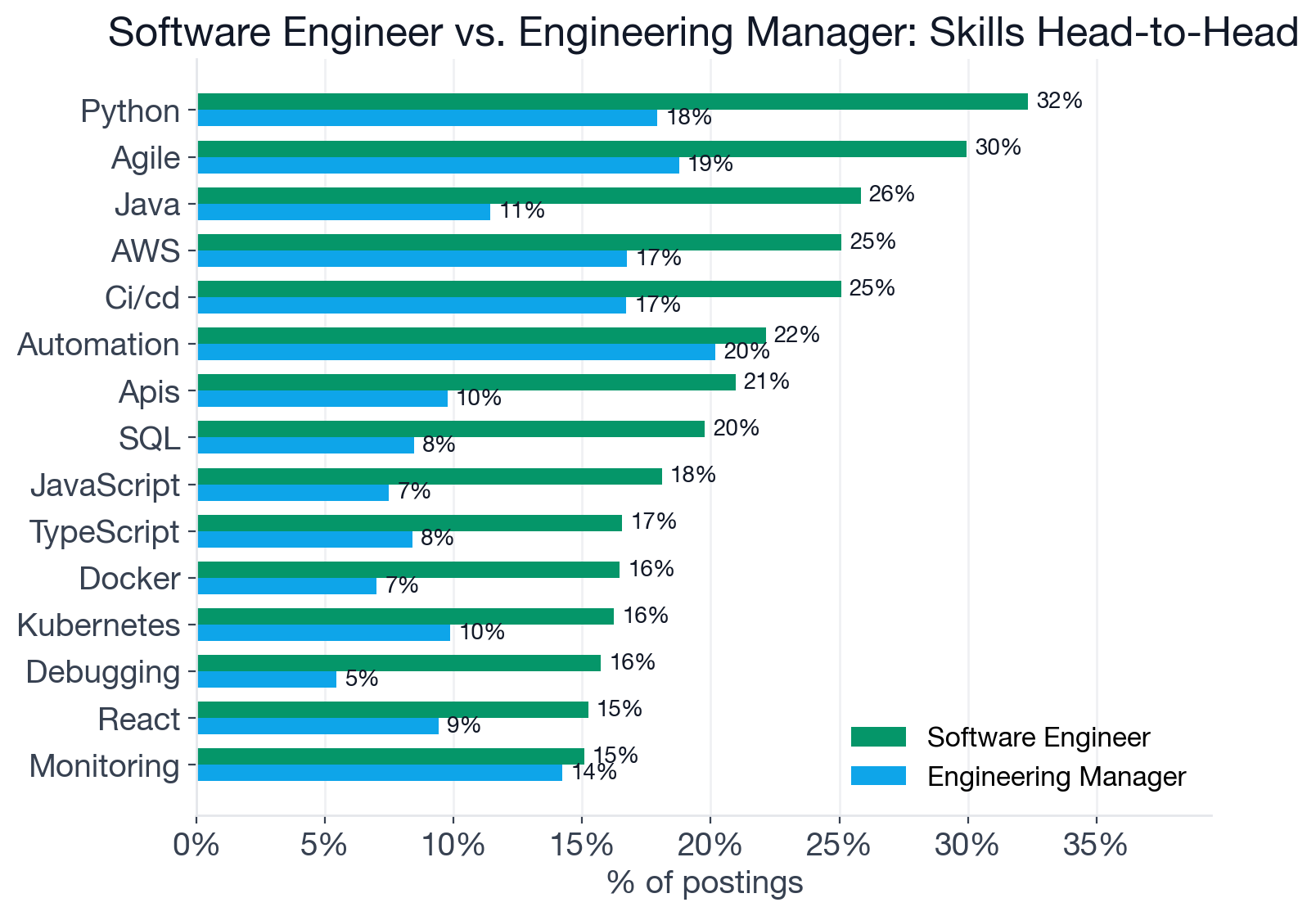
Share of postings that mention each top-shared skill. Emerald bars are Software Engineer; blue bars are Engineering Manager.
The five closest-matched shared skills by individual frequency:
- Python: 32% of SE postings, 18% of EM postings
- Agile: 30% of SE postings, 19% of EM postings
- Automation: 22% of SE postings, 20% of EM postings
- Monitoring: 15% of SE postings, 14% of EM postings, the closest-matched skill in this dataset (under 1 percentage point gap)
- Scalability: 14% of SE postings, 11% of EM postings
Monitoring's near-parity reflects a genuine shared expectation: both SEs and EMs are responsible for understanding system health, whether they own the code or the team that ships it. Automation sits almost as close (under 2pp gap), though the keyword spans software contexts (CI/CD pipelines, infrastructure as code) and operational or manufacturing contexts, with the latter likely contributing given the EM dataset's broader mix of engineering management disciplines. The EM skill profile does not drop the SE technical vocabulary; it asks for it at a lower frequency because the role is evaluated on more dimensions than code execution.
The 0.76 Jaccard coefficient also has a practical implication: if you are currently a Software Engineer preparing for interviews, roughly three-quarters of the technical foundations you build apply directly to EM interviews as well. The deeper investment you make in software engineer skills, distributed systems, cloud architecture, and CI/CD discipline, carries over almost entirely.
Where Do the Roles Diverge?
Four skills clear the exclusivity threshold for Software Engineer: Git (14.1%), Linux (12.8%), C++ (12.3%), and C# (12.0%). None of these appear in EM postings above the 5% floor.
This cluster signals the SE-exclusive domain: low-level systems work, version-control fluency, platform-level languages. Companies hiring engineers for embedded systems, game engines, or infrastructure software don't list those requirements in EM postings. The EM exclusivity list, on the other hand, is empty. Every skill that appears in Engineering Manager postings above 8% also appears in Software Engineer postings above 5%, making the EM technical profile a variation of the SE technical profile rather than a distinct one.
The practical implication: the differentiation between a strong SE candidate and a strong EM candidate is not about what tools they know. It is about evidence of having multiplied a team's output, delivered complex cross-team projects, and built the organizational trust to set technical direction. None of that evidence shows up in a keyword scan.
Which Pays More?
Engineering Managers earn more. Among US postings with structured salary data, the median US base salary is $155,000 for Engineering Manager (n=2,008) vs $140,000 for Software Engineer (n=10,729), a $15,000 (10.7%) premium. These are base salary only: equity, bonuses, RSUs, and sign-on are not disclosed in postings and are not in this data. Total compensation at top employers is meaningfully higher than these figures for both roles.
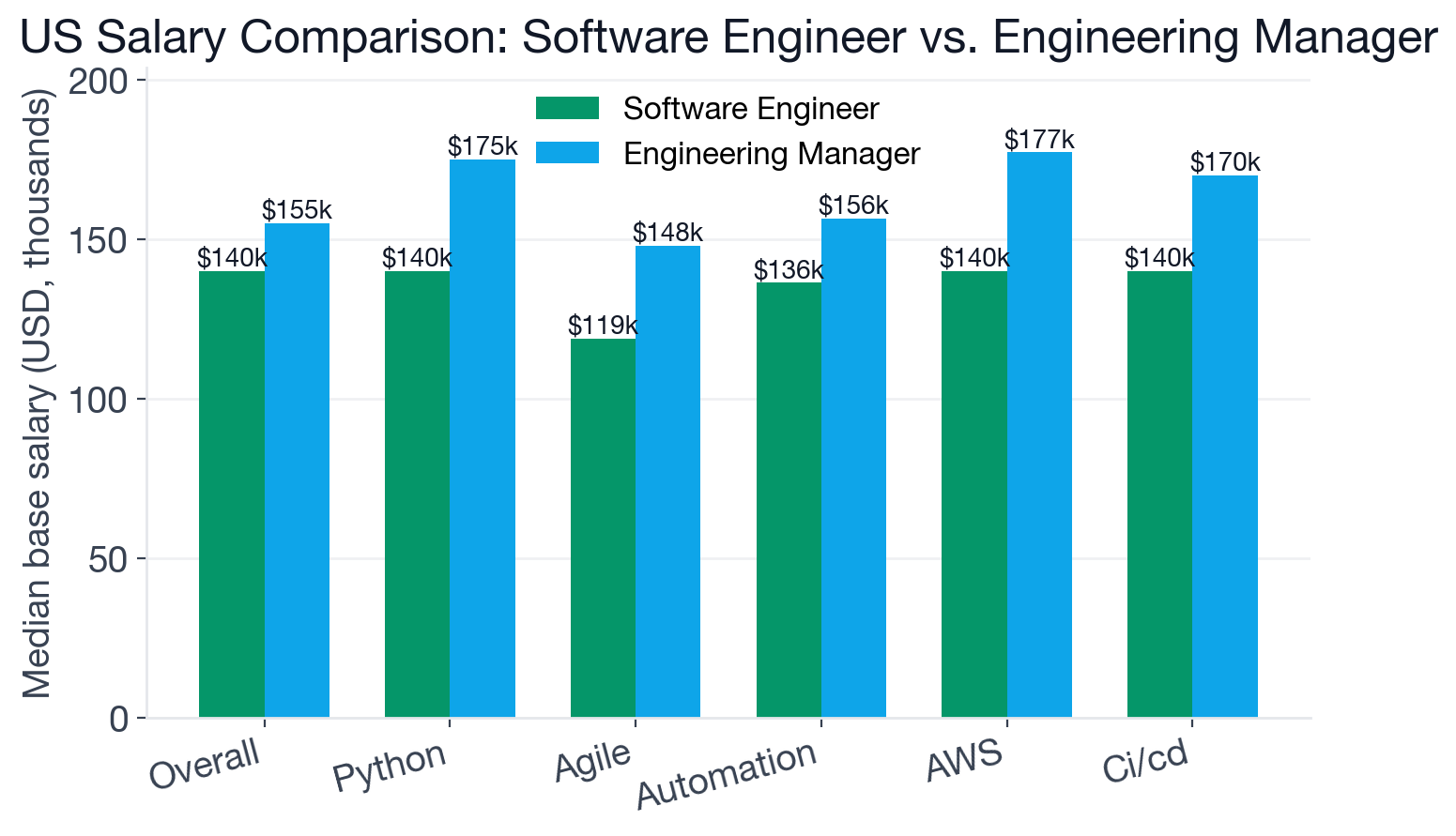
Median US base salary in USD. Software Engineer (emerald) vs Engineering Manager (blue). Skill bars show the median for postings that mention each skill.
The more interesting story is the premium structure above each baseline. Technical-depth skills pay a substantially larger premium for EMs than for SEs:
| Skill | SE median | EM median |
|---|---|---|
| Baseline (all postings) | $140,000 | $155,000 |
| Distributed Systems | $160,000 (+$20K) | $200,000 (+$45K) |
| Apache Spark | $159,200 (+$19K) | $197,200 (+$42K) |
| Machine Learning | $154,100 (+$14K) | $193,900 (+$39K) |
| Observability | $160,000 (+$20K) | $186,000 (+$31K) |
| Python | $140,000 (+$0) | $175,000 (+$20K) |
Python earns zero premium over the SE baseline because it is table stakes: fluency is priced in, not rewarded. For Engineering Managers, Python fluency adds $20K because not all EMs code actively, so those who do get a signal value. The distributed systems premium tells an even sharper story: an EM who can credibly architect for scale is compensated at more than double the SE premium for the same capability.
Which Has More Job Openings?
Software Engineer is not close: 48,134 active SE postings vs 8,942 EM postings as of May 2026, a 5.4x difference. The US is the largest market for both, at 37% of SE postings and 42% of EM postings. India is the second-largest market for SE (19%), but a smaller share for EM (12%), reflecting that senior people-management roles are more concentrated in the headquarters market.
Seniority is where the career-shape difference becomes clearest. SE postings skew toward experienced ICs: 30% senior and 14% staff. EM postings pack more weight at the top of the mid-level band (62.7% mid-level) with 14.1% senior and 18.8% staff. The high mid-level share for EM reflects the "Engineering Manager" title itself mapping to mid-level in title-based seniority inference, as distinct from "Senior Engineering Manager" or "Director" at the higher tiers.
Entry-level share is 4% for both. The 4% EM figure does not represent a real entry-management path: it captures fringe cases (mislabeled titles, non-software engineering management roles) that pass the job-board quality filter. Companies hiring Engineering Managers screen for demonstrated IC track record. The real entry bar for EM hiring is a senior or staff IC title, not a fresh graduation date.
Which Should You Choose?
Choose Software Engineer if you:
- Want to stay close to code and build deep technical expertise in a specific area (systems, AI infrastructure, mobile, web platform)
- Need maximum job-market optionality: 5.4x more openings means faster search, broader company coverage, and more leverage in negotiation
- Are earlier in your career: mid-level and senior IC rungs are more numerous and more accessible
- Want to reach specialist compensation through technical depth: Rust ($165K), Distributed Systems or Observability ($160K) each add $20K to $25K over the $140K baseline
Choose Engineering Manager if you:
- Find your highest leverage comes from multiplying a team's output rather than shipping code yourself
- Have a solid senior IC foundation and are ready to use people management as the primary growth dimension
- Can accept a 5.4x smaller market in exchange for the $15K salary premium and a distinct career trajectory
- Are willing to build the ML, distributed-systems, and Kafka-based streaming depth that adds $39K to $45K over the $155K baseline, because that is where EM compensation scales most steeply
How to Use This in Your Job Search
For Software Engineer prep: practice with AI mock interviews focused on system design and coding, use the question bank to drill the distributed systems, data structures, and cloud architecture topics that show up most in onsite rounds, and filter current Software Engineer openings by skill stack to find roles that match what you are building. For Engineering Manager prep: the interview format shifts heavily toward behavioral and system-design-at-scale questions; AI mock interviews with engineering-leadership scenarios and the preparation guides for target companies are the highest-leverage tools at that stage. Browse Engineering Manager openings filtered by geography and company to calibrate the real market.
FAQ
Q. What is the salary difference between Software Engineer and Engineering Manager in 2026?
Engineering Managers earn a $15,000 higher median US base salary than Software Engineers: $155,000 vs $140,000. That is a 10.7% premium. Both figures cover US postings only (n=2,008 for EM, n=10,729 for SE) and reflect base salary only; equity and bonus are not disclosed in postings and are not in this dataset.
Q. How much do Software Engineer and Engineering Manager skills overlap?
The Jaccard overlap on each role's top-30 skill list is 0.76, meaning about 3 in 4 skills demanded in one role also appear in the other. Python, Agile, Automation, AWS, CI/CD, and Monitoring are in the top tiers of both. The analytics show no skill exclusive to Engineering Manager at the 8% threshold, confirming that the EM-role differentiator is scope and people leadership, not a distinct technology stack.
Q. Which has more job openings, Software Engineer or Engineering Manager?
Software Engineer by a wide margin: 48,134 active postings vs 8,942 for Engineering Manager as of May 2026 on the InterviewStack.io job board, a 5.4x difference. The US is the largest market for both (37% of SE postings, 42% of EM postings), and both roles share an 18% fully-remote posting share.
Q. What skills do both Software Engineers and Engineering Managers need?
Python (SE 32%, EM 18%), Agile (SE 30%, EM 19%), Automation (SE 22%, EM 20%), AWS (SE 25%, EM 17%), and CI/CD (SE 25%, EM 17%) appear in the top tiers of both roles. Monitoring and Scalability also clear the shared threshold. The strong overlap means SE skills transfer almost entirely into EM postings.
Q. Is Engineering Manager a realistic first-management role?
In practice, no. While 4% of EM postings carry entry-level signals, 62.7% are mid-level and 18.8% are staff-level or above. The distribution reflects a real hiring bar: companies expect Engineering Manager candidates to have demonstrated IC delivery before adding people-management scope. Most career paths route through senior or staff IC first.
Q. Should I become a Software Engineer or an Engineering Manager?
Choose Software Engineer if you want to stay deep in code, maximize the breadth of open roles (5.4x more openings), and reach a $140,000 US base median with specialist premiums up to $25,000 higher for Rust, distributed systems, or observability. Choose Engineering Manager if you want to influence outcomes through a team rather than through code, accept a more constrained opening pool, and target a $155,000 US base median with technical-depth premiums of $39,000 to $45,000 for ML, distributed systems, and Kafka-based streaming.
Final Thoughts
The skill data makes the transition from SE to EM look deceptively smooth: the technical vocabulary is nearly identical, and your existing foundations transfer almost entirely. What the data cannot show is the full scope change. You go from being evaluated on what you ship to being evaluated on what your team ships. Both are strong career paths with healthy demand and clear compensation ladders. The question is which kind of leverage feels like the right fit at this stage of your career. Browse Software Engineer openings and Engineering Manager openings on InterviewStack.io to see what the real market looks like right now.
Topics
Ready to practice?
Put what you've learned into practice with AI mock interviews and structured preparation guides.