
Working Together, Worlds Apart
On most product teams, these two roles sit next to each other. The PM decides what to build; the UI Designer decides how it looks and feels. They share standups, sprint reviews, and launch nights. But in the job market, they live on different planets.
Across 15,524 active Product Manager postings and 1,041 UI Designer postings on the InterviewStack.io job board as of June 2026, the gap is stark: nearly 15 times more PM openings, a $51,000 median salary advantage for PMs, and skill profiles so divergent that only Agile clears the significance threshold in both roles.
| Product Manager | UI Designer | |
|---|---|---|
| Median US base salary | $140,000 | $89,000 |
| Active postings | 15,524 | 1,041 |
| Top skill | Agile (27%) | Figma (58%) |
| Remote share | 24% | 29% |
| Entry-level share | 4% | 9% |
| Skill overlap (Jaccard) | 0.30 across top-30 | (pairwise) |
Key Findings
- Product Manager has 15,524 active postings vs UI Designer's 1,041, a 14.9x difference in volume.
- Median US base salary: $140,000 for Product Manager (n=3,743) vs $89,000 for UI Designer (n=103), a $51,000 gap (57% higher for PM). Base salary only; equity excluded.
- Jaccard skill overlap is 0.30 across each role's top-30 skills. Only Agile appears at meaningful frequency in both: 27% for PM, 14% for UI Designer.
- UI Designer has a higher entry-level share: 9.4% (98 entry postings) vs 4.3% (674 entry postings) for Product Manager.
- Top PM salary premium skills vs the $140K baseline: LLMs at $170,000 (+$30K, n=142), System Design at $160,000 (+$20K, n=61), Machine Learning at $157,600 (+$18K, n=258).
- Top UI Designer premium skill vs the $89K baseline: Design Systems at $100,000 (+$11K, n=37). Figma adds +$5K. Prototyping sits below baseline.
- Explicit AI requirements are low in postings (~5% PM, ~2% UI Designer), but survey data shows 94% of PMs (Productboard) and 91% of designers (State of AI in Design) use AI tools daily or near-daily. The gap between those numbers is the ambient layer job postings cannot see.
What Does Each Role Actually Do?
Product Manager: A PM's day is defined by decisions and alignment. They translate business objectives into scoped product requirements, manage the roadmap against competing priorities from engineering, sales, and leadership, and make the calls that let the team ship. The exclusive skills are telling: Jira and Scrum for coordination, SQL and Excel for data-driven analysis, APIs for the technical fluency to have credible conversations with engineers. PMs rarely build directly; they enable others to build well.
UI Designer: A UI Designer's day is defined by visual craft and handoff precision. They translate wireframes and user flows into polished screens: typography hierarchies, component states, interaction specs, and developer-ready assets. Figma dominates the role at 58% of postings, the highest single-skill concentration for either role. Design Systems at 33% reflects the industry shift toward component-based design: rather than designing screens from scratch, designers now build and maintain shared component libraries that keep products visually consistent as they scale.
Where the Skill Profiles Part Ways
The shortest summary: Product Manager needs process fluency and data literacy; UI Designer needs visual craft and front-end proximity. They share almost no required skills.
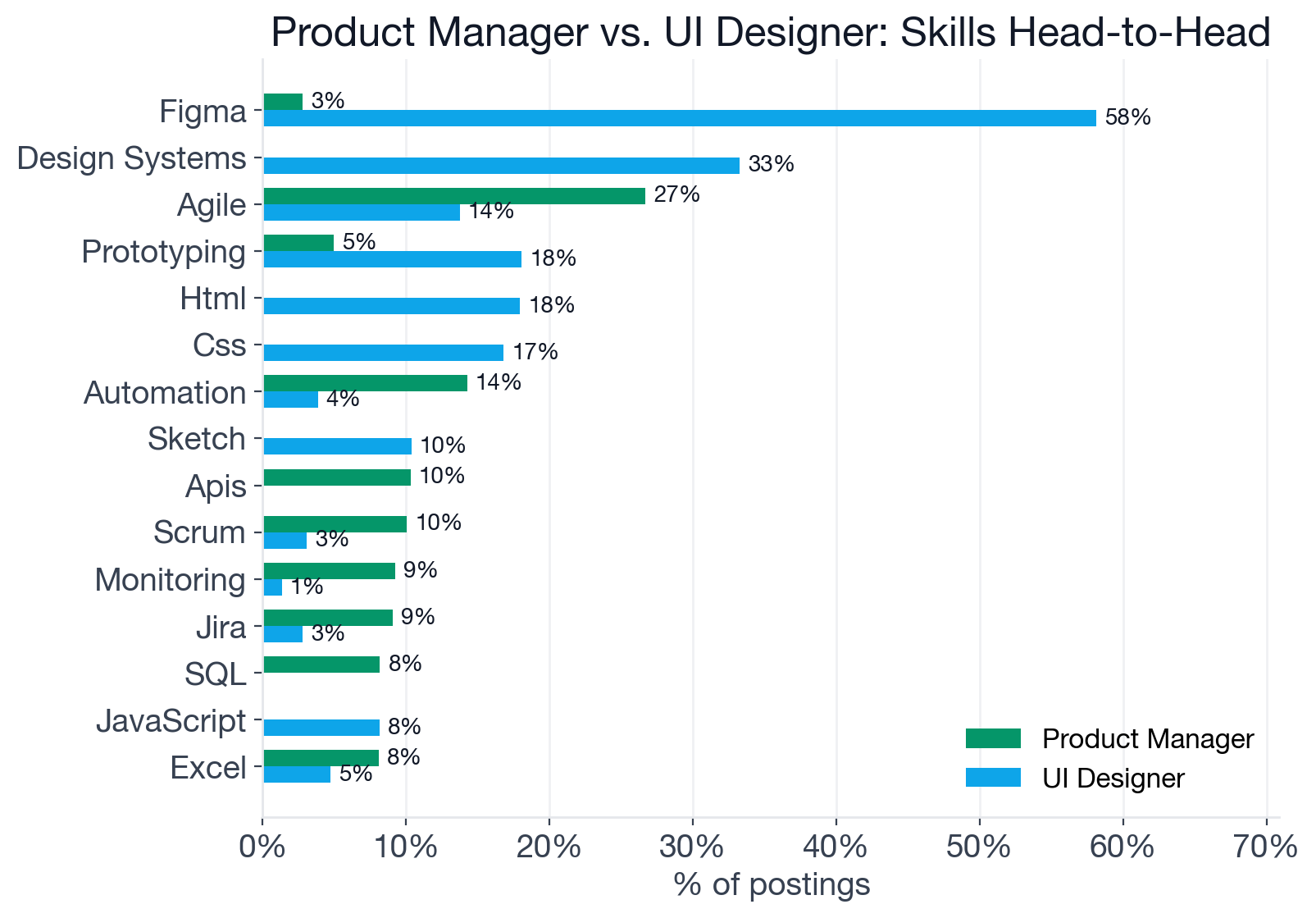
Top skills from 15,524 PM and 1,041 UI Designer postings. Only Agile appears at significant frequency in both roles.
PM-exclusive skills (≥8% in PM postings, below 5% in UI Designer postings):
- Automation (14%): Central to PMs managing growth loops, testing pipelines, and internal tooling roadmaps.
- APIs (10%): Technical PMs spec integrations and evaluate platform feasibility. Understanding what an API call does (and what it costs) is now a baseline expectation.
- Scrum and Jira (10% and 9%): Process literacy is non-negotiable. Most tech organizations run Agile sprints and use Jira to track them.
- SQL (8%): Data-capable PMs query their own analytics rather than waiting on a data team. SQL is a real salary signal in this role, as the next section shows.
- Excel (8%): Persistent in enterprise, B2B, and healthcare companies.
UI Designer-exclusive skills (≥8% in UI Designer postings, below 5% in PM postings):
- Figma (58%): Table stakes. The industry has consolidated on Figma for interface design, prototyping, and developer handoff.
- Design Systems (33%): Building and maintaining shared component libraries is now a core expectation, not a bonus. It is also the highest-paying skill in the role.
- Prototyping (18%): Designers validate interactions before engineering builds them.
- HTML and CSS (18% and 17%): Designers who can read and write basic front-end code communicate more precisely with engineers and spot translation errors in implementation.
- Sketch (10%) and JavaScript (8%) round out the craft toolkit.
On AI: neither role requires building AI systems in most postings. About 5% of PM postings explicitly name Generative AI or LLMs; about 2% of UI Designer postings do the same. Those figures measure who is hired to deploy AI as a primary deliverable. They do not capture ambient usage. According to Productboard's 2026 product management research, 94% of product professionals use AI tools daily or often. For designers, State of AI in Design 2026 finds 91% use AI weekly, though designers are more skeptical than developers about quality improvement: 47% say AI makes them better at their role, vs. 68% of developers in the Figma 2025 AI report. Both roles treat AI tool use as ambient and expected. The small posting percentages just tell you how many companies explicitly hire to build AI products.
Which Pays More?
Product Manager earns a $140,000 median US base salary (n=3,743); UI Designer earns $89,000 (n=103). These are base salaries only: equity, bonuses, and sign-on are not disclosed in postings, so total compensation at top employers runs higher than these numbers. Two caveats apply to the UI Designer figure: the sample is small (103 postings disclosed salary out of 1,041 total), and the role classifier captures a broader category than pure UI interface design , visual designers, web designers, marketing/creative designers, and some adjacent specialties are all included. This category breadth likely pulls the $89,000 median modestly below what postings explicitly titled "UI Designer" or "Product Designer" would show in isolation. Treat it as a visual design market median with moderate uncertainty rather than a precise figure for any single specialty.
The $51,000 gap (57% premium for PM) reflects scope and cross-functional accountability. PMs own decisions that affect engineering, design, and business simultaneously, and that breadth commands a premium across industries. UI Designers are more supply-rich relative to demand, and the craft focus typically lives within a single function.
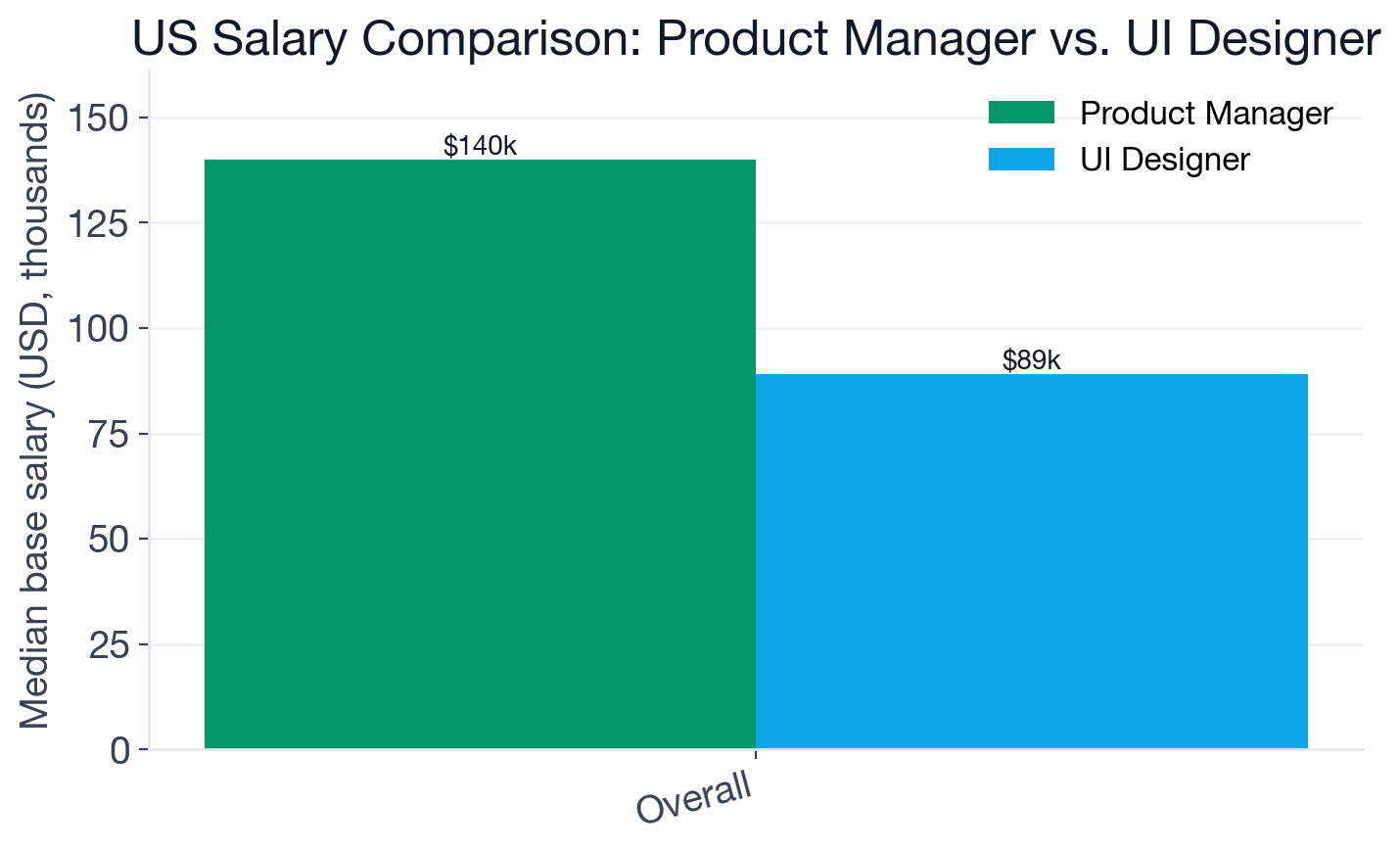
Median US base salary from postings with disclosed compensation data. Base salary only; equity and bonuses excluded.
Highest-premium skills for Product Managers (vs. the $140,000 baseline, all n≥25):
- LLMs: $170,000 (n=142), +$30K. PMs on AI-native product teams earn a clear market premium.
- System Design: $160,000 (n=61), +$20K. Technical depth translates directly into offers.
- Machine Learning: $157,600 (n=258), +$18K. ML product roles command a meaningful premium.
- Design Systems: $155,900 (n=46), +$16K. PMs who understand the design system layer earn above baseline. This is also the top-paying skill for UI Designers, which makes it a rare cross-discipline signal.
- APIs: $150,000 (n=474), +$10K. The most common high-premium skill by sample size.
For UI Designers (vs. the $89,000 baseline, US postings, all n≥25):
- Design Systems: $100,000 (n=37), +$11K. Systems-level thinking is the clearest salary differentiator in this role.
- Figma: $94,100 (n=54), +$5K. Table stakes for the role, but still above baseline.
- Prototyping: $86,800 (n=28), slightly below baseline. Associated with more exploratory or junior work.
The Job Markets Are Not Even Close
Product Manager has 15,524 active postings vs UI Designer's 1,041: a 14.9x difference that shapes every practical dimension of the comparison.
Entry-level access: UI Designer is proportionally more accessible. About 9.4% of UI Designer postings are explicitly entry-level (98 openings) vs 4.3% for PM (674 openings). PM has more total entry-level openings in absolute terms, but 1 in 10 UI Designer postings is entry-level vs 1 in 23 for PM.
Remote work: Both roles are onsite-dominant. PM: 45% onsite, 31% hybrid, 24% remote. UI Designer: 44% onsite, 25% hybrid, 29% remote. UI Designer is slightly more remote-friendly, though neither role is especially amenable to remote.
Geography: PM postings are US-heavy at 43% of the total, followed by India (6%), UK (5%), and Canada (5%). UI Designer is more globally distributed: the US is 27%, with Germany and India each at 6%, Canada at 5%, and the UK at 5%. If you are based in Europe, UI Designer openings represent a proportionally stronger market.
Which Should You Choose?
Choose Product Manager if you:
- Want work centered on decisions, strategy, and cross-functional influence rather than visual craft.
- Have or want to build technical literacy: SQL, APIs, and system design fluency all carry real salary premiums (see above).
- Prioritize job volume and compensation ceiling: the market is 15x larger with a $51,000 median salary advantage.
- Are willing to clear a steeper proportional entry bar (4.3% entry-level share) in exchange for a much larger total opportunity set.
Choose UI Designer if you:
- Find visual problem-solving more compelling than coordination and stakeholder management.
- Want a proportionally more accessible entry path: 1 in 10 UI Designer postings is explicitly entry-level.
- Are building a craft toolkit (Figma, Design Systems, HTML/CSS) that is deep and transferable across products and industries.
- Are based in or open to European markets, where the UI Designer share is stronger relative to PM.
How to Use This in Your Job Search
For Product Manager candidates: the data rewards technical literacy. Browse PM openings that ask for SQL or APIs to calibrate which companies expect that depth. The question bank covers product strategy, prioritization, and metrics frameworks. AI mock interviews let you practice estimation, product design, and stakeholder scenarios under realistic conditions.
For UI Designer candidates: the salary data signals that systems thinking matters more than individual-screen polish. Browse UI Designer openings that ask for Design Systems to see the kind of work companies pay a premium for. Interactive courses build the conceptual foundations that show up in design portfolio reviews and panel critiques.
FAQ
Q. What is the salary difference between a Product Manager and UI Designer in 2026?
Product Managers earn a median US base salary of $140,000 (n=3,743 postings with disclosed salary data), compared to $89,000 for UI Designers (n=103). That is a $51,000 gap, or 57% more for PMs. Both figures are base salary only; equity and bonuses are not disclosed in posting data.
Q. How different are Product Manager and UI Designer skill sets?
Very different. Jaccard similarity across each role's top-30 skills is 0.30, and only Agile appears as a shared skill at meaningful frequency in both roles: 27% for PM, 14% for UI Designer. Product Managers need process tools (Agile, Scrum, Jira), data skills (SQL, Excel), and technical literacy (APIs, Monitoring). UI Designers need visual tools (Figma, Design Systems, Prototyping) and front-end skills (HTML, CSS, JavaScript).
Q. Which role has more job openings, Product Manager or UI Designer?
Product Manager has dramatically more: 15,524 active postings vs 1,041 for UI Designer, a 14.9x difference. The US is the largest market for both, but PM postings are more US-concentrated (43%) while UI Designer postings are more globally distributed (27% US, with Germany and India each near 6%).
Q. Is UI Designer easier to break into than Product Manager?
By entry-level share, yes. UI Designer postings are 9.4% entry-level, more than double the 4.3% entry-level share for Product Manager. In absolute numbers, UI Designer has 98 entry-level openings vs 674 for PM. PM has more total entry openings but a steeper proportional barrier for junior applicants.
Q. What are the highest-paying skills for Product Managers and UI Designers in 2026?
For Product Managers (US base, $140K baseline), LLMs command $170,000 median (+$30K), System Design $160,000 (+$20K), and Machine Learning $157,600 (+$18K). For UI Designers (US base, $89K baseline), Design Systems is the top skill at $100,000 (+$11K above baseline); Figma comes in at $94,100 (+$5K). Prototyping sits slightly below the $89K baseline at $86,800. All figures are base salary only from US postings.
Q. Do Product Managers and UI Designers need AI skills in 2026?
Job postings show low explicit AI requirements: about 5% of PM postings mention Generative AI or LLMs, and about 2% of UI Designer postings mention Generative AI. But survey data shows near-universal ambient use: 94% of product professionals use AI tools daily or often (Productboard, 2026) and 91% of designers use AI weekly (State of AI in Design, 2026). The posting figures measure who is hired to build AI systems; the survey figures measure the ambient tool use that both roles now treat as standard.
Q. Should I become a Product Manager or UI Designer?
Choose Product Manager for a larger job market (15x more openings), higher compensation ($51K median premium), and work spanning strategy, data, and cross-functional coordination. Choose UI Designer for more accessible entry (9.4% entry-level vs 4.3%), a stronger European job market, and work centered on visual craft and front-end proximity. The skill sets share almost nothing in common, so the decision is primarily about which kind of work you want to do daily.
The Bottom Line
These two roles build products together but compete in markets that look nothing alike. If compensation ceiling and job volume are your primary criteria, the data points clearly toward Product Manager. If entry accessibility, visual craft, or European job markets matter more, UI Designer offers a different calculus. Start with live data: browse Product Manager openings and UI Designer openings on InterviewStack.io, filtered to the skills and seniority levels that match where you are today.
Topics
Ready to practice?
Put what you've learned into practice with AI mock interviews and structured preparation guides.