
BGP Is a Bar to Clear. Python Is What Gets You Past It.
Network Engineering in 2026 has a salary structure that runs backward from what most candidates expect. BGP (Border Gateway Protocol, the routing standard for directing traffic between large networks), OSPF (Open Shortest Path First, the interior routing protocol most enterprise networks run), and firewalls are the traditional routing-and-security skills you'll find across much of the market. They also happen to pay close to the $126,800 US median or below it. The skills that clear the ceiling are automation-adjacent: observability tooling carries a $38,000 premium over baseline, CI/CD pipeline experience adds $35,000, and Terraform adds $16,000.
To map this, we analyzed every active Network Engineer posting on the InterviewStack.io job board as of June 2026: 3,240 listings with skills normalized and synonyms collapsed. One secondary signal belongs in the first paragraph: this is an onsite-heavy role. Only 9.4% of postings are tagged remote, compared to roughly 27% for Data Engineers and higher for many software roles. If physical presence at a data center or campus is a constraint, that shapes your options before any skill choice does.
The strategic implication: getting hired as a Network Engineer requires solid protocol and security knowledge. Getting paid above median requires adding programmability and automation to that foundation.
Key Findings
- 3,240 active Network Engineer postings analyzed on the InterviewStack.io job board as of June 2026.
- No skill clears 50%. Monitoring leads at 48.2% (1,563 postings), followed by Firewalls (40.3%), Automation (33.3%), and BGP (31.9%). The role fragments across routing, security, cloud networking, and automation specializations, each with its own distinct skill cluster.
- Median US base salary: $126,800 (n=979 US postings with salary disclosed). Equity, bonuses, and sign-on are excluded from this figure.
- The salary inversion is stark: BGP earns a median $129,300 (+$2.5K over baseline) and Firewalls sits exactly at $126,800 (at baseline). Observability adds +$38K, CI/CD adds +$35K, Terraform adds +$16K, and Ansible adds +$11K.
- Entry-level access is narrow: Only 3.4% of postings (111 of 3,240) are explicitly entry-level; 65.8% are mid-level.
- 63.1% of postings are onsite, 30.3% hybrid, and 9.4% remote, one of the most location-constrained roles in tech infrastructure.
- Defense and government contractors dominate hiring: Leidos (76 postings), General Dynamics IT (68), Booz Allen Hamilton (51), and Northrop Grumman (44) lead by a wide margin.
What Skill Families Cover This Role?
Group every individual skill into the broader domain it belongs to and the role's real shape becomes clearer. The dominant families are networking-specific competencies (93% of postings ask for at least one), Tools and Infrastructure (68%), and Coding Languages (31%).
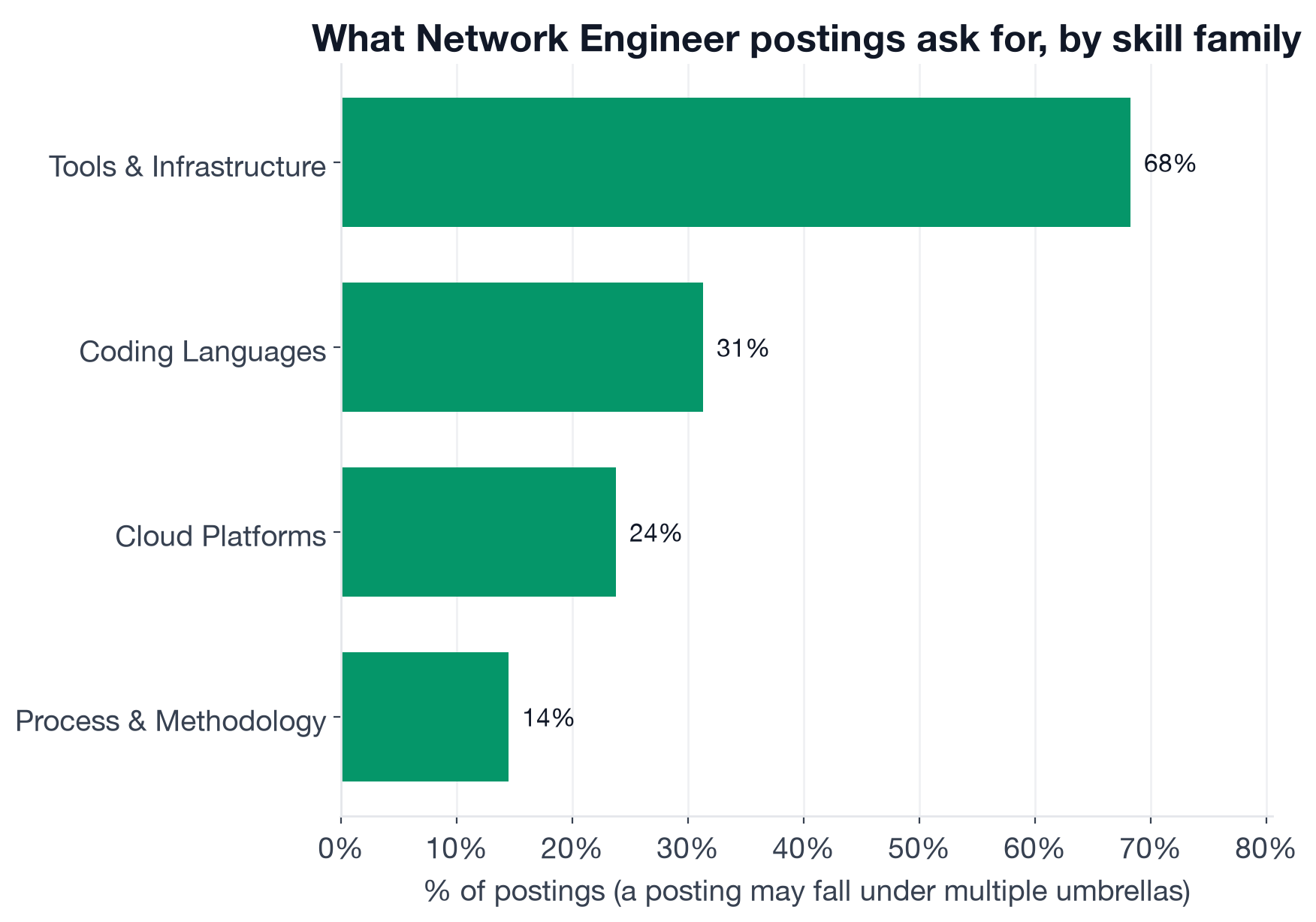
Share of Network Engineer postings that ask for at least one skill in each family. A posting that mentions both Firewalls and BGP counts once under "Networking."
The 93% "networking core" captures everything that defines the traditional role: routing protocols (BGP, OSPF), connectivity services (VPN, DHCP, DNS), and security controls (firewalls, network security). Nearly every posting touches this layer, which is why it tops the chart. But universality also means baseline pricing: a skill that everyone must have does not make you more valuable than the next candidate who also has it.
Above that foundation, the Tools and Infrastructure family at 68% captures monitoring platforms, automation tooling, and Linux. This is the operational layer that keeps networks running at scale. Coding Languages at 31% is the number most likely to surprise a traditional network engineer: one in three postings explicitly asks for a programming skill, primarily Python (22% of all postings).
What is absent matters equally. Machine Learning and AI sits at just 2.3% of postings. That number measures engineers hired to build or operate AI-driven network systems (AIOps platforms, intent-based networking pipelines). It does not capture ambient AI use: the 85% of developers who now use AI tools regularly per JetBrains' 2025 Developer Ecosystem Survey of 24,534 developers, or the 51% who use them daily per Stack Overflow's 2025 Developer Survey. When a posting asks for Python and Ansible automation, it expects the candidate to use AI tools to write those scripts faster. The explicit percentage is a floor, not a ceiling.
Which Skills Are Actually Expected?
Drill into individual skills and three tiers emerge, and one signal stands out before anything else: no skill clears the 50% mark.
This is unusual across tech roles. Data Engineering has three skills above 70%. Software Engineering, with its own specialization breadth, also shows no skill clearing 50% on the InterviewStack job board. For Network Engineers, even the top skill (Monitoring at 48.2%) barely misses the table-stakes line. The reason is genuine fragmentation: a routing-specialist posting emphasizes BGP and OSPF, a security-focused posting emphasizes firewalls and zero trust, a cloud network posting emphasizes Azure and AWS, and a field-tech posting emphasizes DHCP and DNS. These clusters do not fully overlap, so no single skill becomes universal.
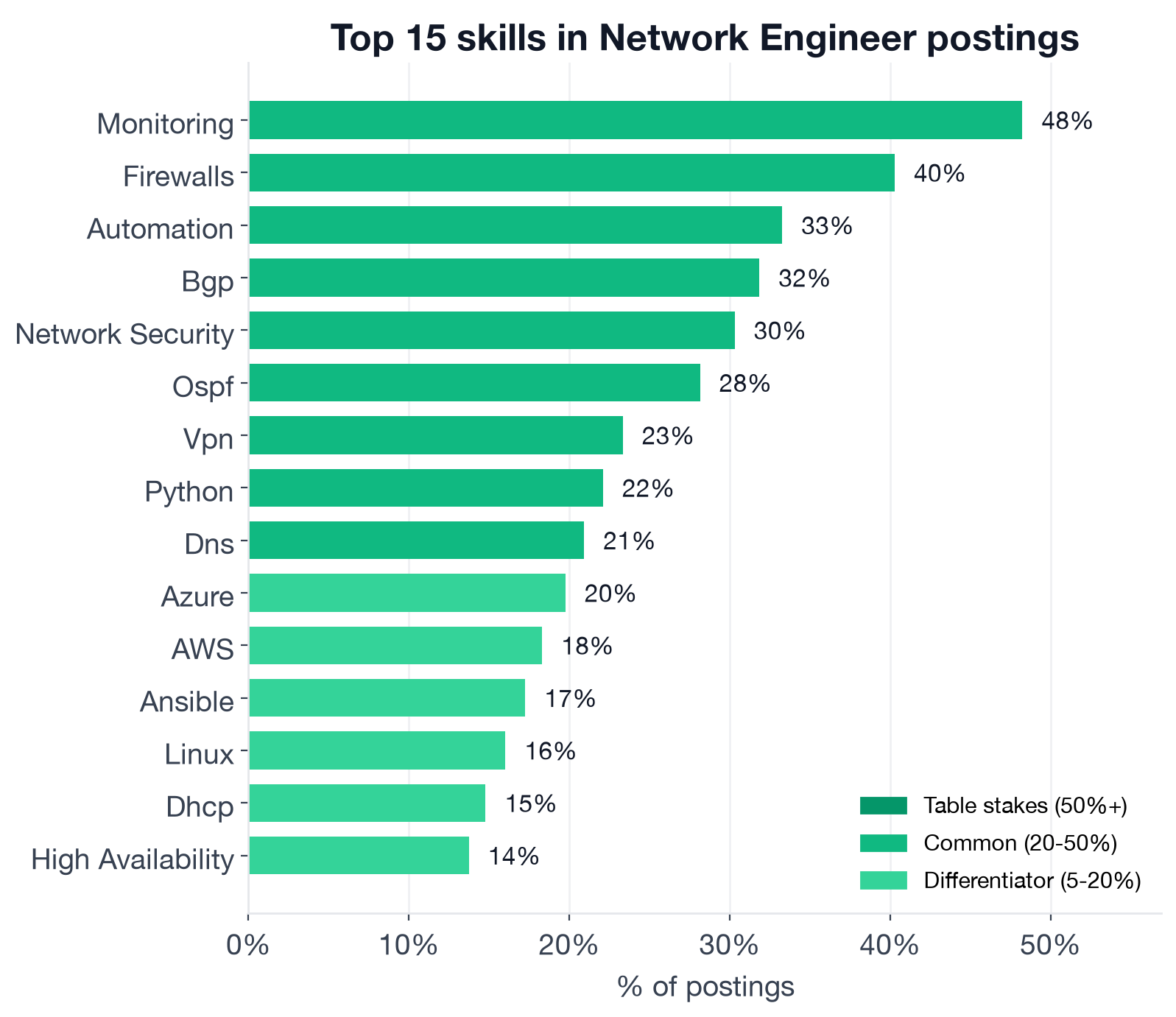
Top individual skills by share of Network Engineer postings. Skills from 20-50% are "common"; 5-20% are differentiators. No skill reaches the 50% table-stakes threshold.
Common Expectations (20-48% of postings)
Nine skills sit in this band, each expected in a significant portion of the market:
| Skill | Share of postings |
|---|---|
| Monitoring | 48.2% |
| Firewalls | 40.3% |
| Automation | 33.3% |
| BGP | 31.9% |
| Network Security | 30.3% |
| OSPF | 28.1% |
| VPN | 23.3% |
| Python | 22.1% |
| DNS | 20.9% |
Monitoring tops the chart because visibility is expected regardless of specialization. Whether you run routing, security, or cloud networking, you're expected to monitor what you build or operate. The protocols cluster (BGP, OSPF, VPN, firewalls) is the routing-and-security backbone most people associate with network engineering.
Python crossing into the common tier at 22.1% is the clearest signal of how the role is evolving. Writing Python scripts for network automation is no longer a differentiator; it is a baseline expectation in roughly one in five postings, and that share is growing.
Differentiators (5-20% of postings)
The differentiator tier is long. Cloud platforms (Azure 19.8%, AWS 18.3%), automation tooling (Ansible 17.3%), Linux (16.0%), connectivity services (DHCP 14.8%, MPLS 12.7%), and security practices (Zero Trust 8.1%, encryption 5.5%) all clear the 5% threshold. MPLS is Multiprotocol Label Switching, a technique for directing traffic using short path labels rather than full IP addresses, used heavily in carrier and enterprise WAN environments.
The automation stack in this tier (Ansible paired with Python, discussed in the pairs section below) is where the salary premium lives. Browse Network Engineer postings that ask for Ansible and you'll see roles that mix scripting, configuration management, and traditional networking. These postings pay above baseline.
Why the Routing Expert Doesn't Earn the Most
All salary numbers below are US-only base salary from postings where wage-transparency laws produce consistent disclosure (n=979). Equity, RSUs, bonuses, and sign-on are not disclosed in postings and are excluded. Total compensation at top employers is meaningfully higher than what we report here, especially at large technology and defense firms.
The median US base for Network Engineer postings is $126,800. Here is where the salary actually moves:
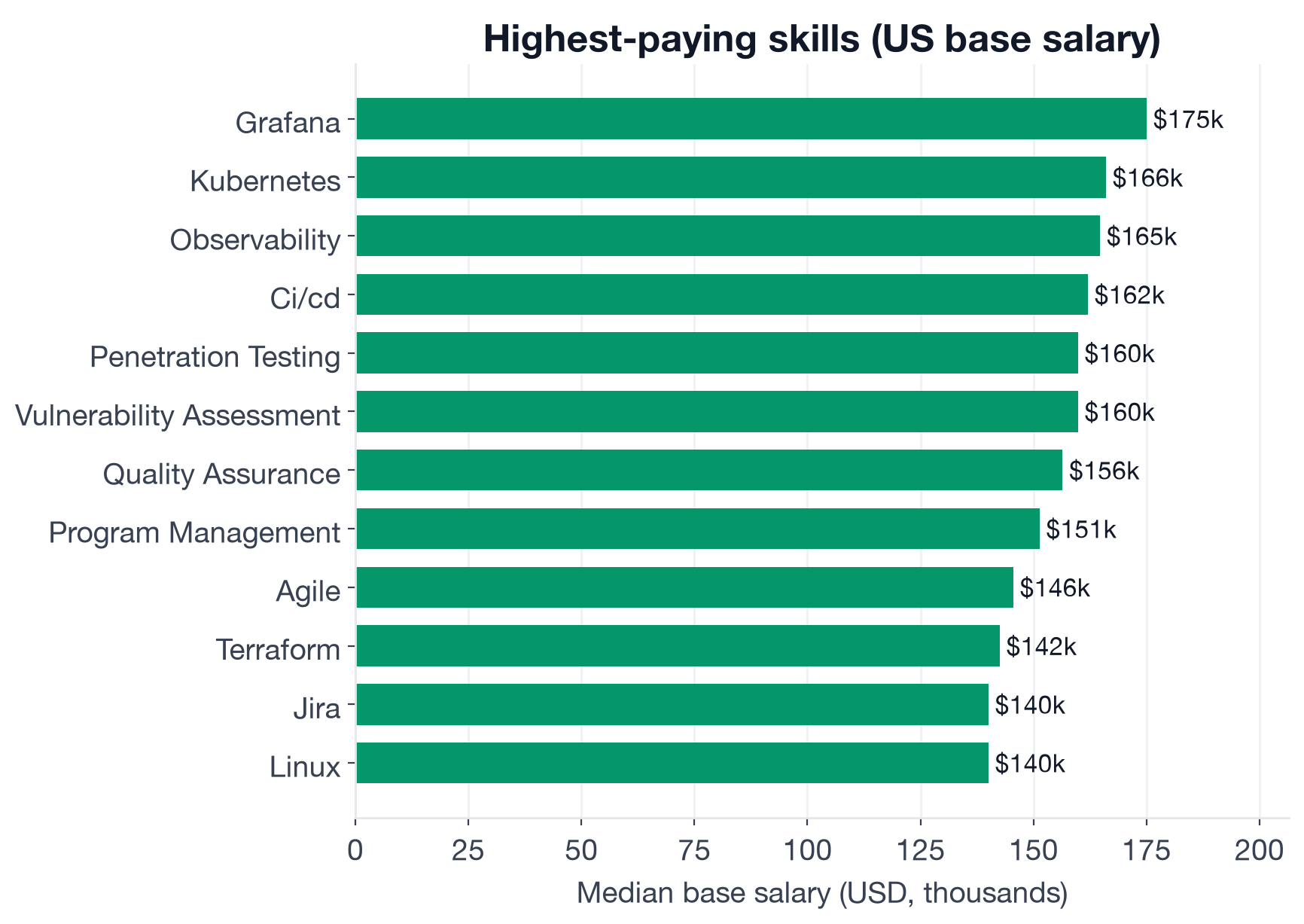
Median US base salary for Network Engineer postings that mention each skill. US postings only, base salary only.
Skills with the largest premiums over the $126,800 baseline:
| Skill | Median US base | Premium | n |
|---|---|---|---|
| Observability | $164,700 | +$37,900 | 51 |
| CI/CD | $162,000 | +$35,200 | 45 |
| Agile | $145,500 | +$18,700 | 85 |
| Terraform | $142,500 | +$15,700 | 71 |
| Linux | $140,000 | +$13,200 | 176 |
| Ansible | $137,800 | +$11,000 | 170 |
| Python | $134,600 | +$7,800 | 200 |
| Automation | $134,200 | +$7,400 | 315 |
Core routing and security skills, near or below baseline:
| Skill | Median US base | vs. baseline | n |
|---|---|---|---|
| BGP | $129,300 | +$2,500 | 342 |
| OSPF | $129,600 | +$2,800 | 322 |
| Monitoring | $128,700 | +$1,900 | 488 |
| Firewalls | $126,800 | at baseline | 372 |
| VPN | $125,900 | -$900 | 214 |
| DNS | $115,000 | -$11,800 | 179 |
| DHCP | $103,100 | -$23,700 | 141 |
| Fiber | $98,200 | -$28,600 | 148 |
| Technical Support | $93,300 | -$33,500 | 116 |
The top half of this table is almost entirely DevOps-adjacent. The bottom half is almost entirely traditional networking and field-support work. That pattern reflects two distinct segments of the Network Engineer market.
The first segment builds and automates infrastructure with programmability at its center: Linux, Ansible, Terraform, Python, CI/CD, and observability tooling. Engineers in this segment operate closer to platform engineers in practice, and the market prices them accordingly.
The second segment maintains connectivity: configuring routers, managing DHCP and DNS, running fiber deployments, handling field support. This work is essential infrastructure, but it carries a lower salary ceiling. Firewalls and VPN sit at or below the median because they are expected in routing-and-security roles, not differentiating within them. DHCP, fiber, and technical support sit substantially below median, pulling toward an ISP, field-tech, or support-adjacent job family that the "Network Engineer" title also covers.
One note on the Agile premium (+$18,700 at n=85): the premium likely reflects engineers working in enterprise-transformation programs where the methodology is formally embedded in delivery, not that Agile knowledge alone commands the wage. It is a real data signal but a weaker causal one than the infrastructure-as-code and observability premiums.
If you are searching for Network Engineer roles that ask for Python, you are in the segment of the market that skews toward the top half of this salary table.
How the Market Actually Groups Skills
Co-occurrence patterns reveal the market's internal segmentation more cleanly than individual skill frequencies.
| Skill pair | Postings | Share | Lift |
|---|---|---|---|
| DHCP + DNS | 428 | 13.2% | 4.27 |
| AWS + Azure | 478 | 14.8% | 4.08 |
| Ansible + Python | 434 | 13.4% | 3.51 |
| BGP + OSPF | 817 | 25.2% | 2.81 |
| Ansible + Automation | 480 | 14.8% | 2.58 |
| Automation + Python | 589 | 18.2% | 2.47 |
| Firewalls + VPN | 521 | 16.1% | 1.71 |
Lift above 1.0 means the pair appears together more than their individual frequencies would predict by chance. Four patterns tell the story:
DHCP + DNS (lift 4.27): The strongest pair in the dataset. DHCP (Dynamic Host Configuration Protocol, which assigns IP addresses to devices automatically) and DNS always appear together because they are both core network services typically managed by the same team. These postings lean toward ISP, enterprise IT, and managed-services work. As the salary section shows, they carry below-baseline wages.
AWS + Azure (lift 4.08): Multi-cloud network engineering postings. Companies asking for both are running hybrid cloud environments or managing migrations between providers. The high lift reflects how uncommon that combination is: most companies standardize on one cloud, so a posting that requires both is deliberately scoped. Browse multi-cloud Network Engineer postings to see this segment directly.
Ansible + Python (lift 3.51): The automation stack. Ansible (an open-source automation tool for deploying and managing configurations across network devices) is written in Python, and teams that adopt it want engineers who can write automation code, not just run existing playbooks. This pair appears in 13.4% of all postings: not a majority, but the segment that earns above baseline. The salary premium for Ansible (+$11K) and Python (+$8K) over the role median confirms the direction.
BGP + OSPF (lift 2.81): The routing stack. These two protocols appear together in 817 postings (25.2% of the market), the most common co-occurrence by raw volume. When a company wants BGP, it almost certainly wants OSPF too, because they address different routing layers in enterprise and carrier networks. The lift of 2.81 reflects how tightly scoped these routing-specialist postings are. But as the salary data makes clear, this is the specialization closest to the role baseline, not the one that clears the ceiling.
The practical read: Ansible + Python defines the automation track. BGP + OSPF defines the routing track. Both are common. Their salary trajectories diverge by $10-35K depending on how far up either stack you go.
How Hard Is Network Engineering to Break Into?
Entry-level access is narrow. Only 3.4% of postings (111 of 3,240) carry an explicit entry-level signal, while 65.8% are mid-level. Senior roles account for 22.5% and staff-level for 8.3%.
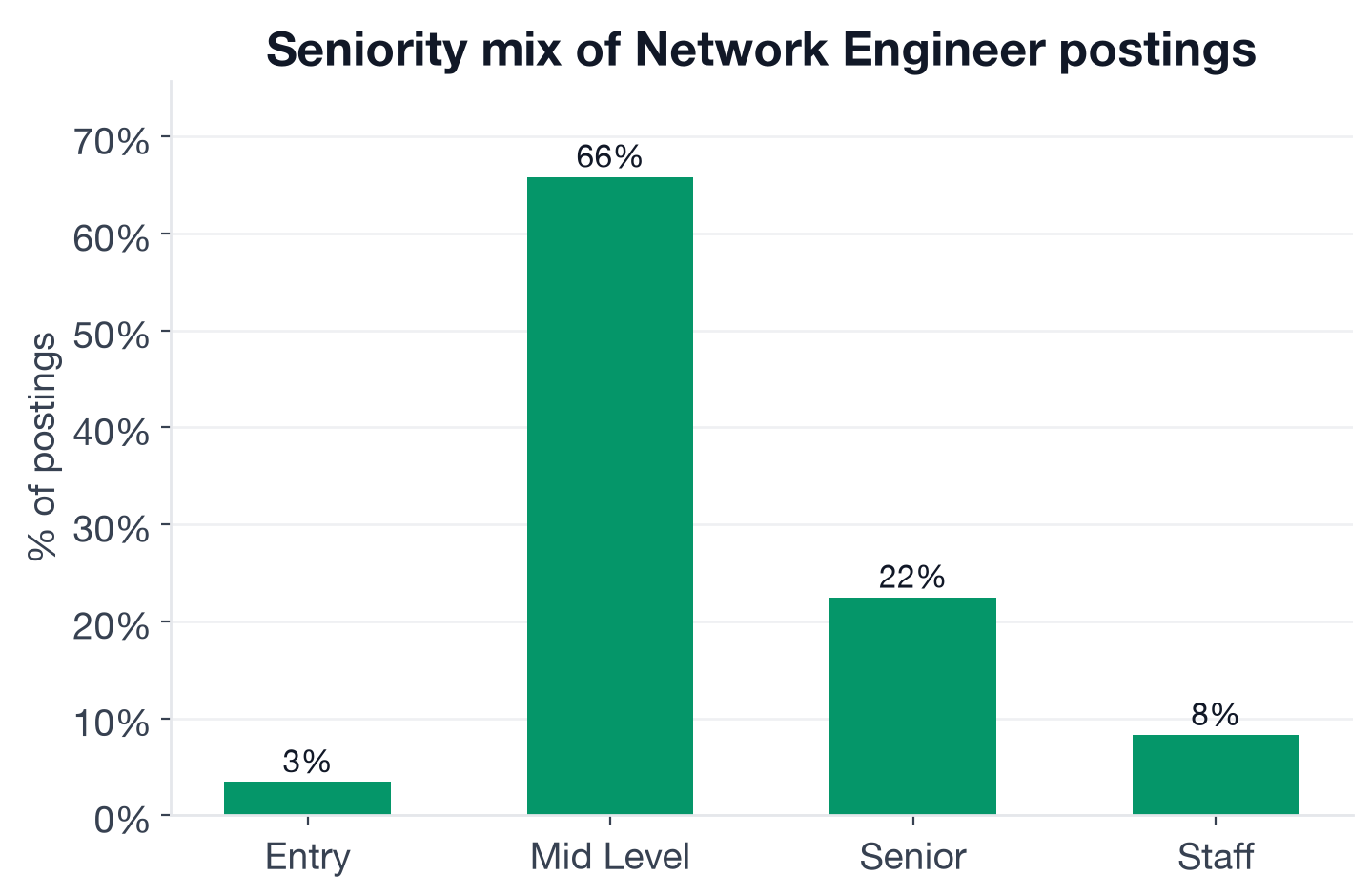
Seniority distribution of Network Engineer postings, inferred from job-title keywords. Postings without an explicit signal default to mid-level.
The 3.4% entry-level share is consistent with what we see across infrastructure roles: companies want engineers who have already worked with enterprise-grade hardware in a real network environment. Lab simulations and certifications establish the conceptual foundation, but employers want evidence of production exposure. The standard entry path runs through network operations center (NOC) technician roles, systems administrator positions, or IT support roles where hands-on device access is available before stepping into full Network Engineer responsibility.
For those targeting the senior tier (22.5% of the market), the skills picture shifts. Senior Network Engineer openings tend to require automation skills, cloud networking experience, and some architecture responsibility layered on top of the routing and security baseline.
The Most Onsite-Heavy Tier in Infrastructure Work
The US dominates the geographic distribution at 55.3% of postings (1,792 of 3,240). India accounts for 6.9% (222 postings), the UK 3.8% (124), with Canada, Germany, Philippines, and Singapore each in the 1-2% range.
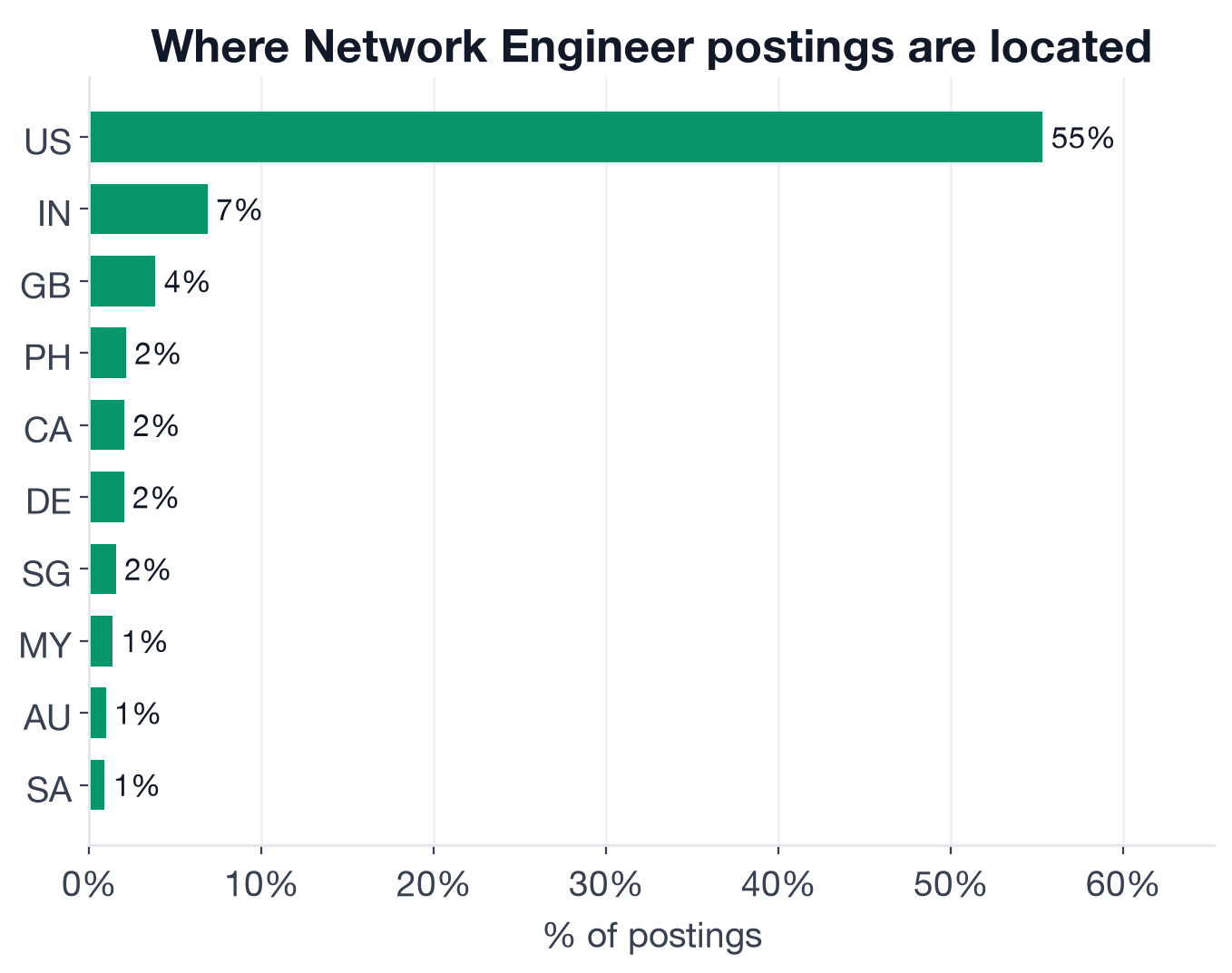
Top countries by share of Network Engineer postings. "Unknown" includes postings without a disclosed location.
The US concentration at 55% (versus 29% for Data Engineers) reflects both the role's physical infrastructure dependency and the large defense and government sector, which posts almost exclusively in the US and frequently requires candidates to hold or be eligible for a security clearance.
Work mode is where the sharpest constraint sits:
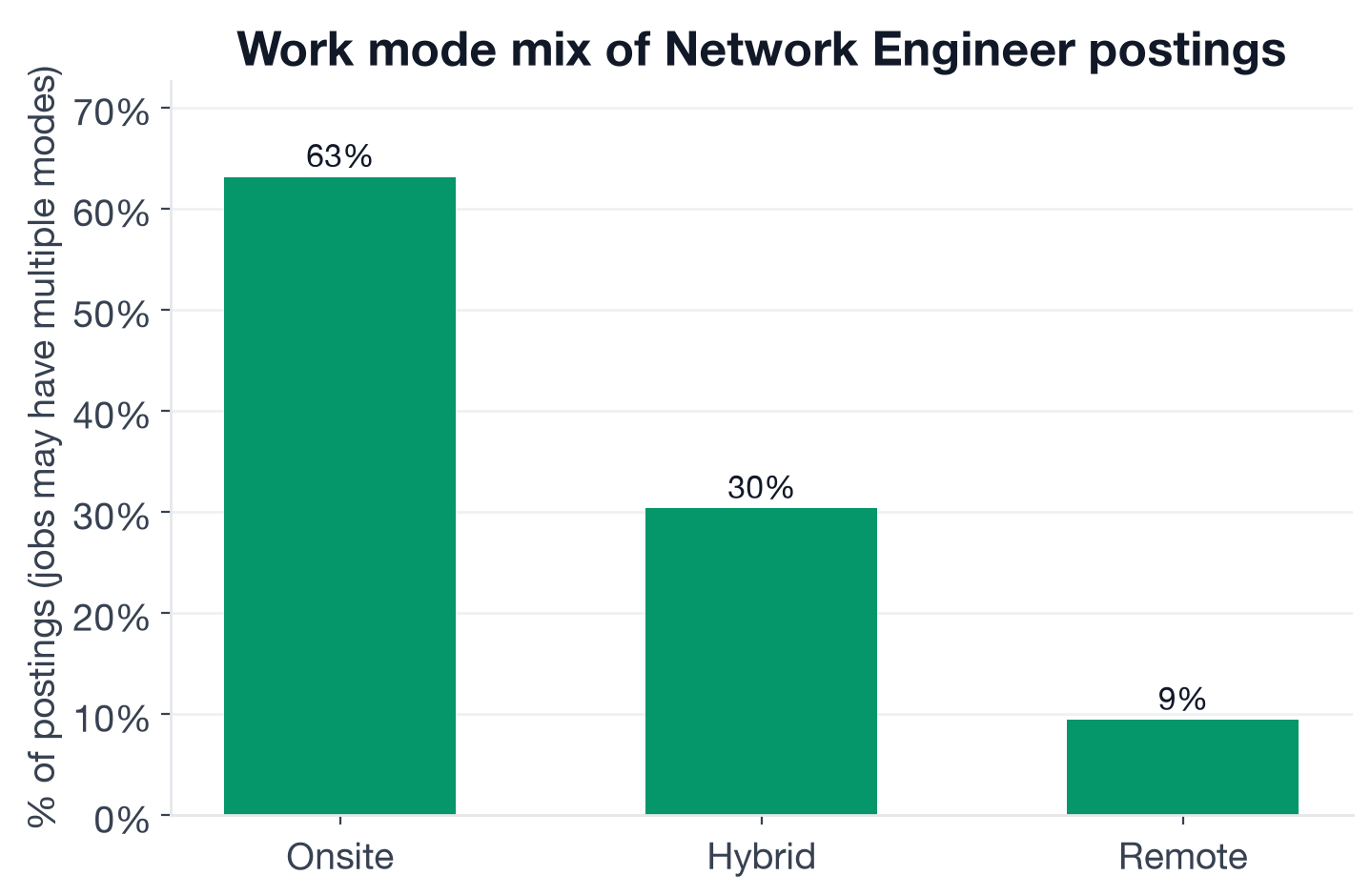
Share of Network Engineer postings by work mode. Some postings carry multiple tags (e.g., "hybrid or remote"), so figures can overlap.
Only 9.4% of postings are tagged remote (305 of 3,240). For context, cloud infrastructure roles run at 15-25% remote, and many software engineering disciplines run higher. Network Engineering's physical hardware dependency (patching switches, racking equipment, running cable, hands-on troubleshooting at the data center) keeps the vast majority of roles onsite or hybrid.
Fully remote Network Engineer openings exist but concentrate in a narrow slice of the market: cloud-native environments and companies with mature automation that reduces on-premise presence requirements. If remote work is essential, filtering for it upfront is the right move rather than assuming flexibility will emerge later in the hiring process.
Who's Driving Demand: A Defense-Heavy Roster
The employer list for Network Engineering looks dramatically different from most tech roles. Technology companies and SaaS firms fill the top of the hiring list for Data Engineers, Software Engineers, and Product Managers. For Network Engineers, defense and government contractors hold the top four spots by a wide margin.
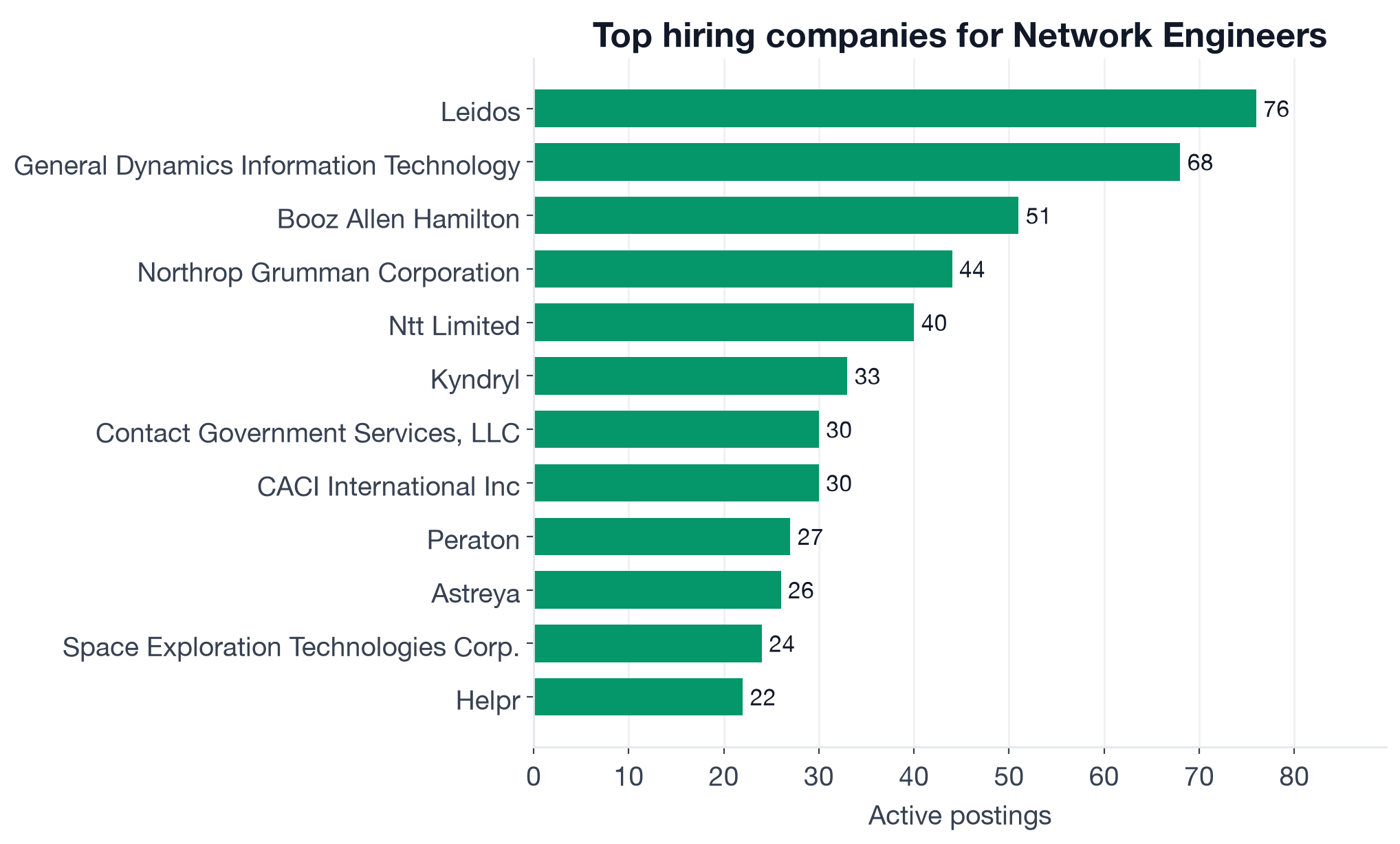
Top companies by distinct active Network Engineer postings.
| Company | Active postings | Segment |
|---|---|---|
| Leidos | 76 | Defense/government IT |
| General Dynamics IT | 68 | Defense/government IT |
| Booz Allen Hamilton | 51 | Defense consulting |
| Northrop Grumman | 44 | Defense |
| NTT Limited | 40 | Global telecom and IT |
| Kyndryl | 33 | IT infrastructure services |
| CACI International | 30 | Defense/government IT |
| Peraton | 27 | Defense/government |
| SpaceX | 24 | Aerospace |
| AT&T | 21 | Telecom |
| TDS Telecom | 20 | Telecom |
| NTT DATA | 14 | IT services |
The defense-contractor concentration (Leidos, GDIT, Booz Allen, Northrop Grumman, CACI, Peraton) has a direct implication for job seekers: a meaningful share of Network Engineer roles in this dataset require or strongly prefer a US security clearance, often Secret or higher. Candidates without a clearance are largely excluded from this segment until they obtain one through an entry-level or support role at a cleared facility.
Telecom (NTT Limited, AT&T, TDS Telecom) and IT infrastructure services (Kyndryl) round out the picture. Consumer tech firms and startups post Network Engineer roles too, but they represent a smaller share of total volume here. For company-specific interview processes, the InterviewStack preparation guides cover expectations and rounds by employer.
How to Use This in Your Job Search
The data points to a clear sequence depending on where you are in your career.
Breaking in: With only 3.4% of postings at entry level, the standard route runs through a NOC technician, IT support, or systems administrator role first. These positions build the hands-on exposure to real network equipment that hiring managers for mid-level Network Engineer roles expect to see. Certifications (CCNA-level routing and switching knowledge) establish the conceptual foundation; the operational reps are what open the door.
Growing your salary: The routing and security baseline is priced into the role. Adding Python proficiency moves your median by roughly $8K. Ansible automation adds $11K on top of that. Terraform (infrastructure-as-code tooling for provisioning cloud and on-premises resources) adds $16K. Observability tooling, which involves instrumenting systems for signals beyond basic uptime checks, sits at the top of the salary curve at +$38K. The order of investment follows the salary data: scripting first, then configuration automation, then infrastructure-as-code, then full observability discipline.
On the AI layer: employers asking for Python and Ansible today expect candidates to use AI tools (GitHub Copilot, ChatGPT) to write scripts and troubleshoot configurations faster. The 85% of developers who regularly use AI tools per JetBrains' 2025 Developer Ecosystem Survey include infrastructure engineers. That expectation is baked into "automation" postings even when it is not written into the job description.
For interview preparation: our interactive courses cover networking, Linux, and scripting foundations. The question bank lets you drill BGP/OSPF routing, network security, firewall configuration, and automation topics with structured Q&A. AI mock interviews are particularly useful when targeting senior roles that involve architecture decisions: cloud network design, automation strategy, and reliability discussions benefit from practiced verbal delivery under time pressure.
For the job search itself: browse current Network Engineer openings on the InterviewStack.io job board and combine skill and level filters to match your exact profile. If the defense and government segment is your target, filtering for US postings with security or clearance signals in the title is the fastest way to find the relevant subset.
FAQ
Q. What skills do Network Engineer job postings require most in 2026?
The nine most-demanded skills (each in 20-48% of postings) are Monitoring (48.2%), Firewalls (40.3%), Automation (33.3%), BGP (31.9%), Network Security (30.3%), OSPF (28.1%), VPN (23.3%), Python (22.1%), and DNS (20.9%). No single skill appears in more than half of postings, reflecting how fragmented the role is across routing, security, cloud, and automation specializations.
Q. What is the median Network Engineer salary in 2026?
The median US base salary for Network Engineer postings is $126,800 (n=979 postings with US salary disclosed). This excludes equity, bonuses, and sign-on; total compensation at top employers is meaningfully higher.
Q. Which Network Engineer skills pay the most above the baseline?
The largest premiums come from Observability ($164,700, or +$38K above the $126,800 baseline), CI/CD ($162,000, +$35K), Agile ($145,500, +$19K), Terraform ($142,500, +$16K), and Linux ($140,000, +$13K). Traditional routing skills add far less: BGP ($129,300, +$2.5K) and OSPF ($129,600, +$2.8K) sit barely above the baseline.
Q. Is Network Engineering a good entry-level role to break into?
It is difficult to enter. Only 3.4% of postings (111 of 3,240) are explicitly entry-level, while 65.8% are mid-level. Most companies expect prior hands-on experience with enterprise networking equipment, routing protocols, or network security.
Q. Are Network Engineer jobs remote-friendly in 2026?
Mostly not. Only 9.4% of Network Engineer postings are tagged remote (305 of 3,240), 30.3% are hybrid, and 63.1% are onsite. Physical access to data centers and network hardware makes this one of the most onsite-heavy disciplines in technology.
Q. What companies hire the most Network Engineers in 2026?
Defense and government contractors dominate: Leidos (76 postings), General Dynamics Information Technology (68), Booz Allen Hamilton (51), Northrop Grumman (44), and NTT Limited (40). AT&T, CACI International, and Peraton also appear prominently. Many roles require or prefer US security clearances.
Q. What is the dominant Network Engineer skill stack in 2026?
Two stacks define the market: routing-focused (BGP + OSPF co-occur in 817 postings, 25% of the market, lift 2.81) and automation-focused (Ansible + Python appear together in 434 postings, lift 3.51). The automation stack carries a substantially higher salary ceiling.
Where to Put Your Next 90 Days
The most important strategic choice in Network Engineering right now is which direction you extend your skill set. Deepening routing and security expertise earns you the baseline; adding automation, observability, and infrastructure-as-code is what moves you above it. The salary gap between a traditional routing specialist and an automation-first network engineer is $11-38K depending on how far up the stack you go, and that gap is widening as more employers expect engineers to script and automate rather than configure manually. The role's onsite constraint means location still shapes your availability more than it does in most tech disciplines, but within that constraint, the skills that pay are the ones at the intersection of networking and software engineering. That intersection is wider than it was two years ago and is getting wider still.
Topics
Ready to practice?
Put what you've learned into practice with AI mock interviews and structured preparation guides.