
One Title, Three Stacks
The two most-requested skills in Mobile Developer job listings both pay below the role's own median salary. Android appears in 64% of active postings and iOS in 57%, yet US postings asking for Android have a $157,500 median base salary and iOS postings have a $154,200 median. Both sit below the $162,500 role baseline. That finding comes from 2,481 active Mobile Developer postings on the InterviewStack.io job board as of June 2026. The platform you build for gets you through the filter. What you know beyond it determines your pay.
The "Mobile Developer" title covers three distinct career paths that rarely get separated in hiring conversations: Android-native engineers (Kotlin, Jetpack Compose, MVVM), iOS-native engineers (Swift, SwiftUI, UIKit depth), and cross-platform engineers who bridge both with React Native or Flutter. Each path has its own language requirements, interview structure, and salary trajectory. React Native, often characterized as the cross-platform compromise, posts the highest median US salary of any common mobile skill at $180,000: $30,000 above the Swift median and $40,000 above the Kotlin median.
Key Findings
- 2,481 active Mobile Developer postings analyzed on the InterviewStack.io job board as of June 2026.
- Only two skills are table stakes: Android (64.2%) and iOS (57.4%). No other skill exceeds 50% of postings.
- US median base salary is $162,500 (n=431, base only; equity and bonus not included in postings).
- Android ($157,500) and iOS ($154,200) both pay below the role median. The skills required most often are not where the salary premium lives.
- React Native posts the highest median of any common skill at $180,000 (n=39), $17,500 above the role baseline.
- Scalability ($202,300) and Observability ($203,500) mark the top of the mobile salary ceiling, roughly $40K above the baseline.
- Only 3.3% of postings are entry-level (83 of 2,481). Senior and staff roles together account for 45%.
- Onsite is the default at 51% of postings; remote is 28%, hybrid is 25%.
What Skill Families Define a Mobile Developer in 2026?
Every individual skill maps to a higher-level family. Counting how many postings request at least one skill in each family reveals the competency layers the role is built on.
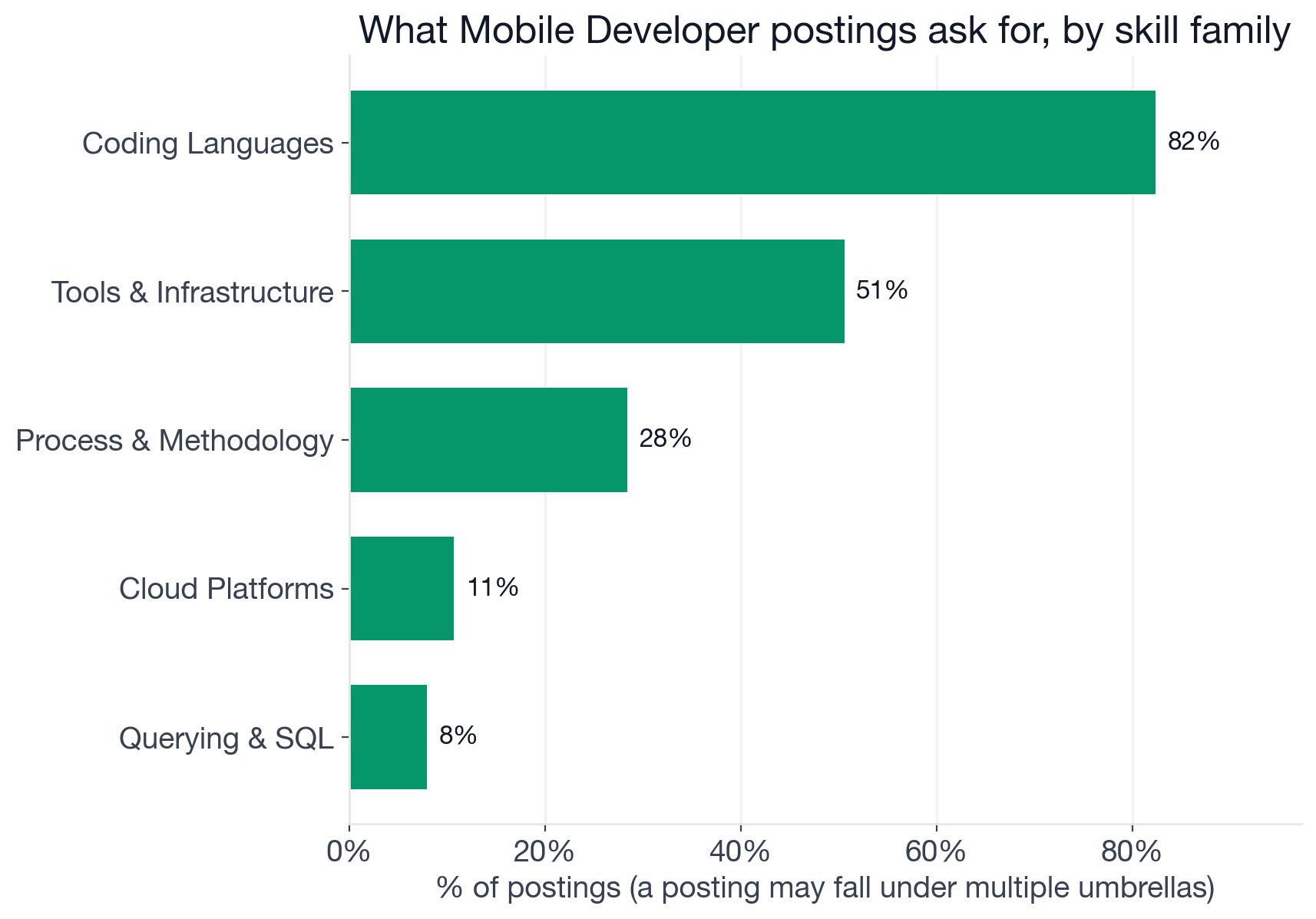
Share of Mobile Developer postings that ask for at least one skill in each family. Platform-specific skills (Android, iOS, React Native, CI/CD, MVVM) are domain-specific and span multiple families. Counts deduplicate per posting.
The families that shape the role beyond the platform layer:
Coding Languages: 82%. Kotlin (47%), Swift (36%), and Java (27%) define the language tier. Nearly every posting expects a language commitment. The divergence reflects the platform split: Kotlin is the modern Android language, Swift is iOS. Java still shows up because many Android codebases started there and are mid-migration to Kotlin.
Tools & Infrastructure: 51%. Git (29%), automation tooling, and GitHub. This is the engineering-practices floor that appears regardless of platform: version control and deployment basics every engineering team expects.
Process & Methodology: 28%. Agile (25%) and Scrum (11%). Common enough to be expected in team contexts, not a differentiator.
Cloud Platforms: 11%. AWS (8%), Azure (4%). Most mobile developers are not managing cloud infrastructure directly, but postings requiring backend integration sometimes ask for cloud exposure.
Machine Learning and AI: 5%. Just 120 of 2,481 postings explicitly mention AI or ML skills. These are postings for mobile developers building on-device ML models, LLM-powered chat features, or computer vision functionality. That 5% is a floor, not a ceiling. It measures jobs where constructing AI systems is the work. It does not measure the ambient reality.
According to Stack Overflow's 2025 Developer Survey, 84% of developers use AI coding tools in their workflow, up from 76% in 2024. The JetBrains 2025 State of Developer Ecosystem survey puts regular AI tool use at 85% across all developers, with 44% having AI at least partially integrated into their daily workflow. For mobile developers specifically, the tooling barrier collapsed in mid-2025: GitHub Copilot added native integration for Xcode (iOS) and Android Studio (Android) in June 2025, making AI-assisted code generation directly available in the two IDEs where virtually all mobile development happens. GitHub's own data shows 80% of new developers use Copilot within their first week on the platform. A mobile team that isn't using Copilot, Cursor, or a similar AI coding tool somewhere in its workflow is the exception, not the rule in 2026.
The Three Tiers: Expected, Common, and What Sets You Apart
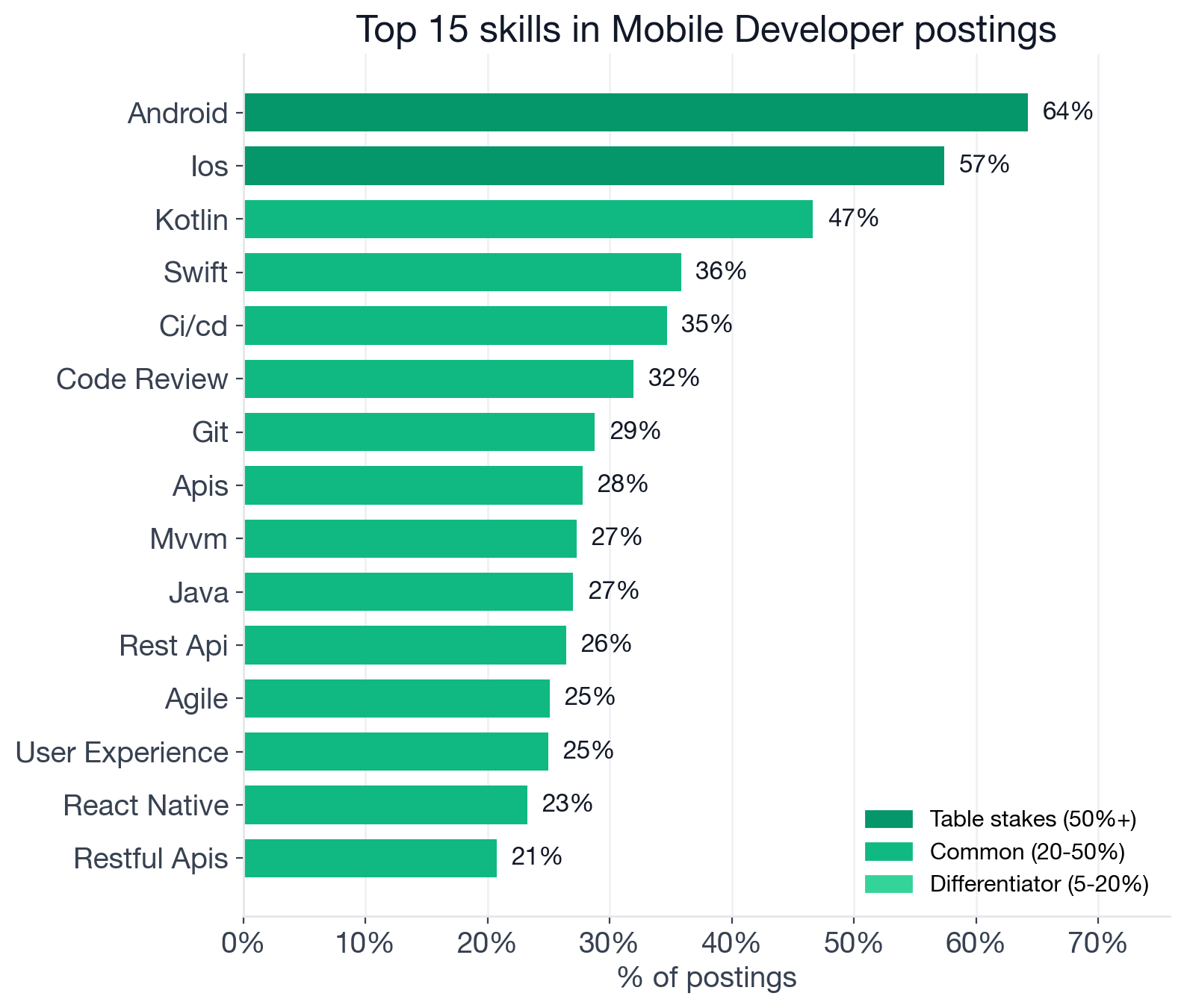
Individual Mobile Developer skills by share of postings. Above 50% is table stakes; 20-50% is common; 5-20% is differentiator.
Table Stakes (50%+ of postings)
- Android: 64.2% (browse Android-required Mobile Developer openings)
- iOS: 57.4% (browse iOS-required openings)
These are the only two skills that filter candidates before a resume is read. They are platform markers, not language or framework choices. About 38% of all postings ask for both, signaling that cross-functional mobile teams are common even when individual developers specialize in one platform.
Common Expectations (20-50% of postings)
This tier contains the language and workflow skills that define what "Mobile Developer" actually means in practice:
- Kotlin: 46.6% (the standard language for new Android development)
- Swift: 35.8% (iOS + Swift openings)
- CI/CD: 34.7%
- Code Review: 32.0%
- Git: 28.8%
- APIs: 27.8%
- MVVM: 27.3% (Model-View-ViewModel, the architectural pattern most Android teams use to separate UI logic from business logic)
- Java: 27.0% (primarily legacy Android; the salary data shows a meaningful gap versus Kotlin)
- REST API / RESTful APIs: 21-26%
- Agile: 25.1%
- User Experience: 24.9%
- React Native: 23.3% (React Native openings)
- Android Development: 20.6%
The Kotlin-to-Java ratio tells the story of Android's evolution. Kotlin at 47% vs Java at 27% is a snapshot of an industry that has largely completed its language migration. Modern Android development is Kotlin-first, with Java showing up in legacy codebases and in certain hiring pipelines outside the US.
MVVM at 27% is worth noting: it signals that companies are not just hiring for platform knowledge but for architectural discipline. An Android developer who knows Kotlin but cannot reason about MVVM or the ViewModel lifecycle is less competitive than one who can.
Differentiators (5-20% of postings)
This is where modern UI frameworks and engineering maturity skills appear:
- Jetpack Compose: 16.0% (Google's declarative UI toolkit for Android, replacing the older XML-based layout system)
- SwiftUI: 15.5% (Apple's declarative UI framework for iOS, the modern replacement for UIKit and Storyboards)
- Debugging: 14.5%
- Flutter: 13.7% (Google's cross-platform toolkit that compiles to native Android and iOS code from a single Dart codebase)
- Automation: 13.3%
- Testing: 13.2%
- Performance Optimization: 12.5%
- Design Patterns: 12.3%
- TypeScript: 12.3%
- Scalability: 9.6%
- Monitoring: 8.9%
Jetpack Compose and SwiftUI mark the generational transition in each platform's UI layer. Companies building greenfield apps increasingly require them; companies maintaining large legacy codebases may list older UI skills implicitly. Knowing either one signals you are building current-generation apps, not maintaining decade-old ones.
Which Skills Actually Move Mobile Salaries?
Salary figures below are restricted to US postings only, where wage-transparency laws produce consistent disclosure, so the numbers are directly comparable. They represent base salary only: equity, RSUs, bonuses, and sign-on are not captured in job postings, so total compensation at top employers is meaningfully higher than what is reported here.
The overall US base salary median is $162,500 (n=431).
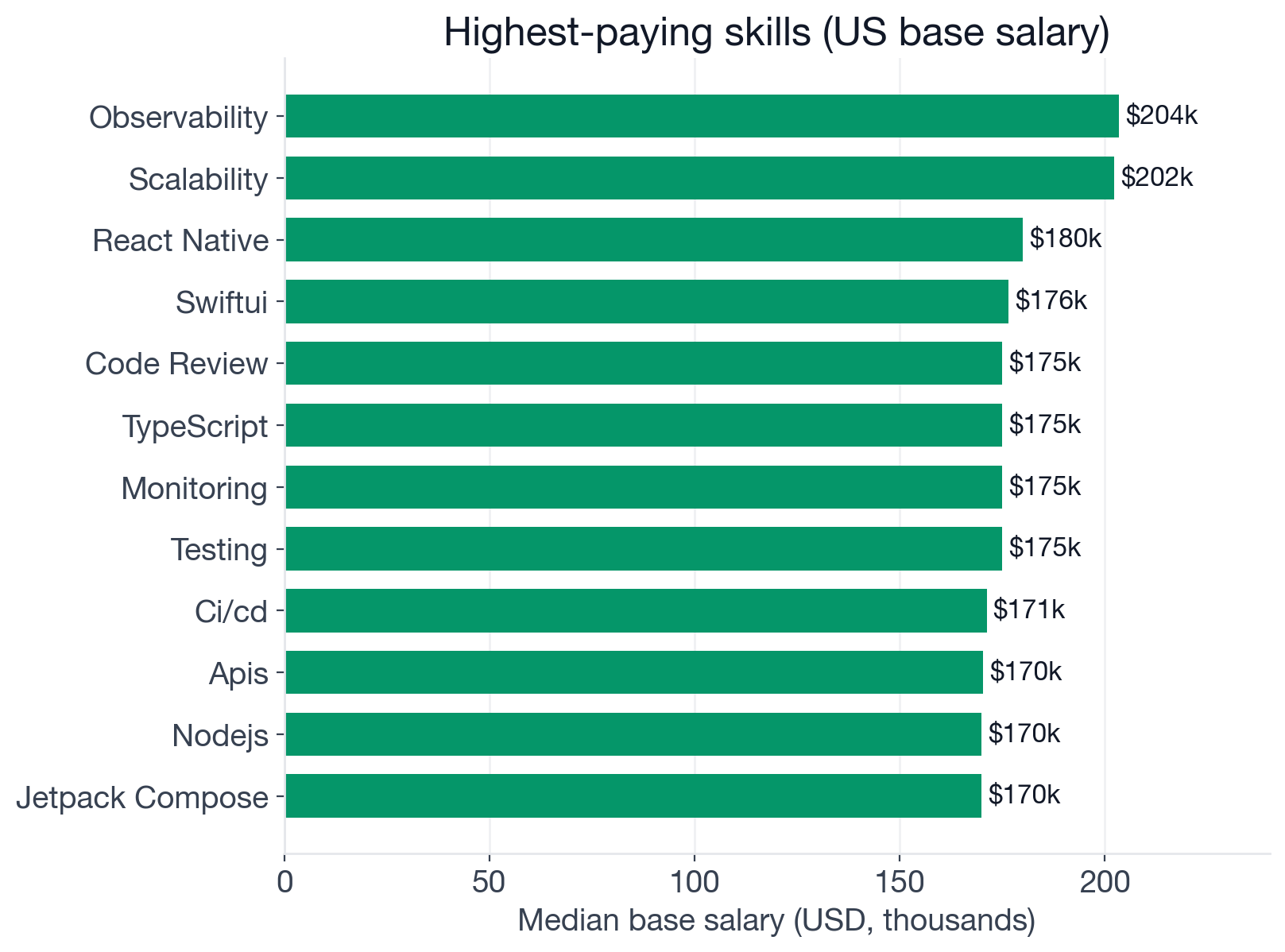
Median US base salary in USD for Mobile Developer postings that mention each skill, restricted to US postings with structured salary data. Skills with fewer than 25 US data points are excluded.
The central finding is in what sits below baseline. Android posts a $157,500 median (n=315) and iOS posts $154,200 (n=326). Swift comes in at $150,000 (n=158) and Kotlin at $140,000 (n=268). The table-stakes and common-tier skills that every posting requires are not the ones that differentiate pay.
The $200K ceiling (architectural scope):
| Skill | US Median | n | Premium |
|---|---|---|---|
| Observability | $203,500 | 35 | +$41,000 |
| Scalability | $202,300 | 28 | +$39,800 |
These are not mobile-specific skills. They are engineering maturity signals that appear across senior software engineering roles. A mobile developer fluent in scalability (app architectures that handle load, offline states, and distributed backend integration) or observability (instrumented apps that emit meaningful logs, traces, and metrics) is being hired as a platform engineer who happens to build mobile, not just a developer who ships screens.
The cross-platform premium:
| Skill | US Median | n | Premium |
|---|---|---|---|
| React Native | $180,000 | 39 | +$17,500 |
| SwiftUI | $176,500 | 59 | +$14,000 |
React Native at $180,000 is the standout. It sits $30,000 above the Swift median and $40,000 above the Kotlin median, despite React Native being commonly described as the cross-platform compromise. The market tells a different story: React Native engineers who can bridge platforms are undersupplied relative to the demand that wants them.
The engineering-practices premium ($8K-$13K above baseline):
| Skill | US Median | n | Premium |
|---|---|---|---|
| Code Review | $175,000 | 69 | +$12,500 |
| TypeScript | $175,000 | 35 | +$12,500 |
| Monitoring | $175,000 | 33 | +$12,500 |
| Testing | $175,000 | 28 | +$12,500 |
| CI/CD | $171,200 | 49 | +$8,700 |
| APIs | $170,400 | 100 | +$7,900 |
| Node.js | $170,000 | 67 | +$7,500 |
| Jetpack Compose | $170,000 | 110 | +$7,500 |
| User Experience | $170,000 | 139 | +$7,500 |
| Automation | $170,000 | 41 | +$7,500 |
The pattern in this tier is engineering quality culture: testing discipline, monitoring, code review, CI/CD pipelines. These skills signal "senior engineer who ships reliable software" rather than "developer who builds features." TypeScript in mobile context typically means React Native (since React Native apps are TypeScript-first); its $175,000 median reinforces the cross-platform salary story.
One data note: Java, RESTful APIs, REST API, and Git cluster at $62,400 in the US salary slice, a value consistent with FX-converted international salaries miscategorized as US data. These are not meaningful US Mobile Developer salary signals and are excluded from the comparisons above.
The Core Stacks in Practice
Co-occurrence lift measures whether two skills appear together more than their individual frequencies would predict. Lift above 1 means the combination is over-represented in the market.
| Skill pair | Postings with both | % of market | Lift |
|---|---|---|---|
| Android + Kotlin | 1,095 | 44.1% | 1.47 |
| iOS + Swift | 840 | 33.9% | 1.65 |
| Java + Kotlin | 533 | 21.5% | 1.71 |
| Kotlin + MVVM | 499 | 20.1% | 1.58 |
| CI/CD + Code Review | 441 | 17.8% | 1.60 |
| iOS + React Native | 410 | 16.5% | 1.24 |
| Android + React Native | 407 | 16.4% | 1.10 |
Android + Kotlin (lift 1.47) is the core Android professional stack. An Android posting is 47% more likely to mention Kotlin than the base rate would predict. Kotlin is no longer an alternative to Java on Android; it is the default.
iOS + Swift (lift 1.65) is the iOS equivalent. Seeing "iOS" in a posting is a strong signal you will be writing Swift. The same lift roughly characterizes how SwiftUI layers on: companies hiring for modern iOS work want the modern language and the modern UI framework together.
Java + Kotlin (lift 1.71) is the migration signal and the highest-lift meaningful pair in the dataset. A posting that lists both languages is almost always a company mid-migration from a legacy Android codebase. The two-language ask reflects a real codebase condition, not a wishlist. Engineers who can navigate both and reason about the migration path are the specific hire.
Kotlin + MVVM (lift 1.58) pairs the language with the architecture. MVVM is the standard Android architectural pattern in Google's Jetpack ecosystem, and Kotlin is how you implement it in 2026. Their lift confirms they travel together in postings.
CI/CD + Code Review (lift 1.60): postings that ask for CI/CD are 60% more likely to also require code review skills. This is the engineering culture fingerprint. It appears across all three mobile stacks (Android, iOS, cross-platform) and is one of the cleaner signals that a company runs a serious engineering operation rather than a shipping-at-all-costs environment.
iOS + React Native (lift 1.24): cross-platform skills build on top of native knowledge, not in place of it. Companies asking for React Native tend to also ask for iOS, confirming that React Native engineers are expected to understand the native layer they are bridging.
How Competitive Is Entry-Level Mobile Development?
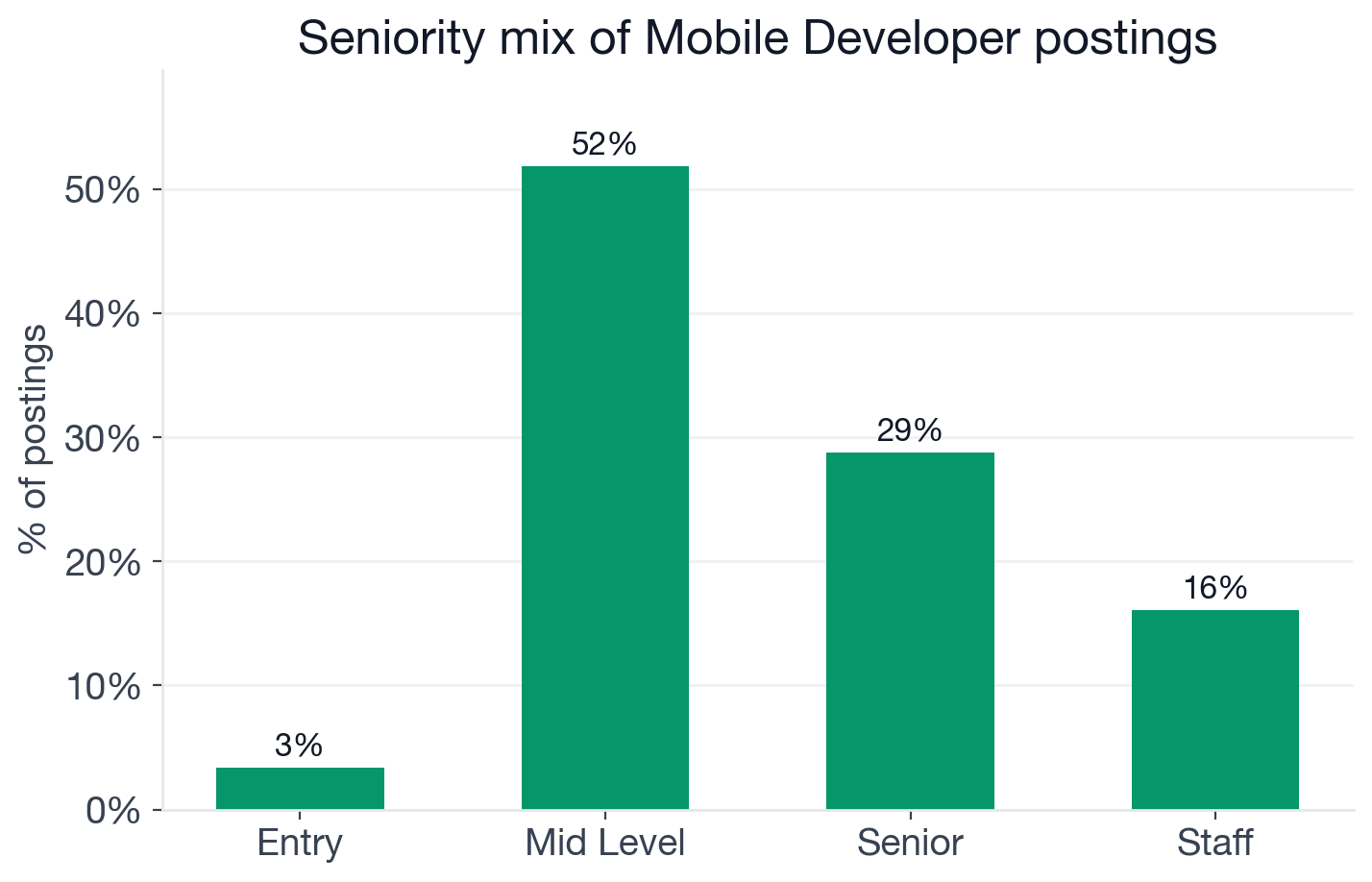
Seniority distribution of active Mobile Developer postings, inferred from title keywords.
- Mid-level: 51.8% (1,286 postings)
- Senior: 28.7% (713) (senior Mobile Developer openings)
- Staff / Lead: 16.1% (399)
- Entry: 3.3% (83)
One in thirty postings is explicitly entry-level. That is a genuine scarcity signal, not a technicality. Mobile development has a specific barrier that other software roles don't: companies want to see shipped apps. It is difficult to fake App Store or Play Store experience with tutorial projects. The device testing cycle, the submission process, the crash reporting, the release management workflow: all of it requires having actually done it.
The senior-and-above slice (senior plus staff at 45%) is also notable. Mobile work at scale involves memory management, battery constraints, app size budgets, offline behavior, OS version targeting, and deep integration with platform APIs. There is genuine technical depth, and companies are hiring for it. An engineer who understands those constraints is not interchangeable with one who simply knows Swift or Kotlin syntax.
For career-switchers, the fastest paths in are: building and shipping something visible (even a single-purpose utility app), contributing to an open-source mobile project with App Store or Play Store presence, or coming in through a React Native role where JavaScript/TypeScript background creates a lower cold-start bar.
Where Are Mobile Developer Jobs, and How Remote Are They?
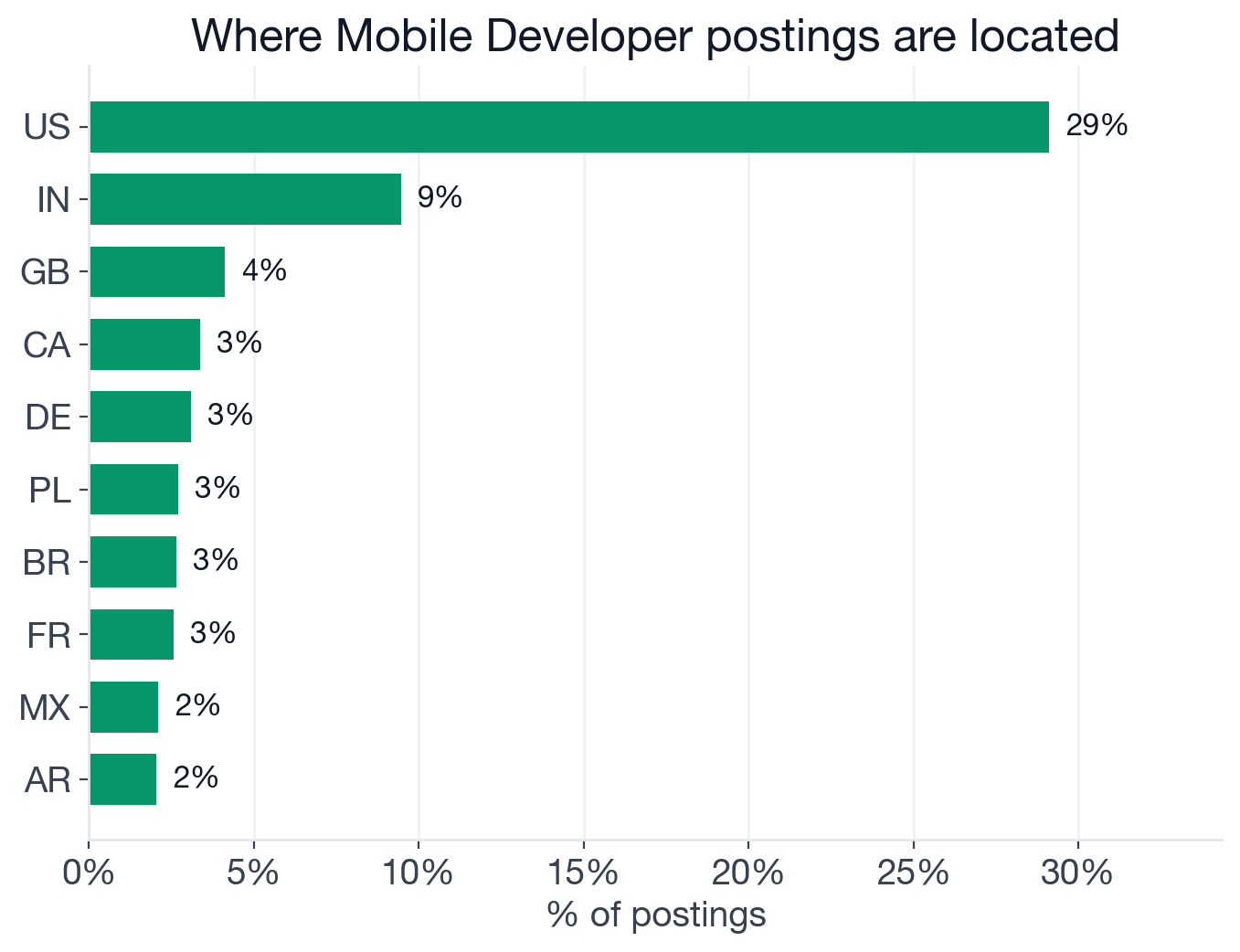
Top countries by share of active Mobile Developer postings.
- United States: 29.1% (US-only Mobile Developer openings)
- India: 9.5%
- United Kingdom: 4.1%
- Canada: 3.4%
- Germany: 3.1%
- Poland: 2.7%
- Brazil: 2.7%
- France: 2.6%
- Mexico: 2.1%
The US leads at nearly 30%, with India at a comparatively modest 9.5%. That contrast with Data Engineer hiring (where India represents 23% of postings) reflects a structural difference: mobile development is typically closer to the product surface, closer to the end-user market, and more embedded in the home country of the company building the app. The India-heavy consulting and software-services pattern that dominates Data Engineer hiring is less pronounced here.
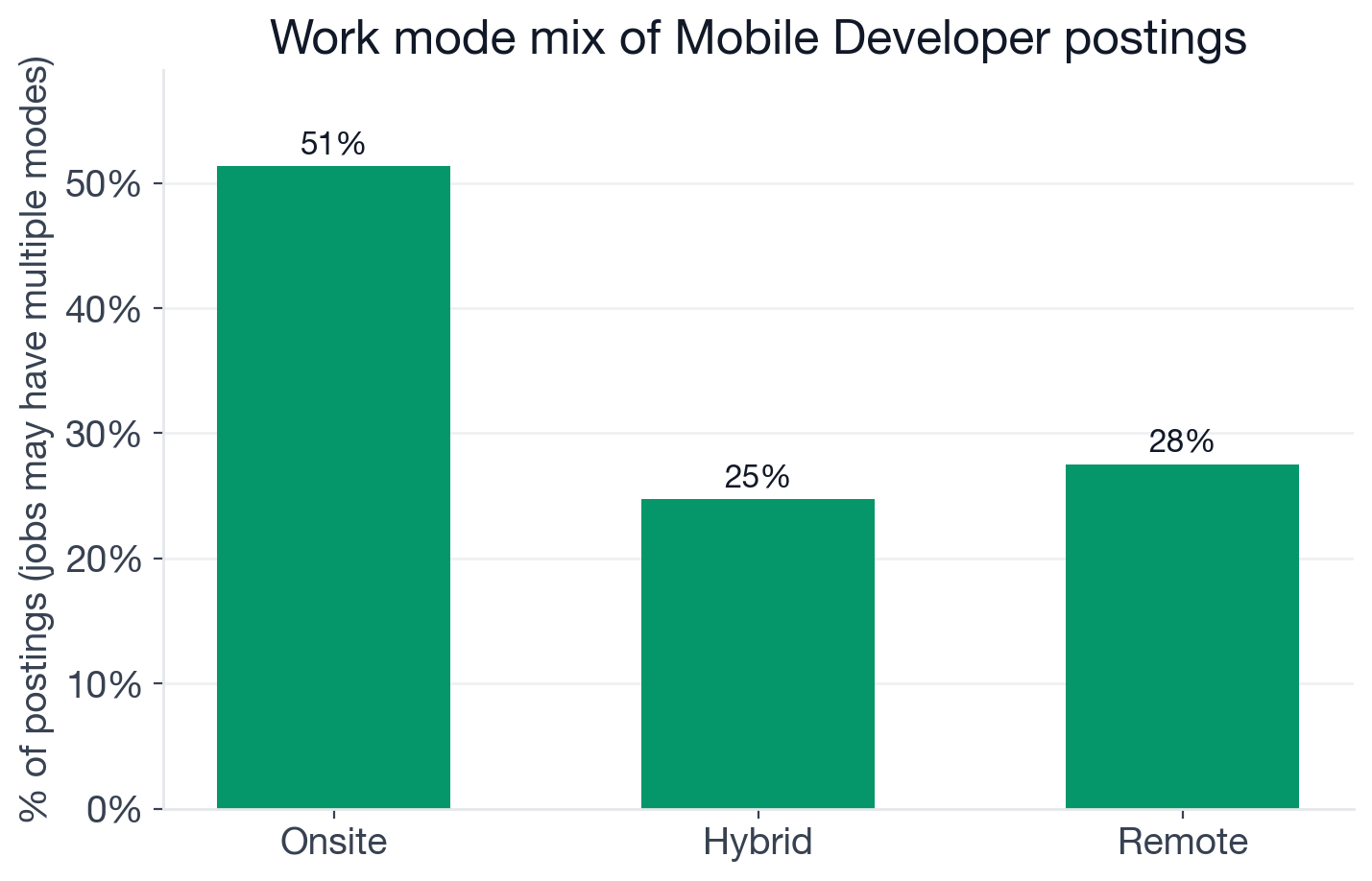
Share of Mobile Developer postings tagged with each work mode. Some postings carry multiple tags, so percentages can sum above 100%.
- Onsite: 51.4% (1,274 postings)
- Remote: 27.5% (683) (fully-remote Mobile Developer openings)
- Hybrid: 24.7% (613)
More than half of Mobile Developer postings are onsite, which is consistent with roles that require physical device testing, team collaboration on UI decisions, and proximity to product teams. Remote availability runs at about 28% and concentrates in product-led startups and mid-size tech companies where engineering culture supports distributed work. Enterprise, fintech, and healthcare employers default to onsite or hybrid.
How to Use This in Your Job Search
The data provides a clear sequence.
Start with a platform commitment and complete it. Pick Android or iOS and build to the professional standard: language (Kotlin or Swift), architecture (MVVM or equivalent), CI/CD pipeline, and store submission. That full stack, demonstrated on a real shipped project, is what moves a resume past the filter for most common-tier postings. The question bank covers Android system design, iOS architecture, and mobile interview topics in depth. AI mock interviews let you practice technical and behavioral rounds before the onsite.
Layer on the salary-moving skills next. The data is clear about what the premium pays for: testing discipline, monitoring, code review culture, and CI/CD. None of these require switching platforms. A Kotlin developer who instruments their app for observability, maintains comprehensive unit tests, and ships through a CI pipeline is in a meaningfully different salary band from one who does not. Our interactive courses cover the software engineering foundations, including testing patterns and system design, that underpin those skills.
Take the React Native path seriously if you are starting fresh. The $180,000 median makes React Native the highest-paying common-tier skill in mobile. If you have a TypeScript or JavaScript background, the path to React Native is shorter than the path to native Android or iOS, and it opens a market that pays above both pure-native paths. The iOS + React Native co-occurrence data (lift 1.24) also suggests that companies hiring React Native engineers expect you to understand the native layer, so pairing React Native proficiency with at least one native platform gives a durable skill combination.
Use the job board to close the gap. Browse current Mobile Developer openings and combine skill filters to see exactly what mid-level postings in your target market require. A filtered search for React Native openings or Kotlin openings makes the specific skill expectations visible so your prep has a concrete target.
FAQ
Q. What skills do Mobile Developer jobs require most in 2026?
Android (64%) and iOS (57%) are the only table-stakes skills; they appear in more than half of all postings. Above them, Kotlin (47%), Swift (36%), CI/CD (35%), Code Review (32%), Git (29%), APIs (28%), MVVM (27%), Java (27%), REST API (26%), and Agile (25%) form the common tier.
Q. What is the median Mobile Developer salary in 2026?
The median US base salary is $162,500 across 431 Mobile Developer postings with disclosed salary data. These are base-salary figures only; equity, bonuses, and sign-on are not captured in job postings, so total compensation at top employers is meaningfully higher.
Q. Which Mobile Developer skills pay the highest salary premium in 2026?
Among US postings, Scalability ($202,300, n=28) and Observability ($203,500, n=35) sit at the top, roughly $40K above the $162,500 baseline. React Native pays $180,000 median (n=39), the highest of any common mobile skill and $17,500 above the baseline. SwiftUI ($176,500), Code Review, TypeScript, Testing, and Monitoring each sit at $175,000.
Q. Is React Native worth learning for salary purposes?
Yes. React Native postings carry a median US salary of $180,000 (n=39), $17,500 above the $162,500 role baseline and $30,000 above the Swift median ($150,000). It appears in 23% of Mobile Developer postings and pairs with both iOS (lift 1.24) and Android (lift 1.10) in co-occurrence data.
Q. How hard is it to break into Mobile Developer roles without experience?
Entry-level postings make up only 3.3% of Mobile Developer listings (83 of 2,481). Mid-level dominates at 52%, and senior-plus tiers (senior + staff) account for 45%. Most entry paths go through shipped app portfolios, open-source contributions, or projects with App Store or Google Play presence.
Q. Where are Mobile Developer jobs located, and how remote-friendly are they?
The US is 29% of postings (722). India (9.5%), UK (4.1%), Canada (3.4%), and Germany (3.1%) follow. About 28% of postings are tagged remote, 25% hybrid, and 51% onsite. Remote roles concentrate in product-led tech companies; enterprise and fintech employers tend to require onsite or hybrid.
Q. What is the dominant Mobile Developer skill stack in 2026?
Android developers pair Kotlin (lift 1.47 with Android) with MVVM (lift 1.58 with Kotlin). iOS developers pair Swift (lift 1.65 with iOS) with SwiftUI. Cross-platform developers layer React Native on top: iOS + React Native appears in 16.5% of all postings (lift 1.24). CI/CD and Code Review (lift 1.60) form the engineering-practices layer across all three stacks.
Make the Platform Split Work for You
The three-market structure inside "Mobile Developer" is the most useful frame for building a mobile career in 2026. Android-native, iOS-native, and cross-platform are not interchangeable; they have different entry costs, different interview conventions, and different salary ceilings. The data shows clearly where each ceiling sits. Kotlin-based Android postings carry a $140,000 median; add Jetpack Compose, CI/CD, and testing and that moves to $170-175K. React Native with TypeScript sits at $180,000. Scalability and observability depth, regardless of platform, is the $200K path. None of those progressions require switching careers. They require going deeper into the discipline than most Mobile Developer candidates bother to.
Topics
Ready to practice?
Put what you've learned into practice with AI mock interviews and structured preparation guides.