
The Triage Step Candidates Skip
A mid-level security analyst interview on log analysis and threat hunting is not about knowing what fields a firewall log contains. It is about whether you can drive an investigation from an ambiguous alert to a defensible disposition in 30 minutes, under a live interviewer who probes every assumption you skip.
The rubric makes the stakes concrete. Sixty of the 100 points go to Interviewer Objectives Alignment (30 points) and Level-Specific Expectations (30 points). That means HOW you structure the investigation matters more than any individual technical detail. The most common way candidates give up those 60 points is by doing what feels productive: opening a log query immediately instead of forming hypotheses first.
This walkthrough is built from a real AI-interview blueprint for Information Security Analysts at the mid-level, illustrating how a strong 30-minute threat hunting interview runs. Browse open Information Security Analyst positions to see what companies are currently hiring for this skillset.
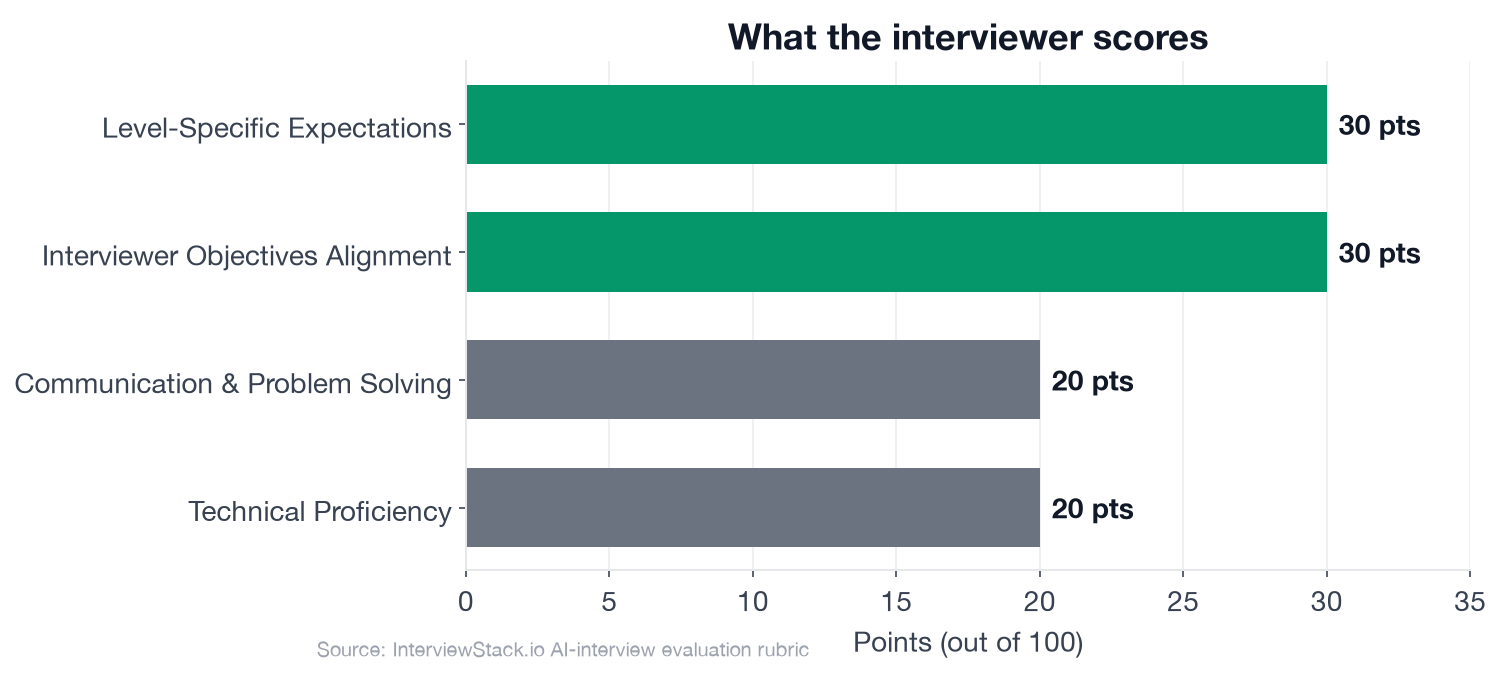
The rubric distributes 60 points across investigation structure and level-appropriate depth; only 20 points go to raw technical accuracy.
Key Findings
- The interview runs 30 minutes across 3 phases: triage (0-8 min), multi-source correlation (8-20 min), and scoping plus hunt follow-through (20-30 min).
- 60 of 100 rubric points test investigation structure: 30 pts for Interviewer Objectives Alignment, 30 pts for Level-Specific Expectations.
- Phase 1 has 4 checklist items including stating at least 2 plausible hypotheses before touching any log source.
- Phase 2 spans all 5 telemetry types: firewall, proxy, DNS, endpoint, and application authentication logs.
- Phase 3 requires behavior-based hunt logic, not just a static IOC block, to satisfy the expectedChecklist.
- Total checklist items across 3 phases: 13, each mapped to a specific rubric dimension.
The Log Analysis and Threat Hunting Interview, Turn by Turn
The interviewer opens with this scenario.
The interview question
You are supporting an internal security operations team for a large cloud-first company. At 09:40, an alert is opened for a corporate laptop after unusual outbound activity was noticed overnight. The environment has the following telemetry available in the SIEM:
- Firewall logs: src_ip, dest_ip, dest_port, action, bytes_sent, bytes_received, timestamp
- Proxy logs: user, device_id, url, domain, http_method, response_code, bytes_out, bytes_in, timestamp
- DNS logs: device_id, user, query, resolved_ip, record_type, timestamp
- Endpoint logs: device_id, user, process_name, parent_process, command_line, file_path, network_connection_ip, network_connection_port, timestamp
- Application authentication logs: user, app_name, src_ip, geolocation, result, timestamp
Walk me through how you would investigate this alert end-to-end using the data above, and how you would decide whether it is a real threat that needs escalation.
The interviewer is probing four things at once: whether you build a structured investigation flow from an ambiguous alert, whether you correctly use each log source's evidentiary value, whether you test competing hypotheses rather than anchoring on one explanation, and whether you can make a defensible escalation call. They are not looking for a perfect answer. They are watching how you reason through uncertainty.
Turn 1: Proxy Upload Triage
Interviewer: "If the proxy logs show large uploads to a previously unseen domain, how would you determine whether this is exfiltration, an approved SaaS workflow, or a developer testing artifact?"
Turn 2: DNS Subdomains Without Firewall Success
Interviewer: "Suppose the DNS logs show many subdomain lookups with low reputation but the firewall logs do not show successful connections afterward. How would that change your assessment?"
Turn 3: PowerShell from a Document Reader
Interviewer: "If the endpoint telemetry shows powershell spawning from a document reader, what additional evidence would you look for before escalating to incident response?"
Turn 4: Converting the Case to a Repeatable Hunt
Interviewer: "How would you turn this investigation into a repeatable threat hunt or detection after the immediate triage is complete?"
Could You Avoid These Mistakes Without a Script?
Reading a walkthrough and spotting where Jordan went wrong is a useful orientation. The real interview has no red boxes, no scripted follow-ups, and no ability to pause and reconsider. You are forming hypotheses, correlating five log sources, and making containment calls while the interviewer watches how you handle uncertainty in real time.
The only thing that builds that fluency is unscripted reps: articulating your reasoning live, recovering when a follow-up reframes the scenario, and practicing the 8-minute Phase 1 window until hypothesis formation is automatic.
The Blueprint a Strong Candidate Hits
The chart below maps the 30-minute interview into its three phases. The blueprint card that follows is exactly what the AI mock interview tracks you against in real time.
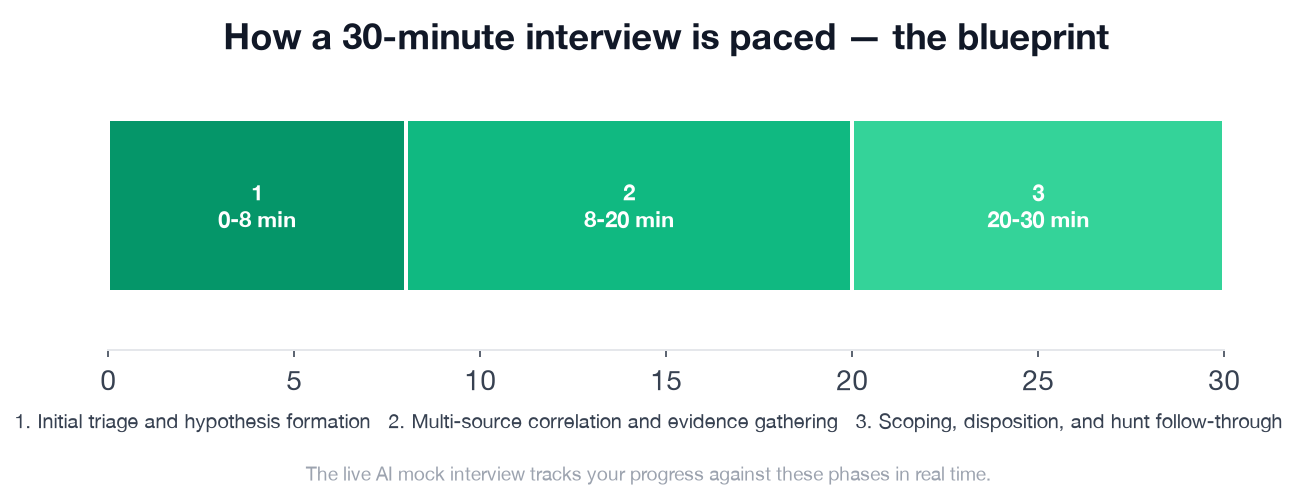
The three phases, their time allocations, and the 13 checklist items a strong candidate covers across the session.
- ✓Clarifies what triggered the alert and the overnight time window before diving into conclusions
- ✓States intent to build a timeline anchored on device, user, destination, and process activity
- ✓Mentions at least two plausible hypotheses such as malware/C2, exfiltration, admin automation, or normal SaaS usage
- ✓Prioritizes highest-signal telemetry first rather than treating all logs equally
- ✓Uses endpoint logs to identify initiating process, parent-child relationship, command line, and outbound connections
- ✓Correlates DNS queries to resolved IPs and then to proxy/firewall destinations across timestamps
- ✓Explains how proxy logs help distinguish browsing from uploads/downloads and identify domains/URLs tied to the activity
- ✓Uses authentication logs to check for concurrent account misuse, unusual source locations, or suspicious app access
- ✓Discusses handling mismatched timestamps, NAT/VPN effects, or partial telemetry without losing investigative rigor
- ✓Defines concrete escalation triggers such as malicious process lineage, confirmed suspicious destination, repeated beaconing, unauthorized uploads, or related activity on other hosts
- ✓Explains how to scope blast radius by searching for the same domain, IP, hash, process, or command line across other users/devices
- ✓Proposes proportionate next steps such as isolate host, disable account, block indicator, preserve evidence, or continue monitoring depending on confidence
- ✓Suggests a repeatable hunt or detection logic based on behaviors observed, not only static indicators
The AI mock interview uses this blueprint in real time: it tracks which checklist items you hit, follows up when you skip a phase, and scores your containment reasoning against the rubric at the end. That feedback is what a one-way walkthrough cannot provide.
Start the AI mock interview for Information Security Analyst log analysis and threat hunting to practice the full 30-minute session with a live follow-up for every turn above. If you want to drill the individual concepts before the full simulation, the log analysis and threat hunting question bank covers each phase's topics separately.
FAQ
Q. What does a log analysis and threat hunting interview test for Information Security Analysts?
The 30-minute interview evaluates four rubric dimensions: Interviewer Objectives Alignment (30 points), Level-Specific Expectations (30 points), Technical Proficiency (20 points), and Communication and Problem Solving (20 points). Sixty of the 100 points test whether you structure the investigation correctly and drive it at the right depth for a mid-level analyst.
Q. What are the three phases of a threat hunting interview for security analysts?
Phase 1 (minutes 0-8): initial triage and hypothesis formation. Phase 2 (minutes 8-20): multi-source correlation and evidence gathering across firewall, proxy, DNS, endpoint, and authentication logs. Phase 3 (minutes 20-30): scoping blast radius, disposition, and converting the case into a repeatable hunt or detection rule.
Q. What is the most common mistake in a security analyst log analysis interview?
Jumping into log queries without first forming hypotheses. The Phase 1 checklist requires stating at least two plausible explanations before picking log sources. Skipping this costs points in both Interviewer Objectives Alignment and Level-Specific Expectations, which together represent 60 of the 100 available points.
Q. What does a mid-level Information Security Analyst need to show in a threat hunting interview?
A mid-level analyst is expected to independently drive triage and correlation, identify common attacker patterns such as beaconing, suspicious scripting, and data staging, and make proportionate containment decisions. They should pivot across SIEM sources using time-bounded searches and host/user/domain pivots. Binary-level malware analysis and building full detection platforms are not expected at this level.
Q. How should a security analyst respond to PowerShell spawning from a document reader in an interview?
This parent-child relationship is itself a concrete escalation trigger: a document reader spawning a shell is a high-confidence malicious indicator consistent with phishing-driven execution. A strong answer names the trigger, identifies what to look for next in endpoint logs (command-line flags, child processes, network connections), and explains how to scope for the same behavior on other endpoints, rather than asking for more evidence before escalating.
Q. How is threat hunting different from triage in a security analyst interview?
Triage closes one alert: confirm or deny, scope, contain. Threat hunting converts one case into a reusable detection: strip out the static indicator and encode the behavior pattern into a search or alert rule that catches the next attacker. The Phase 3 checklist specifically requires behavior-based hunt logic, not just blocking a static IOC.
Where the Score Actually Diverges
Phase 1 is where most 30-minute scores separate. Candidates who spend those first 8 minutes forming hypotheses and anchoring a timeline have a structural advantage for every follow-up that follows. Candidates who open log queries first spend the rest of the interview catching up. The investigation structure that Phase 1 sets is hard to recover later, which is exactly why practicing it under pressure matters more than memorizing log field names.
Topics
Ready to practice?
Put what you've learned into practice with AI mock interviews and structured preparation guides.