
Network Infrastructure Is Going AI-Native, One Tool at a Time
Pull a sample of Network Engineer job postings and count how many mention generative AI. Across 3,105 active listings on the InterviewStack.io job board in June 2026, the answer is 2.1%. That is not a reporting error. It is, in fact, the lowest explicit AI adoption rate of any technical role we track.
And it is paradoxically the most interesting number in this analysis.
The 2.1% measures something specific: Network Engineers hired explicitly to build AI into the network stack, configure LLM-backed automation pipelines, or manage AI-native observability platforms. It does not capture the much larger group of engineers whose daily work now involves tools that are themselves AI-powered, whether or not their job posting mentioned it. The 89% of telecom organizations planning to increase AI spending this year (NVIDIA State of AI in Telecom 2026) are not all writing "AI" into their Network Engineer job descriptions. They are buying AI-native infrastructure that their network teams will operate. The posting language is lagging the procurement cycle.
Key Findings
- 3,105 active Network Engineer postings analyzed on the InterviewStack.io job board, June 2026.
- Only 2.1% of postings (64 of 3,105) explicitly require new-wave generative AI skills. Any AI mention, including traditional machine learning, reaches 4.9% (152 postings).
- Machine Learning leads all AI skill mentions at 2.9% (91 postings); Generative AI follows at 0.74% (23), AI Agents at 0.64% (20), and LLMs at 0.48% (15).
- Median US base salary is $119,319 (n=774 US postings with disclosed salary; equity and bonuses not included). Globally, postings with any AI skill carry a ~$14,000 premium over postings without one ($129,575 vs $115,282, n=83 vs 869).
- Senior roles dominate at 67.6% of postings (2,098 of 3,105); entry-level is just 2.3%, making this one of the harder roles to enter at the junior level.
- Technology companies lead AI adoption among sectors at 5.5% (18 of 328 postings); defense and aerospace together account for 218 postings with 0% explicit AI mention.
Before AIOps: What the Network Engineer Job Was
Three or four years ago, the core network engineer workflow was manual by design. You managed a CLI. You ran show interfaces, watched utilization graphs from SNMP polling, opened a ticket when something spiked, and pushed configuration changes by hand in a terminal window. Automation existed (Ansible playbooks, Python via Netmiko or NAPALM) but it was still the domain of forward-leaning engineers who had deliberately crossed into network automation work.
AI in any meaningful sense was not part of the standard toolset. Monitoring meant threshold-based alerts: if utilization crosses 80%, page someone. Capacity planning meant looking at historical trend lines and extrapolating. Incident response was a human process from first alert to ticket closure. Vendor platforms offered analytics dashboards that surfaced statistics, not predictions. The engineer was the inference engine.
That baseline matters for reading what comes next. Network automation was already accelerating before the AI wave hit: roughly 20% of network tasks were automated in 2024, rising to about 31% of campus and branch tasks in 2025 (IDC via TechTarget). The AI layer is building on top of an automation foundation that was already shifting the job.
How Much of the Shift Has Reached Job Postings?
The straightforward answer: not much, at least not yet as explicit requirements.
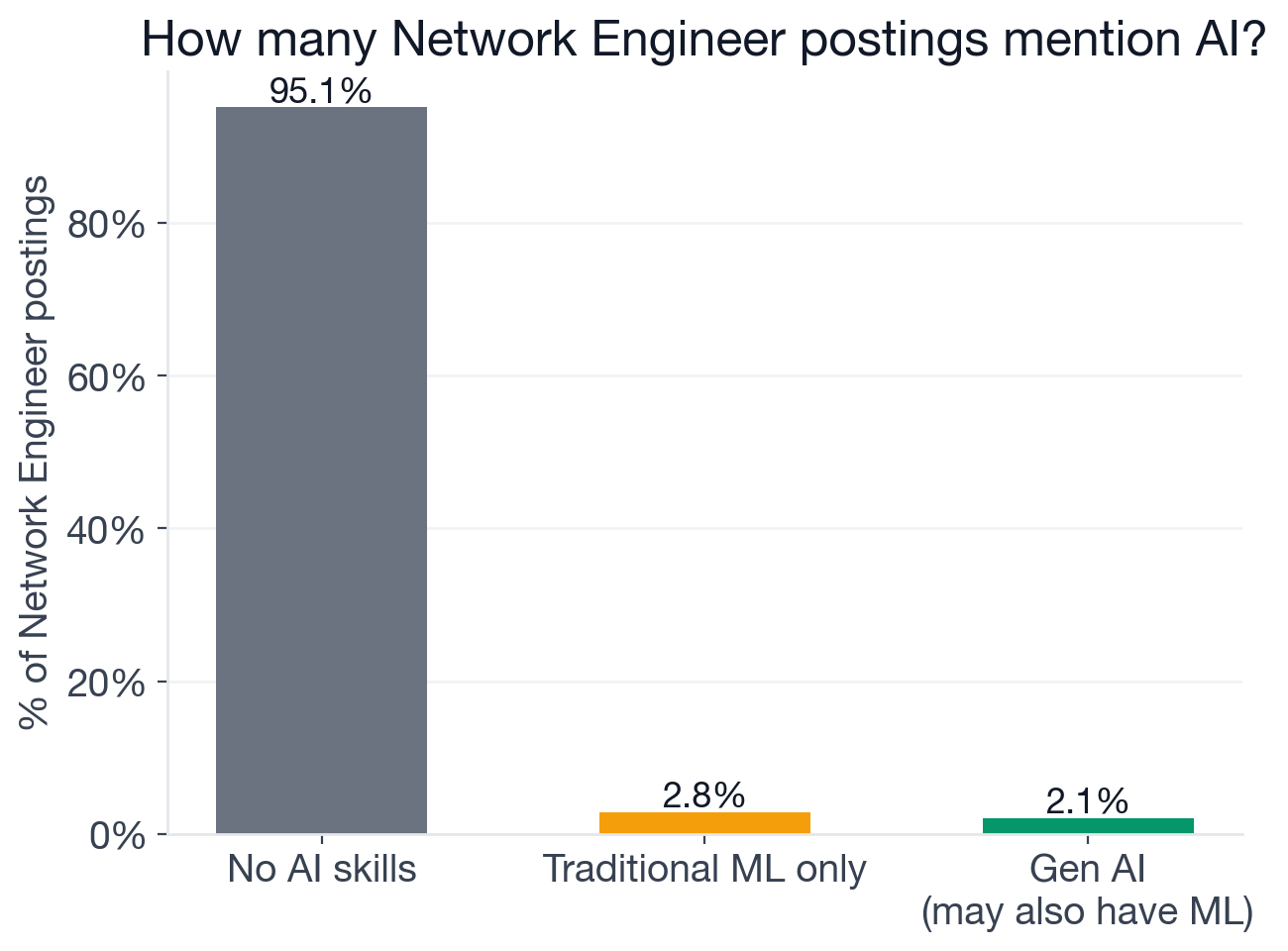
Share of 3,105 active Network Engineer postings by AI requirement type, June 2026. "New-wave" covers generative AI tools from 2023 onward; "traditional ML" covers machine learning and deep learning that predate the generative AI era.
Breaking this down:
- 4.9% of postings (152) mention any AI skill at all.
- 3.2% (100) mention traditional ML or deep learning, reflecting established analytics and anomaly detection use cases that have appeared in networking for several years.
- 2.1% (64) require new-wave generative AI skills: LLMs, AI Agents, Generative AI, or similar tools that emerged post-2022.
- 0.4% (12) ask for both.
The 95.1% with no explicit AI mention are not untouched by AI. They are running infrastructure that is AI-augmented without the posting naming it. Cisco Meraki's dashboard has been ML-powered for years. Juniper Mist uses AI-driven Wi-Fi optimization. Palo Alto Networks embeds AI into firewall policy management. The engineer managing these platforms uses AI daily; the job posting just doesn't reflect it.
The ambient layer is real and broad. Stack Overflow's 2025 developer survey found 84% of developers use or plan to use AI tools, with 51% doing so daily. JetBrains' 2025 research shows 85% regularly use AI for coding tasks and 62% have adopted at least one AI coding assistant. Those figures cover developers writing network automation code just as much as they cover backend engineers. The posting data measures something narrower: who is specifically hired to build or configure AI systems. For Network Engineers, that is 2.1%.
Which AI Skills Are Showing Up, and What Do They Signal?
Among the postings that do mention AI, the distribution points clearly to two use cases.
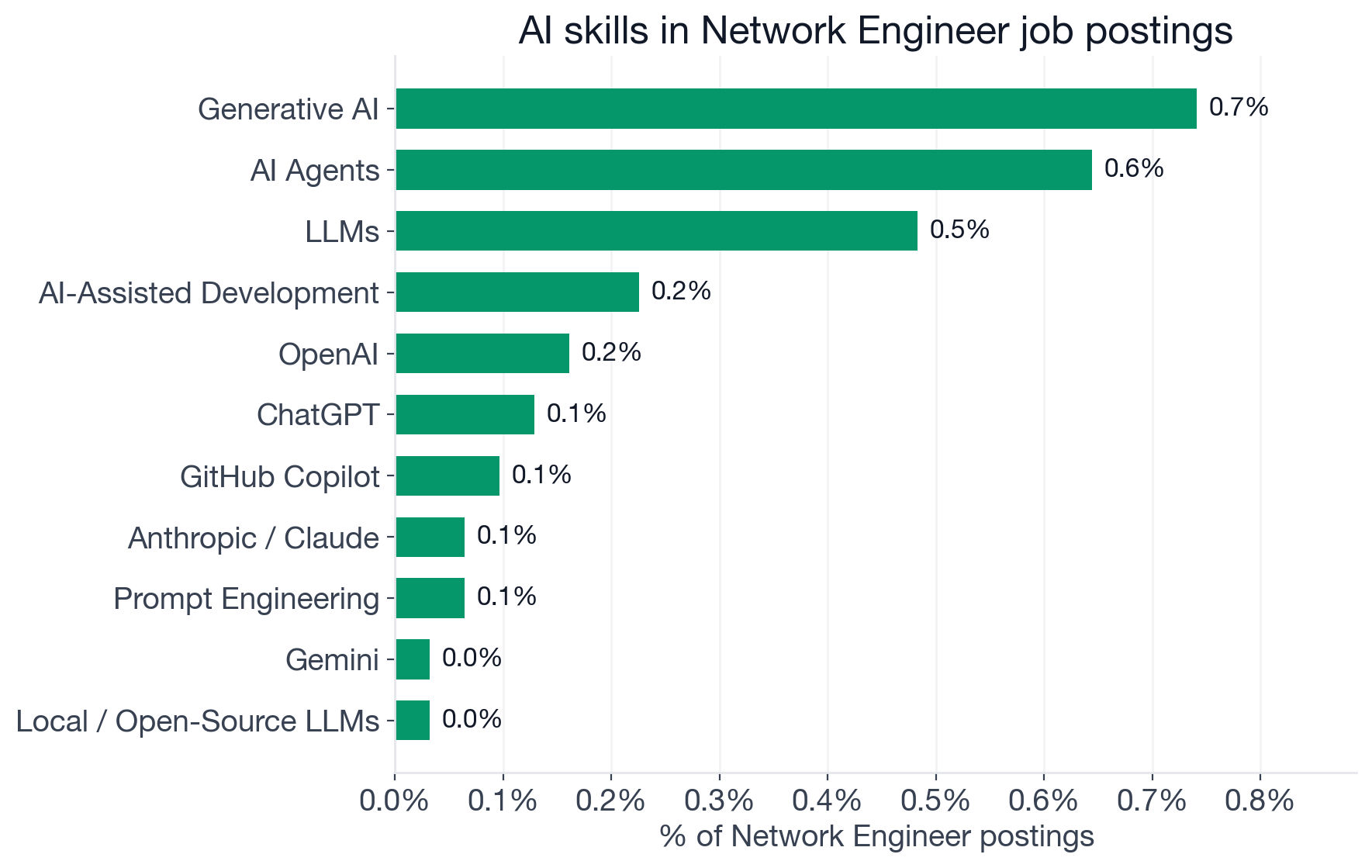
Percentage of active Network Engineer postings mentioning each AI skill, June 2026. Top 9 of 15 tracked skills shown.
| AI Skill | Postings | % of Role |
|---|---|---|
| Machine Learning | 91 | 2.9% |
| Generative AI | 23 | 0.74% |
| AI Agents | 20 | 0.64% |
| LLMs | 15 | 0.48% |
| Deep Learning | 11 | 0.35% |
| AI-Assisted Development | 7 | 0.23% |
| OpenAI | 5 | 0.16% |
| ChatGPT | 4 | 0.13% |
| GitHub Copilot | 3 | 0.10% |
Machine Learning at 2.9% (91 postings) represents the older AI thread in networking: AIOps, traffic classification, anomaly detection, and predictive capacity planning. These use cases have been growing steadily as vendors baked ML into their platforms, and they show up in postings for roles that integrate or extend those capabilities.
The generative AI cluster (Generative AI at 0.74%, AI Agents at 0.64%, LLMs at 0.48%) represents something newer. These postings expect engineers to integrate LLM-based automation into network operations: AI-driven runbook generation, agentic troubleshooting assistants, natural language interfaces to network management platforms. This is still a small fraction of the total market, but it is growing from a base of effectively zero two years ago.
GitHub Copilot appears in just 3 postings (0.10%). That is not a signal that Network Engineers don't use it. It is a signal that employers treat it as assumed. JetBrains data shows 30% of developers have already adopted Copilot, and 85% regularly use some form of AI for coding. Network engineers writing Ansible and Python automation scripts sit inside that population. The absence from postings is the same story as internet access not appearing in 2005 job descriptions: it became invisible precisely because it became universal.
Does AI in the Posting Change the Salary Picture?
Among US postings with disclosed salary data, the median Network Engineer base salary is $119,319 (n=774 US postings). These are US base salary figures only; equity, bonuses, and sign-on pay are not captured in postings, so total compensation at employers offering equity runs meaningfully higher than these numbers.
The US new-wave AI sample is too small to report a reliable US-specific premium: only 17 US postings mention new-wave AI skills with disclosed salary, below the threshold for a stable median. The global picture is more informative: postings with any AI skill carry a median of $129,575 (n=83) versus $115,282 for postings without (n=869), a global premium of roughly $14,000. Cross-market salary comparisons mix pay scales, so treat the gap as directional rather than exact. The signal holds: explicitly AI-tagged Network Engineer roles command more, and the premium likely grows as AIOps specializations become more distinct from generalist networking work.
One counterpoint worth noting: Stack Overflow's 2025 survey found developer trust in AI accuracy fell to 29% in 2025, down 11 percentage points from the prior year. For a role where misconfiguring a device can affect production traffic for thousands of users, skepticism about AI-generated configurations is rational. That trust gap may be part of why adoption is slower here than in application development; it does not mean adoption will stay slow.
Senior-Heavy, Sector-Split: The Seniority and Industry Picture
Network Engineering skews heavily senior. Senior-level roles make up 67.6% of all postings (2,098 of 3,105). For most technical roles, senior accounts for 30-40% of the market; here it is two-thirds.
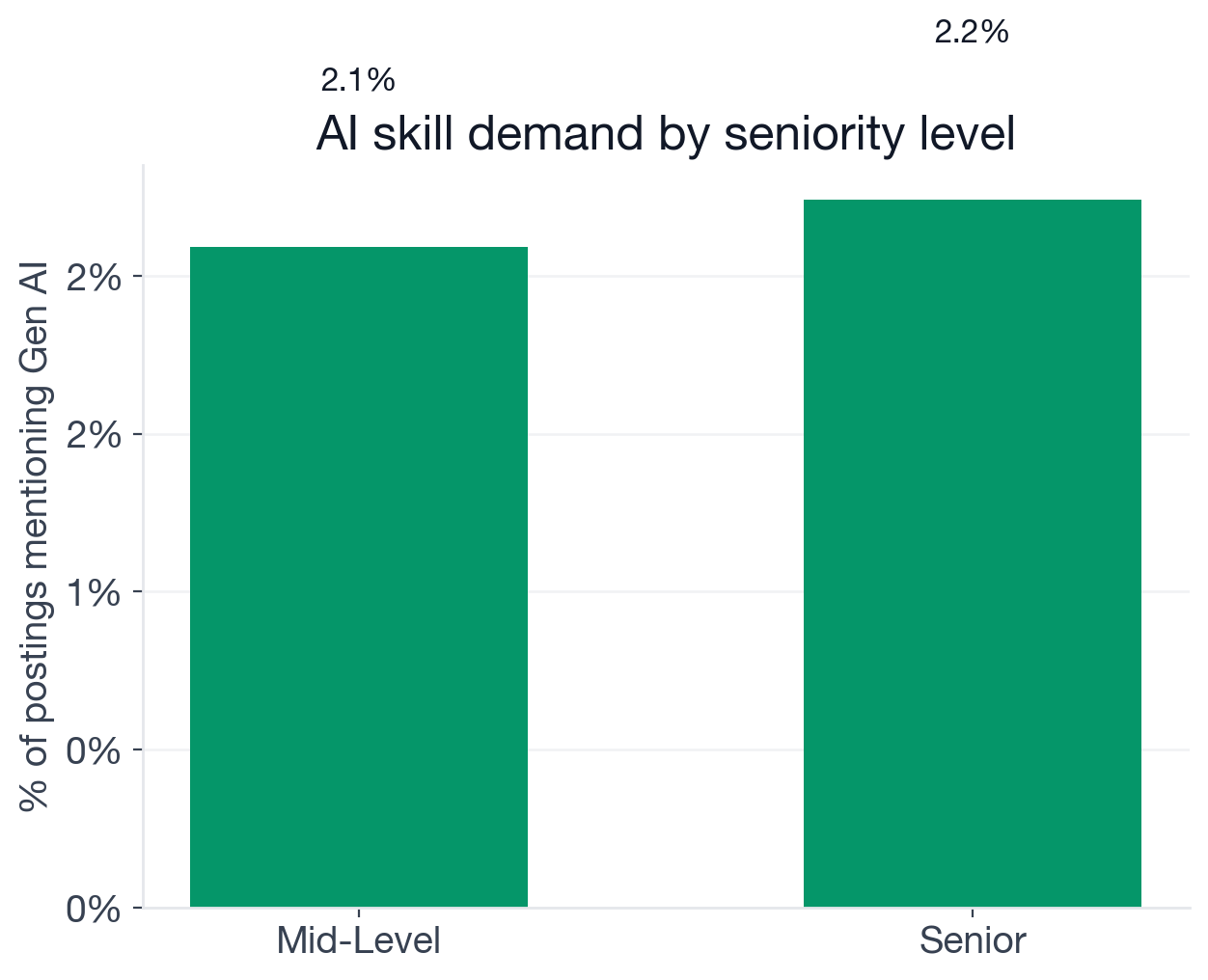
Share of postings by seniority level (left axis) with AI adoption rate per tier (right axis). June 2026.
Entry-level is just 2.3% of postings (71 of 3,105). That is a harder entry bar than most technical roles: Data Analyst entry-level sits at around 8%, for comparison. Network Engineering is typically reached through a path: IT support, network operations center work, or systems administration come first. The seniority skew reflects a role that is fundamentally built on operational experience, not one where classroom skills alone open doors.
On AI adoption across seniority levels, the rates are remarkably flat: senior at 2.2%, mid-level at 2.1%, staff at 1.2%. The AI signal is not concentrated at the senior tier in this role; it is distributed evenly and thin across all levels. That pattern suggests the AI shift in networking has not yet crystallized into a distinct career tier, the way it has for roles like AI Engineer or ML Engineer.
The sector picture tells a sharper story.
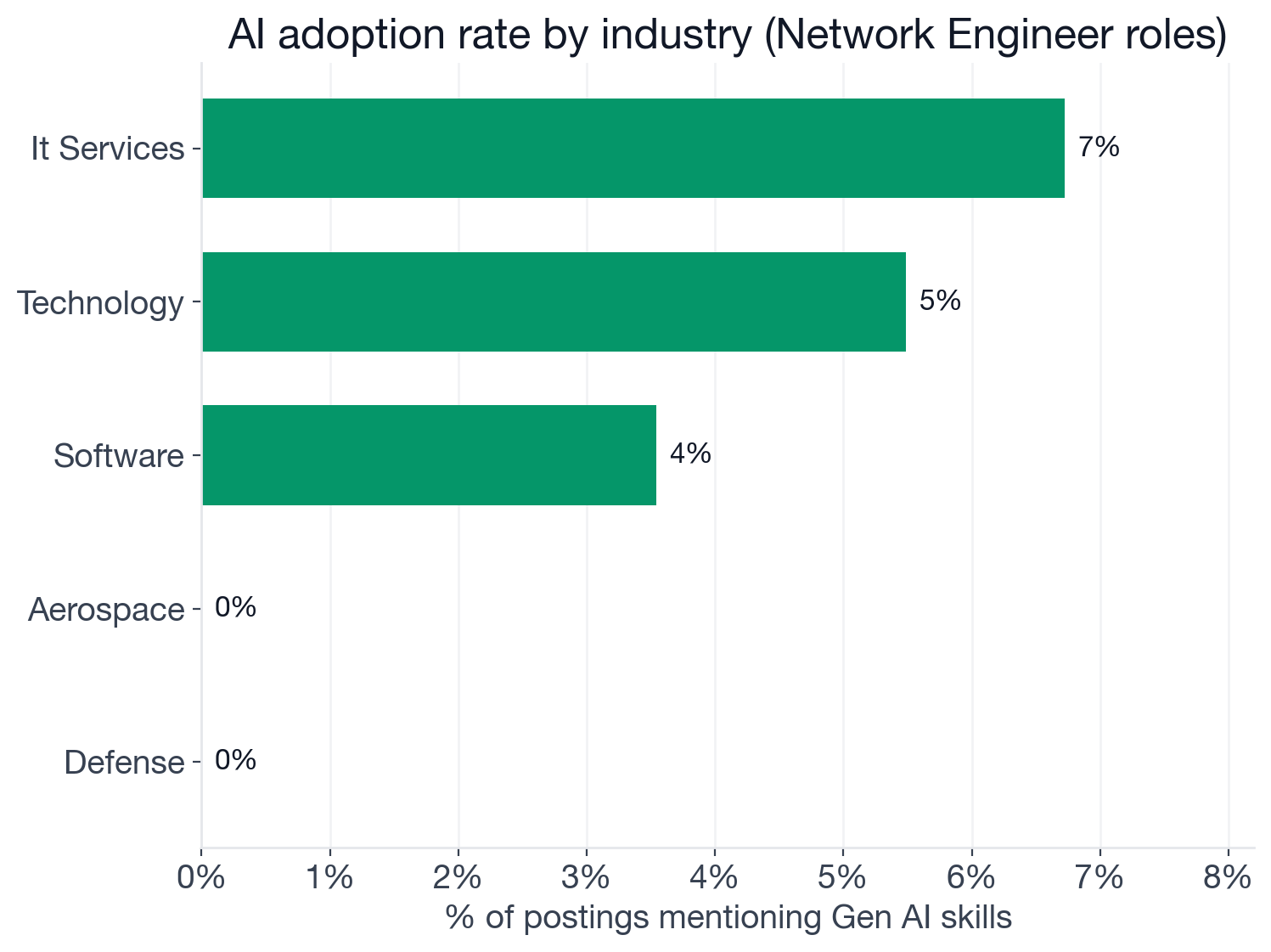
AI adoption rate (% of postings mentioning any AI skill) by industry for Network Engineer roles. IT services excluded due to single-firm concentration. June 2026.
Technology companies show 5.5% explicit AI adoption (18 of 328 postings), the highest clean signal among sectors. Software follows at 3.5% (9 of 254). These are the industries running cloud-native, high-traffic infrastructure where AIOps capabilities translate directly into reliability and cost efficiency.
Defense and aerospace, on the other hand, show 0% explicit AI mention across 218 combined postings. That is not a signal those roles are low-complexity. Defense network engineers often work on classified, high-availability systems where tolerance for experimental tooling is low, security clearance is the primary qualification screen, and the AI vocabulary is deliberately absent from job descriptions. The sector moves on a different adoption timeline than commercial tech, and the gap between them is among the widest visible in this dataset.
How to Use This in Your Job Search
If you are a Network Engineer planning the next 12 to 18 months of skill development, the data points to a layered approach rather than a single pivot.
Start with the active market: browse current Network Engineer openings to gauge demand in your geography and seniority band. If you want to filter specifically for roles with an AI component, postings that mention Machine Learning are the most populated AI-adjacent filter in the role today.
On the ambient layer: you do not need to wait for a posting to mention AI before building these habits. GitHub Copilot for writing Python automation scripts and Ansible playbooks, ChatGPT for debugging config issues and writing runbook documentation, and AI-native monitoring surfaces from your vendors are all worth becoming fluent in before they are formally required. JetBrains data shows 62% of developers already use at least one AI coding assistant. Being in the other 38% is a choice that carries increasing cost.
On the explicit layer: AIOps is the clearest skill family for network engineers who want the AI credential in their next role. Machine Learning (2.9% of postings today), AI Agents (0.64%), and LLM integration (0.48%) map to real use cases in anomaly detection, automated runbook generation, and AI-powered network management platforms. These are buildable skills for someone with a solid networking foundation and are increasingly visible in technology and software sector postings.
Prepare for the interview: AI mock interviews let you practice the full range of what senior Network Engineer interviews actually cover. In 2026 that mix includes traditional depth on routing, switching, BGP, and security, alongside questions about automation, observability, and how you approach AI-augmented tooling in production.
The InterviewStack.io question bank covers both the foundational networking topics that still dominate interviews and the emerging AIOps and automation material that appears in senior-level technical screens. For building the underlying concepts around machine learning and system design that underpin AI-adjacent networking roles, our interactive courses provide the structured foundation. For company-specific interview formats at the employers where the AI shift is most visible, the preparation guides are a useful companion.
FAQ
Q. What percentage of Network Engineer postings explicitly require AI skills in 2026?
Only 2.1% of Network Engineer postings (64 of 3,105 analyzed) explicitly require new-wave generative AI skills. Including traditional machine learning, any AI mention reaches 4.9% (152 postings). The low explicit rate reflects that AI in networking is increasingly embedded in tooling rather than listed as a standalone requirement.
Q. What is the baseline salary for a Network Engineer in 2026?
Among US postings with disclosed salary data, the median Network Engineer base salary is $119,319 (n=774 US postings). These figures reflect base pay only; equity and bonuses are not captured. Globally, postings with any AI-related skill show a roughly $14,000 premium over postings without one ($129,575 vs $115,282 global median, n=83 vs 869).
Q. Which AI skills appear most often in Network Engineer job postings?
Machine Learning leads at 2.9% of postings (91 of 3,105), reflecting demand for AI-driven network analytics and anomaly detection. Generative AI appears in 0.74% (23 postings), AI Agents in 0.64% (20 postings), and LLMs in 0.48% (15 postings). AI-Assisted Development is listed in just 0.23% (7 postings), likely understating real tool adoption since most employers treat scripting assistants as ambient productivity tools.
Q. Which seniority level is dominant in Network Engineer hiring in 2026?
Senior-level roles represent 67.6% of all Network Engineer postings (2,098 of 3,105), making this one of the most senior-skewed roles on the job board. Mid-level accounts for 20% and staff for 5.3%. Entry-level is just 2.3% of postings (71), making Network Engineering a challenging role to break into without prior infrastructure experience.
Q. Which industries are leading AI adoption in Network Engineer roles?
Technology companies show the highest clean AI adoption rate among the top industries, at 5.5% (18 of 328 postings). Software comes in at 3.5% (9 of 254). Defense and aerospace, despite representing 218 combined postings, show 0% explicit AI mention, reflecting those sectors' emphasis on security clearances and operational reliability over emerging tooling.
Q. Is AI adoption in network engineering mainly a US trend?
No. The US accounts for 51.3% of Network Engineer postings with a 2.1% AI adoption rate. India shows a higher explicit rate at 4.8% (10 of 209 postings). Canada and the Netherlands both show rates above 5%, though on smaller posting volumes. The structural shift toward AI-managed infrastructure is global, driven by telecom investment, though explicit job posting language consistently lags operational reality.
Q. How should a Network Engineer prepare for AI in 2026?
Two layers matter. First, build fluency with ambient tools: GitHub Copilot and ChatGPT for scripting and config automation are practical baselines even when postings don't list them. Second, develop literacy in AIOps concepts (anomaly detection, predictive capacity planning, automated fault remediation) as these are reshaping the infrastructure network engineers manage every day, regardless of whether "AI" appears in the job title.
Where to Start in a Shifting Stack
Network Engineering's AI story is structurally different from most technical roles: the explicit posting signal is quiet at 2.1%, but 89% of telecom organizations are increasing AI investment and network automation has overtaken every other AI use case as the leading deployment priority (NVIDIA State of AI in Telecom 2026). The gap between what postings say and what the infrastructure demands is the clearest signal in this data. The practical window for building AIOps literacy, ambient AI tool habits, and Python automation depth before they become hard requirements is open now. Start with the tools your vendors already ship; the formal job descriptions will follow.
Topics
Ready to practice?
Put what you've learned into practice with AI mock interviews and structured preparation guides.