
When AI Tools Stopped Being Optional
AI-Assisted Development is the single most-demanded explicit AI skill across Mobile Developer postings in 2026. Not on-device ML. Not LLM integrations. The tool mobile developers use to write code faster. Employers are starting to formally require that developers work with AI coding assistants, and the productivity baseline has shifted from assumed to stated.
The data comes from 1,911 active Mobile Developer postings on the InterviewStack.io job board, analyzed in June 2026. Fourteen-and-a-half percent of those postings explicitly require some form of new-wave generative AI skill. That figure is the floor of the shift, not the ceiling, and it has a story inside it worth reading carefully.
Before we get there: if you are a Mobile Developer wondering whether AI matters to your career, the short answer is yes at every level. The longer answer is that it matters in two distinct ways, and conflating them will give you the wrong picture of where you need to invest.
Key Findings
- 14.7% of Mobile Developer postings (280 of 1,911 analyzed) explicitly require new-wave generative AI skills. Including traditional ML, the share rises to 17.2%.
- AI-Assisted Development leads all explicit AI skills at 8.6% of postings (165 jobs), ahead of LLMs at 5.9% (112 jobs) and AI Agents at 4.2% (80 jobs).
- Machine Learning appears in 7.3% of postings (139 jobs), reflecting on-device and backend ML integration that predates the generative AI era.
- US postings requiring new-wave AI skills show a median base salary of $198,275 versus $148,750 without AI skills, a $49,525 directional gap (AI group n=39; equity excluded).
- Staff-level roles require AI in 20.6% of postings, compared to 16.0% for senior, 11.1% for mid-level, and 8.4% for junior.
- 85% of developers across all roles regularly use AI tools for coding (JetBrains 2025), and 51% use them daily (Stack Overflow 2025), regardless of what any job posting says.
- 90% of new mobile apps are forecast to incorporate AI capabilities by 2026, driven partly by on-device AI hardware now standard across flagship smartphone hardware.
The Mobile Developer Stack Before AI Changed It
Three or four years ago, being a competitive Mobile Developer was a clearly-defined problem. On native platforms: Swift for iOS, Kotlin for Android. On cross-platform: React Native or Flutter. Performance profiling, UI layout, platform API integration, push notifications, App Store deployment. The toolkit was stable and well-understood.
On-device machine learning existed. Apple's Core ML and Google's TensorFlow Lite gave developers a path to running small models locally, and some consumer apps used them meaningfully for photo filters, handwriting recognition, or live translation. But this was specialist territory. A typical Mobile Developer in 2022 had not touched Core ML and would not be expected to. ML was an add-on for specific products, not a baseline assumption of the role.
AI coding tools did not exist at scale. GitHub Copilot launched its general availability in June 2022; ChatGPT launched in November of the same year. In 2021 and for most of 2022, the average Mobile Developer wrote every line of Swift, Kotlin, or Dart themselves, relying on Stack Overflow for debugging and API reference. That workflow is essentially extinct now.
The change was compressive: within 18 months, the entire developer toolchain absorbed a new productivity layer, smartphone OEMs shipped AI hardware on flagships (Apple's Neural Engine in A-series chips, Google's Tensor G4, Qualcomm's Snapdragon AI Engine), and app stores filled with AI-powered features that users expected by default. According to industry analyst forecasts, 90% of new mobile apps will incorporate AI capabilities by 2026. The job posting data has not fully caught up with that transformation, but 14.7% of postings now name AI explicitly.
What Does 14.7% Explicit Adoption Actually Mean?
The 14.7% figure measures one specific thing: Mobile Developer postings that explicitly state an AI skill requirement. It captures engineers hired to BUILD or ARCHITECT AI-powered features: LLM integrations in apps, on-device ML pipelines, AI Agents inside products, generative UI experiences.
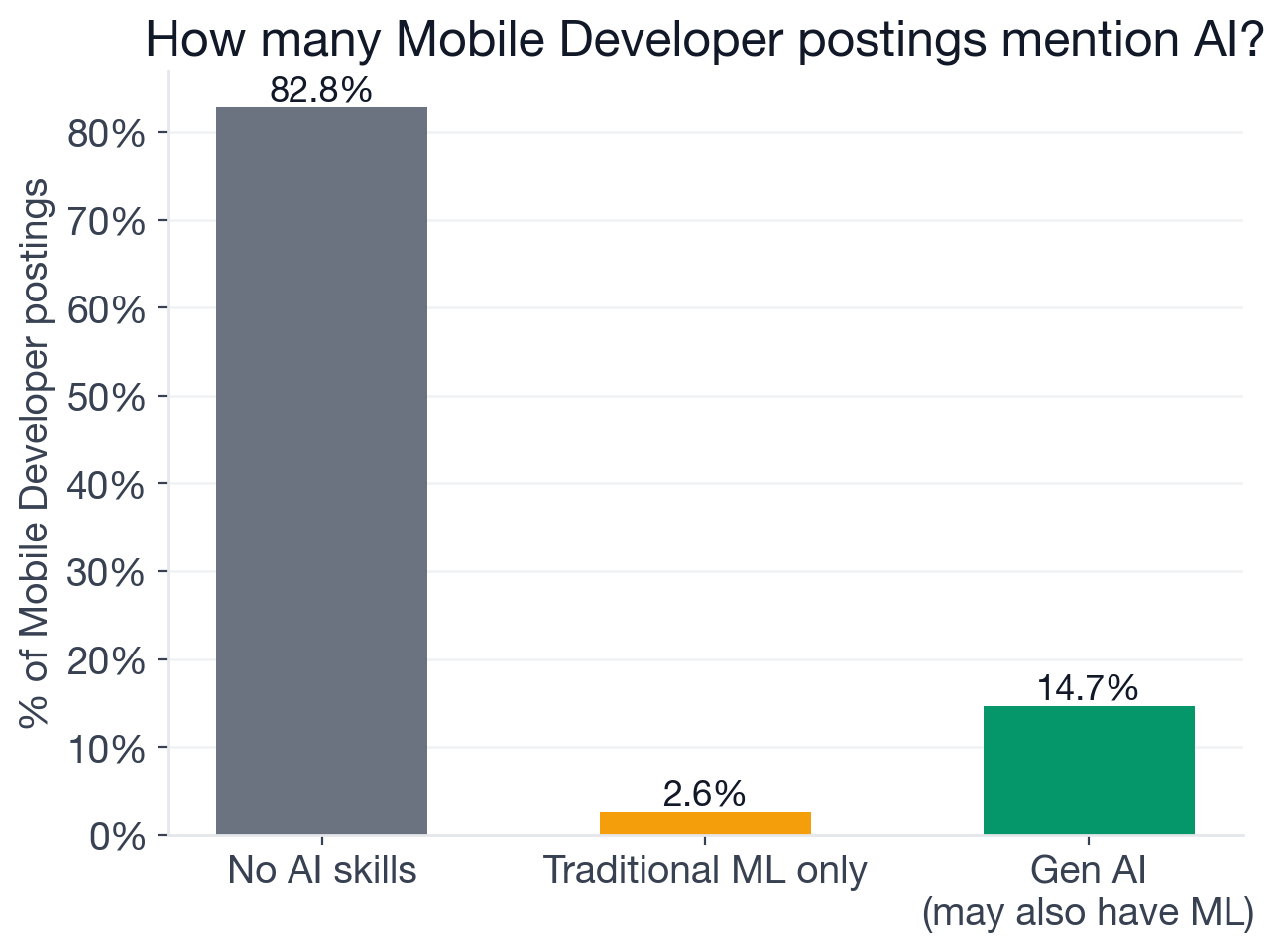
Share of 1,911 Mobile Developer postings by AI requirement tier. "New-wave AI" covers generative AI tools introduced in 2023 or later; "traditional ML" covers ML frameworks present in postings for five or more years.
What 14.7% does not capture is the ambient layer. The JetBrains 2025 State of Developer Ecosystem survey found 85% of developers regularly use AI coding tools, and 62% rely on at least one AI coding assistant daily. Stack Overflow's 2025 Developer Survey found 51% of professional developers use AI tools daily. None of that appears in job postings. Employers do not list "uses GitHub Copilot" in a job description the same way they never listed "uses Google to debug" in 2005. It is assumed.
The honest two-layer picture for Mobile Developers in 2026:
Layer 1 (Build AI): 14.7% of postings explicitly require it. If you are in this segment, you are integrating LLMs, building on-device inference pipelines, or shipping agentic features into apps. This is where the salary premium concentrates.
Layer 2 (Use AI): Essentially all of the field. Writing Swift, Kotlin, Flutter, or React Native code without an AI coding assistant means operating at a productivity disadvantage against the 85% of developers who use one. The ambient layer is not optional at any level.
A reader who finishes this section should not come away thinking "85% of Mobile Developer jobs do not require AI." The correct takeaway is: 14.7% require you to BUILD AI systems into the apps you ship. Virtually all of them expect you to USE AI tools to ship code.
Which AI Skills Are Mobile Employers Asking For?
Not all explicit AI requirements are equal. The ranked skill demand reveals where the real demand is concentrating:
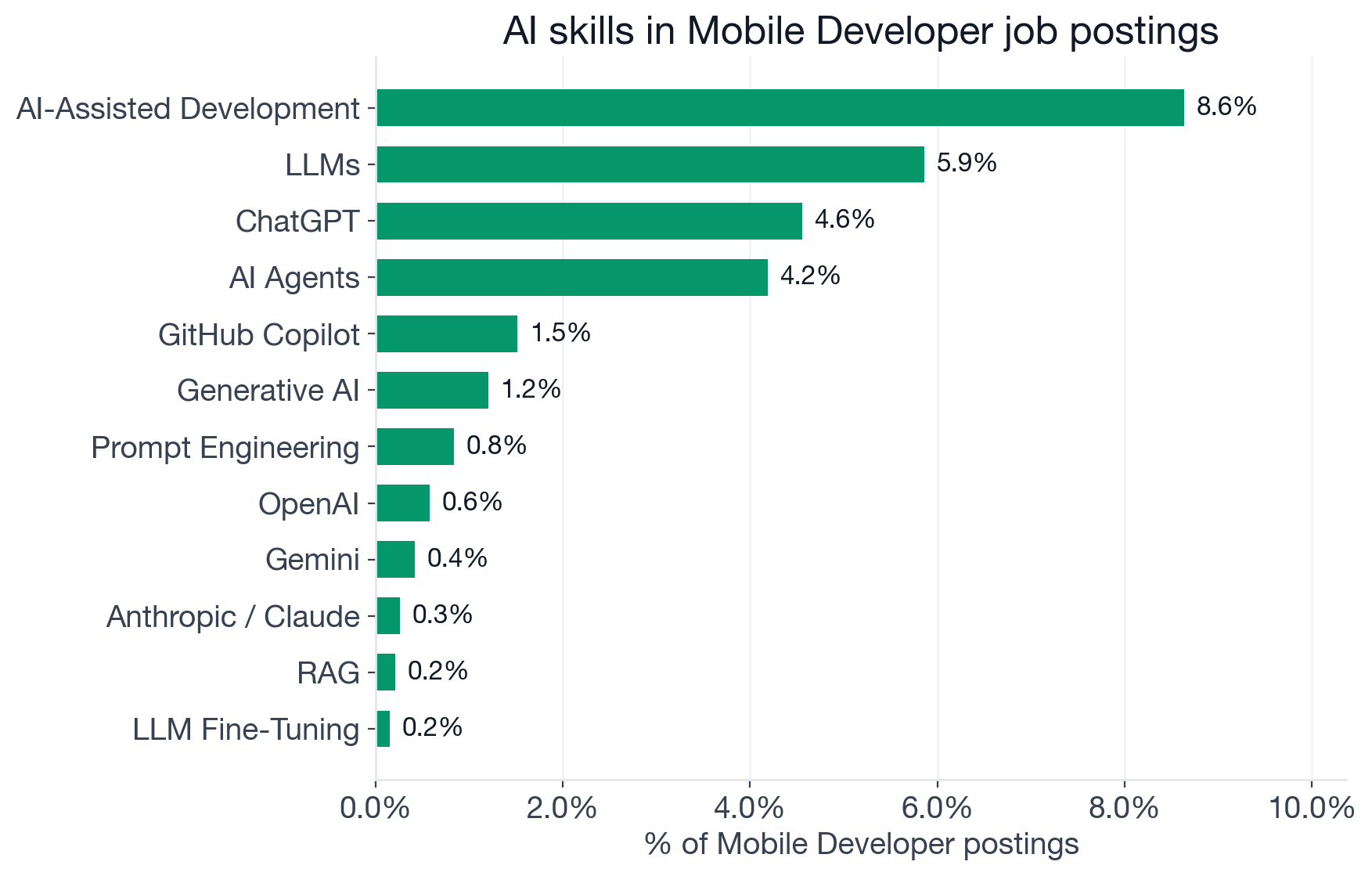
New-wave AI skills ranked by share of active Mobile Developer postings. Skills marked new-wave were introduced post-2023; Machine Learning and Deep Learning are pre-2023 baseline skills.
The top of the list splits into two groups with different implications:
AI dev tools (the ambient layer going explicit): AI-Assisted Development at 8.6% and ChatGPT at 4.6% are not asking you to build AI features. They are asking you to use AI in your development workflow. The fact that these are now written into job postings is significant: what was assumed is starting to be required. Browse Mobile Developer roles that mention AI-assisted development to see where this concentration is highest.
Building AI into the product: LLMs (5.9%), AI Agents (4.2%), and Prompt Engineering (0.8%) represent roles that go deeper, integrating language models into the app, building agentic workflows, or managing model behavior inside a product. These are the roles where "build AI" is the actual deliverable, not the tool. See Mobile Developer postings that require LLM integration for where this demand lives.
Machine Learning at 7.3% sits in a category of its own. This is traditional ML: model inference on device, classification tasks, recommendation systems. It reflects the on-device AI layer that has been part of mobile development since Core ML and ML Kit launched, well before ChatGPT changed the conversation. The 7.3% rate means a meaningful and sustained slice of mobile employers have always wanted ML expertise.
GitHub Copilot appears in only 1.5% of postings, far below the 85% of developers who actually use it. That gap is the ambient layer in action. Most employers simply assume Copilot or a similar tool will be part of the workflow and never mention it.
What the Salary Data Is Signaling
Among US postings with disclosed salary data, roles requiring new-wave generative AI skills show a median base salary of $198,275 (n=39), compared to $148,750 for postings without AI requirements (n=344). That is a $49,525 directional gap, a premium of roughly 33% over the non-AI baseline.
Salary scope note: These are US base salaries only, drawn from postings with disclosed compensation data. Equity, RSUs, bonuses, and sign-on pay are not captured in posting data; total compensation at top employers runs meaningfully higher than these figures.
The AI-group sample size of 39 is small enough that the exact dollar figure should be treated as directional rather than precise. A few high-outlier postings can shift a median by tens of thousands of dollars at that sample size. What the data supports confidently is that the premium exists and is large.
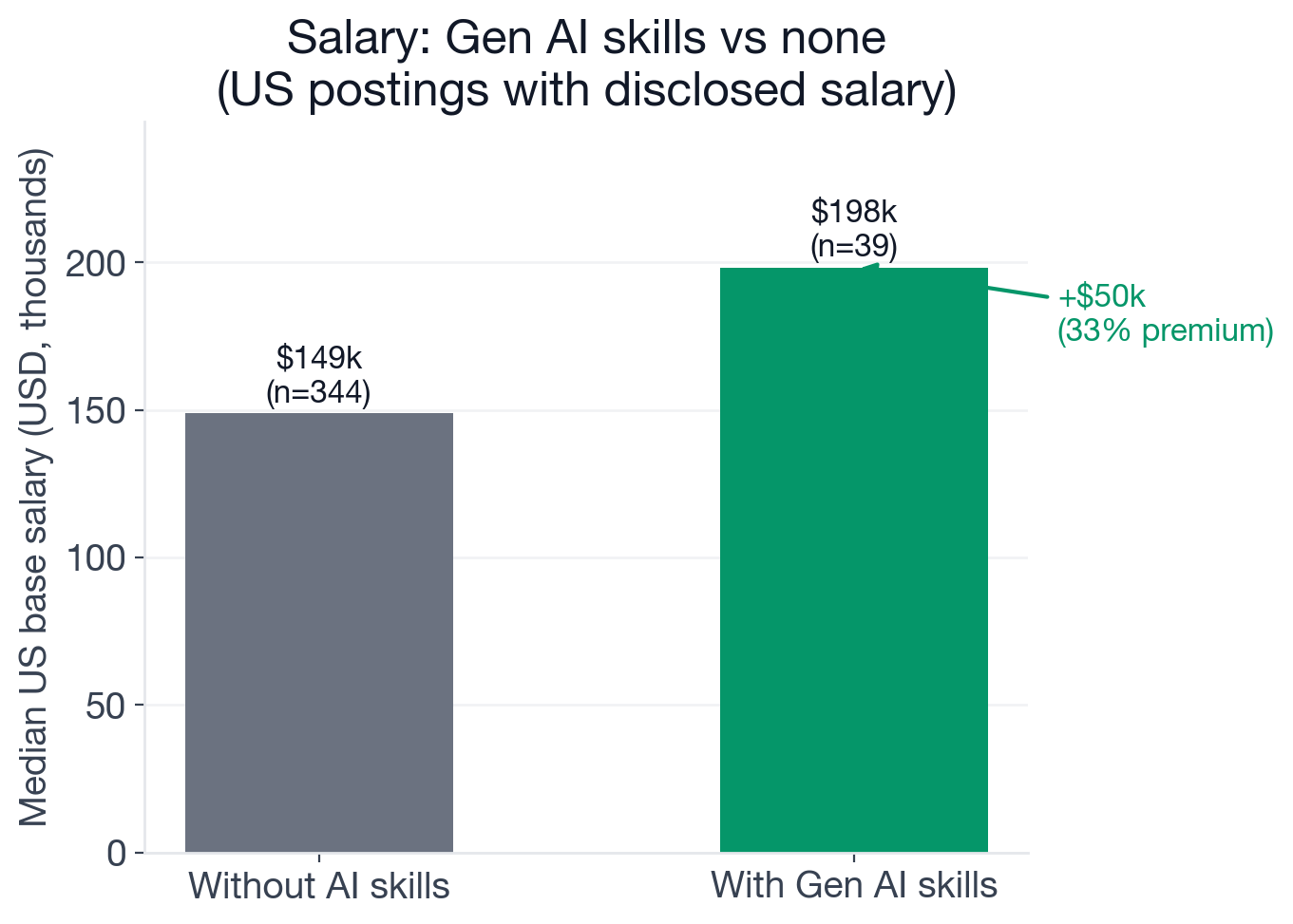
US base salary comparison for Mobile Developer postings with and without explicit new-wave AI skill requirements. AI group n=39; non-AI group n=344. Equity not included.
The practical implication is clear even with the caveat: Mobile Developers who can BUILD AI-powered features into apps (not just use AI tools to write faster code) are commanding a premium that is far above the baseline. The ambient layer (AI dev tools everyone uses) is priced in at the baseline salary already. The feature-building layer is where the gap opens.
Where AI Requirements Are Concentrated
The seniority distribution reveals which part of the Mobile Developer workforce absorbs AI requirements fastest:
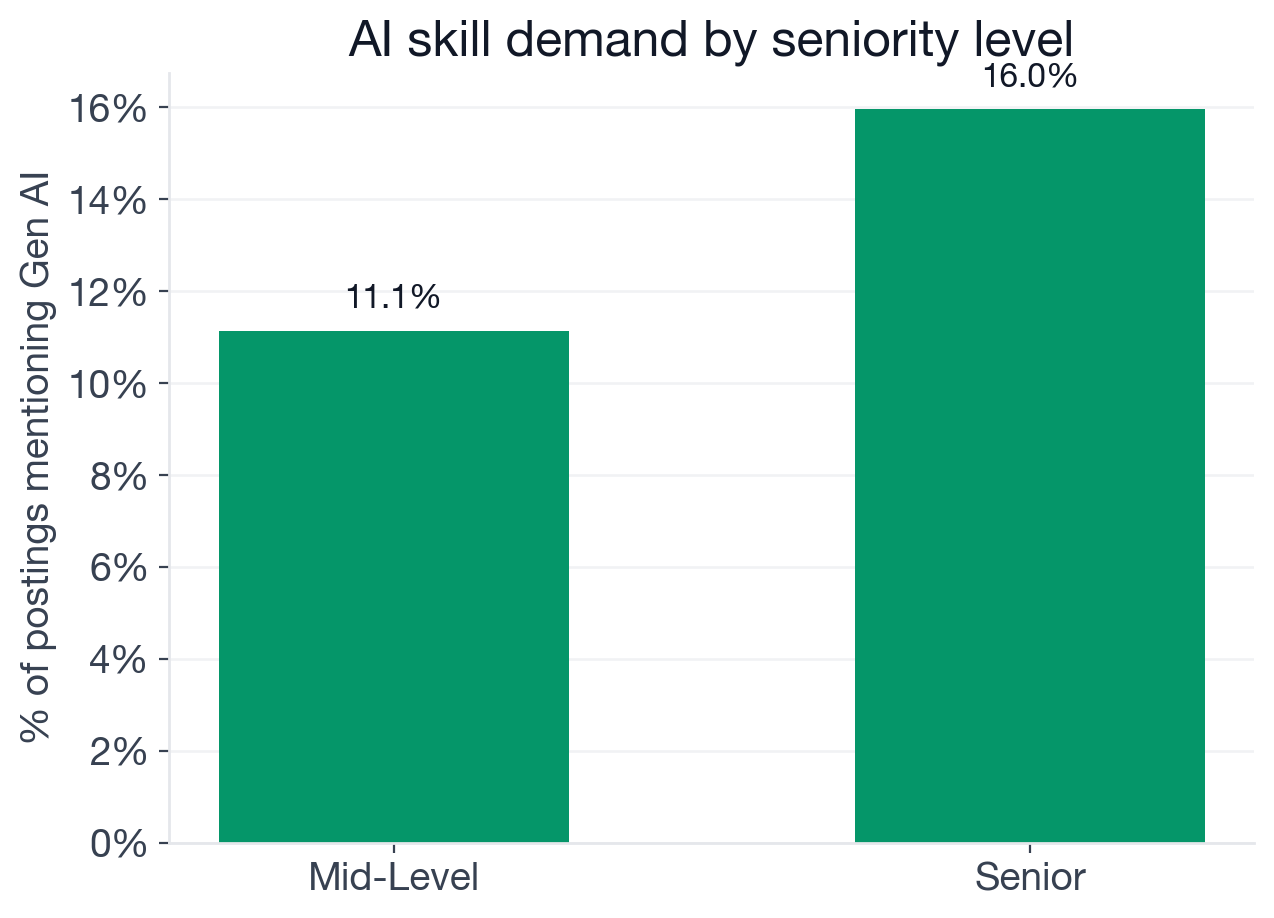
Percentage of Mobile Developer postings at each seniority level that explicitly require new-wave AI skills.
Staff-level roles carry the highest AI adoption rate at 20.6% (13 of 63 postings), nearly 2.5 times the junior rate. Senior roles follow at 16.0% (210 of 1,316). The gradient is consistent across the four main seniority tiers analyzed (junior through staff).
This reflects how AI feature ownership works inside mobile engineering organizations. Junior and mid-level developers are implementing features within existing app architectures. Staff and senior engineers are designing the AI integration strategy: choosing which models to deploy, deciding on-device versus cloud inference, and building the abstraction layers that others will eventually ship against. Architectural ownership concentrates at the top of the seniority ladder, and the explicit AI requirement follows it.
For anyone entering Mobile Developer roles: the 8.4% junior AI rate (10 of 119 postings) is below average, but not negligible. A portfolio project that integrates an LLM API or builds a simple on-device inference pipeline already puts you in a minority of junior candidates who have touched the technology.
The industry picture deserves a careful read:
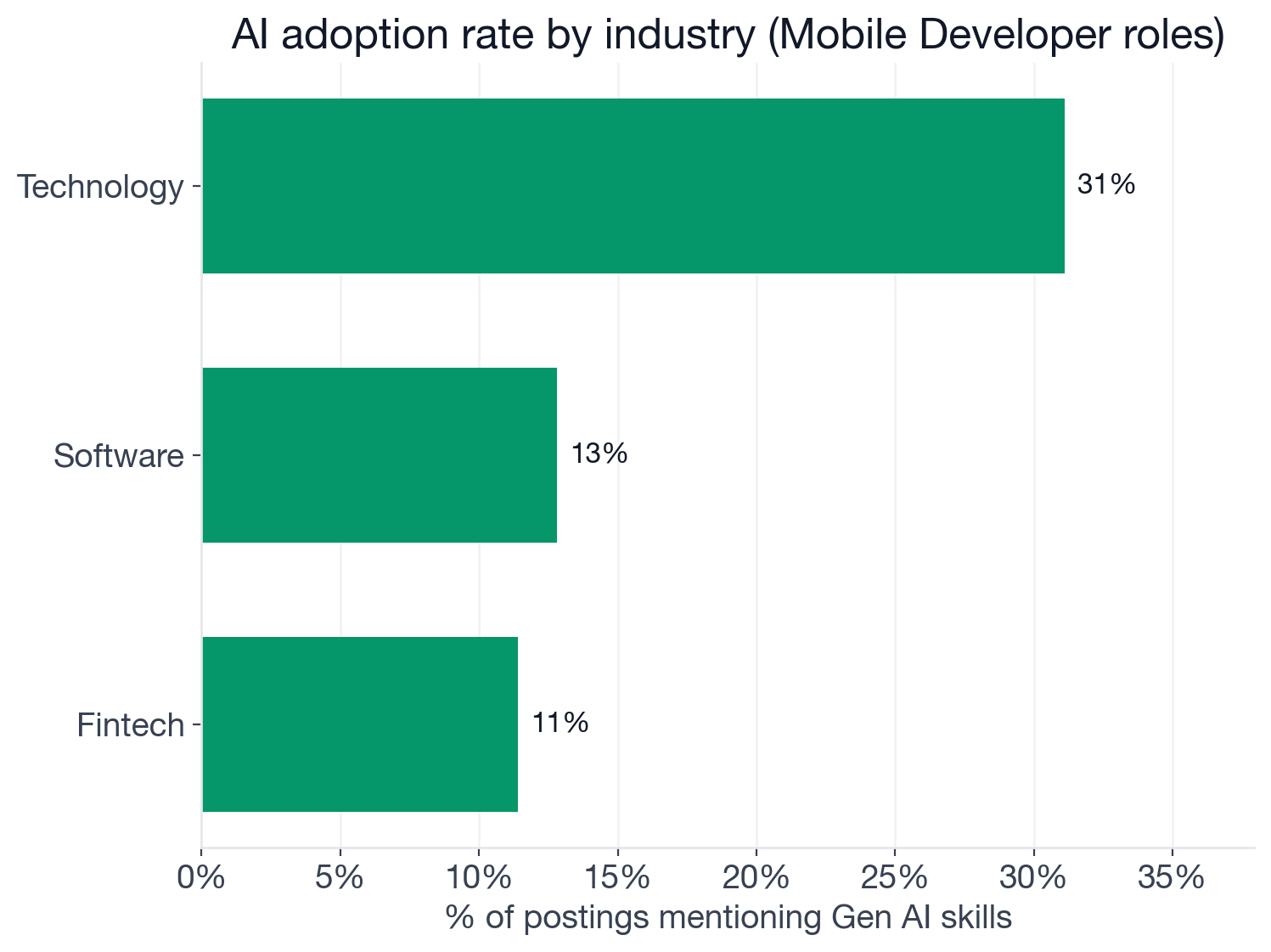
AI adoption rate by industry for Mobile Developer postings. Only industries with 100 or more total postings are shown.
Software companies (12.8% AI adoption across 250 postings) and fintech (11.4% across 158 postings) are the clearest industry-level signals. These reflect organizations building AI-powered consumer products and financial tools on mobile platforms. The technology sector headline rate in the raw data is higher, but a large share of those postings comes from a single firm, making it a concentration artifact rather than a real sector trend. Software and fintech are more reliable indicators of genuine industry demand.
How to Use This in Your Job Search
Know which layer you are targeting. Before applying to any Mobile Developer role, decide whether it is asking for AI dev tools (ambient layer going explicit: Copilot and ChatGPT in the workflow) or AI feature building (LLMs, agents, on-device inference). The job description will tell you. Each requires different preparation and attracts different salary ranges.
Practice for the interview, both sides of the work. Mobile Developer AI interviews in 2026 cover both product thinking around AI-powered app features and hands-on technical implementation questions. AI mock interviews let you practice the technical depth and communication expected at each seniority level.
Drill the foundational concepts. If you are building toward the AI-feature side (LLM integration, AI Agents, on-device ML), the question bank has Mobile Developer questions covering model integration, API design for AI features, and on-device inference tradeoffs. The interactive courses cover ML fundamentals and model deployment if you need to build the foundation before the application.
Use the job board to map the explicit demand. Browse current Mobile Developer postings on InterviewStack.io. The skill filters let you narrow to the exact tier you are targeting: AI-Assisted Development roles for the ambient-going-explicit layer, or AI Agents roles for the deeper feature-building segment. The salary profiles and seniority distributions differ meaningfully between these filters.
Use preparation guides for company-specific processes. If you are targeting a specific company, preparation guides outline what to expect in the interview process before you apply.
FAQ
Q. What percentage of Mobile Developer postings require new-wave AI skills in 2026?
14.7% of active Mobile Developer postings (280 of 1,911 analyzed) explicitly require new-wave generative AI skills. Including traditional ML and deep learning, the share rises to 17.2%.
Q. What is the salary premium for AI-skilled Mobile Developers in 2026?
US postings requiring new-wave AI skills show a median base salary of $198,275 versus $148,750 for postings without AI skills, a $49,525 gap. The AI-group sample is 39 postings, so treat this as a directional signal, not a precise figure. Equity and bonus are not included.
Q. Which AI skills do mobile employers explicitly require most?
AI-Assisted Development leads at 8.6% of postings (165 jobs), followed by Machine Learning at 7.3% (139 jobs), LLMs at 5.9% (112 jobs), ChatGPT at 4.6% (87 jobs), and AI Agents at 4.2% (80 jobs).
Q. Do all Mobile Developers need AI skills to be competitive in 2026?
Yes, but the depth varies. Only 14.7% of postings explicitly require building AI-powered features. The JetBrains 2025 Developer Ecosystem survey found that 85% of developers regularly use AI tools for coding, and Stack Overflow found 51% use them daily. Ambient AI tool use is a baseline expectation across all seniority levels.
Q. How does seniority affect AI requirements in Mobile Developer roles?
AI adoption rates in postings rise consistently with seniority. Staff-level roles require AI in 20.6% of postings (13 of 63), senior in 16.0% (210 of 1,316), mid-level in 11.1% (43 of 386), and junior in 8.4% (10 of 119).
Q. Which industries are leading demand for AI-skilled Mobile Developers?
Among industries with meaningful sample sizes, software companies show a 12.8% AI adoption rate across 250 postings, and fintech shows 11.4% across 158 postings.
Q. What did the Mobile Developer role look like before generative AI?
In 2021-2022, Mobile Developers worked almost exclusively in Swift and Kotlin for native platforms, or React Native and Flutter for cross-platform. On-device ML existed via Core ML and TensorFlow Lite, but it was specialist work used by a small fraction of teams. AI coding tools did not exist at meaningful scale, and neither employer nor candidate assumed AI proficiency in the daily workflow.
The Layered Reality
The 14.7% figure tells you which Mobile Developer roles are explicitly built around AI. The 85% ambient figure tells you the floor that virtually every role assumes. The right lens for your job search is not "do I need AI?", because the answer is yes at both layers. The useful question is "which layer am I targeting?" If you want the baseline, AI tool fluency is the expectation regardless of whether the posting names it. If you want the premium, the path runs through genuine depth in LLM integrations, on-device inference, and AI-powered product features. The data is showing you exactly where that demand concentrates and what it pays.
Topics
Ready to practice?
Put what you've learned into practice with AI mock interviews and structured preparation guides.