
How Has the Full-Stack Developer Role Changed in 2026?
A Full-Stack Developer job description in 2022 had a familiar shape. A front-end framework (React, Angular, or Vue). A back-end language or runtime (Node.js, Python, or Java). SQL. REST APIs. Git. CI/CD. Some cloud. That checklist was wide enough to span every product type and stable enough to look near-identical across industries. What it almost never included: any mention of language models, AI agents, or generative AI tooling.
In 2026 the checklist still starts the same way, but a new layer has been added on top for a growing share of postings: build AI features into those same products, integrate LLM APIs, ship retrieval-augmented systems, and use AI-assisted tools to do all of it faster. To put numbers on exactly how much changed, we analyzed every active Full-Stack Developer posting on the InterviewStack.io job board over the trailing 90 days as of June 2026, 6,973 listings, with AI skills extracted from descriptions and synonyms collapsed.
The headline: one in four Full-Stack Developer postings now explicitly asks for new-wave generative AI skills, those roles carry a $25,000 US salary premium over non-AI postings, and the engineers at the top of the seniority ladder face the steepest AI expectations. This post shows where the shift is concentrated, which skills are driving it, and how to position yourself for it.
Key Findings
- 6,973 active Full-Stack Developer postings analyzed on the InterviewStack.io job board in June 2026.
- 26.5% of postings explicitly require new-wave generative AI skills (1,845 of 6,973). When traditional machine learning is added, the share reaches 32.8% (2,290 postings).
- AI Agents is the #1 new-wave requirement, appearing in 10.4% of all postings (727 listings), ahead of LLMs (9.8%) and AI-Assisted Development (7.2%).
- The US base salary premium for AI skills is $25,000: postings requiring new-wave AI show a median of $140,000 (n=239) versus $115,000 without AI requirements (n=445). Equity and bonuses are not captured in posting data.
- Staff-level developers lead AI adoption at 38.3% of their postings; senior developers (69% of the overall market) sit at 24.9%.
- Technology and consulting lead by industry: tech posts AI requirements in 39.0% of Full-Stack Developer listings; consulting at 36.4%. IT Services trails at 6.3%.
- 85-90% of all developers already use AI coding tools regularly (JetBrains 2025; JetBrains April 2026), meaning the ambient AI baseline runs far ahead of what job postings explicitly state.
What Did Full-Stack Development Look Like Before AI?
Three or four years ago, the role had a consistent mental model: you were the engineer who could own the whole product layer, from database to back end to browser, without handing off to specialists at each boundary. The Stack Overflow Developer Survey 2022 captured the baseline: JavaScript, TypeScript, Python, and SQL were the most-used languages, Git sat at roughly 94% professional adoption, and Docker was the most popular non-language tool. A typical posting asked for React, Node.js or Django, REST or GraphQL, CI/CD, and a cloud provider. Generative AI was absent because it barely existed as a practical engineering tool: ChatGPT launched in November 2022, and "LLM integration" was not in any hiring manager's vocabulary.
The change since then has come in two waves. The first is ambient: AI coding tools have moved from novelty to daily infrastructure for most engineers, without appearing in job postings. The JetBrains Developer Ecosystem Survey 2025 found 85% of developers regularly using AI tools; a follow-up JetBrains study from April 2026 put that figure at 90% using at least one AI coding tool at work. GitHub reports 46% of written code now comes from AI suggestions for average Copilot users. For full-stack developers, the context-switching between front-end, back-end, and database layers is exactly where AI code completion delivers consistent daily value.
The second wave is explicit: postings now ask for engineers who can build AI into products, not just use AI to write faster. That is what the 26.5% figure measures.
What Are Companies Explicitly Asking For Now?
One in four Full-Stack Developer postings carries at least one new-wave generative AI requirement in its description. That is the explicit build-AI signal, distinct from the ambient tool-use baseline that applies to virtually every engineer regardless of what their posting says.
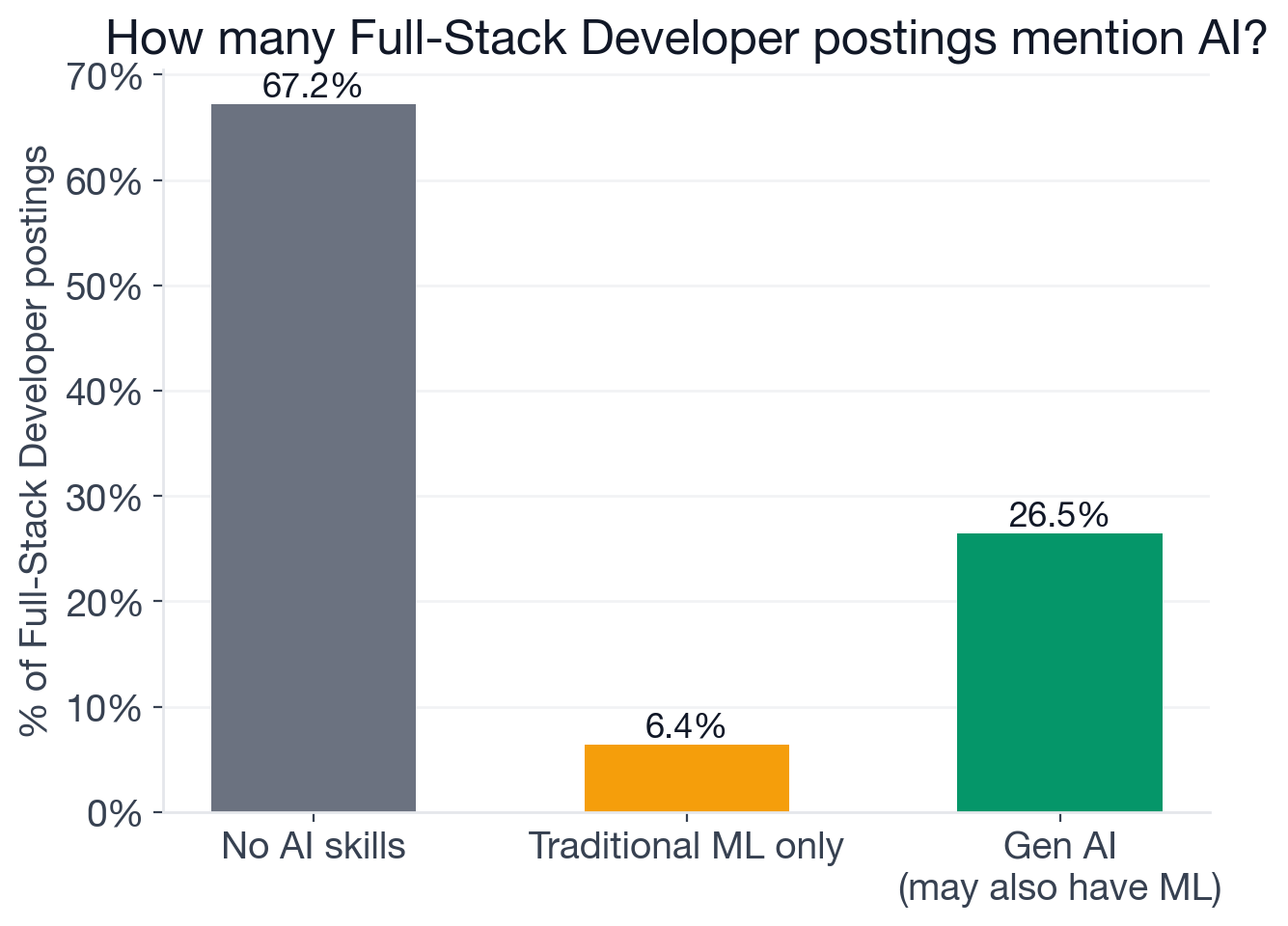
Of 6,973 active Full-Stack Developer postings, 32.8% mention some form of AI. New-wave generative AI (the LLM-era stack: Agents, RAG, Prompt Engineering, Vector DBs, Copilot) appears in 26.5% of postings, with 7.7% requiring both generative AI and traditional ML.
Three things stand out from that chart. First, the new-wave generative AI cohort (18.7% with no ML) is nearly three times the size of the pure traditional-ML cohort (6.4%). In the three years since ChatGPT, the LLM-era toolkit has overtaken deep learning as the primary AI hiring signal inside Full-Stack Developer postings. Second, 7.7% of postings ask for both, typically senior or staff roles at companies that already ran ML infrastructure and are now layering agentic and retrieval capabilities on top. Third, 67.2% still ask for neither. Front-end, back-end, and full-product-layer engineering without explicit AI requirements still dominates the market.
The right frame for a career decision: roughly one in three open Full-Stack Developer roles now screens for some form of AI competency, and the roles that do pay materially more.
Which AI Skills Are Reshaping Full-Stack Development?
The AI demand is not uniform, and it is not just asking for "ChatGPT users." The ranked skill list shows what type of AI work companies want full-stack engineers to actually do.
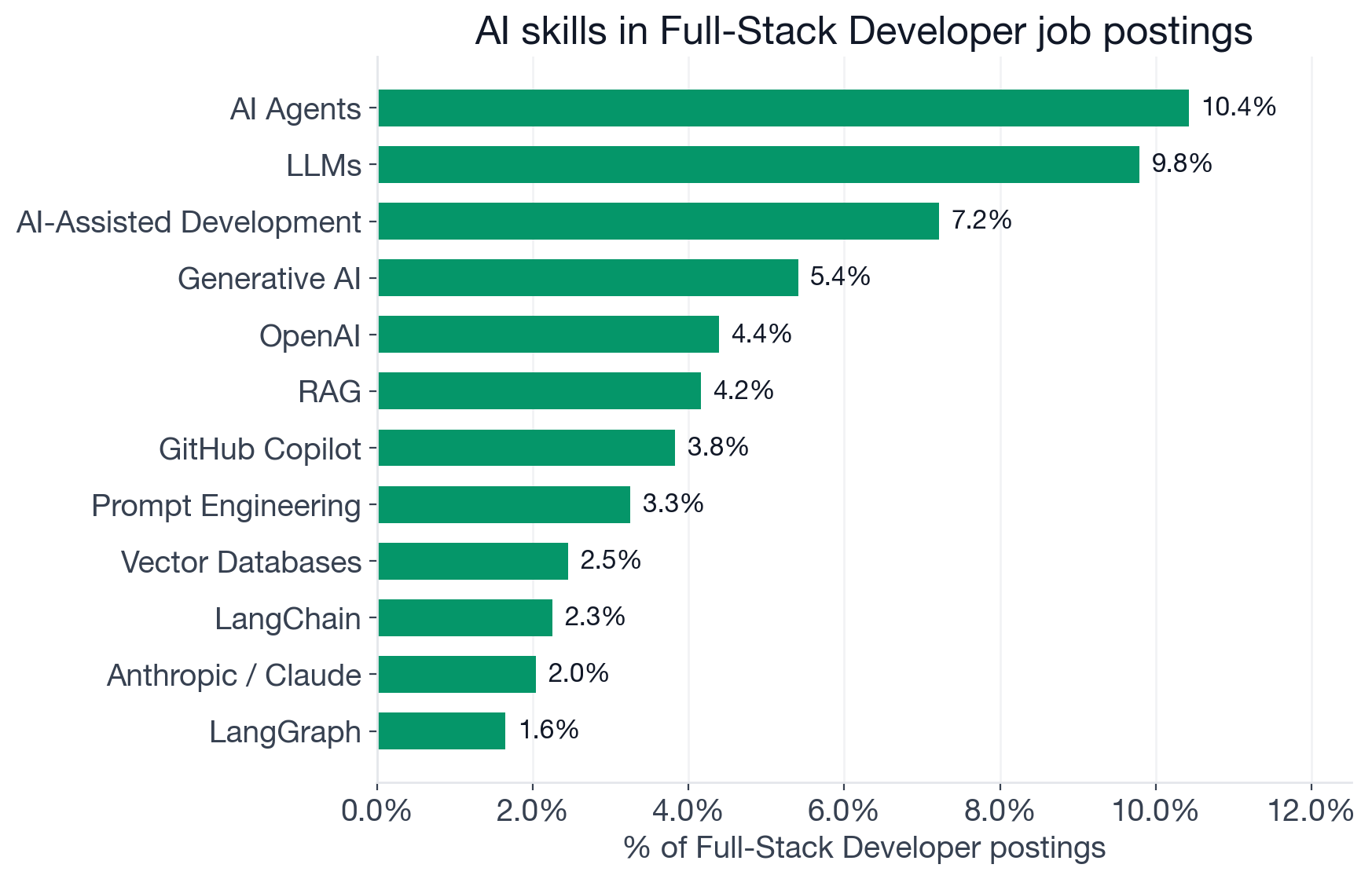
Share of Full-Stack Developer postings mentioning each AI skill. Traditional ML skills (gray) have been in postings for years; the new-wave generative AI stack (highlighted) is what has shifted since 2023.
The ranking tells a clear story about the type of AI work now expected:
AI Agents (10.4%, 727 postings) tops the new-wave list. Companies are not asking full-stack engineers to simply consume AI tools: they are asking them to build systems where LLMs make decisions, call tools, and orchestrate multi-step workflows. This is a builder-level requirement, not a user-level one. Browse Full-Stack Developer roles that require AI Agents or LLMs.
LLMs (9.8%) and Generative AI broadly (5.4%) form the next tier. Postings in this band expect practical familiarity with at least one foundation-model API and a working understanding of context windows, token costs, and output evaluation. RAG (4.2%) and Vector Databases (2.5%) follow as the retrieval infrastructure that serious LLM work requires. RAG, short for Retrieval-Augmented Generation, is the pattern of fetching relevant documents at query time so a language model can ground answers in real data rather than hallucinated recall.
AI-Assisted Development (7.2%) and GitHub Copilot (3.8%) sit in a separate category. These postings explicitly ask engineers to use AI in their own development workflow, not just build AI features. The fact that GitHub Copilot appears as an explicit requirement in 267 postings underlines how quickly "ambient tool" is becoming "listed credential."
LangChain (2.3%), LangGraph (1.6%), OpenAI API (4.4%), and Anthropic/Claude (2.0%) round out the practical builder stack. LangChain and LangGraph are Python libraries for composing LLM-powered pipelines and stateful agent workflows; full-stack engineers typically encounter them when building AI feature back ends rather than as standalone specialties.
The clearest signal across the full ranking: the new role expects builders, not just users. AI Agents, RAG, LLM application engineering, and structured prompt design are systems-level skills, the same kind of thinking that defined "strong back-end engineer" a few years ago, now applied to AI infrastructure.
What Salary Premium Do AI Skills Command?
Among US postings, where wage-transparency laws produce consistent salary disclosure, the median Full-Stack Developer base salary in postings that do not require AI skills is $115,000 (n=445 postings with disclosed US salary). In postings that require new-wave generative AI skills, the median rises to $140,000 (n=239 postings), a $25,000 difference, or 21.7% above the non-AI baseline. Equity, bonuses, and sign-on are not captured in job posting data, so total compensation at AI-heavy employers runs materially higher than these base figures.
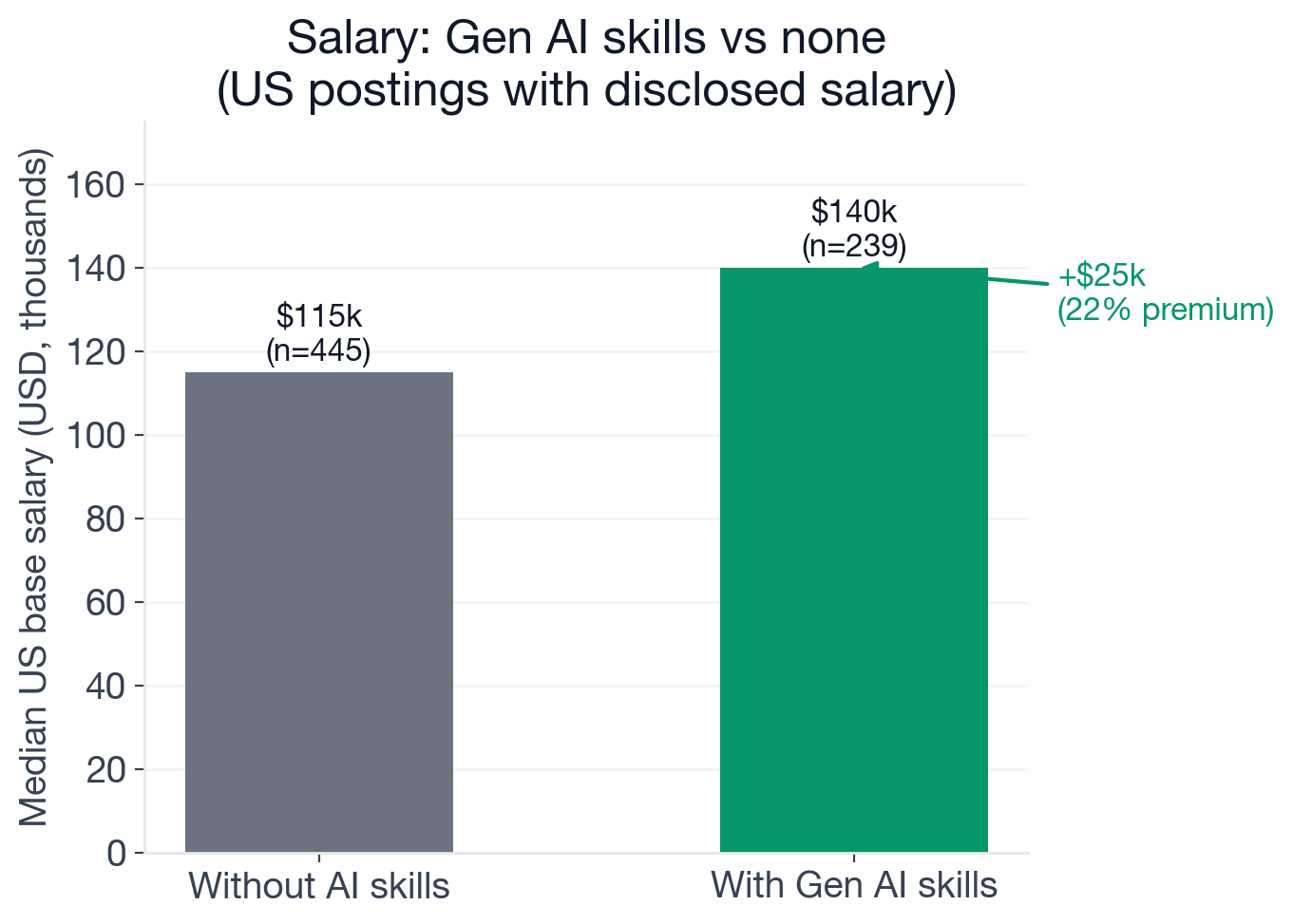
Median US base salary for Full-Stack Developer postings with and without new-wave AI skill requirements. US base salary only; equity and bonus are not disclosed in postings.
A few caveats worth keeping in mind. The premium is a market median, not a ceiling: specific AI-heavy roles at frontier labs or AI-product companies price well above $200K base, and total comp with equity is in an entirely different bracket. The premium also reflects role complexity: staff-level Full-Stack Developer postings have the highest AI adoption rate (38.3%), and staff-level engineering compensation is typically above the senior average regardless. Part of the $25K gap captures that AI-requiring roles are more often at the complex, senior end of the spectrum. With 239 US-salary postings in the new-wave AI cohort and 445 in the non-AI cohort, this is a broad market pricing signal, not a small-sample artifact.
For a mid-level full-stack engineer deciding whether to invest focused time in LLM application development, the payback period at this premium level is short. Browse Full-Stack Developer roles that require AI skills to see the current live demand.
Who Is Leading the AI Shift in Full-Stack Development?
The shift is concentrated by seniority, by industry, and by employer type in ways that are worth understanding before you target a search.
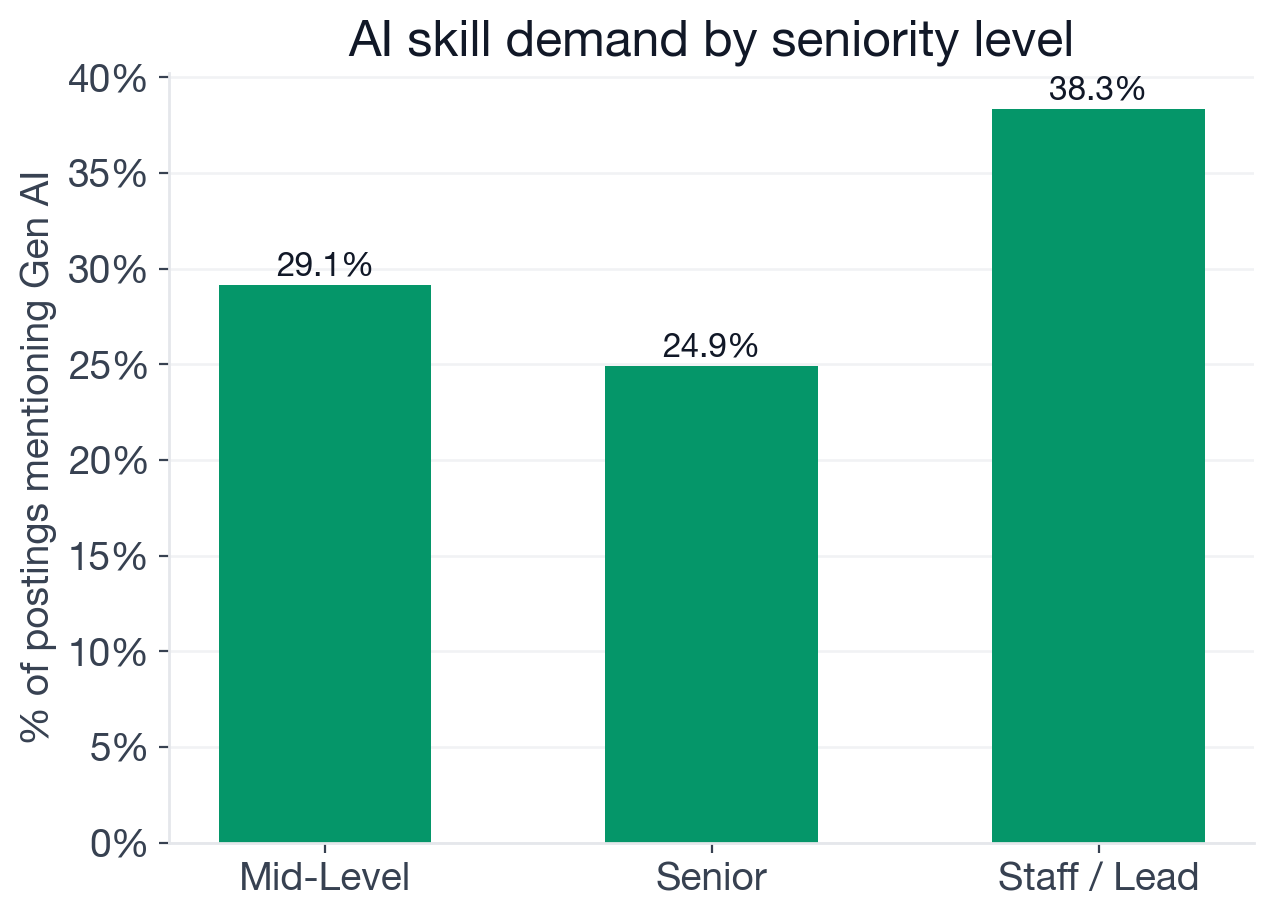
Share of Full-Stack Developer postings at each seniority level that require new-wave AI skills. Staff leads; senior is below the overall 26.5% average despite making up 69% of all postings.
The seniority breakdown holds a counterintuitive finding. Senior Full-Stack Developers make up 69% of all postings but have the lowest AI adoption rate among the senior cohorts at 24.9%, below the overall 26.5% average. Staff-level roles lead at 38.3%. The pattern makes sense: staff and principal engineers are expected to design the AI architecture, which makes the explicit AI requirement show up in the job description. Senior engineers are executing across the full stack on products that may include AI features without AI being the primary requirement in the posting. For mid-level engineers, the 29.1% AI rate in that band is already above the overall baseline, an early signal that AI requirements are filtering down through the career ladder.
The industry picture fills in the other half of the story.
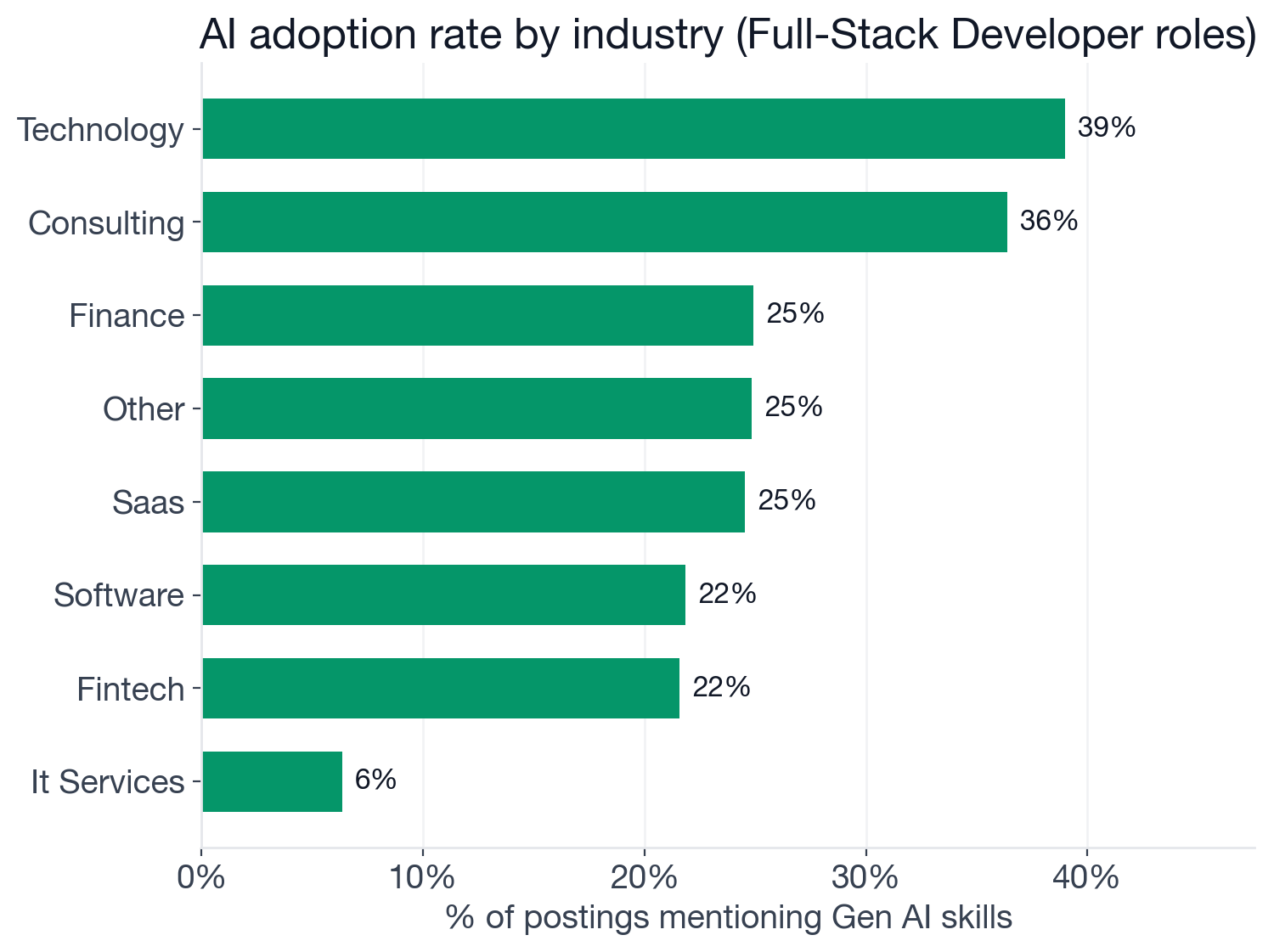
Share of Full-Stack Developer postings within each industry that require AI skills. Technology and consulting lead; IT Services lags by a wide margin.
Technology companies post AI requirements in 39.0% of their Full-Stack Developer listings; consulting firms follow at 36.4%. Both sectors are actively building AI-powered products and expect full-stack engineers who can integrate LLM APIs and ship AI features as part of their normal sprint work. Finance (24.9%) sits just below the 26.5% overall average: banks and asset managers are embedding AI into trading platforms, risk tools, and customer-facing interfaces, though the sector as a whole has not yet pulled ahead of the market-wide rate. At the other end, IT Services sits at 6.3%, a third of the overall average. Offshore delivery firms oriented around enterprise application maintenance have been slower to attach AI requirements to full-stack roles, though that gap will likely narrow as their clients push AI features into the products being supported.
On the employer side, the highest-volume AI-requiring hiring flows through software-services and outsourcing firms: AgileEngine (133 AI postings, 53% of its Full-Stack Developer listings) and Accenture (70 AI postings, 50%) lead by absolute count. Financial institutions are also prominent, with Royal Bank of Canada (61% AI adoption) and BNY Mellon (roughly 31% across 78 postings) scaling AI-capable full-stack teams. PricewaterhouseCoopers, Truelogic, and Encora round out the mid-tier.
How Can You Act on This Data Right Now?
Three things follow directly from the data that you can act on this quarter.
Treat AI as the next layer of your existing stack, not a separate career pivot. AI requirements are appearing inside generalist Full-Stack Developer postings, not just inside ML Engineer or AI Engineer titles. (If you're weighing the Full-Stack path against a more specialized back-end track, see how these two roles compare in 2026.) A full-stack engineer who adds AI Agent design, RAG pipeline experience, and LLM API integration competes for higher-paying generalist roles without switching tracks. Practice the systems-design side of AI (retrieval pipelines, agent orchestration, LLM evaluation) the way you practiced microservices a few years ago. Our AI mock interviews include scenarios for LLM-powered feature design and agentic architecture, calibrated to what full-stack hiring rounds actually test.
Drill the AI concepts that recur. AI Agents, LLM application design, RAG patterns, and prompt engineering show up across hundreds of postings and have well-defined interview question patterns. The Question Bank lets you drill these topics directly. Pair the drilling with a real portfolio project: build a RAG-powered feature or an agentic workflow in your existing tech stack and push it to GitHub. Postings ask for "built with," not "read about."
Filter your search by AI signal. A generic Full-Stack Developer feed is roughly two-thirds non-AI postings. Full-Stack Developer roles requiring LLMs and roles requiring GitHub Copilot are good starting filters; broaden to AI Agents and RAG as you build matching portfolio work. The full feed at Full-Stack Developer openings on InterviewStack.io gives the wider view, and our interactive courses cover the foundations underpinning both the core full-stack stack and the AI layer on top.
FAQ
Q. How many Full-Stack Developer jobs require AI skills in 2026?
26.5% of active Full-Stack Developer postings explicitly require new-wave generative AI skills (1,845 of 6,973 postings analyzed in June 2026). When traditional machine learning is included, the share rises to 32.8% (2,290 postings). The top individual requirements are AI Agents (10.4% of all postings) and LLMs (9.8%).
Q. Do AI skills increase Full-Stack Developer salaries?
Yes. The median US base salary for Full-Stack Developer postings that require new-wave AI skills is $140,000 (n=239 postings with US salary disclosed), compared with $115,000 for postings without AI requirements (n=445). That is a $25,000 premium, or 21.7% above the non-AI baseline. Equity and bonuses are not disclosed in job postings, so total compensation at AI-heavy employers runs higher than these figures.
Q. Which AI skills are most in demand for Full-Stack Developers in 2026?
The top new-wave generative AI skills by share of all Full-Stack Developer postings are AI Agents (10.4%), LLMs (9.8%), AI-Assisted Development (7.2%), Generative AI broadly (5.4%), OpenAI API (4.4%), RAG (4.2%), and GitHub Copilot (3.8%). Traditional Machine Learning, which has appeared in postings for years, leads the overall AI ranking at 13.9%.
Q. Is AI replacing Full-Stack Developers or changing the role?
The data points clearly to role change, not replacement. Hiring volume for Full-Stack Developer remains high (6,973 active postings in June 2026), and AI-related skills appear as additions to the standard job description, not as substitutes for the core front-end and back-end stack. The #1 new-wave AI requirement, AI Agents (10.4% of postings), presupposes someone writing the systems.
Q. Which seniority levels have the highest AI demand in Full-Stack Developer roles?
Staff-level Full-Stack Developers see the highest AI adoption rate at 38.3% of their postings, compared with mid-level (29.1%), entry-level (29.5%), junior (26.9%), and senior (24.9%). The senior cohort makes up 69% of all Full-Stack Developer postings, so even its lower AI adoption rate translates to the largest absolute count of AI-requiring roles.
Q. Which industries are leading AI adoption in Full-Stack Developer hiring?
Technology companies lead at 39.0% AI adoption across their Full-Stack Developer postings, followed by consulting (36.4%), finance (24.9%), SaaS (24.5%), and software companies (21.8%). IT Services lags significantly at 6.3%, reflecting offshore delivery models that have been slower to adopt explicit AI requirements.
Q. What was a Full-Stack Developer expected to know in 2022 versus 2026?
In 2022, Full-Stack Developer postings centered on a front-end framework (React, Angular, or Vue), a back-end language (Node.js, Python, or Java), SQL, REST APIs, Git, CI/CD, and cloud basics. Generative AI was not a hiring requirement. By June 2026, that core stack is still required, but 26.5% of postings additionally ask for new-wave AI skills: AI Agents, LLMs, RAG, GitHub Copilot, and AI-assisted development workflows.
Final Thoughts
The Full-Stack Developer role in 2026 is wider than it was in 2022, not narrower. The core stack, front end to back end to data store, is still in every posting. On top of it, one in four postings now asks for engineers who can build AI features into that product layer: integrate LLM APIs, design retrieval pipelines, wire up agentic workflows. The engineers who treat that new layer as a natural extension of systems design (rather than a separate AI career) will land in the higher-paying cohort of an already-strong market. And regardless of what any posting says explicitly, the ambient expectation that a working full-stack engineer uses AI tools every day is already the industry baseline, not an optional upgrade.
We will refresh this analysis as the market evolves.
Topics
Ready to practice?
Put what you've learned into practice with AI mock interviews and structured preparation guides.