
How Has the Data Scientist Job Description Changed in 2026?
The title has not changed. The requirements have.
In 2022, a Data Scientist posting meant scikit-learn, pandas, SQL, maybe PyTorch, and some experience with A/B tests. By 2026, 28.6% of Data Scientist postings on the InterviewStack.io job board now explicitly require new-wave generative AI skills: LLMs, Generative AI, AI Agents, RAG architectures, prompt engineering. We looked at 7,590 active postings to quantify what changed, what stayed, and what the gap means for compensation.
The short answer: traditional ML is still the foundation, a second layer has been added on top of it for more than a quarter of all roles, and that layer commands a $32,000 US salary premium.
Key Findings
- 7,590 active Data Scientist postings analyzed on the InterviewStack.io job board as of June 2026.
- 28.6% explicitly require new-wave generative AI skills (LLMs, Generative AI, AI Agents, RAG, Prompt Engineering, LangChain): 2,175 postings.
- 56.0% still require traditional ML or Deep Learning (4,254 postings); 23.8% require both.
- US median base salary: $130,000 for AI-required roles (n=491) vs. $98,000 for non-AI roles (n=569), a $32,000 premium.
- Machine Learning leads at 54.9% of all postings; Generative AI (14.2%), LLMs (13.4%), and AI Agents (12.3%) are the fastest-growing explicit requirements.
- Senior roles dominate: 64.3% of postings are senior-level; only 4.9% are explicitly entry-level.
- Technology (37.5%), software (36.3%), and finance (33.9%) lead AI adoption by sector across large samples.
- Staff and junior levels show the highest AI rates: 35.2% and 34.8%, above the overall 28.6% average.
What Did the Data Scientist Role Look Like Before Generative AI?
Three years ago, the canonical Data Scientist interview covered statistics, ML algorithms, SQL, and maybe a systems question about model deployment. The stack was scikit-learn for modeling, pandas for transformation, matplotlib for charts, and something like MLflow for experiment tracking. Deep learning was a specialty. Most Data Scientists never touched anything LLM-related because the tools were barely mature enough to deploy.
That baseline still exists in the postings: Machine Learning appears in 54.9% of active listings, Deep Learning or Neural Nets in 20.4%, and MLOps in 12.2%. What happened is that it acquired a second floor.
What postings do not capture is the ambient layer that has quietly become standard. Developer surveys tell a different story than job descriptions: 85% of software engineers now report using AI tools regularly, according to the JetBrains State of Developer Ecosystem 2025. A January 2026 update to the same research put that figure at 90% across professional developers. GitHub Copilot crossed 20 million users, and GitHub Octoverse 2025 reports that roughly 80% of new GitHub developers adopt Copilot within their first week. Microsoft has published an entire library of Copilot workflows specifically for Python and Jupyter notebooks, the Data Scientist's native environment.
The same way no one listed "internet access" as a skill in 2005 job ads, no one lists "uses AI coding tools" in most 2026 postings. It is assumed.
What Do Companies Explicitly Require Now?
The generative AI signal in Data Scientist postings is significant and growing. Across 7,590 active listings, 28.6% now include at least one new-wave AI requirement. Roughly 1 in 3.5 Data Scientist jobs is explicitly asking you to demonstrate you can build with modern AI tools.
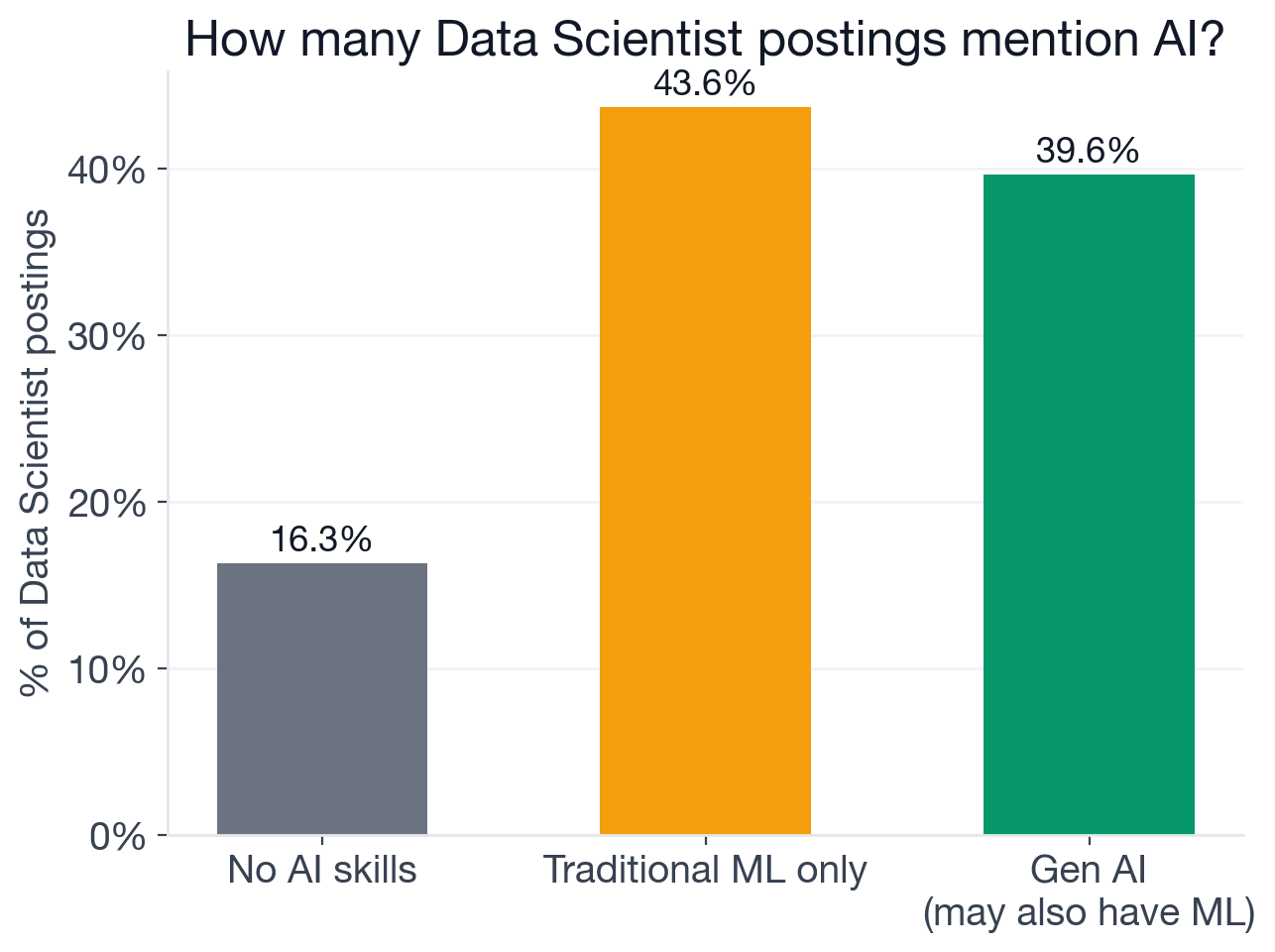
Share of 7,590 active Data Scientist postings mentioning each AI tier. "Any AI" includes both generative and traditional ML; categories overlap.
The most important number in that chart is not the 28.6%. It is the 23.8%. Nearly 1 in 4 Data Scientist postings now requires both traditional ML and generative AI skills. The role is not splitting into two separate camps. The most in-demand version holds both.
The postings confirm the shift numerically: when 12.3% of all Data Scientist listings now ask for AI Agent experience, the day-to-day work has moved from optimizing a loss function to designing systems that make decisions, invoke external tools, and need guardrails, not just gradient descent.
Which AI Skills Are Companies Asking Data Scientists to Have?
The generative AI skills showing up in Data Scientist postings break across four categories:
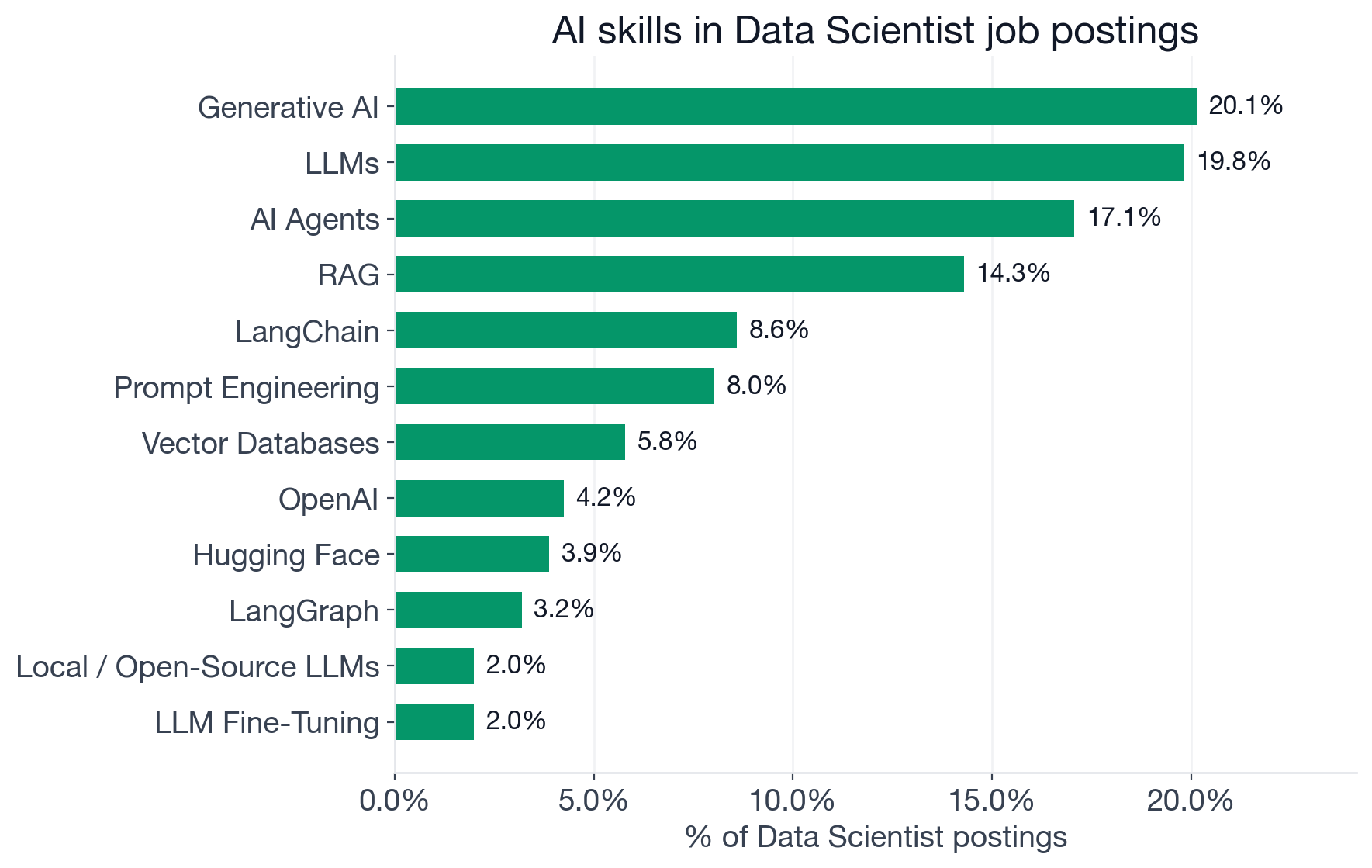
Percentage of active Data Scientist postings mentioning each AI skill. New-wave generative AI skills (2023+) are the shift signal.
Traditional foundation (still dominant):
Machine Learning (54.9%), Deep Learning or Neural Nets (20.4%), and MLOps (12.2%) have not disappeared. They anchor the new requirements rather than competing with them. A Data Scientist role without ML basics is still the exception.
New-wave core (the shift signal):
- Generative AI: 14.2% of postings (1,081 listings)
- LLMs: 13.4% (1,014 listings)
- AI Agents: 12.3% (932 listings)
- RAG: 8.9% (673 listings), retrieval-augmented generation, a technique for grounding LLM outputs in real data
- Prompt Engineering: 5.4% (413 listings)
The AI Agents number is the most structurally significant. Designing and orchestrating agents requires a fundamentally different mindset from training a classification model: you are managing systems that make decisions and invoke external tools, not optimizing a loss function. That is a fundamentally different discipline from the model-training workflow that defined the role three years ago.
Frameworks (growing fast):
- LangChain: 5.0% (379 listings), a Python framework for chaining LLM calls and connecting them to data sources
- LangGraph: 2.0% (149 listings), a lower-level framework for stateful agent workflows
- LlamaIndex: 1.2% (89 listings), a data-indexing framework for LLM applications
Infrastructure:
Vector Databases: 3.8% (291 listings), the storage layer most RAG pipelines depend on.
The pattern resembles where MLflow and Kubernetes were in 2021: specialized today, common-tier expectations by 2027. Generative AI, LLMs, and AI Agents are already at double-digit adoption in postings. Browse Data Scientist roles requiring generative AI or LLM-focused postings to see the current shape of that market.
What Is the Salary Gap Between AI-Required and Standard Roles?
Among US postings with disclosed salary data, the gap is substantial. These numbers are US base salary only; equity, bonuses, RSUs, and sign-on are not disclosed in job postings, and total compensation at employers with aggressive equity programs runs considerably higher than what we can report here.
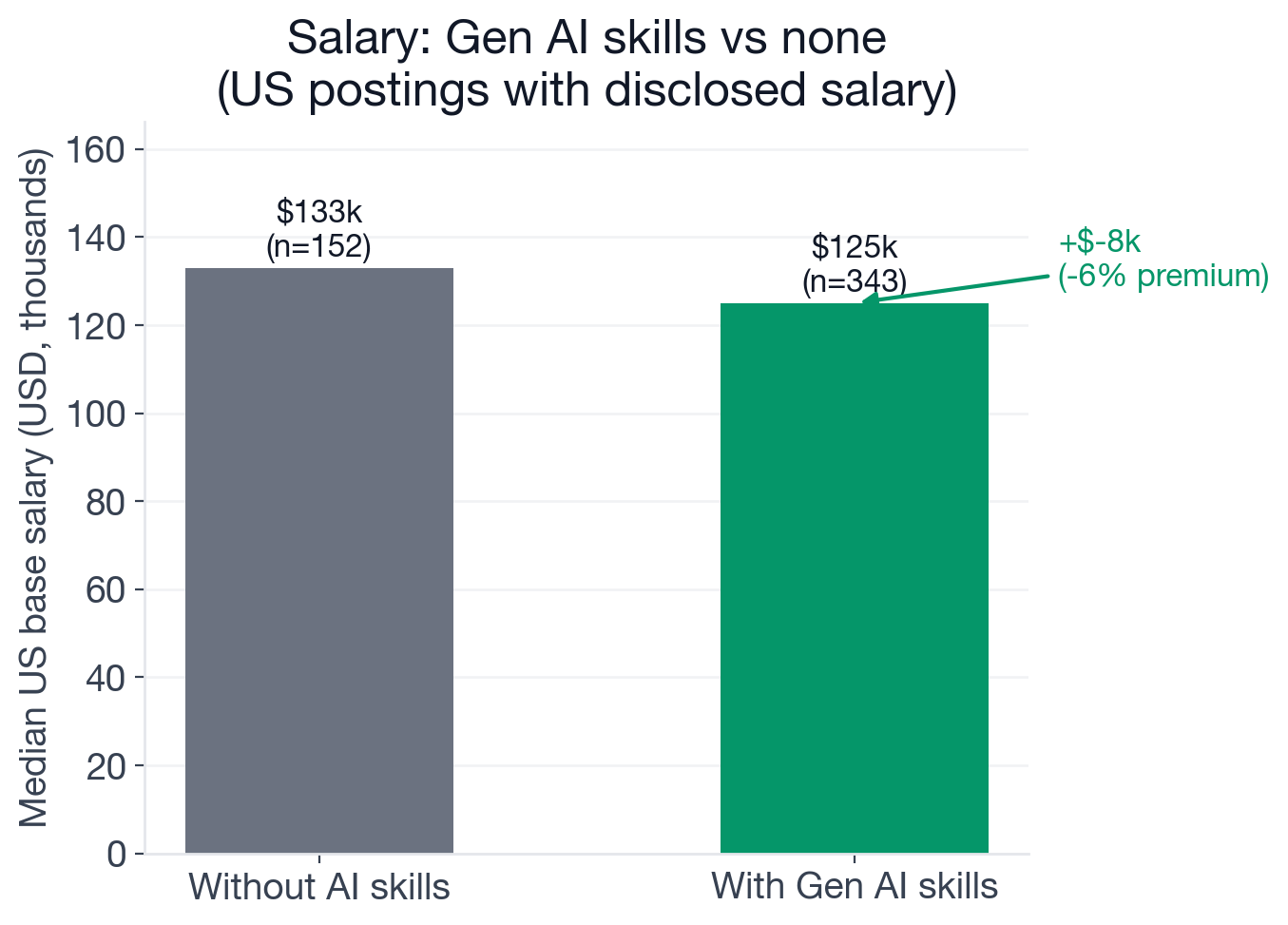
Median US base salary for Data Scientist postings with and without new-wave generative AI skill requirements. US postings only; equity and bonus not included.
- Postings requiring new-wave AI skills: $130,000 median (n=491 US postings with disclosed salary)
- Postings without AI requirements: $98,000 median (n=569)
- Gap: $32,000
A $32K base salary difference is not a rounding error. In many markets it spans an entire career-level salary band. The interpretation is straightforward: roles with generative AI requirements are harder to fill because the skills are genuinely scarce relative to demand, so employers are pricing accordingly.
The practical implication is not "pivot entirely to GenAI." It is "the Data Scientist who can do the traditional ML work and demonstrate competence with LLM pipelines, RAG, and agent design is worth significantly more than the one who can only do one." The two layers compound, they do not replace each other.
Who Is Leading the AI Shift in Data Science Hiring?
By Seniority
The seniority picture has two interesting features.
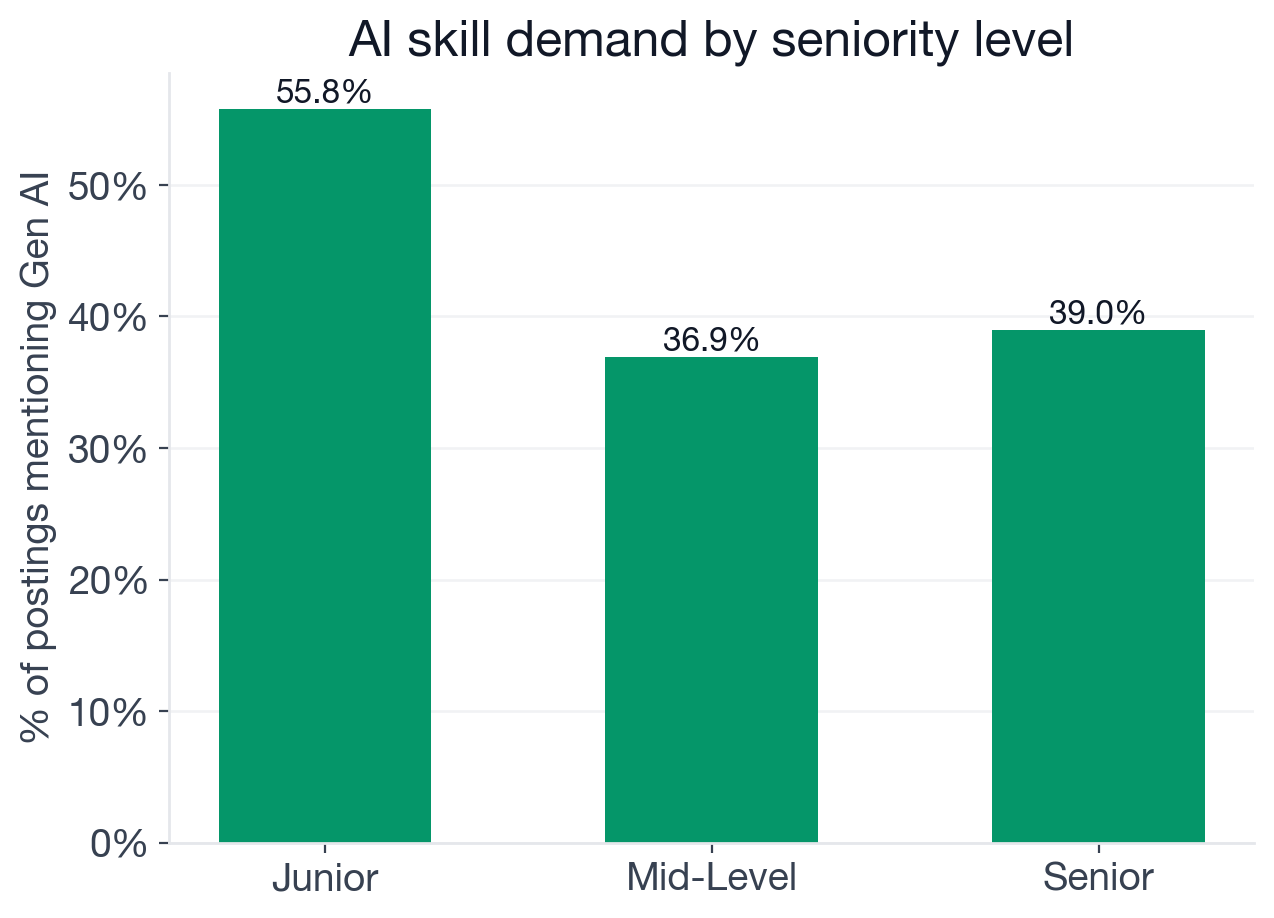
Share of Data Scientist postings at each seniority level that include new-wave generative AI skill requirements.
Staff-level roles show the highest AI adoption rate at 35.2%, which fits: senior individual contributors are being asked to architect AI systems, not just operate them. More surprising is junior at 34.8%. The junior segment is small overall (7.3% of postings), but it signals that companies are not treating GenAI as a senior-only concern.
Even entry-level roles show 20.9% AI adoption. 1 in 5 genuinely entry-level Data Scientist jobs now lists some generative AI requirement. That is the floor for explicit requirements; the ambient productivity layer applies at every level regardless.
The overall seniority distribution also deserves attention: 64.3% of Data Scientist postings are senior-level, and only 4.9% are explicitly entry-level. Companies hiring Data Scientists mostly want people who have already built models in production. If you are targeting your first role, entry-level Data Scientist openings are a narrow slice, and the ones that exist increasingly expect some AI literacy.
By Industry
Technology leads in absolute volume and shows 37.5% AI adoption across 656 postings: the largest credible sample in the data. Software follows at 36.3% across 457 postings, and finance at 33.9% across 363. All three are large enough to represent real sector trends. The chart also shows Professional Services at 49.4% and Retail at 43.9%, both above Technology, but on smaller samples (156 and 139 postings respectively). Those rates are directionally interesting, not yet representative sector signals.
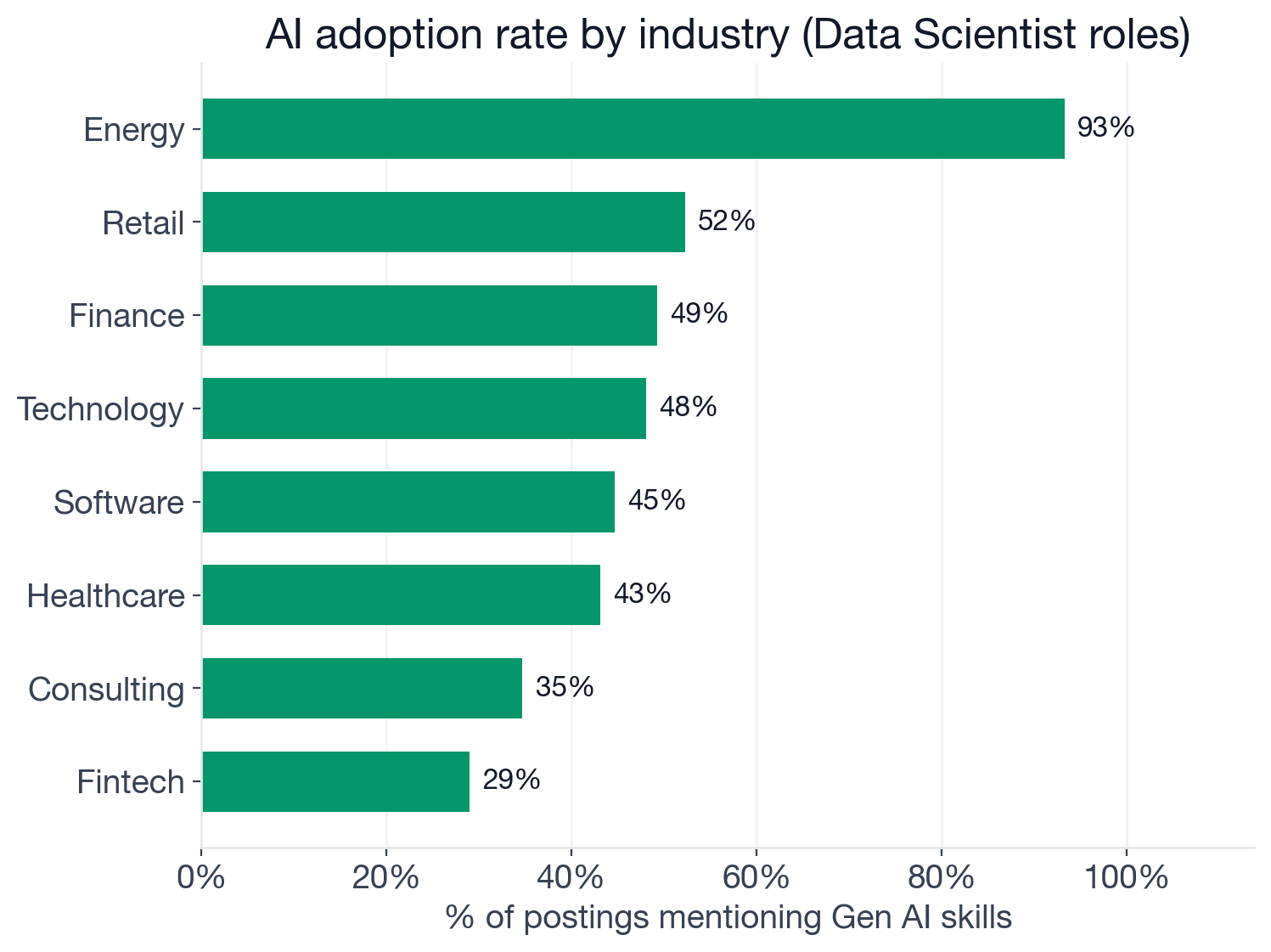
Percentage of Data Scientist postings in each industry that include new-wave generative AI requirements.
Healthcare (25.3% across 613 postings) and biotech (24.2%) show lower but consistent AI adoption, reflecting both regulatory friction and the structured clinical data complexity that makes pure LLM approaches harder to deploy. Consulting at 32.9% maps cleanly to the consulting firms appearing in the top-employer list below.
By Company
The employers leading on AI-specific Data Scientist hiring span life sciences, consulting, defense, tech, pharma, and financial services: a broad mix that reflects how far the "build with AI" requirement has spread beyond pure tech companies.
| Company | AI-Required Postings | Total Postings | AI Rate |
|---|---|---|---|
| RELX Group | 61 | 78 | 78% |
| PricewaterhouseCoopers | 39 | 78 | 50% |
| IQVIA | 35 | 174 | 20% |
| Booz Allen Hamilton | 28 | 89 | 31% |
| OpenAI | 26 | 26 | 100% |
| Merck & Co. | 20 | 29 | 69% |
| Micron Technology | 19 | 42 | 45% |
| Novartis | 18 | 29 | 62% |
| Royal Bank of Canada | 17 | 34 | 50% |
| Johnson & Johnson | 16 | 50 | 32% |
| Accenture | 16 | 42 | 38% |
RELX Group, a data analytics company (parent of LexisNexis and Elsevier), pushes 78% of its Data Scientist postings toward generative AI requirements. IQVIA, which provides analytics for the life sciences industry, has the largest total posting volume at 174. The pharma presence (Merck, Novartis, Johnson & Johnson) tells a consistent story: companies with massive proprietary research datasets are building the infrastructure to make those datasets accessible to LLM-based systems.
How to Use This in Your Job Search
The data makes one argument clearly: the traditional ML foundation is not under threat, but it no longer differentiates you in the upper tier of the market. The $32K premium on AI-required roles goes to the people who can do both.
The sequence that makes sense: build or refresh your ML fundamentals first, then layer in the specific GenAI skills that map to the roles you want. For most people, that means getting comfortable with one LLM framework (LangChain is the most-listed at 5% of postings), understanding how RAG architectures connect a vector database to an LLM output, and being able to discuss agent design trade-offs in a technical screen.
Practicing these concepts under interview conditions matters as much as learning them. AI mock interviews let you work through data science and ML design questions in a realistic format, with immediate feedback on your reasoning. The question bank covers both ML fundamentals and the AI architecture topics increasingly appearing in technical screens. For concept-building on the generative AI and system design side, our interview-prep courses cover the foundations without locking you into specific tools.
On the job search itself: browse current Data Scientist openings and use skill filters to narrow to your exact readiness level. Senior Data Scientist roles are the majority of the market; AI-required Data Scientist postings are the premium tier. The board updates daily.
FAQ
Q. What percentage of Data Scientist jobs require AI skills in 2026?
Among 7,590 active Data Scientist postings analyzed in May-June 2026, 61.3% mention some form of AI or machine learning, and 28.6% explicitly require new-wave generative AI skills such as LLMs, Generative AI, AI Agents, or RAG. An additional 23.8% require both generative AI and traditional ML, meaning the role increasingly spans both layers.
Q. How much more do Data Scientists with generative AI skills earn?
Among US postings with disclosed salary data, Data Scientist roles that explicitly require new-wave generative AI skills show a median base salary of $130,000 (n=491), compared with $98,000 (n=569) for postings without any AI requirement, a $32,000 gap. These are US base salary figures; equity and bonuses are not disclosed in job postings.
Q. What generative AI skills do companies want Data Scientists to have in 2026?
The most-demanded new-wave AI skills in Data Scientist postings are Generative AI (14.2% of postings), LLMs (13.4%), AI Agents (12.3%), RAG (retrieval-augmented generation, 8.9%), Prompt Engineering (5.4%), and LangChain (5.0%). Vector Databases (3.8%) and LangGraph (2.0%) round out the fastest-growing requirements.
Q. Is traditional machine learning still relevant for Data Scientists in 2026?
Yes, more than ever. Machine Learning appears in 54.9% of all Data Scientist postings (4,172 of 7,590), and Deep Learning or Neural Nets in 20.4%. MLOps appears in 12.2%. Traditional ML skills are not being replaced by generative AI; they are being extended by it, with 23.8% of postings now requiring both.
Q. Which industries are leading AI adoption among Data Scientist roles?
Technology companies show 37.5% AI adoption across 656 postings, software companies 36.3% across 457, and finance 33.9% across 363, each large enough to represent real sector trends. Professional services comes in at 49.4%, though that sample is smaller (156 postings).
Q. How has the Data Scientist role changed from 2022 to 2026?
In 2022, a Data Scientist role centered on building and deploying ML models, statistical analysis, and SQL-based data extraction. By 2026, 28.6% of postings now add generative AI requirements: LLM pipelines, RAG architectures, agent orchestration, and prompt engineering that barely existed as job requirements three years ago. The traditional ML foundation remains in 56% of postings; the two layers increasingly coexist.
Q. Do entry-level Data Scientists need to know AI tools?
Explicitly required AI skills appear in 20.9% of entry-level Data Scientist postings, the lowest AI adoption rate across seniority levels. But the ambient layer matters at every level: developer surveys show 85-90% of engineers now use AI-assisted tools regularly regardless of whether their job posting mentions it. For entry-level candidates, the baseline expectation is tool fluency (Copilot, AI-assisted notebooks); the explicit AI requirement grows as seniority increases.
Final Thoughts
The Data Scientist role in 2026 is the same job with a harder top tier. Traditional ML, statistical reasoning, and Python-based data work remain the majority of what postings ask for. But 28.6% of the market has added a second layer, that layer pays $32,000 more in US base salary, and the employers building it span healthcare, pharma, finance, and tech. The ambient AI fluency that developer surveys measure is now table stakes at every level regardless of what a posting says; the explicit generative AI skills are what move you into the premium segment. For Data Scientists willing to close that gap, the signal from the job board is clear: the demand is real, the employers are serious, and the compensation reflects it.
Topics
Ready to practice?
Put what you've learned into practice with AI mock interviews and structured preparation guides.