
How Is the Data Analyst Job Description Changing in 2026?
Three years ago, a Data Analyst posting looked like it always had: SQL, Excel, Tableau or Power BI, maybe Python, and a line about "communicating insights to stakeholders." The role's tool stack had been stable for years. Nobody was asking analysts to think about language models.
In 2026, that familiar baseline still exists, but it has a new layer on top. We analyzed 3,891 active Data Analyst postings on the InterviewStack.io job board as of May 2026 to measure how far the AI shift has actually gone. Skills were extracted from full job descriptions with synonyms collapsed, so "generative AI" and "gen AI" count once, and "machine learning" and "ML" count once.
The numbers tell a two-part story. One part is about what companies are explicitly hiring for. The other is about what they are silently expecting. Both matter, and they are pointing in the same direction.
Key Findings
- 3,891 active Data Analyst postings analyzed on the InterviewStack.io job board, May 2026.
- 6.9% explicitly require new-wave generative AI skills (267 of 3,891): LLMs, prompt engineering, AI agents, generative AI, or related frameworks.
- 18.7% mention any form of AI (727 postings), counting traditional machine learning alongside new-wave tools.
- Machine Learning is the most-cited AI skill at 13.3% of postings (518); among new-wave skills, Generative AI (2.4%, 92 postings), LLMs (2.3%, 90 postings), and AI Agents (2.1%, 83 postings) lead.
- The salary gap is $22,200: US postings with new-wave AI requirements show a median base salary of $102,200 vs. $80,000 for non-AI postings (US base only, equity excluded).
- Software and fintech firms lead: 13.5% and 13.1% of postings in those sectors require AI, versus 4.3% in healthcare and 2.1% in education.
- Senior roles carry the highest AI adoption at 9.2%, but the gap between seniority levels is smaller than expected.
What Did a Data Analyst Role Look Like Before 2023?
From roughly 2019 to 2022, the job description for a Data Analyst was remarkably consistent across industries. SQL was the core skill, appearing in most postings without exception. Excel was assumed to the point where it often went unwritten. Tableau and Power BI were the visualization outputs of choice. Python was a differentiator, not a requirement. Statistics mattered for senior roles and experimentation-heavy environments; for the average analyst, it sat in the background.
Machine learning was, for most analysts, a reference to a neighboring discipline. If a posting asked for ML, it was typically looking for a Data Scientist. The boundary between the two roles was reasonably crisp: analysts answered specific business questions from structured data; data scientists built predictive models. That division kept the job description stable.
Then the tools shifted. GitHub Copilot launched publicly in June 2022. ChatGPT arrived in November 2022. By 2023 and 2024, data teams were either actively using AI tools for query drafting, exploratory analysis, and documentation, or being asked why not. The JetBrains Developer Ecosystem Survey 2025 found that 85% of developers now use AI tools regularly, with 62% relying on at least one AI coding assistant. The Stack Overflow Developer Survey 2025 put 84% of developers using or planning to use AI tools, with 51% doing so daily.
Those figures are not Data Analyst-specific. But they describe the professional environment data analysts inhabit. On the organizational side, a Salesforce survey of 600 data leaders found that 7 in 10 organizations have adopted generative AI for data and analytics workflows. And nearly 80% of data teams still spend more than half their time on data preparation rather than insight generation, according to Informatica's CDO research: AI-assisted tools are the primary intervention targeting that bottleneck. The pressure to adopt is coming from above and below simultaneously.
What Are Companies Explicitly Requiring Now?
The short version: 6.9% of postings are explicitly hiring analysts to work with generative AI tools. That number is real, but it is also the wrong frame for understanding the shift.
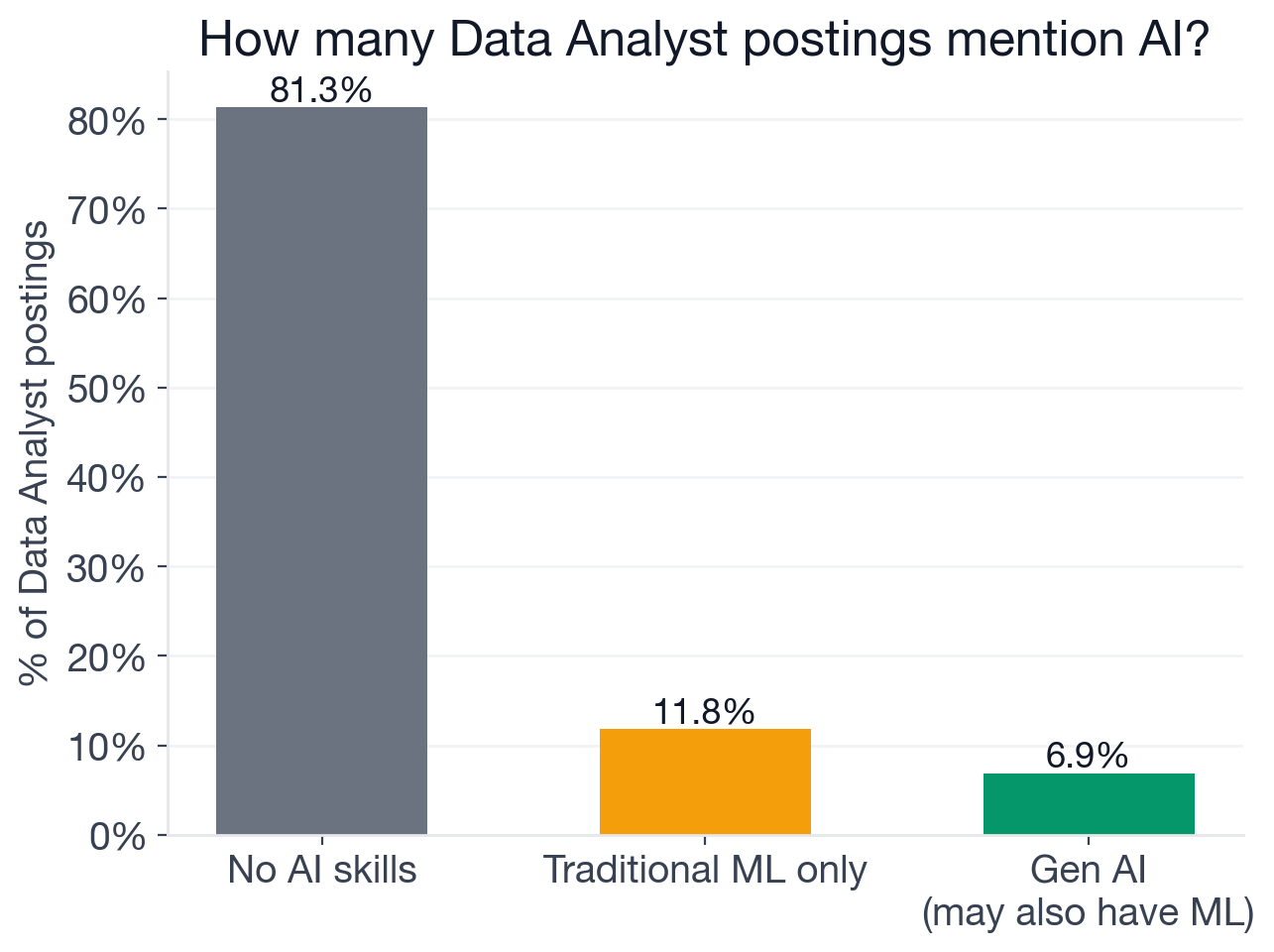
Coverage rates for each AI skill tier across 3,891 Data Analyst postings, May 2026. Note: 68 postings (1.7%) mention both traditional ML and new-wave AI, so the three figures do not sum to 100%. "New-wave AI" includes LLMs, generative AI, prompt engineering, AI agents, and related tools from the 2023+ era. "Traditional ML" includes machine learning, deep learning, and neural networks.
Think of it this way: job postings list skills when they need someone who can BUILD or DEPLOY a system using those skills. They do not list skills that every competent professional is assumed to have. In 2010, no Data Analyst posting required "proficiency with email" or "comfortable using the internet." Both were universal baselines.
AI tool fluency is crossing that threshold now. The 6.9% measures analysts hired to architect prompts, design agent workflows, or integrate LLMs into business processes. The 84-85% from developer surveys measures how many technical professionals across all roles use AI tools at all. Employers are not listing "uses ChatGPT to draft SQL queries" for the same reason they stopped listing "uses Google to research problems": it is now expected infrastructure, not a specialty.
A McKinsey State of AI 2025 report found that 88% of organizations are using AI in at least one business function. Most data analysts work inside those organizations. The question is no longer whether AI applies to their work. It is how deep the AI fluency their specific role requires.
Which AI Skills Are Reshaping the Data Analyst Role?
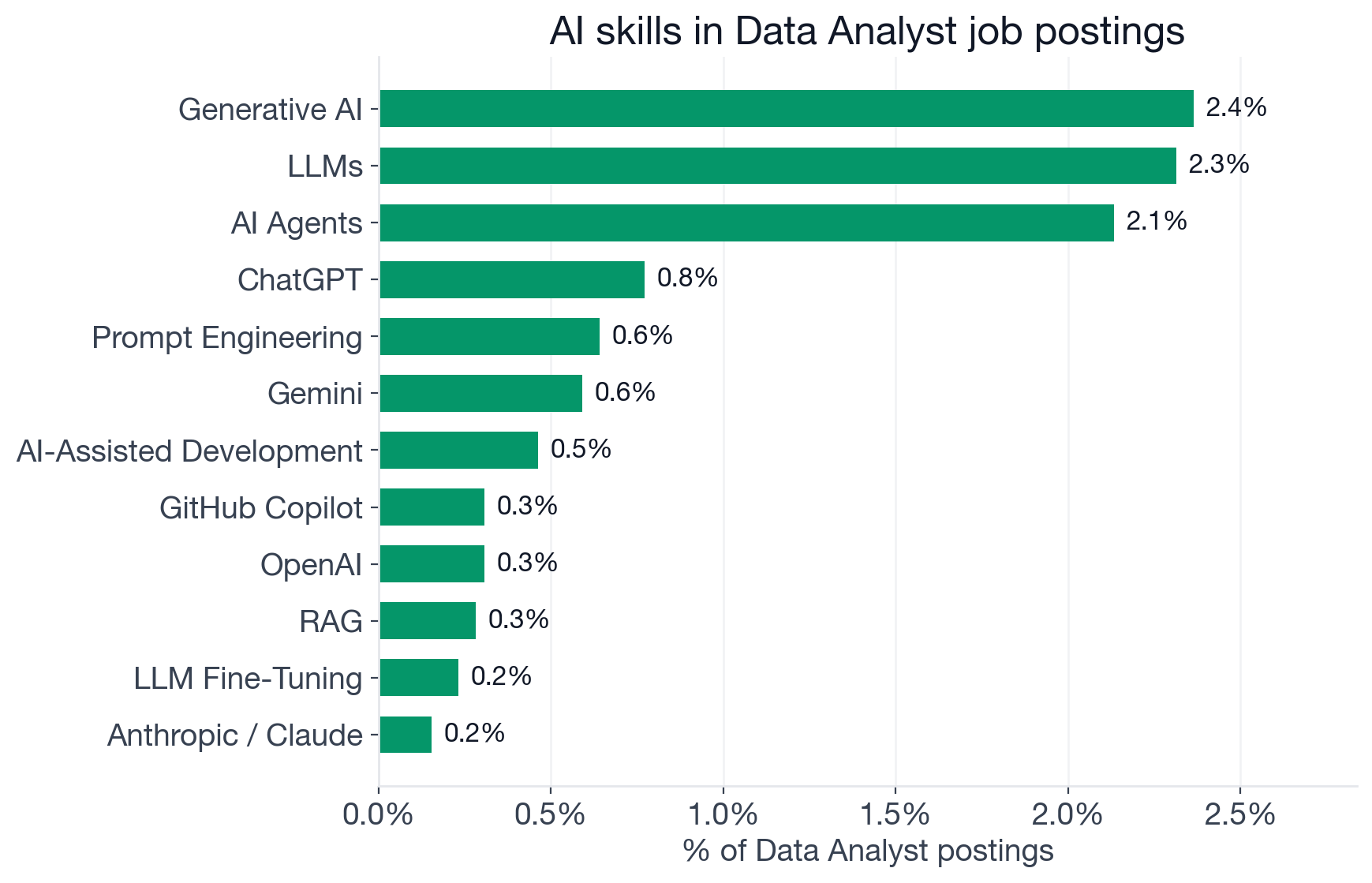
AI skills ranked by share of active Data Analyst postings that mention them, May 2026. Traditional ML skills (pre-2023) are shown alongside new-wave generative AI skills.
The skill list splits cleanly into two cohorts.
Traditional ML skills have been present in analyst postings for years. Machine Learning at 13.3% (518 postings) is the dominant AI skill in the dataset by a wide margin. These postings are not asking analysts to train models. They are asking analysts who can work alongside data science teams: running inference on existing models, monitoring model performance in production, and evaluating model outputs against business metrics. It is a support role relative to ML, not a builder role.
The new-wave cohort is more recent and more telling. Generative AI (2.4%, 92 postings), LLMs (2.3%, 90 postings), and AI Agents (2.1%, 83 postings) are the top three. Together, these three account for most of the 6.9% new-wave AI total in this dataset. These roles ask analysts to do things that did not exist in the job description three years ago: evaluate LLM outputs for accuracy and hallucination, build prompt templates for recurring business queries, or connect data pipelines to AI agent workflows. ChatGPT appears explicitly in 0.77% of postings, a figure that understates real usage but signals that some employers are building it into formal role requirements.
For most analysts, the immediate priority is the ambient layer, not the explicit-requirement tier. Getting fluent with AI-assisted SQL drafting, learning to critically evaluate AI-generated analysis, and being able to explain AI outputs to non-technical stakeholders is more broadly applicable than fine-tuning a language model. The explicit requirements are the advanced tier. The ambient tools are the new baseline.
Browse Data Analyst postings that mention Generative AI or postings that require LLM experience to see what the actual job descriptions look like at the explicit-requirement tier.
Does Knowing AI Pay More for Data Analysts?
Yes, and the gap is larger than most would expect.
Salary numbers here are restricted to US postings only (where wage-transparency laws produce consistent disclosure) so they are directly comparable. These figures are US base salary only: equity, bonuses, RSUs, and sign-on are not disclosed in postings, so total compensation at top employers is meaningfully higher than what is reported here.
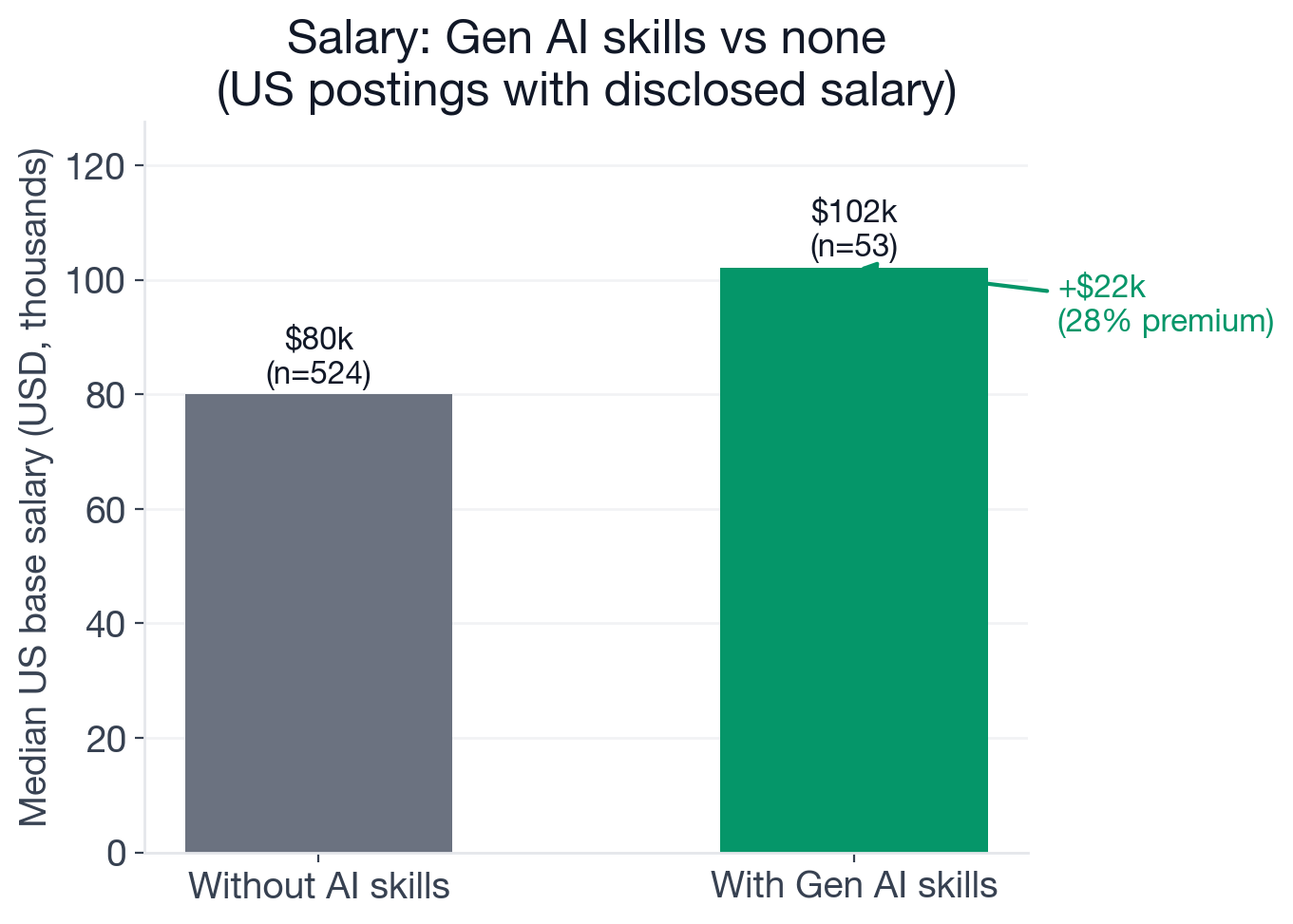
Median US base salary for Data Analyst postings with and without explicit new-wave AI skill requirements. "New-wave AI" includes generative AI, LLMs, AI agents, prompt engineering, and related 2023+ skills. US base salary only.
- With new-wave AI skills required: $102,200 median US base salary (n=53)
- Without AI requirements: $80,000 median US base salary (n=524)
- Premium: $22,200
The $22,200 gap is substantial. The sample on the AI side is small: 53 US postings with both explicit new-wave AI requirements and disclosed salary, which is above the statistical minimum but warrants treating the exact figure as directional rather than definitive. The direction itself is unambiguous. Companies hiring analysts to BUILD with AI are paying a premium of roughly 28% over the standard analyst market rate.
That premium reflects scarcity, not just difficulty. When SQL is nearly universal among analysts and only 6.9% of postings require generative AI work, the supply at the AI-skilled tier is thin and compensation reflects it. For the full picture of how individual skills move the Data Analyst salary beyond the AI dimension, the Data Analyst skills analysis breaks down salary by the broader skill set.
Who Is Leading the AI Shift in Data Analytics?
The shift is not happening evenly. Seniority level, industry, and company all predict how likely a given Data Analyst posting is to require AI skills.
By Seniority Level
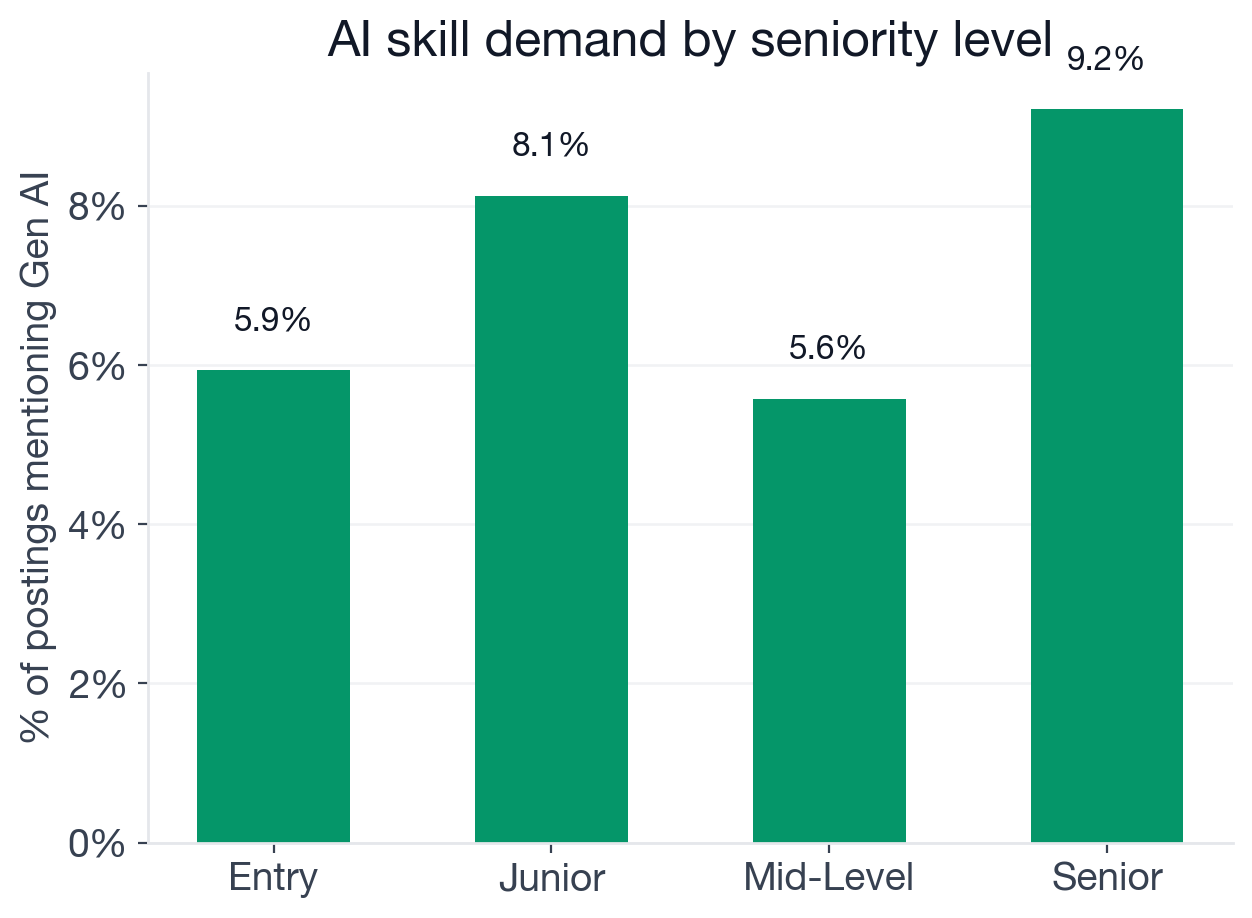
Percentage of postings at each seniority level that mention new-wave AI skills, May 2026.
Senior postings lead at 9.2% (103 of 1,118 senior postings), followed by junior at 8.1% (23 of 283). Mid-level postings, which make up 57% of all postings in the dataset, have the lowest AI adoption at 5.6%.
The senior concentration makes intuitive sense. AI-adjacent analyst work frequently involves designing analytical frameworks around LLM outputs, leading the data team's adoption process, or interfacing with engineering teams building AI systems. Those are senior responsibilities. The junior number is less obvious: at 8.1%, it is higher than mid-level. One plausible explanation is that some companies are explicitly seeking AI-native talent at the entry tier, analysts who grew up using these tools and can apply them without a learning curve. The mid-level dip may reflect that most mid-level postings are refilling established roles with established requirements, while junior and senior openings are more frequently shaped around new functions.
By Industry
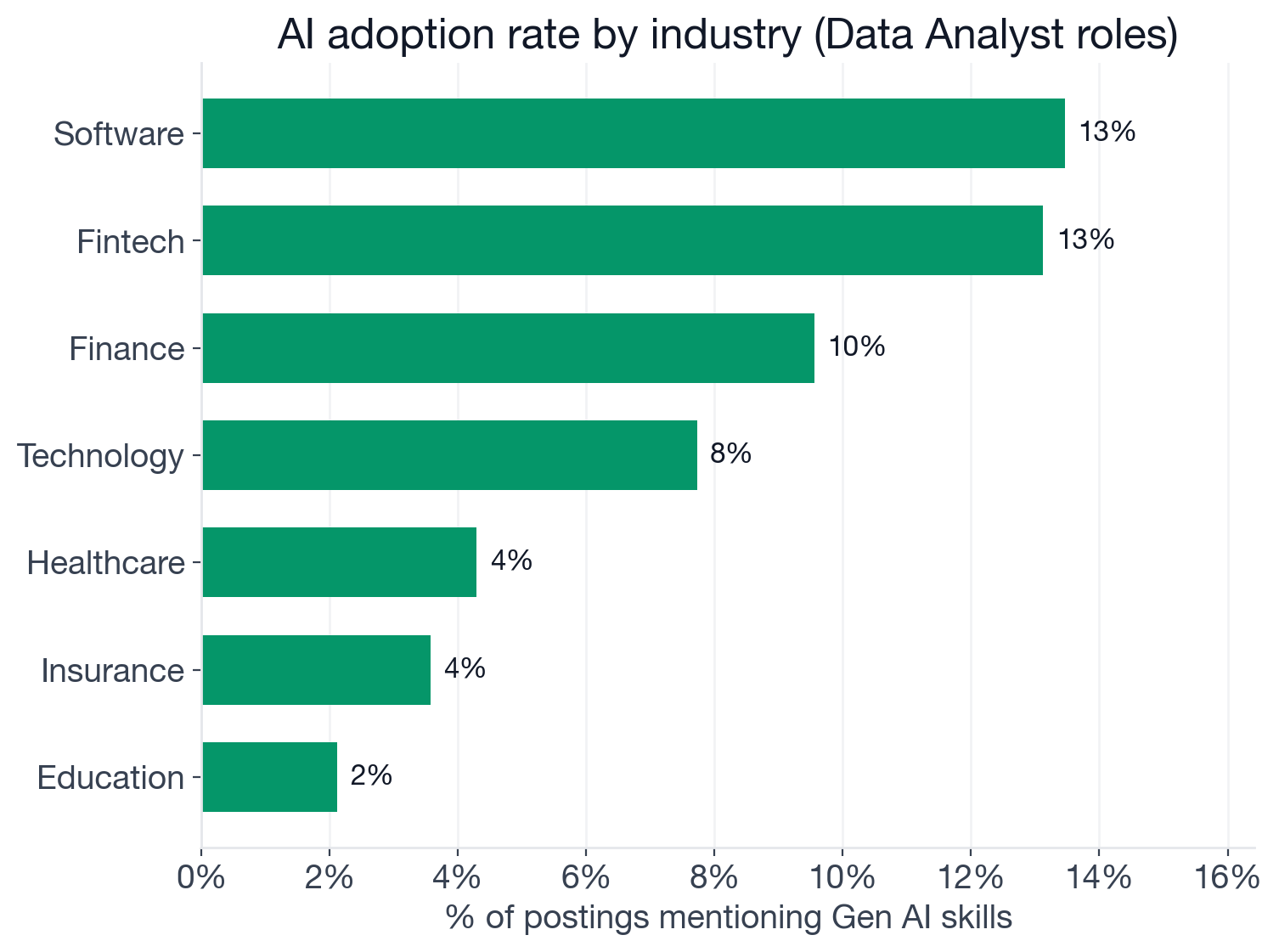
Percentage of postings in each industry that require new-wave AI skills, May 2026. Industries with fewer than 100 postings excluded.
Software (13.5%, 21 of 156) and fintech (13.1%, 21 of 160) are the clearest early adopters. Finance sits at 9.6% and technology at 7.7%. Healthcare (4.3%), insurance (3.6%), and education (2.1%) lag by a wide margin.
The gap between software/fintech and healthcare/education is not about whether AI is useful in those sectors. It is about how fast each sector can deploy AI in analytical workflows given regulatory constraints and data-sensitivity requirements. Healthcare and insurance organizations face strict compliance rules around automated decision-making; that extends the path from "AI is useful" to "we require AI skills in this posting." For analysts in regulated industries: the ambient AI layer still applies broadly. Using AI for query drafting, data summarization, and exploratory analysis is compatible with most regulatory frameworks. What is constrained is using AI outputs to make or directly influence patient or risk decisions.
Top Companies Requiring AI Skills
The companies where explicit AI skills appear in the highest share of their analyst postings:
| Company | AI postings | Total postings | AI share |
|---|---|---|---|
| VML | 7 | 7 | 100% |
| Truelogic | 5 | 5 | 100% |
| Brex | 5 | 5 | 100% |
| Delivery Hero SE | 6 | 8 | 75% |
| Coupang | 10 | 22 | 45% |
| RELX Group | 6 | 20 | 30% |
Note: each company's figures are based on a small number of postings (5–22 total), so these AI share percentages are directional signals rather than statistically stable benchmarks.
VML and Truelogic are marketing technology firms where data teams work directly with AI-driven campaign and content tools. Brex is a fintech company that has built AI into its data infrastructure as a core product capability. Delivery Hero SE uses AI for demand forecasting and operational analytics across its global food-delivery network. Coupang, the South Korean e-commerce platform, has one of the highest absolute counts of AI-requiring analyst postings in the dataset. RELX Group, an information analytics company, is a case where AI is a core product component rather than a back-office add-on.
The pattern is consistent: companies where data products are a revenue driver, not a support function, are furthest along on requiring AI skills from analysts.
How to Use This in Your Job Search
The two-layer framing translates directly into a two-stage preparation strategy.
Stage 1: The ambient layer. Before applying to any analyst role, get comfortable with AI-assisted work. Use ChatGPT or a comparable tool for drafting queries, summarizing data, and accelerating exploratory analysis. Use an AI coding assistant when writing Python or SQL. Learn the AI-native features in whatever BI tool you use: Power BI Copilot, Looker's AI features, or Tableau Pulse. None of these require deep knowledge of how LLMs work internally. They require using them effectively and validating their outputs critically. Most employers now expect this without saying so.
Stage 2: The explicit-requirement tier. If you want to target the 6.9% of postings with explicit AI requirements, or the higher-paying positions at that tier, you need to go deeper. Understand what LLMs are and are not reliably good at. Learn prompt engineering well enough to write repeatable prompts for analytical queries. Understand what an AI agent is and when one would be appropriate versus a simpler automation. Practice explaining AI outputs, including their failure modes, to a non-technical audience. Our AI mock interview tool lets you practice both the technical questions and the stakeholder communication scenarios that come up in those roles.
The question bank covers the data analyst fundamentals that show up at every tier: SQL, data modeling, statistics, and Python. Our interview-prep courses build the conceptual foundations across statistics, machine learning, and analytical thinking, useful for both the standard analyst market and for stepping into AI-adjacent roles.
When you are ready to apply, browse the full Data Analyst job board or filter specifically for AI-requiring analyst roles to see where demand is concentrating right now.
FAQ
Q. What percentage of Data Analyst job postings require AI skills in 2026?
Based on 3,891 active postings analyzed in May 2026, 6.9% explicitly require new-wave generative AI skills (267 postings) and 18.7% mention any form of AI including traditional machine learning (727 postings). Those figures measure only postings where AI is an explicit requirement. Developer surveys indicate that 84-85% of technical professionals use AI tools regularly, suggesting that ambient AI tool use is now a baseline expectation that most employers do not state in job descriptions.
Q. How much more do Data Analyst roles that require AI skills pay?
Among US postings with disclosed salary data, the median base salary for Data Analyst postings that explicitly require new-wave AI skills is $102,200 (n=53), compared with $80,000 for postings without any AI requirement (n=524), a gap of $22,200. These are US base salaries only; equity, bonuses, and sign-on are not reflected.
Q. Which AI skills are most in demand for Data Analysts in 2026?
Machine Learning tops the list at 13.3% of postings (518 of 3,891), reflecting roles where analysts are expected to understand or support ML pipelines. Among new-wave generative AI skills specifically, Generative AI (2.4%, 92 postings), LLMs (2.3%, 90 postings), and AI Agents (2.1%, 83 postings) lead, followed by ChatGPT (0.77%), Prompt Engineering (0.64%), and Gemini (0.59%).
Q. Do senior Data Analyst roles require AI skills more than junior roles?
Senior postings have the highest explicit AI adoption at 9.2% (103 of 1,118), compared with 5.6% for mid-level (124 of 2,223) and 5.9% for entry-level (12 of 202). The senior skew makes sense: AI-adjacent analyst work often involves designing or overseeing ML-supported workflows rather than executing them, which lands higher on the seniority ladder. Entry-level AI adoption being comparable to mid-level suggests companies do not see AI fluency as strictly senior territory.
Q. Which industries are most likely to require AI skills from Data Analysts?
Software companies lead at 13.5% AI adoption (21 of 156 postings), followed closely by fintech at 13.1% (21 of 160). Finance sits at 9.6% (15 of 157) and technology at 7.7% (18 of 233). Healthcare (4.3%), insurance (3.6%), and education (2.1%) lag significantly, reflecting both regulatory caution around AI in those sectors and the slower pace of generative AI integration in non-tech industries.
Q. If my Data Analyst job description doesn't mention AI, does that mean AI doesn't matter?
No. Job postings only list AI skills when employers explicitly need someone to build or deploy AI systems. The ambient layer of AI tool use, such as using ChatGPT for ad-hoc queries, GitHub Copilot for Python and SQL, or AI-assisted features in Excel and Power BI, is now assumed baseline behavior that most employers do not list, the same way internet access or email proficiency stopped appearing in job ads years ago. Stack Overflow's 2025 Developer Survey found that 84% of developers use or plan to use AI tools, and 51% use them daily.
Q. How should a Data Analyst build AI skills to stay competitive in 2026?
Start with the ambient layer: get fluent with ChatGPT for drafting queries and summaries, GitHub Copilot or an equivalent AI coding assistant for Python and SQL, and the AI-native features in whichever BI tool you use. For the explicit-requirement tier, generative AI concepts (LLMs, prompt engineering, AI agents) and a surface-level understanding of machine learning are the entry points, since those appear most frequently in postings that require AI. Practice translating between raw data questions and LLM prompts, and be prepared to explain the outputs and their limitations to non-technical stakeholders.
Final Thoughts
The 6.9% and 81.3% figures in this dataset are not in tension. One measures analysts being hired to build AI systems; the other is the baseline for all other postings. But "baseline" no longer means "AI-free": it means the employer expects AI tool fluency as ambient infrastructure and did not feel the need to write it down. Data analysts in 2026 are not choosing between an AI path and a non-AI path. They are choosing between roles where AI is an explicit job requirement and roles where it is an unspoken expectation. The preparation looks different at the margins, but the foundation is the same.
Topics
Ready to practice?
Put what you've learned into practice with AI mock interviews and structured preparation guides.