
The Number-One New-Wave AI Skill in Cybersecurity Postings Is AI Agents
Security teams don't just want engineers who can use AI. They want engineers who can build systems that act autonomously, triaging alerts and hunting threats without a human approving every move. That is what the top-line data in Cybersecurity Engineer postings reveals: AI Agents ranks as the leading new-wave AI skill, appearing in 8.8% of postings, ahead of LLMs (6.8%), Generative AI (3.3%), and RAG (1.5%). The demand isn't for AI assistance; it's for autonomous AI defense.
Among the 5,379 active Cybersecurity Engineer postings on the InterviewStack.io job board analyzed in June 2026, 16.3% explicitly require new-wave generative AI skills. That is the "build AI" number. It sits alongside a different figure: 85% of all developers use AI tools regularly according to the 2025 JetBrains State of Developer Ecosystem survey, and 77% of organizations are already running generative AI or LLMs in their security stack per the WEF Global Cybersecurity Outlook 2026. The gap between 16.3% and 85% is not a gap in adoption. It is the gap between employers who explicitly require you to architect AI security systems and every other employer who simply expects AI fluency as a working baseline.
Key Findings
- 16.3% of Cybersecurity Engineer postings (876 of 5,379) explicitly require new-wave generative AI skills; 22.0% (1,183) mention any AI category including traditional ML.
- AI Agents is the top new-wave AI skill at 8.8% (474 postings), outranking LLMs (6.8%), Generative AI (3.3%), and RAG (1.5%).
- $160,000 vs $127,525: US postings requiring new-wave AI skills carry a median base salary of $160,000 (n=261) versus $127,525 for non-AI postings (n=1,060), a $32,475 gap.
- Software and technology sectors lead AI adoption at 23.8% and 23.6% respectively; defense is 3.7% and aerospace is under 1%.
- Senior and staff postings carry higher AI rates (17.0% and 17.7%) than entry-level postings (9.3%).
- 77% of organizations are running GenAI or LLMs in their cybersecurity stack (WEF Global Cybersecurity Outlook 2026), far exceeding what job postings explicitly require.
- AI/ML is now the number-one skill need cited by 41% of security teams, per the ISC2 2025 Cybersecurity Workforce Study.
- AI-service API key leaks surged 81% on public GitHub in 2025 (GitGuardian 2025 State of Secrets Sprawl), adding AI governance directly to the cybersecurity engineer's scope.
What the Role Looked Like Before the AI Agent Era
Before 2022, the Cybersecurity Engineer job was primarily a detection and response role built on manual processes: configuring SIEM (Security Information and Event Management) platforms to aggregate logs, writing correlation rules, triaging alerts one by one, and running penetration tests to surface vulnerabilities before attackers found them. Machine learning existed inside commercial threat-detection products, mostly in the vendor's anomaly detection logic, but it was the vendor's problem to maintain, not the engineer's skill to demonstrate.
The volume problem was already visible. A large enterprise's SOC (security operations center) might generate hundreds of thousands of alerts per day, and even well-staffed teams struggled to maintain sub-hour response times. AI was widely discussed as the solution, but deploying it in-house required data engineering, model evaluation, and LLM infrastructure skills that most security teams didn't have. The tools that exist now, including autonomous agents that triage alerts and LLMs that summarize threat intelligence across thousands of log entries, simply weren't productionized at scale yet.
The shift since 2023 has been rapid. The ISC2 AI Pulse Survey 2025 found 30% of cybersecurity professionals have formally integrated AI security tools into daily operations, with 42% actively testing adoption and 70% of adopters reporting positive impacts on team effectiveness. One nuance the survey captures: cybersecurity professionals show more measured adoption than general developer surveys suggest for all engineers broadly. That caution is professional, not hesitation: security engineers are acutely aware of AI-introduced vulnerabilities, hallucination risk in threat reports, and the attack surface that AI-powered tooling adds. The deliberately careful approach is a feature of the role, not a lag.
How Many Cybersecurity Engineer Postings Explicitly Require AI in 2026?
The adoption overview separates the three categories clearly.
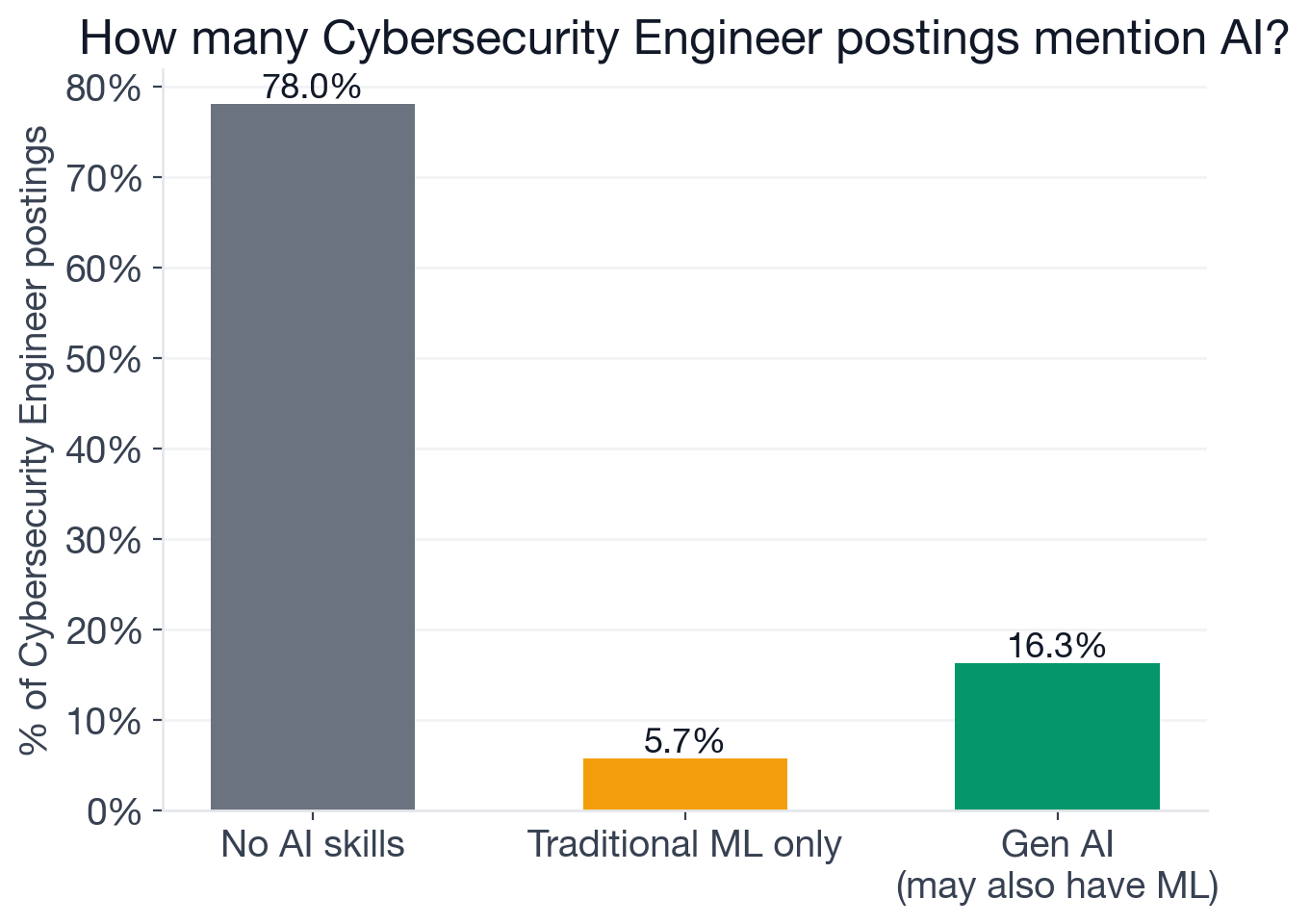
Share of Cybersecurity Engineer postings that require no AI skills, traditional ML skills only, new-wave generative AI only, or both. Based on 5,379 active postings, June 2026.
The 22.0% that mention any AI skill breaks down into three distinct tiers:
- New-wave generative AI only (no traditional ML): 10.4% of all postings (558)
- Both new-wave generative AI and traditional ML: 5.9% (318)
- Traditional ML only: the remaining roughly 5.7% (307), largely postings that list Machine Learning as a broad skill for working alongside existing ML-based detection tools rather than building them
The new-wave bucket (16.3% combined) represents a qualitatively different job description: deploying LLMs over security log data, building retrieval pipelines over threat intelligence, and operating autonomous security agents. These postings pay more and require a different profile than the traditional security-engineer resume.
The two-layer reality matters here. Gartner's 2026 cybersecurity trends analysis estimates over 60% of organizations will rely on AI-augmented cybersecurity automation platforms in 2026, up from under 20% in 2023. That 60% figure captures the "use AI" layer: organizations running AI-powered tools that their security engineers are responsible for evaluating, governing, and defending. The 16.3% explicit posting figure captures those specifically hired to build and architect those systems. Both numbers are real; they measure different things.
Which AI Skills Are Companies Actually Specifying?
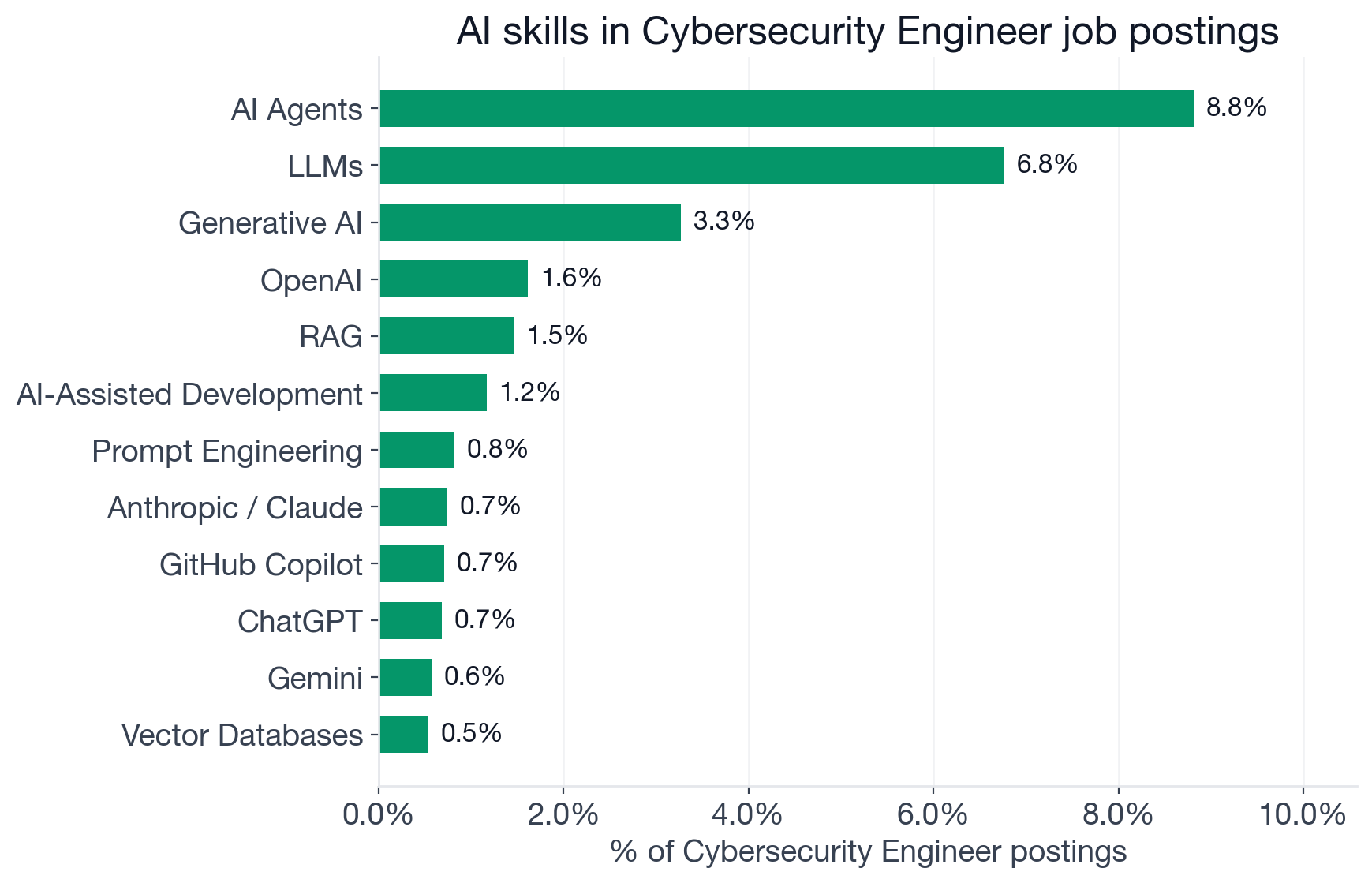
Top AI skills by share of Cybersecurity Engineer postings, June 2026. "New-wave" skills include generative AI era tools (2023+); "Traditional ML" includes machine learning and deep learning.
The ranked list tells a specific story about where the AI work in security is actually concentrated.
Traditional ML leads overall at 11.5%. Machine Learning appears in 621 postings, often for roles that involve building or evaluating anomaly detection and behavioral analytics systems. It has been present in security postings for years; it marks the continuation of a trend rather than the leading edge of the current shift.
AI Agents at 8.8% is the clearest new-wave signal. In security postings, "AI Agents" covers a spectrum: at one end, engineers who can build and deploy multi-agent LLM architectures (autonomous systems that continuously monitor network traffic, correlate threat intelligence from multiple sources, and escalate anomalies without requiring a human to triage every individual alert). At the other end, engineers who can work with commercial AI-native security platforms (EDR, NDR, SIEM) that market their detection capabilities as deploying "AI agents." The 474 postings likely include both; the clearest driver is SOC automation demand, where the alert-volume problem is most acute, but the keyword alone does not cleanly separate architects of novel agent systems from practitioners working with packaged AI security tooling.
LLMs at 6.8% (364 postings) closely follows the Agents tier. Postings asking for LLM skills often overlap with the AI Agents requirement. The combination points to a specific architecture: natural language interfaces over structured security data, log summarization, threat intelligence synthesis, and LLM-backed agents that can reason about novel attack patterns without a rigid rules engine.
RAG at 1.5% (79 postings) is the data retrieval piece of this stack. RAG (retrieval-augmented generation) in a security context means connecting an LLM to live threat intelligence feeds, CVE databases, or historical incident logs so it can reason about your specific environment rather than generic training data. Engineers who can build and maintain this retrieval layer are solving the "the model doesn't know our environment" problem that generic security AI tools leave open.
OpenAI (1.6%, 87 postings) appears in postings that explicitly require building with the OpenAI API, distinct from general familiarity with ChatGPT as a productivity tool.
Cybersecurity Engineer postings that specify AI Agents skills and those requiring LLM skills show what this looks like in practice: product security engineers building AI red-teaming tools, SOC automation engineers deploying agentic triage pipelines, and application security engineers governing LLM usage in their organization's developer workflows.
The AI Salary Premium in Cybersecurity Engineering
Among US postings with disclosed salary data, the numbers are direct. These figures are US base salary only; equity, bonuses, and sign-on are not disclosed in postings, and total compensation at top employers is meaningfully higher.
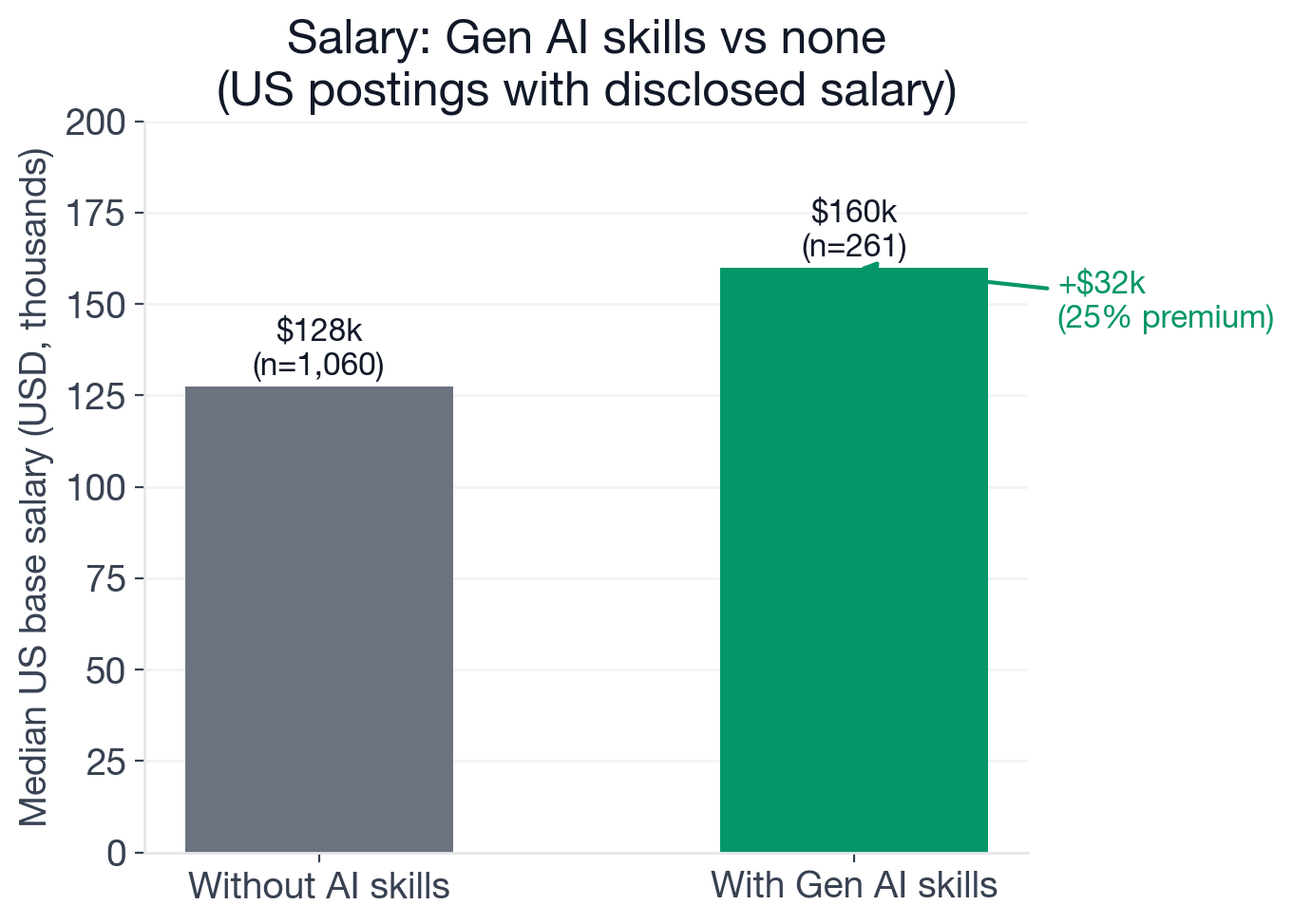
Median US base salary for Cybersecurity Engineer postings, split by whether they require new-wave AI skills. Without AI: $127,525 (n=1,060); with new-wave AI: $160,000 (n=261).
The $32,475 gap is significant, but it requires one important framing note. AI-requiring postings are on average more senior (senior and staff roles show AI rates of 17-18% versus 9% for entry-level) and concentrated in software and technology sectors, which pay above industry average regardless of AI involvement. The AI skill requirement correlates with the seniority level and company type where higher salaries already cluster; it does not independently cause the full $32K premium by itself.
What the premium does confirm: security engineers with AI system-building skills are not competing in the same candidate pool as those without. Whether you're evaluating a role at a cybersecurity product company, a fintech firm building compliance automation, or a cloud-native tech company securing its own platform, AI-fluent candidates command a structurally distinct baseline offer.
Where Adoption Concentrates: Tech at 24%, Defense at Under 4%
The sector breakdown is the sharpest finding in this dataset, and the clearest indicator that "Cybersecurity Engineer" encompasses roles with radically different AI mandates depending on where you work.
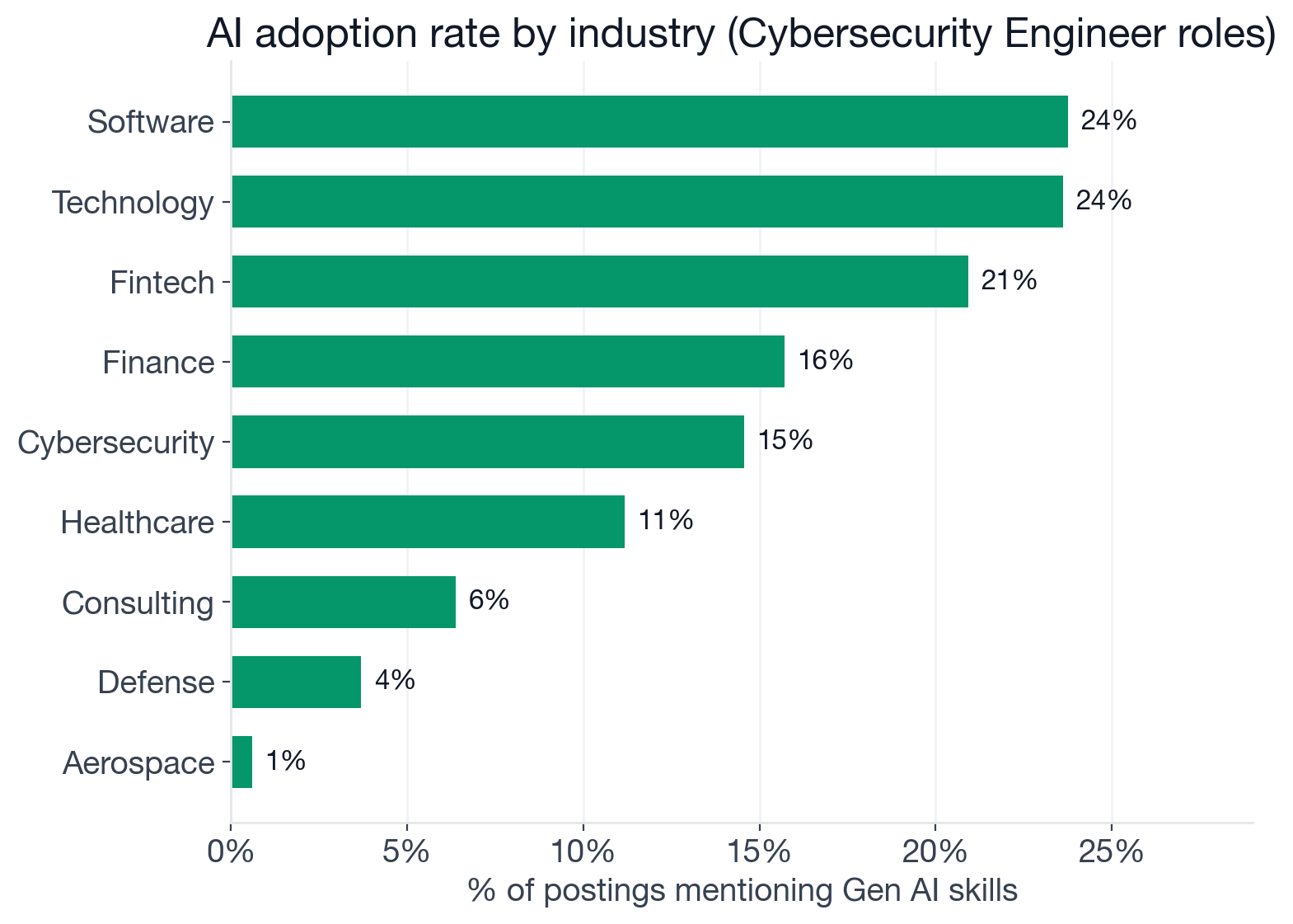
Share of Cybersecurity Engineer postings requiring AI skills, by industry sector. Based on postings with identifiable industry tags, June 2026.
Software and technology companies (23.8% and 23.6% AI rates) are hiring cybersecurity engineers to build AI-native security systems from the ground up. Product security, AI red-teaming, LLM safety evaluation, and SOC automation are expanding functions in software-first environments where the infrastructure is cloud-native and AI tooling is already embedded in the engineering workflow.
Defense and aerospace sit at the opposite end: 3.7% and under 1%. This is not a technology gap. It is a policy gap. Air-gapped networks, security clearance requirements, and export-control regulations mean that commercial AI tools, including most cloud-hosted LLMs, often cannot be formally required in classified environments. Cybersecurity engineers working in defense are still expected to understand AI in a broad operational sense, but the explicit tooling requirements diverge sharply from commercial software.
Fintech (20.9%) and finance (15.7%) track closer to the software tier, driven by fraud detection, transaction monitoring, and regulatory compliance automation that are natural fits for AI-powered security pipelines. Healthcare (11.2%) trails, reflecting HIPAA-driven caution about where AI systems can access patient data. Consulting (6.4%) is generalist and compliance-focused rather than deployment-heavy; note that AI postings in this category are concentrated at a small number of large firms rather than distributed across the sector, so the figure is directional.
The seniority picture adds another layer.
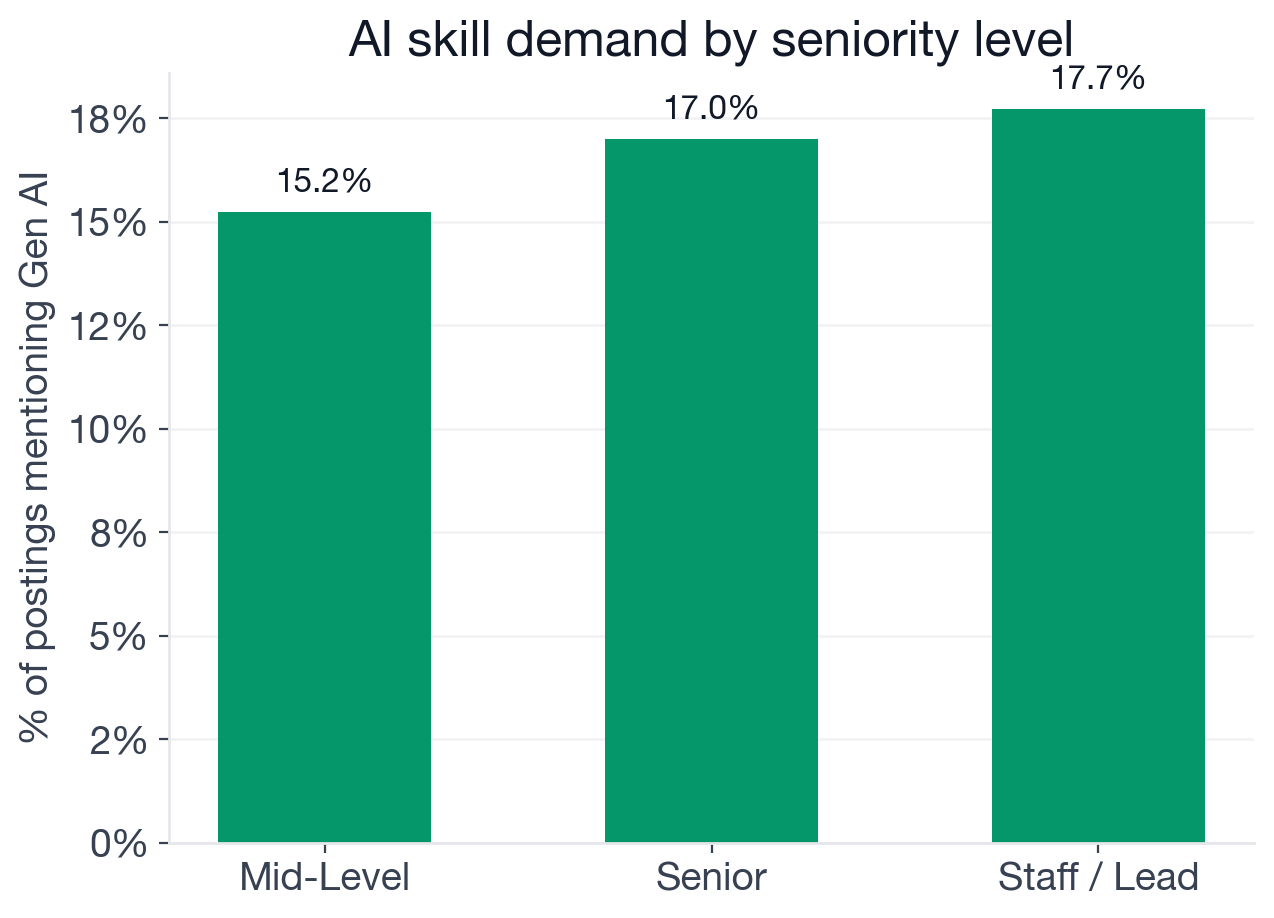
Share of Cybersecurity Engineer postings requiring AI skills by seniority level, June 2026.
Senior and staff postings show AI rates of 17.0% and 17.7%, compared with 9.3% for entry-level and 7.8% for junior roles. Senior engineers are being hired to lead AI security projects; entry-level engineers are being hired to work alongside existing security tooling. Breaking into the AI tier mostly happens at the senior level, not at the entry point. That means the path for most engineers is: build solid production security experience first, then layer in the ML systems and agentic architecture skills that command the $160K median.
How to Use This in Your Job Search
The data points to three practical priorities.
Know which market you're targeting before applying. The AI bar at software, tech, and fintech companies is already shaping senior-level hiring. Defense and aerospace operate under structural constraints that won't change quickly; the explicit AI bar there is low, but the core security fundamentals remain demanding. Browse active Cybersecurity Engineer openings by sector to calibrate which postings match your actual background.
AI Agents and LLMs are architectural skills, not topics to skim. The 8.8% AI Agents demand and 6.8% LLMs demand are not asking for familiarity. They are asking for deployment experience: designing a threat detection pipeline using LLMs over security log data, evaluating its false-positive rate, and maintaining it in production. Engineers who can do that in a security context are the ones landing in the $160K tier. The InterviewStack question bank covers AI systems and security architecture topics that appear in technical rounds for these roles. AI mock interviews let you practice articulating security design decisions under realistic interview conditions.
The ambient AI layer applies regardless of what your posting says. The GitGuardian 2025 State of Secrets Sprawl report found AI-service API key leaks surged 81% on public GitHub in 2025, with 28.65 million new hardcoded secrets added that year. Security engineers are now expected to audit AI-generated code for vulnerabilities, govern how their organization's developers use AI tools, and understand the expanded attack surface that LLM-powered applications introduce. These expectations live in the job even when they don't appear in the posting. Our interactive courses cover the machine learning fundamentals and system design patterns that underpin the agentic security stack, and the InterviewStack preparation guides break down the interview process at companies actively building AI security systems.
FAQ
Q. What share of Cybersecurity Engineer postings explicitly require AI skills in 2026?
16.3% of Cybersecurity Engineer postings (876 of 5,379 analyzed in June 2026) explicitly require new-wave generative AI skills. A further 5.7% (307 postings) mention only traditional ML skills, bringing the total with any AI skill to 22.0%. The explicit figure measures engineers hired to build or architect AI systems; it does not capture the much larger share who use AI tools daily as part of their workflow.
Q. What AI skills are most in demand for Cybersecurity Engineers in 2026?
AI Agents is the leading new-wave AI skill at 8.8% of postings (474 of 5,379), followed by LLMs (6.8%, 364 postings), Generative AI (3.3%, 176 postings), and RAG (1.5%, 79 postings). Traditional Machine Learning leads the overall AI list at 11.5% (621 postings). The AI Agents finding reflects both demand for engineers who can build autonomous security pipelines and those who can evaluate and deploy AI-native security platforms that market their detection capabilities as "agents." The keyword alone does not cleanly separate architects of novel systems from practitioners working with packaged security tooling.
Q. What is the salary premium for AI skills in Cybersecurity Engineering?
Among US postings with disclosed salary data, the median base salary is $160,000 for postings requiring new-wave AI skills (n=261) versus $127,525 for non-AI postings (n=1,060), a gap of $32,475. These are US base salary figures only; equity and bonuses are not disclosed in postings, and total compensation at top employers is meaningfully higher.
Q. Do defense and aerospace cybersecurity jobs require AI skills in 2026?
Rarely, based on current postings. Defense-sector Cybersecurity Engineer postings show a 3.7% AI adoption rate (4 of 108 postings) and aerospace is under 1% (1 of 167). The low rates reflect classified-environment constraints, air-gapped systems, and export-control rules that limit which commercial AI tools can be formally required, not a lack of interest in AI.
Q. Why is AI Agents the top new-wave AI skill for Cybersecurity Engineers?
AI Agents in cybersecurity postings spans a range: from building multi-agent LLM architectures for autonomous threat detection, triage, and SOC automation, to working with AI-native security platforms (EDR, NDR, SIEM) that describe their capabilities in terms of "AI agents." Companies are hiring engineers who can build and evaluate agents that monitor networks, correlate alerts, and escalate anomalies without requiring human review of every event. The demand reflects a broader move toward agentic SOCs, where threat volume exceeds what analysts can triage in real time; the high ranking reflects demand across both in-house AI builders and engineers working with packaged AI security tooling.
Q. How does the cybersecurity sector compare to tech and software in AI adoption rates?
Software (23.8%) and technology (23.6%) sector postings have the highest AI adoption rates among Cybersecurity Engineer roles, while defense (3.7%) and aerospace (0.6%) are at the other extreme. Fintech sits at 20.9%, finance at 15.7%, healthcare at 11.2%, and consulting at 6.4%. The spread reflects how much classified-environment constraints and regulatory caution reduce explicit AI demand in government-adjacent roles.
Q. How has the Cybersecurity Engineer role changed since 2021-2022?
Three years ago, cybersecurity engineers were expected to configure security tools, conduct penetration testing, monitor logs, and respond to incidents manually. In 2026, a meaningful share of postings expects engineers to build or evaluate AI-powered threat detection pipelines, deploy LLM-based security agents, and govern how AI tools are used across the organization. The ISC2 2025 Cybersecurity Workforce Study found AI/ML is now cited as the number-one skill need by 41% of security teams.
What This Means Going into the Second Half of 2026
The Cybersecurity Engineer role is bifurcating in a specific way: not between "AI-affected" and "AI-unaffected," but between engineers who build autonomous AI defense systems and engineers who operate more traditional security tooling. Both are real jobs with strong demand. The $32,475 salary gap is a direct consequence of that fork. For engineers targeting software, tech, or fintech companies, the AI tier is increasingly the norm at the senior level. For those in defense and aerospace, structural constraints around classified environments are unlikely to change quickly, but the ambient expectation that security engineers understand AI attack surfaces applies everywhere regardless. The practical question for 2026 is not whether to engage with AI in a security career, but at what depth: building AI systems, governing AI usage across the organization, or defending against AI-powered threats. The market is paying a meaningful premium for those who can do at least one of those things well, and the data suggests most hiring managers are expecting familiarity with all three.
Topics
Ready to practice?
Put what you've learned into practice with AI mock interviews and structured preparation guides.