
The Job Posting Says Cloud Engineer. The Workload Is AI.
Cloud infrastructure and AI are not converging. They have already converged. An estimated 74% of AI workloads run on public cloud platforms (Netguru, 2026), which means the engineer provisioning the Kubernetes cluster, managing the GPU node pool, and securing the LLM inference endpoint is, by definition, running AI infrastructure. The job posting just calls them a Cloud Engineer.
That gap between what companies write in postings and what the work actually involves is the defining tension of the Cloud Engineer role in 2026. We analyzed 3,400 active postings on the InterviewStack.io job board as of June 2026. Only 7.2% explicitly require new-wave generative AI skills. Yet a 2025 ZapCap analysis ranked Cloud Engineers first in AI tool adoption across all professional roles, combining the highest AI-related search volume of any profession with roughly 70% active AI usage. One number describes what you have to put on a resume to pass the screen. The other describes what happens on your first Monday.
When postings do call out AI skills explicitly, they pay for it: a $32K median salary gap separates AI-listed Cloud Engineer roles from their non-AI counterparts. That premium is the market's signal that building AI infrastructure has quietly become a distinct and more senior specialization, even when both specializations share the same job title.
Key Findings
- 7.2% of Cloud Engineer postings explicitly require new-wave generative AI skills (245 of 3,400 analyzed in June 2026).
- 12.4% require any form of AI or ML, including traditional Machine Learning (420 of 3,400).
- AI-listed postings carry a $31,792 median salary premium: $166,792 vs. $135,000 US base (n=36 AI-skill, n=480 non-AI; equity not included).
- Staff-level engineers carry nearly double the AI adoption rate of senior-level: 13.1% vs. 7.0%.
- Healthcare leads industry AI adoption in Cloud Engineer hiring at 16.2%, ahead of Finance (13.1%) and Technology (12.0%).
- AI Agents (3.0%, 103 jobs) and Generative AI (2.9%, 97 jobs) are the leading new-wave skills; Machine Learning appears in 6.5% of all postings.
- 71% of cloud teams say generative AI is increasing their infrastructure-as-code (IaC) volume (ControlMonkey, 2026).
- 74% of AI workloads run on cloud platforms, making cloud infrastructure the operational backbone of the AI era.
The Role Before Generative AI
In 2021 and 2022, a Cloud Engineer's core skill set was built around provisioning and orchestration: Terraform for infrastructure-as-code, Kubernetes for container scheduling, CI/CD pipelines for deployment automation, and deep familiarity with at least one major cloud provider's service catalog. The AI component was limited and reactive. Data scientists occasionally needed GPU instances or S3 buckets; a cloud engineer would provision them, but AI was just another workload type, not a discipline woven through the role.
Three things changed that picture between 2022 and now. The scale of AI workloads jumped from occasional training runs to continuous inference endpoints serving millions of requests daily. A new class of infrastructure concern emerged alongside that scale: vector databases, LLM orchestration frameworks, GPU cluster management, and MLOps pipelines all landed on the Cloud Engineer's desk. And the dev tooling shifted: GitHub Copilot reached 15 million users by early 2025, growing 4x year-over-year, and became a daily tool for writing Terraform modules and debugging YAML configuration errors. The 85% of developers who now regularly use AI tools (JetBrains Developer Ecosystem Survey 2025, n=24,534) includes the Cloud Engineers writing the infrastructure that runs those same tools.
The Explicit AI Signal
The 7.2% explicit rate should be read as a floor, not a ceiling. It measures what companies wrote in the posting: engineers hired specifically to design, deploy, or manage AI systems on cloud infrastructure.
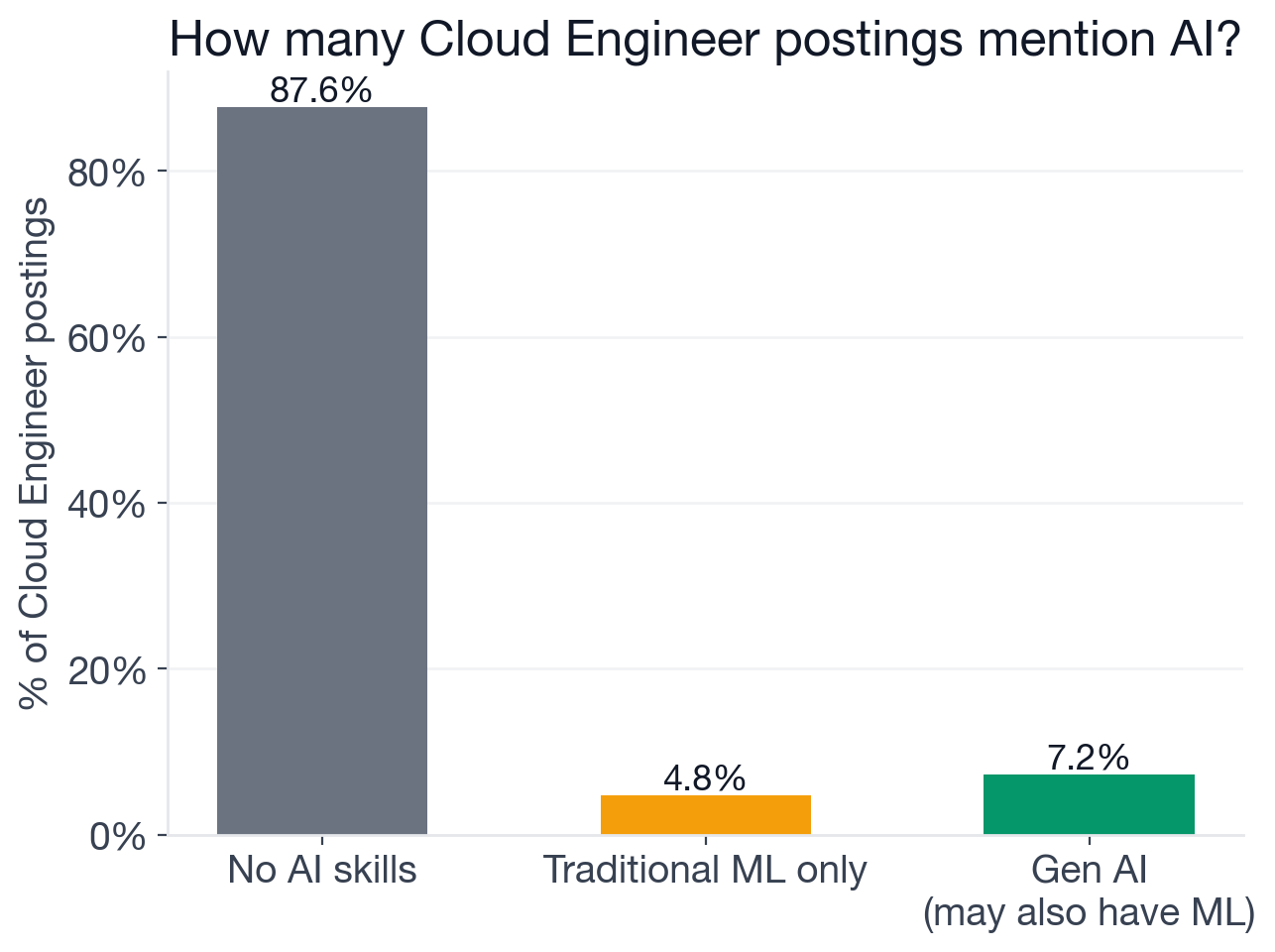
Breakdown of 3,400 Cloud Engineer postings by AI skill signal. 87.6% list no AI skills of any kind; that figure includes teams running LLM inference on Kubernetes who simply assume every competent hire arrives with AI tools already in use. Note: the dataset captures the full "Cloud Engineer" category from the InterviewStack.io classifier, which includes cloud software engineering, cloud administration, and some adjacent IT infrastructure roles; a small subset of postings may be IT infrastructure management or data center titles rather than pure cloud software engineering, which means the 7.2% adoption rate is a conservative floor for cloud software specialists specifically.
What the chart shows: 5.4% of postings are purely new-wave AI (generative AI tools, no traditional ML), 1.8% require both generative AI and traditional ML together, and 4.8% ask for traditional ML with no generative AI requirements. The remaining 87.6% say nothing about AI explicitly.
The Flexera 2026 State of the Cloud Report (n=753 cloud decision-makers globally) found that 100% of surveyed organizations now use some form of generative AI from public cloud providers, with 45% using it extensively. A hiring manager writing a 2026 Cloud Engineer job description is not omitting AI because AI is irrelevant. They are omitting it because every credible candidate they interview already uses it. The posting gap reflects an assumption, not an absence.
Which AI Skills Are Cloud Infrastructure Postings Actually Asking For?
The explicit skills that surface in Cloud Engineer postings with AI requirements tell a consistent story: the job is about running AI systems, not building the models themselves.
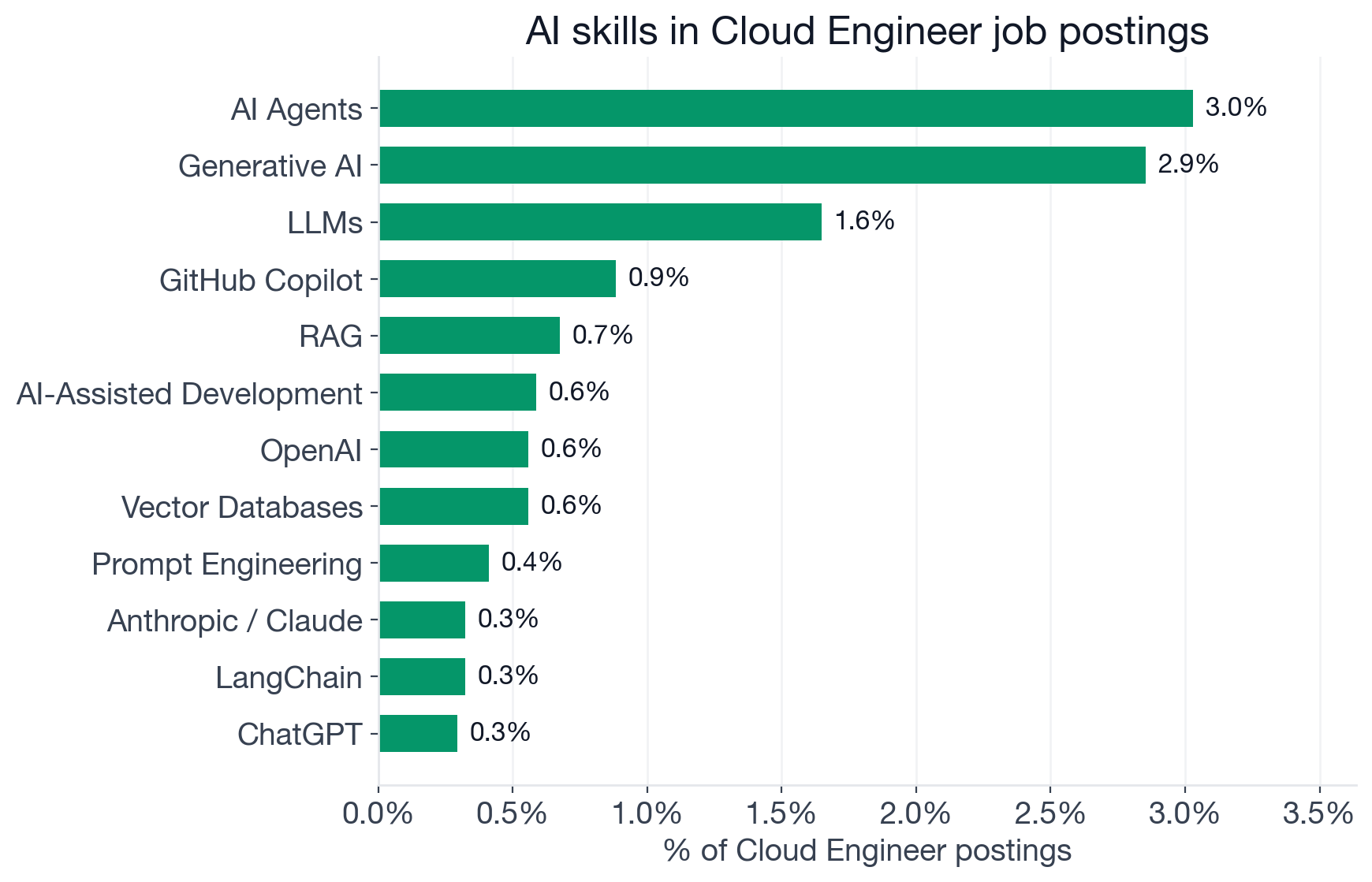
Percentage of Cloud Engineer postings mentioning each AI skill. Both new-wave (2023+) and traditional AI skills are shown.
Machine Learning at 6.5% has been in Cloud Engineer postings for years; provisioning ML training infrastructure predates the LLM era. The notable shift is the second tier:
AI Agents (3.0%, 103 jobs) is the most prominent new-wave skill. Postings asking for AI Agents are describing engineers who build and operate the infrastructure for autonomous AI workflows: managing the cloud services, message queues, and compute that keep multi-step agent loops running reliably in production.
Generative AI (2.9%, 97 jobs) and LLMs (1.6%, 56 jobs) typically appear in postings concerned with model deployment and inference management: serving models at scale, controlling costs per token, and wiring the APIs that application teams consume.
MLOps (1.6%, 55 jobs) is the traditional handoff between Data Science and Cloud Engineering, and it has picked up urgency as the number of production models in most organizations has grown from a handful to dozens. The practice of operationalizing machine learning pipelines in production now involves model registries, drift detection, and retraining pipelines that live on cloud infrastructure.
GitHub Copilot (0.9%, 30 jobs) is listed explicitly in only 30 postings, but the Stack Overflow Developer Survey 2025 found 51% of professional developers use AI tools daily. The remaining 3,370 postings that don't mention Copilot still expect their hires to use it. RAG (Retrieval-Augmented Generation, a technique for grounding LLM responses with a private-data search step) and Vector Databases appear at 0.7% and 0.6% respectively, signaling the fast-growing Cloud Engineer responsibility for enterprise knowledge retrieval infrastructure.
What Does Explicit AI Experience Pay?
Among US postings where salary is disclosed, Cloud Engineer openings that list new-wave generative AI skills show a median of $166,792 versus $135,000 for postings with no AI requirements. These are US base salaries only; equity, bonuses, and sign-on are not reflected in posting data and can be substantial at larger employers.
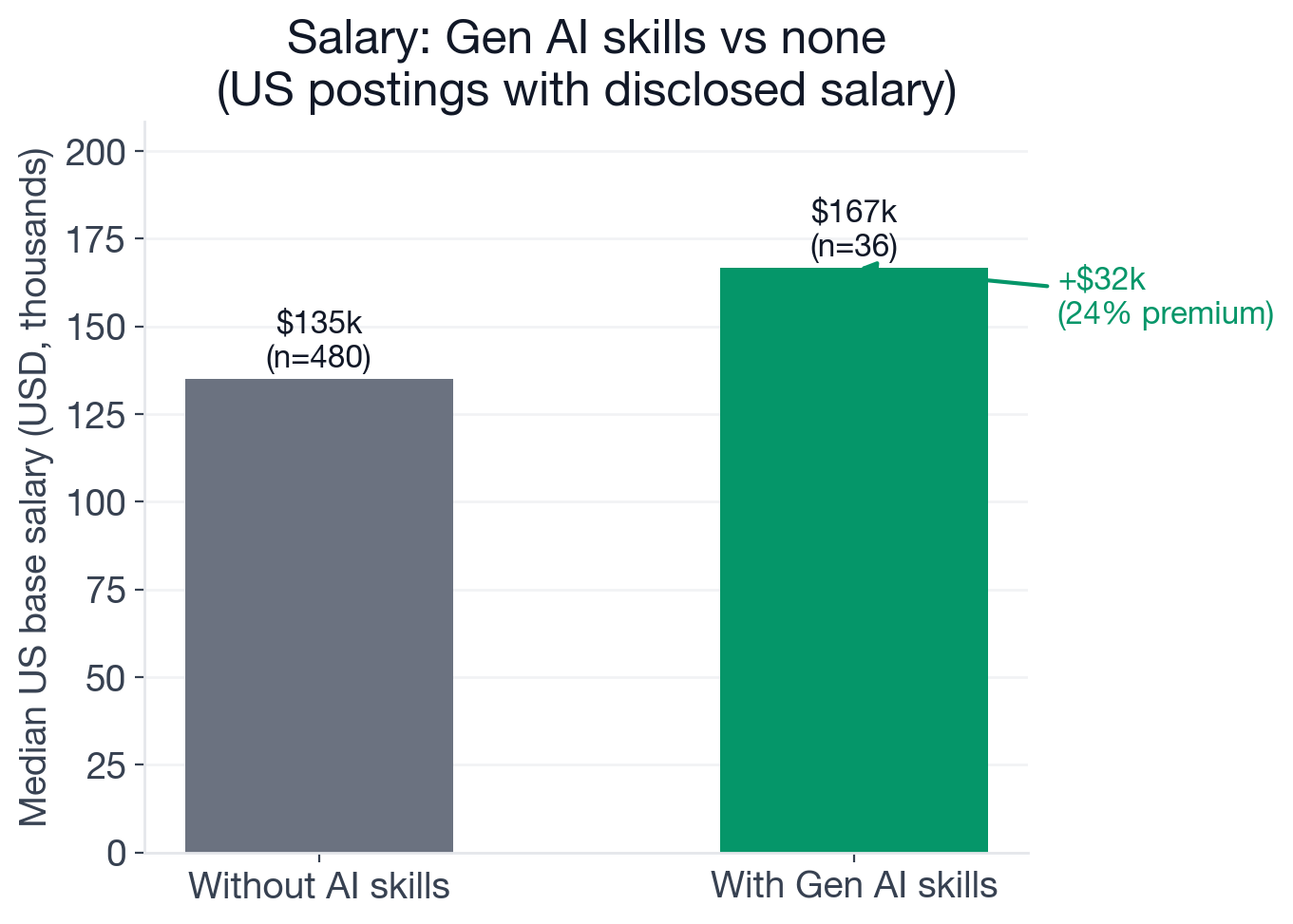
US base salary medians for Cloud Engineer postings with and without new-wave AI requirements (n=36 AI-listed, n=480 non-AI). Equity not included.
The $31,792 premium (approximately $32K) is directionally clear but comes with a caveat: the AI-listed salary sample is small (n=36), above the N=25 floor for reporting but not large enough to treat as a precise market rate. The number will sharpen as more postings include explicit AI requirements and disclosed salary data.
Part of the premium reflects the seniority distribution: AI-listed Cloud Engineer postings skew heavily toward senior and staff levels, and staff engineers command higher base pay regardless of AI involvement. The premium is real, but it is partly a measure of where in the org chart AI infrastructure work currently lands.
Where Is the AI Demand Concentrating?
Not all Cloud Engineering work is equally AI-forward. The seniority and industry distributions show where the explicit demand is clustering.
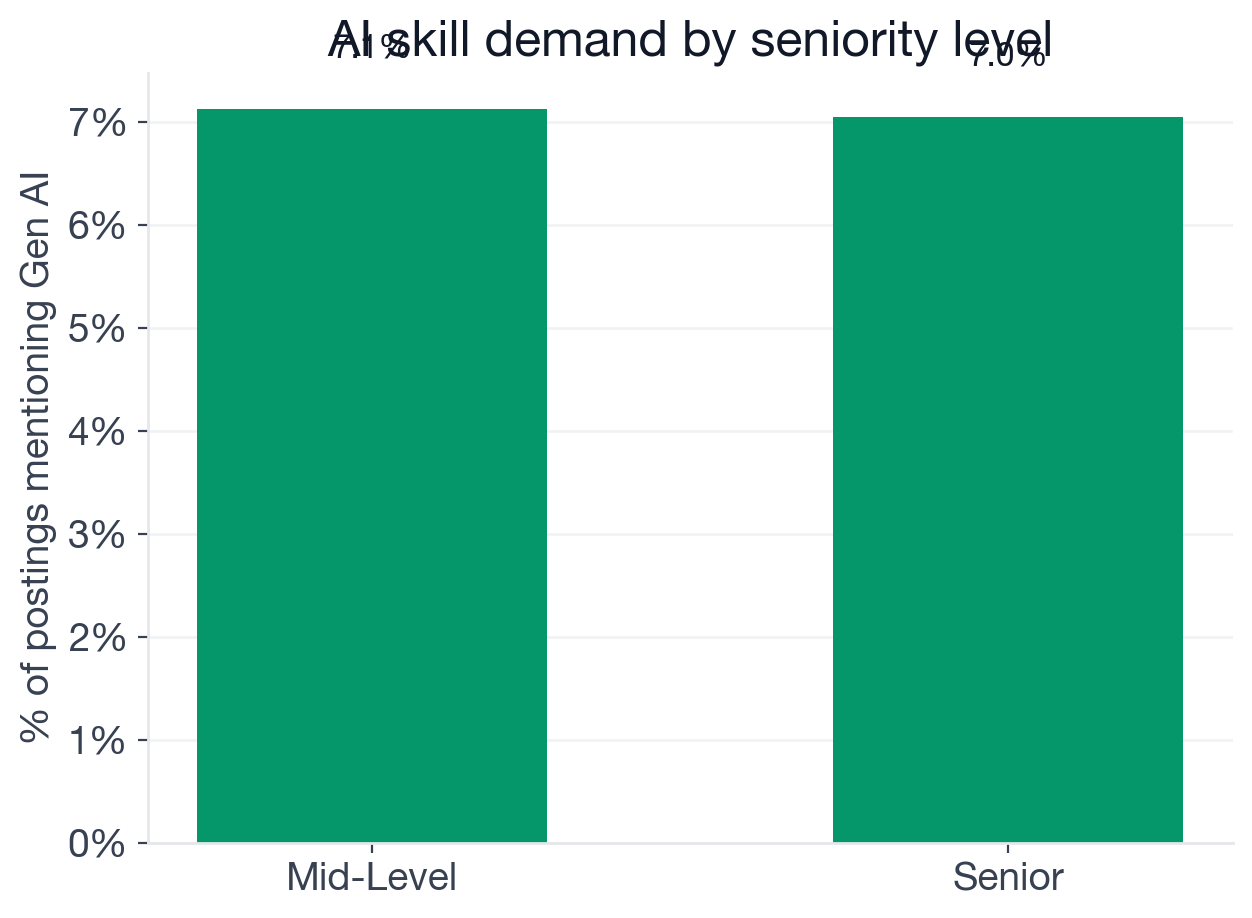
Share of Cloud Engineer postings at each seniority level that carry AI requirements.
Staff-level engineers stand at 13.1%, roughly double the rate for senior (7.0%) and mid-level (7.1%). Entry and junior levels sit below 6%. The pattern reflects where AI infrastructure strategy lands: deciding which LLM inference framework, which vector store, and which AI orchestration pattern the organization will standardize on is a principal-engineer problem that requires both deep cloud fluency and AI context. Junior engineers provision the services that staff engineers specify.
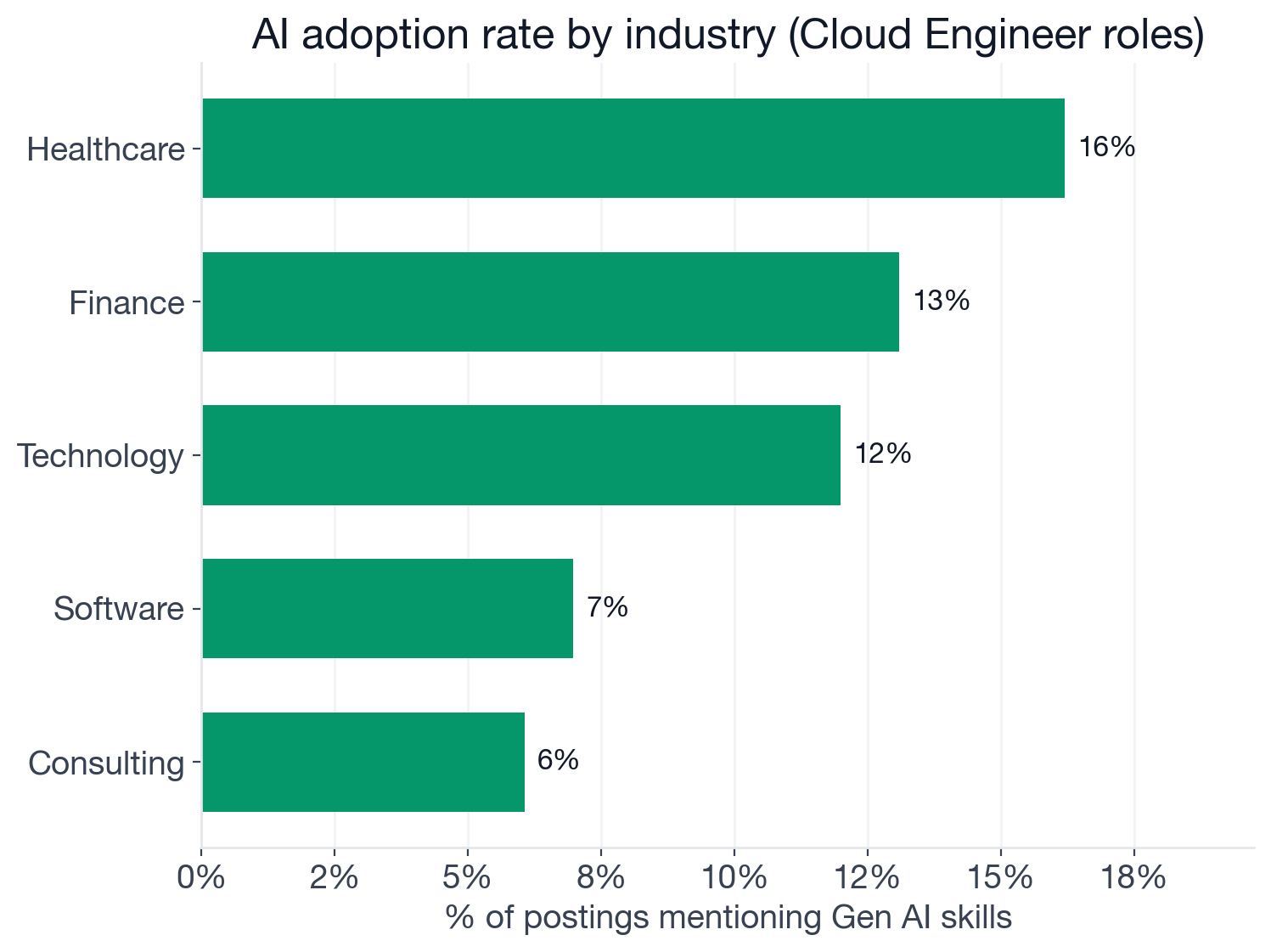
Top industries by AI adoption rate in Cloud Engineer postings. Healthcare and Finance lead Technology.
The industry picture is the dataset's most counterintuitive finding. Healthcare leads at 16.2% AI adoption, ahead of both Finance (13.1%) and Technology (12.0%). The regulated-sector lead reflects a real phenomenon: health systems and insurers are deploying AI heavily for clinical documentation, prior authorization automation, and diagnostics support, and those workloads require cloud infrastructure that is HIPAA-compliant, auditable, and built for high-availability requirements that have little margin for error.
Finance at 13.1% follows a similar logic: fraud detection, risk modeling, and document processing workloads demand cloud infrastructure that is both AI-capable and governed. Technology at 12.0% covers a wide range of employers, from cloud consulting firms to enterprise SaaS companies that have integrated AI into their core product lines.
How to Use This in Your Job Search
The skill signal for Cloud Engineers targeting the AI infrastructure tier is clear: AI Agents, LLM inference infrastructure, and MLOps are where explicit demand is growing. Browse open Cloud Engineer roles on the InterviewStack.io job board to see the full picture of what postings actually require; filter by skill to see which combinations appear most in AI-focused openings.
For interview preparation, the gap between posting language and actual team work means you will likely face AI infrastructure questions in interviews that do not advertise AI requirements. Practice with AI mock interviews to work through cloud architecture scenarios, including LLM deployment patterns and MLOps design questions, before you are in the room. The Question Bank covers Kubernetes, MLOps, and cloud infrastructure topics spanning the AI and non-AI infrastructure boundary.
For skill building, the fastest path into the AI infrastructure tier runs through the tools that are already mainstream: GitHub Copilot for IaC work, hands-on GPU provisioning on AWS or GCP or Azure, and working familiarity with at least one vector database. Our interactive courses covering cloud architecture, system design, and infrastructure fundamentals can accelerate that foundation.
FAQ
Q. How is AI changing the Cloud Engineer job in 2026?
Most Cloud Engineers are not being hired to build AI models; they are hired to provision, scale, and manage the infrastructure those models run on. 7.2% of postings explicitly require new-wave generative AI skills (245 of 3,400 analyzed in June 2026), but the ambient reality is much broader: the profession ranks first in AI tool adoption across all roles, and 74% of AI workloads run on cloud platforms. The role has shifted from pure infrastructure automation to supporting, operating, and increasingly architecting AI workloads.
Q. What AI skills do Cloud Engineer job postings ask for most?
Among new-wave generative AI skills, AI Agents appears most often (3.0% of postings, 103 jobs), followed by Generative AI (2.9%, 97 jobs) and LLMs (1.6%, 56 jobs). Machine Learning is the most requested AI skill overall at 6.5% (220 jobs), as traditional ML workloads have been a Cloud Engineer responsibility for years. GitHub Copilot rounds out the explicit mentions at 0.9% (30 jobs), though its ambient use across the profession is far higher.
Q. Do Cloud Engineers with AI skills earn more?
Yes. US postings requiring new-wave generative AI skills show a median of $166,792 versus $135,000 for non-AI postings, a $31,792 premium (n=36 AI-skill postings; US base salary only, equity not included). The sample is small and skews senior, but the directional signal is consistent with AI-skill premiums seen across other engineering roles in 2026.
Q. Which industries are most actively hiring Cloud Engineers for AI work?
Healthcare leads at 16.2% of its Cloud Engineer postings carrying AI requirements (17 of 105), ahead of Finance at 13.1% (14 of 107) and Technology at 12.0% (49 of 409). The regulated-sector lead reflects heavy investment in AI-assisted diagnostics, fraud detection, and document processing, all of which require robust, compliant cloud infrastructure.
Q. Do I need AI skills to get a Cloud Engineer job in 2026?
Not explicitly: 87.6% of postings list no AI skills of any kind. But employers assume ambient AI fluency. Using GitHub Copilot for Terraform and Kubernetes configuration, ChatGPT for debugging YAML, and AI-assisted CLI tools is now a baseline expectation that rarely appears in job descriptions. Entry-level openings represent just 2.5% of Cloud Engineer postings (84 of 3,400), making this a senior-weighted market regardless of AI requirements.
Q. Are staff-level Cloud Engineers more likely to see AI requirements?
Yes. Staff engineers show the highest AI adoption rate at 13.1% of their postings carrying AI requirements, compared to 7.1% for mid-level and 7.0% for senior. That gap reflects where AI requirements land: principal and staff engineers are being asked to architect AI platforms and set the infrastructure strategy for LLM deployment.
Q. How is generative AI changing cloud infrastructure work day-to-day?
Three shifts are most visible. First, AI development tools like GitHub Copilot assist with IaC generation and YAML debugging: 71% of cloud teams say generative AI is increasing their IaC volume (ControlMonkey, 2026). Second, cloud engineers now provision AI-specific infrastructure: GPU clusters, vector database deployments, and LLM inference endpoints. Third, that expansion creates new governance problems: 58% of cloud teams have seen misconfigurations from AI-generated infrastructure, making validation and drift detection new core competencies.
The Infrastructure Tier Already Made Its Move
The ambiguity in posting language is a signal, not a gap. A team building LLM infrastructure writes "Senior Cloud Engineer" in the title because that is what the job is: the AI part is the workload, not a separate discipline. What the 7.2% explicit rate and the $32K salary premium together indicate is that the teams already deep in AI infrastructure have started naming it, and they are paying a premium to hire for it. The teams that have not named it yet are not far behind. The question for any Cloud Engineer in 2026 is not whether AI infrastructure is coming to their stack. It is whether they are building that fluency now, or catching up later.
Topics
Ready to practice?
Put what you've learned into practice with AI mock interviews and structured preparation guides.