
Same Core Language Stack, Two Very Different Futures
React is the top skill for Full-Stack Developer postings and the second-most-demanded skill for Frontend Developers. TypeScript and JavaScript follow in the top three for both. With a Jaccard overlap coefficient of 0.46 across the top-30 skill sets, nearly half the combined toolkit is common to both roles, which is why the two job titles regularly appear in the same resume stack-ranking.
Beneath that shared surface, though, a structural divide is forming. Full-Stack Developer postings now carry an explicit AI-building skill tier: LLMs, Generative AI, RAG (retrieval-augmented generation), and embeddings appear in hundreds of postings at median US salaries of $165,000 to $198,300 above the $151,500 Full-Stack baseline. None of these appear at meaningful frequency in Frontend Developer salary data. Both roles use AI coding tools every day; roughly 90% of engineers now use tools like Copilot or Cursor at least weekly regardless of job title. The question is which role is being hired to BUILD AI into products versus which is being hired to USE AI to ship faster.
We analyzed 14,158 active postings (8,566 Full-Stack Developer and 5,592 Frontend Developer) on the InterviewStack.io job board as of June 2026, with skills extracted from descriptions and synonyms normalized.
| Full-Stack Developer | Frontend Developer | |
|---|---|---|
| Median US base salary | $151,500 | $129,600 |
| Active postings | 8,566 | 5,592 |
| Top skill | React (54%) | JavaScript (43%) |
| Remote share | 28% | 19% |
| Entry-level share | 2.5% | 23% |
| Skill overlap (Jaccard) | 46% shared | (pairwise) |
Key Findings
- Full-Stack Developers earn a median US base salary of $151,500 (n=1,298) versus $129,600 for Frontend Developers (n=615), a $21,900 gap.
- The Jaccard skill overlap is 0.46: roughly half the combined skill set is common to both roles, anchored by React, TypeScript, and JavaScript.
- Full-Stack has 8,566 active postings versus Frontend's 5,592, a 1.53x larger market.
- AI-building skills (LLMs, Generative AI, RAG, embeddings) appear in Full-Stack salary data at $165,000 to $198,300 medians; none appear in Frontend Developer postings at equivalent frequency.
- Frontend Developer postings are 23% entry-level versus 2.5% for Full-Stack Developer. This figure includes retail "front end" positions from grocery and big-box employers; software-focused Frontend entry-level access is real but narrower than 23%.
- Full-Stack roles are hybrid or remote in 54% of postings; Frontend roles in 38%.
A Day in Each Role
A Full-Stack Developer works across both client and server in the same sprint. They wire up React components in the morning and write API endpoints, database queries, or cloud infrastructure logic in the afternoon. The role requires reasoning about how frontend and backend interact, tracing bugs across layers, and deciding where logic should live. Exclusive signals like Docker (29% of postings), PostgreSQL (26%), and Microservices (21%) confirm the role routinely crosses the browser boundary.
A Frontend Developer lives almost entirely in the browser. The work is about rendering, state management, accessibility, and performance: what users see and how it behaves. They translate visual specs into interactive components, often working closely with designers. Exclusive signals like Accessibility (16%), Design Systems (10%), and Next.js (12%) place this role close to the user experience layer rather than the data layer. Its larger entry-level share reflects a narrower scope that's more learnable in isolation.
Which Skills Do These Roles Actually Share?
React, JavaScript, and TypeScript form the shared core. React appears in 54% of Full-Stack postings and 41% of Frontend postings; TypeScript in 45% and 34% respectively; JavaScript is virtually tied at 42-43% across both.
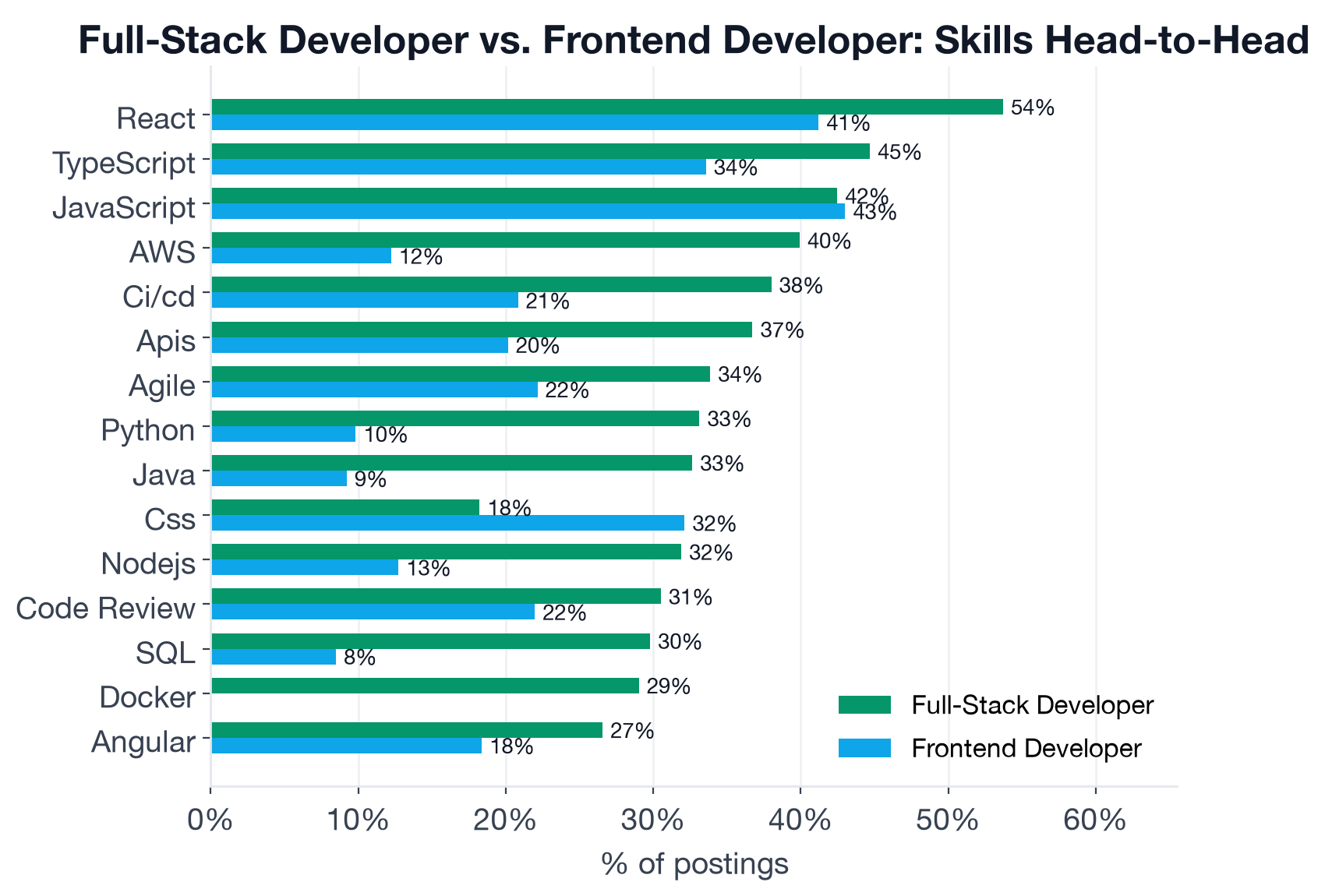
Side-by-side skill frequencies for both roles. Skills appearing at the top of both bars represent the shared foundation; gaps in either direction mark the divergence.
The shared cluster extends to CI/CD (38% Full-Stack vs 21% Frontend), APIs (37% vs 20%), Agile (34% vs 22%), and Code Review (31% vs 22%). These are the collaboration and workflow expectations every engineering team carries, regardless of specialization. If you have the React/TypeScript/CI stack from a Frontend role, roughly half of a Full-Stack posting is already covered on paper.
The Backend Layer That Separates These Roles
The skills exclusive to Full-Stack map precisely to backend and infrastructure work. Docker appears in 29% of Full-Stack postings; PostgreSQL in 26%; Azure in 23%; Microservices and Kubernetes each around 21%. These are solidly "common" tier skills for Full-Stack candidates, appearing in one in four or five postings, not niche additions. They are below the detection threshold for Frontend Developer postings.
Frontend Developer exclusive skills run the other direction: Accessibility (16%), HTML5 (13%), Next.js (12%), Performance Optimization (11%), Design Systems (10%), and CSS3 (10%) are the differentiators for a browser specialist. Worth noting: "Customer Service" appeared in 23% of Frontend Developer postings, a concentration artifact from the same retail employer that accounts for roughly 20% of the Frontend dataset. Its presence reflects customer-facing store roles, not software Frontend Developer skill requirements, and we treat it as a dataset artifact rather than a genuine differentiating skill.
The practical implication for career switchers: adding a containerization tool, a relational database, and a cloud platform to a Frontend portfolio covers much of the distance to a Full-Stack title. It is a meaningful investment but not a different career track.
Which Role Pays More, and Why?
These figures are US base salaries only. Equity, bonus, and sign-on are not disclosed in postings and would raise total compensation meaningfully above these numbers, especially at larger tech and finance employers.
Full-Stack Developers earn a median of $151,500 among 1,298 US postings with salary data. Frontend Developers earn $129,600 across 615 comparable postings, a $21,900 gap. Part of that is a complexity premium for managing more layers. Part of it is an AI premium. The AI skill tier in Full-Stack postings commands some of the highest medians in the dataset: LLMs at $185,000, Prompt Engineering at $180,000, Generative AI at $179,800, RAG at $165,000, and Embeddings at $198,300. Those represent premiums of $13,500 to $46,800 over the Full-Stack baseline, with no comparable tier in Frontend postings.
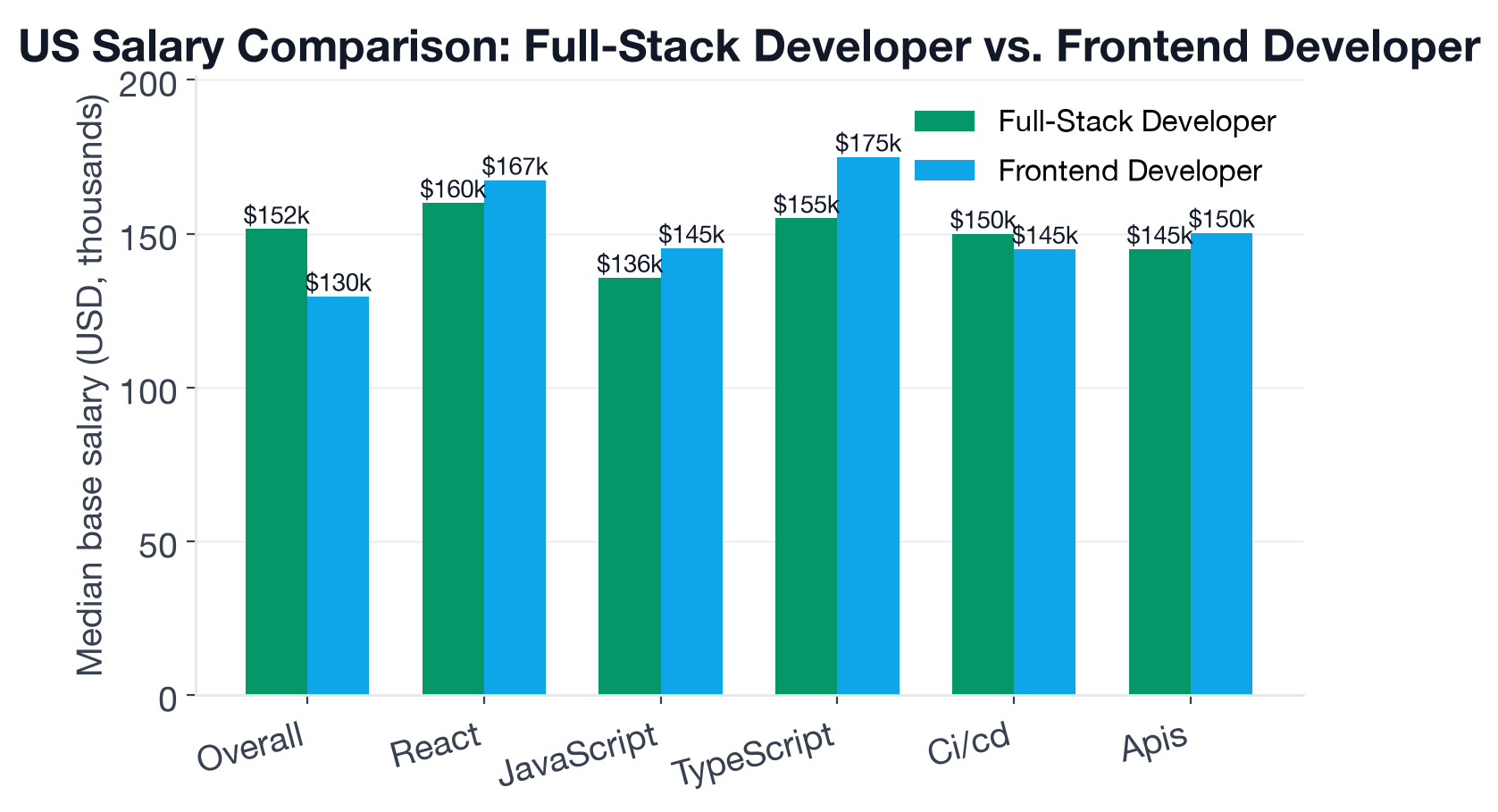
US base salary, disclosed postings only. Full-Stack Developer n=1,298; Frontend Developer n=615.
For Frontend Developers, salary levers come from specialization within the browser: TypeScript at $175,000, Design Systems at $170,000, React at $167,400, and Observability at $175,000 all reward deep craft. The ceiling for a strong Frontend specialist is real. It is just built on different skills than the AI-builder tier Full-Stack creates access to.
One note on the Frontend median: a single retail employer accounts for roughly 20% of Frontend Developer postings in this dataset, pulling in roles that blend customer-facing and web development work at below-software-market pay scales. The $129,600 figure reflects the full breadth of what companies classify as Frontend Developer work.
Which Is Easier to Break Into?
The seniority data answers this directly. About 23% of Frontend Developer postings are explicitly entry-level (1,295 of 5,592); just 2.5% of Full-Stack postings are (214 of 8,566). That is roughly a 9-to-1 ratio on paper, with an important caveat: this dataset includes retail employers (one accounts for roughly 20% of all Frontend postings) whose "Front End Entry Level" titles are store floor positions, not software engineering roles. Accounting for that, the genuine software-focused entry-level share for Frontend is real but meaningfully lower than the 23% headline figure. Full-Stack skews toward mid-level (57%) and senior (32%), which reflects employers expecting engineers who can work across layers without close supervision from day one.
Full-Stack does win on flexibility. Its 28% remote and 26% hybrid rate (54% combined flexible) beats Frontend's 19% remote and 19% hybrid (38% combined). Full-Stack postings are also more globally distributed: 27% US, 14% India, 5% Germany. Frontend postings are US-concentrated at 40% US and 10% India.
Full-Stack or Frontend: How to Decide
Choose Full-Stack Developer if you:
- Already have React and TypeScript fundamentals and are ready to invest in backend and cloud skills (Docker, PostgreSQL, a cloud platform)
- Want access to the AI-builder salary tier: LLMs, RAG, and Generative AI skills pay $165K-$198K in this role
- Value remote or hybrid flexibility (54% of Full-Stack postings offer it versus 38% for Frontend)
- Can clear a higher entry bar (only 1 in 40 postings is entry-level, so prior experience matters)
Choose Frontend Developer if you:
- Are earlier in your career and need volume in accessible openings (23% entry-level means roughly 1 in 4 postings is a realistic target)
- Want to specialize in UI craft: accessibility standards, design systems, performance optimization
- Prefer narrower scope with deeper browser expertise while building experience
- Are targeting roles at companies where the frontend product IS the product (consumer apps, design-led organizations)
Browse live Full-Stack Developer postings and Frontend Developer postings side by side to see which descriptions match where you are now.
Both roles are being reshaped by AI tooling. The 2026 Pragmatic Engineer AI survey found engineers using AI for 75% of their work, with Frontend developers favoring in-editor tools like Cursor for component flow and Full-Stack developers leaning toward CLI agents like Claude Code for cross-layer, multi-file work. Either way, AI fluency is a baseline expectation. The distinguishing question is whether you want to build the AI systems others rely on or use AI tools to build exceptional user interfaces.
Practice the skills that fit your target: AI mock interviews for system design and backend patterns, the question bank for component architecture and accessibility depth, or our interactive courses for building the fundamentals of either path.
FAQ
Q. What is the salary gap between Full-Stack and Frontend Developers in 2026?
Among US postings with disclosed base salary, Full-Stack Developers earn a median of $151,500 (n=1,298) versus $129,600 for Frontend Developers (n=615), a $21,900 gap. The gap is partly driven by an AI-building skill tier in Full-Stack postings: LLMs, Generative AI, and RAG command $165,000 to $185,000 medians, with no equivalent in Frontend postings.
Q. Which role has more entry-level opportunities in 2026?
Frontend Developer has a higher share of entry-level postings. About 23% of Frontend Developer postings are flagged entry-level versus just 2.5% for Full-Stack Developer. That gap is real, but the 23% figure includes retail employers whose 'Front End Entry Level' titles are store floor positions, not software engineering jobs; one retailer alone accounts for roughly 20% of Frontend postings in this dataset. Accounting for that, software-focused Frontend entry-level access is meaningfully higher than Full-Stack, but the ratio is narrower than 9-to-1. Full-Stack skews heavily toward mid-level and above.
Q. What skills do Full-Stack and Frontend Developers share?
React, JavaScript, and TypeScript form the shared foundation, appearing in 41-54% of postings across both roles. The shared skill set also includes CI/CD, APIs, Agile, Code Review, Angular, Node.js, Git, CSS, and HTML. The Jaccard overlap coefficient is 0.46, meaning roughly half the combined skill set is common to both roles.
Q. What skills are exclusive to Full-Stack Developers?
Full-Stack Developers require backend and cloud skills that rarely appear in Frontend postings: Docker (29%), PostgreSQL (26%), Azure (23%), Microservices (21%), and Kubernetes (21%). These are the skills that define the role's second layer beyond the browser.
Q. Do Full-Stack Developers work more remotely than Frontend Developers?
Yes. About 28% of Full-Stack Developer postings are tagged remote versus 19% for Frontend Developer, with hybrid rates following the same pattern (26% vs 19%). Roughly 54% of Full-Stack roles offer remote or hybrid arrangements, compared with 38% of Frontend roles.
Q. Are AI skills required for Frontend Developers in 2026?
Explicit AI-building requirements (LLMs, RAG, Generative AI, embeddings) appear in Full-Stack Developer postings but not at meaningful frequency in Frontend Developer postings. Both roles use AI coding tools heavily; roughly 90% of engineers use tools like Copilot or Cursor weekly per JetBrains 2025, but Full-Stack Developers are increasingly being asked to integrate AI systems into products, while Frontend Developers primarily use AI tools to ship UI faster.
Your 2026 Starting Point
The two roles share enough foundation that switching between them is a targeted investment, not a career restart. Adding Docker, a database, and a cloud platform to a Frontend portfolio covers much of the Full-Stack transition; the AI-building tier is the stretch goal that unlocks the highest salary multiples. With a higher share of entry-level openings in Frontend (23% in the raw data, partly inflated by retail "front end" positions) and a $22K higher median ceiling in Full-Stack once you're mid-level, the tradeoff is unusually legible. Browse live Full-Stack Developer postings or Frontend Developer postings and see which description already describes you.
Topics
Ready to practice?
Put what you've learned into practice with AI mock interviews and structured preparation guides.