
TypeScript Has Overtaken JavaScript, and the Pay Gap Tells You Why
For most of the last decade, "full-stack developer" meant JavaScript developer: Node.js on the backend, React or Angular on the frontend, JavaScript all the way through. That picture has quietly shifted. TypeScript now appears in more Full-Stack Developer postings than JavaScript does (45.2% vs 41.5% across 7,309 active postings on the InterviewStack.io job board), and it commands a US median salary $20,000 higher.
The gap is not random. TypeScript's strong type system makes AI-generated code safer to ship: when GitHub Copilot or Cursor writes a function, TypeScript catches the contract mismatches before they hit production. As AI-assisted coding becomes the default workflow for most developers (85% of developers report using AI coding tools regularly per JetBrains' 2025 survey; 84% use or plan to use them per Stack Overflow 2025), the language that keeps AI output reliable has become the language worth paying for.
React remains the only skill appearing in more than half of all postings (54.1%), making it the role's single table-stakes requirement. Beyond React, the choices fragment enough that even TypeScript and JavaScript don't cross the 50% threshold. Full-stack hiring in 2026 is wide: the exact stack varies company to company, but the TypeScript-over-JavaScript transition is the clearest directional signal in the data.
Key Findings
- 7,309 active Full-Stack Developer postings analyzed across the live job board as of June 2026.
- React is the only table-stakes skill at 54.1% (3,959 postings); TypeScript (45.2%) leads JavaScript (41.5%) among all languages.
- Median US base salary: $130,000 across 697 postings with disclosed US salary data.
- TypeScript commands $140,000 US median; JavaScript commands $120,000, a $20,000 gap on a $130,000 baseline.
- LLM and Generative AI skills pay $150,000-$160,000 US median, a $20,000-$30,000 premium above the role baseline.
- Only 3.4% of postings are entry-level (250 of 7,309); mid-level dominates at 58.5%.
- 28.3% of postings are tagged remote, making Full-Stack slightly more remote-friendly than most data and infrastructure roles.
- Docker and Kubernetes co-occur with a lift of 2.71 (1,184 postings), the highest pairing lift in the dataset, signaling that container orchestration is hired as a single competency.
Which Skills Do Full-Stack Developer Postings Actually Require?
Individual skills in Full-Stack Developer postings sort into three distinct tiers, and the pattern at the top is unusual.
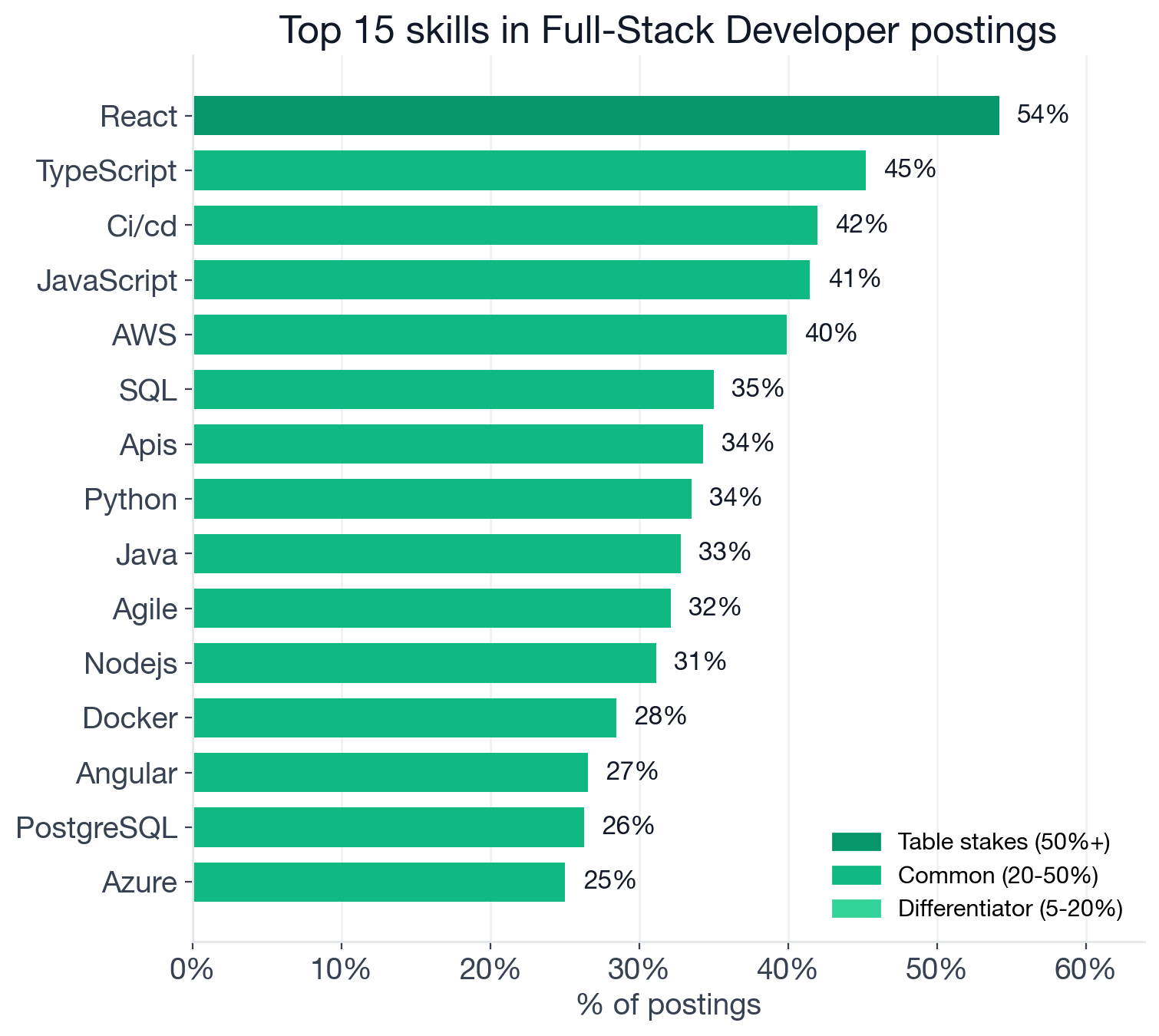
Top individual skills in Full-Stack Developer postings by share. Skills above 50% are table stakes; 20-50% are common; 5-20% are differentiators.
Table stakes (50%+):
React at 54.1% is the only skill in this tier. Not TypeScript, not JavaScript, not Python: React alone clears the majority threshold. That's a notable statement about frontend convergence in a role where the backend language is still contested. Angular shows up in 26.5% of postings and Vue.js in 7.8%, so roughly half the non-React postings spread across alternatives. React is the one near-universal expectation.
Common tier (20-50%):
This is where the real prioritization happens. Eighteen skills land here: TypeScript (45.2%), CI/CD (42%), JavaScript (41.5%), AWS (39.9%), SQL (35%), APIs (34.3%), Python (33.5%), Java (32.8%), Agile (32.1%), Node.js (31.1%), Docker (28.5%), Angular (26.5%), PostgreSQL (26.3%), Azure (25%), REST API (24.8%), Git (24.4%), Microservices (22.1%), and Kubernetes (21%).
TypeScript and JavaScript appear separately in this tier because many postings ask for one or the other explicitly. A typed-React-plus-TypeScript stack and a plain-React-plus-JavaScript stack are genuinely different hiring targets. Which one pays more is what the next section covers.
Differentiator tier (5-20%):
The long tail includes monitoring, Spring, MySQL, MongoDB, NoSQL, GraphQL, Next.js, Terraform, distributed systems, Kafka, containerization, Vue.js, Django, Jenkins, and system design, among others. These appear in a minority of postings but are precisely where salary premiums concentrate.
Which Full-Stack Skills Actually Move the Salary Needle?
Among US postings with salary data, the median Full-Stack Developer base salary is $130,000 (n=697 postings). These numbers cover base salary only, drawn from postings that disclosed compensation. Equity, bonuses, RSUs, and sign-on are not included in job posting data, so total compensation at top employers is meaningfully higher, particularly in tech and finance.
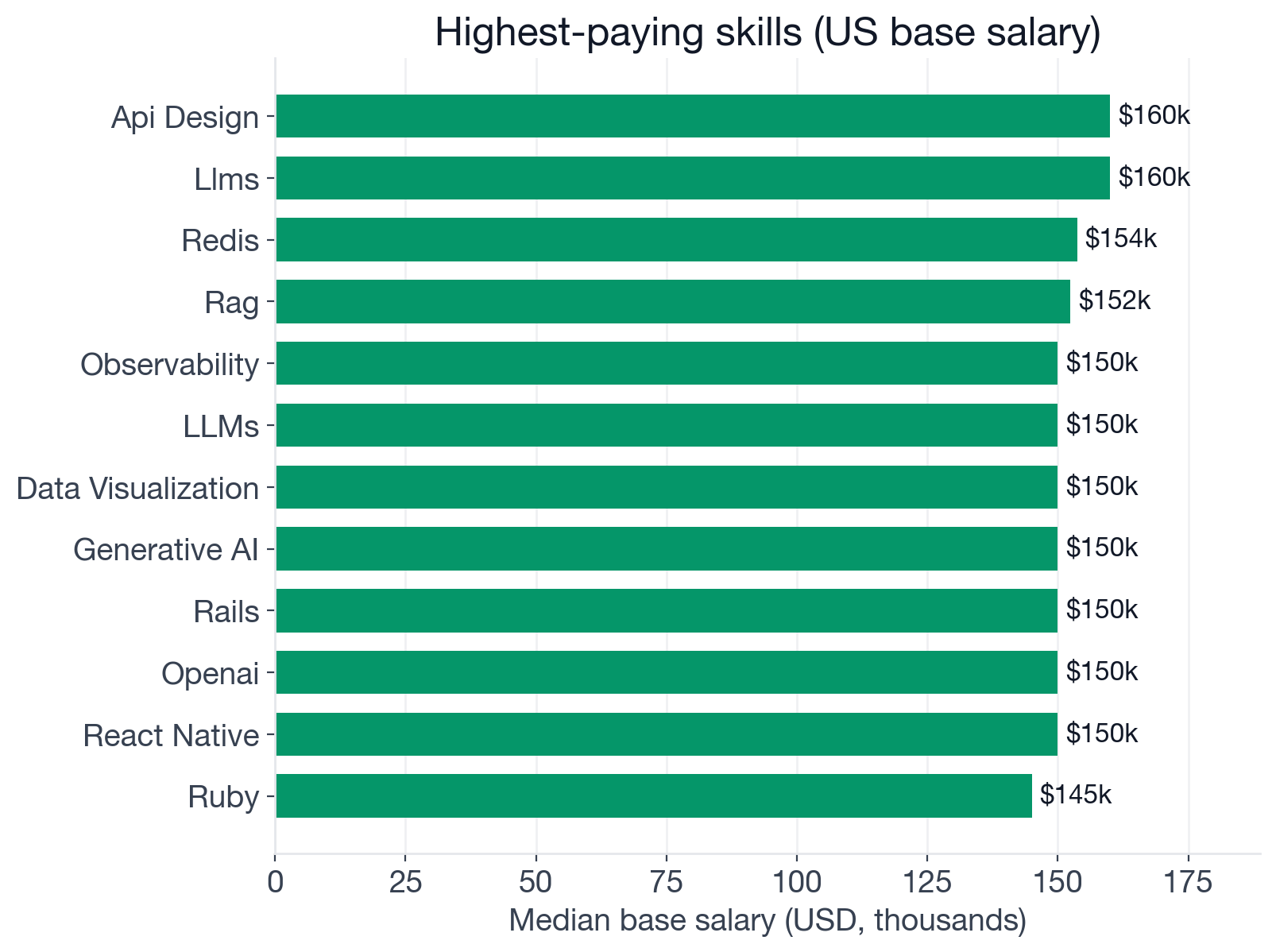
Median US base salary for postings that mention each skill. Baseline is $130,000 (n=697 US postings with disclosed salary data).
The sharpest story in the data is the divergence within the JavaScript ecosystem:
| Skill | US Median | vs. Baseline | Sample |
|---|---|---|---|
| LLM skills | $150,000-$160,000 | +$20K to +$30K | n=61-64 |
| Observability | $150,000 | +$20,000 | n=137 |
| Generative AI | $150,000 | +$20,000 | n=49 |
| System Design | $143,200 | +$13,200 | n=68 |
| Next.js | $143,000 | +$13,000 | n=93 |
| Distributed Systems | $140,000 | +$10,000 | n=89 |
| TypeScript | $140,000 | +$10,000 | n=390 |
| Terraform | $140,000 | +$10,000 | n=75 |
| Python | $136,500 | +$6,500 | n=310 |
| React | $135,000 | +$5,000 | n=431 |
| Node.js | $133,700 | +$3,700 | n=238 |
| JavaScript | $120,000 | -$10,000 | n=326 |
| Agile | $110,000 | -$20,000 | n=284 |
TypeScript at $140,000 (n=390) sits $10,000 above the baseline. JavaScript at $120,000 (n=326) sits $10,000 below it. A $20,000 gap between two languages that overlap heavily in their postings is a real market signal: companies are actively differentiating on this choice.
Two observations on the lower end of the table. JavaScript at $120K is not a sign that JavaScript is worthless; it reflects that JavaScript-only postings cluster toward less senior roles and companies that haven't adopted typed workflows. Second, Agile at $110K (a $20K discount to baseline) is consistent with Agile appearing most often at large enterprises with established teams, rather than the product companies and startups that compete hardest on base salary. Both findings point toward the same conclusion: technical depth and modern tooling commands a premium; process methodology and legacy ecosystems do not.
AI-adjacent skills dominate the top of the salary ladder. Observability (instrumenting production systems with structured logs and distributed tracing) at $150K and Generative AI at $150K are skills companies pay to hire for specifically, not traits they assume. They're scarce, which is why the pay premium is largest there.
The AI Layer That Job Postings Don't Fully Capture
The Machine Learning & AI skill family shows up in 14.3% of Full-Stack Developer postings. Within that umbrella, pay varies significantly by specialization: the LLM and Generative AI-specific roles (engineers hired to build LLM integrations, RAG pipelines (retrieval-augmented generation systems that connect language models to structured data), and GenAI product layers) command $150,000 to $160,000 US median. The broader "machine learning" skill, which spans more traditional ML work, sits at $132,000 US median (n=33 US postings). That's the explicit AI requirement tier.
What that 14.3% does not measure: the ambient AI usage across every full-stack role today. Stack Overflow's 2025 developer survey found 84% of developers use or plan to use AI tools, with 51% using them daily. JetBrains' 2025 survey found 85% of developers regularly use AI coding tools, with 62% relying on at least one AI coding assistant or agent. GitHub reports 80% of new developers are using Copilot in their first week, with 20 million cumulative users as of mid-2025.
For full-stack developers, AI coding tools like GitHub Copilot, Cursor, and Claude Code target the multi-file, cross-stack navigation that defines the role. The productivity benefit cited most often is scaffolding and boilerplate generation (74% of JetBrains respondents), exactly the repetitive work full-stack developers do when wiring up new routes, database models, and UI components.
The connection to TypeScript runs deeper here. TypeScript's rise to the number one language on GitHub (per GitHub Octoverse 2025) is tied directly to the AI-coding era: strong typing makes AI-generated code safer, more reviewable, and easier to debug. If you're using Copilot or Cursor to write large portions of a codebase, TypeScript isn't just a style preference. It's a risk-management decision.
The takeaway: the 14.3% explicit AI adoption rate measures Full-Stack Developers hired to build AI systems. The 84-85% ambient usage figures measure the full-stack developers using AI tools every day regardless of what their job posting says. In 2026, not using AI coding tools as a full-stack developer is the exception, not the rule.
What Skill Families Does Full-Stack Hiring Actually Cover?
Group individual skills into higher-level families and the role's breadth becomes visible.
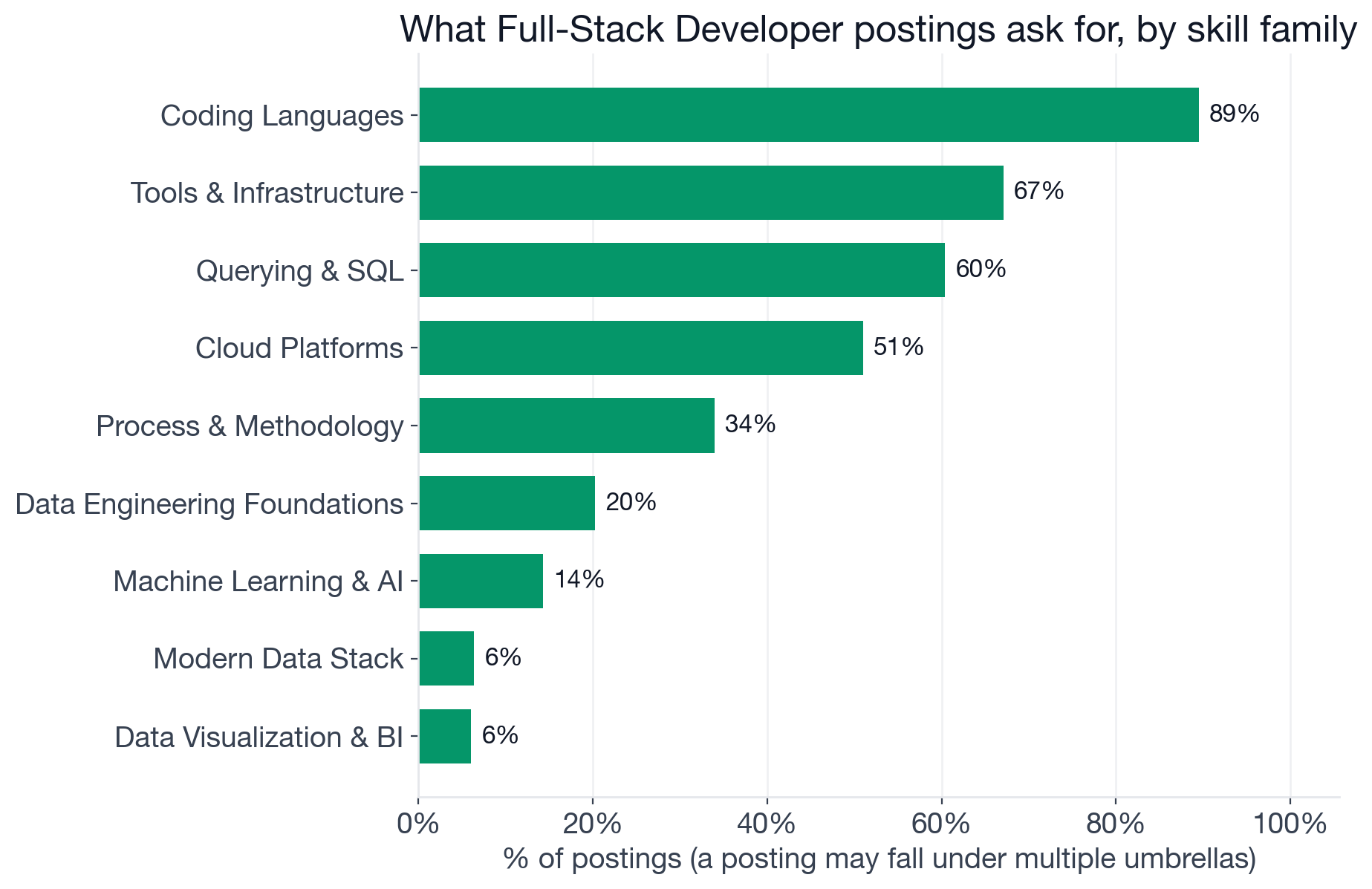
Share of Full-Stack Developer postings that ask for at least one skill in each family. A posting that names React and Angular counts once under the relevant family.
The "Coding Languages" family at 89.5% and the broader "Other" bucket at 95.7% (capturing frameworks, API patterns, and tooling) dominate because full-stack work is fundamentally a coding job. What stands out is the Querying & SQL family at 60.4%: 3 in 5 postings include a database component, with PostgreSQL (26.3%), MySQL (14%), and MongoDB (13.8%) filling the differentiator tier beneath SQL (35%). The full-stack developer is expected to write queries, design schemas, and understand relational and document database trade-offs, not just consume an ORM.
Cloud Platforms at 51% means "knows how to deploy" is now part of the full-stack expectation in most companies, not a separate DevOps specialization. AWS leads at 39.9%, Azure at 25%, and Google Cloud at 15.9%. Machine Learning & AI at 14.3% is the explicit-AI segment discussed above, worth building toward even if the current role doesn't require it.
The Pairings That Signal How Companies Actually Hire
Co-occurrence among the top 25 skills reveals which combinations are hired as units and which just happen to overlap.
| Skill pair | Postings with both | % of postings | Lift |
|---|---|---|---|
| Docker + Kubernetes | 1,184 | 16.2% | 2.71 |
| AWS + Docker | 1,282 | 17.5% | 1.54 |
| CI/CD + Docker | 1,347 | 18.4% | 1.54 |
| Node.js + TypeScript | 1,359 | 18.6% | 1.32 |
| AWS + Node.js | 1,184 | 16.2% | 1.30 |
| React + TypeScript | 2,227 | 30.5% | 1.24 |
| Node.js + React | 1,571 | 21.5% | 1.27 |
| Python + React | 1,615 | 22.1% | 1.22 |
Lift greater than 1 means the two skills appear together more often than their individual frequencies would predict. Data from top-25 skill co-occurrence analysis.
Docker + Kubernetes (lift 2.71) stands apart as the highest-lift pair in the dataset by a wide margin. A posting that mentions Docker is 2.71 times more likely to also require Kubernetes than baseline frequencies predict. Container orchestration is being hired as a single skill cluster: companies that containerize expect you to also run containers at scale, not just write Dockerfiles. Pair that with AWS + Docker (lift 1.54) and CI/CD + Docker (1.54), and a clear picture emerges: containerization in full-stack hiring is a deployment competency, not a standalone tool.
React + TypeScript (lift 1.24) is the highest-volume strong pair: 2,227 postings (30.5% of the market) ask for both. This confirms the typed-React stack as the dominant modern frontend expectation. Node.js + TypeScript (lift 1.32) shows the same pattern on the backend: TypeScript's strongest pull is in Node.js environments, where the type system catches contract mismatches between API layers before they reach production. Browse postings that ask for Node.js and TypeScript together to see what the full-stack TypeScript stack looks like in practice.
How Competitive Is the Full-Stack Market for Entry-Level Candidates?
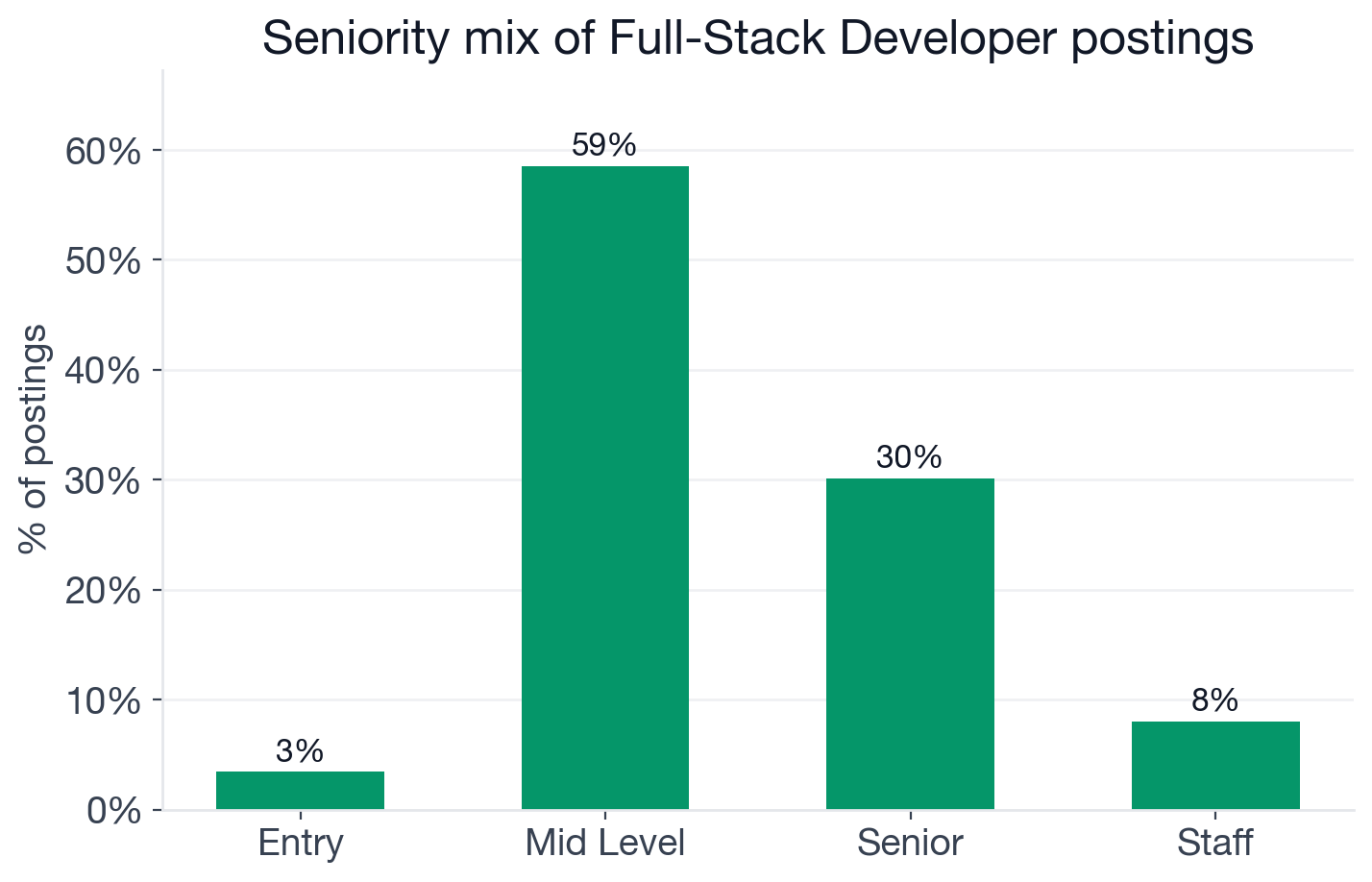
Seniority distribution of Full-Stack Developer postings. Postings without explicit seniority signals default to mid-level.
Only 3.4% of postings are explicitly entry-level (250 of 7,309). That is as tight as Data Engineer hiring and tighter than most software engineering roles. Mid-level dominates at 58.5% (4,278 postings), senior at 30.1% (2,200), and staff at 8% (583). Senior Full-Stack Developer openings alone account for nearly a third of the market.
The 38% senior-and-above share (senior plus staff combined) is substantial. Companies genuinely need full-stack engineers who can make cross-stack architectural decisions, not just implement features. At that level, the differentiator skills (distributed systems, observability, system design, Terraform) are what separate the senior candidates from the principal engineers. Postings requiring system design, for instance, pay a $13,200 premium to baseline.
For candidates starting out: the 3.4% explicit entry-level rate doesn't mean the market is closed. It means most postings are written for someone with at least one shipped production feature. The clearest path in is a deployed project demonstrating React + TypeScript, an API with at least one database query, and evidence you understand what CI/CD does, even if you haven't operated it yourself.
Where Full-Stack Developer Jobs Are, and How Remote-Friendly They Are
Full-Stack Developer hiring is more geographically distributed than most tech roles.
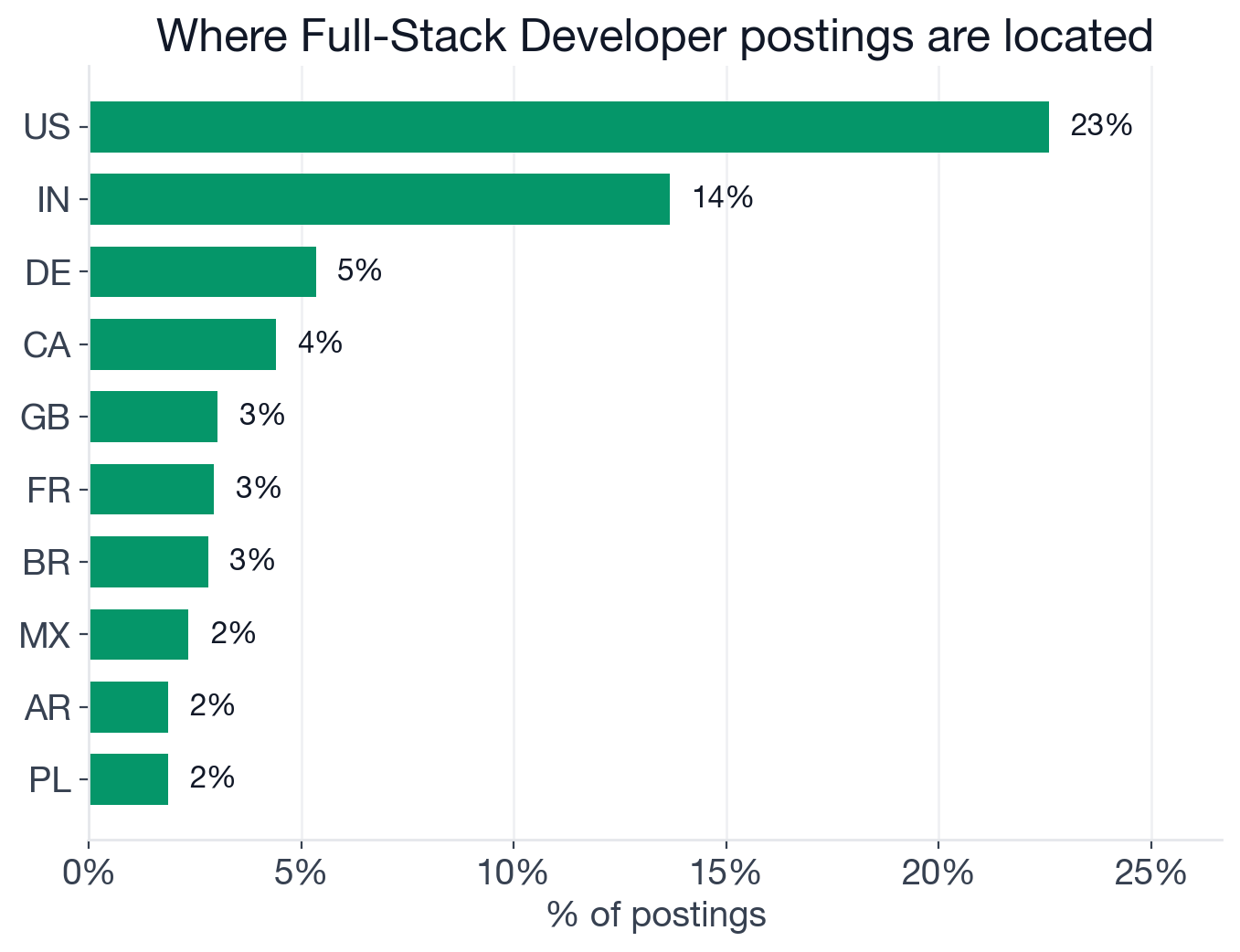
Top countries by share of Full-Stack Developer postings.
- United States: 22.6% (1,652 postings) (US Full-Stack Developer openings)
- India: 13.7% (999)
- Germany: 5.4% (391)
- Canada: 4.4% (322)
- United Kingdom: 3.0% (222)
- France: 3.0% (216)
- Brazil: 2.8% (206)
- Mexico: 2.4% (172)
- Argentina: 1.9% (137)
Germany at 5.4% is the third-largest country market, ahead of Canada and the UK. The EU has a strong direct appetite for full-stack talent, and Germany's share reflects both the domestic hiring market and the nearshore outsourcing flowing to Poland and other Eastern European markets. Latin America's combined share (Brazil 2.8%, Mexico 2.4%, Argentina 1.9%, Colombia 1.75%) puts the region at roughly 9%, reflecting the growth of remote hiring from US product companies into LATAM engineering talent pools.
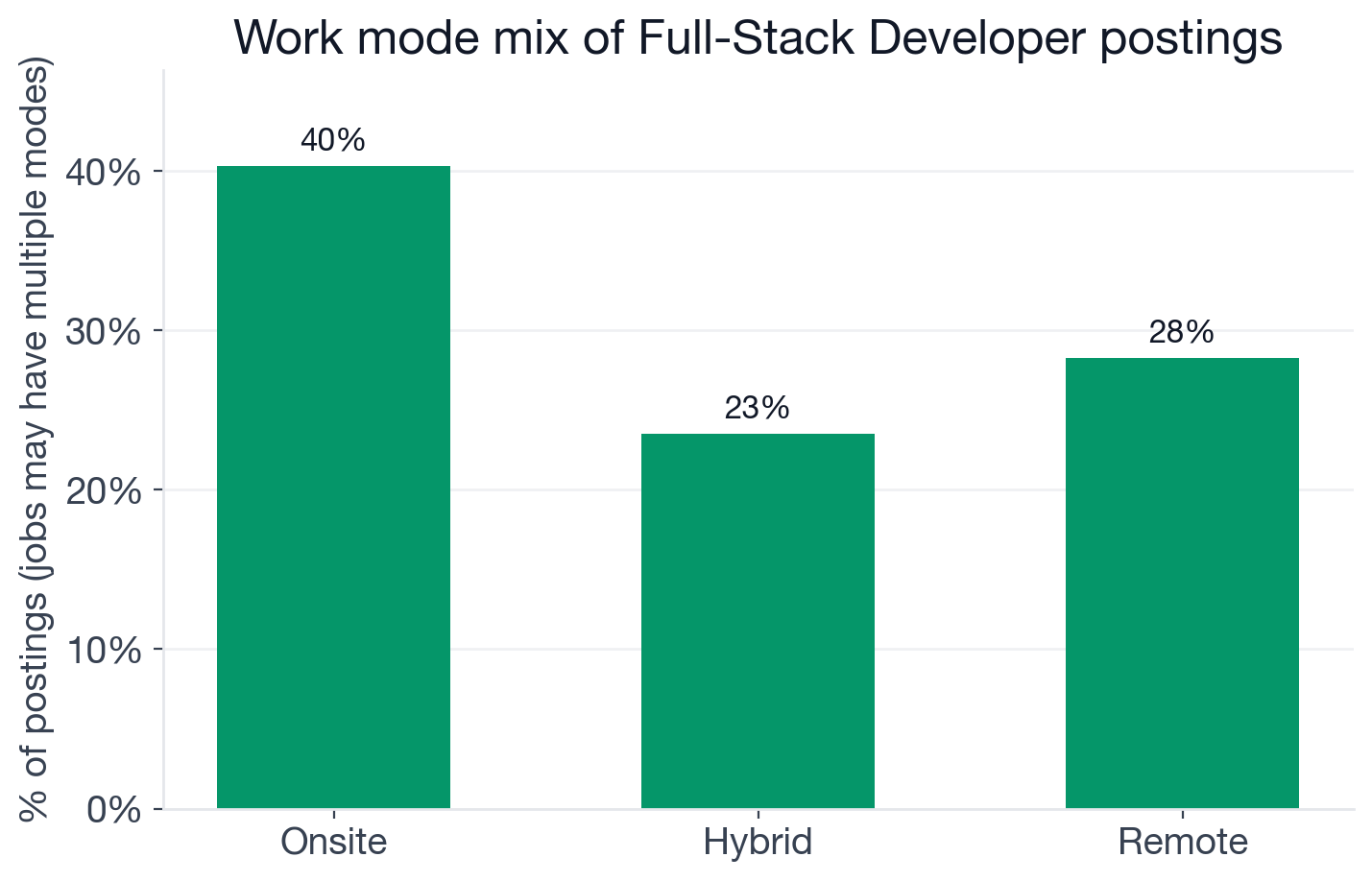
Work mode distribution in Full-Stack Developer postings. Some postings carry multiple tags, so percentages do not sum to 100%.
Remote at 28.3% (2,068 postings) is above the share seen in Data Engineer (27%) and most data and infrastructure roles in our dataset. The role's nature, coding in an IDE and deploying to cloud services without a dependency on local hardware, makes physical colocation less critical than in infrastructure-heavy roles. Onsite still leads at 40.3%, mostly in financial services, healthcare, and enterprise software. Fully remote Full-Stack Developer openings are a real portion of the market, concentrated in product-led tech and SaaS companies.
Who Is Hiring Full-Stack Developers in 2026?
Software services and staffing firms dominate posting volume in this segment because they aggregate demand from multiple end clients.
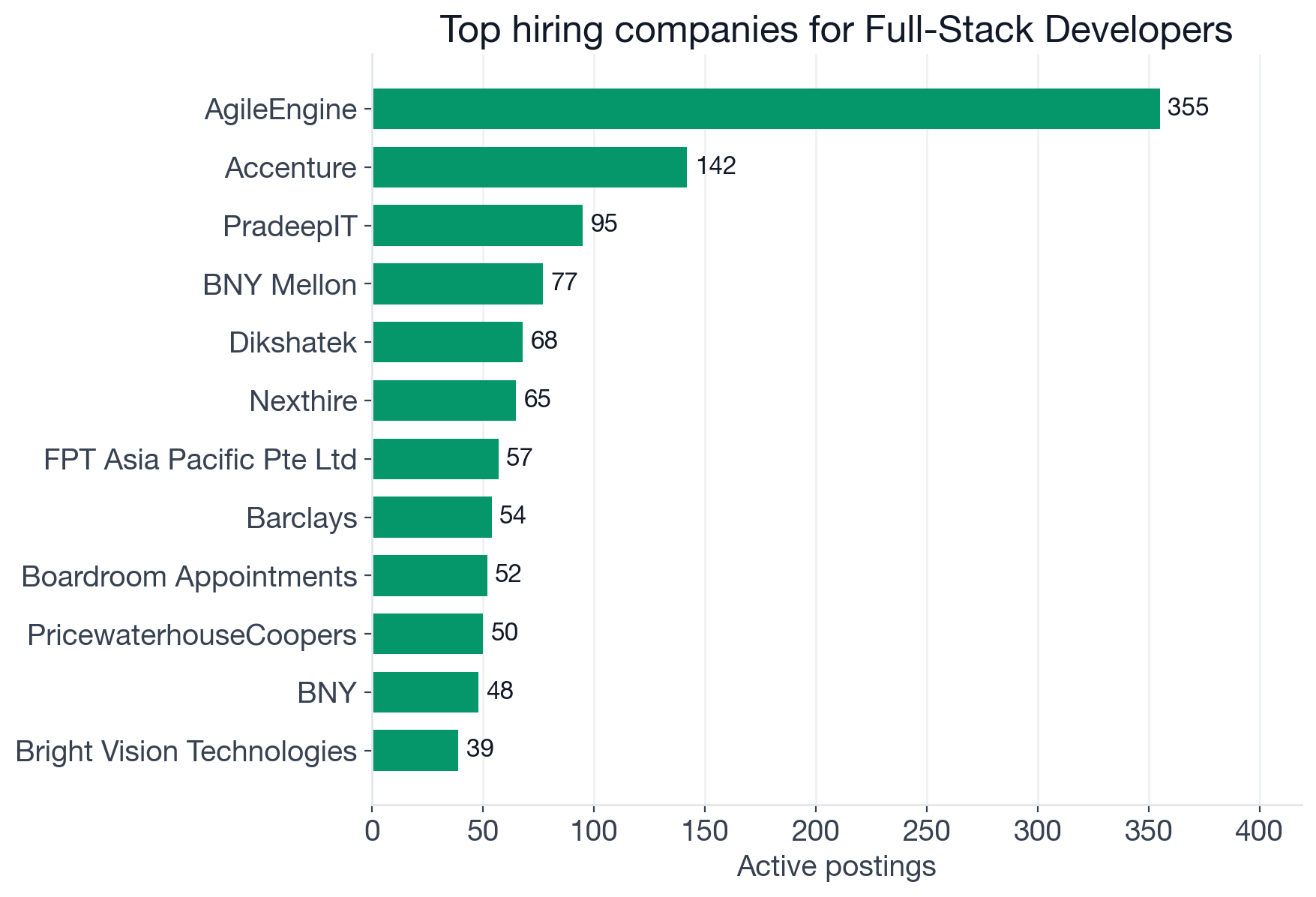
Top companies by distinct active Full-Stack Developer postings. AgileEngine (#1), PradeepIT (#3), Dikshatek (#5), Nexthire (#6), FPT Asia Pacific (#7), and Boardroom Appointments (#9) are staffing, recruiting, or software services firms that aggregate demand from client companies. BNY Mellon, Barclays, PricewaterhouseCoopers, and others listed are direct employers.
AgileEngine (355 distinct postings) is a software services and nearshore outsourcing firm that places engineers at client companies globally. Accenture (142) and PricewaterhouseCoopers (50) operate similarly as global consulting firms. PradeepIT, Dikshatek, and Nexthire are recruiting and staffing operations; FPT Asia Pacific is a software services firm with global delivery.
The direct-employer hiring in the top tier clusters in financial services:
- BNY Mellon / BNY: 125 combined (banking and asset management)
- Barclays: 54 (banking)
- Royal Bank of Canada: 37 (banking)
- Fidelity Investments: 26 (investment management)
Financial services consistently needs full-stack developers to build and maintain client portals, trading interfaces, compliance dashboards, and internal tooling. The Java (32.8% of postings) and Angular (26.5%) shares in this dataset partly reflect the enterprise financial stack, which often pairs Java backends with Angular frontends rather than the Node.js + React combination dominant in product companies. For company-specific interview processes, our preparation guides break down the rounds, topic priorities, and behavioral expectations firm by firm.
How to Use This in Your Job Search
Build the TypeScript stack first. React + TypeScript appears in 30.5% of all postings with a co-occurrence lift of 1.24, and TypeScript commands a $10K salary premium over the role baseline while JavaScript runs $10K below it. If you're building in React with plain JavaScript today, the $20K salary gap makes the migration worth prioritizing before applying. Browse TypeScript Full-Stack Developer openings to see what the postings actually ask for at each seniority level.
Add Node.js for the backend layer. Node.js + TypeScript is the highest-lift pair among the TypeScript-language pairings (1.32, above React + TypeScript at 1.24). Full-stack postings that want TypeScript on the frontend almost always want it on the backend too. The React + TypeScript + Node.js combination covers the core skill cluster for a large share of product-company hiring.
Don't skip containers. Docker + Kubernetes has the highest co-occurrence lift in the entire dataset (2.71). Companies that mention Docker are 2.71 times more likely to also require Kubernetes than baseline frequencies suggest. Understanding Kubernetes fundamentals (not just Dockerfile syntax) is the differentiation point, and pairing it with AWS, which co-occurs with Docker at lift 1.54, maps directly to what postings are asking for.
The LLM premium is real and accessible. Postings that require LLM skills pay $20,000 to $30,000 above the role baseline. Building a project that integrates an LLM API, a retrieval pipeline, or a GenAI feature is now a portfolio differentiator that maps directly to the top-paying job-board segment. The entry cost is lower than for ML engineering: you don't need to understand model training, just API integration, prompt design, and the data-retrieval layer.
Practice the full cross-stack round. Full-stack interviews test both frontend and backend reasoning: component design, state management, REST API design, database schema, deployment awareness, and system design for senior-level roles. AI mock interviews let you practice the end-to-end round under realistic conditions with on-demand feedback. The question bank is where you drill the specific topics that come up most: TypeScript patterns, React hooks and state, Node.js async handling, and database query design. Interactive courses cover the foundational concepts in JavaScript, system design, and SQL that this dataset identifies as common-tier expectations across the role.
FAQ
Q. What skills do companies want for Full-Stack Developer roles in 2026?
React is the only table-stakes skill, appearing in 54.1% of postings. TypeScript (45.2%), CI/CD (42%), JavaScript (41.5%), AWS (39.9%), SQL (35%), and Python (33.5%) make up the common tier. Docker, Kubernetes, Angular, PostgreSQL, and Node.js round out the common-tier expectations.
Q. What is the median salary for a Full-Stack Developer in 2026?
The median US base salary across 697 Full-Stack Developer postings with disclosed salary data is $130,000. That figure covers base salary only; equity, bonuses, and sign-on are not included in job posting disclosures, so total compensation at top employers is meaningfully higher.
Q. Does TypeScript really pay more than JavaScript for Full-Stack Developers?
Yes, by a significant margin. In US postings with salary data, TypeScript commands a median of $140,000 (n=390) versus $120,000 for JavaScript (n=326), a $20,000 difference on a $130,000 baseline. TypeScript is simultaneously more in-demand (45.2% of postings vs 41.5%) and better paid.
Q. Which Full-Stack Developer skills pay the highest salary premium in 2026?
AI-adjacent skills dominate the upper salary tier: postings that mention LLM skills pay a median $150,000-$160,000, Observability $150,000 (n=137), and Generative AI $150,000 (n=49). TypeScript ($140K, n=390), Distributed Systems ($140K, n=89), Terraform ($140K, n=75), System Design ($143,200, n=68), and Next.js ($143,000, n=93) each sit $10,000 or more above the $130,000 baseline.
Q. How competitive is Full-Stack Developer hiring for entry-level candidates?
Quite competitive. Only 3.4% of Full-Stack Developer postings are explicitly entry-level (250 of 7,309), which is similarly tight to Data Engineer hiring. Mid-level roles dominate at 58.5%, senior at 30.1%, and staff at 8%. Most postings expect candidates who have shipped features in a production environment.
Q. Where are Full-Stack Developer jobs located, and how remote-friendly are they?
The United States leads at 22.6% of postings (1,652), followed by India at 13.7% (999) and Germany at 5.4% (391). Full-Stack is more globally distributed than most roles. About 28.3% of postings are tagged remote, 23.5% hybrid, and 40.3% onsite, making it slightly more remote-friendly than Data Engineer or Data Analyst roles.
Q. What is the dominant Full-Stack Developer skill stack in 2026?
React and TypeScript appear together in 30.5% of postings (2,227) with a lift of 1.24, making it the highest-volume strong pair in the dataset. Node.js and TypeScript pair with a lift of 1.32 (1,359 postings). For infrastructure, Docker and Kubernetes co-occur with a lift of 2.71 (1,184 postings), the highest lift in the dataset, signaling that container orchestration is treated as a unified competency.
The TypeScript Bet Is Already Paying Off
Full-Stack Developer in 2026 is a broader title than ever, covering React shops, Node.js APIs, Java financial backends, containerized deployments, and an expanding segment of LLM integrations. What's converging is the language layer: TypeScript has crossed the JavaScript line in both posting frequency and pay, and the AI-coding era explains why. The engineers who combine the typed-React-Node.js core with container fundamentals, system design depth, or LLM integration experience are the ones at the top of the salary table. The foundations are accessible; the differentiators are where the ladder extends.
Browse current Full-Stack Developer openings on the InterviewStack.io job board to see where the React + TypeScript stack, the Node.js backend, and the emerging LLM integration roles are hiring right now.
Topics
Ready to practice?
Put what you've learned into practice with AI mock interviews and structured preparation guides.