
The Question Everyone Underestimates
You are 10 minutes into a 30-minute mid-level full-stack developer interview at a leading tech company. The first question has been asked. You have described the project. Now: "Walk me through how you designed and implemented it across the frontend, backend, and data layers, including the key trade-offs you made."
This is the highest-stakes question in the session. It carries signals across all four scoring dimensions, and the gap between a 70 and a 90 almost never comes down to technology choices. It comes down to something quieter: whether you can show what you personally built, why you made specific decisions, and what those decisions changed in the world.
Stack fluency is table stakes. The interviewer is probing end-to-end ownership: not whether you used React and Postgres, but whether you, specifically, made a concrete decision that moved a measurable outcome. Candidates who list technologies without grounding them in decisions they made and outcomes they measured lose most of the Interviewer Objectives Alignment dimension (30 pts) before the first follow-up arrives.
Key Findings
- The project walkthrough is scored on 4 dimensions worth 100 points total: Interviewer Objectives Alignment (30 pts), Level-Specific Expectations (30 pts), Technical Proficiency (20 pts), and Communication and Problem Solving (20 pts).
- Ownership framing occupies the first 6 minutes and must establish personal contribution, business context, and at least one success metric to hit the Phase 1 checklist.
- The technical walkthrough phase runs from minutes 6-17 (11 minutes) and has 6 explicit checklist items spanning frontend stack, component decisions, backend API shape, database fit, cross-layer contracts, and concrete implementation detail.
- The trade-offs and scale phase (17-26 min) includes a direct scalability probe: what holds under 10x load and what breaks first?
- Level-Specific Expectations (30 pts) explicitly require separating "I owned" from "the team owned" and connecting personal decisions to measurable outcomes, not vague impact statements.
- The reflection close (26-30 min) scores on balanced judgment: articulating what you would redesign and why you didn't do that version originally given real constraints.
- Forbidden territory for this interview: whiteboard algorithm problems, machine learning model design, distributed systems theory beyond practical project scope.
How Does a Full-Stack Developer Project Interview Actually Work?
The question is open-ended, but the interviewer is running a structured evaluation. Four phases, four scoring dimensions, 30 minutes. Understanding the structure before the question lands is what separates candidates who pace themselves from those who spend 15 minutes on Phase 1 and run out of time.
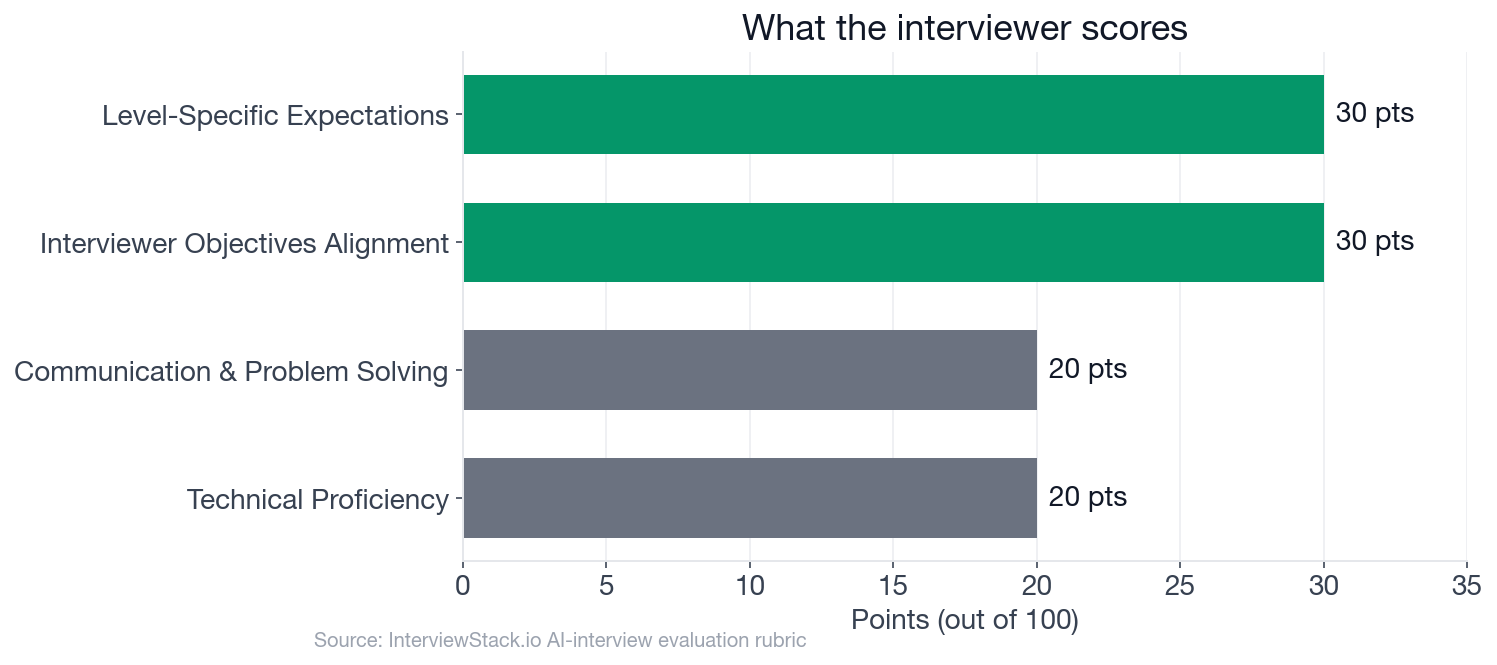
The four scoring dimensions and their weights. Objectives alignment and level expectations together account for 60 of the 100 available points.
The interview question
Walk me through one significant full-stack project you personally drove end-to-end, and explain how you designed and implemented it across the frontend, backend, and data layers, including the key trade-offs you made and the impact it had.
The interviewer's objective is precise: evaluate whether you can communicate end-to-end ownership of a real project, explain architecture decisions across all three layers, justify trade-offs at a mid-level scope, and connect technical decisions to practical impact on performance, scalability, reliability, or user experience. The session has four phases to probe exactly this, with follow-up questions designed to surface what the opening answer leaves vague.
The Full-Stack Project Experience Interview, Turn by Turn
Below is a walk through the four highest-signal turns in a 30-minute session. The mistakes are illustrative of common patterns, not a transcript of any real candidate.
Turn 1: Opening the Ownership Frame
Interviewer: "Walk me through one significant full-stack project you personally drove end-to-end."
Turn 2: The Technical Decision Probe
Interviewer: "What was the most important technical decision you made on that project, and what alternatives did you consider before choosing that approach?"
Turn 3: The Impact Verification
Interviewer: "How did you measure success for the feature after launch, and what changed in user behavior, system performance, or team operations as a result?"
Turn 4: The 10x Scale Test
Interviewer: "If traffic or usage had grown 10x, which parts of your design would have held up and which parts would have needed to change first?"
Spotting It on the Page Is Not the Same Thing
Reading the four turns above, the correct moves feel obvious. That is the trap. In a live 30-minute interview you are watching the interviewer's expression, deciding whether to go deeper or move on, answering a follow-up you did not prepare for, and keeping track of remaining time, all at once. Ownership blur, vague impact statements, and all-or-nothing scalability answers surface under that pressure, not because candidates don't know the right approach, but because they have never rehearsed it live.
Reps are the only fix. Not reading more coaching notes: actually forming an answer to an unscripted follow-up, hearing yourself blur "I" and "we," and getting scored on it in real time.
The Complete Blueprint
This is the exact structure the AI mock interview tracks you against in real time. A strong 30-minute full-stack project experience interview hits every phase and every checklist item below.
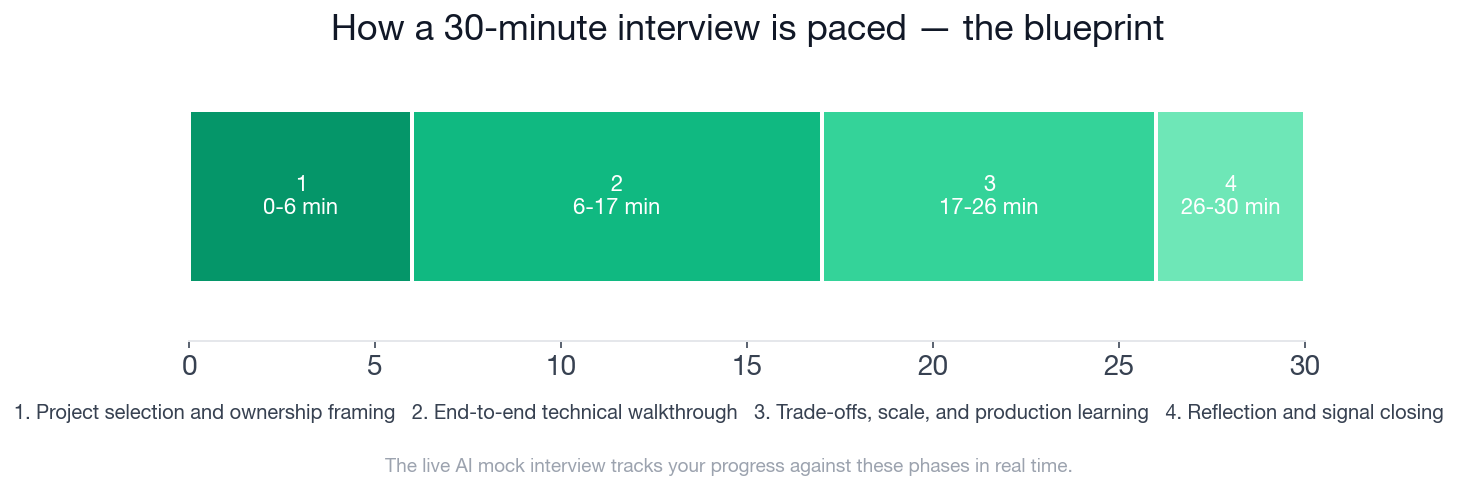
Phase timing for a 30-minute Full-Stack Developer Project Experience interview. Phase 2 (technical walkthrough, 6-17 min) carries the most checklist items; Phase 3 (trade-offs and scale, 17-26 min) carries the highest scoring density per minute.
- ✓Names a real project or feature with identifiable user/problem context
- ✓States what the system or feature did in one or two concise sentences
- ✓Clearly distinguishes 'I owned' from 'the team owned'
- ✓Mentions at least one success metric or intended outcome
- ✓Explains the frontend stack and why it was appropriate for the feature
- ✓Describes key UI flows, component/state decisions, or rendering/data-fetching patterns they implemented
- ✓Explains the backend service or API shape with enough detail to understand request flow
- ✓Identifies the database or storage solution used and the reason it fit the access pattern
- ✓Shows understanding of integration points between layers, such as contracts, validation, or error handling
- ✓Keeps the explanation grounded in concrete implementation details instead of only naming technologies
- ✓Describes at least one non-trivial trade-off and why it was reasonable at the time
- ✓Connects a technical decision to a measurable outcome such as latency, engagement, conversion, or error reduction
- ✓Identifies a bottleneck, failure mode, or edge case encountered in production
- ✓Explains a debugging process with signals used, not just the final fix
- ✓Can reason about what would break or need redesign under significantly higher traffic or usage
- ✓Articulates one thing they would redesign or reprioritize now
- ✓Explains why that choice was not made originally given time, scope, or team constraints
- ✓Shows balanced judgment rather than claiming the project was flawless
Ready to Practice the Live Version?
The blueprint above is exactly what the AI mock interview for Full-Stack Developer Project Experience scores you against in real time. It runs the full 30-minute session, fires unscripted follow-up questions across all four phases, and gives you dimension-level feedback at the end showing where ownership framing, technical depth, and impact articulation cost you points.
For focused drilling before a full session, the Full-Stack Developer question bank has targeted practice on ownership framing, architecture walkthroughs, and trade-off reasoning organized by topic. You can also explore company-specific preparation guides to calibrate how deeply different companies probe project depth at the mid-level.
FAQ
Q. What does a mid-level full-stack developer project interview cover?
The interview runs 30 minutes across four structured phases: project selection and ownership framing (0-6 min), an end-to-end technical walkthrough of frontend, backend, and data layers (6-17 min), trade-offs and production learning (17-26 min), and a reflection close (26-30 min). The interviewer scores on four dimensions worth 100 points total: Interviewer Objectives Alignment (30 pts), Level-Specific Expectations (30 pts), Technical Proficiency (20 pts), and Communication and Problem Solving (20 pts).
Q. How is the full-stack project experience interview scored?
Four dimensions sum to 100 points: Interviewer Objectives Alignment (30 pts) measures whether you address the core problem end-to-end; Level-Specific Expectations (30 pts) assess mid-level ownership depth without requiring staff-level architecture; Technical Proficiency (20 pts) covers accuracy of design choices across layers; and Communication and Problem Solving (20 pts) covers clarity, structure, and handling ambiguity.
Q. What is the most common mistake in a full-stack project walkthrough interview?
Using "we" throughout without separating personal contribution from team effort. This directly misses a Level-Specific Expectations checklist item, costing up to 30 points. Interviewers are explicitly assessing whether a mid-level candidate can clearly distinguish "I owned" from "the team owned" and connect personal decisions to measurable outcomes.
Q. How should you describe your project architecture in the interview?
Cover all three layers with enough concrete detail to understand request flow: explain the frontend stack and why it fit the feature, describe the API shape and request-handling logic you personally wrote, identify the database or storage solution and why it fit the access pattern, and show how the layers connect through contracts, validation, or error handling. Name technologies only as support for decisions, not as a substitute for them.
Q. How long is a full-stack project experience interview?
30 minutes, divided into four phases. The technical walkthrough (6-17 min) is the longest at 11 minutes and is where most points are won or lost. The trade-offs and production learning phase (17-26 min) is the second-longest at 9 minutes and probes engineering judgment under realistic constraints.
Q. What does end-to-end ownership mean at the mid-level?
At the mid-level, end-to-end ownership means personally driving a feature or project slice across frontend, backend, and data layers, with clear accountability for implementation decisions, not multi-year platform architecture. You should be able to describe specific APIs, component design, database queries, testing, and rollout choices you made, while crediting collaborators for their parts without blurring the line.
Q. How can I practice for a full-stack project walkthrough interview?
Run live mock interviews on the InterviewStack.io platform. The AI mock interview for Full-Stack Developer Project Experience uses the same 30-minute blueprint with real follow-up questions across all four phases and scores each answer against the four-dimension rubric in real time. The question bank also contains focused drills on ownership framing, architecture walkthroughs, and trade-off reasoning.
Start With a Rep, Not a Rehearsal
The single highest-leverage thing you can do before a full-stack project interview is to hear your own ownership blur out loud, under time pressure, with a follow-up question you did not expect. That is what reps build that notes cannot. Start the AI mock interview now and find out exactly where the gap is.
Topics
Ready to practice?
Put what you've learned into practice with AI mock interviews and structured preparation guides.