
The Short Answer
Engineering Manager earns $25,800 more per year at the US median and has 18% more active postings. The complication: DevOps Engineer has five skills that appear in over half of all postings, a well-defined technical vocabulary with a clear mastery bar. Engineering Manager has no skill above 21%. These two roles share only 30% of their top-30 skill profile despite appearing in the same technical contexts.
| Engineering Manager | DevOps Engineer | |
|---|---|---|
| Median US salary | $180,800 | $155,000 |
| Active postings | 8,666 | 7,362 |
| Highest-frequency skill | Automation (21%) | CI/CD (65%) |
| Remote share | 17% | 22% |
| Entry-level share | 4% | 2% |
| Skill overlap (Jaccard) | 30% shared | n/a |
Technical Expertise Has Its Price. So Does Managing It.
DevOps Engineer is one of the most technically explicit roles in software. Five skills appear in over half of all postings: CI/CD (65%), Automation (55%), AWS (52%), Kubernetes (51%), and Python (51%). The role has a well-defined vocabulary, a learnable tool stack, and a clear expertise ladder. Engineering Manager has none of that precision. Its highest-frequency individual skill, Automation, appears in just 21% of postings. The profile shifts depending on what kind of engineering team the manager leads, because EM is hired from many different technical backgrounds.
Despite that, Engineering Manager earns $25,800 more at the US median. That gap reflects organizational authority: EMs own hiring decisions, delivery accountability, and team health for an entire engineering domain. We analyzed 8,666 active Engineering Manager and 7,362 active DevOps Engineer postings from the InterviewStack.io job board as of June 2026. The Jaccard overlap between the roles is 30%, meaning they share roughly 3 in 10 skills despite overlapping vocabulary. One dataset caveat worth noting: the Engineering Manager category on this job board captures engineering management roles across industries (software, hardware, aerospace, and industrial sectors all use this title). This breadth suppresses skill-frequency benchmarks (non-tech EMs don't list cloud or container requirements) and blends salary data with a wider population than software-only EM roles. DevOps Engineer is a software-specific role, so the comparison is approximate at the extremes.
Key Findings
- Engineering Manager: 8,666 active postings, median US base salary $180,800 (n=2,120 with salary disclosed).
- DevOps Engineer: 7,362 active postings, median US base salary $155,000 (n=1,227); the gap is $25,800 (17%).
- DevOps has 5 skills above 50% of postings: CI/CD (65%), Automation (55%), AWS (52%), Kubernetes (51%), Python (51%). Engineering Manager has zero above 21%.
- Skill overlap: 30% Jaccard. These roles share vocabulary, not specialization.
- Engineering Manager is 60% onsite; DevOps is 50% onsite with more remote flexibility (22% remote vs. 17%).
- Entry bar: 4% entry-level for EM, 2% for DevOps. Both are experience-heavy markets with thin entry-level pipelines.
- AI/ML skills carry large premiums above already-high baselines: EM Machine Learning postings median $224,300 (+$43,500 above $180,800), DevOps MLOps postings median $183,700 (+$28,700 above $155,000).
- EM dataset scope: Engineering Manager postings span software, hardware, aerospace, and industrial sectors. Skill frequencies and the $180,800 salary figure reflect this cross-industry blend; DevOps Engineer is a software-specific role.
What Do These Roles Actually Do?
Engineering Managers run the human system. A typical week involves one-on-ones, design and code reviews, sprint planning, cross-functional alignment with product and operations, and recruiting. EMs carry deep technical credibility, usually earned from several years as a senior or staff engineer, but they are no longer writing most of the code. The job is to multiply the team's output, remove blockers, and make hiring and architectural decisions that outlast any individual sprint.
DevOps Engineers run the delivery system. They build and maintain CI/CD pipelines, manage container orchestration in Kubernetes, provision and automate cloud infrastructure (typically via Terraform, an infrastructure-as-code tool), and own the monitoring and alerting that tells the rest of the team when production is unhealthy. They are the first call when a deployment breaks or an alert fires overnight. The work is deeply operational, and the stakes are immediate.
What Skills Do Both Roles Share?
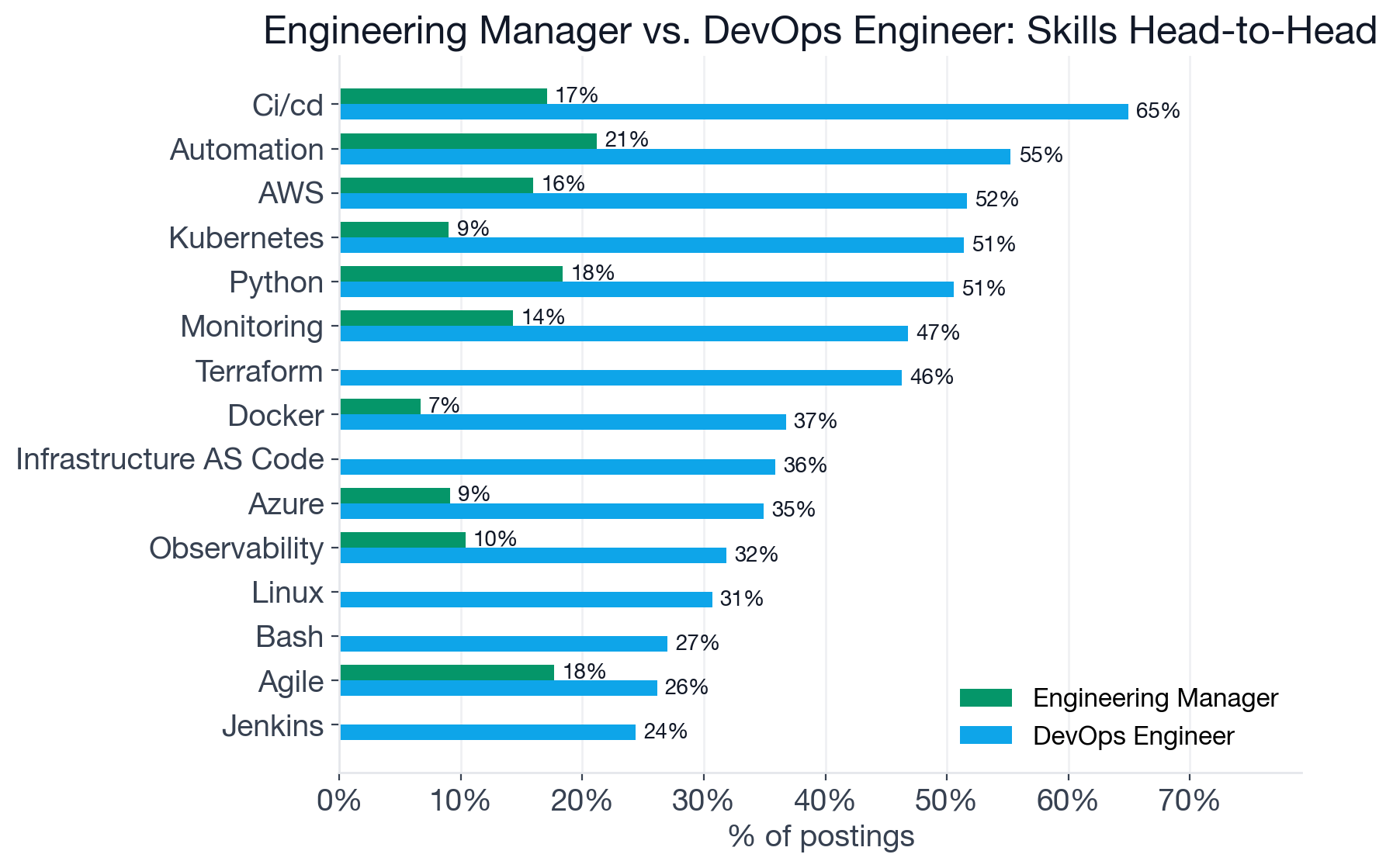
Top skills for Engineering Manager (teal) and DevOps Engineer (blue) by share of postings. The shared bars reveal how differently each role applies the same vocabulary.
Fourteen skills appear in both roles' top-30 lists: CI/CD, Automation, Python, AWS, Monitoring, Kubernetes, Azure, Agile, Docker, Observability, Scalability, Google Cloud, Java, and SQL. But shared vocabulary does not mean shared intensity. CI/CD appears in 65% of DevOps postings and 17% of Engineering Manager postings. Python appears in 51% of DevOps postings and 18% of EM postings. Kubernetes appears in 51% of DevOps postings and 9% of EM postings.
For a career switcher already fluent in cloud, containers, or CI/CD tooling, the skills transfer in concept. In practice, DevOps demands depth that EM postings do not require: configuring Helm charts (a Kubernetes package manager), scripting in Bash, or debugging container networking is expected for DevOps and largely optional for EM.
The Operations Layer Sets DevOps Apart
DevOps has ten skills that appear frequently but have almost no footprint in Engineering Manager postings: Terraform (46% of DevOps postings), Infrastructure as Code (36%), Linux (31%), Bash (27%), Jenkins (24%), Ansible (23%), Gitlab (21%), Grafana (20%), Prometheus (19%), GitHub Actions (18%). These form a complete infrastructure and automation toolkit. If you hold this stack fluently, you speak DevOps natively. If you do not, Python and AWS experience alone does not compensate.
Engineering Manager's exclusive cluster is thinner: APIs (10%), React (9%), Distributed Systems (9%). Distributed Systems and APIs are the cleaner signals of technical leadership context. React at 9% likely reflects a mix of EMs leading frontend teams and some cross-role noise in the dataset (IC frontend developers occasionally surface in this category). The marker of EM is not a specific framework but architectural fluency across whatever stack the team owns.
One split involves AI. Job postings explicitly flag AI requirements for only a sliver of each role: ML appears in 5.8% of EM postings, and MLOps and AI/ML signals sit below DevOps's top-30 threshold. Neither number captures the ambient reality. Annual developer surveys consistently report that the large majority of engineers now use AI coding tools regularly, making ambient AI usage a baseline expectation for both roles regardless of posting language. For DevOps specifically, AI-powered operations tooling (AIOps) is becoming mainstream: automated anomaly detection, predictive alerting, and AI-assisted incident response are now standard features of observability platforms. For EMs, the story is similar: managing an AI-augmented team is now a core part of the job, even when the posting does not say so.
Which Role Pays More: Engineering Manager or DevOps Engineer?
All figures below are US base salary only (where wage-transparency laws produce consistent disclosure). Equity, RSUs, bonuses, and sign-on are not captured in posting salary data, so total compensation at top employers runs meaningfully higher than what we report here.
Engineering Manager baseline: $180,800 median (n=2,120). DevOps Engineer baseline: $155,000 (n=1,227). The $25,800 gap holds before examining any individual skill premium. The EM figure blends engineering management roles across software, hardware, and industrial sectors; software-only EMs at tech companies are not separately broken out in this dataset. DevOps Engineer is a software-specific role, so interpret the gap as directionally correct rather than a precision figure.
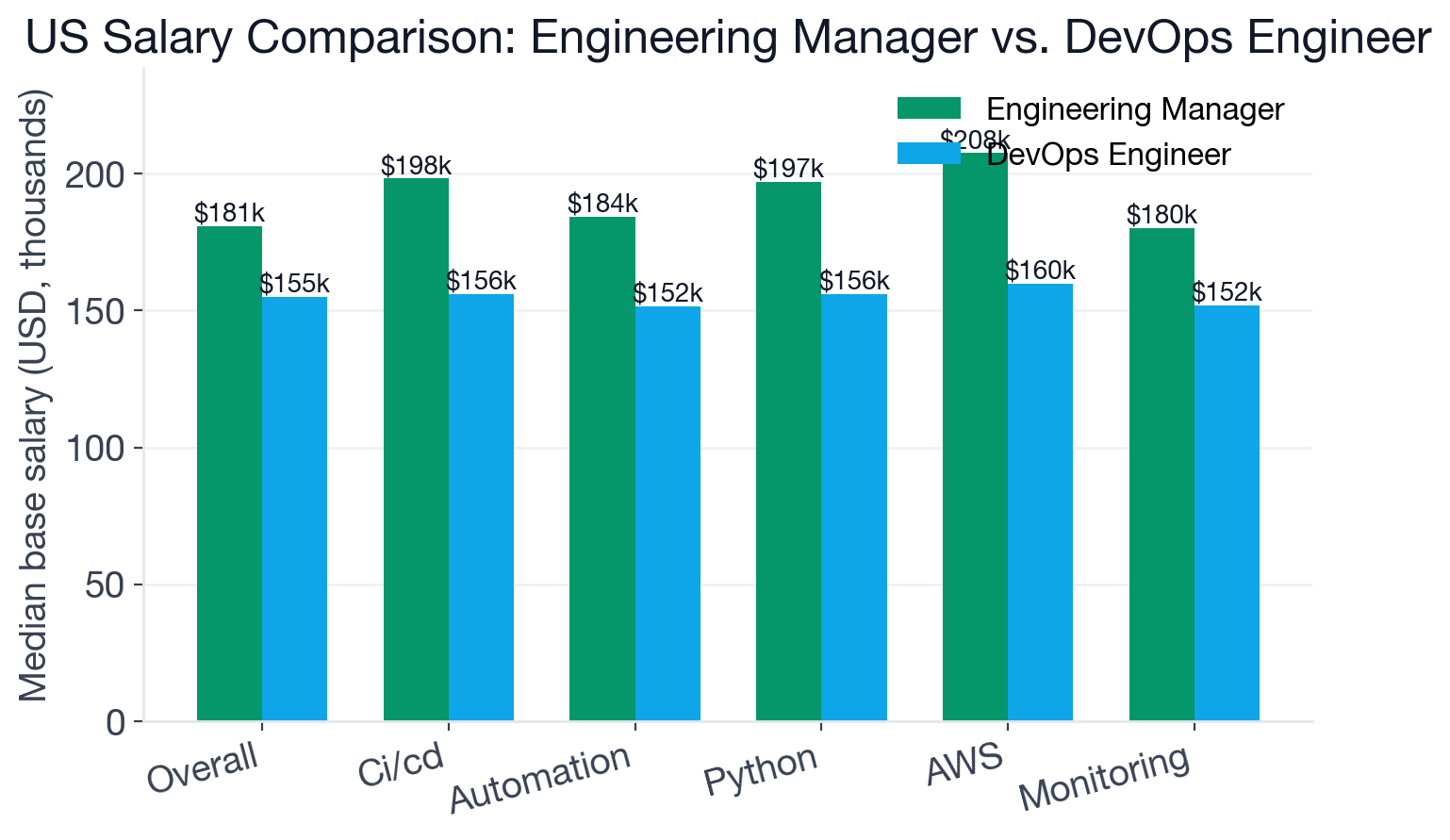
Median US base salary for Engineering Manager and DevOps Engineer, overall and for selected shared skills. Engineering Manager commands higher pay at the baseline and at every shared-skill tier.
Differentiator skills extend the gap further. For Engineering Managers: Distributed Systems ($232,700, a $51,900 premium over baseline), Machine Learning ($224,300, +$43,500), and Kubernetes ($219,500, +$38,700) represent the highest-paying skill adjacencies. For DevOps Engineers: Pulumi ($195,000, a $40,000 premium, n=36), Machine Learning ($191,500, +$36,500), and MLOps ($183,700, +$28,700) mark the ceiling. An ML-adjacent EM clears $224K at the median; an ML-adjacent DevOps engineer reaches $191K. The gap widens at the top, not just the middle.
Which Has More Openings?
Engineering Manager has 8,666 active postings vs. 7,362 for DevOps, a 1.18 ratio. Neither role has a meaningful entry-level tier: 4.2% of EM postings (roughly 363) and 2.1% of DevOps postings (roughly 154) are explicitly entry-level.
Seniority shapes differ significantly. Engineering Manager concentrates at mid-level (63%) with a notable staff and director layer (18%). DevOps has heavier senior concentration: 30% of its postings are senior-level, vs. 15% for EM. If you are targeting senior DevOps Engineer roles, you are competing for over 2,200 postings, but against a field where deep hands-on expertise is expected at each level.
Geography also diverges. Engineering Manager is US-concentrated: 43% of postings are in the US, 12% in India. DevOps is more globally distributed: US at 30%, India at 14%. The EM salary figures above represent a wider sample of the actual market.
Which Should You Choose?
Choose Engineering Manager if you:
- Already have 5+ years as a senior engineer and find yourself naturally coaching, unblocking, and driving team decisions
- Value organizational impact over a pure technical specialty and are comfortable with a people-first daily rhythm
- Are primarily targeting US roles (43% of postings) and can work mostly onsite (60%)
- Want the higher salary ceiling: EM earns $26K more at the median, with AI/ML and distributed-systems adjacency pushing senior EMs toward $220K-$235K
Choose DevOps Engineer if you:
- Want a precisely defined, learnable technical stack: CI/CD, Kubernetes, Terraform, Linux, monitoring, and scripting
- Prefer more remote flexibility (22% remote vs. 17% for EM) and value a globally distributed job market
- Are transitioning from sysadmin, cloud infrastructure, or platform engineering work
- Understand the entry bar is strict (2% entry-level): most DevOps engineers route through cloud or IT operations roles first to build Kubernetes and infrastructure-as-code fundamentals
To assess your readiness, AI mock interviews cover both engineering leadership scenarios (for the EM track) and infrastructure design questions (for the DevOps track). The question bank lets you drill Kubernetes, system design, distributed systems, and CI/CD topics before applying.
FAQ
Q. Which pays more, Engineering Manager or DevOps Engineer?
Engineering Manager pays more. The median US base salary for Engineering Manager postings is $180,800 (n=2,120) vs. $155,000 for DevOps Engineer (n=1,227), a $25,800 gap. These are base salaries only; equity and bonus are not reflected. Note that the EM figure blends engineering management roles across industries (software, hardware, aerospace); DevOps is a software-specific role, so the comparison is directional rather than exact.
Q. What skills do Engineering Manager and DevOps Engineer share?
CI/CD, Automation, Python, AWS, Monitoring, Kubernetes, Azure, Agile, Docker, Observability, Scalability, Google Cloud, Java, and SQL appear in both roles' top-30 skill lists. The catch: frequencies differ sharply. CI/CD appears in 65% of DevOps postings but only 17% of Engineering Manager postings.
Q. How do the skill requirements differ between Engineering Manager and DevOps Engineer?
DevOps Engineer has five skills above 50% of postings: CI/CD (65%), Automation (55%), AWS (52%), Kubernetes (51%), and Python (51%). Engineering Manager has no single skill above 21%. The roles share vocabulary but at very different intensities.
Q. Which role is easier to break into?
Engineering Manager skews slightly more accessible at 4.2% entry-level vs. 2.1% for DevOps Engineer, though both are experience-heavy markets. EM hiring is heavily mid-level (63%); DevOps has a larger senior tier at 30% vs. 15% for EM.
Q. Which role offers more remote work flexibility?
DevOps Engineer is modestly more remote-friendly: 22% of DevOps postings are remote vs. 17% for Engineering Manager. Hybrid is 33% for DevOps vs. 26% for EM. Engineering Manager postings are 60% onsite, reflecting the in-person demands of people management.
Q. How is AI changing Engineering Manager and DevOps Engineer roles?
Job postings explicitly mention AI requirements for a small share of each role (ML appears in 5.8% of EM postings; MLOps and AI/ML skills appear sub-threshold in DevOps but carry a $28,700 salary premium). Annual developer surveys consistently report that the large majority of engineers now use AI coding tools regularly, making ambient AI usage a baseline for both roles regardless of posting language. For DevOps specifically, AI-powered operations tooling (AIOps) is becoming a mainstream practice, with automated anomaly detection and AI-assisted incident response now standard in major observability platforms.
Where to Start
Both markets are healthy. Engineering Manager's $181K median and people-leadership scope suit engineers ready to move off the IC track; DevOps's precise tool stack and more remote-friendly footprint suit those who want to go deep on infrastructure. Browse active Engineering Manager openings and DevOps Engineer openings on the InterviewStack.io job board to see the real distribution of current openings by skill, seniority, and location.
Topics
Ready to practice?
Put what you've learned into practice with AI mock interviews and structured preparation guides.