
The Turn Most Candidates Miss
Six minutes into a 30-minute Engineering Manager interview, you have laid out the facts: an engineer eight months in, missed delivery commitments, avoidable production incidents, peers routing around them. The interviewer asks how you would handle this from the first sign of a pattern.
Most mid-level EM candidates answer by describing their first 1:1. Clear feedback. Behavior-based examples. Supportive tone. It sounds right. It also skips the first eight minutes of the blueprint, the phase where the rubric decides whether you understand performance management or just know how to give feedback.
Interviewer Objectives Alignment (30 pts) and Level-Specific Expectations (30 pts) together represent 60 of 100 rubric points. Both are scored primarily on how you frame and diagnose the problem before you act. Candidates who jump straight to the feedback conversation surrender those points before the follow-up questions even start.
Key Findings
- The 30-minute interview has 4 phases; Phase 1 (diagnosis, 0-8 min) and Phase 2 (feedback and improvement plan, 8-18 min) cover 18 of 30 minutes and set the majority of the score.
- Interviewer Objectives Alignment (30 pts) and Level-Specific Expectations (30 pts) total 60 of 100 rubric points, both evaluated primarily on diagnostic framing.
- The Level-Specific Expectations rubric names 4 common EM mistakes: waiting too long, being too vague, over-indexing on empathy without accountability, and moving to punitive action before diagnosis.
- A mid-level EM is expected to separate at least 4 problem types: skill deficiency, execution inconsistency, communication gaps, and behavioral concerns.
- Phase 3 (accountability and documentation, 18-26 min) requires knowing specifically what to document and when to involve HR, not just "keep notes."
- Phase 4 (decision-making, 26-30 min) requires at least 2 plausible outcome paths and willingness to name the hard call.
- Communication and Problem Solving (20 pts) is measured on structure, handling ambiguity, and receptiveness to follow-up probes across all 4 phases.
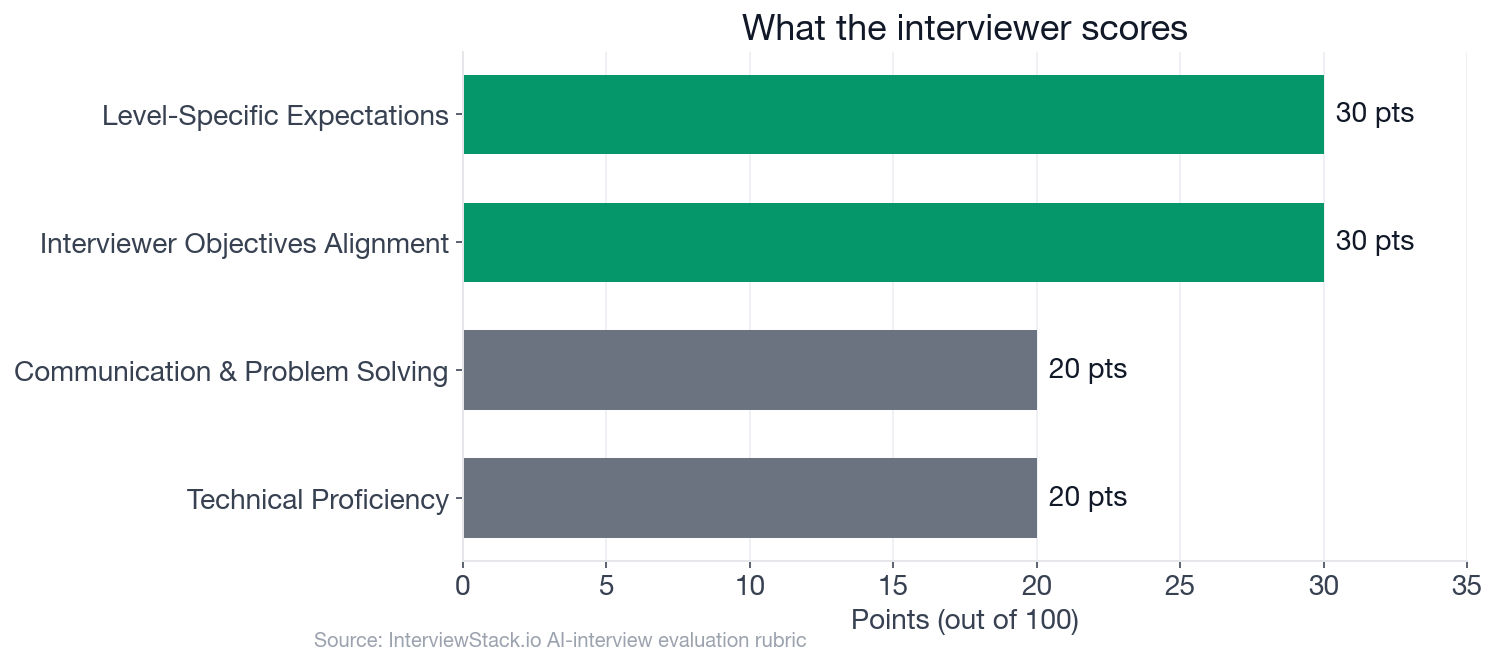
Diagnosis and seniority signals together account for 60 points. The two lower-weighted dimensions (Technical Proficiency and Communication) are still meaningful, but a weak Phase 1 cannot be recovered by being articulate in Phase 3.
What the Engineering Manager Performance Management Interview Actually Tests
The scenario places you as the manager of a 7-person team with quarterly roadmap commitments and an on-call rotation. One engineer eight months in has become a delivery and reliability risk.
The interview question
You manage a team of 7 engineers working on a customer-facing platform with quarterly roadmap commitments and an on-call rotation. One engineer, who joined 8 months ago, has recently missed multiple delivery commitments, introduced a few avoidable production issues, and peers have started routing around them during cross-functional work. The engineer is well-liked, but team confidence in their reliability is dropping. You have 30 minutes to walk me through how you would handle this situation as their manager.
How would you approach this situation from the moment you first notice the pattern through the likely outcomes over the next several weeks?
The interviewer is probing whether you diagnose the problem type before acting, whether you balance support with real accountability, how you partner with HR, and how you protect the team's delivery and morale throughout. Practice this exact scenario in the AI mock interview for Engineering Manager Performance Management before you face it live.
The Walkthrough: Four Turns That Decide the Score
Turn 1: What Kind of Problem Is This?
Interviewer: "How would you determine whether this is a performance issue, a capability gap, or a problem caused by unclear expectations or team process?"
Turn 2: The Feedback Conversation
Interviewer: "What would you say in your first direct conversation with the engineer, and how would you structure the feedback?"
Turn 3: When Documentation Becomes Formal
Interviewer: "At what point would you start documenting more formally or involve HR or your manager, and what would you document?"
Turn 4: The Hard Call
Interviewer: "If the engineer improves somewhat but remains inconsistent, how would you decide between continued coaching, changing scope, or moving to a formal performance plan?"
Knowing This Is Not the Same as Doing It
Spotting these mistakes on the page is easy. Avoiding them live, with a real clock running, an unscripted follow-up in front of you, and the pull toward safe-sounding empathy, is a different skill. That gap only closes through reps.
The AI mock interview for Engineering Manager Performance Management and Feedback runs you through this exact scenario with live follow-ups and scores you against all four rubric dimensions when you finish. If you want to drill individual questions first, the Performance Management and Feedback question bank has the full set. For company-specific interview prep, the Engineering Manager preparation guides cover what different employers emphasize in people-management rounds.
The Complete Blueprint
This is the blueprint a strong candidate hits across the full 30 minutes, and exactly what the AI mock interview tracks you against in real time.
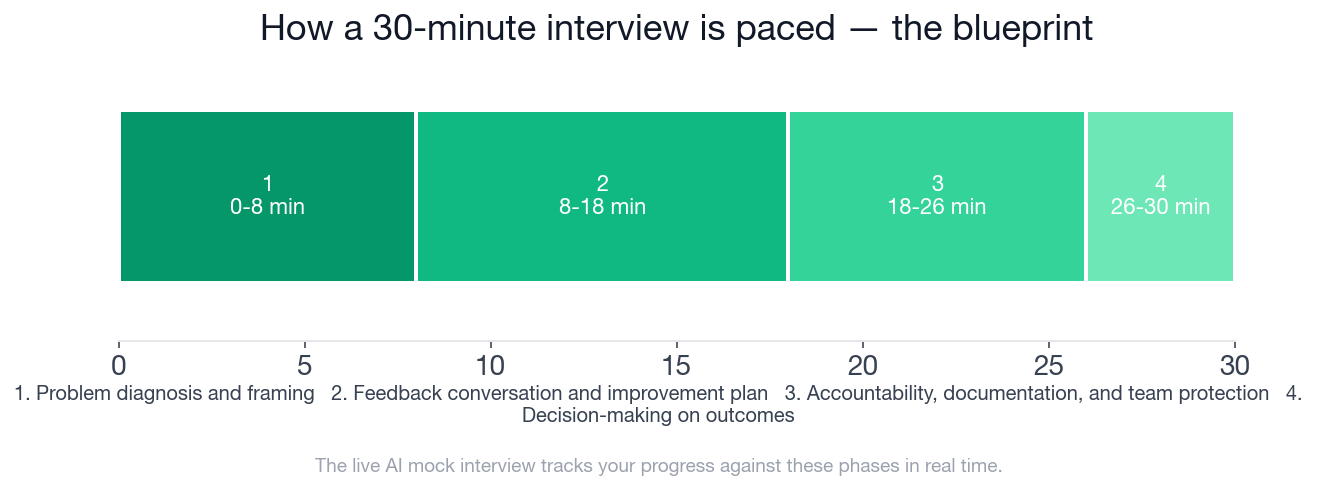
Phases 1 and 2 cover 18 of 30 minutes and determine the majority of rubric scoring. Phase 3 is 8 minutes of accountability and documentation judgment. Phase 4 is 4 minutes: the candidates who have done the work earn their score here by naming the hard call clearly.
- ✓States they would validate the pattern using concrete examples across delivery, quality, incidents, and collaboration
- ✓Looks for context such as tenure, onboarding quality, scope difficulty, changing expectations, and dependency issues
- ✓Separates skill deficiency, execution inconsistency, communication gaps, and behavioral concerns instead of treating all as the same problem
- ✓Identifies impact on roadmap predictability, on-call risk, and peer trust
- ✓Describes a timely 1:1 conversation with clear, behavior-based feedback and examples
- ✓Explains expectations in concrete terms such as meeting commitments, proactively flagging risk, improving review quality, or reducing repeated production mistakes
- ✓Includes support actions such as tighter check-ins, mentorship, pairing, narrower scope, training, or clearer milestones
- ✓Defines a reasonable review window over several weeks with specific checkpoints rather than vague 'let's see improvement'
- ✓Invites the engineer's perspective and tests for hidden issues while still maintaining accountability
- ✓Explains what they would document: examples, expectations communicated, support provided, follow-up notes, and progress against goals
- ✓Knows when to involve HR or a skip-level, especially if there is sustained underperformance, fairness risk, or likely formal action
- ✓Describes temporary adjustments to scope, code review safeguards, or on-call support to reduce business risk without isolating or humiliating the engineer
- ✓Addresses team trust carefully through operational changes and private coaching, not by disclosing confidential performance details
- ✓Articulates at least two plausible outcomes: successful improvement, partial improvement requiring scope change or extended coaching, or transition to formal PIP
- ✓Uses consistency over time, not one good week, as the basis for decision-making
- ✓Shows willingness to make a hard call if support has been provided and expectations remain unmet
FAQ
Q. How long is the Engineering Manager performance management interview?
The standard format runs 30 minutes across 4 phases: problem diagnosis and framing (0-8 min), feedback conversation and improvement plan (8-18 min), accountability, documentation, and team protection (18-26 min), and decision-making on outcomes (26-30 min).
Q. What does the rubric score in this interview?
The 100-point rubric has four dimensions: Interviewer Objectives Alignment (30 pts), Level-Specific Expectations (30 pts), Technical Proficiency (20 pts), and Communication and Problem Solving (20 pts). The first two dimensions together account for 60 points and are both evaluated primarily on how the candidate diagnoses and frames the performance problem.
Q. What is the biggest mistake candidates make in EM performance management interviews?
Skipping the diagnosis phase. Most candidates jump straight to the feedback conversation without first separating whether the problem is a skill gap, unclear expectations, role mismatch, or behavioral issue. This costs points in both Interviewer Objectives Alignment and Level-Specific Expectations, which together represent 60 of 100 rubric points.
Q. When should a mid-level EM involve HR in a performance case?
A mid-level EM should involve HR when underperformance is sustained beyond the informal coaching window, when fairness or equity risk exists, or when the situation is likely to move toward formal action. Looping in HR proactively for documentation and process guidance is a sign of good judgment, not weakness, and the rubric scores it as such.
Q. What does a strong improvement plan look like in this interview?
A strong improvement plan includes behavior-based feedback with specific examples, concrete expectations (meeting commitments, flagging risk proactively, reducing production incidents), defined support (tighter check-ins, narrower scope, pairing), and a review window of several weeks with named checkpoints, not a vague 'let's see how it goes.'
Q. How do you protect team morale while managing an underperformer?
The rubric expects temporary scope or process adjustments (extra code review, adjusted on-call load) to reduce business risk, while handling team trust through operational changes and private coaching rather than disclosing confidential performance details. Morale is protected through clarity and follow-through, not avoidance.
Q. What is the bar for a mid-level Engineering Manager in this interview?
A mid-level EM is expected to run a straightforward individual-contributor performance case: timely feedback, concrete expectations, consistent follow-up, and knowing when to involve HR. They are not expected to design org-wide performance systems or navigate complex legal cases. Solid execution for one person on one team is the standard.
One Rep Changes the Pattern
Reading these mistakes is useful preparation. What the interview actually tests is pattern recognition under pressure: noticing when you skipped diagnosis, catching when empathy ran ahead of accountability, landing the hard call without a script in front of you. That is a practiced skill, not a read one. Start the AI mock interview for Engineering Manager Performance Management and Feedback and find out exactly where your gaps are before the real one counts.
Topics
Ready to practice?
Put what you've learned into practice with AI mock interviews and structured preparation guides.