
Embedded Is No Longer Just a C++ Job
For most of its history, embedded development was synonymous with C and C++. You wrote tight, deterministic code with no operating system, counted clock cycles, and owned every byte of RAM. Python was what your web-developer colleagues used.
In 2026, that picture has shifted. We analyzed 2,821 active Embedded Developer postings on the InterviewStack.io job board and found Python mentioned in 37% of postings: statistically identical to C++ at 37%. For the first time in any dataset we have run for this role category, the two languages are tied. The assumption that C++ is the defining language of embedded work is no longer accurate at the market level.
This does not mean C++ has faded. It means Python has arrived, and it arrived for the automation, scripting, and AI-inference layers that sit above the hardware, not in place of C++. The salary data confirms which layer is being rewarded: skills at the AI and performance-engineering intersection command about $35,500 above the role's $157,500 US median, a premium that places AI-intersection embedded work among the highest-paying sub-specializations in the engineering market.
Key Findings
- 2,821 active Embedded Developer postings analyzed as of June 2026 on the InterviewStack.io job board.
- No skill clears the 50% table-stakes threshold. The top skill, Firmware, appears in 39% of postings. C++ and Python are tied at 37% each.
- Median US base salary is $157,500 (n=881 postings with US salary disclosed). Equity and bonus are excluded from posting data.
- AI and performance skills command a $35,500 premium: Computer Vision, Machine Learning, and Device Drivers all reach $193,000 in US median base salary.
- The hardware-protocol cluster is tightly coupled: I2C and SPI co-occur with a 4.81x lift, meaning a posting that asks for one is nearly five times more likely to ask for the other.
- Entry-level demand is scarce: only 4% of postings target junior engineers (113 of 2,821).
- 73% of postings are onsite, making embedded one of the most site-bound software engineering disciplines on the board.
- Aerospace, defense, and semiconductor firms dominate hiring: NVIDIA (82 openings), Anduril (69), Cisco (89 combined), Marvell (49), and SpaceX (35) rank among the top employers.
A note on dataset scope: the "Embedded Developer" classification captures firmware engineers, FPGA engineers, and some adjacent hardware engineering roles alongside the core title (different job titles companies use for closely related or overlapping work). The core embedded software skills (C++, firmware, communication protocols) show consistent demand across all segments in this dataset.
Which Skill Families Define Embedded Developer Work in 2026?
Embedded roles draw from a broader family tree than most software engineering titles. Grouping individual skills into higher-level categories shows the role's actual shape.
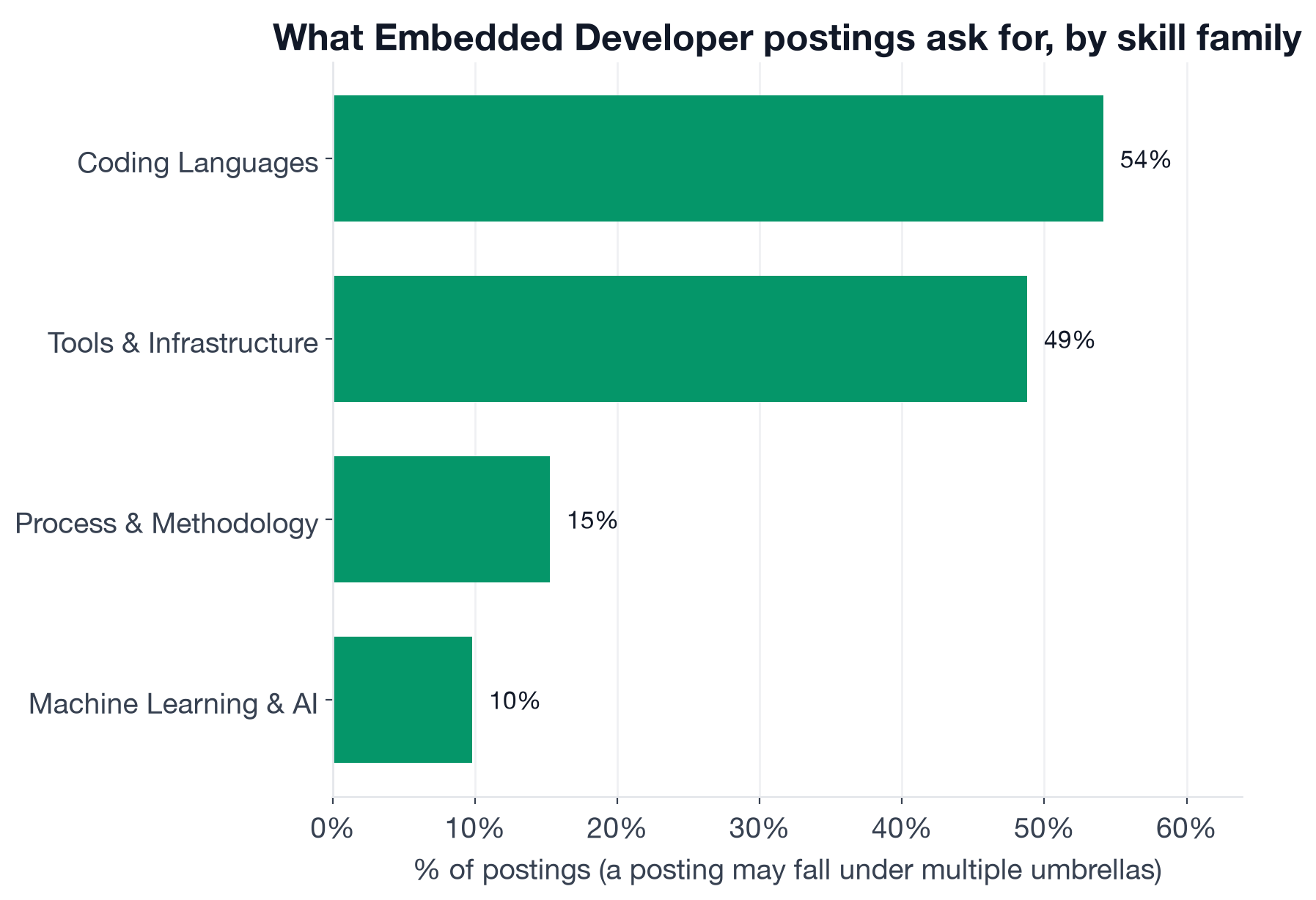
Share of Embedded Developer postings that ask for at least one skill in each family. A posting that mentions both C++ and Python counts once under "Coding Languages."
The "Other" umbrella covers 93% of postings because it contains the hardware-specific vocabulary that does not map cleanly to standard software categories: firmware, embedded systems, communication protocols, FPGA (Field-Programmable Gate Arrays, configurable hardware logic chips), debugging, and real-time operating systems. Everything distinctly embedded ends up here.
Below that:
- Coding Languages: 54% of postings (C++, Python, Bash, Rust)
- Tools & Infrastructure: 49% (Linux, automation tooling, Git, monitoring)
- Process & Methodology: 15% (Agile, project management)
- Machine Learning & AI: 10% (computer vision, on-device machine learning)
The 10% Machine Learning umbrella captures something specific: postings where an Embedded Developer is hired to deploy ML or computer vision on hardware, an explicitly specialized role in inference engines, ADAS systems, and robotics. The ambient AI layer is much wider. JetBrains' 2025 State of Developer Ecosystem survey found 85% of developers regularly use AI tools, and an April 2026 follow-up measured 90% using at least one at work. For embedded engineers specifically, that adoption follows a different pattern than in web or backend development. AI tools are used for documentation, boilerplate, and test scaffolding rather than for core firmware, because Copilot-generated C++ routinely uses dynamic memory allocation and exception handling that RTOS or bare-metal constraints rule out. Embedded engineers apply a correction pass that a web developer does not need. The explicit 10% measures who is building AI systems on hardware; the ambient 85-90% measures who is using AI tools to write the other 90% of their work faster.
The Skill Tiers: What Gets You Filtered In, What Gets You Paid
With no skill clearing the 50% table-stakes threshold, the tier structure here differs from most software roles. The "common" band (20-49%) functions as the de facto baseline. A large "differentiator" band (5-19%) spans hardware-protocol and systems depth that moves salary.
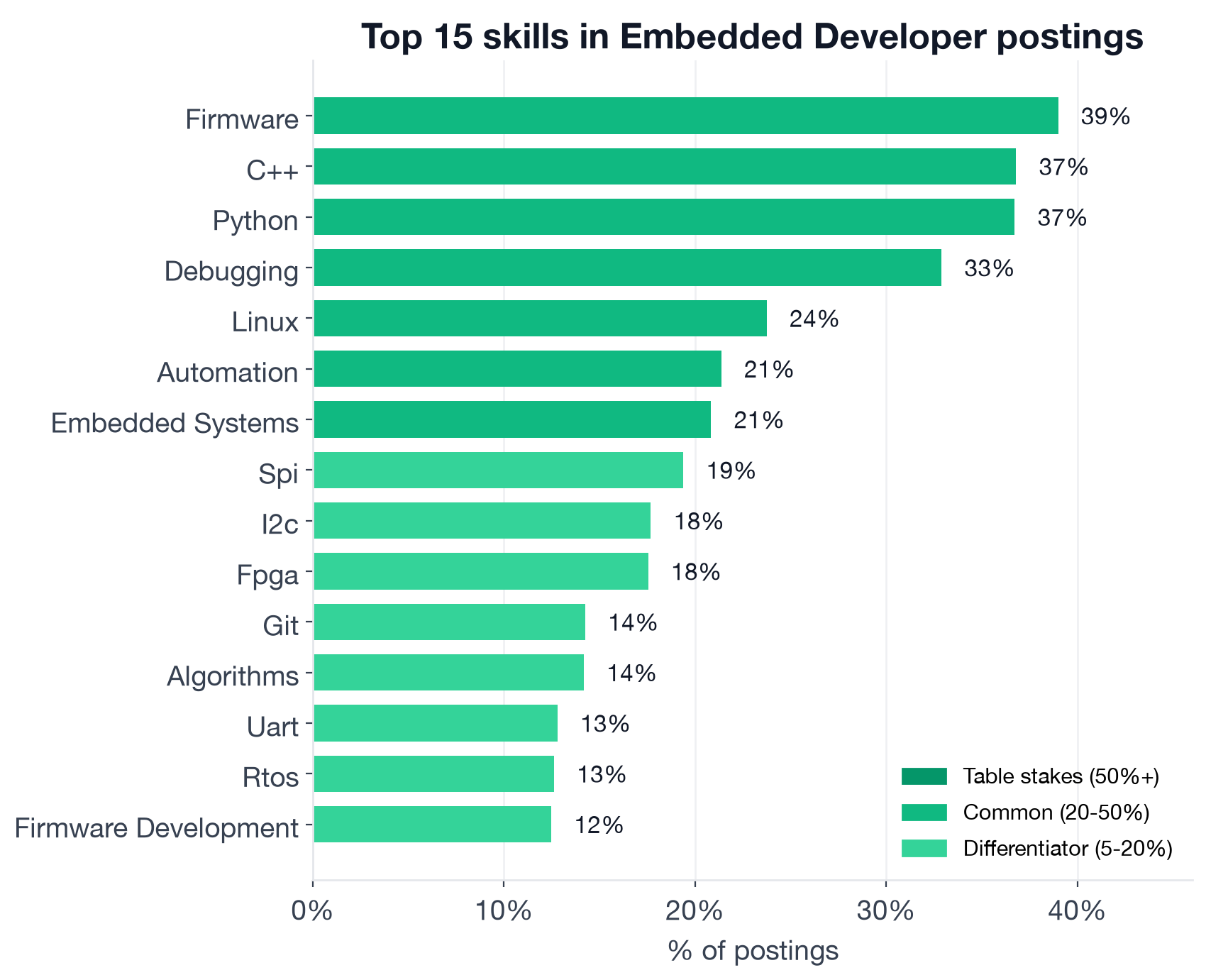
Top individual skills in Embedded Developer postings by share of listings. No skill clears 50%. Skills at 20-49% are "common"; 5-19% are "differentiators."
Common skills (20-49%), the de facto baseline:
- Firmware: 39% (Embedded Developer + Firmware openings)
- C++: 37% (Embedded Developer + C++ openings)
- Python: 37% (Embedded Developer + Python openings)
- Debugging: 33%
- Linux: 24%
- Automation: 21%
- Embedded Systems: 21%
Differentiator skills (5-19%), two distinct clusters:
Hardware-protocol and silicon layer:
- SPI (Serial Peripheral Interface, a short-distance synchronous serial bus used to connect sensors and peripherals): 19%
- I2C (Inter-Integrated Circuit, a two-wire serial protocol common in sensor communication): 18%
- FPGA: 18%
- UART (Universal Asynchronous Receiver-Transmitter, the hardware serial communication standard): 13%
- RTOS (Real-Time Operating Systems, which provide timing-deterministic scheduling for firmware): 13%
- Verilog (a hardware description language for programming FPGAs and ASICs): 10%
- Microcontrollers: 10%
- PCIe (Peripheral Component Interconnect Express, the high-speed bus standard common in servers and AI accelerators): 10%
Software and process layer:
- Git: 14%
- Algorithms: 14%
- Firmware Development: 12%
- MATLAB: 11%
- Agile: 10%
- CI/CD: 9%
- System Integration: 9%
- Embedded Linux: 8%
The two clusters point at two hiring segments within the "Embedded Developer" title. One is hardware-close work: bare-metal C++ communicating over SPI, I2C, and UART, FPGA programming in Verilog, and RTOS task scheduling. The other is firmware-adjacent systems work: Python automation, CI/CD pipelines, and integration of embedded subsystems into larger software stacks. The same employer often hires both profiles, but the interview will be very different depending on which cluster the role actually sits in.
Which Skills Add $35K to the Baseline?
Among US postings (where wage-transparency laws produce consistent salary disclosure), the median Embedded Developer base salary is $157,500 (n=881). Equity, bonuses, and RSUs are not included in posting data, so total compensation at top employers is meaningfully higher than these numbers.
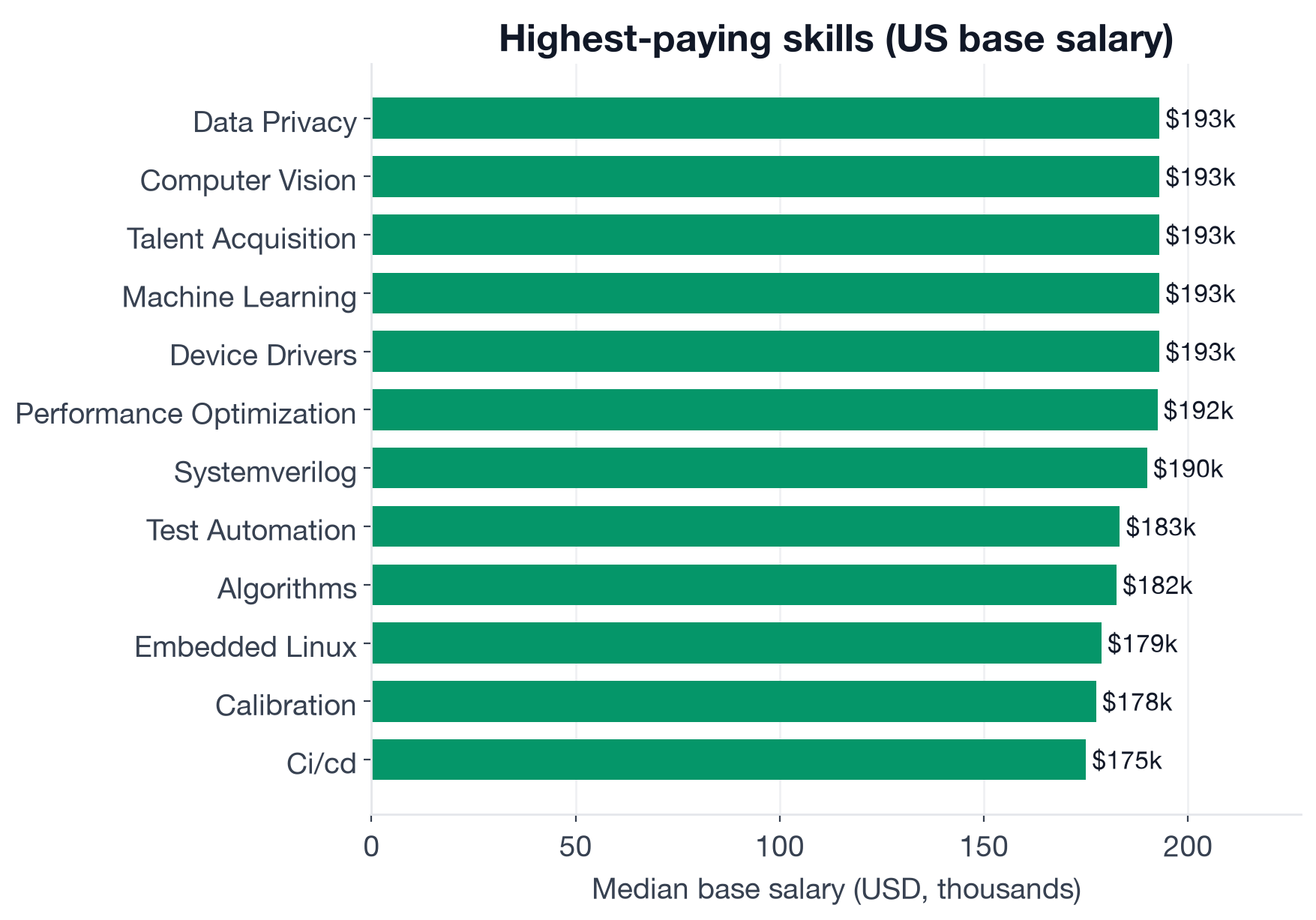
Median US base salary in USD for Embedded Developer postings that mention each skill, among postings with structured US salary data.
The top of the salary table belongs to two intersections: AI on hardware, and deep performance work.
$25K to $35K above baseline ($182K to $193K US base):
| Skill | US Median | Sample | Premium |
|---|---|---|---|
| Computer Vision | $193,000 | n=80 | +$35,500 |
| Machine Learning | $193,000 | n=46 | +$35,500 |
| Device Drivers | $193,000 | n=42 | +$35,500 |
| Performance Optimization | $192,500 | n=29* | +$35,000 |
| Algorithms | $182,500 | n=153 | +$25,000 |
*Small sample; treat as directional.
These are not generic embedded roles. Computer Vision and Machine Learning cluster in a specialist sub-market where the hardware boundary and the AI boundary converge: edge inference engines, ADAS, robotics vision systems. Device Drivers require deep kernel-level knowledge sitting at the intersection of OS engineering and embedded hardware; that combination is genuinely rare and commands a price to match.
$12K to $22K above baseline ($170K to $179K US base):
| Skill | US Median | Sample | Premium |
|---|---|---|---|
| Embedded Linux | $178,800 | n=76 | +$21,300 |
| CI/CD | $175,000 | n=77 | +$17,500 |
| Rust | $173,300 | n=36 | +$15,800 |
| PCIe | $172,000 | n=117 | +$14,500 |
| FPGA | $170,000 | n=219 | +$12,500 |
| RTOS | $170,000 | n=113 | +$12,500 |
The Embedded Linux premium ($178,800) reflects a product-facing tier: connected devices, automotive head units, industrial controllers that require software integration depth beyond the firmware layer. Rust's $173,300 comes from a small but growing segment concentrated in safety-critical and automotive work, where memory safety is becoming a compliance consideration.
Near or below baseline:
- C++: $165,000 (+$7,500 above baseline)
- Python: $164,800 (+$7,300 above baseline)
- Firmware: $164,600 (+$7,100 above baseline)
- MATLAB: $154,600 (about $2,900 below baseline)
- Microcontrollers: $157,500 (exactly at baseline)
- Agile: $148,900 (about $8,600 below baseline)
- Technical Documentation: $145,000 (about $12,500 below baseline)
The core takeaway: C++ and Python, despite being the two most commonly requested skills, add only $7K above the role baseline. The differentiation that moves the offer envelope is AI on hardware, device drivers, and systems-level specialization. Getting the common tier on your resume gets you to the interview; the differentiator tier gets you to the top of the offer.
The Protocol Cluster at the Heart of Embedded Hiring
We computed every two-skill co-occurrence across the top 25 skills to find the pairings that appear together more often than individual frequency would predict.
The most striking pattern is the hardware-protocol trio:
| Skill pair | Postings (both) | % of market | Lift |
|---|---|---|---|
| I2C + SPI | 465 | 16.5% | 4.81 |
| SPI + UART | 330 | 11.7% | 4.71 |
| I2C + UART | 302 | 10.7% | 4.73 |
| Firmware + Firmware Development | 352 | 12.5% | 2.56 |
| Firmware + RTOS | 271 | 9.6% | 1.95 |
| C++ + Linux | 452 | 16.0% | 1.83 |
| C++ + Python | 617 | 21.9% | 1.62 |
| Automation + Python | 352 | 12.5% | 1.59 |
I2C, SPI, and UART co-occur with lifts between 4.71 and 4.81: a posting that mentions any one of these protocols is nearly five times more likely to also ask for the other two. That is not a recruiting coincidence. In real hardware, all three buses coexist on the same board because different sensors and peripherals use different interfaces. A firmware engineer who programs one almost always works with the others. If you see any one of these in a job description, the rest of the protocol layer is almost certainly expected.
The C++ and Python pairing (lift 1.62, 617 postings) confirms the dual-language story from the opening. Postings that ask for both describe a role where C++ handles low-level hardware interaction and Python handles test automation, scripting, or higher-level systems glue. They are complements, not alternatives. Browse Embedded Developer openings that specify RTOS and you will see the firmware-close cluster of skills alongside them: SPI, I2C, bare-metal C++, Firmware Development appearing together in tight combinations (Firmware + RTOS lift 1.95, 271 postings).
How Selective Is Embedded Development? The Seniority Picture
Entry-level openings are scarce in embedded for a different reason than in data engineering. The barrier is not just algorithmic coding depth; it is hardware familiarity that requires physical lab time to build.
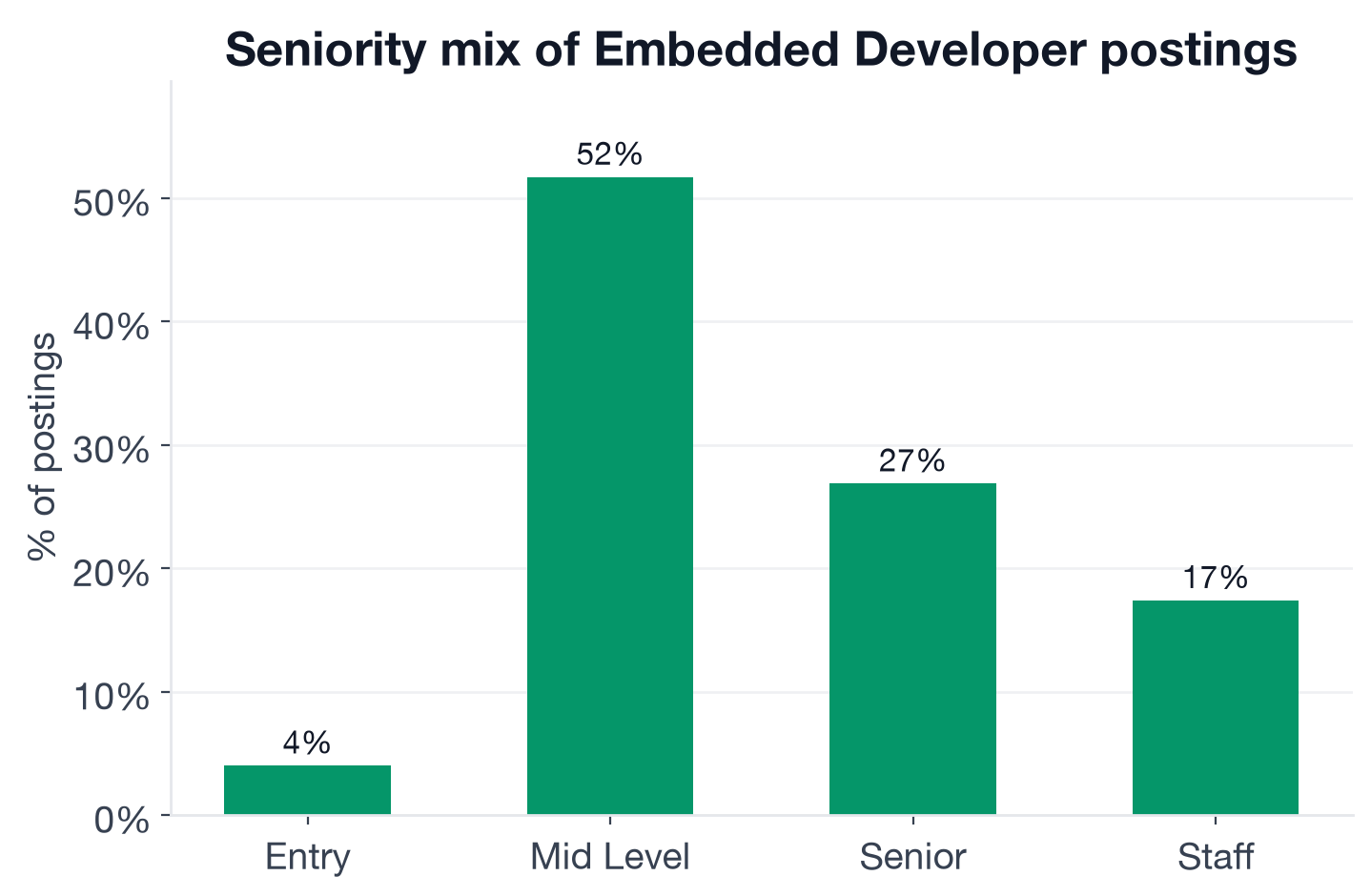
Seniority mix of Embedded Developer postings.
- Mid-level: 52% (1,459 postings)
- Senior: 27% (758)
- Staff: 17% (491) (staff-level Embedded Developer openings)
- Entry: 4% (113)
Only 4% of postings are explicitly entry-level: 113 of 2,821. That matches the notoriously narrow entry door in Data Engineer hiring (3%) and sits well below the software-engineering average. Companies expect engineers who have connected a microcontroller to a sensor, observed timing failures on a logic analyzer, and debugged an RTOS context switch. Those are skills difficult to fake with coursework alone.
The senior and staff tiers together make up 44% of all postings. Staff-level embedded engineers are being asked to design hardware/software architectures at the system level, not just write firmware modules. The demand at that level signals a genuine IC ladder rather than a role that tops out at senior. If you are targeting the higher seniority tiers, the differentiator-tier skills (FPGA, Embedded Linux, PCIe, CI/CD) show up as requirements rather than bonuses.
Where Are Embedded Developer Jobs, and Why Is Remote So Rare?
Geography for this role reflects the industries that do most of the hiring: aerospace, defense, semiconductor, automotive, and industrial hardware. Those sectors are not remote-first.
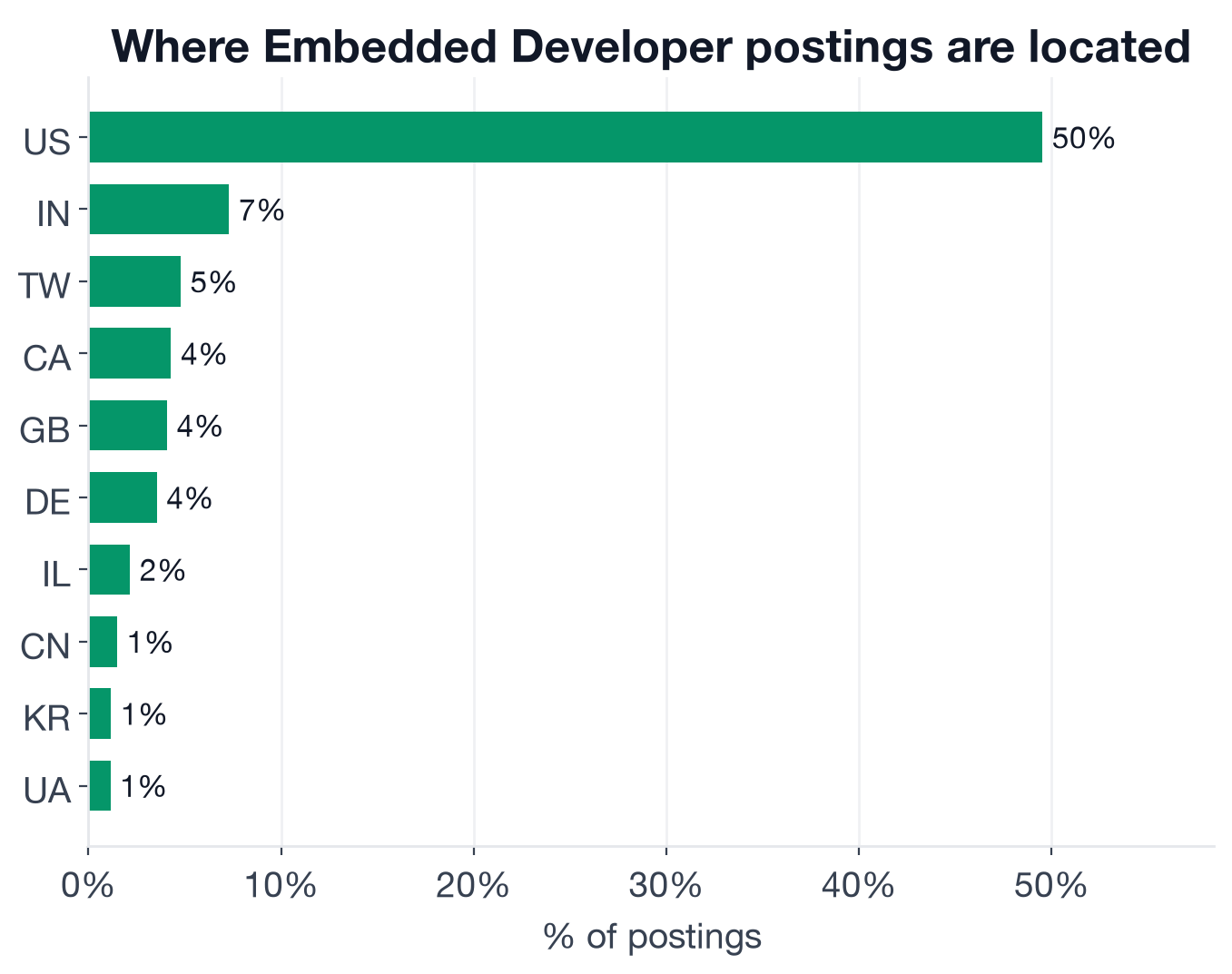
Top countries by share of Embedded Developer postings on the InterviewStack.io job board.
- United States: 50% (US-based Embedded Developer openings)
- India: 7%
- Taiwan: 5%
- Canada: 4%
- United Kingdom: 4%
- Germany: 4%
- Israel: 2%
Taiwan at 5% stands out. The concentration reflects the semiconductor supply chain: chip-design and chip-test firms in the broader ecosystem around TSMC, fabless semiconductor companies, and hardware manufacturers shipping silicon globally all employ embedded developers at a rate that exceeds Taiwan's share of global tech headcount. For US-based candidates, this translates into meaningful competition from Taiwan-based candidates at semiconductor-focused employers. Germany and Israel both appear above 2%, driven by automotive firmware (Germany) and defense/aerospace hardware (Israel).
The work-mode picture is the starkest in the role-skills dataset.
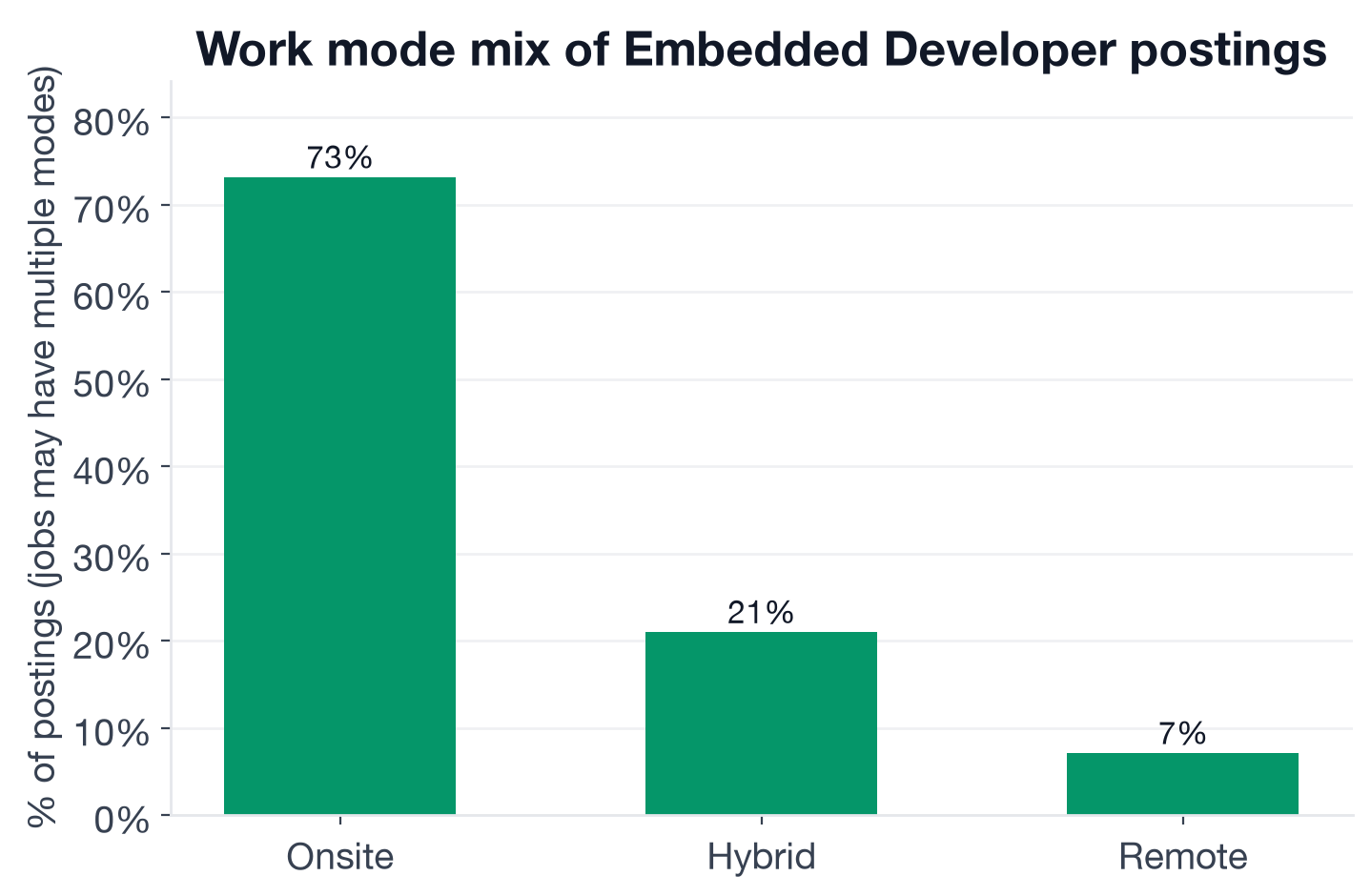
Share of Embedded Developer postings by work mode.
- Onsite: 73% (2,065 postings)
- Hybrid: 21% (593)
- Remote: 7% (202)
Percentages may sum above 100% because some postings carry more than one work-mode tag; 137 postings have no disclosed work mode.
Seven percent remote is one of the lowest rates for any software engineering role. Embedded work requires physical access: development boards, oscilloscopes, logic analyzers, JTAG debuggers, thermal chambers, and in some cases hardware-in-the-loop test rigs that live in a lab. You cannot debug firmware on real silicon over video call. The remote 7% concentrates in higher-level embedded work (Embedded Linux, networked device firmware, simulation-heavy development) rather than bare-metal board bring-up. If location flexibility is a priority, those sub-roles are worth filtering for specifically.
Who's Hiring Embedded Developers in 2026
The employer roster tells you which industries are actually growing headcount rather than just posting theoretically.
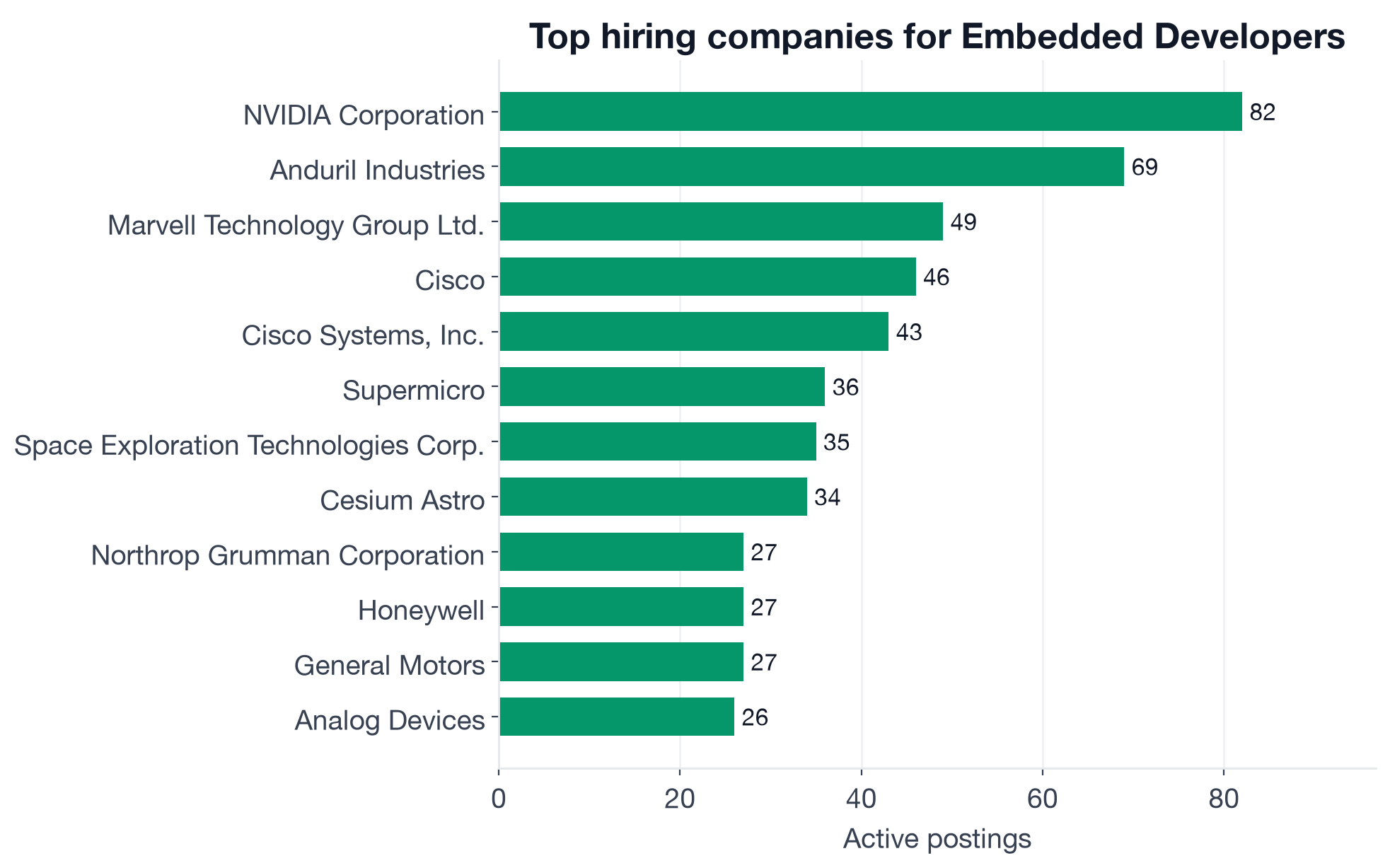
Top companies by active Embedded Developer openings. Cisco appears as two separate legal entities (Cisco and Cisco Systems, Inc.) with 89 openings combined.
| Company | Openings | Sector |
|---|---|---|
| Cisco / Cisco Systems | 89 (combined) | Networking hardware |
| NVIDIA | 82 | Semiconductors, AI hardware |
| Anduril Industries | 69 | Defense AI |
| Marvell Technology | 49 | Semiconductors |
| Supermicro | 36 | Server hardware |
| SpaceX | 35 | Aerospace |
| Cesium Astro | 34 | Satellite communications |
| Northrop Grumman | 27 | Defense |
| Honeywell | 27 | Industrial, aerospace |
| General Motors | 27 | Automotive embedded |
| Analog Devices | 26 | Semiconductors |
| NXP Semiconductors | 25 | Automotive/IoT semiconductors |
| Blue Origin | 25 | Aerospace |
| Astera Labs | 24 | PCIe semiconductors |
| Broadcom | 23 | Semiconductors |
The pattern is unmistakable: semiconductors, defense, aerospace, and automotive. These sectors have long hiring pipelines, stable headcount growth, and in the defense segment, clearance requirements that filter for US citizenship or permanent residency. Astera Labs' appearance near the top (PCIe semiconductors) tracks directly with PCIe showing up in 10% of postings as a differentiator skill. General Motors, NXP, and Honeywell together represent meaningful automotive embedded demand, particularly for safety-critical firmware and the AUTOSAR framework that governs it. For company-specific interview prep, the InterviewStack.io preparation guides cover what each firm prioritizes across technical and behavioral rounds.
How to Use This in Your Job Search
Embedded hiring rewards a specific kind of preparation that generic coding-interview advice misses.
Build the hardware intuition before the interview. The single biggest difference between a candidate who clears the embedded phone screen and one who does not is hands-on hardware time. Buy a development board. Wire a sensor over SPI and I2C. Write a bare-metal interrupt handler. The protocol names on a resume become credible when a candidate can describe debugging an SPI clock-phase mismatch at 2 MHz and why it caused data corruption. That kind of specificity does not come from tutorials; it comes from hardware time.
Decide which cluster before you apply. The hardware-protocol cluster (SPI, I2C, UART, FPGA, RTOS, bare-metal C++) and the automation/systems cluster (Python, CI/CD, Embedded Linux) lead to very different interviews and very different daily work. Look at the differentiator skills in each target posting, not just the common-tier skills. Embedded Developer + FPGA openings and Embedded Developer + Embedded Linux openings are two distinct job descriptions, even though both use the same title.
If salary is the goal, the AI intersection is the premium tier. Computer Vision, Machine Learning, and Device Drivers at $193,000 US median are not generic embedded roles. They require both embedded depth (RTOS constraints, memory budgets, thermal envelopes) and AI fluency (quantizing a model for edge inference, writing a driver for an inference accelerator). That combination is genuinely rare and paid accordingly. The InterviewStack question bank covers the system-design and algorithms topics that show up at the intersection of embedded and AI work. AI mock interviews let you practice explaining low-level technical decisions under time pressure, which is exactly what embedded onsites test.
Filter the board for your specific stack. Browse current Embedded Developer openings, then layer skill filters to match your background: C++ and automation roles, Python-heavy systems openings, or remote and hybrid listings if location matters. The board updates daily, so listings reflect current activity.
FAQ
Q. What skills do companies require for Embedded Developer roles in 2026?
No single skill clears the 50% threshold. The most common are Firmware (39%), C++ (37%), Python (37%), Debugging (33%), Linux (24%), and Automation (21%). Above those, 24 differentiator skills span hardware protocols (SPI 19%, I2C 18%, FPGA 18%, UART 13%), real-time systems (RTOS 13%), and software practices (Git 14%, CI/CD 9%).
Q. What is the median base salary for an Embedded Developer in 2026?
The median US base salary is $157,500 across 881 postings with US salary disclosed. That covers base pay only: equity, RSUs, and bonuses are not captured in posting data, so total compensation at top employers is meaningfully higher.
Q. Which Embedded Developer skills pay the highest premium above the baseline?
Computer Vision, Machine Learning, and Device Drivers all reach $193,000 in US median base salary, roughly $35,500 above the $157,500 role baseline. Algorithms ($182,500), Embedded Linux ($178,800), CI/CD ($175,000), and FPGA ($170,000) follow with premiums in the $12,500 to $25,000 range.
Q. How hard is it to break into embedded development in 2026?
It is one of the harder software engineering specializations to enter at junior level. Only 4% of postings (113 of 2,821) are explicitly entry-level, compared with Data Analyst hiring (8%) and Data Engineer hiring (3%). Companies expect hands-on firmware experience with real hardware. Most entry paths run through aerospace or defense internships, academic hardware projects, or adjacent EE/CS hybrid roles.
Q. How remote-friendly is embedded development?
Embedded is among the least remote-friendly software engineering disciplines. Only 7% of postings are remote, 21% hybrid, and 73% onsite. Physical hardware access (lab benches, oscilloscopes, logic analyzers, dev boards) explains most of that constraint. Remote opportunities are more common in higher-level work such as Embedded Linux and networked device firmware.
Q. What is the dominant skill combination in Embedded Developer job postings?
The most statistically over-represented combination is the hardware-protocol trio of I2C, SPI, and UART, which co-occur with lift values of 4.7x to 4.8x above chance. The most common raw pair is C++ and Python together in 617 postings (22% of the market, lift 1.62). Firmware and RTOS co-occur in 271 postings with lift 1.95.
Q. Where are most Embedded Developer jobs, and which countries stand out?
The US accounts for 50% of postings, followed by India (7%), Taiwan (5%), Canada (4%), and the UK (4%). Taiwan's 5% share reflects the semiconductor supply chain centered there. Defense and aerospace roles skew heavily US-based, while semiconductor-focused work is globally distributed across Taiwan, South Korea, and Germany.
Before You Apply
Embedded development in 2026 rewards specificity more than almost any software engineering role. Knowing which hardware communication protocol a target company uses, which RTOS its firmware runs on, and whether the role is hardware-close or systems-integration work tells you precisely what to prepare. The salary data is clear on which direction is being paid: AI at the edge, device drivers, and performance engineering command $25K to $35K above the $157,500 baseline. The onsite reality is equally clear: plan for lab access, not a home office. Start with the current opening list and let the skill filters guide you to the cluster that matches your experience and goals.
Topics
Ready to practice?
Put what you've learned into practice with AI mock interviews and structured preparation guides.