
Frontend Opens the Door, DevOps Raises the Ceiling
The decision between DevOps Engineer and Frontend Developer looks like a standard tech-career fork until you look at the seniority numbers, and then one finding stands out: Frontend Developer postings are explicitly entry-level at roughly 10 times the rate of DevOps. Across 5,348 active Frontend Developer listings and 6,687 active DevOps Engineer listings on the InterviewStack.io job board, 21% of Frontend postings carry an entry-level signal versus just 2% for DevOps. If you are a career switcher or new graduate trying to land a first engineering role, that ratio matters more than almost anything else in this comparison.
The trade-off is real, though. DevOps carries a median US base salary of $153,000 versus $131,500 for Frontend, a $21,500 gap. DevOps is also substantially more remote-friendly: 59% of postings offer remote or hybrid work, against 40% for Frontend. So the two roles present a genuine choice between the accessible path now and the better-compensated, more flexible path that requires more experience to unlock.
| DevOps Engineer | Frontend Developer | |
|---|---|---|
| Active postings | 6,687 | 5,348 |
| Median US base salary | $153,000 | $131,500 |
| Salary sample (US) | n=1,151 | n=564 |
| Entry-level share | 2.1% | 21.4% |
| Remote + hybrid share | 59% | 40% |
| Top skill | CI/CD (66%) | JavaScript (44%) |
| Skill overlap (Jaccard) | 0.22 (pairwise) | (pairwise) |
Key Findings
- DevOps Engineer postings outnumber Frontend Developer by 1.25x (6,687 vs. 5,348 active listings).
- Median US base salary: $153,000 for DevOps Engineer (n=1,151) vs. $131,500 for Frontend Developer (n=564), a $21,500 difference.
- Entry-level share is 21.4% for Frontend Developer (1,145 of 5,348 postings) versus 2.1% for DevOps Engineer (143 of 6,687), roughly a 10x gap in this dataset. Caveat: the same employer concentration (17.9% of FD postings) that affects the salary figure also inflates this count via retail "Front End Entry Level" store positions. The tech-focused entry-level advantage over DevOps is real but smaller than 10x.
- DevOps Engineer offers 59% remote or hybrid work (22% remote, 37% hybrid); Frontend Developer offers 40% (20% remote, 20% hybrid).
- Jaccard skill overlap across the top-30 skill sets is 0.22, meaning only about 1 in 5 top skills appears in both job descriptions.
- TypeScript is the strongest bridge skill: present in 34% of Frontend postings and 12% of DevOps postings.
- One employer accounts for 17.9% of Frontend Developer postings in this dataset, which inflates the distribution and may pull the $131,500 median below the software-focused norm.
What Does Each Role Actually Do?
DevOps Engineers own the infrastructure software runs on. A typical week involves building and maintaining CI/CD pipelines, managing Kubernetes clusters, configuring cloud environments on AWS or Azure, and handling production incidents. The work is systems-level: less about writing application features and more about the reliability, scalability, and security of the platform that hosts them. At senior levels, the role tilts toward infrastructure as code (Terraform, Ansible) and observability stacks (Prometheus, Grafana) that let the rest of engineering ship faster. A growing subset of DevOps postings also ask for AI infrastructure skills; LLM and Generative AI experience each command premiums of $28K or more above the $153,000 baseline, reflecting demand for engineers who can keep AI systems production-worthy.
Frontend Developers own what users see and touch. Their week centers on React components, TypeScript, CSS layouts, and the performance trade-offs that determine whether an interface feels fast or broken. They work alongside designers and product managers, translating Figma specs and wireframes into working UI. The exclusive skill cluster (JavaScript, React, CSS, HTML, UX, Angular, accessibility) is almost entirely browser-layer work. AI coding tools have become ambient here: survey data from 2025 and 2026 shows frontend developers are among the heaviest daily users of tools like Cursor and GitHub Copilot, even though job postings rarely state that explicitly.
What Skills Do Both Roles Share?
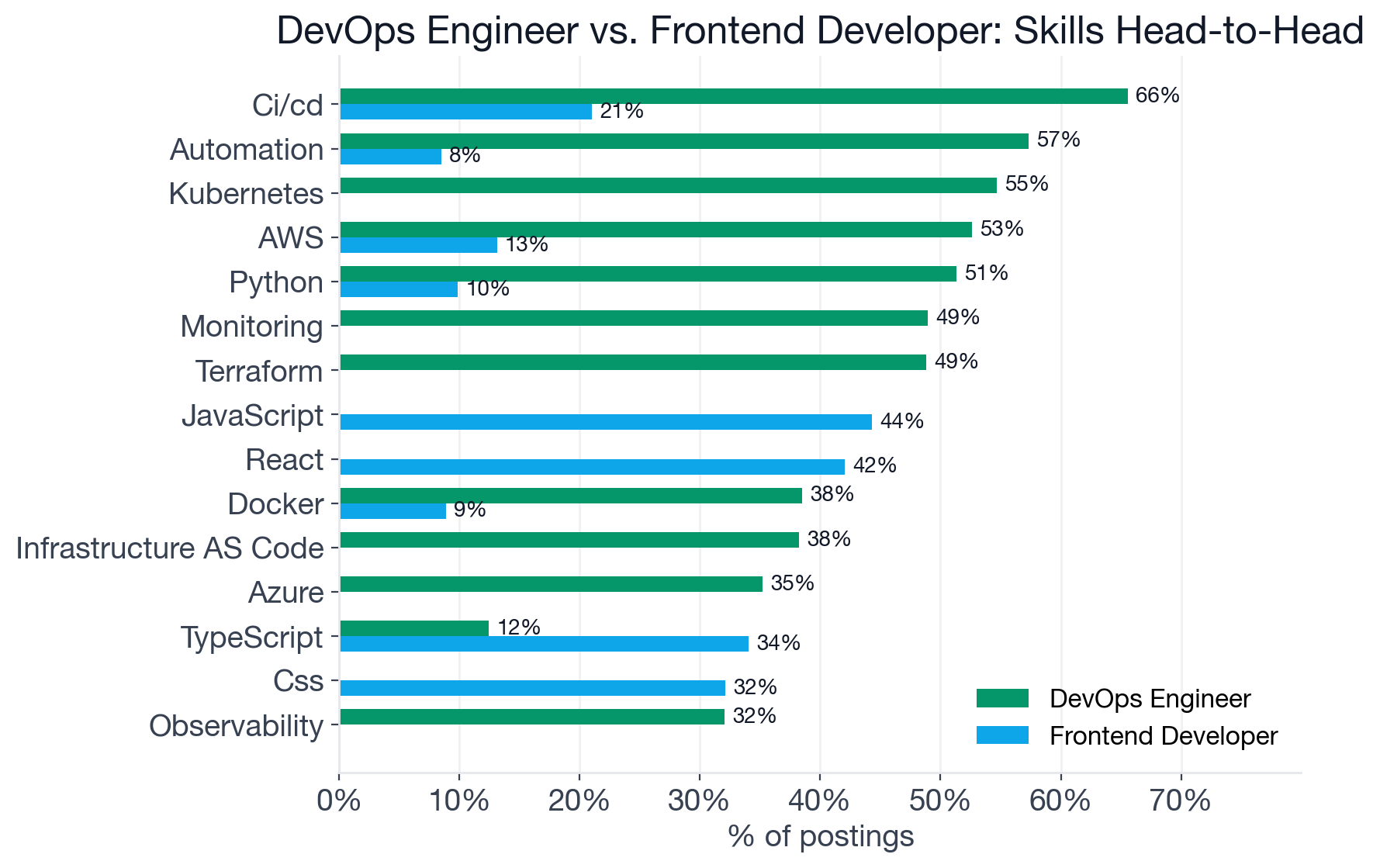
Frequency of top skills across DevOps Engineer and Frontend Developer postings. A 0.22 Jaccard coefficient reflects largely distinct tool sets with a modest shared layer.
Eleven skills clear a meaningful threshold in both job descriptions: TypeScript, CI/CD, Git, APIs, Agile, Python, AWS, Docker, Automation, Scalability, and Java. These are the transferable foundations for anyone considering a move between the two roles.
TypeScript is the most practically useful bridge. It shows up in 34% of Frontend postings (as the primary language for app and component code) and 12% of DevOps postings (for platform tooling and scripting). CI/CD is the process connection: DevOps teams build and own the pipelines (66% frequency) while Frontend developers consume and contribute to them (21%). Git, APIs, and Agile are everyday defaults on both sides. Python appears in 51% of DevOps postings as a scripting and automation language and in 10% of Frontend postings in backend-adjacent contexts. The shared layer is real, but it represents the foundations rather than the specialization that defines either role.
Where the Skill Sets Split Apart
Beyond the shared layer, the two roles operate in almost entirely different vocabularies.
DevOps-exclusive skills are infrastructure and operations tools: Kubernetes (55%), Monitoring (49%), Terraform (a cloud infrastructure provisioning tool, 49%), Infrastructure as Code (38%), Azure (35%), Observability (32%), Linux (32%), Bash (27%), Jenkins (25%), and Ansible (a configuration management and automation platform, 23%). The cluster has a single theme: building and operating resilient, self-healing systems at scale. None of these appear at meaningful frequency in Frontend Developer postings.
Frontend-exclusive skills are rendering-layer tools and disciplines: JavaScript (44%), React (42%), CSS (32%), HTML (25%), User Experience (22%), Code Review (22%), Angular (19%), Accessibility (16%), and Node.js (13%). The set is more language-centered than the DevOps side: JavaScript and its typed superset TypeScript account for the majority of the differentiation, with React as the dominant framework and Angular as a secondary option.
One data note: "Customer Service" appears in 21% of raw Frontend Developer postings, but a single retail employer accounts for 17.9% of all Frontend listings in this dataset. That concentration pulls in retail and customer-facing tech roles that use the Frontend Developer title loosely. We have excluded Customer Service from the exclusive skills list as a concentration artifact rather than a genuine technical signal.
Which Role Pays More?
Salary figures below are US base salary only, restricted to postings with disclosed compensation (n=1,151 for DevOps, n=564 for Frontend). Equity, bonuses, RSUs, and sign-on are not captured in posting salary fields, so total compensation at top employers runs meaningfully higher than these medians.
DevOps Engineer: $153,000 median. Frontend Developer: $131,500 median. Gap: $21,500.
The premium is real, and it reflects the seniority difference: DevOps postings run 31% senior and 12% staff, while Frontend runs 23% senior and 9% staff. DevOps hiring is weighted toward engineers with production experience, and that scarcity drives compensation.
One caveat for Frontend: the employer concentration noted above (one firm at 17.9% of postings) pulls retail-adjacent Frontend roles into the distribution that pay below the software-focused norm. The $131,500 figure reflects the full breadth of what companies classify as Frontend Developer work.
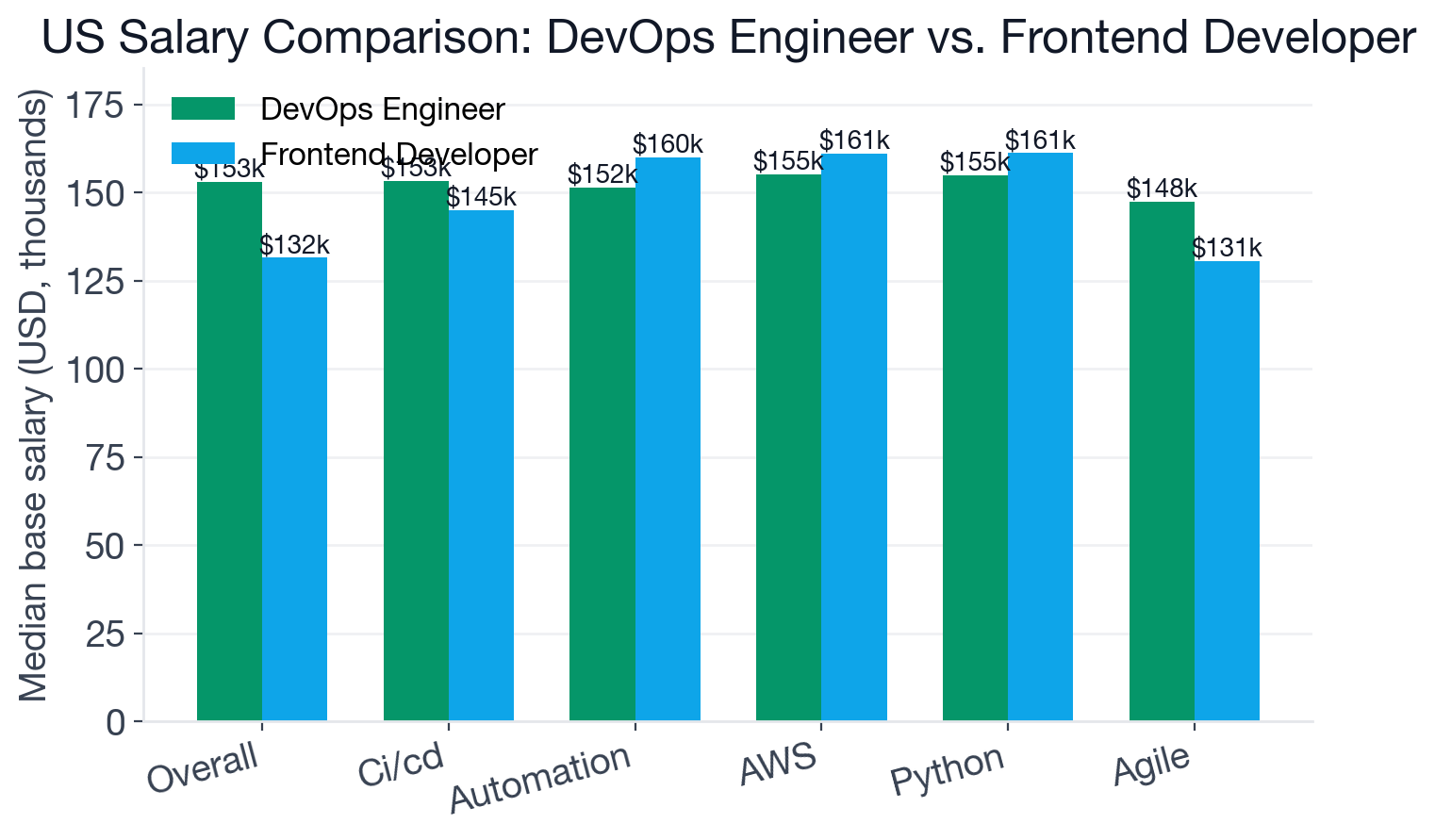
Median US base salary for DevOps Engineer and Frontend Developer. US postings with disclosed salary only. Base salary; equity and bonus not included.
The skills that move salary meaningfully differ by role. For DevOps, the premium tier is AI infrastructure work: LLMs ($181,800 median), Generative AI ($181,200), and distributed systems ($185,900) each sit $28K or more above baseline. Core DevOps tools like Kubernetes ($159,500), Terraform ($156,000), and AWS ($155,100) sit within a few thousand dollars of the $153,000 baseline; they get you the job, not the raise. For Frontend, TypeScript ($175,000, n=210) and React ($168,600, n=216) are where compensation separates candidates most visibly. CSS ($136,000, n=159) and HTML ($135,000, n=124) sit near the baseline; JavaScript ($146,800, n=228) runs $15,000 above it but still trails both TypeScript and React by more than $20K, confirming that table-stakes skills alone don't drive pay to the top of the band.
How Open Is the Entry Door for Each Role?
DevOps Engineer has 25% more postings overall (6,687 vs. 5,348), but that advantage is misleading for early-career candidates.
DevOps Engineer seniority: 2.1% entry, 55.2% mid, 30.6% senior, 12.1% staff. Frontend Developer seniority: 21.4% entry, 46.2% mid, 23.1% senior, 9.3% staff.
One in five Frontend postings is explicitly open to entry-level candidates. For DevOps, it is closer to one in 50. Companies hiring DevOps Engineers want engineers who have already owned production systems somewhere. That prerequisite makes the role genuinely difficult to enter without prior platform or infrastructure experience, while Frontend is where most career-changers and recent graduates can actually compete from day one.
A note on the entry-level figures: the 21.4% entry-level signal for Frontend Developer is partially inflated by the same employer concentration flagged in the salary section. The title sample shows "Front End Entry Level" appearing repeatedly; these postings are largely retail store associate roles, not software developer openings. Filtering to established tech employers would narrow the entry-level advantage considerably, though Frontend still leads DevOps on genuine software entry-level access.
The remote picture reinforces the contrast. DevOps offers 59% hybrid or remote availability versus 40% for Frontend, with Frontend running 61% onsite. That onsite skew reflects how many Frontend roles sit inside product companies and retail organizations that want in-person design collaboration. The US leads for both roles (31% of DevOps postings, 39% of Frontend), but the path in looks very different depending on where you are in your career.
Which Should You Choose?
Choose DevOps Engineer if you:
- Have at least 2 to 3 years of engineering or IT experience to clear the 2% entry-level bottleneck
- Want the higher salary ceiling ($153K median US base) and stronger remote or hybrid availability (59%)
- Prefer systems-level work: reliability engineering, infrastructure automation, incident response
- Are comfortable with on-call responsibilities and owning the health of production environments
Choose Frontend Developer if you:
- Are early in your career or transitioning from another field (21% entry-level share gives you far more openings to compete for)
- Want visual, product-facing work: components, design systems, accessibility, browser performance
- Plan to build a foundation in JavaScript, React, and TypeScript and grow toward full-stack over time
- Prefer working closely with design and product stakeholders on what users directly experience
How to Use This in Your Job Search
Browse DevOps Engineer openings and Frontend Developer openings on the InterviewStack.io job board and apply work-mode and seniority filters to match your actual situation. On the DevOps side, filtering on Kubernetes or Terraform narrows to the higher-complexity postings where the premium skills matter. On the Frontend side, filtering on TypeScript or React surfaces the postings with the strongest salary upside.
Before any technical interview, use AI mock interviews to rehearse system design and infrastructure scenarios for DevOps, and component architecture and performance questions for Frontend. The question bank covers CI/CD, Kubernetes, React, and TypeScript in dedicated topic sets. For building foundational fluency before you apply, our interactive courses cover the underlying computer science and systems concepts both roles draw on.
FAQ
Q. Which pays more: DevOps Engineer or Frontend Developer in 2026?
DevOps Engineer earns a median US base salary of $153,000 vs. $131,500 for Frontend Developer, a $21,500 (16%) gap, based on 1,151 and 564 US postings with disclosed salary data respectively. Base salary only; equity and bonuses are not captured in job postings.
Q. Which role is easier to break into without experience?
Frontend Developer. 21.4% of Frontend Developer postings are explicitly entry-level (1,145 of 5,348), compared with just 2.1% for DevOps Engineer (143 of 6,687). Note: a meaningful share of the Frontend entry-level count reflects retail "Front End Entry Level" store positions from one heavily concentrated employer (17.9% of FD postings). The software-focused entry-level advantage over DevOps is real, but candidates should apply company and industry filters to surface genuine developer openings rather than retail roles.
Q. What skills do DevOps Engineers and Frontend Developers share?
The two roles share 11 skills with meaningful frequency in both: TypeScript, CI/CD, Git, APIs, Agile, Python, AWS, Docker, Automation, Scalability, and Java. Their Jaccard similarity across the top-30 skill sets is 0.22, meaning roughly one in five skills on each side appears in both job descriptions.
Q. Which role offers more remote and hybrid work in 2026?
DevOps Engineer is substantially more remote-friendly: 22% of postings are remote and 37% are hybrid, giving 59% combined flexibility. Frontend Developer postings run 20% remote and 20% hybrid, totaling about 40% flexible work, with 61% onsite.
Q. What are the top skills for a DevOps Engineer in 2026?
The top five skills by posting frequency are CI/CD (66%), Automation (57%), Kubernetes (55%), AWS (53%), and Python (51%). The role's exclusive cluster includes Kubernetes, Terraform (49%), Monitoring (49%), Infrastructure as Code (38%), Azure (35%), Observability (32%), Linux (32%), and Bash (27%).
Q. What are the top skills for a Frontend Developer in 2026?
The top five are JavaScript (44%), React (42%), TypeScript (34%), CSS (32%), and HTML (25%). The exclusive skill cluster includes React, CSS, HTML, UX, Angular (19%), Accessibility (16%), and Node.js (13%). Among high-demand core skills, TypeScript ($175,000, n=210) and Next.js ($175,000, n=52) show the strongest salary signal at scale; Playwright ($182,500, n=27) and GraphQL ($176,300, n=46) rank higher in the salary table with smaller sample sizes.
Q. Can a Frontend Developer transition to DevOps?
Yes, though the transition requires deliberate investment in infrastructure skills. TypeScript, CI/CD, Git, and Agile transfer directly. The gaps are Kubernetes, Terraform, Monitoring, Linux, and Bash: all in the 27-55% frequency range for DevOps but below 5% for Frontend. The entry bar on the DevOps side is much higher (2% entry-level), so most transitions happen through a mid-level stepping stone rather than a straight lateral move.
Choose the Work You Can Actually Start
If you are early in your career, the data makes a clear case for starting on the Frontend side: entry access is 10 times more open, the skill set is more standardized, and a strong TypeScript and React profile can reach $175,000 medians as seniority builds. If you are already mid-level and want higher base compensation plus more remote flexibility, DevOps's $153,000 median and 59% hybrid or remote availability are hard to argue with. See what the market looks like for your target stack today: DevOps Engineer openings and Frontend Developer openings.
Topics
Ready to practice?
Put what you've learned into practice with AI mock interviews and structured preparation guides.