
Are Data Analyst and Data Scientist Still the Same Job in 2026?
From the outside, the two roles look interchangeable: similar posting volumes, similar geographies, similar work-mode mix. From the inside, they are two different jobs that happen to share a top-skill list. The Data Analyst sits next to the business and explains what happened with SQL and a dashboard; the Data Scientist sits next to the product and explains what is likely to happen with a model.
We compared every active Data Analyst posting (6,485 listings) with every active Data Scientist posting (6,087 listings) on the InterviewStack.io job board as of May 2026, with skills extracted from descriptions and synonyms collapsed. The takeaway is sharper than the headline overlap suggests: roughly half the skills appear in both lists, but the salary, the modeling stack, and the senior-career ceiling all push decisively toward Data Scientist.
Key Findings
- Volume is essentially tied: 6,485 Data Analyst postings vs 6,087 Data Scientist postings (ratio 1.07).
- Median US base salary gap is $32,300: $95,000 for Data Analyst (n=1,376) vs $127,300 for Data Scientist (n=1,370), a 25% premium for Data Scientist.
- Skill overlap is moderate: Jaccard 0.46 on top-30 skill sets, so roughly half of each role's skill profile transfers.
- The lead skill flips: SQL leads Data Analyst (60% of postings) while Python leads Data Scientist (64%).
- Modeling stack is exclusive to Data Scientist: Generative AI (14%), LLMs (14%), TensorFlow (13%), PyTorch (13%), scikit-learn (11%), Deep Learning (10%), and NLP (10%) clear our exclusivity threshold.
- BI stack tilts toward Data Analyst: Tableau (32% vs 14%), Power BI (31% vs 14%), and Excel (33% vs 11%) are 2 to 3 times more common in Data Analyst postings.
- Staff ceiling is nearly 2x higher for Data Scientist: 13% of Data Scientist postings are staff-level, vs 7% for Data Analyst.
- Geography and work mode are near-identical: US 39% in both, fully-remote share 22% vs 21%.
At a Glance: How Do the Two Roles Compare?
| Dimension | Data Analyst | Data Scientist |
|---|---|---|
| Active postings | 6,485 | 6,087 |
| Median US base salary | $95,000 (n=1,376) | $127,300 (n=1,370) |
| Lead skill | SQL (60%) | Python (64%) |
| Skill profile overlap (Jaccard) | 46% | 46% |
| Entry-level share | 8% | 9% |
| Staff+ share | 7% | 13% |
| Fully-remote share | 22% | 21% |
| Largest country share | US (39%) | US (39%) |
| Top exclusive skills | Looker, Data Modeling | Generative AI, LLMs, PyTorch, TensorFlow |
The table is the comparison in one frame: volumes match, geography matches, work mode matches. What does not match is pay, the senior ceiling, and which half of the modeling-and-BI continuum the role lives on.
How Similar Are the Two Skill Profiles?
Compute Jaccard similarity across each role's top-30 skill list and the answer is 0.46, meaning roughly half the skill set transfers. That is high enough that a Data Analyst with strong Python and Statistics can credibly retool toward Data Science, but low enough that the resumes are not interchangeable.
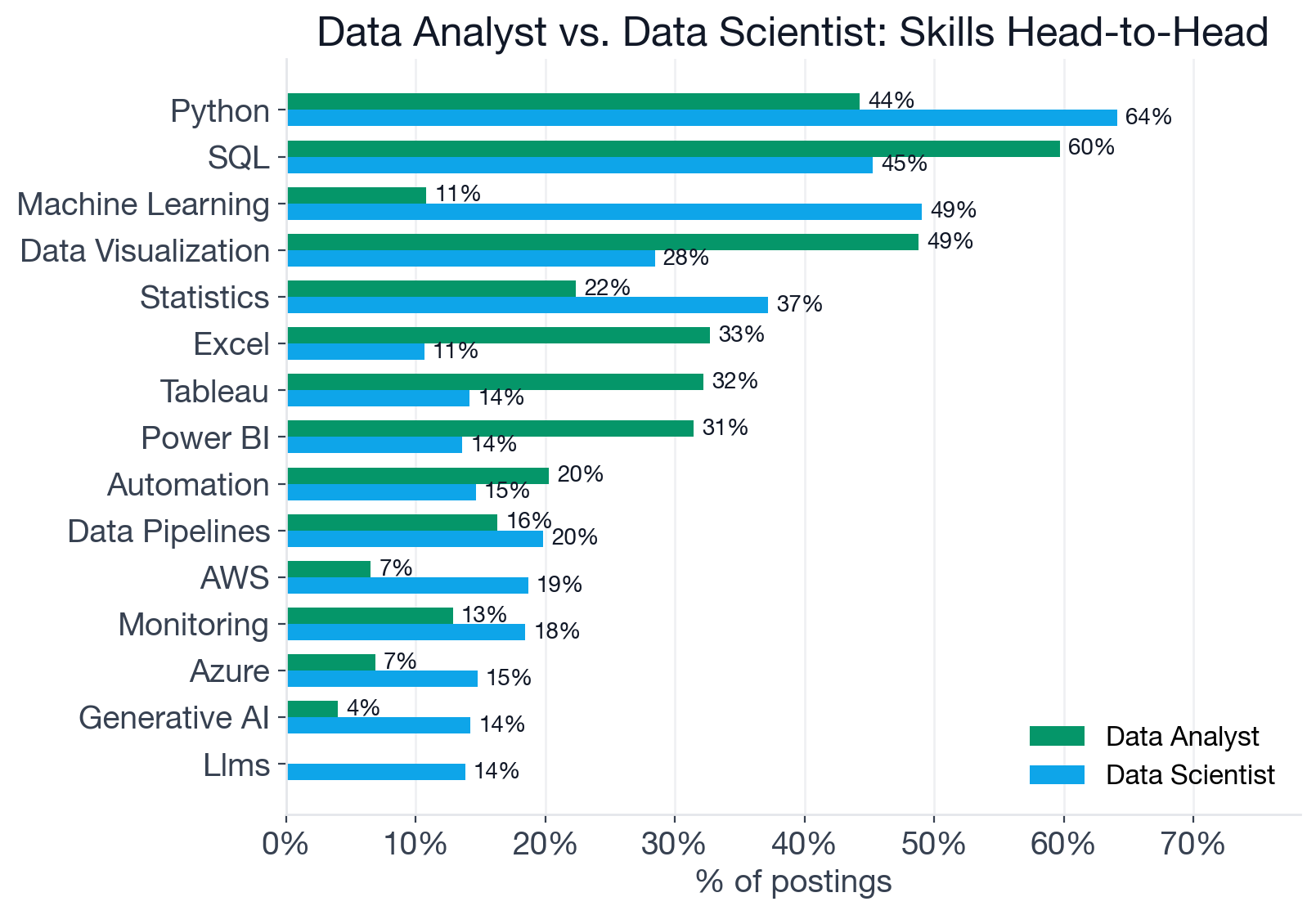
Share of postings that mention each top-shared skill, Data Analyst (emerald) vs Data Scientist (blue). Each bar is the percentage of that role's postings that name the skill.
The most telling part of the chart is how the lead skill flips. SQL is the most-demanded skill in Data Analyst postings (60% of listings), but only the third-most for Data Scientist (45%). Python is the inverse: it leads Data Scientist at 64% but trails to third place in Data Analyst at 44%. The two roles share a vocabulary; they emphasize different syllables.
Machine Learning is the cleanest divider. It appears in 49% of Data Scientist postings and only 11% of Data Analyst postings, the widest gap among shared skills. Statistics tells the same story at smaller scale (37% vs 22%). A Data Analyst posting that asks for ML is usually a hybrid analyst-scientist role; a Data Scientist posting without ML is rare.
Which Skills Does Each Role Own Outright?
Beyond the shared list, each role has skills the other almost never asks for. We define "exclusive" as: appears in at least 8% of one role's postings and fewer than 5% of the other's.
Exclusive to Data Scientist (the modeling stack):
- Generative AI: 14%
- LLMs: 14%
- Apache Spark: 13%
- TensorFlow: 13%
- pandas: 13%
- PyTorch: 13%
- Google Cloud: 12%
- scikit-learn: 11%
- Deep Learning: 10%
- NLP: 10%
Exclusive to Data Analyst (BI and modeling-for-warehousing):
- Looker: 12%
- Data Modeling: 9%
The asymmetry is striking. Ten skills clear the exclusivity bar for Data Scientist, only two for Data Analyst. That is the practical meaning of the salary gap: Data Scientist roles ask for a longer, more specialized list of model-building tools, and pay accordingly.
Two other patterns worth naming. First, the BI stack (Tableau, Power BI, Excel) does not clear the exclusivity threshold because Data Scientist postings still ask for it 11% to 14% of the time, but it is 2 to 3 times more common in Data Analyst postings. If your strength is dashboards and stakeholder-facing visualization, Data Analyst openings that ask for Tableau or Power BI are the higher-density target. Second, cloud platforms (AWS, Azure, Google Cloud) cluster on the Data Scientist side, reflecting that production model deployment requires more cloud surface area than building a dashboard does.
How Much More Do Data Scientists Earn?
Salary numbers below are restricted to US postings only (where wage-transparency laws produce consistent disclosure) so they are directly comparable. They are base salary: equity, bonuses, RSUs, and sign-on are not disclosed in postings, so total compensation at top employers runs meaningfully higher than what we report here, especially in tech and finance.
The median US base salary for Data Analyst postings is $95,000 (n=1,376). For Data Scientist postings it is $127,300 (n=1,370). That is a $32,300 gap, roughly 25% higher for Data Scientist.
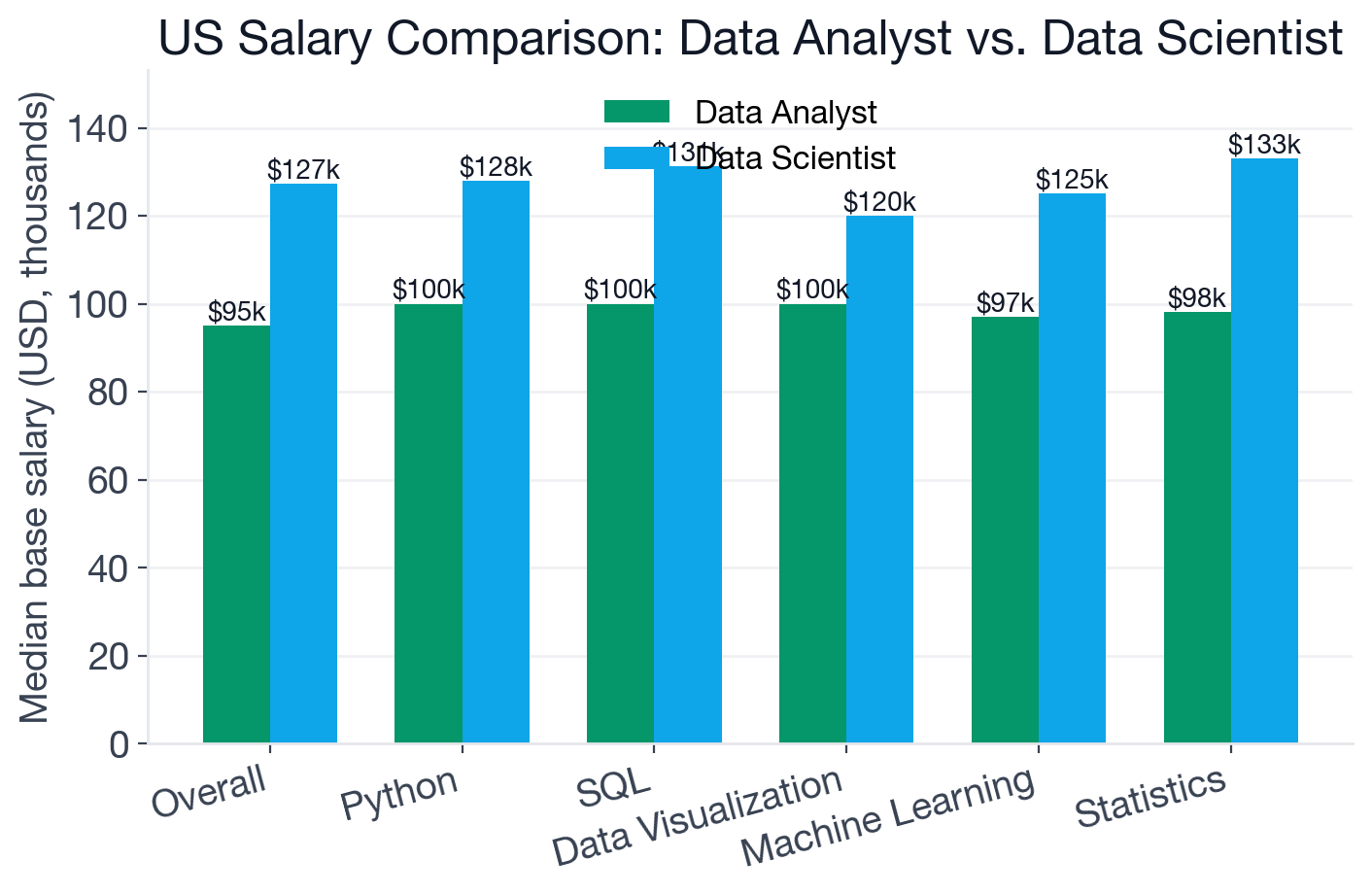
Median US base salary for postings that mention each skill, by role. The skill-level comparison shows the gap is structural, not just a mix-shift toward different skills.
The more revealing test is to hold the skill constant and look at salary by role:
| Skill | Data Analyst median | Data Scientist median | Premium |
|---|---|---|---|
| SQL | $100,000 (n=850) | $131,200 (n=701) | +$31,200 |
| Python | $100,000 (n=606) | $128,000 (n=948) | +$28,000 |
| Statistics | $98,200 (n=371) | $133,100 (n=633) | +$34,900 |
| Machine Learning | $97,100 (n=154) | $125,100 (n=762) | +$28,000 |
| Snowflake | $115,000 (n=173) | $137,500 (n=151) | +$22,500 |
| Tableau | $99,500 (n=503) | $113,500 (n=210) | +$14,000 |
At every shared skill, the Data Scientist title carries a premium of roughly $14K to $35K. The conclusion: the salary gap is not just a mix-shift (more cloud and ML on the Data Scientist side); it is a real, role-level premium. The same SQL pays $31K more in a Data Scientist posting than in a Data Analyst one.
Is One Role More Entry-Friendly Than the Other?
Both roles look similar at the entry door but diverge sharply at the top of the ladder.
| Seniority | Data Analyst | Data Scientist |
|---|---|---|
| Entry | 8% (499) | 9% (550) |
| Mid-level | 61% (3,940) | 54% (3,257) |
| Senior | 25% (1,592) | 24% (1,461) |
| Staff / Lead / Principal | 7% (454) | 13% (819) |
Entry-level openings are slightly more common in Data Scientist postings (9% vs 8%), which surprises most people: the conventional wisdom that Data Analyst is the "easier" first job into data does not show up in our hiring data. What the data does show is that the staff-and-above ceiling is nearly twice as high for Data Scientist (13% vs 7%). If you are picking a role for long-term career trajectory, Data Science has more senior IC runway above the mid-level band.
The mid-level concentration is also worth flagging. 61% of Data Analyst postings are mid-level, compared with 54% for Data Scientist, so Data Analyst hiring is more bunched in the middle of the experience curve. A senior-leaning candidate may find a deeper Data Scientist market for senior roles and a shallower one for senior Data Analyst.
Where Are the Jobs, and How Remote-Friendly Is Each Role?
Geography and work mode are the dimensions where the two roles look nearly identical, so neither should be the tiebreaker.
Geography (top 5):
| Country | Data Analyst | Data Scientist |
|---|---|---|
| United States | 39% | 39% |
| India | 11% | 12% |
| United Kingdom | 5% | 5% |
| Canada | 5% | 4% |
| Germany | 3% | 3% |
Work mode (postings can carry multiple tags, so percentages sum to more than 100%):
| Mode | Data Analyst | Data Scientist |
|---|---|---|
| Onsite | 57% | 57% |
| Hybrid | 33% | 32% |
| Remote | 22% | 21% |
The labor markets that hire one role hire the other; the work-mode default for both is onsite, with hybrid as a strong second. If fully-remote work is the priority, fully-remote Data Scientist openings and fully-remote Data Analyst openings exist in similar proportions, but neither role is remote-first in 2026.
How Should You Choose Between Data Analyst and Data Scientist?
The data points to a clean decision frame.
Pick Data Analyst if you want a faster on-ramp, prefer working close to business stakeholders with SQL and a BI tool (Tableau, Power BI, Looker), and are comfortable trading the salary ceiling for a more stakeholder-facing day-to-day. The skills compound into senior analyst, analytics engineer, and BI lead roles. Mid-level dominates the postings (61%), so once you clear the entry-level door, demand is broad.
Pick Data Scientist if you are willing to invest in machine learning, statistics, and the Python ML stack (PyTorch, TensorFlow, scikit-learn, plus increasingly MLOps and LLM tooling). You get a $32K higher median, a longer staff-level ladder (13% of postings are staff vs 7%), and direct exposure to the Generative AI and LLM work that is reshaping the role. The trade is a higher technical floor and more cloud and model-deployment surface area.
The hybrid path is real: the Data Engineer route sits adjacent to both, with its own salary premium and a different stack focus. The cleanest skill ladder from analyst to scientist is to layer Python plus Statistics plus one of scikit-learn/PyTorch onto a strong SQL foundation, then move into a Data Scientist or hybrid analyst-scientist role.
Whichever side you target, our interactive courses cover the foundations across SQL, Python, statistics, and ML, and the question bank lets you drill the specific topics that come up in onsite rounds. For the final mile, AI mock interviews reproduce the analytics case study or ML system design conversation you will actually face. When you are ready to apply, filter Data Analyst openings or Data Scientist openings to your stack.
FAQ
Q. Is Data Scientist a better-paid role than Data Analyst in 2026?
Yes. The median US base salary for Data Scientist postings is $127,300 (n=1,370), versus $95,000 for Data Analyst postings (n=1,376). That is a $32,300 gap, roughly 25% higher for Data Scientist roles. The gap is structural, not skill-explained: at the same listed skill (SQL, Python, Statistics), Data Scientist postings pay $28K to $35K more than Data Analyst postings.
Q. How much do Data Analyst and Data Scientist skills overlap?
About half. The Jaccard overlap on each role's top-30 skill list is 0.46, meaning roughly half of the skills demanded in one role are also demanded in the other. SQL, Python, Statistics, and Machine Learning appear in both, but with very different intensities: SQL is the lead skill for Data Analysts (60% of postings) while Python is the lead skill for Data Scientists (64%).
Q. Which skills are exclusive to Data Scientist vs Data Analyst?
Data Scientist postings own the modeling stack: Generative AI (14%), LLMs (14%), Apache Spark (13%), TensorFlow (13%), PyTorch (13%), scikit-learn (11%), Deep Learning (10%), and NLP (10%) all clear our exclusivity threshold. Data Analyst postings own the BI and spreadsheet stack: Looker (12%) and Data Modeling (9%) are the only skills with strong exclusivity, but Tableau, Power BI, and Excel each appear in Data Analyst postings 2 to 3 times more often than in Data Scientist postings.
Q. Is it easier to break in as a Data Analyst or a Data Scientist?
Entry-level share is similar: 8% of Data Analyst postings and 9% of Data Scientist postings are tagged entry-level. The bigger contrast is the ceiling: staff-level roles make up 13% of Data Scientist postings versus only 7% for Data Analyst, so the senior career runway is longer in Data Science. Mid-level dominates both (61% Data Analyst, 54% Data Scientist).
Q. Are Data Scientist jobs more remote-friendly than Data Analyst jobs?
No, the two roles are nearly identical on work mode. Onsite is the dominant tag for both (57% in each), hybrid is around one-third (33% Data Analyst, 32% Data Scientist), and fully-remote tags appear on 22% of Data Analyst and 21% of Data Scientist postings. Geography also matches closely: the US is 39% of postings in both, India is 11% to 12%, and the UK is 5%.
Q. Should I become a Data Analyst or a Data Scientist?
Pick Data Analyst if you want to enter the data field faster, work closer to business stakeholders with BI tools, and accept a lower salary band ($95K US median) for an easier on-ramp. Pick Data Scientist if you are willing to invest in machine learning, statistics, and the Python ML stack (PyTorch, TensorFlow, scikit-learn, MLOps) in exchange for a $32K higher median, a longer staff-level career ladder, and exposure to Generative AI and LLM work that increasingly defines the role.
Final Thoughts
The Data Analyst and Data Scientist titles share half a vocabulary and almost the same labor market, but they price out and ladder out differently. Pick the role that matches the work you actually want to do (stakeholder-facing analysis or model-building), then use the skill data above to close the specific gap that separates today's resume from the role you are targeting. We will refresh this comparison quarterly so the trend lines stay current.
Topics
Ready to practice?
Put what you've learned into practice with AI mock interviews and structured preparation guides.