
Where Security Architecture Interviews Actually Score
Security architecture interviews are not a vocabulary test. A mid-level Cybersecurity Engineer who can define zero trust, least privilege, and defense in depth is table stakes for this question; the rubric does not reward that. What it rewards is whether you can map those principles to concrete controls across identity, network, compute, application, and data layers, under a 30-minute clock.
This walkthrough follows a simulated mid-level Cybersecurity Engineer interview on Security Architecture Principles and Fundamentals, using a blueprint that mirrors what the InterviewStack.io AI mock interview tracks in real time. The goal: show where candidates who understand the material still lose points.
Key Findings
- The 100-point rubric puts 60 points across two dimensions: Interviewer Objectives Alignment (30 pts) and Level-Specific Expectations (30 pts). Both score control coverage, not principle fluency.
- Phase 2 (Architecture proposal, 7-20 min) carries 7 checklist items spanning identity, network, compute, application, and data layers, more than any other phase.
- Phase 1 (0-7 min) requires the candidate to identify at least 4 distinct actor types (employees, analysts, admins, internal services, processing jobs) before proposing any controls.
- The 3-phase blueprint runs Problem framing (0-7 min), Architecture proposal (7-20 min), and Trade-offs and operations (20-30 min), each with explicit checklist items the AI interviewer tracks.
- Mid-level expectations require RBAC and ABAC pattern recognition and sensible trade-offs, but do not require novel designs or organization-wide governance frameworks.
- 4 skill areas are explicitly out of scope: reverse engineering and malware analysis, deep cryptographic algorithm design, digital forensics procedures, and low-level exploit development. Time spent there signals scope confusion, not depth.
What Does a Cybersecurity Engineer Security Architecture Interview Actually Test?
The question is a platform design problem, not a definitions exercise. The interviewer is evaluating whether you scope the system and map trust boundaries first; produce a layered architecture across identity, storage, compute, and API; reason about preventive, detective, and corrective controls; and make pragmatic trade-offs within a two-quarter delivery horizon.
The interview question
You are joining an internal platform security review for a company building a new service that lets employees upload customer support exports from third-party vendors, process them, and make sanitized results available to approved internal teams through an API and a web dashboard.
The system will:
- accept uploads from employees in multiple business units
- store raw files and processed results in cloud storage
- run background processing jobs in containers
- expose a dashboard for analysts and an API for downstream internal services
- contain data with mixed sensitivity, including customer identifiers and internal business metadata
- be used globally by several teams with different access needs
The engineering team wants a practical security architecture they can implement in the next two quarters.
How would you design the security architecture for this system so that it is secure by default while still usable for internal teams?
The interviewer is probing control layering across the full system surface: who is authenticated and how, what data each actor can reach, how secrets and workload credentials are managed, and whether the candidate's first instinct is to deny by default rather than permit and patch later.
The Walkthrough: 4 Turns That Decide the Score
Turn 1: Authentication Trifecta
Interviewer: "How would you handle authentication and authorization for employees, service-to-service calls, and background jobs?"
Turn 2: Data Isolation by Business Unit
Interviewer: "If different business units should only see their own data by default, how would you enforce that in the architecture?"
Turn 3: Secrets and Key Management
Interviewer: "What secrets and key management approach would you use for this system, and what failure modes would you want to prevent?"
Turn 4: Trade-off Negotiation
Interviewer: "Suppose the team pushes back that some of your controls will slow delivery or hurt analyst usability. How would you prioritize and negotiate trade-offs?"
Spotting these mistakes on the page is easy when they are annotated and slowed down. What the interview tests is whether you make these same calls correctly, in sequence, in real time, with unscripted follow-ups and the clock running.
Phase 1 framing determines everything that follows. If you skip asset identification and trust boundary mapping in the first 7 minutes, the architecture phase has no foundation, and the interviewer has no checklist evidence to award. The score diverges there, not in the technical details of Phase 2.
The Complete Blueprint
Here is the full structure a strong candidate hits across 30 minutes, shown as the same Blueprint the AI mock interview tracks you against in real time.
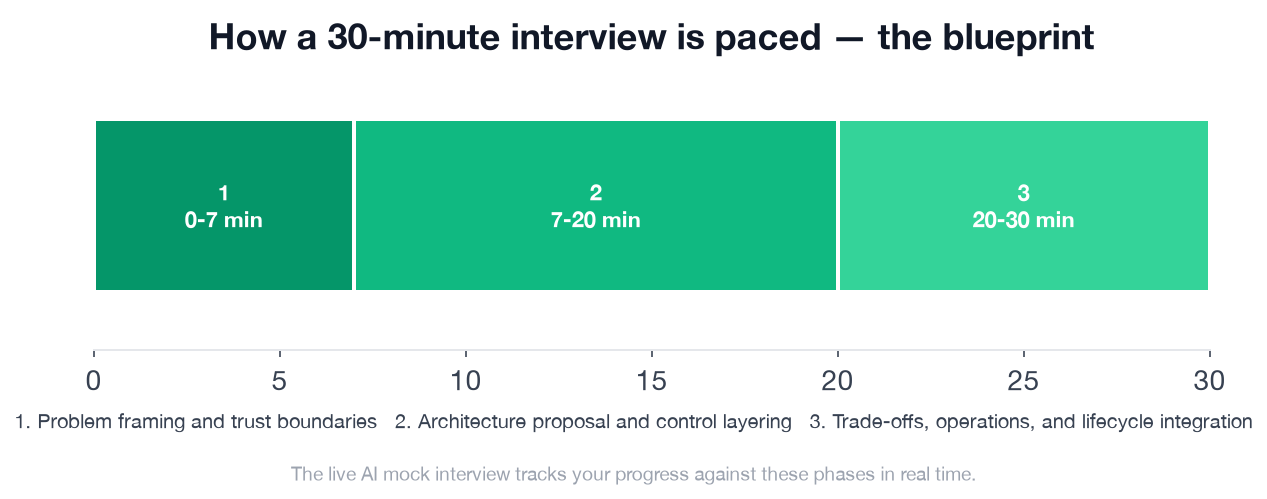 The 30-minute security architecture interview paced into 3 phases, with time and checklist items per phase.
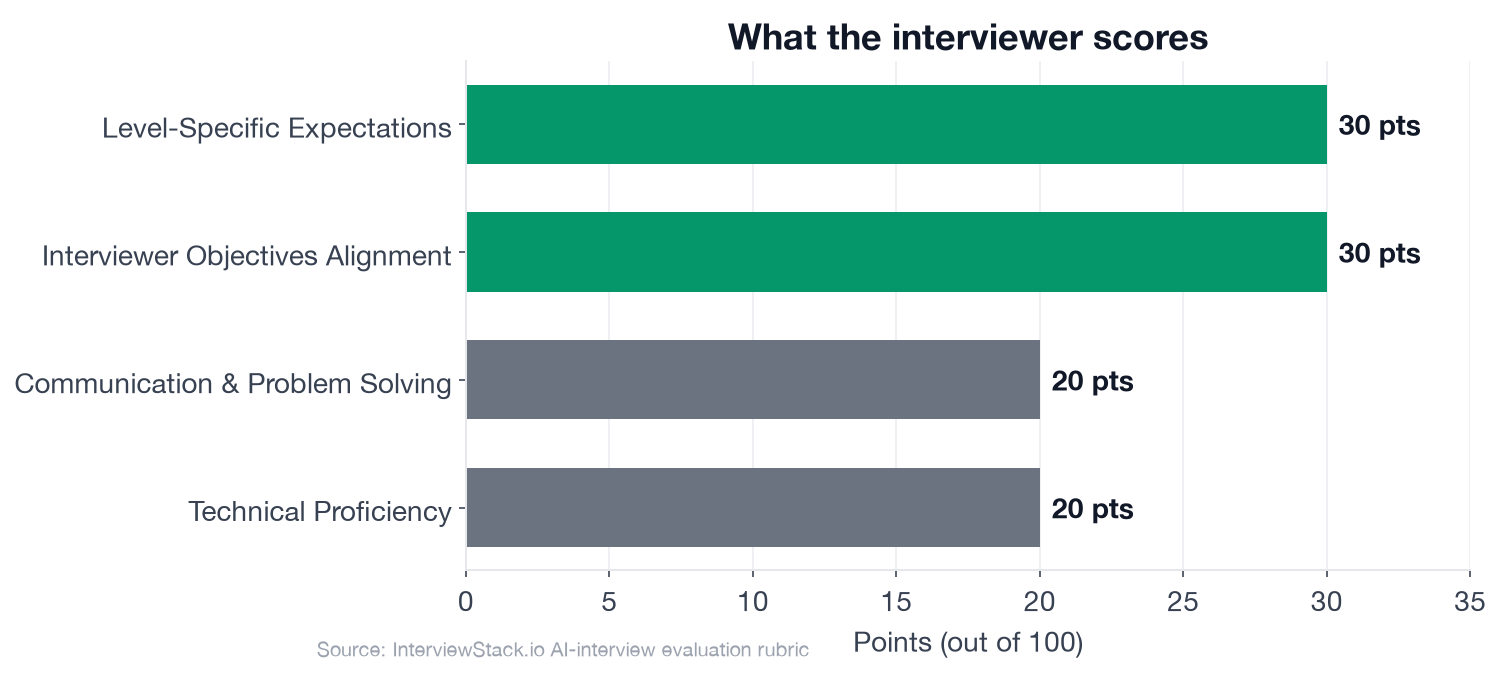 Interviewer Objectives Alignment and Level-Specific Expectations together account for 60 of 100 rubric points.
- ✓Identifies major assets such as raw uploads, processed outputs, credentials, audit logs, and identity metadata
- ✓Differentiates actor types such as employees, analysts, admins, internal services, and processing jobs
- ✓Calls out trust boundaries across user entry points, storage, processing, API, and dashboard
- ✓States initial design principles such as deny by default, least privilege, and data sensitivity-based controls
- ✓Proposes centralized employee authentication using enterprise identity with strong auth and avoids local credential stores
- ✓Describes authorization model using roles and/or attributes tied to business unit, environment, job function, or data classification
- ✓Enforces separation between raw and processed data access and limits who or what can read each
- ✓Uses service identities for workloads and avoids hardcoded secrets; mentions secret rotation or short-lived credentials
- ✓Describes network and service-layer controls such as segmentation, private service communication, restricted ingress, or mutual authentication
- ✓Applies secure defaults such as private-by-default storage, least-privileged service accounts, and restricted admin paths
- ✓Includes data protections such as encryption at rest/in transit and some integrity/audit consideration
- ✓Prioritizes a realistic first-release control set versus later enhancements
- ✓Names useful detections such as privileged access changes, unusual data export patterns, failed access attempts, or unexpected service behavior
- ✓Mentions corrective mechanisms such as access revocation, credential rotation, job isolation, rollback, or quarantine of suspicious uploads
- ✓Explains how threat modeling, design review, and security requirements fit into planning and implementation over two quarters
- ✓Makes at least one explicit trade-off among security, usability, performance, or engineering cost and justifies it
Start the AI mock interview to run the full 30-minute simulation with real-time rubric tracking against this exact blueprint. Before your session, work through the Security Architecture Principles and Fundamentals question bank to drill the specific checklist items. For broader Cybersecurity Engineer preparation, the Cybersecurity Engineer prep guides cover additional topic areas.
FAQ
Q. What is the scoring breakdown for a Cybersecurity Engineer security architecture interview?
The 100-point rubric splits as: Interviewer Objectives Alignment (30 pts), Level-Specific Expectations (30 pts), Technical Proficiency (20 pts), and Communication and Problem Solving (20 pts). The first two dimensions, which reward architectural control coverage rather than principle recitation, account for 60% of the total score.
Q. What phases does the security architecture interview follow?
The interview runs 30 minutes across 3 phases: Problem framing and trust boundaries (0-7 min), Architecture proposal and control layering (7-20 min), and Trade-offs, operations, and lifecycle integration (20-30 min). Phase 2 is the most demanding, with 7 concrete control expectations spanning identity, network, compute, application, and data layers.
Q. What are the biggest mistakes mid-level candidates make in this interview?
The most common mistakes are: treating the question as a principles quiz rather than a design problem; proposing a single authentication model without separating employee, service, and job identities; describing RBAC without addressing data isolation by business unit; and failing to name concrete trade-offs when pushed on delivery speed versus security controls.
Q. What topics are out of scope for this security architecture interview?
The blueprint explicitly excludes reverse engineering, malware analysis, deep cryptographic algorithm design, digital forensics procedures, and low-level exploit development. The focus is on architectural controls and system design, not offensive security techniques.
Q. How can I practice for a Cybersecurity Engineer security architecture interview?
The most effective preparation is timed live practice. The AI mock interview on InterviewStack.io runs the full 30-minute security architecture blueprint in real time, tracks your coverage across all 3 phases, and gives rubric-aligned feedback. Pair this with the Security Architecture Principles and Fundamentals question bank to drill the specific checklist items before your session.
What the Blueprint Teaches You About the First 7 Minutes
The 16 checklist items across 3 phases look like a lot to hit in 30 minutes. They are. But the score distribution points toward where to focus: 60 of 100 points go to the dimensions most heavily seeded in Phase 1. Scope the system correctly, name the actors, call the trust boundaries, and state your starting principles in the first 7 minutes, and the architecture phase builds from a foundation the interviewer can verify. Skip that framing, and you spend the next 13 minutes constructing controls the interviewer cannot map to any risk model.
The distinction the rubric draws is between a candidate who starts from the system outward, and one who starts from a list of security terms inward. That distinction is what 60 points are measuring. The only way to practice it under real conditions is to run the clock.
Topics
Ready to practice?
Put what you've learned into practice with AI mock interviews and structured preparation guides.