
Cloud Engineer Is the Market That Forgot to Agree on a Stack
Every other major tech role has a handful of skills that appear in more than half its postings. Data Engineers have Python and SQL. ML Engineers have Python and machine learning. Systems Administrators have Windows and Linux. Cloud Engineer is different: nothing in 3,548 active postings clears the 50% mark. The highest-demanded skill, Automation, sits at 47%. AWS and Azure are statistically tied at 45.8% and 45.7% respectively, a gap of 0.06 percentage points across the entire dataset.
That fragmentation is the defining feature of the role. We analyzed every active Cloud Engineer posting on the InterviewStack.io job board as of June 2026, 3,548 listings with skills extracted from descriptions and synonyms collapsed, so iac and infrastructure as code count once, gcp and google cloud count once. The dataset captures the full "Cloud & Infrastructure" hiring category: core cloud-platform, DevOps, and IaC engineering roles make up the majority, but a portion includes adjacent titles (cloud support specialists, infrastructure operations managers, and critical-infrastructure technical roles), so the most reliable signals are the platform and automation skills at the top of the frequency list.
The practical implication: there is no single Cloud Engineer job market. There are at least three: the AWS-shop market, the Azure-enterprise market, and the GCP/multi-cloud market. Each draws from a largely overlapping toolkit, but the skill weighting shifts enough that a resume optimized for one does not read the same way in another. The good news is that salary is not randomly distributed across this fragmented landscape. Depth skills, specifically observability, Kubernetes, cloud security, and high availability, pay a consistent $12 to $17K above the role median regardless of which cloud you specialize in.
Key Findings
- 3,548 active Cloud Engineer postings analyzed from the InterviewStack.io job board as of June 2026.
- No table-stakes skill exists for this role: the highest-demand skill (Automation) appears in only 47% of postings, the widest dispersion we have seen in any tech role.
- AWS (45.8%) and Azure (45.7%) are within 0.06 percentage points of each other, making Cloud Engineer the most genuinely multi-cloud role in our dataset.
- Median US base salary is $142,400 (n=645 postings with disclosed salary data). Equity and bonuses are not captured in posting data.
- Depth skills command $12-17K premiums: observability ($159,100, +$16,700), Kubernetes ($155,000, +$12,600), cloud security ($154,500, +$12,100), and high availability ($154,300, +$11,900).
- GCP pays above the baseline ($151,500), AWS is flat at baseline ($142,500), and Azure sits $2,400 below it ($140,000); choosing your cloud platform has measurable salary consequences.
- Only 3.7% of postings are entry-level (131 of 3,548); mid-level dominates at 62%.
- Only 1 in 6 postings (16%) is fully remote, despite the role's cloud-native nature; onsite leads at 51%.
What Skill Families Shape the Cloud Engineer Role?
Group every individual skill into its broader family to see the shape of what companies actually want when they post a Cloud Engineer opening.
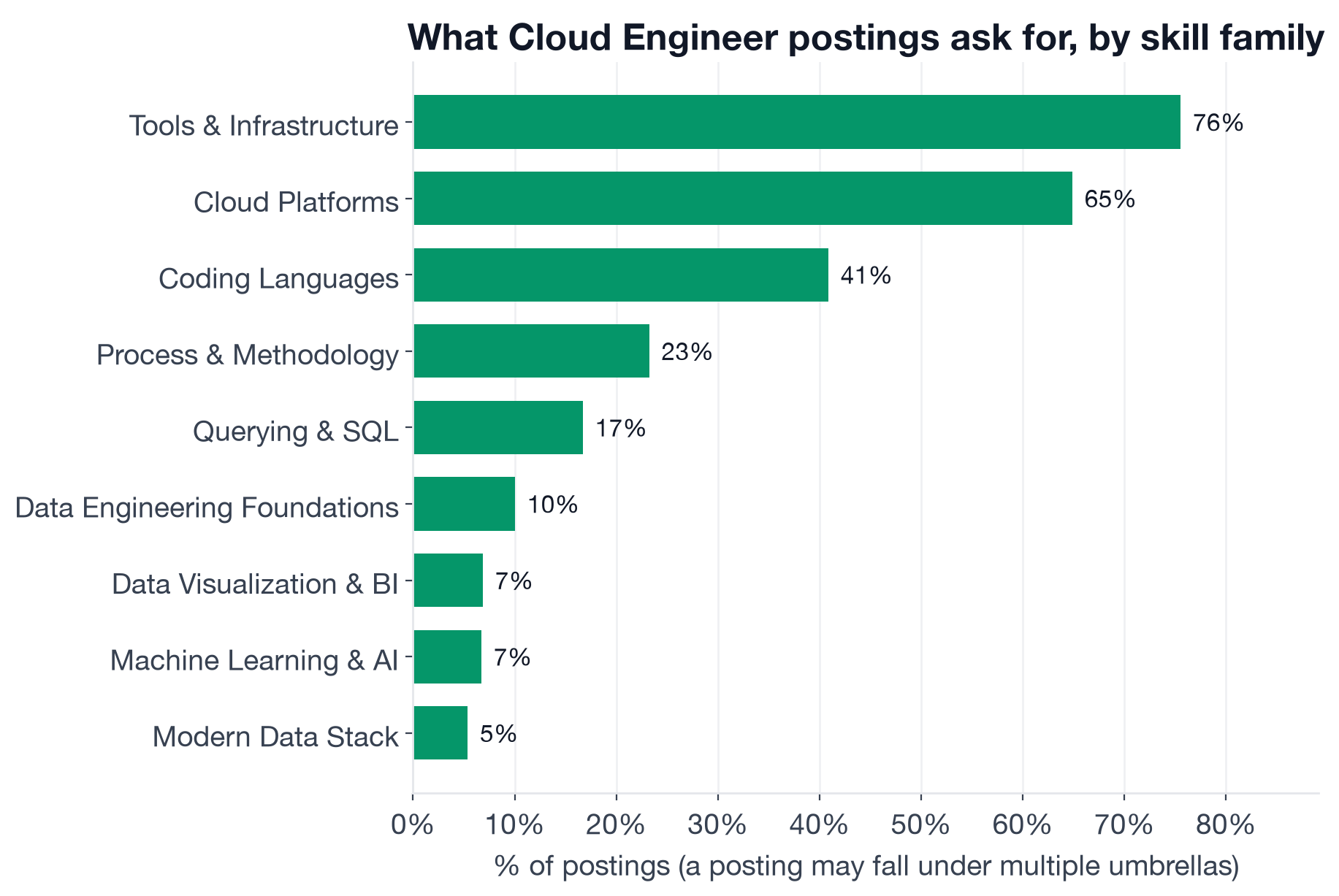
Share of Cloud Engineer postings that ask for at least one skill in each family. A posting mentioning both AWS and Azure counts once under "Cloud Platforms."
Three families define the role's skeleton:
Tools and Infrastructure (75.5%) is the dominant family, covering Terraform, Kubernetes, Linux, Docker, Ansible, and monitoring tooling. Three in four Cloud Engineer postings ask for at least one of these. CI/CD (34%, tracked separately in the data) sits alongside these skills in practice. This is infrastructure automation work, not cloud consumption.
Cloud Platforms (64.9%) covers AWS, Azure, and Google Cloud. Nearly two-thirds of postings name a specific cloud provider. The remaining third implicitly assumes one, so the practical coverage is closer to universal. What the data reveals, though, is that no single cloud dominates enough to become truly mandatory.
Coding Languages (40.9%) sits at two in five postings, driven almost entirely by Python (32.5%) and Bash (16.2%). Cloud Engineers are expected to write code; they just write it in service of infrastructure automation rather than application logic.
Process and Methodology (23.3%) mostly reflects Agile (15.8%), a soft signal that these roles sit inside larger engineering organizations with structured delivery cycles. Machine Learning and AI sits at 6.7% of postings (239 of 3,548), but that figure captures only roles explicitly hired to run AI infrastructure, such as GPU node pools, inference clusters, or ML pipeline compute. The ambient reality is different: 85% of developers now use AI coding tools regularly according to the JetBrains State of Developer Ecosystem 2025. For Cloud Engineers specifically, AI-generated Terraform, Kubernetes manifests, and CloudFormation templates are already standard practice whether or not the job posting mentions it. The 6.7% measures who you are hired to support AI for; the 85% measures who uses AI tools to do their daily work.
The Tier Structure, and Why There Are No Table Stakes
Drill into individual skills and the tier structure tells a specific story.
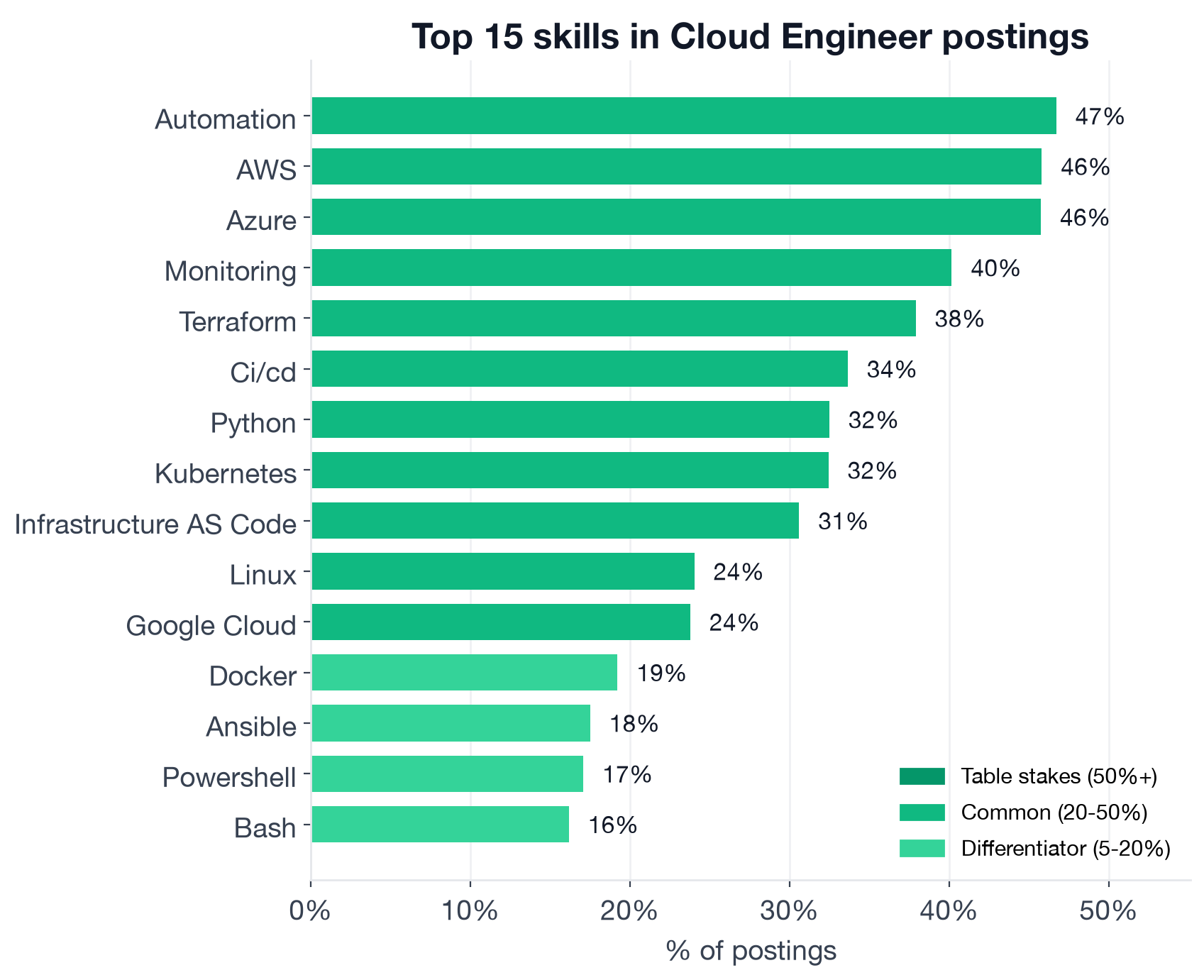
Top individual skills in Cloud Engineer postings by share of listings. Skills in the 20-50% range are the common tier; 5-20% are differentiators. The table-stakes tier (50%+) is empty for this role.
Table Stakes (50%+): None
This is the defining data point. In every other tech role we have analyzed, at least two or three skills clear 50%. Here, zero do. The closest candidate, Automation, sits at 46.7%. This is not a data quality issue; it reflects genuine market fragmentation. An AWS-first enterprise automation role does not look like an Azure DevSecOps role at a bank, which does not look like a multi-cloud infrastructure role at a SaaS company. All three are called "Cloud Engineer." None requires the same specific tool.
Common Expectations (20-50%): Where the Actual Bar Lives
With no table stakes, the common tier does the filtering work. A candidate who can credibly claim five or six of these skills will be competitive across most postings:
- Automation: 46.7% (Cloud Engineer + automation openings)
- AWS: 45.8% (Cloud Engineer + AWS openings)
- Azure: 45.7%
- Monitoring: 40.2%
- Terraform: 37.9% (the leading infrastructure-as-code tool; see the IaC + Terraform pairing in the next section) (Cloud Engineer + Terraform openings)
- CI/CD: 33.7%
- Python: 32.5%
- Kubernetes: 32.4% (Cloud Engineer + Kubernetes openings)
- Infrastructure as Code: 30.6%
- Linux: 24.0%
- Google Cloud: 23.8%
The AWS/Azure tie is particularly striking because in adjacent infrastructure roles, AWS has historically led Azure by a wide margin. Here, the gap is immeasurably small. This reflects a genuinely multi-cloud hiring market: enterprises with Azure estates hire Cloud Engineers on Azure; AWS-native startups hire on AWS; multi-cloud shops want both. No single platform has won.
Differentiators (5-20%): The Signals That Separate Candidates
The differentiator tier is unusually large for this role, spanning more than 35 distinct skills. The ones worth knowing:
- Docker (19.2%), Ansible (17.5%), PowerShell (17.1%): container runtime, configuration management, and Windows automation; relevant to which segment of the market you are targeting
- Observability (15.3%) and Scalability (15.3%): these appear together because they belong to the same concern: operating infrastructure at production scale, not just deploying it
- IAM (14.4%): identity and access management; the security perimeter for cloud resources
- Cloud Security (10.5%) and Cloud Architecture (10.4%): senior-leaning skills that signal design responsibility, not just implementation
- Grafana (9.4%) and Prometheus (8.5%): the open-source observability stack; Grafana is the visualization layer, Prometheus the metrics backend
Which Cloud Engineer Skills Pay More Than the Baseline?
Numbers in this section come from US postings only, where wage-transparency laws produce consistent base salary disclosure. The figures are base salary; equity, RSUs, bonuses, and sign-on are not captured in posting data, so total compensation at top employers runs higher than these figures.
The median US base salary for Cloud Engineer postings is $142,400 (n=645 postings with disclosed salary data). That is already a strong baseline, sitting above comparable medians for Systems Administrators and Information Security Analysts.
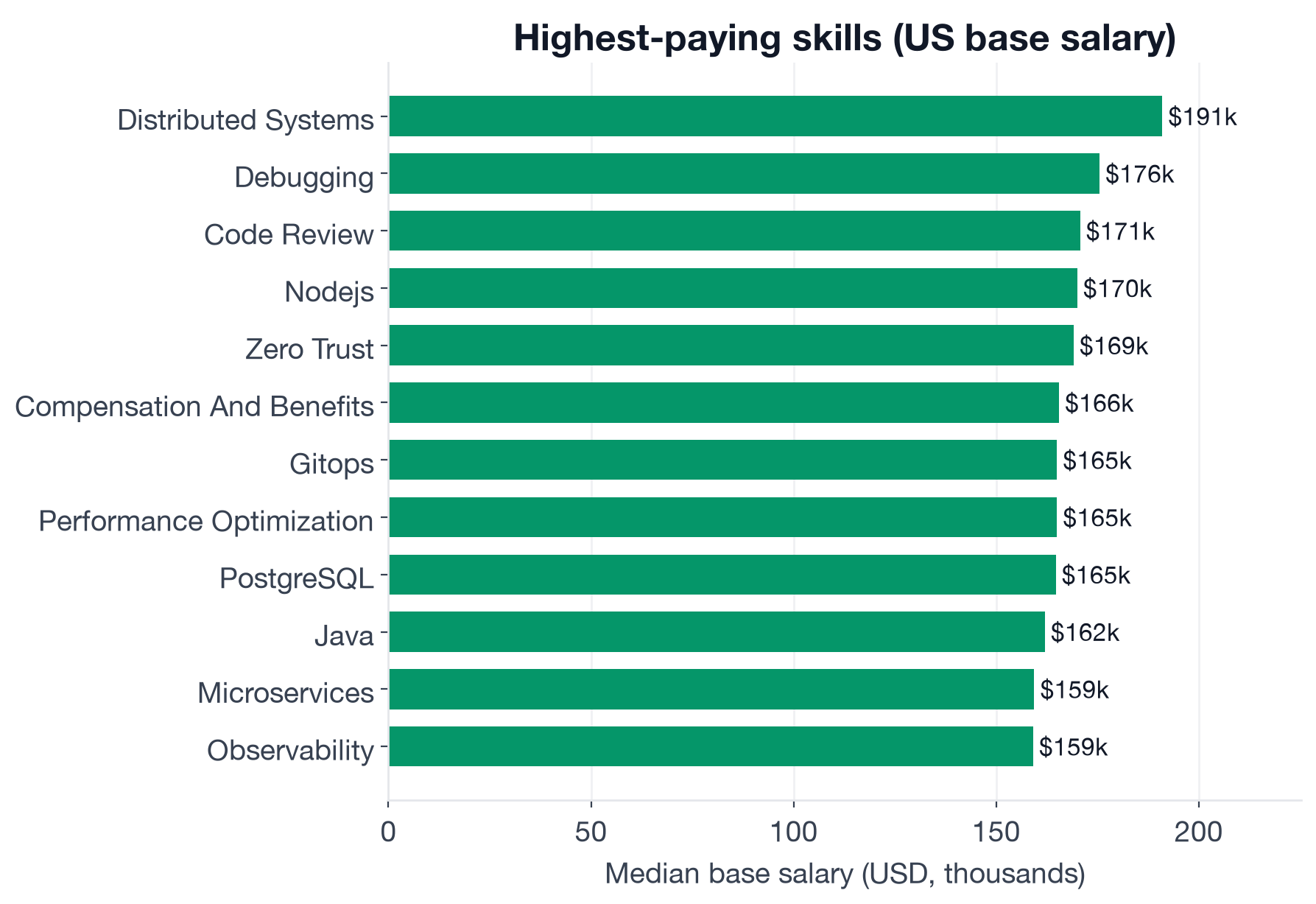
Median US base salary in USD for postings that mention each skill, among Cloud Engineer postings with structured US salary data. Baseline: $142,400 (n=645).
The salary story for Cloud Engineers is a clean split between breadth skills and depth skills.
Depth skills, each paying $11K to $17K above the baseline:
| Skill | Median US base | Premium over baseline | Sample size |
|---|---|---|---|
| Observability | $159,100 | +$16,700 | 118 |
| Kubernetes | $155,000 | +$12,600 | 223 |
| Cloud Security | $154,500 | +$12,100 | 81 |
| High Availability | $154,300 | +$11,900 | 76 |
| Incident Response | $153,900 | +$11,500 | 69 |
The platform premium picture:
| Cloud Platform | Median US base | vs. Baseline | Sample size |
|---|---|---|---|
| Google Cloud | $151,500 | +$9,100 | 166 |
| AWS | $142,500 | +$100 | 357 |
| Azure | $140,000 | -$2,400 | 301 |
GCP pays $9K above the baseline; AWS is essentially flat; Azure sits slightly below. This is almost certainly a composition effect: GCP adoption concentrates in product-led tech companies and AI-forward organizations that pay above-market salaries across the board, while the Azure market includes a larger share of enterprise IT and government work where comp benchmarks differently. Still, if your skills are genuinely transferable across clouds, the data suggests that GCP-focused roles are worth pursuing for salary upside.
Breadth skills fall well short of the depth premiums:
The skills that appear most often in postings, Automation ($151,800, n=336), Terraform ($150,300, n=276), CI/CD ($150,000, n=205), and Monitoring ($142,500, n=270), all sit within $10K of the baseline and well below the $12–17K depth premiums. They are necessary to get past screening, but companies are not paying a premium for them because every candidate has them. Baseline does not mean low. $142K to $152K is strong compensation; it is just not where the upside comes from.
The outlier worth mentioning with a caveat:
Distributed systems (a catch-all for large-scale distributed infrastructure) shows a median of $191,000 (n=41) in US postings. That $48,600 premium is striking, but the sample is small enough that a few outlier postings from hyperscalers or defense contractors can skew it. Treat it as directionally true rather than definitively true: deep distributed-systems experience belongs on a senior Cloud Engineer's resume, and it does attract above-market offers, but the exact premium varies significantly by employer type.
To drill into Cloud Engineer openings that match your depth profile, the InterviewStack.io job board lets you filter by skill to see current open roles asking for observability, Kubernetes, or cloud security specifically.
The Pairs That Define the Dominant Stack
Every two-skill co-occurrence among the top 25 skills shows which combinations appear together above chance. Lift greater than 1 means the pair shows up together more often than their individual frequencies would predict; lift of 2.0 means the pair appears twice as often as random.
| Skill pair | Postings with both | % of market | Lift |
|---|---|---|---|
| Infrastructure as Code + Terraform | 906 | 25.5% | 2.20 |
| CI/CD + Kubernetes | 738 | 20.8% | 1.91 |
| CI/CD + Terraform | 864 | 24.4% | 1.91 |
| CI/CD + Infrastructure as Code | 698 | 19.7% | 1.91 |
| Kubernetes + Terraform | 793 | 22.4% | 1.82 |
| AWS + Google Cloud | 705 | 19.9% | 1.82 |
| Python + Terraform | 766 | 21.6% | 1.75 |
| AWS + Terraform | 939 | 26.5% | 1.52 |
What these pairs tell you:
Infrastructure as Code + Terraform (lift 2.20) is the strongest pairing in the dataset. Postings that mention IaC as a concept are 2.2 times more likely to also name Terraform specifically. Terraform has won the IaC category for Cloud Engineers; it is the default implementation of the concept.
CI/CD + Kubernetes (1.91) and CI/CD + Terraform (1.91) both hit the same lift value, signaling that the Cloud Engineer's core workflow is not "pick one of these" but "operate both together." Kubernetes manages the runtime; Terraform provisions the platform it runs on; CI/CD automates how changes move through both. The three are a stack, not alternatives.
AWS + Google Cloud (1.82) is notable because it says multi-cloud is real demand, not just a marketing term. Postings asking for both appear nearly twice as often as you would expect by chance. These are not roles where a single cloud suffices.
AWS + Azure (1.40) with 1,044 postings at 29.4% of the market is the most common multi-cloud pair by volume, even if its lift is lower than the AWS + GCP pairing. The lower lift here reflects that AWS and Azure are each so common individually that their co-occurrence, though frequent, is less statistically elevated.
Who Gets Hired at Which Level?
Seniority tagging is based on title keywords. Postings without an explicit signal default to mid-level.
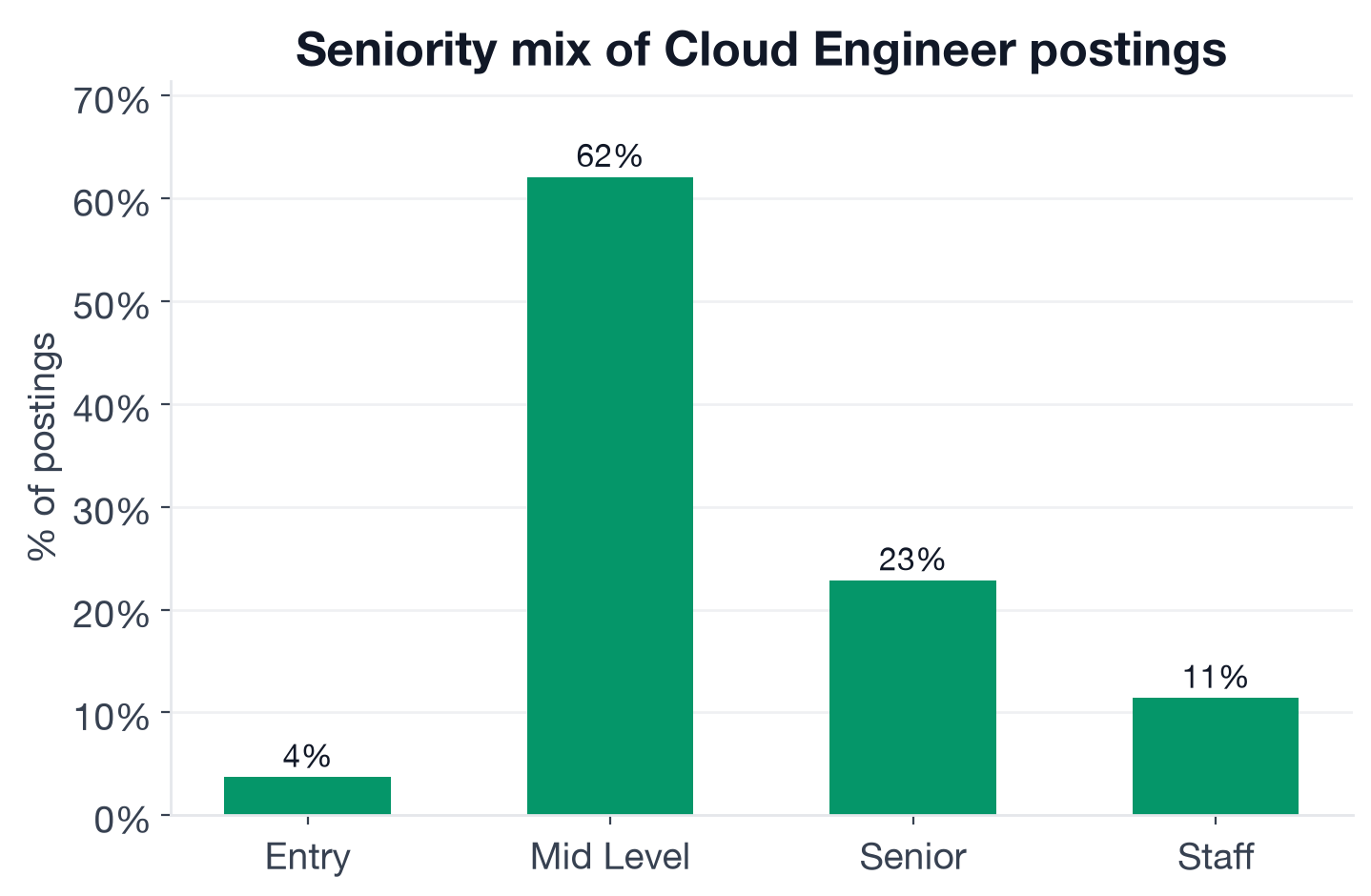
Seniority distribution of active Cloud Engineer postings.
- Mid-level: 62.1% (2,203 postings)
- Senior: 22.8% (810)
- Staff / Lead / Principal: 11.4% (404)
- Entry: 3.7% (131)
Mid-level dominates to an unusual degree: nearly two in three postings are mid-level, the highest concentration we have seen across engineering roles. The implication is that Cloud Engineer is primarily a role for engineers with two to five years of experience in cloud infrastructure, not a clear path for fresh graduates and not a role with the same senior-skew seen in Data Engineering, where senior-and-above accounts for roughly 45% of postings.
The 3.7% entry rate (131 postings) confirms the role is not the right first job. Companies expect hands-on platform experience before they hire. The realistic entry path is via a junior DevOps or SRE role, a systems administrator position where cloud responsibilities accumulate, or a cloud-support role at one of the major hyperscalers. From any of those, the Cloud Engineer mid-level market opens up relatively quickly.
For candidates targeting senior Cloud Engineer openings, the differentiator skills become more relevant: cloud architecture (10.4%), observability (15.3%), and high availability (11.1%) increasingly appear in senior-titled postings.
Where Are Cloud Engineer Jobs, and How Remote Is This Role Really?
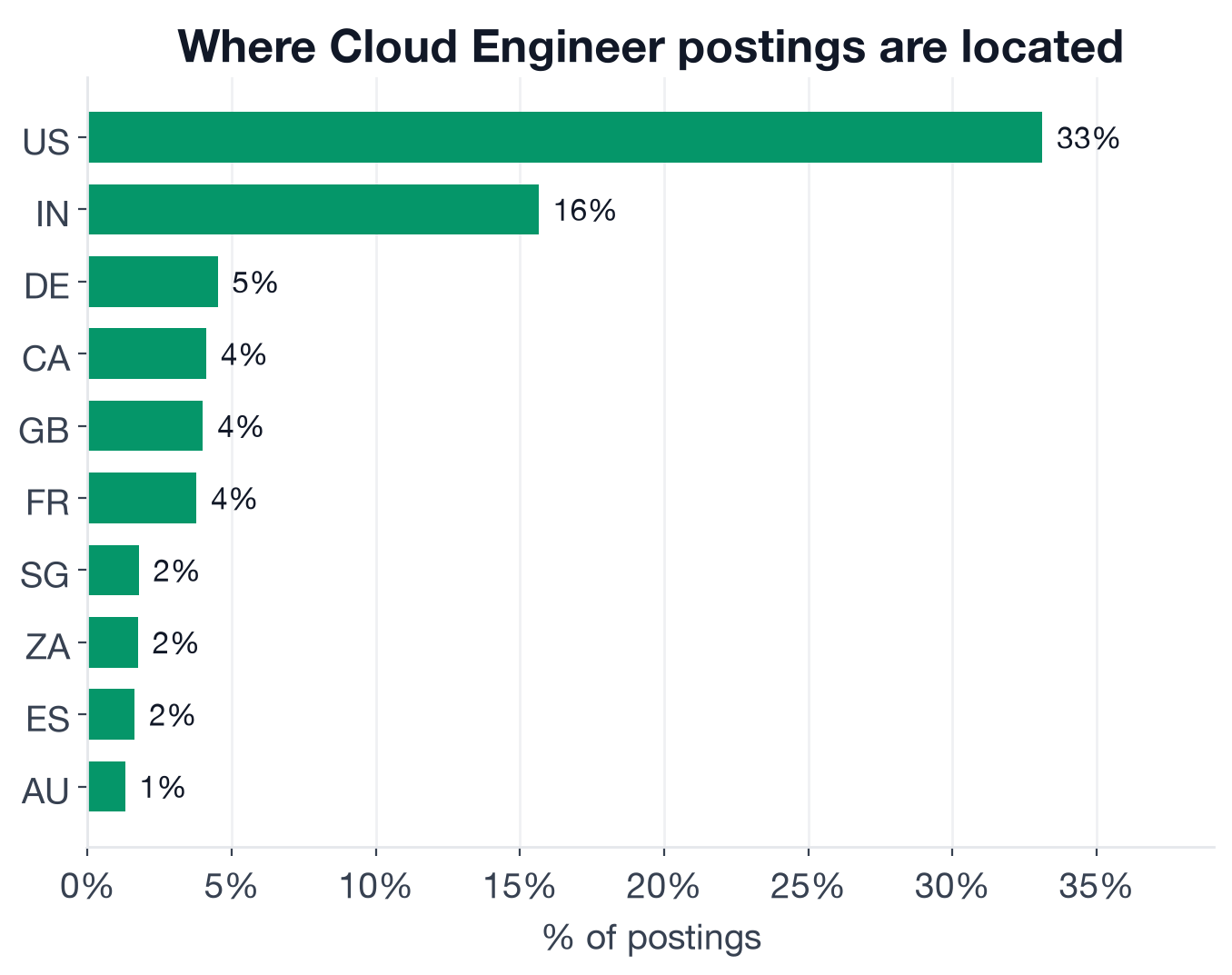
Top countries by share of Cloud Engineer postings.
- United States: 33.1% (1,175 postings)
- India: 15.6% (555)
- Germany: 4.5% (160)
- Canada: 4.1% (146)
- United Kingdom: 4.0% (142)
- France: 3.8% (134)
The US holds a third of all postings, a larger share than Data Engineering (29%) or Data Analysis. India is second at 15.6%, meaningful but not the near-parity it represents for Data Engineers. Germany, Canada, and the UK are each in the 4% range, suggesting a genuinely distributed global market with the US significantly ahead. For candidates focused on the US salary tier, this geographic spread is favorable: the US pool is large relative to competing markets.
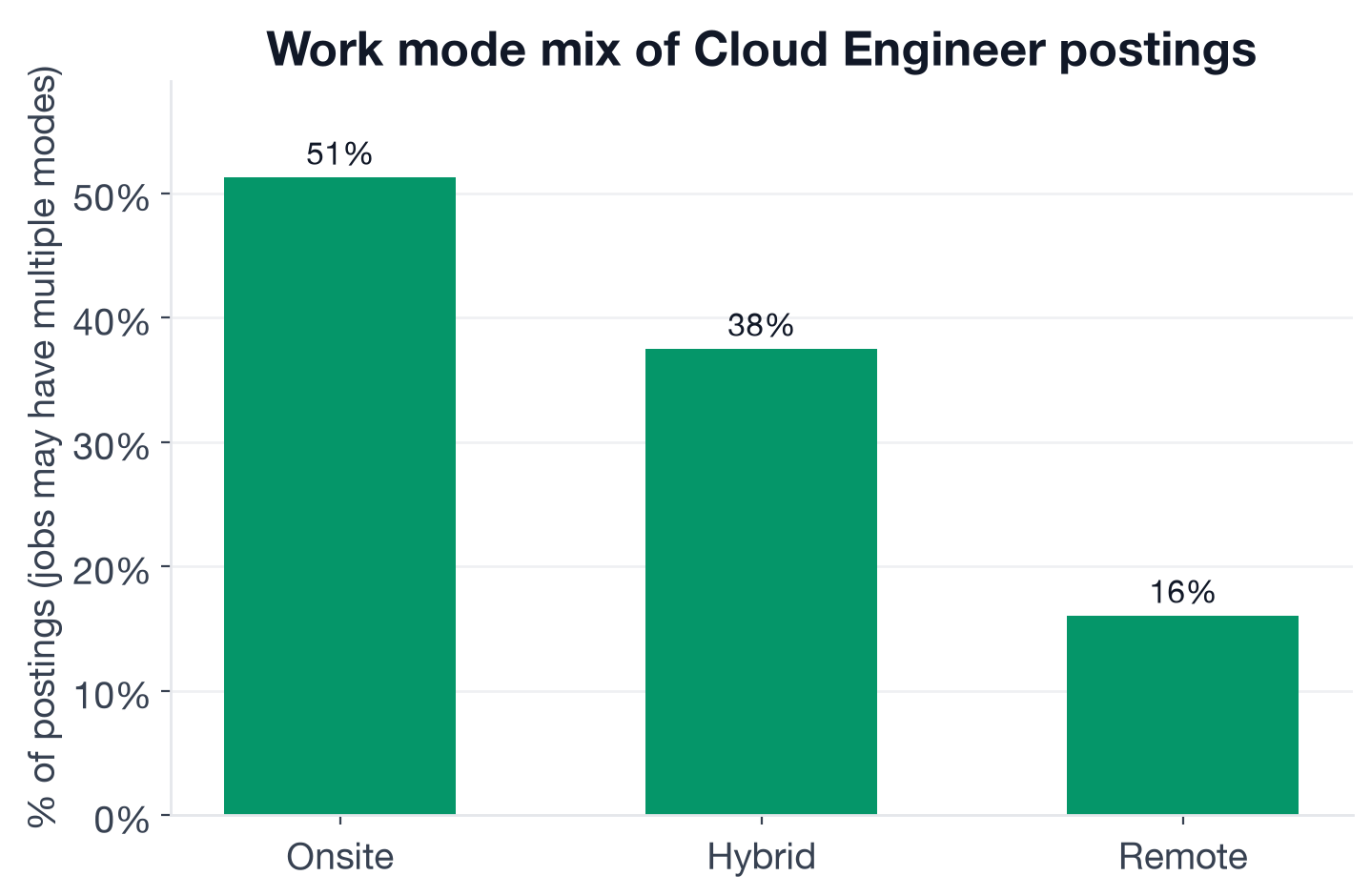
Share of Cloud Engineer postings tagged with each work mode.
- Onsite: 51.3% (1,820 postings)
- Hybrid: 37.5% (1,331)
- Remote: 16% (570) (fully-remote Cloud Engineer openings)
The remote number is the number most likely to surprise practitioners. A Cloud Engineer's entire job runs on remote infrastructure, so the assumption is that the role itself is remote-flexible. It is not, at least not at the median. Fully remote postings account for only 1 in 6 openings. The most plausible explanation: the consulting, defense, and financial services firms that dominate hiring (see below) tend to require physical presence in client environments or cleared facilities, pulling the remote share down relative to what you would see in a pure SaaS or startup market.
Hybrid at 37.5% represents a middle ground that grew from the pandemic and has stabilized. Combined remote-plus-hybrid covers about 54% of the market, so flexible arrangements are accessible for candidates who screen for them.
Who's Hiring Cloud Engineers in 2026?
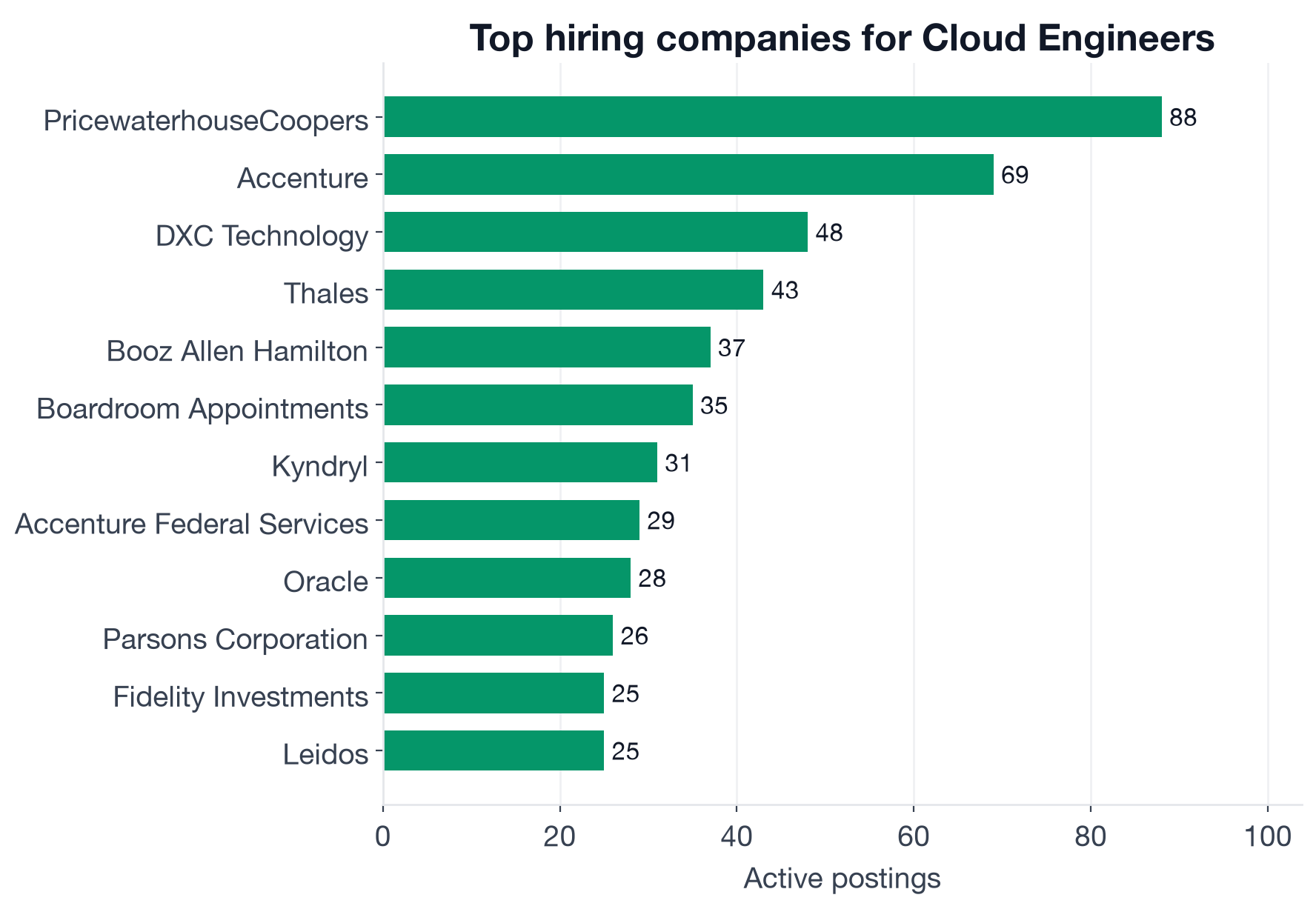
Top companies by distinct active Cloud Engineer postings.
| Company | Active postings | Profile |
|---|---|---|
| PricewaterhouseCoopers | 88 | Big Four consulting |
| Accenture | 69 | Global consulting |
| DXC Technology | 48 | IT services |
| Thales | 43 | Defense and aerospace |
| Booz Allen Hamilton | 37 | Government consulting |
| Kyndryl | 31 | IT infrastructure services |
| Accenture Federal Services | 29 | Federal IT consulting |
| Oracle | 28 | Enterprise software and cloud |
| Parsons Corporation | 26 | Defense and critical infrastructure |
| Fidelity Investments | 25 | Financial services |
| Leidos | 25 | Defense and intelligence |
| General Dynamics IT | 24 | Defense IT |
The roster tells the real story of who employs Cloud Engineers at scale: consulting firms, defense contractors, and financial services companies, not hyperscalers. AWS, Microsoft, and Google are not in the top 12 here; they hire at those titles internally, but as SREs, Platform Engineers, and Cloud Architects, not as "Cloud Engineers." The generic title pools in the consulting and defense sector.
This has practical implications. If you are early in your Cloud Engineer career, the consulting firms (PwC, Accenture, DXC, Kyndryl) are often the highest-volume, easiest-to-access path in. The tradeoff is that consulting Cloud Engineer roles tend to be more operational than architectural, often maintaining migrations and managing client environments rather than designing platforms from scratch. Defense-adjacent firms (Booz Allen, Parsons, Leidos, GDIT) frequently require clearances, which are a meaningful barrier but also a durable market signal: the cleared Cloud Engineer market is large and consistently understaffed. For interview prep specific to these firms, the InterviewStack.io preparation guides cover hiring process expectations across major employers.
How to Use This in Your Job Search
1. Accept that platform choice is the first filter. With AWS and Azure in a dead heat and no table-stakes skill across the market, you cannot prepare for "Cloud Engineer jobs" as a generic category. Pick the cloud that matches the companies you want to work for, then build depth in that platform's native tooling (AWS: EC2, S3, Lambda, CloudWatch, CloudFormation; Azure: Azure DevOps, Azure Monitor, ARM templates; GCP: GKE, Cloud Build, Pub/Sub). Multi-cloud breadth is valuable at senior levels; platform fluency is what gets you hired at mid-level.
2. Terraform and Kubernetes belong on every resume. The pairing data makes this clear. Terraform appears in 38% of postings and co-occurs with Infrastructure as Code at lift 2.2. Kubernetes appears in 32% of postings and pairs with CI/CD at lift 1.91. Both are platform-agnostic and transfer across AWS, Azure, and GCP. If you only have bandwidth to learn two tools outside your primary cloud, these are the ones. Browse current Terraform-focused openings and Kubernetes-focused openings to see how these filter the market.
3. Target observability for the strongest large-sample salary return. The salary data is consistent: depth in observability (Grafana, Prometheus, structured logging, SLOs) pushes median US salary from $142,400 to $159,100, a $16,700 premium backed by a sample large enough to trust (n=118). Two other cloud-relevant disciplines show higher medians with smaller samples: zero trust ($169,100, n=39) and gitops ($165,000, n=28). Both are directionally real but less statistically settled than observability's 118-posting base. Kubernetes adds $12,600 (n=223). Cloud security adds $12,100 (n=81). None of these require changing your platform specialization; they layer on top of whatever cloud stack you already know. Practicing interview questions on cloud architecture and observability is where candidates who know these skills need to prove they can articulate the tradeoffs under interview pressure.
4. AI tools are now the assumed baseline. Only 6.7% of Cloud Engineer postings explicitly require AI or ML skills, and those specifically measure roles hired to build or operate AI infrastructure (GPU clusters, inference pipelines, model-serving compute). The ambient reality is different: according to the JetBrains 2025 State of Developer Ecosystem survey, 85% of developers use AI tools regularly, and 46% of code written by active GitHub Copilot users is now AI-assisted (GitHub Octoverse 2025). For Cloud Engineers, AI-generated Terraform and Kubernetes YAML is already common practice. Using these tools well, including reviewing and correcting their output before applying, is a baseline expectation, not a differentiator.
5. Build toward the interviews before the applications. AI mock interview practice covers the architecture-design, failure-scenario, and IaC trade-off questions common in Cloud Engineer rounds. For foundation gaps in system design, Linux, or cloud networking, interactive courses provide structured prep. Start with whichever gap the tier analysis above identifies.
FAQ
Q. What skills do companies look for in Cloud Engineer roles in 2026?
No single skill appears in more than half of all Cloud Engineer postings, making this one of the most fragmented tech roles by demand. The closest to shared expectations are Automation (47%), AWS (46%), Azure (46%), Monitoring (40%), Terraform (38%), and CI/CD (34%). Kubernetes (32%), Python (32%), and Infrastructure as Code (31%) round out the common tier. Nothing qualifies as a table stake.
Q. What is the median Cloud Engineer salary in 2026?
Among US postings with salary data disclosed, the median Cloud Engineer base salary is $142,400 (n=645). That figure covers base salary only; equity, bonuses, and sign-on are not captured in job postings, so total compensation at top employers runs higher.
Q. Which Cloud Engineer skills pay the highest premium in 2026?
Among US postings, observability pays a median of $159,100 (n=118), about $16,700 above the $142,400 baseline. Kubernetes commands $155,000 (n=223, +$12,600), cloud security $154,500 (n=81, +$12,100), and high availability $154,300 (n=76, +$11,900). The broad-platform skills cluster at or below baseline: AWS pays $142,500, Azure $140,000, and monitoring $142,500.
Q. Is Cloud Engineering an entry-level-friendly career path?
Not especially. Only 3.7% of Cloud Engineer postings are explicitly entry-level (131 of 3,548 analyzed), and the dominant tier is mid-level at 62.1%. Companies typically expect hands-on experience with at least one cloud platform and one IaC tool. The most common entry path runs through junior DevOps, systems administrator, or cloud support roles.
Q. How remote-friendly are Cloud Engineer jobs in 2026?
Less remote than the role's cloud-native nature might suggest. Only 16% of Cloud Engineer postings (570 of 3,548) are tagged fully remote, while hybrid accounts for 37.5% and onsite for 51.3%. The US holds 33% of postings, followed by India (16%), Germany (4.5%), Canada (4.1%), and the UK (4%).
Q. Does choosing AWS, Azure, or GCP affect Cloud Engineer pay?
Yes, noticeably. US postings mentioning Google Cloud show a median salary of $151,500 (n=166), about $9,100 above the $142,400 baseline. AWS postings land at $142,500 (n=357, essentially at baseline), and Azure postings at $140,000 (n=301, slightly below baseline). GCP's premium likely reflects that GCP-focused roles skew toward tech-forward companies with above-average compensation structures.
Q. What is the dominant skill pair in Cloud Engineer postings?
Infrastructure as Code and Terraform co-occur with a lift of 2.2, the strongest pairing in the dataset: 906 postings (25.5%) mention both, and their co-occurrence is 2.2 times what their individual frequencies would predict. The next strongest clusters are CI/CD plus Kubernetes (lift 1.91) and CI/CD plus Terraform (lift 1.91), confirming that the dominant Cloud Engineer stack centers on automated deployment pipelines with IaC-managed infrastructure.
Where to Focus in 2026
Cloud Engineer is a strong role with a wide-open mid-level market: 2,200 mid-level postings across a genuinely global hiring base, an already-high $142K US baseline, and a clear ladder to $155-159K for anyone who goes deep on observability or Kubernetes. The fragmentation that makes it hard to prepare also makes it forgiving to specialize: you do not need to master every cloud. You need to be excellent at one, fluent in Terraform and Kubernetes across all of them, and deep enough in at least one operational discipline (observability, cloud security, or high availability) to move past the common tier into the premium range. Current Cloud Engineer openings on the InterviewStack.io job board are filtered by role, skill, and work mode, so you can scope to the exact segment of the market that matches your stack.
Topics
Ready to practice?
Put what you've learned into practice with AI mock interviews and structured preparation guides.