
Saying Terraform Isn't Enough
You have run Terraform in production. You can name the resources this service needs without hesitating: stateless instances behind a load balancer, a managed database, object storage, monitoring, and secrets. A mid-level Cloud Engineer infrastructure automation interview should be comfortable territory. Then the follow-ups start. How does the codebase stay consistent across three environments without copy-pasting resource blocks? Who is allowed to run apply, and under what conditions? How do secrets travel from a secrets service into the resources that need them without touching state files or CI logs? Each question probes a design decision you implied but did not articulate. Those decisions carry 60 of the 100 rubric points.
This post walks through four turns of a simulated 30-minute interview on infrastructure automation and provisioning for a mid-level Cloud Engineer. Each turn shows a common answer and what it costs, then the coaching correction.
Key Findings
- A mid-level Cloud Engineer infrastructure automation and provisioning interview runs 30 minutes across 3 scored phases.
- 60 of 100 rubric points go to Interviewer Objectives Alignment (30 pts) and Level-Specific Expectations (30 pts): framing and implementation judgment outweigh tool knowledge.
- Phase 1 (0-8 minutes) holds 5 checklist items covering IaC tool justification, resource scope, environment separation, and establishing a Git-reviewed path to production.
- Phase 2 (8-20 minutes) carries 6 checklist items: module structure, variable strategy, remote state, locking, apply access control, and idempotency awareness.
- Phase 3 (20-30 minutes) has 6 checklist items including drift detection, at least one testing approach, a realistic rollback strategy, observability integration, and deployment pattern trade-offs.
- Technical Proficiency and Communication and Problem Solving each account for 20 of the 100 points, rewarding clarity under follow-up rather than just correct unprompted answers.
What the Cloud Engineer Infrastructure Automation and Provisioning Interview Is Really Testing
The interview question
A product team at our company is launching a new internal service that must run in dev, staging, and production on a major cloud provider. The service consists of stateless application instances behind a load balancer, a managed relational database, object storage for artifacts, basic monitoring/alerting, and secrets for database credentials and API keys. Multiple engineers will contribute infrastructure changes through Git, and deployments should be safe enough that production changes are reviewable before apply.
You are asked to design the infrastructure automation and provisioning approach for this service so that new environments can be created consistently and ongoing changes can be made safely over time.
How would you design and implement the infrastructure automation for this service?
The question is open by design. What the interviewer tracks is whether you think in systems: reusable module definitions, environment-specific variable injection, state safety across multiple contributors, secrets hygiene, and a change workflow that keeps production reviewable. Naming the tool and mapping the six resources handles the first checklist item. The remaining 22 minutes and 16 checklist items probe everything else.
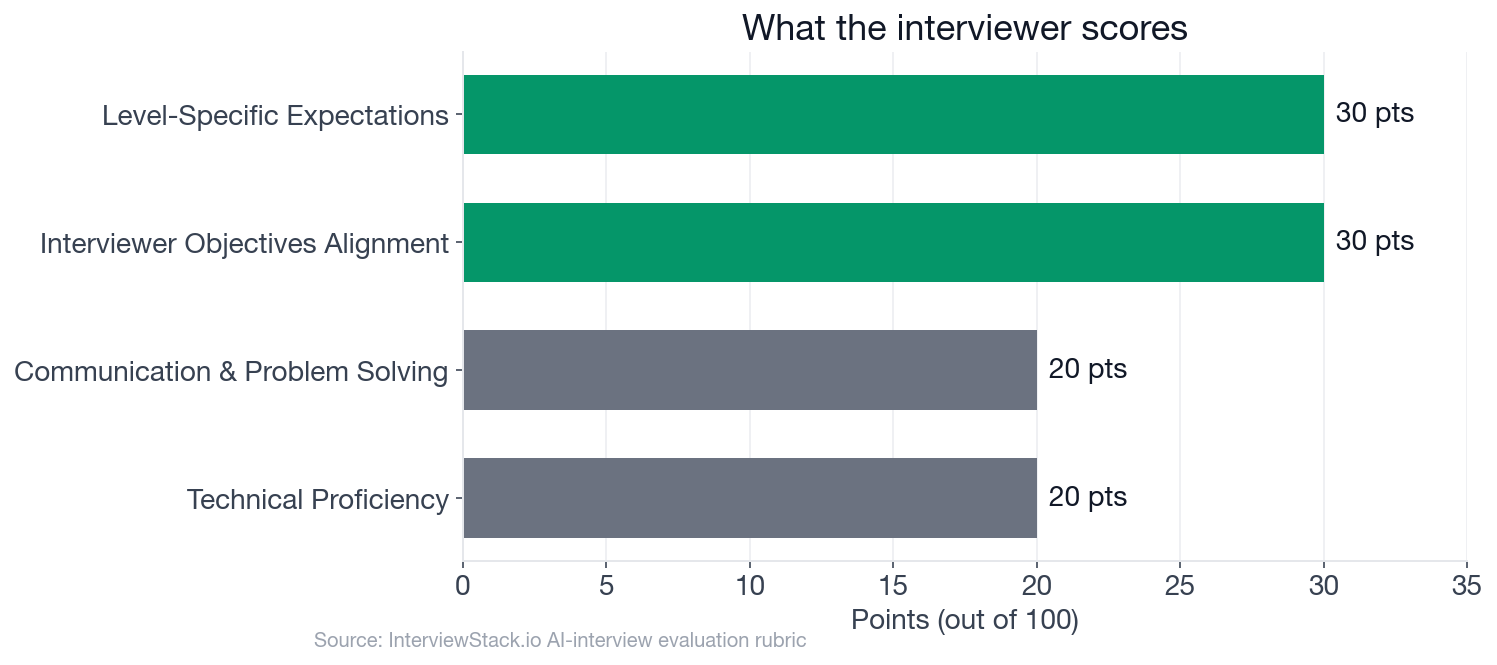
The two largest dimensions each carry 30 points. Both are won or lost on system-level judgment, not on syntax recall.
Four Turns, Four Places Candidates Leave Points Behind
Turn 1: Module Structure
Interviewer: "How would you organize the Terraform, CloudFormation, or similar codebase so that dev, staging, and production stay consistent without becoming hard to maintain?"
Turn 2: Remote State and Locking
Interviewer: "What would you do to manage remote state, locking, and collaboration safely when several engineers are applying infrastructure changes?"
Turn 3: Secrets Handling
Interviewer: "How would you handle secrets and sensitive values so they are usable by automation but do not leak through code, state, logs, or CI pipelines?"
Turn 4: CI Validation Gates
Interviewer: "What testing and validation steps would you add in CI/CD before allowing infrastructure changes to reach production?"
Coaching Corrections Are Easier to See Than to Apply
Reading the mistakes above, the corrections look obvious. On the page they are labeled, the context is frozen, and there is no follow-up arriving before you have finished thinking. Under 30-minute interview conditions, each question probes the exact gaps in what you just said, and the recovery skill (hearing the signal in the follow-up, pivoting without defensiveness, not doubling down) only comes from running the interview, not from reading a recap.
The Complete Blueprint: What a Strong 30-Minute Interview Hits
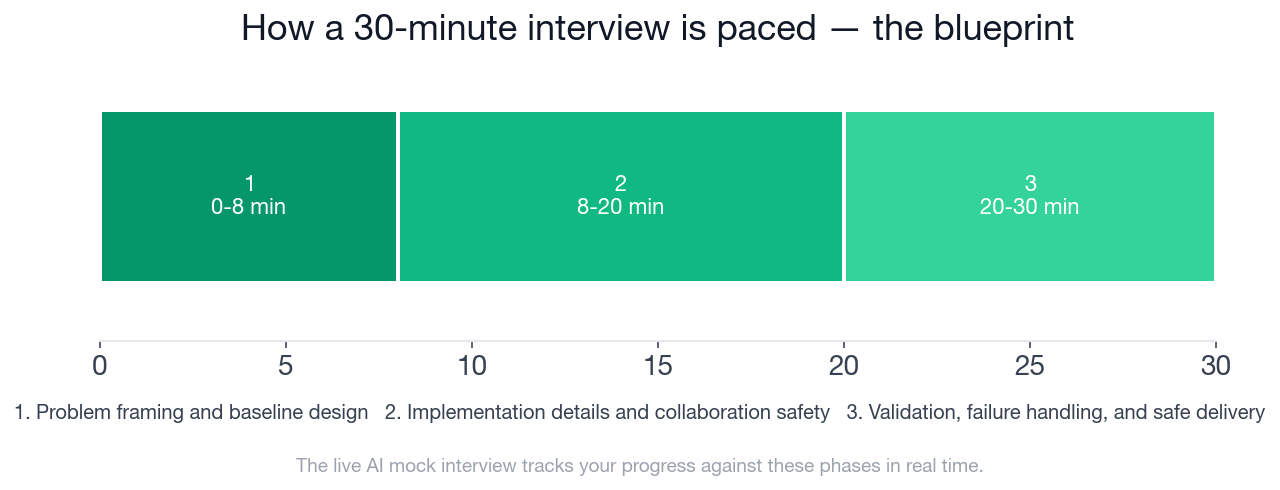
The chart below maps the 30 minutes into its three scored phases. Every checklist item is what the AI mock interview tracks you against in real time.
- ✓Chooses a primary IaC approach such as Terraform, CloudFormation, or ARM/Bicep and gives a reasonable justification
- ✓Identifies key resources to provision: networking assumptions if needed, compute or autoscaling group, load balancer, managed database, object storage, monitoring, secrets integration
- ✓Separates provisioning concerns from application deployment concerns at a sensible level
- ✓Describes how dev, staging, and production will be represented without duplicating all definitions
- ✓States that changes should flow through Git review before production apply
- ✓Explains a module or template structure that avoids copy-paste across environments
- ✓Describes where variables live and how environment-specific values are injected cleanly
- ✓Uses remote state with locking and mentions why local state or ad hoc applies are risky for shared infrastructure
- ✓Explains who or what is allowed to run apply, ideally through CI or controlled automation rather than unrestricted local execution
- ✓Mentions sensitive outputs or state concerns and proposes secret manager usage instead of hardcoding credentials
- ✓Shows awareness that declarative runs should be repeatable and idempotent
- ✓Adds pre-merge or pre-apply checks such as formatting, linting, validate, plan generation, and human review for production
- ✓Discusses at least one testing approach such as module/unit tests, ephemeral environment validation, or post-apply smoke checks
- ✓Explains how to detect drift and how often or where that check runs
- ✓Provides a realistic recovery or rollback approach, acknowledging that some infrastructure changes are not instantly reversible
- ✓Connects observability to provisioning by ensuring alerts, dashboards, or health checks are created alongside infrastructure
- ✓Can discuss when blue-green, canary, or immutable replacement is useful versus when an in-place change is acceptable
Practice Before the Clock Starts
The Cloud Engineer infrastructure automation and provisioning question bank covers every concept pattern that appears across these three phases. Drill individual topics there to build fluency with module design, state backends, secrets patterns, and CI gate sequences before taking the full simulation.
When you're ready for the complete 30-minute experience, start an AI mock interview for Cloud Engineer infrastructure automation and provisioning. The AI interviewer follows this exact blueprint, tracks your checklist coverage phase by phase, and delivers structured feedback on each scoring dimension. The Cloud Engineer preparation guide has a broader topic roadmap if you are prepping across multiple interview areas.
FAQ
Q. How long is a mid-level Cloud Engineer infrastructure automation and provisioning interview?
A typical mid-level Cloud Engineer interview on this topic runs 30 minutes across three phases: problem framing and baseline design (0-8 minutes), implementation details and collaboration safety (8-20 minutes), and validation, failure handling, and safe delivery (20-30 minutes). Each phase has a distinct checklist the interviewer tracks.
Q. What scoring dimensions matter most in a Cloud Engineer infrastructure automation interview?
The rubric has four dimensions adding to 100 points: Interviewer Objectives Alignment (30 points), Level-Specific Expectations (30 points), Technical Proficiency (20 points), and Communication and Problem Solving (20 points). The first two together account for 60 points, meaning framing and implementation judgment outweigh raw technical accuracy.
Q. How should you structure Terraform modules for multiple environments in a Cloud Engineer interview?
The key signal interviewers look for is separation between reusable module definitions and environment-specific configuration. A strong answer proposes a shared module (compute, database, networking, monitoring) called from thin per-environment wrappers that inject variable values. This avoids copy-pasting resource blocks across dev, staging, and production and makes the code easier to audit and evolve.
Q. How should remote state and locking be managed in a Cloud Engineer infrastructure interview?
Interviewers expect candidates to propose a remote state backend (such as S3 with DynamoDB locking for Terraform) and to explain why local state is risky when multiple engineers share infrastructure. A stronger answer restricts apply permissions to a CI pipeline rather than individual developer machines, so plan output is reviewable in pull requests and simultaneous applies are blocked by the backend lock.
Q. How should you handle secrets in a Cloud Engineer infrastructure automation interview?
A common mistake is proposing environment-variable injection at the CI level without addressing Terraform state exposure. Interviewers award points for mentioning a managed secrets service (AWS Secrets Manager, HashiCorp Vault, or a cloud equivalent) as the retrieval mechanism, marking sensitive Terraform outputs explicitly, and using short-lived IAM roles or service accounts for automation rather than long-lived credentials.
Q. What CI/CD validation steps are expected in a Cloud Engineer provisioning interview?
The Phase 3 checklist expects at least a format check, syntax validation, a linting or policy scan (such as tflint or Checkov), plan generation with the output surfaced as a reviewable artifact, and at least one post-apply verification such as a smoke test or ephemeral environment check. Production applies should require a manual approval step, not just an automated gate.
The Score Sits in the System, Not the Tool
The question asks you to design the infrastructure automation approach, not to name your preferred IaC tool. A tool name answers one checklist item. The remaining 16 items ask how the system holds up when three engineers push changes the same week, when a production apply fails halfway, and when the database credential needs rotating without anyone touching a .tfvars file. Those decisions are the interview.
Topics
Ready to practice?
Put what you've learned into practice with AI mock interviews and structured preparation guides.