
Azure Leads Every Metric Except One
Azure is the most-required platform in Cloud Architect postings, appearing in 45% of active listings, five percentage points ahead of AWS and twenty ahead of Google Cloud. It's also the most visible credential on LinkedIn profiles, the most common answer in recruiter calls, and the platform most enterprise cloud teams run day-to-day. So you'd expect Azure fluency to be where the salary premium lives. It isn't.
Across 1,840 active Cloud Architect postings on the InterviewStack.io job board, analyzed in June 2026, Azure-tagged positions carry a $165,000 US base salary median. The overall role median is $168,300. That puts Azure $3,300 below the baseline. Meanwhile Java, which appears in only 11% of postings, carries a $196,900 US median: a $28,600 premium over the same baseline. Python (24% of postings) comes in at $184,000. Security and reliability specialties (Cloud Security, Zero Trust, DevSecOps, Observability, Containerization) cluster between $174K and $178K.
The pattern is consistent: the skills that show up in the most postings tend to pay at or below the median, because they're commoditized within the role. The skills that appear in fewer postings and require deeper expertise are what companies actually bid for. Azure gets you the interview. Java, security depth, and reliable platform engineering close the offer.
Dataset note: The 1,840 postings are classified under "Cloud Architect" and cover the full range of that title: cloud infrastructure architects, enterprise cloud architects, multi-cloud solution architects, and adjacent specialist roles including some system architects and domain specialists. Cloud-platform and cloud-tooling skill frequencies (Azure, AWS, Kubernetes, Terraform) are the most direct signals from cloud-focused postings in this dataset; general architect skills may reflect a somewhat broader title mix.
Key Findings
- 1,840 active Cloud Architect postings analyzed on the InterviewStack.io job board as of June 2026.
- Azure leads demand at 45% of postings but carries a $165,000 US median, $3,300 below the $168,300 role baseline.
- Java commands the largest salary premium among cloud skills analyzed in this post: $196,900 US base median (+$28,600 above baseline, n=36). Python follows at $184,000 (+$15,700, n=103).
- Security and reliability skills pay $6-9K above baseline: Cloud Security ($177,000), Zero Trust ($174,700), DevSecOps ($174,400), Observability ($177,500), Containerization ($177,500).
- No true table-stakes skills: nothing exceeds 50% of postings. The common tier spans Azure (45%) down to Scalability (22%).
- Infrastructure as Code + Terraform is the highest-lift pair in the dataset at 3.48: postings that ask for IaC almost always also require Terraform.
- Near-zero entry-level pipeline: only 0.87% of postings (16 of 1,840) are explicitly entry-level. Mid-level accounts for 66%, senior for 19%, staff for 14%.
- Remote is limited: 19% of postings are remote, 44% hybrid, 45% onsite.
Which Skill Families Define Cloud Architect Work in 2026?
Group individual skills by their broader domain and a picture of the role's shape emerges clearly.
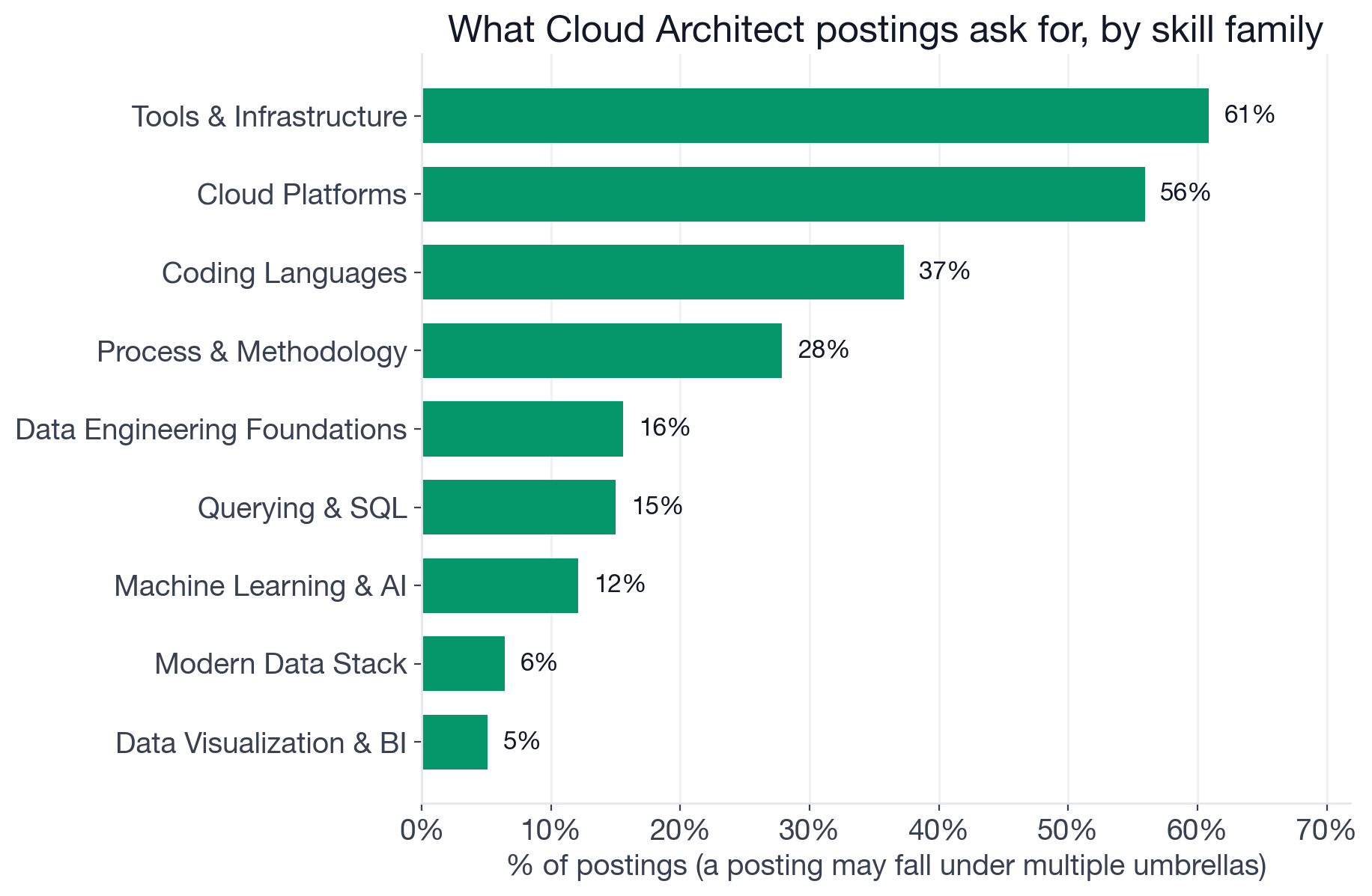
Share of Cloud Architect postings that ask for at least one skill in each major family. A posting mentioning both AWS and Azure counts once under "Cloud Platforms."
Cloud Platforms appears in 56% of postings, covering AWS, Azure, and Google Cloud. The pair data reveals how common multi-cloud requirements already are: AWS and Azure appear together in 31% of all postings, and either of those paired with Google Cloud shows up in roughly 22%. Multi-cloud fluency is not an edge expectation; it is embedded in nearly a third of Cloud Architect job descriptions.
Tools and Infrastructure shows up in 61% of postings, anchored by Automation (34%), Kubernetes (25%), Monitoring (24%), and Terraform (24%). This is the operational spine of the role: the architect is expected to build, run, and observe infrastructure at scale, not just design it on a whiteboard.
Coding Languages appears in 37% of postings, primarily Python (24%) with Java (11%) and Bash (7%) trailing. The presence of programming languages in more than a third of Cloud Architect postings is a meaningful signal. This is not a pure ops role. Companies want architects who can automate, script, and sometimes write the application-layer code that rides on the infrastructure they design.
Machine Learning and AI appears in 12% of postings (Generative AI specifically at 7%). Those postings measure architects hired to design or manage AI/ML infrastructure. But the ambient layer is larger: the Stack Overflow 2025 Developer Survey found 51% of professional developers use AI tools daily. For Cloud Architects specifically, that ambient layer shows up as Copilot-assisted Terraform authoring, ChatGPT-drafted architecture docs, and AI-driven Kubernetes observability. The 7% explicit figure measures architects building AI systems. The daily-use baseline is far higher.
Where the Salary Premium Actually Lives
Salary numbers below are restricted to US postings only, where wage-transparency laws produce consistent disclosure, so they're directly comparable. These are base salary figures only: equity, bonuses, RSUs, and sign-on are not disclosed in postings, and total comp at top employers is meaningfully higher than what we report here.
The overall US base median for Cloud Architects is $168,300 across 386 postings with disclosed salary data. Here is how individual skills shift that figure:
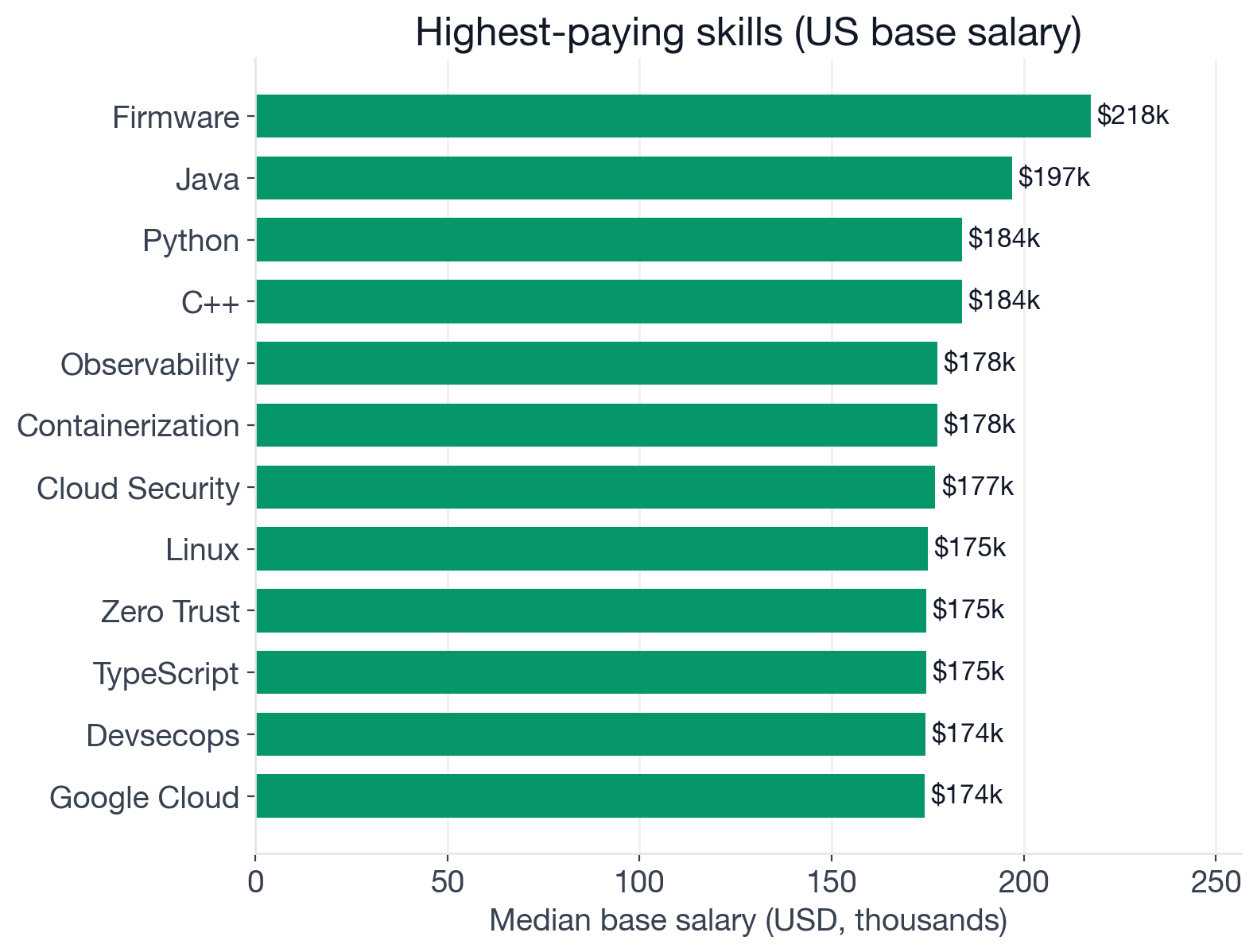
Median US base salary in USD for Cloud Architect postings that mention each skill. US postings only, base salary only, minimum 25 salary data points per skill.
The coding tier (+$15K to +$29K above baseline):
Java sits at $196,900 (n=36), the largest premium among the cloud skills analyzed here, at $28,600 above the role baseline. Python is at $184,000 (n=103), adding $15,700. A Cloud Architect who can write production Java or Python code is a different candidate profile: one who can participate in application design decisions, not just infrastructure design. That distinction is worth nearly one salary band.
The security and reliability tier (+$6K to +$9K):
Observability and Containerization each add $9,200 above baseline ($177,500 median; n=59 and n=35 respectively). "Observability" here means instrumenting systems with distributed tracing, structured logging, and SLO-based alerting, not just wiring up a dashboard. Cloud Security ($177,000, n=38) and Zero Trust (a security model requiring strict identity verification for every user and device, $174,700, n=40) follow closely. DevSecOps ($174,400, n=42) rounds out this cluster. The common thread: security is being woven into the architecture layer, not handed off to a separate team, and companies pay extra for architects who own that integration.
The operational skills (at or below baseline):
The skills that appear in the most postings tell a different story. Terraform at 24% of postings carries a $163,700 US median, $4,600 below baseline. Infrastructure as Code (20% of postings) is at $162,500, $5,800 below baseline. Automation (34%) is at $164,000. Azure (45%) is at $165,000. Monitoring (24%) is at $164,500.
These are not weak skills. They're the floor. Every Cloud Architect is expected to know Terraform, work with Azure, and build automated pipelines. Because they're universal within the role, they don't differentiate candidates from each other, and they don't move salary. The premium lives where the skills are harder to find: deep reliability engineering, coding fluency, and security integration.
What Does a Competitive Cloud Architect Skill Set Look Like Now?
With no skills crossing 50% of postings, there is no single table-stakes requirement for Cloud Architects. The role is defined by a common tier that spans Azure down to Scalability, with a long differentiator tail. Browse current Cloud Architect openings and the range of expectations becomes clear.
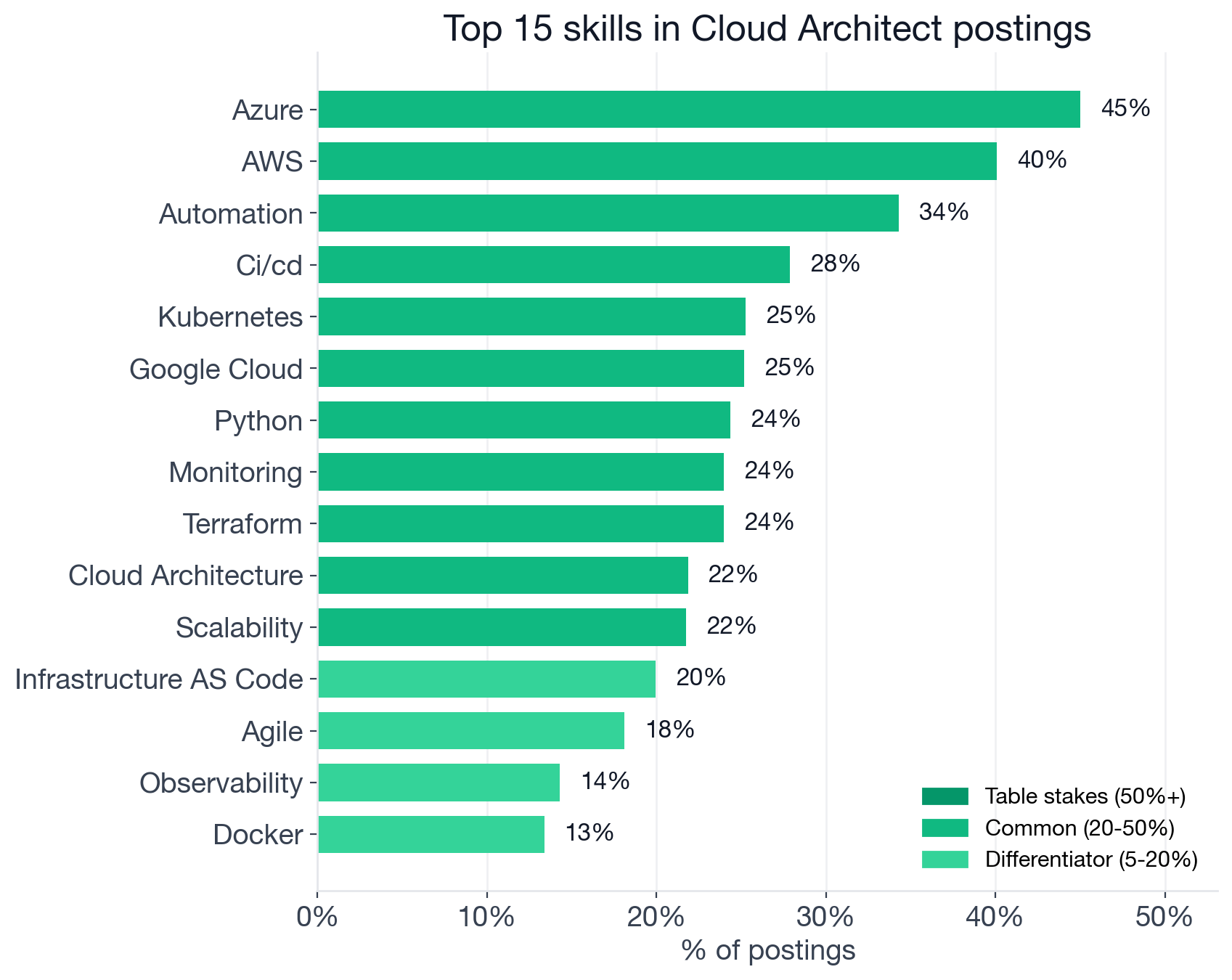
Top individual skills in Cloud Architect postings by mention rate. 20-50% is the common tier; 5-20% is the differentiator tier. No skills exceed 50%.
Common Expectations (20-50% of postings)
These skills appear in at least one in five postings, making them the baseline hiring managers expect to see:
- Azure: 45% | AWS: 40% (browse Cloud Architect + AWS openings) | Google Cloud: 25%
- Automation: 34% | CI/CD: 28% | Kubernetes: 25% (Cloud Architect + Kubernetes openings)
- Python: 24% | Monitoring: 24% | Terraform: 24%
- Cloud Architecture: 22% | Scalability: 22%
The cloud platform mix is worth reading carefully. AWS and Azure are nearly tied at demand level, but they serve different markets: Azure-heavy postings tend to come from enterprises running Microsoft stacks; AWS-heavy postings skew toward tech-forward and startup environments. Google Cloud at 25% is smaller but carries the highest salary premium of the three platforms ($174,300 US median, $6,000 above baseline). A candidate fluent in Azure qualifies for 45% of postings; AWS fluency reaches 40%. Either major cloud alone covers a large share of the market, and a candidate fluent in two is well-positioned for multi-cloud roles, which are becoming more common.
Differentiators (5-20% of postings)
The differentiator tier is unusually dense for this role, with nearly 40 individual skills between 5% and 20%. The highest-value subset:
- Infrastructure as Code: 20% (at the top of the differentiator tier; pairs almost exclusively with Terraform)
- Observability: 14% (worth $9,200 above baseline; under-weighted relative to its pay signal)
- Docker: 13% | Ansible: 12% | Java: 11% (+$28,600 if you can add it)
- IAM (Identity and Access Management): 11% | Linux: 11% (+$6,700)
- Containerization: 9% | Cloud Security: 9% (+$8,700) | Virtualization: 9%
- Disaster Recovery: 8% | Stakeholder Management: 8%
- CloudFormation (AWS's native IaC service): 8% | System Design: 8%
- High Availability: 8% | Generative AI: 7% | DevSecOps: 7% (+$6,100)
- Distributed Systems: 7% | Zero Trust: 6% (+$6,400)
The security cluster (IAM, Cloud Security, Zero Trust, DevSecOps, Encryption) sits between 6% and 11% frequency but 6-9% above the salary baseline. Security expertise at the architecture layer is in demand and under-supplied. If you're building this role from a general infrastructure background, the security vector has the highest ROI on new learning.
Terraform Is the Connective Tissue
Co-occurrence lift measures how much more often two skills appear together than chance alone would predict. A lift above 1 means the pair is over-represented; the higher the number, the tighter the coupling.
| Skill pair | Postings with both | Share | Lift |
|---|---|---|---|
| Infrastructure as Code + Terraform | 306 | 16.6% | 3.48 |
| CI/CD + Infrastructure as Code | 244 | 13.3% | 2.38 |
| CI/CD + Terraform | 280 | 15.2% | 2.28 |
| AWS + Google Cloud | 408 | 22.2% | 2.20 |
| Kubernetes + Terraform | 231 | 12.6% | 2.07 |
| Azure + Google Cloud | 411 | 22.3% | 1.97 |
| CI/CD + Kubernetes | 252 | 13.7% | 1.94 |
| Automation + Infrastructure as Code | 240 | 13.0% | 1.91 |
| Automation + Terraform | 279 | 15.2% | 1.84 |
| AWS + Terraform | 305 | 16.6% | 1.73 |
Skill pairs among the top 25 Cloud Architect skills by co-occurrence lift. Lift greater than 1 means the pair appears together more often than individual frequencies predict.
Terraform dominates this table in a way no other single tool does. It appears in five of the ten highest-lift pairs, including the top spot: IaC + Terraform at 3.48, the single strongest coupling in the entire Cloud Architect skill graph. A posting that asks for Infrastructure as Code almost always expects Terraform specifically. The implication is practical: learning IaC abstractly is not a substitute for hands-on Terraform fluency. The postings are not asking for a concept; they're asking for the tool.
The multi-cloud pairs (AWS + Google Cloud at 2.20, Azure + Google Cloud at 1.97) tell a complementary story. By co-occurrence lift, both GCP-inclusive pairs exceed the AWS+Azure lift (1.72), meaning that when a posting adds a second cloud, it is disproportionately likely to be Google Cloud rather than the alternative primary cloud. The AWS+Azure pair appears in more postings in raw count (569 vs 408 and 411 for the GCP pairs), but GCP is the dominant expansion path by lift. Companies that cross cloud boundaries tend to use Google Cloud as the second platform, not as a primary.
CI/CD pairs strongly with both Terraform (2.28) and Kubernetes (1.94), capturing the pipeline-as-infrastructure expectation: Cloud Architects at modern companies are not just drawing diagrams; they're shipping infrastructure through the same CI/CD process the application teams use. The IaC + CI/CD + Kubernetes cluster is the high-autonomy, high-pay configuration.
Who's Getting Hired, and at What Level?
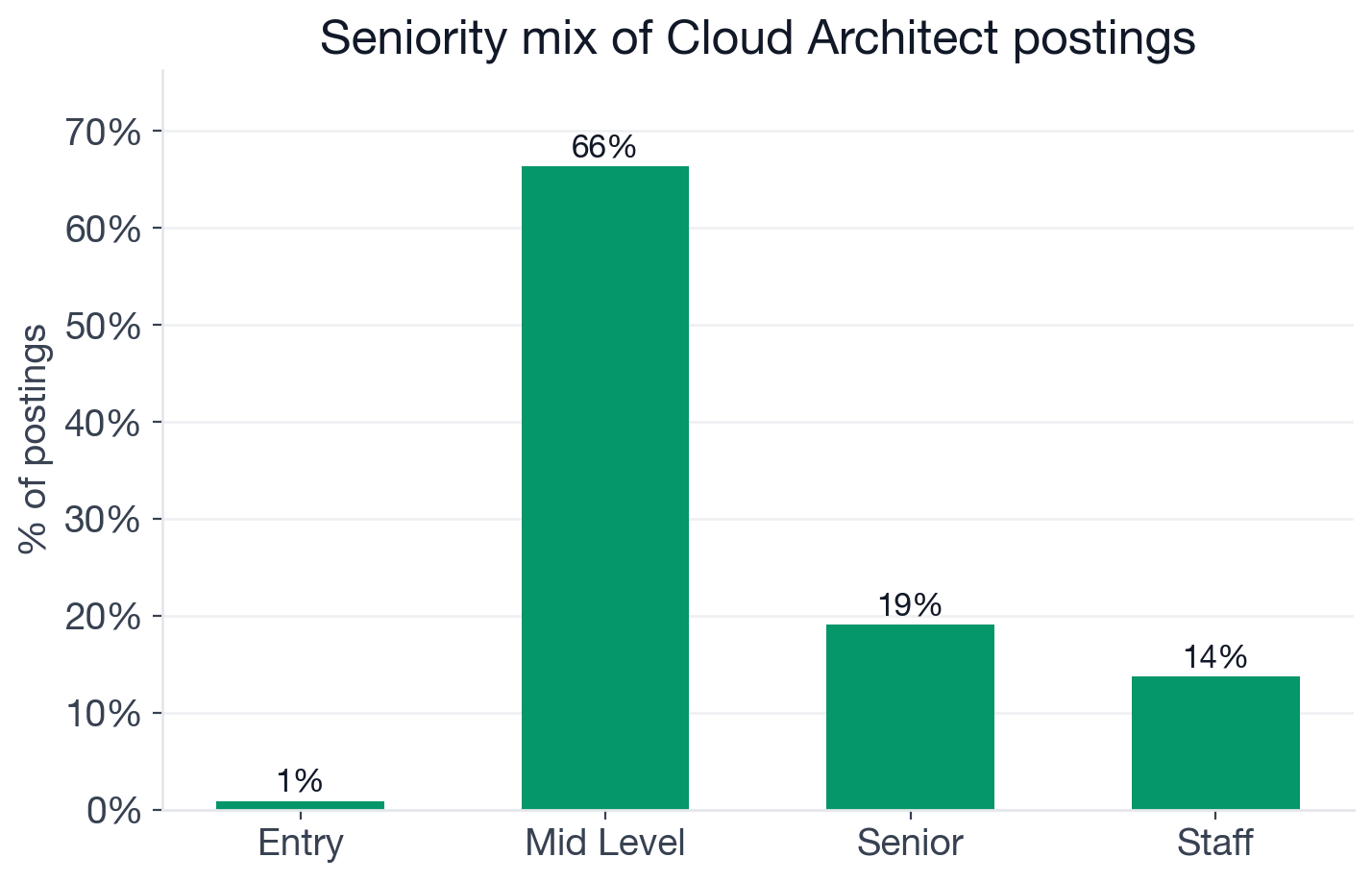
Seniority distribution of Cloud Architect postings based on title-keyword signals. Postings without an explicit signal default to mid-level.
The seniority picture is stark. Mid-level is 66% of the market (1,221 postings). Senior is 19% (351). Staff-level is 14% (252). Entry-level is 0.87%: sixteen postings out of 1,840.
That near-zero entry-level rate is not a quirk of the data. Cloud Architect is one of the highest-experience-bar roles in infrastructure hiring. Companies expect candidates to have made real architectural decisions under production conditions: chosen a service mesh, debugged a Kubernetes failure at 2am, designed a disaster-recovery runbook that was actually tested. None of that happens in an entry-level job. Career-switchers typically route through cloud engineer, DevOps engineer, or platform engineer roles to build the production reps before targeting architect titles.
For the 14% staff-level slice, the differentiator skills (Distributed Systems, Observability, multi-cloud fluency, Terraform at scale) shift from optional to expected. If you're targeting a staff Cloud Architect role, the common-tier skills are your floor, not your pitch.
Where Are Cloud Architect Jobs, and Can You Do Them Remotely?
The United States accounts for 38% of all Cloud Architect postings, the largest single market by a wide margin.
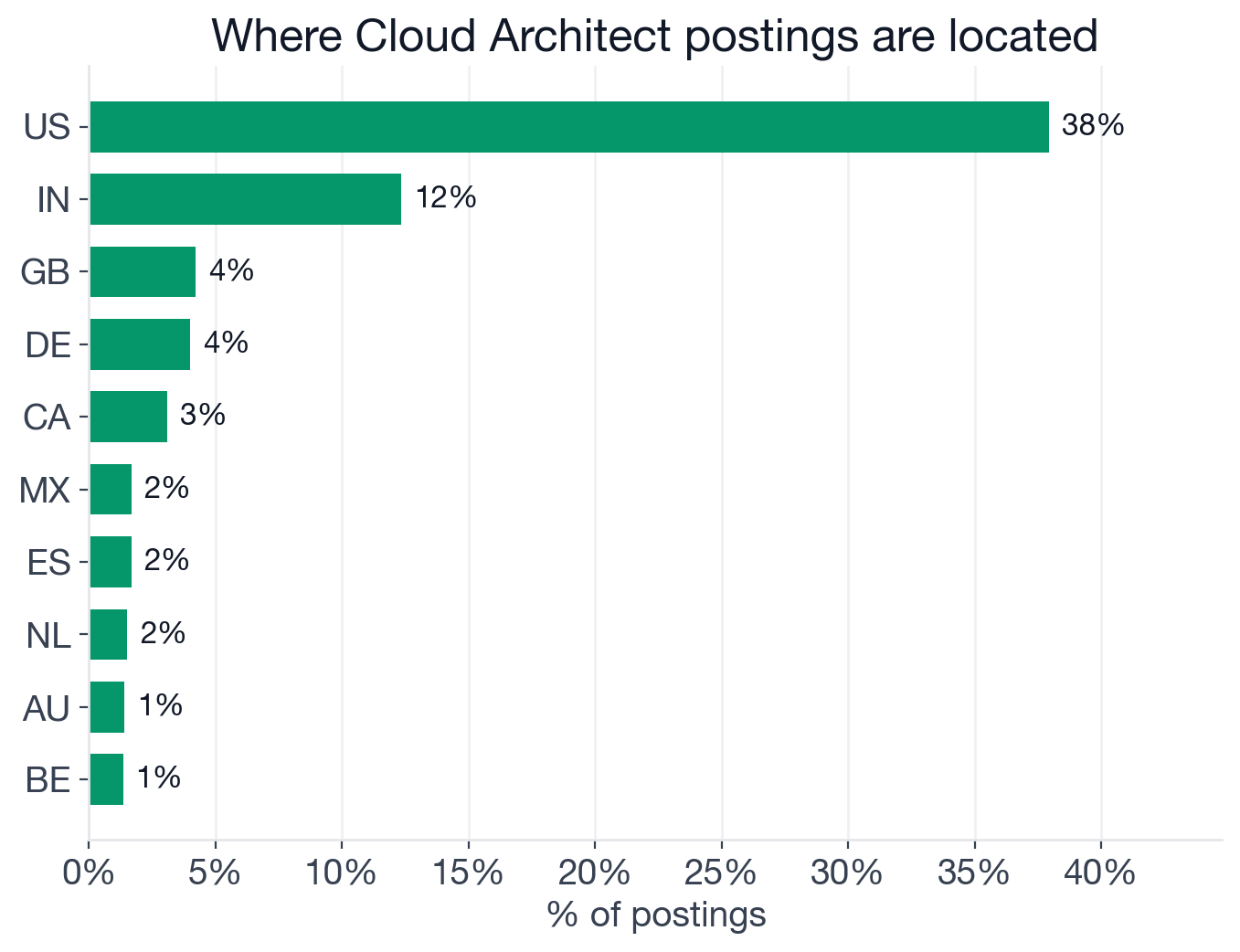
Top countries by share of Cloud Architect postings.
- United States: 38% (US-only Cloud Architect openings)
- India: 12%
- United Kingdom: 4%
- Germany: 4%
- Canada: 3%
The US concentration is higher for Cloud Architect than it is for most data and software roles, reflecting how much of the world's enterprise cloud transformation is funded by US companies. India's 12% share comes primarily through IT services and consulting firms supporting US and UK clients. The UK and Germany each at 4% reflect substantial enterprise cloud investment from European financial services and manufacturing.
On work mode, the assumption that cloud work is inherently remote does not hold:
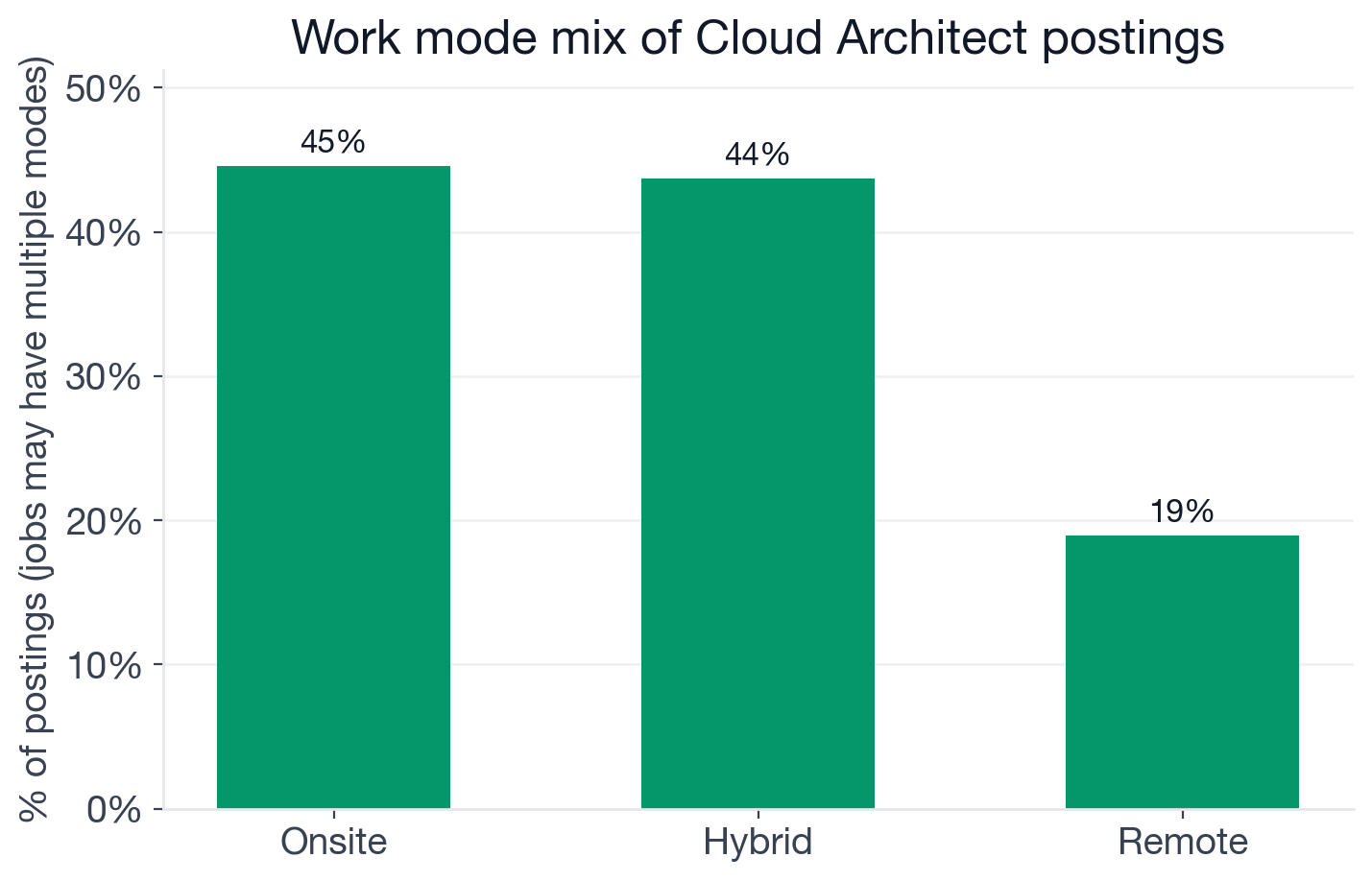
Share of Cloud Architect postings tagged with each work mode. Some postings carry multiple tags (such as "Hybrid or Remote"), so percentages can exceed 100%.
- Onsite: 45% (820 postings)
- Hybrid: 44% (804 postings)
- Remote: 19% (348 postings)
Fully remote Cloud Architect roles are real but not common. Cloud architects are often embedded in platform or infrastructure teams that deal with sensitive internal systems, data residency requirements, and government compliance obligations, all of which push toward in-person or hybrid arrangements. The 19% remote share is lower than software engineer or data roles. If remote is a hard requirement, narrow to tech-first and SaaS companies, where the rate is higher than the average suggests.
Who's Hiring Cloud Architects in 2026?
The employer roster skews toward IT services, government contracting, defense, and technology infrastructure: a mix that reflects where the work of migrating, operating, and securing enterprise-scale cloud environments actually lives.
![Top hiring companies for Cloud Architects: Kyndryl 40, NVIDIA 33, Booz Allen Hamilton 23, Concentrix 21, Thales 20, DoiT International 19, NTT Limited 18, Peraton 16, Red Hat 15, ]init 14, Oracle 12, Honeywell 12, General Dynamics IT 12, KPMG 9
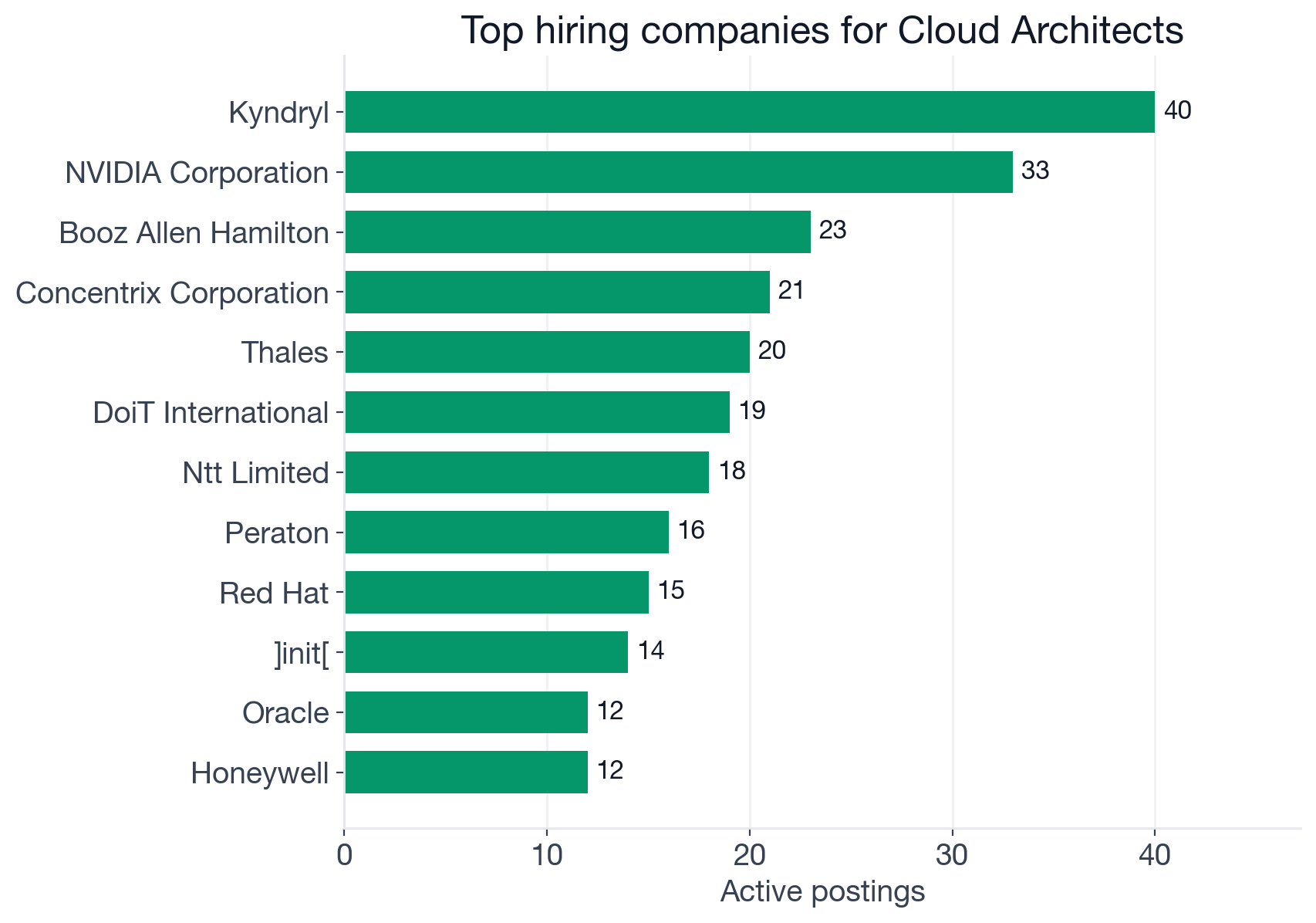
Top companies by distinct active Cloud Architect postings.
| Company | Active postings | Profile |
|---|---|---|
| Kyndryl | 40 | Enterprise IT services (IBM spinoff) |
| NVIDIA Corporation | 33 | Semiconductors and AI infrastructure |
| Booz Allen Hamilton | 23 | Government technology consulting |
| Concentrix Corporation | 21 | Technology-enabled services |
| Thales | 20 | Aerospace, defense, cybersecurity |
| DoiT International | 19 | Google Cloud and multi-cloud advisory |
| NTT Limited | 18 | Global IT services |
| Peraton | 16 | Government IT and cyber contracting |
| Red Hat | 15 | Open-source and hybrid cloud software |
| ]init[ | 14 | German IT services and transformation |
| Oracle | 12 | Enterprise cloud and software |
| Honeywell | 12 | Industrial software and building technology |
| General Dynamics IT | 12 | US defense and government IT services |
| KPMG | 9 | Advisory and technology consulting |
A few patterns stand out. Kyndryl (the world's largest IT infrastructure services company, spun out of IBM) is the top employer, consistent with the volume of cloud migration work flowing through large enterprise services firms. NVIDIA's strong showing reflects how deeply AI infrastructure has entered the Cloud Architect scope: GPU cluster design, high-performance networking, and MLOps infrastructure are now part of what some Cloud Architect postings describe. DoiT International at 19 postings is a Google Cloud premier partner, signaling that cloud advisory practices at specialist consultancies are a distinct and growing hiring channel. Thales appears in the underlying data as both "Thales" and "Thales Group" (the same company); combined, they account for 32 postings, which would rank Thales third overall behind Kyndryl and NVIDIA. For company-specific interview preparation, our preparation guides break down the rounds and expectations at many of these employers.
How to Use This in Your Job Search
Cover the cloud platform range, then go deep on one. With AWS at 40% and Azure at 45%, both major clouds each cover a large share of postings. Pick the one that matches the companies you actually want to work for: Azure for enterprise Microsoft environments, AWS for tech-forward and startup contexts. Build real depth before adding a second platform. Multi-cloud breadth without depth in either is a recruiter filter, not a differentiator. Google Cloud at 25% is worth targeting if you're open to cloud-native and AI-infrastructure-heavy roles, where its salary premium ($174,300 vs $165,000 for Azure) is most apparent.
Add a coding language before you need it. Java's $28,600 premium and Python's $15,700 premium are not coincidences. They reflect a market that wants architects who can contribute to the application layer, not just the infrastructure layer. Python fluency for Cloud Architects shows up in automation scripts, SDK usage, Lambda and Cloud Functions authoring, and data pipeline orchestration. You don't need to be a software engineer, but demonstrating you can write production-quality automation code changes the tier you're interviewing for.
Build toward security, not just operations. The security and reliability cluster (Cloud Security, Zero Trust, DevSecOps, Observability, Containerization) is the highest-ROI specialization for an architect who already has platform fundamentals. Each adds $6-9K to the median US offer. Security architecture in particular is in structural demand across defense, financial services, and healthcare, which together account for a significant share of Cloud Architect postings.
Drill Terraform until it's automatic. Terraform at 3.48 lift with IaC, 2.07 with Kubernetes, and 1.73 with AWS is the connective tissue of the role. Interviewers who post IaC requirements expect Terraform fluency: module authoring, state management, remote backends, and workspace patterns. Practice whiteboarding a Terraform architecture, not just describing what Terraform does. Our AI mock interviews let you practice infrastructure and system design questions with feedback calibrated to the Cloud Architect scope. The question bank covers Kubernetes, distributed systems, and cloud security topics that appear in technical screens. Our interactive courses cover cloud fundamentals, system design, and the DevOps toolchain for candidates building from the ground up.
FAQ
Q. What is the median Cloud Architect salary in 2026?
The median US base salary is $168,300 across 386 Cloud Architect postings with disclosed US salary data. That figure is base only: equity, bonuses, and sign-on are not disclosed in postings, so total comp at top employers runs meaningfully higher.
Q. Which Cloud Architect skills command the highest salary premium in 2026?
Java at $196,900 median US base salary carries the largest premium among cloud skills analyzed in this post ($28,600 above the $168,300 baseline, n=36). Python follows at $184,000 (+$15,700, n=103). Security and reliability specialties form the next tier: Observability ($177,500, +$9,200), Containerization ($177,500, +$9,200), Cloud Security ($177,000, +$8,700), Zero Trust ($174,700, +$6,400), and DevSecOps ($174,400, +$6,100).
Q. Does Azure or AWS pay more for Cloud Architects?
AWS pays more. US postings requiring AWS show a $172,500 median, roughly $4,200 above the $168,300 role baseline. Azure postings show a $165,000 median, about $3,300 below baseline. Google Cloud pays the highest of the three at $174,300. Azure leads demand volume (45% of postings) but trails on pay.
Q. Is Cloud Architect an entry-level role?
No. Only 0.87% of postings (16 of 1,840 analyzed) are explicitly entry-level. Mid-level dominates at 66%, senior at 19%, and staff-level at 14%. The role expects demonstrated architectural decision-making from day one, and the near-absence of entry-level openings reflects that.
Q. What is the most important individual tool for Cloud Architects?
Terraform, measured by co-occurrence lift. The Infrastructure as Code plus Terraform pair has the highest lift in the dataset at 3.48, meaning postings that mention IaC almost always also mention Terraform. Terraform also pairs strongly with CI/CD (lift 2.28), Kubernetes (lift 2.07), and AWS (lift 1.73), making it the connective tissue of the role's skill graph.
Q. How remote-friendly are Cloud Architect roles in 2026?
Less than most people assume. Only 19% of postings offer remote work, 44% are hybrid, and 45% are onsite. The US is the largest single market at 38% of postings. Remote Cloud Architect roles exist but concentrate in SaaS and cloud-native product companies; enterprise and government default to onsite or hybrid.
Q. How important is AI for Cloud Architects in 2026?
There are two layers. Explicitly, 12.1% of postings fall under the Machine Learning and AI umbrella (7.0% mention Generative AI specifically), measuring roles hired to design or manage AI/ML infrastructure. At the ambient level, AI tools are now part of daily Cloud Architect workflows: Copilot-assisted Terraform authoring, ChatGPT-drafted architecture docs, and AI-driven Kubernetes observability. The Stack Overflow 2025 Developer Survey found 51% of professional developers use AI tools daily.
Before You Apply in 2026
Cloud Architect is a senior role by construction: the near-zero entry-level rate and the 33% staff-and-above share tell you the market wants decision-makers, not learners. The salary data sharpens that into a roadmap. Platform fluency (any of the major three clouds) gets you qualified. Python or Java fluency moves you into the premium tier. A security or observability specialty (Cloud Security, Zero Trust, DevSecOps, Containerization) gets you above $174K. Terraform anchors the technical screen regardless of which path you take.
Browse current Cloud Architect openings and use role plus skill filters to target the exact configuration you are building toward.
Topics
Ready to practice?
Put what you've learned into practice with AI mock interviews and structured preparation guides.