
The Most-Demanded BI Tool Pays Below the Role Average
Power BI is the dominant visualization tool in Business Intelligence Analyst hiring. Nearly two in three postings list it as a requirement, more than any other single skill after SQL and data visualization broadly. Yet postings that ask for Power BI pay a median $123,600 in US base salary, roughly $2,400 below the $126,000 role average. When a skill appears in 63% of postings, fluency in it is a commodity, not a differentiator.
Scroll the salary table and the gap sharpens. Looker, a Google-Cloud-native BI platform that appears in just 12% of postings, sits at $147,500 median. That is a $23,900 difference between the tool that dominates the job count and the one that commands a premium. We analyzed 2,409 active Business Intelligence Analyst postings on the InterviewStack.io job board as of June 2026, with skills extracted from descriptions and synonyms normalized, to map exactly where the market is paying.
The broader finding: the analytics engineering layer (dbt, Looker, Snowflake, BigQuery) carries $19,000 to $26,500 premiums above baseline; the analytical science layer (A/B Testing, Machine Learning, Forecasting) adds $9,000 to $17,000. Power BI and Excel sit below it. SQL, Python, and Data Visualization land within a few thousand dollars of it. The tools that make you most hireable are not the ones that move your salary.
Key Findings
- 2,409 active Business Intelligence Analyst postings analyzed from the InterviewStack.io job board as of June 2026.
- Three table-stakes skills cluster above 60%: Data Visualization (73%), SQL (70%), and Power BI (63%).
- Median US base salary: $126,000 (n=465 postings with US salary disclosed; base salary only, equity and bonuses excluded).
- Power BI postings pay $123,600 median (about $2,400 below the role average); Looker postings pay $147,500, a $23,900 gap between the two tools.
- Airflow tops the salary table at $161,000 (+$35,000 above baseline, n=25; noise-tier at 4.7% of postings, treat as directional); BigQuery leads among broadly-demanded skills at $152,500 (+$26,500, n=27), followed by AWS (+$24,000) and dbt (+$21,800).
- Only 6% of postings are entry-level (roughly 145 of 2,409); 63% are mid-level and 22% are senior.
- Onsite is the dominant work mode: 54% of postings (1,310) are onsite, and just 17% (419) are fully remote.
- Python plus SQL appears together in 37% of postings (lift 1.31), the strongest co-occurring skill pair in the data.
What Skill Families Define BI Analyst Work in 2026?
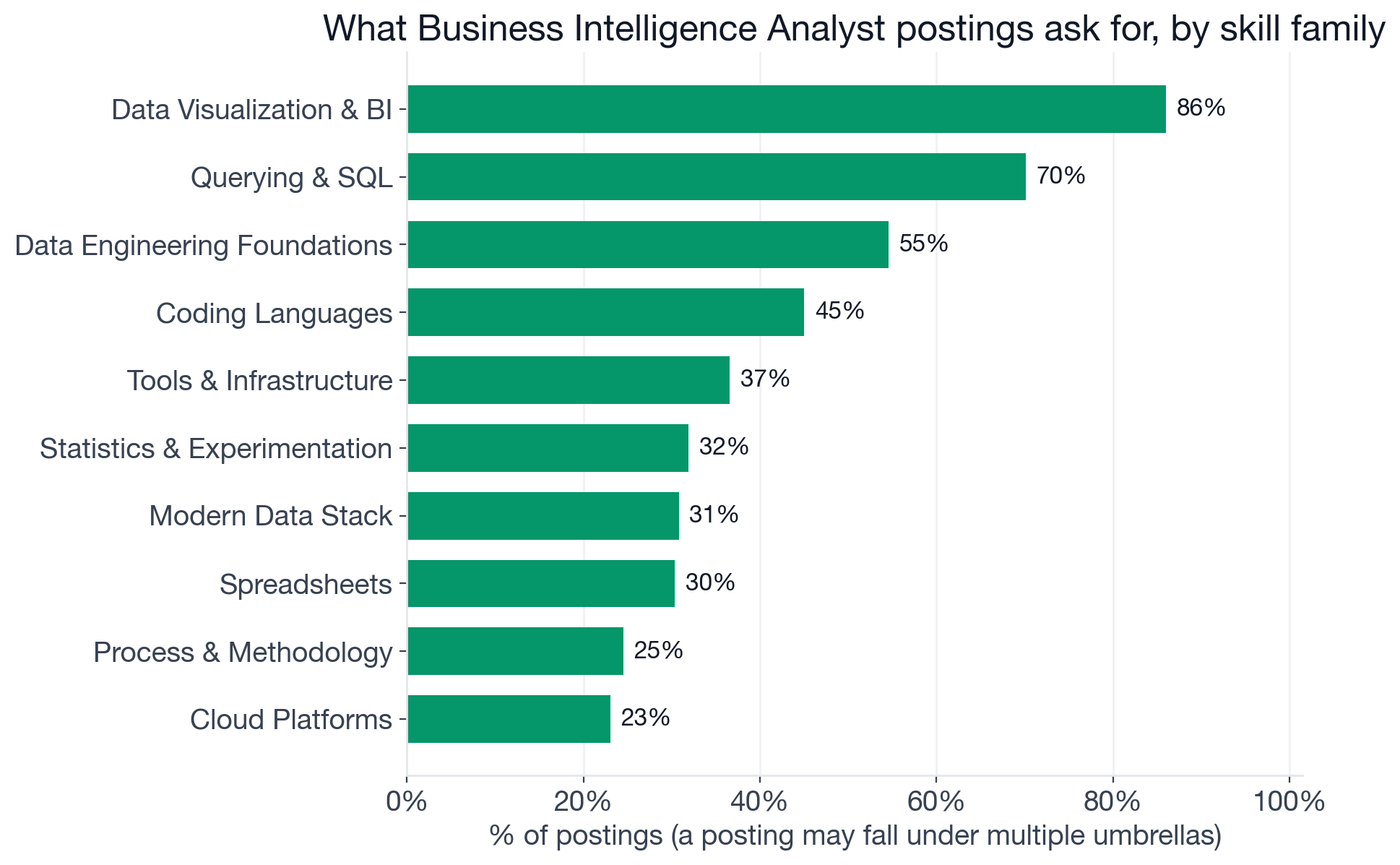
Share of Business Intelligence Analyst postings that ask for at least one skill in each named family. A posting that mentions both Tableau and Power BI counts once under "Data Visualization & BI."
The Data Visualization & BI family sits at 86% of postings; no other named specialty umbrella reaches that share. Visualization is not one competency among many for BI Analysts; it is the job. The rest of the named families layer on top:
- Querying & SQL: 70% (SQL at 70%, with SQL Server a secondary 7%)
- Data Engineering Foundations: 55% (data pipelines 31%, data modeling 25%, data quality 21%, data warehouse 17%, data governance 13%)
- Coding Languages: 45% (essentially all Python, at 40%)
- Tools & Infrastructure: 37% (automation 22%, monitoring 13%, Git 6%)
- Statistics & Experimentation: 32% (statistics 20%, forecasting 12%, A/B testing 8%)
- Modern Data Stack: 31% (Snowflake 16%, Databricks 11%, dbt 10%, BigQuery 7%)
- Spreadsheets: 30% (Excel at 30%)
- Cloud Platforms: 23% (Azure 17%, AWS 11%, Google Cloud 6%)
- Machine Learning & AI: 14% (machine learning 8%, LLMs 4%)
That 14% Machine Learning & AI figure measures roles explicitly hired to build or deploy AI systems, not the ambient productivity layer that now runs through the entire BI stack. Power BI Copilot, available across all paid Power BI SKUs since 2025, handles natural-language report creation, DAX query generation, and narrative summarization. Snowflake Cortex and Databricks both added AI intelligence layers to the warehousing and compute tools that 16% and 11% of postings already require. According to the 2025 Stack Overflow Developer Survey, 84% of developers use or plan to use AI tools. For BI Analysts, the shift is not showing up in job descriptions: it is embedded inside the tools 63%, 16%, and 11% of postings already list as requirements.
Which BI Analyst Skills Pay More Than the Baseline?
All salary data below covers US postings only, where wage-transparency laws produce consistent disclosure. The numbers are base salary; equity, bonuses, RSUs, and sign-on are not disclosed in job postings and are not in this dataset. Total compensation at top employers, particularly in tech and finance, runs meaningfully higher.
The median US base salary across 465 BI Analyst postings with disclosed salary data is $126,000.
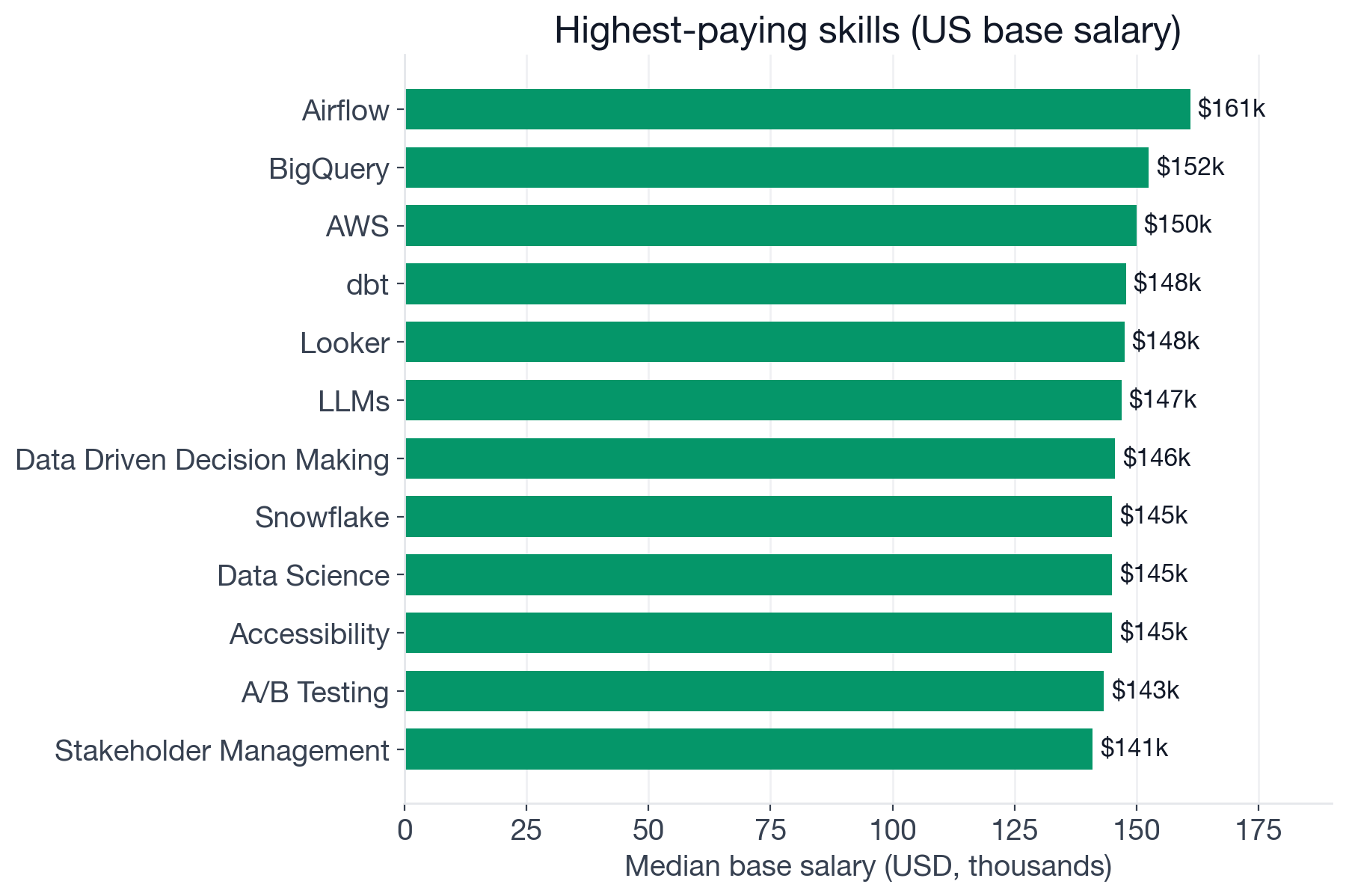
Median US base salary for Business Intelligence Analyst postings that mention each skill. US postings with disclosed salary data only.
Modern data stack and cloud tools: $19K to $26K above baseline
The skills that push a BI Analyst into the analytics engineering layer command the largest premiums:
| Skill | Median US base salary | Premium above $126,000 baseline | Sample size |
|---|---|---|---|
| BigQuery | $152,500 | +$26,500 | n=27 |
| AWS | $150,000 | +$24,000 | n=33 |
| dbt | $147,800 | +$21,800 | n=61 |
| Looker | $147,500 | +$21,500 | n=59 |
| Snowflake | $145,000 | +$19,000 | n=91 |
dbt (a SQL transformation framework that runs inside the data warehouse) earns its premium because companies using it want a BI Analyst who can define transformation models upstream, not just query what has already been built. Looker rewards a similar profile: Looker shops are typically mature data organizations, and they pay for analysts fluent in the semantic modeling layer, not just dashboard assembly. BigQuery and AWS each appear in fewer than 12% of postings but carry premiums above $20K; the small samples (n=27 and n=33 respectively) suggest treating them as directional, but the pattern is consistent with the broader modern-stack premium.
Analytical science and soft skills: $9K to $17K above baseline
| Skill | Median US base salary | Premium above $126,000 baseline | Sample size |
|---|---|---|---|
| A/B Testing | $143,300 | +$17,300 | n=59 |
| Stakeholder Management | $141,000 | +$15,000 | n=33 |
| Machine Learning | $140,000 | +$14,000 | n=41 |
| Storytelling | $137,300 | +$11,300 | n=59 |
| Data Governance | $135,100 | +$9,100 | n=56 |
| Tableau | $135,000 | +$9,000 | n=201 |
The soft-skill premiums here are real and not accidental. Stakeholder Management (+$15,000) and Storytelling (+$11,300) reward the BI Analyst who can run a business review, align executives on a finding, and turn a dashboard into a decision. At the senior level, that capability separates people who build reports from people who shape strategy. Tableau's $9,000 premium compared with Power BI's negative premium reflects a consistent market pattern: Tableau correlates with more analytically demanding environments where the analysis itself is a competitive asset, not just a reporting layer. That is also why Python pairs more strongly with Tableau than with Power BI in the co-occurrence data.
Near or below baseline: the commoditized layer
| Skill | Median US base salary | Versus $126,000 baseline |
|---|---|---|
| Python | $129,800 | +$3,800 |
| SQL | $129,400 | +$3,400 |
| Data Visualization | $128,500 | +$2,500 |
| Power BI | $123,600 | -$2,400 |
| Excel | $116,900 | -$9,100 |
SQL, Python, and Data Visualization are near-neutral because they're so common that having them doesn't separate one candidate from another. Power BI and Excel sit below the baseline because they're the most commoditized skills in the role: expected everywhere, differentiating nowhere. Neither will hurt you in an interview. Neither will move your offer.
The Three Tiers of BI Analyst Skills
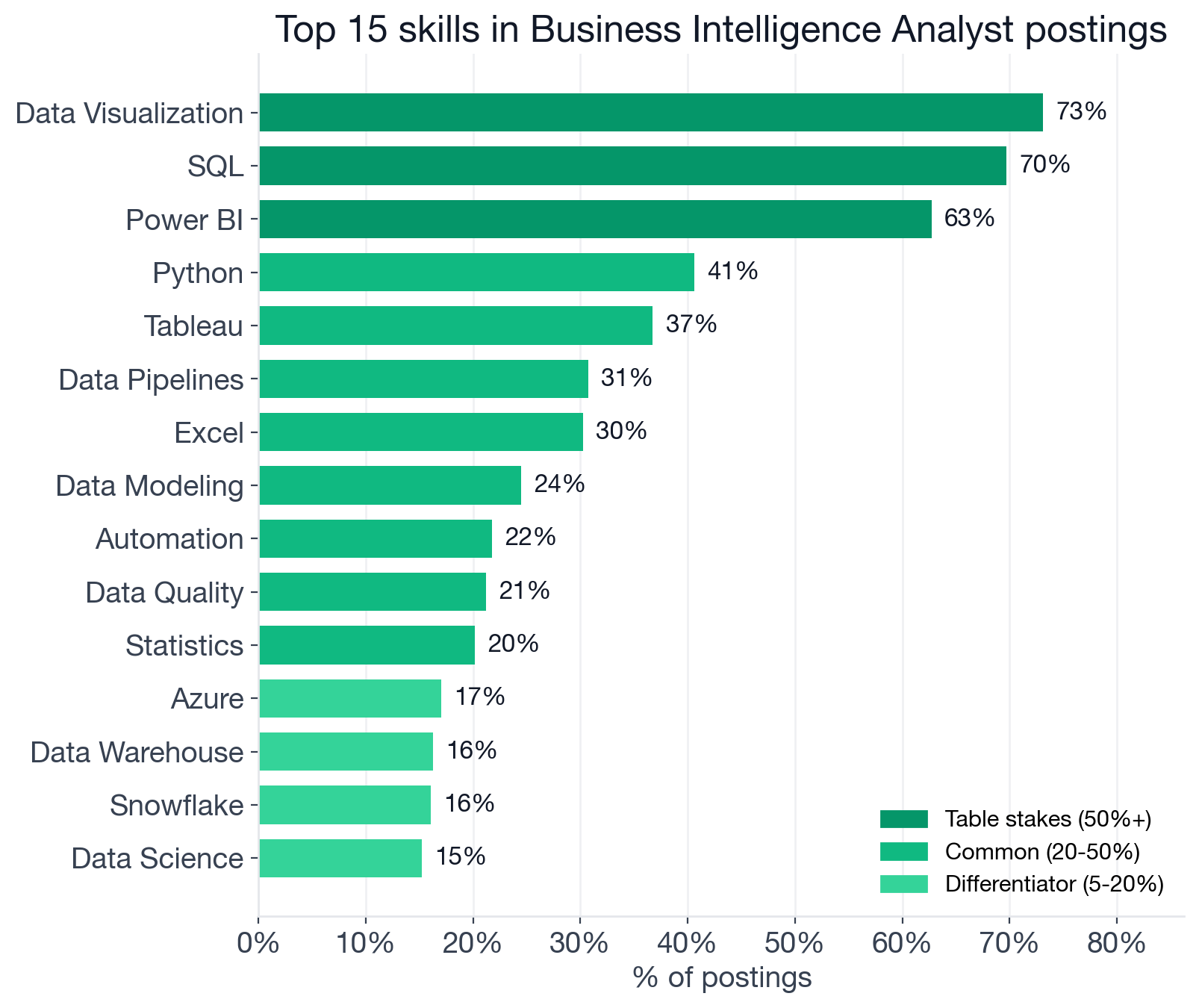
Individual skills in Business Intelligence Analyst postings by share of listings. Skills above 50% are table stakes; 20-50% are common; 5-20% are differentiators.
Table stakes (50%+ of postings):
Missing these means filtering yourself out before a recruiter reads a line.
- Data Visualization: 73%
- SQL: 70% (browse BI Analyst openings that ask for SQL)
- Power BI: 63% (BI Analyst + Power BI openings)
Three skills above 50% is a narrower table-stakes band than most tech roles. The signal is tight: if you cannot build a visualization, write SQL, and work in Power BI, the rest of your resume is moot for the majority of postings.
Common expectations (20-50% of postings):
These define the kind of BI work the company is doing.
- Python: 40%
- Tableau: 37% (BI Analyst + Tableau openings)
- Data Pipelines: 31%
- Excel: 30%
- Data Modeling: 25%
- Automation: 22%
- Data Quality: 21%
- Statistics: 20%
The breadth here reflects the role's expansion beyond pure output work. What was once "build dashboards in Power BI" now routinely asks for Python (40%), pipeline knowledge (31%), and statistical reasoning (20%). A candidate who stops at the table-stakes layer is undershooting what even mid-level postings expect.
Differentiators (5-20% of postings):
These appear in a minority of postings but carry the largest premiums:
Azure (17%), Data Warehouse (17%), Snowflake (16%), Data Science (15%), Data Governance (13%), Monitoring (13%), Agile (12%), Looker (12%), Forecasting (12%), Databricks (11%), AWS (11%), dbt (10%), Storytelling (9%), Machine Learning (8%), Stakeholder Management (8%), A/B Testing (8%), and several more in the 5-8% range.
Every skill in the $9K to $17K and $19K to $26K salary-premium groups sits in this differentiator tier. They show up in fewer postings precisely because they're not universally expected; companies that ask for them pay for them because they're harder to find.
What Skill Stacks Signal Specialization?
Co-occurrence lift measures whether two skills cluster together more often than their individual frequencies would predict. A lift above 1 means the pair appears together more often than chance:
| Skill pair | Postings with both | Share of all postings | Lift |
|---|---|---|---|
| Python + SQL | 889 | 37% | 1.31 |
| Data Warehouse + SQL | 352 | 15% | 1.30 |
| Python + Tableau | 455 | 19% | 1.27 |
| Data Visualization + Data Warehouse | 363 | 15% | 1.27 |
| Data Pipelines + SQL | 645 | 27% | 1.25 |
| Data Modeling + SQL | 508 | 21% | 1.24 |
| Azure + SQL | 355 | 14% | 1.24 |
Python + SQL (lift 1.31) is the strongest pair in the dataset. A posting that mentions Python is 31% more likely to also list SQL than the independent frequencies predict. The combination signals programmatic data work: transformation scripts, automated reports, feeding dashboards from structured data models rather than pointing a tool at a pre-built table.
Data Warehouse + SQL (lift 1.30) and Data Visualization + Data Warehouse (lift 1.27) both point toward the analytics engineering track: build the data layer, not just consume it. Postings asking for both warehouse skills and visualization want an analyst who can model the upstream layer, not just report from it.
Python + Tableau (lift 1.27) is notably higher than Python + Power BI (lift 1.04). Tableau shops are more likely to want Python alongside visualization than Power BI shops, consistent with the salary data showing Tableau correlates with more technically demanding roles.
Azure + SQL (lift 1.24) is the Microsoft stack pattern: companies on Azure want SQL that runs natively inside their infrastructure, and they tend to complete the stack with Power BI. The Microsoft platform cohort is a coherent specialization, the second-largest cloud footprint at 17% of postings.
The picture that emerges: pure BI work (visualization plus SQL) is the commodity layer. Specialization, and the salary premium that comes with it, arrives when Python, pipeline work, or infrastructure tooling gets layered on top.
Who's Hiring at Which Seniority Level?
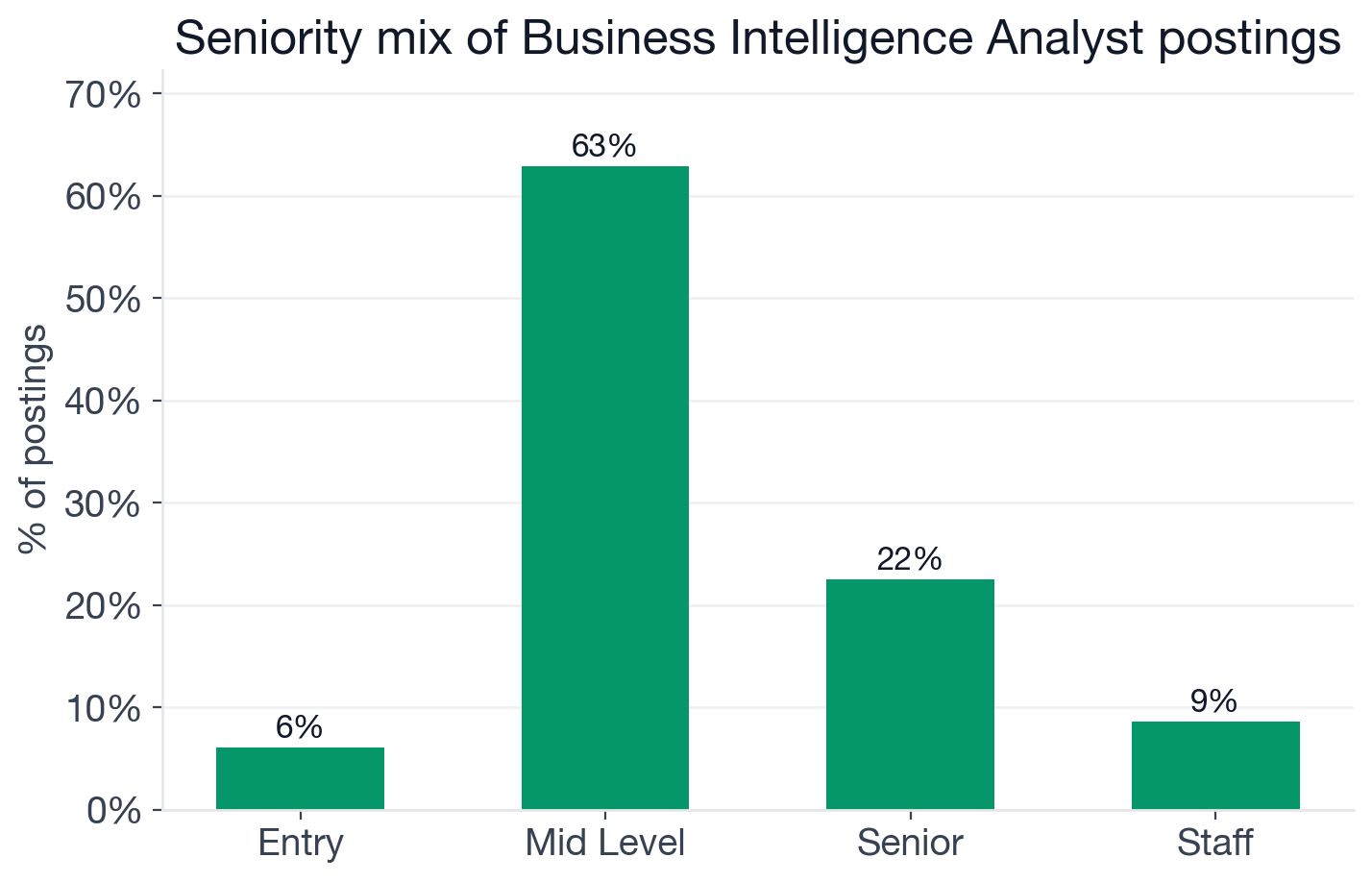
Seniority distribution of Business Intelligence Analyst postings. Postings with no explicit seniority signal default to mid-level.
- Mid-level: 63% (1,515 postings)
- Senior: 22% (541) (senior BI Analyst openings)
- Staff: 9% (208)
- Entry-level: 6% (145)
Only about 1 in 17 postings is explicitly entry-level. BI Analyst hiring typically expects someone who has already sat with a business stakeholder, scoped an analytical question, and delivered a working dashboard under a deadline. Candidates without that experience routinely route in via reporting analyst or junior data analyst roles first.
The senior-and-above tier (31% combined) is meaningfully sized, and at that level the differentiator skills shift from optional to expected. Senior BI Analysts are often governing the semantic model, setting data standards, and owning the analytics platform for a business unit. Stakeholder Management, Data Governance, and the modern data stack skills all earn their premiums at this tier.
Where Are BI Analyst Jobs, and How Remote-Friendly Are They?
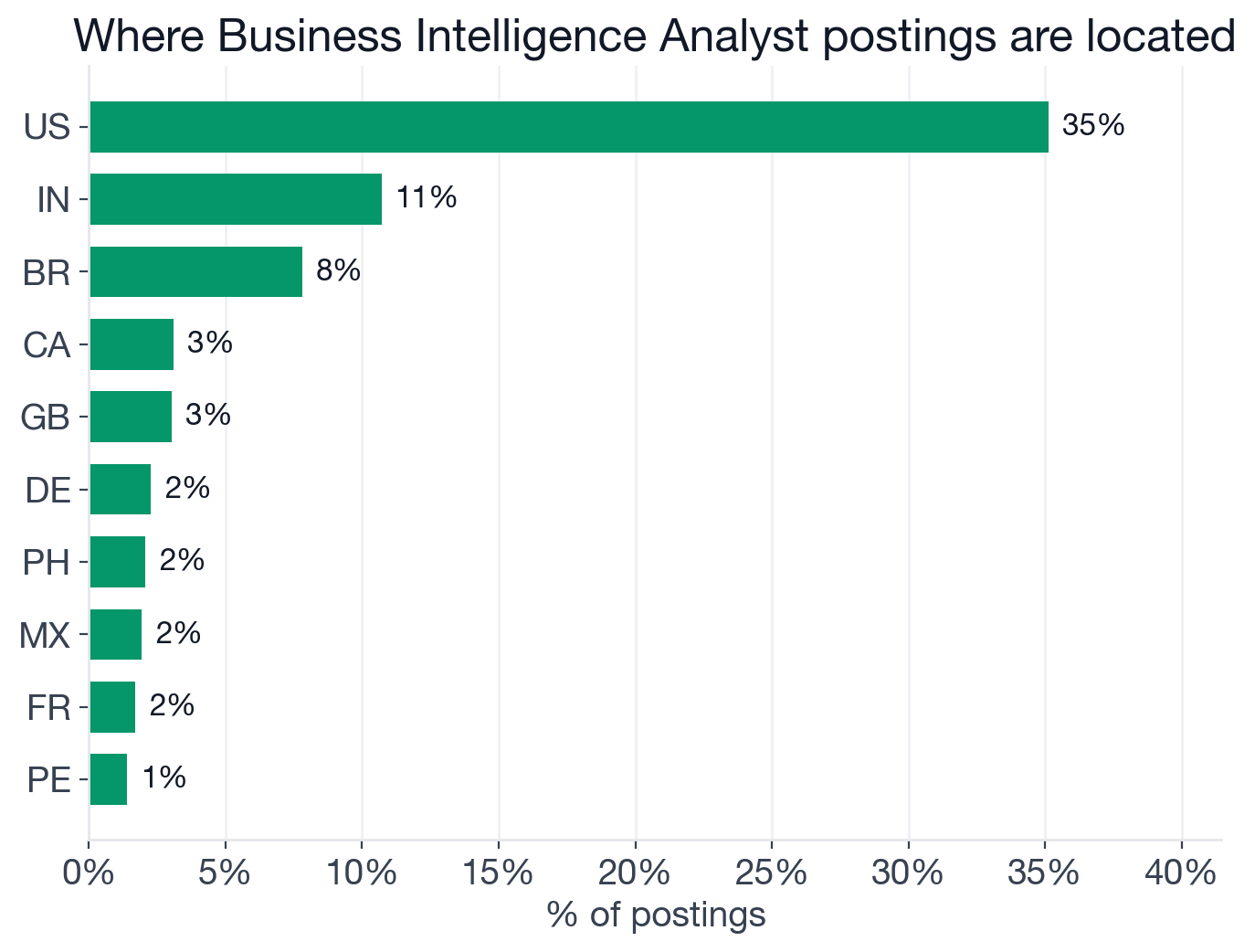
Top countries by share of Business Intelligence Analyst postings.
- United States: 35% (US-only BI Analyst openings)
- India: 11%
- Brazil: 8%
- Canada: 3%
- United Kingdom: 3%
The US leads at 35% and is the primary salary reference market. Brazil's 8% share is notable: financial services (Agibank) and education technology (Arco Educação) are active BI Analyst hirers in the Brazilian market, reflecting the role's broad industry footprint.
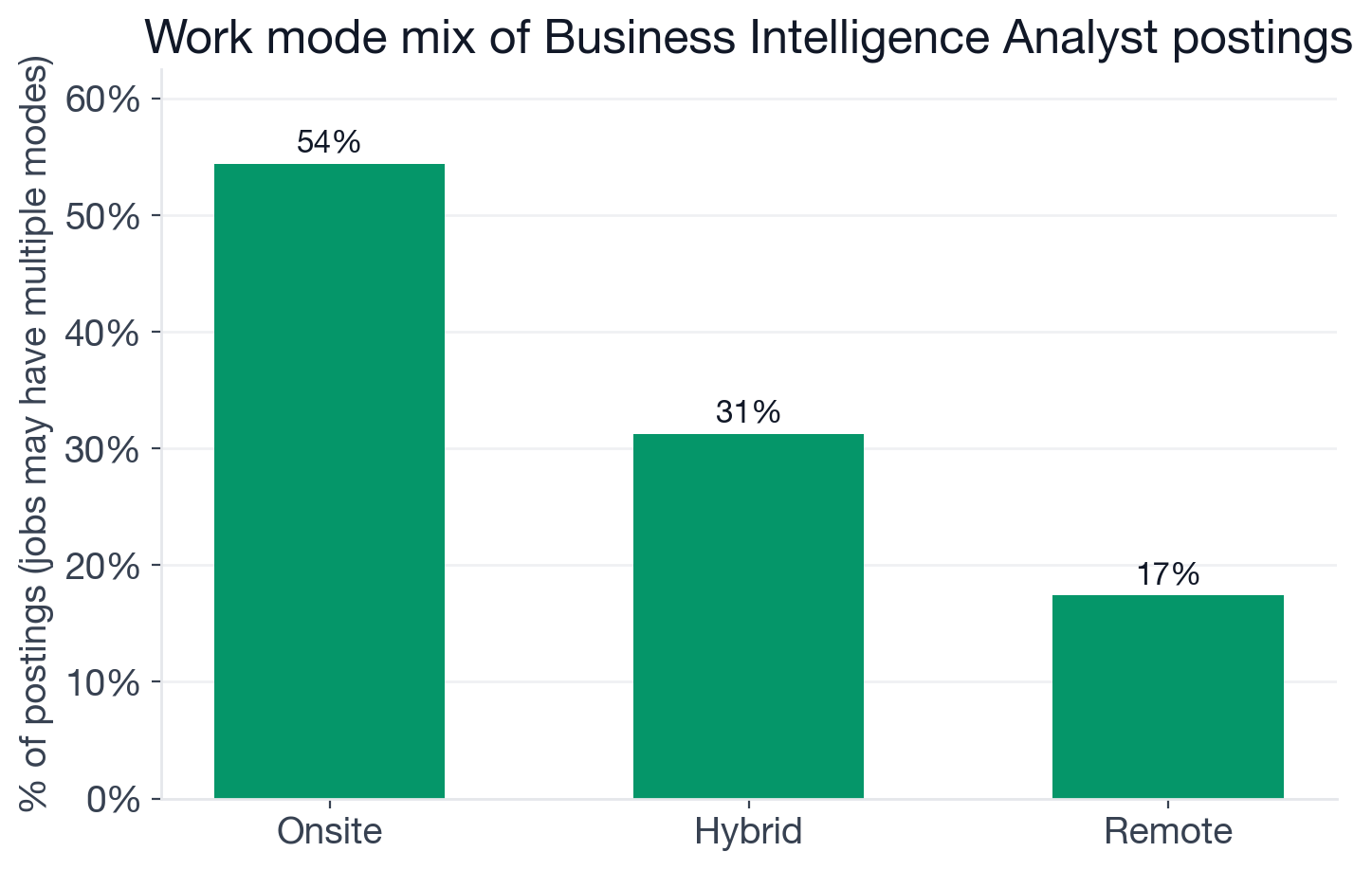
Work mode distribution of Business Intelligence Analyst postings.
- Onsite: 54% (1,310 postings)
- Hybrid: 31% (753)
- Remote: 17% (419) (remote BI Analyst openings)
BI Analyst is a notably onsite role. At 17% remote, it sits well below what data engineers or software engineers typically see. The explanation is structural: BI Analysts work closely with business stakeholders to scope questions, iterate on dashboards, and build ongoing trust. That kind of collaboration favors presence. The 54% onsite share puts this role closer to a financial services operations position than a product engineering role. If remote flexibility matters, filter toward product-led SaaS companies; traditional finance, healthcare, and consulting skew heavily onsite or hybrid.
Who's Hiring Business Intelligence Analysts in 2026?
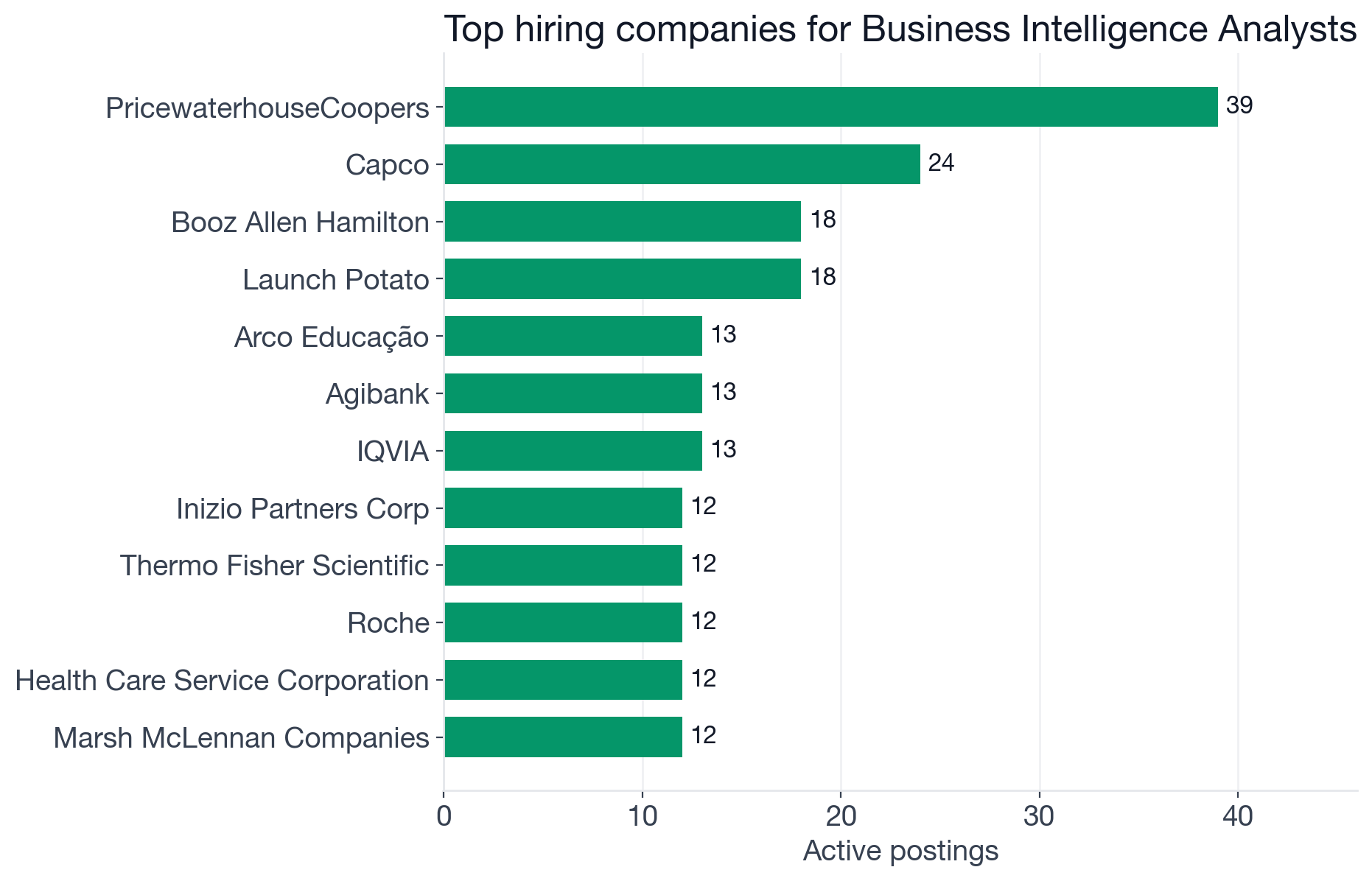
Top companies by active Business Intelligence Analyst postings. Counts reflect distinct openings. Companies with equal posting counts are listed in dataset order.
| Company | Active postings | Sector |
|---|---|---|
| PricewaterhouseCoopers | 39 | Professional services |
| Capco | 24 | Financial services consulting |
| Booz Allen Hamilton | 18 | Government consulting |
| Launch Potato | 18 | Digital media |
| IQVIA | 13 | Healthcare analytics |
| Arco Educação | 13 | Education technology |
| Agibank | 13 | Fintech |
| Inizio Partners Corp | 12 | Healthcare communications |
| Thermo Fisher Scientific | 12 | Life sciences |
| Roche | 12 | Pharma |
| Health Care Service Corporation | 12 | Health insurance |
| Marsh McLennan Companies | 12 | Risk and insurance consulting |
The roster is the sharpest signal about where the BI Analyst role actually lives: consulting (PwC, Capco, Booz Allen, Marsh McLennan), healthcare and life sciences (IQVIA, Thermo Fisher, Roche, HCSC, Inizio), and financial services. Tech companies are nearly absent from the top of this list, the inverse of what you would see for data scientists or ML engineers. BI Analyst is an enterprise-analytics role. The organizations that most need to translate large operational datasets into executive dashboards are the ones hiring at scale. For company-by-company interview prep, our preparation guides cover the rounds, topic priorities, and behavioral expectations for firms with known interview structures.
How to Use This in Your Job Search
Build the table stakes first. SQL, data visualization, and Power BI appear in 63-73% of postings. If your SQL is conversational rather than fluent (window functions, CTEs, query performance tuning), BI Analyst technical screens will surface that quickly. The question bank covers SQL and data modeling topics specifically; drilling those closes the most common gap before a screen.
Pick a premium direction. The salary data presents two clear paths beyond the baseline: the analytics engineering layer (dbt, Looker, Snowflake, BigQuery, AWS) for candidates who want to go deeper into transformation and infrastructure, and the analytical science layer (Machine Learning, A/B Testing, Data Science, Forecasting) for candidates building toward roles where analysis is the output, not just the dashboard. Premiums range from roughly $9,000 (Forecasting) to $26,500 (BigQuery) depending on the skill; the analytics engineering tools cluster at the higher end. Browse BI Analyst openings that ask for Snowflake or dbt to see what specialization postings actually look like.
Practice the business communication layer. Stakeholder Management ($141,000 median) and Storytelling ($137,300 median) both carry real premiums at the senior level. Interviews for senior BI roles routinely test whether you can explain a finding to a non-technical executive and push back on a bad interpretation. AI mock interviews simulate the behavioral and case-based rounds where this matters most.
Use the tools' AI features. Power BI Copilot, Snowflake Cortex, and Databricks AI features are embedded in the tools 63%, 16%, and 11% of postings already require. Using them fluently is a rising baseline expectation. The interactive courses cover SQL, Python, statistics, and data modeling foundations that let you operate these platforms at their ceiling rather than their floor.
Filter the job board for your target stack. Browse current Business Intelligence Analyst openings and apply skill, seniority, and location filters to scope your pipeline. The role is heavily US-and-enterprise, but filtering for remote and skill combinations surfaces the smaller pool where BI Analyst pay is highest and competition is sharpest.
FAQ
Q. What are the table-stakes skills for Business Intelligence Analyst roles in 2026?
Three skills appear in more than half of all BI Analyst postings: Data Visualization (73%), SQL (70%), and Power BI (63%). These are the non-negotiable baseline across 2,409 active postings analyzed from the InterviewStack.io job board.
Q. What is the median salary for a Business Intelligence Analyst in 2026?
Among US postings with disclosed salary data, the median base salary is $126,000 (n=465 postings). That figure covers base salary only; equity, bonuses, and sign-on are not disclosed in job postings, so total compensation at top employers runs higher.
Q. Which BI Analyst skills pay the highest premium in 2026?
Among US postings, Airflow tops the salary table at $161,000 (+$35,000 above the $126,000 baseline), but it appears in just 4.7% of postings (n=25) and is directional rather than reliable. Among skills with meaningful posting coverage, BigQuery leads at $152,500 (+$26,500, n=27), followed by AWS ($150,000, +$24,000); treat both as directional given the sample sizes (n=27 and n=33). dbt (a SQL transformation framework) at $147,800 (+$21,800) and Looker at $147,500 (+$21,500) have larger samples and are more reliable signals. Power BI, despite appearing in 63% of postings, sits at $123,600, about $2,400 below the role median.
Q. Is Business Intelligence Analyst a good entry-level role to break into?
Entry opportunities are limited but exist. Only about 6% of BI Analyst postings are explicitly entry-level (roughly 145 of 2,409 analyzed), compared with 63% mid-level and 22% senior. Most candidates route in through reporting analyst, data analyst, or junior BI developer roles to build the foundational SQL and visualization skills.
Q. What is the dominant skill stack for Business Intelligence Analysts in 2026?
Power BI and SQL together appear in 48% of postings, anchoring the core BI stack alongside Data Visualization. Among the strongest co-occurring skill pairs by lift, Python plus SQL (lift 1.31, appearing together in 37% of postings) and Data Warehouse plus SQL (lift 1.30, 15% of postings) signal the move from basic BI work into the analytical engineering tier.
Q. How remote-friendly are Business Intelligence Analyst roles in 2026?
Less remote than most analytics roles. Onsite postings account for 54% of BI Analyst listings, hybrid for 31%, and fully remote for just 17% (419 postings). BI Analysts are more regularly expected to be on-site than data engineers or product managers, reflecting the role's close work with business stakeholders.
Q. Which industries and company types hire the most Business Intelligence Analysts?
The hiring spread is unusually broad compared with other tech roles. Consulting (PwC, Capco, Booz Allen Hamilton, Marsh McLennan), healthcare and life sciences (IQVIA, Thermo Fisher Scientific, Roche), and financial services all appear in the top employers. Tech companies are not dominant for this role; every major industry sector employs BI Analysts.
What to Do With This in 2026
The BI Analyst market rewards specialization above the commodity layer. SQL, data visualization, and Power BI clear the filter for most postings. They do not move the salary needle. The analytics engineering layer (dbt, Looker, Snowflake, BigQuery) carries $19,000 to $26,500 premiums; the analytical science layer (A/B Testing, Machine Learning, Forecasting) adds $9,000 to $17,000, with the top end (A/B Testing at +$17,300) closer to the engineering premium and the bottom end (Forecasting at +$9,000). Both paths are achievable with focused effort; both show up consistently in the salary data from 2,409 postings. Build the foundation, then pick the direction that matches the companies you actually want to work for.
Topics
Ready to practice?
Put what you've learned into practice with AI mock interviews and structured preparation guides.